Best Bore Water Filter and Tank Water Filter Australia 2026: Test, Then Treat
Drafted with AI assistance and checked against published specifications and certifications. First-hand measurements appear only where stated. How we make content
How this assessment was made. I have not tested a bore or rainwater tank system: my own home is on town water on the Gold Coast. Everything here comes from the source named beside it: the Australian Drinking Water Guidelines (ADWG), enHealth’s guidance on rainwater tanks, SA Health and WA Health bore water guidance, the NSF/ANSI 55 UV standard, and the sellers’ own product pages, checked on 10 Nov 2026. The treatment-train diagram and the chooser are drawn by Clean and Native from those sources.
The best bore water filter or tank water filter is not one product but a treatment train matched to a laboratory test: a sediment filter first, then iron, manganese or hardness treatment if the test calls for it, carbon for taste, and a UV steriliser certified to NSF/ANSI 55 Class A as the final barrier for drinking water. Test before you buy anything.
Bore and tank water are not treated by anyone but you. Town water arrives disinfected and monitored; a bore or a rainwater tank arrives with whatever the aquifer, the roof or the pipework adds. This guide shows the order the stages go in, what each one does and does not remove, the systems worth buying, and the checker below turns your test result into a parts list.
For drinking water from a tank or a bore with good chemistry, a complete sediment, carbon and UV system is the right buy. Fix iron, manganese, hardness or salt problems before the UV, not after, and never skip the laboratory test.
| Need | Pick | Detail |
|---|---|---|
| Complete drinking-water set-up | Pure Water Systems Twin UV Whole House System | $2,499 (10 Nov 2026), sediment + carbon + UV |
| Tank water, non-drinking or before UV | PWS Twin Big White Tank Water Package 20 inch | $739 (10 Nov 2026), phone order |
| Budget DIY two-stage housing | SHIELD Twin Big Blue | $395.00at Amazon AU · as of 19 Nov 2026, 5:29 pm AEST Details |
| Salty (high-TDS) bore, drinking tap | Waterdrop X8 under-sink RO | $611.29at Amazon AU · as of 19 Nov 2026, 11:43 pm AEST Details |
| First step for everyone | NATA-accredited laboratory test | Microbes and chemistry |
Test before you buy anything
Every credible source on private water starts in the same place. SA Health says bore water “should be tested and deemed safe before being used for drinking, cooking”, that all bores need microbiological (E. coli) and chemical testing before use, and that the testing should be done by a National Association of Testing Authorities (NATA) accredited laboratory. WA Health says testing by an accredited laboratory is required to confirm the quality of the water, and suggests asking the laboratory for a Standard Drinking Water Test.
The reason is practical, not bureaucratic. A sediment cartridge, a carbon block and a UV lamp each solve a different problem, and several common bore problems (iron, manganese, hardness, salt, nitrate, arsenic) are not solved by any of them. A test result tells you which stages you need and how big they must be. Without one, you are buying blind.
Ask the laboratory for, at minimum: E. coli, pH, total dissolved solids (TDS), hardness, iron, manganese and nitrate. For a bore near farming, mining or industry, ask what else they recommend for your area. If you are not sure how sampling works, see how to test your water at home: home strips are useful for tracking, but they do not replace a laboratory test for a private supply.
The numbers that matter
Compare your laboratory report with the Australian Drinking Water Guidelines. Some values are health-based, others aesthetic (taste, staining, scale). Both matter when you are choosing equipment.
| Test | ADWG guideline | Type | What treats it |
|---|---|---|---|
| E. coli | Not detected in any 100 mL sample | Health | Disinfection: UV (NSF/ANSI 55 Class A) or chlorination |
| Iron | 0.3 mg/L; no health value set | Aesthetic | Oxidation plus a media filter |
| Manganese | 0.1 mg/L health; 0.05 mg/L aesthetic (2025 update) | Health and aesthetic | Oxidation and filtration, or ion exchange |
| Hardness | 200 mg/L as CaCO3 | Aesthetic (scale) | Ion exchange softener |
| Total dissolved solids | 600 mg/L for good palatability | Aesthetic | Reverse osmosis at the drinking tap |
| Nitrate | 50 mg/L to protect bottle-fed infants under 3 months; up to 100 mg/L for adults and children over 3 months | Health | Reverse osmosis at the drinking tap; another water source for infant formula |
| Arsenic | 0.01 mg/L | Health | Specialist treatment: get advice |
| pH | 6.5 to 8.5 | Aesthetic (corrosion and scale) | pH correction |
The manganese row changed recently. The ADWG manganese fact sheet was updated in 2025: the health-based value is 0.1 mg/L, set to protect bottle-fed infants, and the aesthetic value is 0.05 mg/L measured at the tap. Older articles that quote a 0.5 mg/L health limit are out of date.
The treatment train, in order
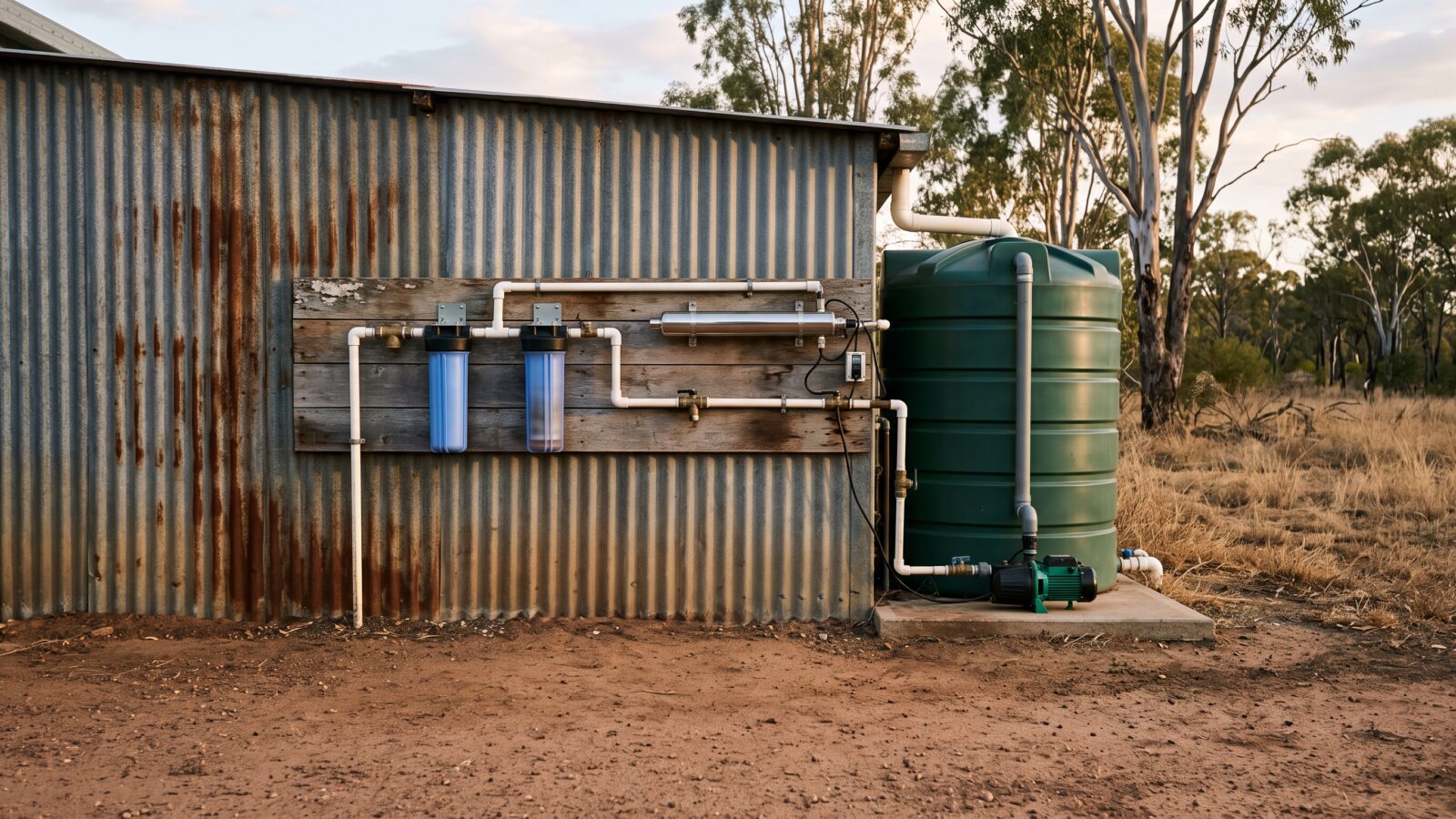
Order matters because each stage protects the one after it. UV light has to pass through the water to reach the microbes, so it goes last, after the sediment that would shade them. Iron and manganese go early because they foul fine cartridges and coat UV sleeves. Hardness treatment goes before any heating or UV for the same reason.
- Sediment. Removes sand, silt and rust particles. Sellers offer cartridges graded by micron size; Pure Water Systems sells its tank-water cartridges in 5, 10, 20 and 50 micron. Coarse first, fine second, so the fine cartridge does not block in a week.
- Iron, manganese, hardness, pH. Only if the test shows them. These need dedicated equipment, sized to the result, and they go before the fine filters and the UV.
- Carbon. Improves taste and odour and reduces some organic chemicals. Useful on tank and dam water; not a disinfection step.
- UV steriliser. The microbial barrier for drinking water. It treats bacteria, viruses and parasites but removes nothing chemical, and it only works on clear water.
- Reverse osmosis at the kitchen tap. Only for salty, high-nitrate or high-TDS water. Reverse osmosis is a point-of-use system, not a whole-house one.
Treatment train chooser
Tick what your laboratory report shows. The chooser lists the stages you need in the order they go in, based on the ADWG values above. It is a starting point for a conversation with a supplier or plumber, not a substitute for one.
Values from the Australian Drinking Water Guidelines. UV class from NSF/ANSI 55. Clean and Native does not test water; confirm your design with your supplier.
Rainwater tank water
A tank’s quality is set mostly by the roof and gutters that feed it. The enHealth Guidance on use of rainwater tanks is the national reference, and its practical points are simple: keep gutters clean, keep the tank sealed and screened against mosquitoes and animals, and fit a first-flush diverter. enHealth suggests diverting about 20 to 25 litres from an average roof, and it advises not collecting the first flush after a bushfire: disconnect early and reconnect once the roof is clear. It also suggests checking for sediment build-up in the tank every 2 to 3 years. Our first flush diverter guide covers sizing in detail.
Filtration then deals with what gets through: fine sediment, taste and odour, and microbes from birds and animals on the roof. For drinking, that means sediment, carbon and UV. For the reasons people drink tank water in the first place, read is rainwater safe to drink before you design a system.
Bore water problems, and which stage fixes them
Bore water is groundwater, and its chemistry comes from the rock it sits in. WA Health notes that bore water may be suitable for uses from stock watering to drinking depending on local conditions, but that it can be contaminated by natural processes and human activity, and that an accredited laboratory test is needed to confirm its quality. The common problems:
- Iron and manganese. Orange or black staining, metallic taste and slime in pipes. WA Health describes how pumping adds oxygen and nutrients to a bore, letting bacterial biofilm grow and trap iron. Treat with oxidation and filtration sized to your result; a cartridge filter alone blocks quickly.
- Hardness. Scale on taps and in hot water systems. Above 200 mg/L, an ion exchange softener is the fix; see the water softener guide.
- Salinity (high TDS). Salty taste, and no filter cartridge will fix it. Reverse osmosis at the drinking tap is the practical answer; see the best reverse osmosis systems.
- Nitrate. From fertiliser, septic systems or animals. The ADWG value of 50 mg/L protects bottle-fed infants under 3 months; adults and children over 3 months can safely drink up to 100 mg/L. Reverse osmosis is the usual point-of-use treatment.
- Microbes. Shallow bores and poorly sealed bore heads can let surface water in. WA Health calls chlorination the most reliable way to ensure drinking water is free from microbiological contamination; a certified UV steriliser is the common chemical-free alternative.
If your bore is only for the garden and toilets, the treatment can be much simpler. WA Health says bore water usually needs no treatment if it has a pH above 5, is colourless and odourless, and is only used to water the garden, wash cars and flush toilets.
Check all seven rooms, not just this one
38 checks, 29 free, ranked by impact. Sent as a 32-page PDF.
We'll email you the audit and a short series of practical guides. Unsubscribe in one click, any time. Privacy.
Sent. Taking you to your download...
Choosing a UV steriliser
UV is the stage people most often get wrong, because the box rarely says the one number that matters: the dose. The US standard NSF/ANSI 55 defines two classes. Class A systems deliver at least 40 mJ/cm2 and are designed to disinfect water contaminated with bacteria and viruses and to deal with Cryptosporidium and Giardia. Class B systems deliver 16 mJ/cm2 and are only for supplemental treatment of water already considered acceptable. For a tank or bore used for drinking, look for Class A certification, or at least a stated dose of 40 mJ/cm2 at your peak flow.
Three more checks: the flow rating must cover every tap running at once, the lamp needs replacing on the maker’s schedule (enHealth says usually every 9 to 12 months), and the quartz sleeve must be kept clean. A UV unit fed by cloudy, iron-rich or hard water loses dose, which is why it goes last in the train. Our UV steriliser guide goes deeper on sizing.
The picks
These systems were chosen on what their sellers publish: stages, cartridge micron sizes, certification and price. None has been tested by Clean and Native.
Best complete drinking-water system: Pure Water Systems Twin UV Whole House System
 PWS$2,49910 Nov 2026
Stage 1: dual gradient sediment cartridge, 50 down to 5 micron | Stage 2: Diamond Flow carbon block | Stage 3: UV lamp | 75 L/min flow stated | $2,499 (10 Nov 2026) | Quote and sizing by phone
See the Twin UV System →This is the full treatment train in one package: a graded sediment cartridge that filters from 50 micron on the outside down to 5 micron on the inside, a carbon block for taste and odour, then a UV lamp. Pure Water Systems states the UV system is “certified to remove 99.9999% bacteria, including E-coli and parasites”; the product page does not name the certifying standard or the UV dose, so ask for the NSF/ANSI 55 class and the dose at your flow before you buy. The seller also recommends a drinking-water system at the kitchen tap and asks buyers to phone for sizing, which is the right approach for a private supply.
- Tank or bore water that tests clean of iron, manganese, hardness and salt problems
- Households that want one supplier for the whole train
- Bores with iron, manganese, hardness or salinity problems until those are treated
- Anyone who needs a documented NSF/ANSI 55 Class A dose before buying, until PWS confirms it
Cons: the most expensive pick, a UV lamp and cartridges to replace, it needs power, and the online page states a 75 L/min flow but no UV dose or NSF/ANSI 55 class.
Best tank water pre-filter: PWS Twin Big White Tank Water Package, 20 inch
 PWS$73910 Nov 2026
Two 20 inch housings | Washable high-flow pleated cartridges in 5, 10, 20 or 50 micron | $739 (10 Nov 2026), unavailable online on 10 Nov 2026: phone Pure Water Systems on 1300 808 966 to order
See the Twin Big White Package →The large 20 inch housings suit whole-house flow from a pump, and the washable pleated cartridges suit tank water, where sediment loads are heavy and rinsing a cartridge is cheaper than replacing it. Pure Water Systems sells the cartridges in 5, 10, 20 or 50 micron. The product page also lists a granular carbon cartridge; confirm with the seller whether it can replace a sediment cartridge in this package. On 10 Nov 2026 the package was shown as unavailable online, with ordering by phone on 1300 808 966. On its own this is sediment and taste treatment, not disinfection: for drinking water it needs a UV stage after it. The 10 inch version is $669 for smaller households.
- Tank water for the whole house, ahead of a UV unit
- Tank water used for washing, laundry and toilets
- Drinking water on its own, without UV after it
- Bores with iron or manganese problems
Cons: no microbial treatment, cartridges need regular washing, and you still need a plumber for a pressurised installation.
Budget DIY housings: SHIELD Twin Big Blue

1 micron sediment + 0.5 micron coconut carbon block | Two pressure gauges | 1 inch brass ports | Listing states WaterMark AS3497 certified | Sold by SHIELD FILTER
Check the Price on Amazon →Amazon AU price: $395.00 · as of 19 Nov 2026, 5:29 pm AEST DetailsA two-stage housing set with a fine 1 micron sediment cartridge and a 0.5 micron carbon block, sold by the Australian seller with a listing that states WaterMark AS3497 certification. Fine cartridges are a strength for taste and clarity and a weakness on dirty water: put a coarser washable pre-filter ahead of it on tank or dam water, or it will block quickly. Like the package above, it does not disinfect.
- Tank or bore water that is already fairly clear
- Owners who want a lower-cost sediment and carbon stage ahead of UV
- Silty or iron-rich water without a coarse pre-filter
- Drinking water without UV after it
Cons: fine cartridges clog fast on dirty water, no disinfection, and cartridge costs add up on high-sediment supplies.
For salty (high-TDS) bores: Waterdrop X8 under-sink RO
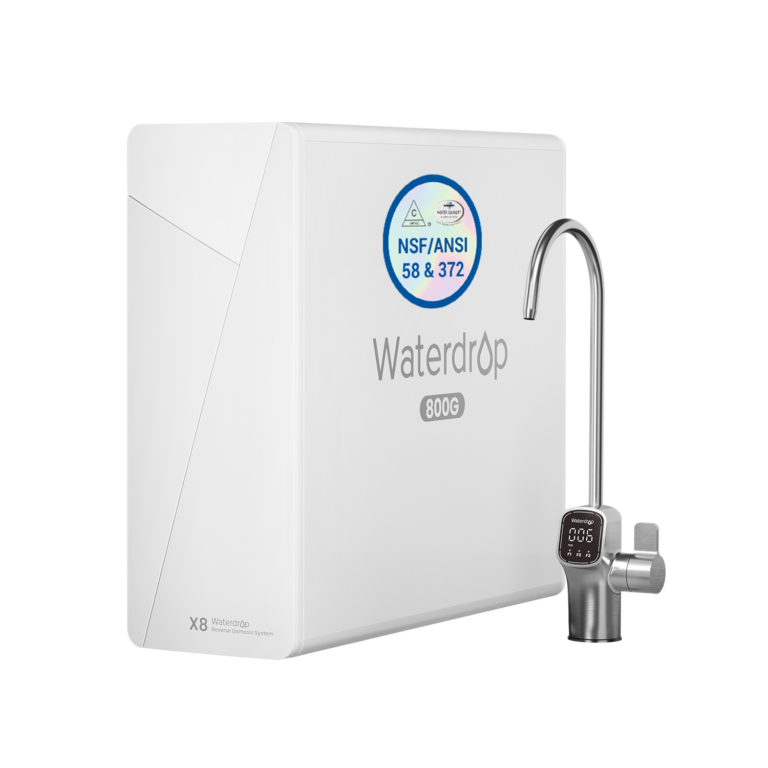
Tankless under-sink RO | Listing states NSF/ANSI 42, 58 and 372 certification
Check the Price on Amazon →Amazon AU price: $611.29 · as of 19 Nov 2026, 11:43 pm AEST DetailsReverse osmosis is the stage that deals with dissolved salts, which no sediment, carbon or UV stage touches. On a salty bore, an under-sink RO system at the kitchen tap gives you treated drinking and cooking water without trying to treat the whole house. The X8 listing states NSF/ANSI 58 certification, the reverse osmosis standard. Waterdrop does not list nitrate reduction for the X8. If nitrate is the problem, choose an RO system whose NSF/ANSI 58 certification includes the nitrate/nitrite reduction claim. Put it after your whole-house sediment and UV stages, not instead of them.
- Bores with TDS above 600 mg/L
- Homes that want treated drinking water at one tap
- Whole-house treatment: RO is point-of-use
- Water with untreated microbial risk: fix that upstream first
Cons: sends some water to drain, which matters on a tank in a dry spell, and needs under-sink plumbing and filter changes.
Comparison table
| System | Stages | Disinfects? | Price | Best for |
|---|---|---|---|---|
| PWS Twin UV Whole House | Sediment 50 to 5 micron, carbon block, UV (75 L/min stated) | Yes (ask for NSF/ANSI 55 class and dose) | $2,499 (10 Nov 2026) | Complete drinking-water set-up |
| PWS Twin Big White 20 inch | Washable sediment | No | $739 (phone order) (10 Nov 2026) | Tank water, before UV |
| SHIELD Twin Big Blue | 1 micron sediment, 0.5 micron carbon block | No | $395.00at Amazon AU · as of 19 Nov 2026, 5:29 pm AEST Details | Budget clear-water pre-treatment |
| Waterdrop X8 | Under-sink reverse osmosis | Not a disinfection stage | $611.29at Amazon AU · as of 19 Nov 2026, 11:43 pm AEST Details | Salty (high-TDS) drinking water |
For whole-house filtration on town water rather than a private supply, see the best whole house water filters, and for every filter type, the best water filters in Australia.
Maintenance schedule
A bore or tank system is only as good as its maintenance, and every stage has one. A practical schedule, built from the enHealth guidance and the sellers’ advice:
| Item | When | Why |
|---|---|---|
| Gutters and roof | Regularly, and before the wet season | Leaves and droppings feed the tank |
| First-flush diverter | After each significant rain, check it has emptied | A full diverter diverts nothing |
| Tank sediment | Every 2 to 3 years (enHealth) | Sludge carries microbes and metals |
| Sediment cartridges | When pressure drops, or on the maker schedule | Blocked cartridges starve the house and the UV |
| UV lamp and sleeve | Lamp every 9 to 12 months (enHealth); clean the sleeve at each service | Old lamps and dirty sleeves lose dose |
| Laboratory test | Before first use, after changes, then routinely | Confirms the system is working |
One habit from my Navy Clearance Diver days fits here: you check the equipment you rely on before you need it, not after it fails. A UV lamp gives no warning when its output drops. Put the service dates in your calendar on the day you install it.
Final verdict
The best bore and tank water filter is the one designed around your laboratory test. For most tank supplies, and bores with good chemistry, that is sediment, carbon and a certified UV steriliser; the Pure Water Systems Twin UV Whole House System is the complete package to price first, and ask for its NSF/ANSI 55 class and UV dose. Fix iron, manganese, hardness and pH before the UV. For salty or high-nitrate bores, add reverse osmosis at the kitchen tap. And test again once it is installed.
Prices change. Check the seller before buying.
Frequently asked questions
What is the best filter for bore water?
There is no single best bore water filter, because bores differ. Test first with a NATA-accredited laboratory. Most drinking-water set-ups then follow the same order: sediment filtration, any iron, manganese or hardness treatment the test calls for, carbon if needed, then UV disinfection sized for your flow. Salty or high-nitrate bores also need reverse osmosis at the drinking tap.
Do I need to test bore water before filtering it?
Yes. SA Health says all bores need microbiological (E. coli) and chemical testing before use, by a NATA-accredited laboratory. WA Health advises asking for a Standard Drinking Water Test. The result decides which stages you need; buying a filter first is guessing.
Does a UV steriliser make tank water safe to drink?
UV is the stage that deals with bacteria, viruses and parasites, but only on clear water. Look for a unit certified to NSF/ANSI 55 Class A, which requires a dose of 40 mJ/cm2 and covers Cryptosporidium and Giardia. Put sediment filtration ahead of it and replace the lamp on the maker’s schedule.
How do I remove iron from bore water?
Iron above the ADWG aesthetic guideline of 0.3 mg/L causes staining and taste problems. Dissolved iron is usually oxidised and then filtered on a dedicated media filter, sized from your test result. A cartridge sediment filter alone will block quickly and is not an iron treatment.
Is manganese in bore water a health risk?
It can be. The ADWG updated manganese in 2025: the health-based guideline is 0.1 mg/L, set to protect bottle-fed infants, and the aesthetic guideline is 0.05 mg/L. If your test shows manganese above 0.1 mg/L, do not use the water for infant formula until it is treated and retested.
What filter do I need for rainwater tank water?
For drinking, most tank systems use a sediment pre-filter, a carbon stage for taste and odour, and a UV steriliser. Keep the roof, gutters and first-flush diverter maintained: enHealth suggests diverting about 20 to 25 litres from an average roof.
Can I drink bore water if it looks clear?
Not on looks alone. Clear water can still carry E. coli, nitrate or arsenic. The ADWG limit for arsenic is 0.01 mg/L and for nitrate is 50 mg/L to protect bottle-fed infants under 3 months. Only a laboratory test tells you.
How often should I test bore or tank water?
Test before you first drink it, after any change in colour, taste or smell, after flooding or bushfire, and after any work on the bore or tank. Ask your state health department or the laboratory for a routine schedule for your supply.
- NHMRC, ADWG fact sheet: iron
- NHMRC, ADWG fact sheet: manganese (endorsed 2025)
- NHMRC, ADWG fact sheet: nitrate and nitrite
- NHMRC, ADWG fact sheet: arsenic
- NHMRC, ADWG fact sheet: total dissolved solids
- NHMRC, ADWG fact sheet: pH
- NHMRC, ADWG fact sheet: hardness
- enHealth, Guidance on use of rainwater tanks
- NHMRC, ADWG fact sheet: Escherichia coli
- SA Health, bore water quality testing
- WA Health (HealthyWA), bore water
- ANSI, NSF/ANSI 55-2024 ultraviolet water treatment systems (Class A and Class B)
- Pure Water Systems, Twin UV Whole House System
- Pure Water Systems, Twin Big White Tank Water Package 20 inch

Former Royal Australian Navy Clearance Diver and TAG-E counter-terrorism operator. Founded Clean and Native to apply the same rigorous thinking to the home environment.
Full biography →The 7-Room Home Audit
Your tap water is one room. The audit covers all seven: 38 checks across water, air and EMF, 29 of them free, ranked by impact against Australian guidelines.
- Morning tap flush: the free lead fix most homes skip
- How to read your utility's water quality report
- Renting or owning: the two reverse osmosis filters I use at home
We'll email you the audit and a short series of practical guides. Unsubscribe in one click, any time. Privacy.
Sent. Taking you to your download...