PFAS Water Filtration: New Tech Removes Forever Chemicals
Drafted with AI assistance and checked against published specifications and certifications. First-hand measurements appear only where stated. How we make content
Reverse osmosis and activated carbon block filters are the two technologies with verified PFAS removal rates for Australian households — RO membranes remove 90-97% of PFAS compounds, while certified compressed carbon block filters achieve 70-90% removal depending on chain length. Whether you actually need one depends almost entirely on your postcode and proximity to known AFFF contamination sites, not on general anxiety about “forever chemicals.”
What PFAS Actually Is — and Why “Forever Chemicals” Is Not Just a Buzzword
Per- and polyfluoroalkyl substances (PFAS) are a group of over 12,000 synthetic chemicals defined by their carbon-fluorine bond — the strongest bond in organic chemistry. That bond is why they do not break down in the environment, in water treatment plants, or inside your body. They accumulate. They do not leave.
The two most studied compounds are PFOA (perfluorooctanoic acid) and PFOS (perfluorooctane sulfonic acid). Both are classified as possible human carcinogens by the International Agency for Research on Cancer. The Australian Drinking Water Guidelines (ADWG) 2022 set guideline values of 0.00007 mg/L (70 ng/L) for PFOA and 0.00007 mg/L for PFOS. These are not arbitrary numbers — they are calculated from chronic dietary exposure models developed by the NHMRC and reviewed against the European Food Safety Authority’s 2020 Tolerable Weekly Intake assessments.
PFAS entered Australian water systems primarily through aqueous film-forming foam (AFFF) — the firefighting foam used on military bases, civilian airports, and industrial fire training facilities. RAAF Base Williamtown in NSW, RAAF Base Tindal in the NT, and RAAF Base East Sale in Victoria are among the most documented contamination sites in the country. The DCCEEW national PFAS contamination register lists over 700 confirmed or suspected investigation sites across Australia as of 2025.
This is the critical point: PFAS contamination is geographically concentrated. It is not uniform across the water network. Whether your household needs a filter depends far more on your location than on PFAS being “everywhere.”
Australian PFAS Contamination Hotspots: Is Your Postcode at Risk?
Sydney Water, Melbourne Water, and Seqwater all publish PFAS monitoring results and currently report concentrations below ADWG guideline values. Sydney Water’s most recent published results show PFOA and PFOS levels at or below the detection limit of 0.000002 mg/L at all monitored points. Seqwater’s testing of the Mt Crosby treatment plant — which serves Brisbane and much of south-east Queensland — shows consistent results below guideline values.
But “below guideline values at the treatment plant” is not the whole story for every Australian household.
Three categories of households carry meaningfully elevated PFAS risk:
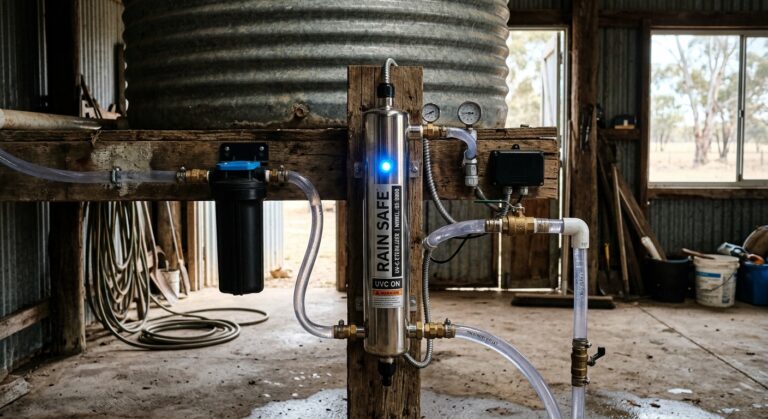
1. Private bore and tank water users near contamination sites. If you draw from a private bore or rainwater tank within a few kilometres of a known AFFF use site, you are outside the municipal monitoring network. No authority is testing your specific source. The Environmental Health Standing Committee (ENHEALTH) recommends independent testing for bore water within 2 km of known sites.
2. Households near active PFAS investigation zones. These include the areas surrounding Williamtown (postcodes 2318, 2319), Katherine in the NT (near Tindal), parts of Oakey QLD (near the Army Aviation Centre), and residential areas adjacent to major civilian airports. The NSW Environment Protection Authority operates a free testing program for residents in Williamtown and Oakey investigation zones — check the NSW EPA website for current eligibility.
3. Industrial corridor households in Perth and Adelaide. Perth’s Kwinana industrial corridor and Adelaide’s northern suburbs near the Edinburgh RAAF base carry site-specific contamination risk distinct from the general metropolitan water supply. Perth’s tap water is sourced from surface catchments and groundwater — Water Corporation WA tests both, but private groundwater use is common in semi-rural areas and is not automatically included in utility monitoring.
If you are not in one of these three categories and you receive reticulated municipal water, your PFAS exposure from tap water is likely below ADWG guideline values. The decision to filter is still legitimate — the ADWG guidelines are protective limits, not zero-risk thresholds — but the urgency level is different to that of someone drawing from a bore 1 km from RAAF Williamtown.
Which Filtration Technologies Actually Remove PFAS — and Which Ones Don’t
This is where most Australian households get misled. Not all filters address PFAS. The distinction matters because buying the wrong filter gives you false confidence while doing nothing measurable to your water chemistry.
Reverse Osmosis: 90–97% Removal, Verified
RO membranes physically reject PFAS molecules based on size and charge. The semi-permeable membrane used in residential RO systems has pores in the 0.0001-micron range — PFAS molecules cannot pass through. NSF/ANSI 58 certification covers RO systems, and NSF/ANSI P473 specifically addresses PFAS reduction in drinking water treatment units. Any RO system carrying NSF/ANSI P473 certification has been independently tested to remove PFOA and PFOS to below 70 ng/L from challenge water spiked at 1,500 ng/L.
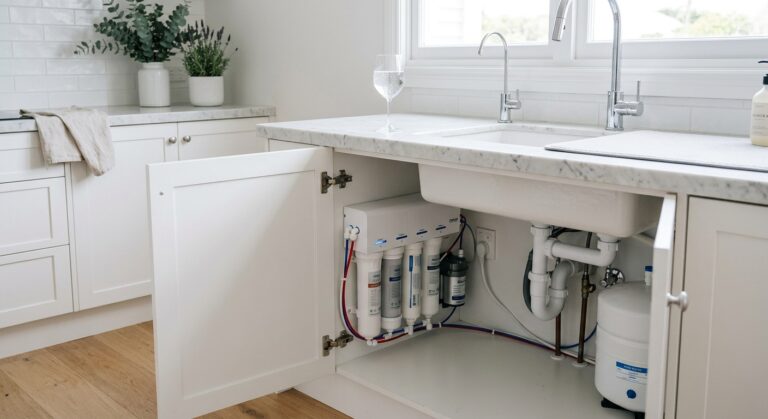
The AquaTru Classic countertop RO (ASIN B0F9C7G3VD) carries NSF/ANSI 58 and P473 certification. It requires no plumbing — it sits on your bench and processes water from your existing tap. The Waterdrop D6 (ASIN B0DRG5CL8D) is an under-sink tankless RO unit designed for permanent installation. Both achieve the verified removal rates.
RO has two practical limitations. First, it rejects fluoride at roughly the same rate as PFAS — which is the intended outcome for most buyers, but means if your water authority adds fluoride and you prefer to retain it, RO removes it. Second, RO produces reject water (the concentrate stream that carries the removed contaminants to drain). The AquaTru’s ratio is approximately 3:1 waste-to-product at mains pressure — you use roughly 3 litres of inlet water for every 1 litre of filtered output. Under-sink systems with pressure pumps run closer to 1:1 to 1.5:1.
Certified Carbon Block: 70–90% Removal — With a Critical Qualifier
Compressed or solid carbon block filters can adsorb PFAS compounds onto the carbon surface via hydrophobic interaction. The key word is “certified.” Standard granular activated carbon (GAC) — the loose carbon beads inside most pitcher filters and cheap benchtop units — has a high void fraction, meaning water can channel around the carbon rather than through it. Contact time is insufficient for meaningful PFAS adsorption.
Compressed carbon block forces water through the entire carbon matrix under pressure. If the block carries NSF/ANSI P473 certification, it has been tested specifically for PFAS reduction. Without that certification, a carbon block’s PFAS removal rate is unknown regardless of what the marketing says. Do not buy a filter marketed as “removes PFAS” without an NSF P473 or equivalent independent certification visible on the product listing or technical documentation.
For Brisbane, Sydney, Adelaide, Gold Coast, and Darwin households — all of which use chloramine for disinfection — a certified compressed carbon block must use catalytic carbon or be combined with an RO stage to address both the chloramine and any PFAS concern. Standard GAC removes chloramine at approximately 1/40th the rate of catalytic carbon. Standard GAC also does not remove PFAS. It is the wrong tool for both problems simultaneously.
Activated Alumina and Ion Exchange: Situational, Not Residential
Activated alumina is effective for some PFAS compounds, particularly longer-chain variants like PFOS and PFOA. It is used in some municipal treatment upgrades. It is not a practical residential solution in standalone form — the media requires periodic regeneration or replacement, and its effectiveness varies significantly by water pH and contact time.
Ion exchange resin (specifically anion exchange resin) is emerging as a municipal-scale PFAS treatment. Some high-end under-sink multi-stage systems incorporate a resin stage alongside RO. At the residential level, the combination of RO + carbon block is more cost-effective and easier to maintain than RO + ion exchange resin.
The 2026 Breakthrough: Australian-Funded Research on PFAS Destruction
A peer-reviewed study published in April 2026, partially funded through Australian research channels, demonstrated a 98% PFAS removal rate using a novel electrochemical oxidation process at the treatment stage. This is a destruction technology — not adsorption or rejection — meaning the PFAS molecules are broken down rather than transferred to a waste stream. The technology is currently at pilot scale and is not available in residential filter products. It is relevant for municipal treatment upgrades, particularly for contaminated groundwater remediation around AFFF sites. Expect to see this incorporated into site-remediation projects over the next 3–5 years, not in your under-sink filter cabinet in 2026.
NSF P473-Certified PFAS Filters — Our Picks
Full water filter rankings for Australian homes →The Certification Gap: Why “PFAS Removal” Claims on Australian Products Are Mostly Unverified
Walk through a Bunnings water filter aisle or search “PFAS water filter” on Amazon AU. You will find products with “reduces PFAS” printed on the box that carry no independent certification whatsoever. This is legal because Australian Consumer Law requires claims to be truthful, but it does not require third-party testing before a claim is made. A manufacturer can claim PFAS reduction based on internal bench tests that have never been reproduced by an independent laboratory.
The standards that matter for PFAS filtration in Australia are:
NSF/ANSI P473: The specific protocol for PFAS reduction in point-of-use drinking water treatment units. Challenge water is spiked with PFOA and PFOS at 1,500 ng/L and 1,500 ng/L respectively. The product must reduce both to below 70 ng/L (matching the ADWG guideline) to pass. This is the only certification that directly mirrors the Australian regulatory threshold.
NSF/ANSI 58: Covers RO systems broadly for contaminant reduction, including Annex A which includes some PFAS-relevant testing. Less specific than P473 but still meaningful for RO systems.
WaterMark (AS/NZS 3497 and related standards): WaterMark certification from the Australian Building Codes Board covers plumbing products for installation compliance — it is a plumbing safety standard, not a contaminant reduction standard. A WaterMark label tells you the product is safe to install in Australian plumbing; it tells you nothing about whether it removes PFAS. Many Australians conflate WaterMark with water quality certification. They are different things.
The ADWG 2022 does not mandate that residential filter products carry any specific certification. The ADWG sets guideline values for the water utilities to meet at the point of supply — it does not regulate what filters households may choose to use. This means the entire residential filter market is largely self-regulated for performance claims. Your protection is demanding the NSF P473 certification number and verifying it on the NSF certified product listings database at info.nsf.org/certified/dwtu.
This gap is where the AquaCo Premium PFAS Three Stage system sits for consideration. AquaCo markets a three-stage system specifically for PFAS. Before purchasing any multi-stage system at a significant price point, ask the supplier for the specific NSF certification number and the contaminant reduction data sheet. If they cannot provide a documented third-party test result against PFAS at a known challenge concentration, the system’s PFAS claim is unverified regardless of what the product name implies.
Five-Year Cost Comparison: Home Filtration vs. Bottled Water vs. Municipal Reliance
If you are in a confirmed high-risk zone, the cost question is real. Here is the maths for a four-person household consuming 8 litres of drinking water per day.
| Option | Upfront Cost | Annual Running Cost | 5-Year Total | Cost per Litre |
|---|---|---|---|---|
| AquaTru Classic RO (countertop) | ~$700 | ~$120 (filter replacements) | ~$1,300 | ~$0.04 |
| Waterdrop D6 Under-Sink RO | ~$850 | ~$150 | ~$1,600 | ~$0.05 |
| NSF P473 certified carbon block (benchtop) | ~$300 | ~$180 (frequent replacement for PFAS) | ~$1,020 | ~$0.03 |
| Bottled water (2L bottles at $2.50) | $0 | ~$3,650 | ~$18,250 | $1.25 |
| Rely on municipal monitoring only | $0 | $0 | $0 | Depends on postcode risk |
Assumes 8L/day household consumption. Filter replacement costs are manufacturer-published estimates. Bottled water price based on Woolworths AU 2025 pricing for 2L house-brand water.
The bottled water cost comparison is not purely financial. Bottled water quality is regulated under Food Standards Australia New Zealand (FSANZ) Standard 2.6.2, which sets microbial and chemical limits — but PFAS is not a parameter specifically tested or disclosed for bottled water sold in Australia. You are not guaranteed a lower PFAS exposure from a bottle than from a correctly operating RO system. The filter wins on cost and transparency.
A Three-Question Decision Framework: Do You Actually Need a PFAS Filter?
Most informational content on PFAS filters in Australia stops at “here is how PFAS is bad, here are the filters.” That is not useful. Here is the actual decision framework.
Question 1: Is your water supply reticulated municipal water from a major utility?
If yes — Sydney Water, Melbourne Water, Seqwater, SA Water, Water Corporation WA, Icon Water (Canberra), Darwin Water — your supply is tested and currently reported below ADWG PFAS guideline values. Filtration remains a personal choice for precautionary reasons, but the risk level does not justify urgent action on PFAS grounds alone. Move to question 2 to refine further.
Question 2: Are you within 5 km of a known AFFF contamination site, or do you use private bore or tank water?
If yes to either: get your water independently tested before buying a filter. The NATA-accredited laboratories that test for PFAS in Australia include ALS Environmental, Eurofins, and Sydney Analytical Labs. A comprehensive PFAS panel (28 compounds) costs approximately $150–$300. This is money better spent before a $700 filter than after. If results show PFAS above ADWG guideline values, RO is the recommended response. If results are below guideline values, you have actual data to inform your decision rather than proximity-based anxiety.
Question 3: Are you in Brisbane, Sydney, Adelaide, Gold Coast, or Darwin?
These cities all use chloramine for water disinfection. If you are buying a filter primarily for PFAS and it will be an RO unit, this distinction matters less — RO handles chloramine effectively. If you are considering a carbon block filter, it must use catalytic carbon or compressed carbon block media to also address the chloramine. A standard GAC filter removes neither PFAS nor chloramine at useful rates. This is the most common filter-selection error in Australian homes using chloramine-treated water.
What to Do Right Now: A Practical Action Plan by Risk Category
Generic advice serves no one. Here is what to actually do depending on your situation.
You are in a major capital city on reticulated water, no known contamination nearby
Check your water utility’s published PFAS monitoring results. Sydney Water, Melbourne Water, and Seqwater publish these online and update them at least annually. If the results are below ADWG guideline values — which they currently are for all three — you have no PFAS emergency. If you still want filtration for peace of mind (a legitimate position), the AquaTru Classic countertop RO is the most practical no-plumbing option. It sits on the bench, takes 10 minutes to set up, and removes PFAS, fluoride, chloramine (via the carbon pre-filter stage), and over 80 other contaminants as independently verified by NSF testing.
You are near a known contamination site or use bore/tank water
Get a PFAS panel test from an NATA-accredited lab before spending money on a filter. Results in hand, if PFAS is detected above ADWG guideline values: install an NSF/ANSI P473-certified RO system at the point of use for drinking and cooking water. Do not wait for a whole-house solution — point-of-use RO at the kitchen tap is the fastest and most cost-effective intervention. The Waterdrop D6 is the under-sink unit I would install in this situation: tankless design, minimal bench intrusion, NSF 58 rated, approximately 1:1.5 waste ratio with its booster pump.
You have children under 12 or are pregnant
The NHMRC’s PFAS health guidance places developing infants and children in a higher-sensitivity category due to body weight-adjusted exposure and developmental period considerations. If you fall into this category and there is any geographic uncertainty about your water source, RO filtration is the prudent choice without waiting for a test result. The cost is $0.04/L. Formula preparation with filtered water eliminates the PFAS exposure vector entirely during the most sensitive developmental window.
Last reviewed: May 2026 — Clean and Native
Ready to filter PFAS from your water?
The AquaTru Classic is the only NSF/ANSI P473-certified countertop RO system available on Amazon AU — no plumbing, verified PFAS removal, and the lowest cost per litre of any residential filter option.
Frequently Asked Questions
Major capital city utilities — Sydney Water, Melbourne Water, Seqwater, SA Water, Water Corporation WA — currently report PFAS concentrations below the Australian Drinking Water Guidelines (ADWG) guideline values of 70 ng/L for PFOA and PFOS. However, households near former military bases, airports, or industrial AFFF use sites — and those using private bore or tank water — face meaningfully higher risk and should seek independent testing.
Reverse osmosis systems certified to NSF/ANSI P473 remove 90–97% of PFAS. Compressed carbon block filters certified to NSF/ANSI P473 remove 70–90%. Standard GAC filters (including Brita-style jugs and most benchtop gravity filters) have negligible PFAS removal rates and should not be used as a PFAS solution. Always verify the NSF P473 certification number at info.nsf.org/certified/dwtu before purchasing.
No. Standard Brita pitcher filters use granular activated carbon (GAC), which has negligible PFAS removal rates — typically below 20% and often unmeasurable. Brita’s own product documentation does not claim NSF P473 certification. A Brita filter does not address PFAS contamination at any meaningful level.
The highest-risk areas are those with confirmed AFFF contamination plumes near groundwater or connected to affected catchments. These include the Williamtown area in NSW (postcodes 2318, 2319), Katherine in the NT (near RAAF Tindal), Oakey in QLD, East Sale in Victoria, and parts of Edinburgh in SA. The DCCEEW national PFAS contamination register lists over 700 investigation sites as of 2025.
The ADWG 2022 sets guideline values of 0.00007 mg/L (70 ng/L) for PFOA and 0.00007 mg/L for PFOS. These are health-based guideline values calculated from chronic dietary exposure models, not zero-risk thresholds. The guidelines are designed for water utilities to meet at the point of supply — they do not regulate residential filter performance.
No. WaterMark certification (from the Australian Building Codes Board, referencing AS/NZS plumbing standards) confirms a product is safe to install in Australian plumbing. It is a plumbing installation standard, not a water quality or contaminant reduction standard. A WaterMark label tells you nothing about PFAS removal. Look for NSF/ANSI P473 certification for PFAS-specific performance claims.
Contact an NATA-accredited laboratory and request a comprehensive PFAS panel (28 compounds). ALS Environmental, Eurofins, and Sydney Analytical Labs all offer residential PFAS water testing. A comprehensive panel typically costs $150–$300. Collect the sample using the lab’s supplied container following their instructions precisely — PFAS can leach from some plastic containers, which contaminates the sample. In NSW Williamtown and QLD Oakey investigation zones, the EPA operates free testing programmes — check the relevant state EPA website for current eligibility.
RO removes longer-chain PFAS compounds (PFOA, PFOS, and similar) at 90–97% efficiency. Shorter-chain PFAS alternatives (such as PFBS and PFBA, increasingly used as substitutes for PFOA and PFOS) are smaller molecules and may pass through RO membranes at slightly higher rates. NSF P473 testing specifically targets PFOA and PFOS. Comprehensive short-chain PFAS removal data for residential RO units is an active area of research. For worst-case contamination scenarios, combining RO with a granular activated carbon post-filter or ion exchange resin stage improves short-chain coverage.
Not necessarily. FSANZ Standard 2.6.2 regulates bottled water for microbial and chemical parameters but does not specifically require PFAS testing or disclosure from bottled water manufacturers. The PFAS content of bottled water in Australia is largely unknown for most brands. A correctly operating NSF P473-certified RO system provides documented PFAS reduction with a known margin of confidence — bottled water does not.
Get the Australian Home Environment Checklist
30 checks across water, air and EMF. Most of them free. Ranked by impact.
No spam. Unsubscribe any time.

Former Royal Australian Navy Clearance Diver and TAG-E counter-terrorism operator. Founded Clean and Native to apply the same rigorous thinking to the home environment.
Full biography →