PFAS in Blue Mountains Drinking Water 2026: What Residents Need to Know
Drafted with AI assistance and checked against published specifications and certifications. First-hand measurements appear only where stated. How we make content
Field Value post_contentPFAS contamination was detected in the Blue Mountains water supply system in 2024, affecting approximately 41,000 homes connected to the Cascade water system — and the Australian federal government’s AU$2 billion lawsuit against 3M in May 2026 has confirmed RAAF Base Richmond as a named upstream contamination source. If you live in Katoomba, Blackheath, Medlow Bath, Leura, or Springwood, here is exactly what happened, what the current risk is, and what you need to do.
What Happened With PFAS in the Blue Mountains Water Supply
In 2024, WaterNSW and Sydney Water confirmed elevated PFAS levels in the Cascade water supply system serving approximately 41,000 Blue Mountains residents. The detection covered communities from Katoomba and Leura through to Blackheath and Medlow Bath — the mid- and upper-Mountains corridor most dependent on the Cascade dam system.
The contamination pathway runs upstream. RAAF Base Richmond, approximately 40 kilometres east of the Blue Mountains urban area, has been a long-documented source of AFFF (aqueous film-forming foam) contamination. AFFF was used extensively on defence bases for jet fuel fire suppression from the 1970s onward and contains PFOS and PFOA at concentrations many orders of magnitude above drinking water guidelines. These compounds leach into the Nepean-Hawkesbury river system and work their way into the catchment areas that feed the Blue Mountains water supply.
A separate incident — a petrol tanker spillage near Medlow Bath — temporarily closed Blue Mountains reservoirs and added to contamination concerns in the same period. The Conversation cited research confirming PFAS compounds persist in the environment for more than three decades once established in catchment soils and groundwater. That is not a hypothetical. It is the measured reality documented at contaminated sites across Australia.
Sydney Water deployed a mobile PFAS filtration unit at the Cascade plant in response. The filter targets PFOS and PFOA at the treatment level before distribution. Sydney Water monitors Blue Mountains supply against the Australian Drinking Water Guidelines (ADWG) and publishes results on their water quality reporting portal at sydneywater.com.au. If you are on mains supply and want current monitoring data, that is your first call.
Is the Blue Mountains Water Safe to Drink in 2026?
The honest answer is: for treated mains supply, probably yes — at current monitored levels and under current ADWG limits. But “probably yes under current limits” carries more qualification than it sounds.
Australia’s drinking water guidelines were updated in June 2025. The new NHMRC guideline values tightened PFAS limits significantly compared to the 2018 standards. According to the Friends of the Earth Australia report from 2024, roughly 73,000 Australians in communities including Katoomba and Blackheath (NSW) were living in areas impacted by PFAS contamination. Those numbers were calculated before the June 2025 guideline tightening, which means some previously “compliant” water supplies have now crossed into elevated-concern territory under the new thresholds.
More significantly: Australia’s current PFAS limits remain 140 times less strict than the US EPA’s 2024 enforceable maximum contaminant levels (MCLs). The US EPA set enforceable MCLs for PFOA at 4 parts per trillion and PFOS at 4 parts per trillion. Australia’s limits, even post the June 2025 revision, sit well above that. This is not a technicality. It reflects a genuine difference in how the two regulatory systems weigh the precautionary principle against economic disruption to treatment infrastructure.
The IARC (International Agency for Research on Cancer) classified PFOA as a Group 1 human carcinogen in December 2023. Group 1 means the evidence for causing cancer in humans is sufficient — the same category as asbestos and tobacco. PFOS is a Group 2B possible carcinogen. These classifications do not automatically require a government to lower its water limits, but they inform what level of residual risk you are personally comfortable accepting.
The highest-risk Blue Mountains residents
If you are on Sydney Water mains supply in Katoomba, Leura, Blackheath, Medlow Bath, or Springwood, your water is tested and filtered at the Cascade plant. The risk is present but regulated. The situation is not equivalent to an unfiltered bore well.
The residents who need to act immediately are those on bore water, rainwater tanks, or private dams — particularly in the lower Blue Mountains towns near the Hawkesbury flood plain and Richmond. These supplies receive no centralised treatment. PFAS compounds in catchment soils migrate into groundwater and into rooftop runoff that feeds tanks. You have no way to know your levels without a NATA-accredited lab test.
The 3M Lawsuit and What It Means for Blue Mountains Residents
In May 2026, the Australian federal government filed a AU$2 billion lawsuit against 3M over PFAS contamination at 28 Defence bases across the country. RAAF Base Richmond is a named site. This is significant for Blue Mountains residents for two reasons.
First, it is a formal legal acknowledgement that Richmond is a contamination source. This matters for any future compensation or remediation claims by affected households or local councils. The case establishes the contamination pathway in the public legal record.
Second, it signals that Australian regulatory and legal frameworks are now moving toward accountability rather than just monitoring. Whether that translates to enforceable limits closer to US EPA standards — and timeline for doing so — is less clear. Legal proceedings of this scale take years. The contamination itself will persist in catchment soils for decades regardless of the lawsuit’s outcome, because PFAS does not break down.
What the lawsuit does not do is clean your water today. Litigation is not a filter. The practical implication for Blue Mountains residents is this: the legal trajectory confirms the contamination is real, upstream Defence activity caused it, and the government is pursuing remediation costs. In the meantime, your household water quality depends on the treatment system between that contaminated catchment and your tap — and whether you have one at the point of use.
For detailed coverage of the 3M lawsuit and its implications for all affected Australian communities, see our full breakdown at Australia’s AU$2 billion 3M PFAS lawsuit — what it means for drinking water.
How to Test Your Blue Mountains Water for PFAS
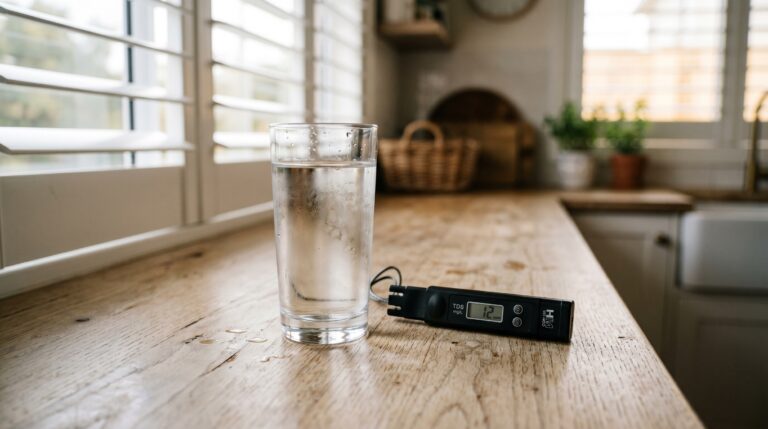
Strip test kits cannot detect PFAS. This is worth stating clearly because hardware stores sell water test kits that check for hardness, pH, chlorine, and heavy metals. None of those kits test for PFAS compounds. There is no colour-change strip that works for PFAS. You need a NATA-accredited laboratory analysis.
NATA (National Association of Testing Authorities) accreditation means the laboratory operates under ISO/IEC 17025 and its testing methods have been independently validated. For PFAS, the relevant analytical method is LC-MS/MS (liquid chromatography-tandem mass spectrometry), which detects individual PFAS compounds at parts-per-trillion concentrations. This is the only technically valid method for drinking water PFAS testing.
What to do if you are on mains supply
Contact Sydney Water directly via sydneywater.com.au and request their most recent PFAS monitoring data for your suburb. They are legally required to publish this. If the published levels are below the June 2025 NHMRC guideline values, mains water is within regulatory compliance. Whether you want an additional point-of-use filter as a precautionary measure is a personal decision — outlined in the section below.
What to do if you are on tank, bore, or dam water
This article contains affiliate links. We may earn a commission at no extra cost to you.
Do not wait. Book a NATA-accredited lab test before making any filter purchasing decisions. The test tells you which PFAS compounds are present and at what concentrations, which determines the right filter specification. Testing through mywaterscore.com.au runs AU$120–299 depending on the panel requested. A comprehensive PFAS panel (testing for PFOA, PFOS, and related compounds) is the one to order — not just a basic metals screen.
For broader guidance on Australian water test kits and what to look for, see our guide to the best water quality test kits in Australia.
Which Water Filters Actually Remove PFAS — And Which Are Rated for Blue Mountains Conditions
Not all filters remove PFAS. This is the fact that most filter marketing carefully avoids stating directly. Standard granular activated carbon (GAC) — the type used in bench-top jug filters and most refrigerator filters — has limited and inconsistent PFAS reduction. It is not independently certified for PFAS removal under NSF/ANSI P473 or NSF/ANSI 58.
Two technologies have independent certification for PFAS removal: reverse osmosis (RO) and certain compressed carbon block filters. RO membranes reject PFAS compounds at 94–99% depending on the specific compound and system design. NSF/ANSI 58 is the certification standard for RO systems and includes reduction claims for PFOA, PFOS, and related long-chain PFAS. NSF/ANSI P473 is the stand-alone PFAS certification applicable to non-RO systems including high-density carbon blocks.
Sydney’s water supply — including Blue Mountains — uses chloramine disinfection, not free chlorine. This matters for filter selection. Standard GAC removes free chlorine effectively but removes chloramine at approximately 1/40th the rate. For both chloramine reduction and PFAS removal, RO or catalytic carbon is the correct technology. Standard GAC fails at both tasks.
PFAS Removal Rate by Filter Technology — Blue Mountains Relevant Options
Based on NSF/ANSI 58 and P473 certified third-party reduction data for PFOA/PFOS at representative inlet concentrations.
AquaTru Classic Smart Alkaline — Best for Blue Mountains Renters and Apartments
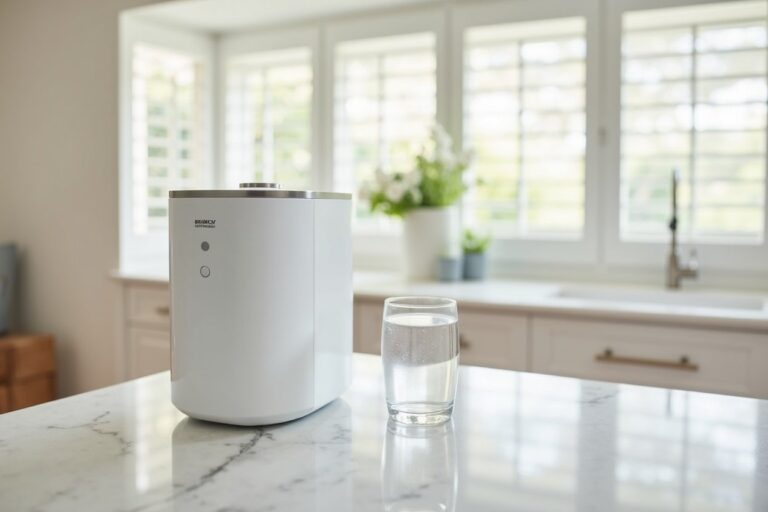
The AquaTru is the filter I recommend first for Blue Mountains renters because it requires no plumbing. You sit it on a bench, fill the top reservoir with tap water, and the 4-stage RO system — sediment pre-filter, RO membrane, activated carbon post-filter, alkaline remineraliser — processes it down to clean water in a sealed lower tank. The NSF/ANSI 58 certification covers PFOA, PFOS, chloramine reduction, and lead. That certification is not a marketing claim — it is a third-party laboratory result published on the NSF certification database.
The one limitation worth naming honestly: the AquaTru has a waste water ratio of approximately 3:1 during filtration. For every litre of filtered water, roughly 3 litres of concentrate goes down the drain. For a household filtering 4 litres per day, that is 12 litres of water used. In a town where water supply has had contamination concerns, some residents may find this tradeoff significant. It is the price of zero-plumbing RO.
Waterdrop D6 Under-Sink RO — Best Permanent Solution for Blue Mountains Homeowners
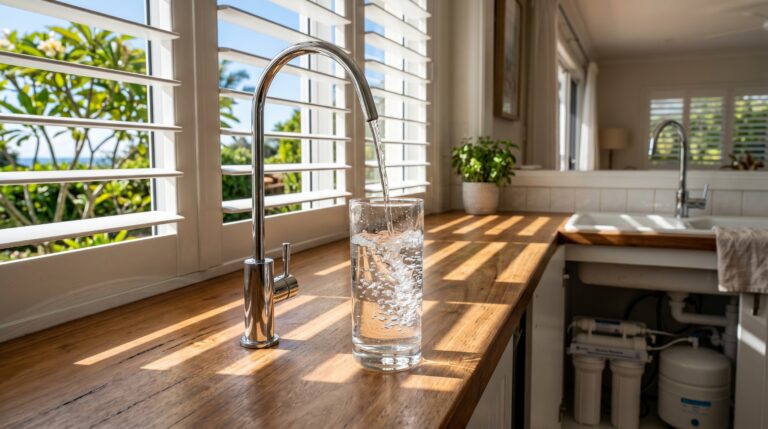
For homeowners who can modify their plumbing, the Waterdrop D6 delivers the same NSF 58 PFAS removal performance as the AquaTru at a lower upfront cost, with no bench space consumed. The tankless design means no pressurised storage tank under the sink — water is filtered on demand. At AU$499, it costs AU$200 less than the AquaTru. The installation requires basic plumbing knowledge or a 30-minute job for a licensed plumber.
TAPP EcoPro Benchtop — Budget Option for Mains-Supply Users
At AU$99, the TAPP EcoPro is the entry point for Blue Mountains mains-supply households who want some PFAS reduction but are not ready to commit to RO. The compressed carbon block reduces PFAS by 40–73% depending on compound chain length — useful for long-chain PFOS and PFOA, less effective for short-chain replacements like PFBS and PFBA. If your NATA test returns PFAS at levels close to but below the June 2025 guideline values, the EcoPro provides meaningful reduction at a low cost. If your levels are elevated, step up to RO.
PFAS Filters for Blue Mountains Residents
Full PFAS filter rankings for Australia →Five-Year Cost Comparison — Blue Mountains PFAS Filter Options
Before you decide, here is what each option actually costs over five years, assuming a 4-litre-per-day household. Bottled water at AU$2 per litre is the comparison that makes the RO decision obvious.
| Filter | Upfront | Annual Filter Cost | 5-Year Total | Cost Per Litre |
|---|---|---|---|---|
| AquaTru Classic RO | $699 | ~$120 | $1,299 | $0.18/L |
| Waterdrop D6 RO | $499 | ~$100 | $999 | $0.14/L |
| TAPP EcoPro Carbon Block | $99 | ~$80 | $499 | $0.07/L |
| Bottled Water (2L, supermarket) | $0 | ~$2,920 | $14,600 | $2.00/L |
The Waterdrop D6 at $0.14/L is 14 times cheaper than bottled water at $2.00/L. Over five years, a household switching from bottled water to the D6 saves AU$13,600. That number is not rhetorical. It is arithmetic.
For more on Sydney-connected water quality and filter selection, the best water filter guide for Sydney 2026 covers the full chloramine context relevant to all Sydney Water-supplied areas including the Blue Mountains.
What Blue Mountains Residents Should Do Right Now — In Order
The decision tree is short. Three questions determine your action.
Step 1: What is your water source? If you are on Sydney Water mains supply, go to sydneywater.com.au and check the most recent PFAS monitoring data for your suburb. If you are on bore water, rainwater, or a private dam, skip directly to Step 2 — you need a test regardless.
Step 2: What did the monitoring data show? If mains supply levels are below the June 2025 NHMRC guideline values, the water is within regulatory compliance. Add a point-of-use RO filter as a precautionary measure if you want to reduce residual PFAS to the lowest achievable level. If your bore or tank test returns elevated PFAS — any level above the June 2025 guideline thresholds — install an NSF 58 RO filter immediately and do not use that supply for drinking or cooking without it.
Step 3: Which filter? Renter or no plumbing access: AquaTru Classic at AU$699. Homeowner with under-sink access: Waterdrop D6 at AU$499. Mains supply, compliance confirmed, precautionary only: TAPP EcoPro at AU$99 as a starting point.
For a comprehensive overview of health effects associated with PFAS exposure, the PFAS health effects guide for Australian residents covers the IARC Group 1 classification, epidemiological data, and what the June 2025 NHMRC guideline changes mean for exposure assessment.
Last reviewed: May 2026 — Clean and Native
Frequently Asked Questions
Sydney Water mains-supplied areas in the Blue Mountains are monitored against the June 2025 NHMRC guideline values for PFAS. The treated supply from the Cascade plant is within current regulatory compliance. However, Australia’s PFAS limits remain 140 times less strict than the US EPA’s 2024 enforceable MCLs. Residents on bore water, rainwater tanks, or private dams should test before drinking — those supplies receive no centralised PFAS treatment.
In 2024, WaterNSW and Sydney Water confirmed elevated PFAS levels in the Cascade water supply system serving approximately 41,000 homes. The contamination was traced upstream to AFFF use at RAAF Base Richmond via the Nepean-Hawkesbury river system. Sydney Water deployed a mobile PFAS filtration unit at the Cascade plant in response and issued notifications to affected residents.
Yes. Sydney Water monitors Blue Mountains supply against the Australian Drinking Water Guidelines and publishes results on their water quality portal at sydneywater.com.au. Results are reported per suburb and updated on a regular schedule. Residents can request suburb-specific data directly from Sydney Water.
Katoomba, Blackheath, and Medlow Bath were specifically named in the 2024 contamination reports as areas connected to the Cascade system with elevated PFAS detection. Leura and Springwood are also in the Cascade supply zone. Residents in lower Blue Mountains areas near the Hawkesbury flood plain and Richmond — particularly those on bore or tank water — face the highest risk from groundwater contamination originating at RAAF Base Richmond.
No. Standard granular activated carbon (GAC) jug filters are not certified for PFAS removal under NSF/ANSI 58 or NSF/ANSI P473. They have no reliable, independently validated PFAS reduction capability. For PFAS removal, you need either an NSF 58-certified reverse osmosis system or an NSF P473-certified high-density carbon block filter.
The May 2026 AU$2 billion federal lawsuit against 3M names RAAF Base Richmond as one of 28 contaminated Defence sites. This formally establishes the contamination pathway in the legal record and may eventually result in remediation funding. It does not alter current water quality or treatment. Blue Mountains residents should not wait for the lawsuit outcome to address household water quality — litigation of this scale takes years.
The NHMRC released updated Australian Drinking Water Guidelines in June 2025 with tightened PFAS limits. The new values are more stringent than the 2018 guidelines. Despite this tightening, Australia’s limits remain significantly higher than the US EPA’s 2024 enforceable MCLs of 4 parts per trillion for PFOA and PFOS. For the specific numerical limits, consult the NHMRC ADWG 2025 publication directly at nhmrc.gov.au.
The Blue Mountains supply is part of the Sydney Water network, which uses chloramine disinfection — not free chlorine. Standard GAC filters and Brita-type jugs remove free chlorine effectively but remove chloramine at approximately 1/40th the rate. For effective chloramine removal, you need catalytic carbon, a compressed carbon block (such as the TAPP EcoPro), or reverse osmosis. Both the AquaTru Classic and the Waterdrop D6 RO systems remove chloramine as well as PFAS.
Test first. Book a NATA-accredited PFAS laboratory test (via mywaterscore.com.au, AU$120–299) before selecting a filter. Rooftop catchment in PFAS-impacted areas can contain PFAS compounds from atmospheric deposition and contaminated rainfall. If your test returns any detectable PFAS, install an NSF 58 RO filter — the AquaTru Classic at AU$699 is the simplest option for tank-supply homes as it requires no plumbing modifications.
Get the Australian Home Environment Checklist
30 checks across water, air and EMF. Most of them free. Ranked by impact.
No spam. Unsubscribe any time.

Former Royal Australian Navy Clearance Diver and TAG-E counter-terrorism operator. Founded Clean and Native to apply the same rigorous thinking to the home environment.
Full biography →