Does Melbourne Tap Water Have Fluoride? 2026 Quality Guide
Yes, Melbourne tap water is fluoridated. Melbourne Water adds fluoride to maintain levels between 0.6 and 1.0 mg/L, consistent with the Australian Drinking Water Guidelines 2022 target of 1.0 mg/L — and has done so since 1977.
Is Melbourne Tap Water Actually Fluoridated?
Yes — and the history is specific. Melbourne began fluoridating its water supply in 1977, making it one of the earlier Australian capital cities to do so. The program is run by Melbourne Water and overseen by the Department of Health under Victoria’s Safe Drinking Water Act 2003. Fluoridation is not optional at a household level — it applies to all properties connected to the metropolitan water network.
The target concentration is 1.0 mg/L, with an operational range of 0.6 to 1.0 mg/L. This aligns precisely with the Australian Drinking Water Guidelines 2022 (ADWG) recommended fluoride level for dental health benefits. The ADWG also sets a maximum of 1.5 mg/L — Melbourne’s supply sits comfortably below this ceiling. The World Health Organisation guideline value is 1.5 mg/L as well, so Melbourne is well within both national and international safety thresholds.
One question that comes up often: is this naturally occurring fluoride or is it added? In Melbourne, it is added. The city’s catchment water — drawn from the Yarra Valley mountain reservoirs (Thomson, Upper Yarra, and O’Shannassy) — is naturally very low in minerals including fluoride. Melbourne Water doses fluoride at the treatment stage before distribution. The source water itself is essentially pristine mountain runoff with negligible natural fluoride content.
Melbourne Water conducts over 70,000 water quality tests per year across its distribution network. Fluoride is measured continuously at dosing points and at network sampling sites. The data is publicly reported in Melbourne Water’s Annual Drinking Water Quality Report — available on their website and one of the more transparent public water quality disclosures in Australia.
Melbourne Tap Water Quality Profile — The Full Picture
Fluoride is one data point. Here is the full picture — because if you are wondering whether to filter your Melbourne water, the complete quality profile matters more than any single parameter.
Melbourne’s water comes from protected mountain catchments in the Yarra Ranges. These are closed catchment areas — no farming, no public access, no industrial activity. The Thomson Reservoir alone has a catchment of approximately 487,000 hectares. The result is source water that is among the least contaminated of any major city in the world. There is no agricultural runoff, no cattle, and no significant pesticide load to speak of.
TDS and Hardness
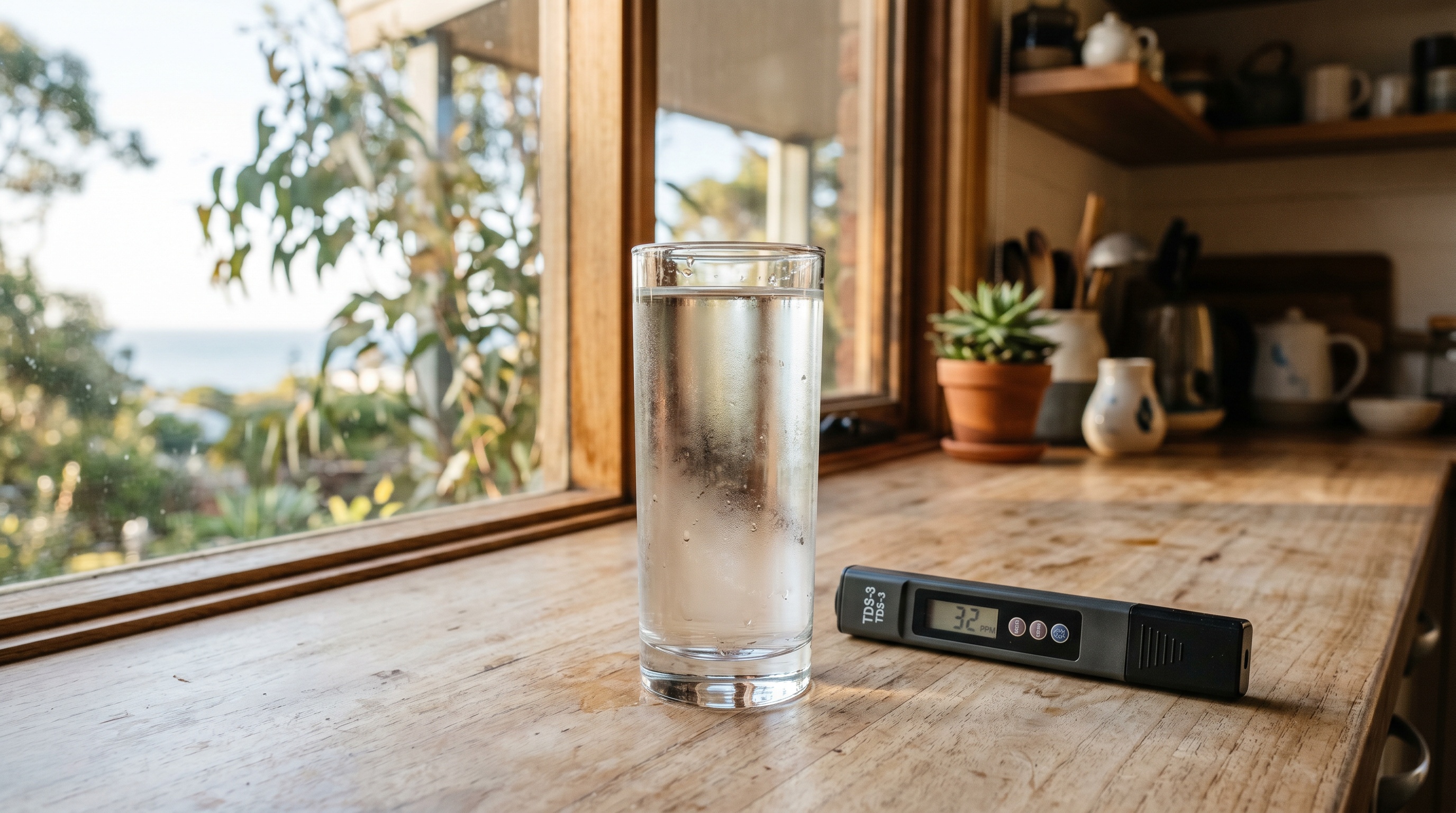
Melbourne’s TDS sits at approximately 18-25 mg/L — this is exceptionally low. For comparison, Adelaide’s TDS runs around 400 mg/L and Perth around 170 mg/L. Melbourne water is classified as very soft, with hardness typically between 10 and 30 mg/L as CaCO3. This means no limescale on your kettle, no white film on your shower glass, and no concern about scaling in your coffee machine.
Disinfection — Free Chlorine, Not Chloramine
Melbourne Water uses free chlorine for disinfection. This is a critical distinction. Brisbane, Sydney, Adelaide, Gold Coast, and Darwin have all switched to chloramine (a chlorine-ammonia compound) as their primary disinfectant. Chloramine is far harder to remove from water — it requires catalytic carbon or reverse osmosis, and it is not neutralised by standard GAC filters at any practical contact time. Standard carbon filters remove free chlorine effectively but remove chloramine at roughly 1/40th the rate.
For Melbourne residents, this means a standard benchtop carbon filter — including the TAPP EcoPro (B0BP5BS7B9) — will effectively reduce chlorine taste and odour from your tap water. You do not need catalytic carbon or RO just to deal with disinfection byproducts. This is a meaningful cost and complexity saving compared to what residents in Brisbane or Sydney face.
PFAS
No PFAS (per- and polyfluoroalkyl substances) have been detected in Melbourne’s catchment water. The protected mountain source and absence of industrial or military activity in the catchment zones means PFAS contamination is not a current concern for Melbourne’s metropolitan supply. This contrasts with parts of Sydney (RAAF Williamtown corridor), Perth’s southern suburbs, and various regional Queensland areas where PFAS has been confirmed at elevated levels.
pH
Melbourne tap water pH runs typically between 7.0 and 7.5 — slightly neutral to mildly alkaline. The ADWG aesthetic guideline is 6.5 to 8.5. Melbourne’s pH is unremarkable, which is exactly what you want.
TDS Comparison — Australian Capital Cities (mg/L)
Free Chlorine vs Chloramine — Why Melbourne Residents Have an Easier Filter Choice
If you live in Brisbane, Sydney, Adelaide, or Gold Coast, the single most important water quality fact for filter selection is this: your water utility uses chloramine, not free chlorine. Chloramine is a disinfectant compound formed by combining chlorine with ammonia. It is more stable than free chlorine, which is why high-population systems prefer it — it persists longer through distribution networks. But it is also much harder to remove from drinking water.
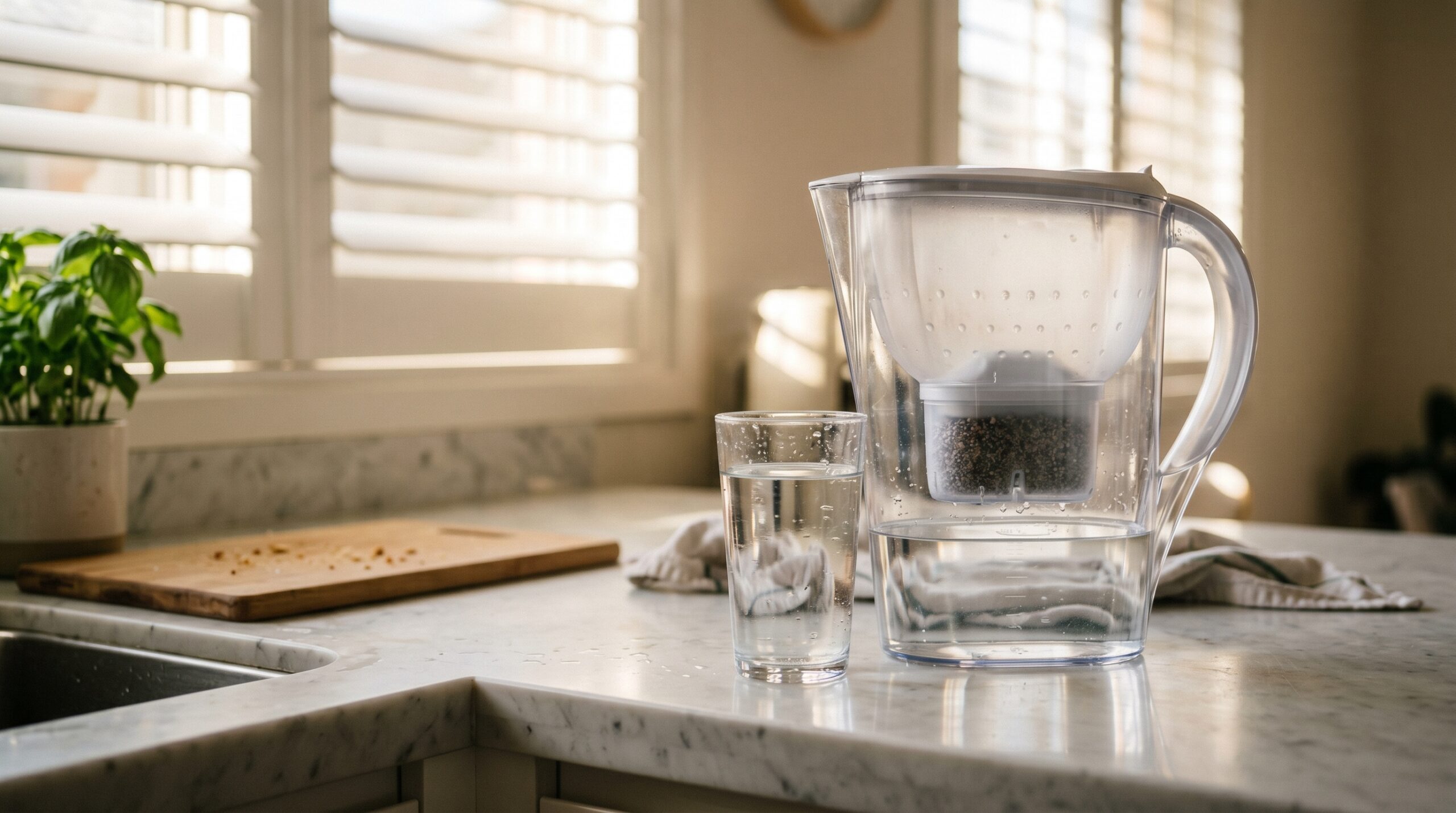
Standard granular activated carbon (GAC) — the media used in most jug filters, including Brita — removes free chlorine readily through adsorption. But it removes chloramine at approximately 1/40th the rate. A Brita jug sitting on a Brisbane kitchen bench is doing almost nothing for chloramine reduction. You need catalytic carbon (a modified form of activated carbon with higher surface reactivity) or reverse osmosis to deal with chloramine effectively.
Melbourne is different. Melbourne Water uses free chlorine. This means a standard carbon block filter — a benchtop unit, a basic under-sink filter, or even a decent jug filter — will effectively remove the chlorine taste and odour from your tap water. The TAPP EcoPro, for instance, uses a compressed carbon block that handles free chlorine well. It is a practical and affordable solution for Melbourne residents who simply want better-tasting water and are not concerned about fluoride.
The important caveat: neither the TAPP EcoPro nor any other carbon-based filter removes fluoride. If fluoride removal is your goal, carbon filtration of any kind is the wrong tool.
Which Filters Actually Remove Fluoride from Melbourne Tap Water?
This is the practical question. You know Melbourne water is fluoridated. You have decided you want to reduce your fluoride intake. Which filters work, and which ones are a waste of money?
Reverse Osmosis — The Only Reliable Method for Most Households
Reverse osmosis (RO) forces water through a semi-permeable membrane at pressure. The membrane has pore sizes around 0.0001 microns — small enough to reject dissolved ions including fluoride. NSF/ANSI 58 is the certification standard for RO systems and includes specific testing for fluoride rejection. A properly certified RO system removes 90-97% of fluoride. For a Melbourne household with tap water at 1.0 mg/L fluoride, a certified RO system will bring that down to approximately 0.03-0.10 mg/L.
Two RO formats work for Melbourne residents — countertop and under-sink. Each has a different installation requirement and upfront cost.
Activated Alumina — The Alternative Worth Knowing
Activated alumina is a porous aluminium oxide media with a high affinity for fluoride ions. It removes 80-95% of fluoride at correct pH (optimal around 5.5-6.5) and flow rate. It is used in point-of-use filter cartridges and in some whole-house systems. Performance degrades over time and requires cartridge replacement — typically every 6-12 months depending on flow volume. It is less common in the Australian retail market than RO but worth knowing about for applications where RO is impractical.
What Does Not Remove Fluoride
Standard carbon block filters — including the TAPP EcoPro, ZeroWater’s carbon stage, Brita jugs, PUR filters, and similar products — do not remove fluoride. Fluoride is a dissolved ion (F-), not a particulate or a chlorine compound. Carbon adsorption works by attracting organic molecules and chlorine compounds to the carbon surface. Fluoride ions do not adhere to carbon. If a filter brand’s marketing implies fluoride removal from a carbon-only product, that claim is not supported by NSF/ANSI 58 testing methodology. The only certified methods are RO and activated alumina.
KDF-55 media — a copper-zinc alloy used in some shower and tap filters — also does not remove fluoride. It is effective for reducing heavy metals like lead and mercury, and for free chlorine reduction, but it has no mechanism for fluoride rejection.
Melbourne Fluoride Removal — Our Recommendations
Which Filter Is Right for Your Melbourne Home?
The honest answer to this depends on what you are actually trying to solve. Here is a direct decision framework — three questions, no fluff.
Question 1: Is fluoride your primary concern?
If yes, you need reverse osmosis. No other filter technology certified to Australian standards will give you reliable fluoride reduction. See the two products above — AquaTru for renters and countertop use, PWS EcoHero for homeowners who can do an under-sink install.
If fluoride is not your concern and you simply want better-tasting water, a quality carbon block benchtop filter is all you need in Melbourne. The TAPP EcoPro (available on Amazon AU, ASIN B0BP5BS7B9) handles free chlorine, sediment, and taste compounds effectively. At Melbourne’s low TDS and soft water profile, it performs well and requires no plumbing modification. This is the right answer for the majority of Melbourne residents asking this question.
Question 2: Do you rent or own?
Renters cannot typically modify under-sink plumbing without landlord permission. The AquaTru Classic is a countertop RO unit — it sits beside your sink, connects via a standard tap adaptor, and requires zero plumbing work. It is NSF 58 certified and removes 90-97% of fluoride, along with lead, PFAS, chlorine, nitrates, and arsenic. The trade-off is a 3:1 waste-to-filtered-water ratio, which is standard for countertop RO units.
Homeowners with access to under-sink cabinet space get more filtration capacity, lower running costs per litre, and a neater install with the PWS EcoHero 5-Stage RO. It carries NSF 58 certification and WaterMark (AS/NZS 4020) compliance, which confirms materials are safe for contact with Australian drinking water. A licensed plumber install takes roughly 90 minutes.
Question 3: Are you filtering for infant formula?
This is a specific use case that warrants direct attention. The University of Melbourne has published guidance noting that Australian infant formula products contain less than 17 micrograms of fluoride per 100kJ — a threshold established to minimise dental fluorosis risk in infants. When formula is reconstituted with fluoridated tap water at 1.0 mg/L, infants consuming formula as their primary nutrition source receive additional fluoride beyond what is in the formula itself.
The Australian Dental Association and NHMRC do not currently recommend specifically filtering water for infant formula, but they acknowledge that parents wishing to minimise fluoride exposure in infants have that option. RO water reduces fluoride to negligible levels and is a reasonable choice for this use case. Use the AquaTru or any NSF 58 certified RO system and confirm the filtered water TDS with a calibrated TDS meter before use.
Melbourne Fluoride Level vs Other Australian Cities — How Does It Compare?
Context matters. Here is where Melbourne sits relative to other Australian capital cities, all of which fluoridate their water supply.
| City | Fluoride (mg/L) | Disinfection | TDS (approx) | PFAS concern |
|---|---|---|---|---|
| Melbourne | 0.6-1.0 mg/L | Free chlorine | ~18-25 mg/L (very soft) | No (protected catchment) |
| Sydney | 0.6-1.0 mg/L | Chloramine | ~80 mg/L (moderate) | Yes (selected areas) |
| Brisbane | 0.6-0.9 mg/L | Chloramine | ~80-115 mg/L (moderate) | Limited (protected zones) |
| Adelaide | 0.6-1.0 mg/L | Chloramine | ~400 mg/L (hard) | No (River Murray) |
| Perth | 0.6-0.9 mg/L | Chloramine | ~170 mg/L (hard) | Yes (southern suburbs) |
Every Australian capital city fluoridates at similar levels. Melbourne is not unusual in its fluoride concentration. What makes Melbourne actually different is everything else — the exceptionally low TDS, the protected mountain catchment, the absence of PFAS, and the free chlorine disinfection method that makes water treatment simpler and less expensive for residents.
A resident in Adelaide dealing with 400 mg/L TDS, chloramine disinfection, and hard water scaling has a legitimately complex filtration problem that justifies the cost and complexity of a full RO system on multiple grounds. A Melbourne resident’s primary filtration argument, if they choose to filter, is fluoride preference or taste improvement — not a water safety emergency. That is an honest assessment and it is worth stating plainly.
For a detailed comparison of disinfection types across every Australian city, see our guide on chloramine vs chlorine in Australian cities.
Last reviewed: May 2026 — Clean and Native
Want to remove fluoride from your Melbourne tap water?
Only reverse osmosis (NSF/ANSI 58 certified) reliably reduces fluoride. The AquaTru Classic needs no plumbing — ideal for renters. The PWS EcoHero 5-Stage is the under-sink option for homeowners wanting a permanent install.
Frequently Asked Questions
Yes. Melbourne Water adds fluoride to all metropolitan water supplies, targeting 1.0 mg/L with an operational range of 0.6 to 1.0 mg/L. This is consistent with the Australian Drinking Water Guidelines 2022. Fluoridation has been in place since 1977.
The target fluoride concentration is 1.0 mg/L, with a maintained range of 0.6 to 1.0 mg/L. Both the ADWG 2022 and the World Health Organisation set a guideline maximum of 1.5 mg/L. Melbourne’s fluoride levels sit well below this ceiling.
Yes. Melbourne’s tap water is drawn from protected mountain catchments (Yarra Ranges), uses free chlorine disinfection, has a very low TDS of approximately 18-25 mg/L, and has no detected PFAS contamination. It is arguably the highest quality metropolitan tap water in Australia. Melbourne Water conducts over 70,000 tests per year to verify compliance with the ADWG.
No. Brita jug filters use granular activated carbon, which does not remove dissolved fluoride ions. No standard carbon-based filter — including Brita, TAPP EcoPro, ZeroWater’s carbon stage, or similar products — removes fluoride. Only reverse osmosis (NSF/ANSI 58 certified) or activated alumina reliably reduces fluoride.
Reverse osmosis is the most practical option for Melbourne households. An NSF/ANSI 58 certified RO system removes 90-97% of fluoride. The AquaTru Classic (countertop, no plumbing required) and the PWS EcoHero 5-Stage (under-sink) are both certified options available in Australia. Activated alumina media also removes fluoride (80-95%) but is less widely available in the local retail market.
Melbourne Water uses free chlorine — not chloramine. This is an important distinction for filter selection. Cities using chloramine (Brisbane, Sydney, Adelaide, Gold Coast, Darwin) require catalytic carbon or RO for disinfectant removal. Standard carbon block filters handle free chlorine effectively, meaning Melbourne residents have a simpler and cheaper filtration problem to solve if fluoride is not their concern.
The NHMRC and Australian Dental Association do not currently mandate filtering tap water for infant formula in Melbourne. However, when formula is the infant’s primary nutrition and is reconstituted with fluoridated tap water at 1.0 mg/L, total fluoride intake increases. Parents wishing to reduce this exposure can use a certified RO system — the AquaTru Classic is a practical countertop option that requires no plumbing. Confirm filtered water quality with a TDS meter before use.
Fluoride is added intentionally. Melbourne’s mountain catchment sources (Thomson, Upper Yarra, O’Shannassy) naturally contain negligible fluoride levels. Melbourne Water doses fluoride at the treatment stage to reach the ADWG target of 1.0 mg/L. Fluoridation of Melbourne’s water supply began in 1977.
No PFAS has been detected in Melbourne’s metropolitan water supply. The protected mountain catchment areas have no industrial or military activity that would introduce PFAS contamination. This contrasts with some Sydney, Perth, and regional Queensland supplies where PFAS is a confirmed issue. If you are in metropolitan Melbourne, PFAS is not a current water quality concern.
Approximately 18-25 mg/L — very low by any measure. For context, Adelaide’s TDS runs around 400 mg/L and Perth’s around 170 mg/L. Melbourne’s low TDS reflects the soft mountain catchment source. It means no limescale on appliances and no mineral taste in the water.
Get the Australian Home Environment Checklist
30 checks across water, air and EMF. Most of them free. Ranked by impact.
No spam. Unsubscribe any time.

Former Royal Australian Navy Clearance Diver and TAG-E counter-terrorism operator. Founded Clean and Native to apply the same rigorous thinking to the home environment.
Full biography →