Perth Water at Risk: Alcoa Mine Access Blocked
Alcoa’s bauxite mining operations intersect directly with Perth’s drinking water catchments in the Darling Range, and Water Corporation inspectors have been blocked from accessing key mining sites within those protected zones. If contamination reaches the Serpentine Pipehead Dam — which supplies more than 100,000 households across southern Perth — remediation and treatment upgrades are estimated to cost $3.25 billion.
SOURCE ARTICLE
Alcoa mine inspectors shut out of Perth drinking water catchment
The Guardian, March 2026. FOI documents obtained by WA Forest Alliance reveal Water Corporation rangers were repeatedly denied access to Alcoa mine sites within Perth’s Darling Range drinking water catchment. Water Corporation formally raised access concerns with Alcoa executives. Conservation groups called the lack of oversight “alarming.”
Read the full investigation at The Guardian →How Alcoa’s Mining Footprint Overlaps Perth’s Water Catchments
Perth’s drinking water supply is more geographically constrained than most Australians realise. The city draws from a chain of surface water storages in the Darling Range — the Mundaring Weir, Canning Dam, Victoria Dam, and Serpentine Pipehead Dam among the major ones. These catchments are legally protected under the Water Agencies (Powers) Act 1984 (WA), which gives Water Corporation authority to exclude activities that threaten water quality. The problem is that Alcoa’s mining tenure in the Darling Range predates or runs concurrently with catchment protection designations, creating a jurisdictional conflict that has never been cleanly resolved.
Alcoa operates three active bauxite mines in WA’s Darling Range: Huntly, Willowdale, and Boddington. Huntly alone is the largest bauxite mine in the world by output. The ore body — a lateritic bauxite layer lying 1-5 metres below the surface — runs directly through the jarrah forest that defines Perth’s water catchment zone. Mining involves clearing native vegetation, stripping the topsoil profile, and exposing the raw laterite below. Each of these steps alters the hydrology of the catchment: reducing canopy interception (which previously slowed stormwater entry into streams), exposing iron-rich soils to oxidation, and changing slope runoff patterns.
The specific overlap is significant. The Serpentine Pipehead Dam catchment — which feeds water to more than 100,000 households across Rockingham, Mandurah, and the southern Perth corridor — sits within bauxite mining tenure boundaries. Water Corporation does not publicly publish the precise cadastral overlap between its protected catchment boundaries and Alcoa’s granted mining leases, but reporting by The Guardian and independent hydrologists has consistently placed active mining operations within or immediately adjacent to this catchment.
What makes the access blockage particularly serious is the monitoring gap it creates. Water Corporation’s standard catchment management protocol relies on physical site inspections to detect early-stage contamination: turbidity spikes from disturbed soil, elevated iron concentrations from mine drainage, or pH changes from exposed ore profiles. When inspectors cannot enter the site, that early-warning function disappears. By the time contamination is detectable at the dam intake — through routine water quality monitoring downstream — the event is already underway.
The Chemistry of the Risk: Iron, Alumina, and pH Disruption
The contamination risk from bauxite mining is not abstract. It has specific chemical signatures that translate directly into water treatment problems — and in some cases, human health thresholds defined by the Australian Drinking Water Guidelines (ADWG 2022, NHMRC).
Iron Loading
Bauxite is a laterite ore: aluminium hydroxide minerals sitting within an iron oxide matrix (primarily goethite and hematite). When mining strips the surface, those iron minerals are exposed to rainfall and runoff. Iron-rich drainage can enter waterways as dissolved ferrous iron (Fe²⁺) under low-oxygen conditions or as suspended ferric particulates (Fe³⁺) in more oxidising environments. Either form elevates turbidity and can drive dissolved oxygen levels down in receiving waterways — a secondary effect that harms the natural biofiltration ecology of the catchment.
The ADWG aesthetic guideline for iron in drinking water is 0.3 mg/L. At concentrations above this threshold, water discolouration, metallic taste, and staining of household fixtures occur. More critically, elevated iron concentrations react with chloramine — the disinfectant Perth’s Water Corporation uses — to create chlorination byproducts. Perth is a chloramine city. Iron-chloramine interactions can generate additional disinfection byproducts (DBPs) not routinely monitored under standard Water Corporation sampling protocols.
Alumina Particulates
Bauxite ore processing generates alumina (Al₂O₃) fines that can become airborne or enter waterways through stormwater runoff from mine sites. At low concentrations, dissolved aluminium is managed in conventional water treatment. At elevated concentrations — particularly during high-rainfall events that mobilise mine site residues — aluminium can exceed the ADWG health guideline of 0.2 mg/L. Aluminium in drinking water is an ongoing research question. The NHMRC flags potential links to neurological outcomes at chronic high exposure, though no definitive threshold has been set below the ADWG guideline. The precautionary argument for keeping aluminium at ALARA (as low as reasonably achievable) is well-established in NHMRC drinking water policy.
pH Disruption
Mining excavation exposes sub-surface mineral profiles that can generate acid or alkaline drainage depending on geology. In the Darling Range laterite profile, the concern is primarily alkaline drainage: exposed bauxite and its associated minerals can produce pH-elevated runoff that alters the receiving waterway chemistry. Elevated pH (above 8.5) reduces the effectiveness of chloramine disinfection — a direct public health implication for Perth’s supply. The ADWG specifies a pH range of 6.5 to 8.5 for drinking water. Events that push catchment inflows above this range require additional treatment intervention.
None of these risks are catastrophic in isolation. Perth’s water treatment infrastructure at the Mundaring and other treatment plants is capable of managing moderate contamination events. The concern is cumulative and temporal: incremental increases in baseline iron and aluminium loading from a decade of mining activity may be occurring within catchments that Water Corporation cannot fully monitor, gradually eroding the treatment margin before any single event triggers a compliance response.
The $3.25 Billion Figure and What It Actually Means
The $3.25 billion cost estimate cited by The Guardian refers specifically to the treatment infrastructure upgrades that would be required if the Serpentine Pipehead Dam catchment were significantly contaminated. This is not a hypothetical worst-case number invented for editorial impact. It reflects the real capital cost of retrofitting advanced treatment — membrane filtration, advanced oxidation, and expanded chemical dosing infrastructure — to a gravity-fed surface water system that was never designed to handle high-turbidity, high-iron, high-aluminium inflows at sustained scale.
For context: Water Corporation’s entire annual capital expenditure is in the range of $1.2-1.5 billion across all infrastructure. A $3.25 billion remediation commitment for a single dam catchment would consume more than two years of the corporation’s total capital budget. It would almost certainly require either a significant state government appropriation or substantial increases to Perth residential water tariffs — or both.
Water Corporation’s “Water Forever 50-Year Plan” — the corporation’s published long-range supply strategy — identifies climate resilience as the primary supply vulnerability for Perth. The plan explicitly prioritises groundwater recharge, desalination capacity expansion, and aquifer storage and recovery as future supply pillars, in recognition that surface water catchment inflows have declined 75-80% since the 1970s due to reduced rainfall. What the plan does not contain is any publicly available scenario modelling for a mine-related contamination event at Serpentine or any other Darling Range storage. The specific Alcoa-catchment overlap risk is not quantified in any publicly accessible Water Corporation planning document.
That absence matters for several reasons. First, it means there is no published trigger threshold — no defined iron or aluminium concentration at which Water Corporation commits to specific remediation actions. Second, it means affected households in Rockingham, Mandurah, and the Serpentine supply corridor have no public document to consult to understand the contingency plan. Third, it means any future contamination event will be managed reactively rather than according to a pre-approved protocol — which is precisely the scenario that drives up both cost and public health risk.
Perth Residents: Filter at the Tap, Not at the Dam
Comparing Alcoa’s Catchment Footprint to Other WA Mining Operations and Interstate Precedents
Alcoa’s position is not unique in Australian mining regulation, but the scale and specific geography of the Darling Range operations make it a more acute case than most comparable situations.
Other WA Catchment Mining Conflicts
The Kwinana industrial corridor, including petrochemical, alumina refinery, and chemical manufacturing operations along Cockburn Sound, presents a separate but overlapping contamination pathway — primarily through groundwater rather than surface water. The Gnangara Mound, Perth’s major unconfined aquifer system and a critical secondary supply, lies to the north of the city and faces diffuse contamination pressure from agriculture, residential development, and industrial activity rather than a single mining operator. Neither of these situations involves the same direct surface-catchment overlap as the Darling Range bauxite mining footprint.
The Collie coal mining region, south of Perth, has historically been managed as a separate water supply zone for industrial users rather than metropolitan supply. Post-mining land rehabilitation in the Collie basin has demonstrated both the persistence of acid mine drainage (AMD) in former open-cut sites and the effectiveness of engineered pit lake systems in containing it — but coal is a different ore chemistry than bauxite, and AMD is a different contamination mechanism than the iron/aluminium particulate risk relevant to Alcoa’s operations.
Interstate Precedents
The most directly comparable precedent in Australia is the Mount Lyell copper mine contamination of the King River in Tasmania, where decades of acid mine drainage and heavy metal leaching from tailings storage facilities contaminated the river system flowing toward Macquarie Harbour. This was not a drinking water catchment, but the regulatory dynamics were instructive: inadequate monitoring access, delayed contamination recognition, and remediation costs exceeding initial estimates by factors of 3-5x. The Tasmanian Environmental Protection Authority did not have unimpeded access to all mine site areas during peak operations.
In New South Wales, the Hunter Valley coal mining region provides a large-scale study in surface water quality management under active mining. The Hunter catchment supplies no major metropolitan drinking water system directly, but NSW DPI Water monitoring has documented statistically significant increases in salinity, suspended solids, and trace metal loading in Hunter tributary systems overlapping with active mining leases. The Hunter data is relevant because it demonstrates the measurable water quality impact of mining at catchment scale even with regulatory monitoring in place — without monitoring, the baseline shift would be invisible until downstream detection triggered a response.
The key difference with Perth’s situation: the Darling Range is not an agricultural or secondary-use catchment. It directly feeds metropolitan drinking water storage for Australia’s fourth-largest city. The treatment infrastructure serving those storages was designed for the relatively pristine jarrah forest hydrology of a protected catchment — not for the elevated turbidity and chemical loads associated with active surface mining at industrial scale.
The Regulatory Gap: Who Has Jurisdiction and Who Doesn’t
The access blockage is not a case of Alcoa simply refusing to comply with a Water Corporation request. It is a product of jurisdictional overlap between mining tenure law and water catchment protection law in Western Australia.
Under WA’s Mining Act 1978, a granted mining lease confers significant access and operational rights on the tenement holder. The Water Agencies (Powers) Act 1984 gives Water Corporation catchment management authority, but the mechanisms for enforcing that authority against a holder of a granted mining lease are not simple. Both pieces of legislation predate the current scale of Darling Range bauxite mining, and neither was drafted with the explicit scenario of active mining within a metropolitan drinking water catchment in mind.
The Department of Mines, Industry Regulation and Safety (DMIRS) administers mining tenure in WA. The Department of Water and Environmental Regulation (DWER) administers water quality and catchment protection. Water Corporation sits under DWER’s broader regulatory umbrella. When Water Corporation inspectors seek access to an Alcoa site within a catchment boundary, they are effectively asserting DWER/Water Corporation authority over an operational area governed primarily by a DMIRS-issued mining lease. The legal resolution of that conflict is not settled.
Alcoa’s position — from publicly available statements — has been that its environmental management obligations under the Environmental Protection Act 1986 (WA) and its licence conditions address water quality protections adequately, and that Water Corporation’s additional access requests exceed what the law requires. Whether this position is legally defensible is a matter for the courts and the regulators. What it produces practically is a monitoring gap.
This is not a regulatory failure unique to WA. The tension between mining tenure rights and catchment protection authority exists across Australian jurisdictions wherever mining leases overlap with protected water supply catchments. Victoria’s Water Act 1989 and NSW’s Water Management Act 2000 each have different mechanisms for resolving this conflict. WA has not, to date, legislated a clear hierarchy that would resolve the Alcoa-Water Corporation dispute without litigation or ministerial intervention.
Perth’s Water Chemistry Right Now: What TDS and Iron Data Tell Us
Before discussing the risk of future contamination, it is worth being clear about what Perth tap water chemistry looks like under current conditions. Perth is a hard water city by Australian standards, with Water Corporation reporting average hardness of approximately 180 mg/L CaCO₃ and TDS typically in the range of 160-190 mg/L for metropolitan supply. Perth’s water is harder than Brisbane (~80-120 mg/L CaCO₃) and significantly harder than Melbourne (~25 mg/L CaCO₃).
Perth uses chloramine disinfection — the same as Brisbane, Sydney, Adelaide, and Darwin. This is the critical point for filter selection. Standard granular activated carbon (GAC) filters, including basic countertop jugs and many whole-house units, remove free chlorine effectively but remove chloramine at approximately 1/40th the rate. For Perth residents, a filter that only advertises “chlorine removal” is not doing the job it needs to do.
Iron concentrations in Perth’s current treated water supply are generally within ADWG guidelines — typically below 0.1 mg/L at the tap. However, the ADWG guideline is 0.3 mg/L, meaning there is headroom before a compliance trigger. The concern raised by mining catchment risk is not that iron is currently elevated at the tap — it is that baseline iron loading in the catchment may be incrementally increasing in ways that are not detectable without site-level monitoring, and that a single high-rainfall mobilisation event could spike concentrations to levels that require emergency treatment response.
For Perth residents — particularly those in the Serpentine supply area including Rockingham, Baldivis, Secret Harbour, Mandurah, and the Peel region — the practical question is whether their home filtration can handle elevated iron and aluminium if a contamination event does occur. The answer depends entirely on the technology they are using.
What Filtration Technology Actually Removes Mining Contaminants
Not all water filters are the same, and in the context of mine-related contamination, the technology gap matters. Here is an honest assessment of what works against the specific contaminant classes relevant to Alcoa’s catchment risk.
Standard Carbon Filters (Jugs, Basic Bench Units)
Standard granular activated carbon (GAC) and basic compressed carbon block filters are designed for chlorine removal, taste improvement, and sediment reduction. They do not remove dissolved iron (ferrous iron), dissolved aluminium, or pH-altering minerals. In Perth — a chloramine city — standard carbon filters also fail to adequately remove chloramine, removing it at approximately 1/40th the rate of free chlorine. A Brita jug is not the appropriate tool for Perth tap water under any conditions, and certainly not under mine contamination risk.
Catalytic Carbon Filters
Catalytic carbon is specifically engineered to oxidise and adsorb chloramine, making it appropriate for Perth’s disinfection chemistry. However, catalytic carbon does not remove dissolved iron at concentrations above approximately 0.3 mg/L without a pre-oxidation or sediment stage upstream. It does not remove fluoride. For chloramine removal, it is a significant upgrade over standard GAC. For heavy metal or particulate contamination events, it is not sufficient as a standalone technology.
Reverse Osmosis (RO)
Reverse osmosis is the only point-of-use technology that addresses all three mining-related contaminant classes simultaneously. RO membranes reject dissolved iron, aluminium, and other metals at rates of 90-97% (NSF/ANSI 58 certified systems). They remove fluoride (90-97%), chloramine (when paired with a catalytic carbon pre-filter, as in most modern RO systems), PFAS (>97%), and elevated TDS. Perth’s high TDS of ~170 mg/L is well within the operating range of standard residential RO membranes.
For Perth households — particularly those in the Serpentine supply corridor from Rockingham to Mandurah — RO is the appropriate technology choice given both the current water chemistry (hard water, chloramine) and the future contamination risk profile (iron, aluminium, pH-related metal mobilisation).
Perth Filter Technology Comparison — Mining Contaminant Removal
| Technology | Free chlorine (Perth metro) | Iron | Aluminium | Fluoride | PFAS | Perth Verdict |
|---|---|---|---|---|---|---|
| Standard GAC / Jug | ✗ Fail | ✗ | ✗ | ✗ | ✗ | Inadequate |
| Catalytic Carbon | ✓ Yes | ✗ Partial | ✗ | ✗ | ✗ | Chloramine only |
| Gravity Filter (Berkey) | ✓ Yes | ✓ Yes | ~ Partial | ✗ | ✗ | Partial — no fluoride |
| Reverse Osmosis (RO) | ✓ Yes | ✓ 90-97% | ✓ 90-97% | ✓ 90-97% | ✓ >97% | Recommended |
Removal rates based on NSF/ANSI 58 certification data and ADWG 2022 technical reference. Chloramine removal via catalytic carbon pre-filter stage in modern RO systems. Fluoride removal: RO only — carbon filters of any type cannot remove fluoride.
Decision Guide: Which Filter Suits Perth Households in the Serpentine Supply Zone
If you live in Rockingham, Baldivis, Golden Bay, Secret Harbour, Lakelands, Mandurah, or anywhere supplied by the Serpentine Pipehead Dam, your filter decision should account for both Perth’s current hard-water, chloramine chemistry and the Alcoa mine contamination risk profile.
Perth Water Filter Decision Tree
Question 1: Can you access under-sink plumbing?
No (renter, limited access) — Go to Question 2.
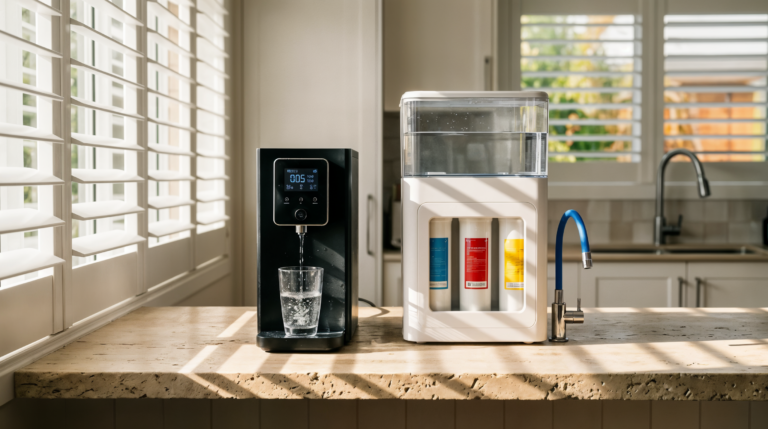
Yes (owner, willing to install) — PWS EcoHero 5-Stage RO is the recommended unit. NSF 58 certified, WaterMark AS3497 compliant, removes iron, aluminium, fluoride, chloramine, and PFAS.
Question 2: Do you want countertop RO without plumbing?
Yes — AquaTru Classic RO. No installation required, removes the full Perth contaminant profile including iron, aluminium, fluoride, and chloramine. 3:1 waste ratio — manageable at Perth TDS levels.
No (gravity-fed is acceptable) — Berkey Royal provides good chloramine and iron reduction but does NOT remove fluoride. Adequate for taste and general contaminant reduction, not comprehensive against mining-related aluminium or fluoride.
Question 3: Do you want whole-house protection?
Yes — PWS Twin Big White Town Water package uses a dual-stage Big Blue housing with catalytic carbon media sized for whole-house flow rates. Addresses chloramine and sediment for all taps and shower. For drinking water specifically, pair with an under-sink RO at the kitchen tap for fluoride and metal removal.
Option 1: AquaTru Classic RO (Countertop, No Installation)
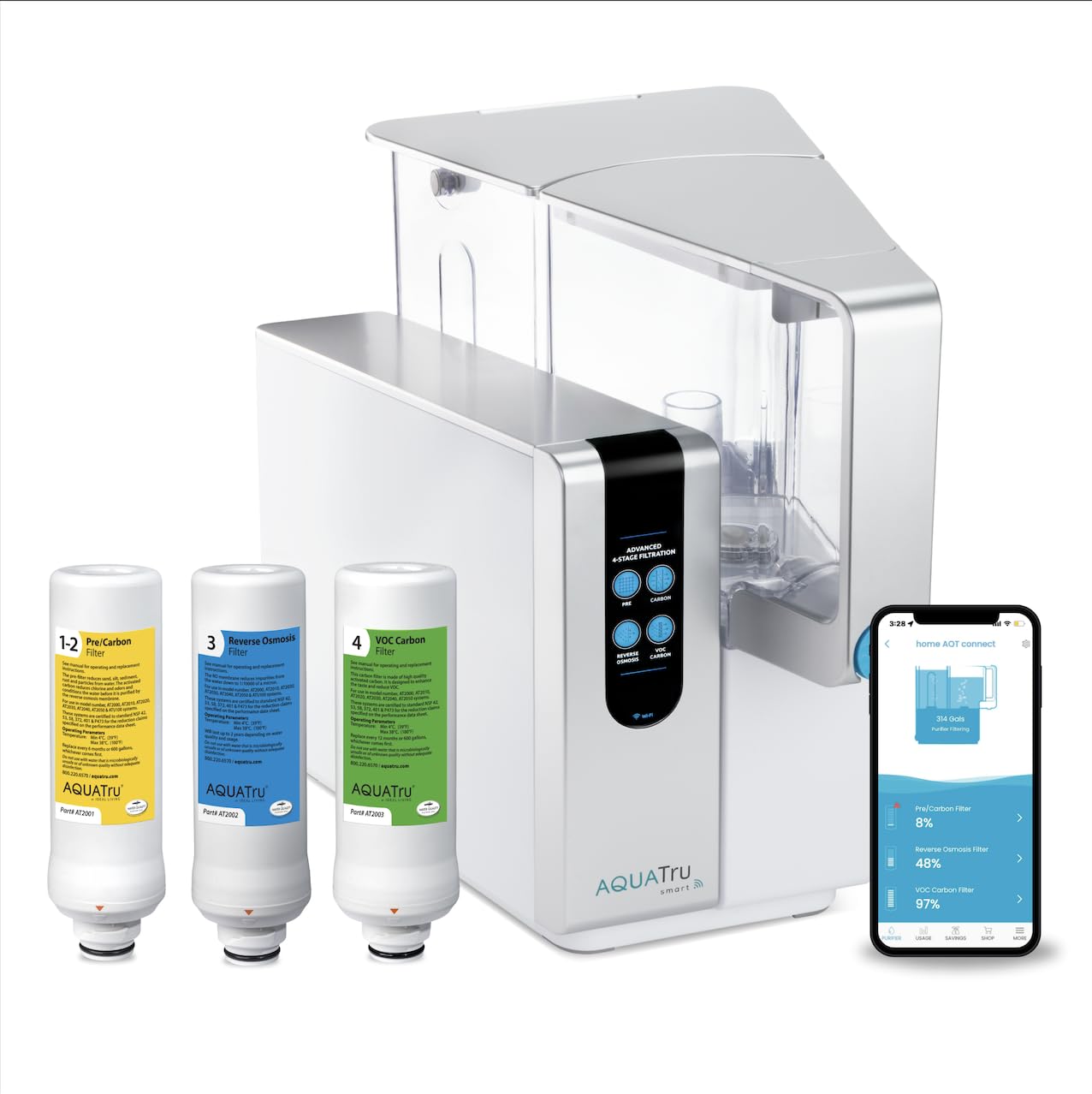
✓ Pros
- NSF/ANSI P473 certified — PFAS removal independently verified
- No plumbing required — suits renters and units
- Removes chloramine, iron, aluminium, fluoride in one unit
- Smart WiFi monitoring for filter life via app
✗ Cons
- 3:1 waste ratio — higher than under-sink RO units
- Countertop footprint is significant in small kitchens
- Reservoir must be manually refilled — not continuous flow
Option 2: PWS EcoHero 5-Stage Under-Sink RO (Permanent Installation)

✓ Pros
- WaterMark AS3497 certified — compliant with WA plumbing regulations
- NSF 58 certified membrane — independently tested rejection rates
- Continuous flow — no reservoir refilling required
- Australian company — local support and filter supply chain
✗ Cons
- Requires licensed plumber for installation — additional cost in WA
- Under-sink space required — not suitable for all kitchen configurations
What Perth Residents Should Do Now
The Alcoa catchment access situation is not resolved. There is no published timeline for regulatory intervention, no confirmed court proceedings that would force access, and no Water Corporation announcement of alternative monitoring infrastructure capable of replacing physical site inspection. The situation will likely remain contested for years.
That means the practical answer for Perth households — particularly those in the Serpentine supply corridor — is to stop relying on the assumption that mains water will remain at its current quality indefinitely. Perth’s water has been safe and well-managed for decades. But safe today, under current conditions, with current monitoring access, does not automatically mean safe tomorrow under changed conditions with a monitoring gap in place.
The specific actions that actually matter:
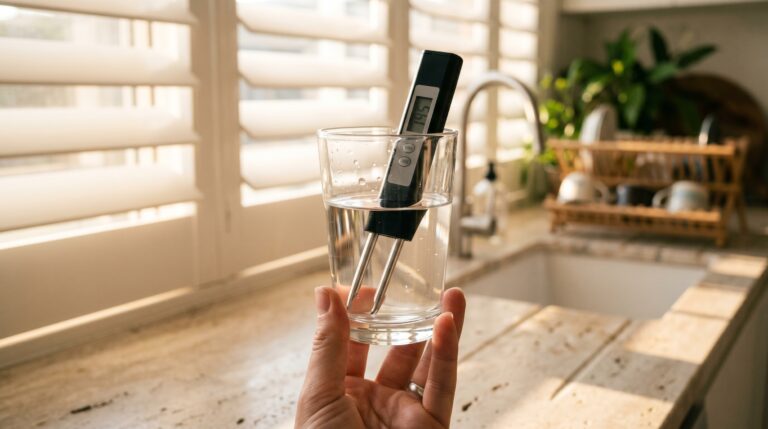
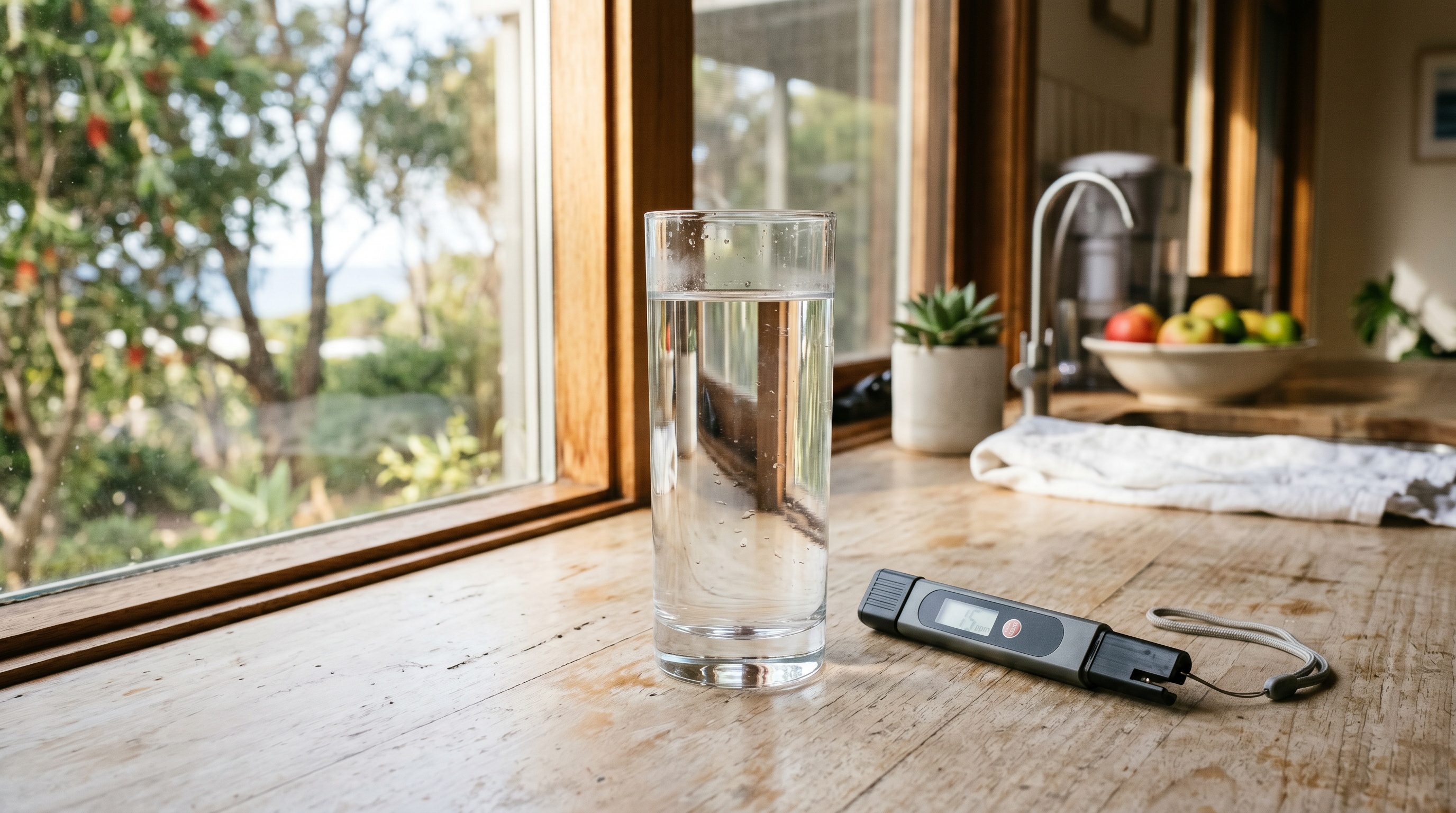
First, test your current water. A basic 17-in-1 test kit (VARIFY, available on Amazon AU) will give you a baseline TDS, iron, and pH reading within minutes. If iron is above 0.15 mg/L or TDS above 200 mg/L, you already have cause for a filtration upgrade independent of the mining risk.
VARIFY 17-in-1 Water Test Kit
Tests TDS, iron, pH, hardness, chlorine + 12 other parameters in under 5 minutes. Get your Perth water baseline before conditions change. 100 strips included.
Second, match your filter to your supply zone. If you are on Serpentine supply (Rockingham to Mandurah corridor), reverse osmosis is the appropriate technology for both current conditions (hard water, chloramine) and future contamination scenarios (iron, aluminium, pH-related metal mobilisation). Catalytic carbon alone is insufficient.
Third, do not buy a standard carbon jug filter and consider the problem solved. In Perth, it is not. Chloramine at 1/40th the removal rate of free chlorine, no iron removal, no fluoride removal, no aluminium removal. It is not appropriate for Perth’s water chemistry under any scenario.
Last reviewed: June 2026 — Clean and Native
Filter your water before the regulator does it for you
For Perth households in the Serpentine supply zone, reverse osmosis is the only technology that covers chloramine, iron, aluminium, fluoride, and PFAS in a single unit. The PWS EcoHero is WaterMark certified for WA plumbing compliance. The AquaTru requires no installation at all.
Frequently Asked Questions
Yes. Perth’s Water Corporation reports that treated tap water currently meets all Australian Drinking Water Guidelines (ADWG 2022) parameters. The Alcoa catchment access issue is a risk to future water quality, not a current compliance failure. Water Corporation monitors supply quality at multiple points through the distribution network and publishes annual water quality reports.
The Serpentine supply corridor covers southern Perth metropolitan and peri-urban areas including Rockingham, Baldivis, Golden Bay, Secret Harbour, Lakelands, Mandurah, and the broader Peel region. Water Corporation publishes a supply zone map on its website. If you are unsure whether your suburb is on Serpentine supply, contact Water Corporation directly with your property address.
Yes. Perth’s tap water is fluoridated at approximately 0.6-0.7 mg/L, within the ADWG target range of 0.6-1.1 mg/L. Only reverse osmosis (removing 90-97%) or activated alumina (80-95%) can reduce fluoride from drinking water. Carbon filters — including catalytic carbon — cannot remove fluoride.
Perth uses chloramine. This means standard carbon filters, including basic countertop jugs, remove chloramine at approximately 1/40th the rate they remove free chlorine — making them largely ineffective for Perth tap water. Effective chloramine removal requires catalytic carbon, compressed carbon block, or reverse osmosis.
The primary contamination risks from bauxite mining in the Darling Range are elevated iron (from iron oxide minerals in the laterite ore body), dissolved and particulate aluminium (from alumina ore and processing residues), and pH disruption (from alkaline or acid drainage associated with exposed sub-surface mineral profiles). All three interact negatively with Perth’s chloramine disinfection system and each has a defined ADWG guideline threshold.
No. Standard granular activated carbon (GAC) filters, including Brita and similar products, do not remove dissolved iron or aluminium. They also fail to adequately remove chloramine in Perth’s supply. For iron, aluminium, fluoride, and chloramine removal in a single unit, reverse osmosis is the required technology.
The access restriction arises from a legal conflict between WA’s Mining Act 1978 — which grants significant operational rights to mining tenement holders — and the Water Agencies (Powers) Act 1984, which gives Water Corporation catchment management authority. Alcoa holds granted mining leases over areas within catchment boundaries, and the legal hierarchy between mining tenure rights and catchment inspection authority has not been definitively resolved in WA legislation.
The Guardian has cited an estimate of approximately $3.25 billion for the treatment infrastructure upgrades required if the Serpentine Pipehead Dam catchment were significantly contaminated by mine drainage. This represents advanced membrane filtration, expanded chemical treatment capacity, and related infrastructure — costs that would flow to WA households through tariff increases or state government appropriations.
No. Water Corporation’s “Water Forever 50-Year Plan” identifies climate resilience — specifically declining surface catchment inflows due to reduced rainfall in the Darling Range — as the primary long-term supply vulnerability. The plan does not contain publicly available scenario modelling for a mine-related contamination event at Serpentine or any other Darling Range storage. The Alcoa-catchment overlap risk is not quantified in any accessible Water Corporation planning document as of June 2026.
Partially. The Berkey Royal uses a compressed carbon block element capable of removing chloramine and reducing iron to well below ADWG guidelines under normal conditions. However, it does not remove fluoride, and its aluminium rejection performance under elevated loading conditions is not independently certified to NSF/ANSI 58. For the full Perth contaminant profile — chloramine, iron, aluminium, fluoride, and PFAS — reverse osmosis is the more complete solution.
Get the Australian Home Environment Checklist
30 checks across water, air and EMF. Most of them free. Ranked by impact.
No spam. Unsubscribe any time.

Former Royal Australian Navy Clearance Diver and TAG-E counter-terrorism operator. Founded Clean and Native to apply the same rigorous thinking to the home environment.
Full biography →