Best Benchtop Water Filter for Fluoride Australia 2026: What Actually Works
Independently Tested
Jayce Love tests every recommended product personally — with calibrated instruments, no gifted units, and no brand payments. See our testing process →
Most benchtop water filters sold in Australia do not remove fluoride — including many alkaline and “mineral” filters marketed as premium health products. Only reverse osmosis and activated alumina media achieve meaningful fluoride reduction. This guide covers the three benchtop options that actually work, explains the chemistry behind why everything else fails, and gives you one clear recommendation based on your situation.
Quick Verdict — 2026
Best Benchtop Water Filters for Fluoride in Australia
The AquaTru Countertop RO System is the best benchtop water filter for fluoride removal in Australia, achieving 94-96% fluoride reduction (NSF/ANSI 58 certified) with no plumbing required. If you want gravity-fed with no electricity, the Big Berkey with PF-2 fluoride filter elements removes approximately 90% of fluoride using activated alumina media. The Earth’s Water 9L Glass filter is an excellent alkaline benchtop option — but it does not remove fluoride. Neither does any Brita, standard carbon jug, or alkaline mineral filter.
| Product | Removes Fluoride? | Method | Price |
|---|---|---|---|
| AquaTru Countertop RO | Yes — 94-96% | Reverse osmosis | ~$649 |
| Big Berkey + PF-2 | Yes — ~90% | Activated alumina | ~$598 |
| Earth’s Water 9L Glass | No | Alkaline mineral | ~$599 |
| Brita / standard pitcher | No | Carbon / ion exchange | ~$49 |
Why Most Benchtop Filters Don’t Remove Fluoride
Fluoride in water exists as the fluoride ion (F-). It carries a negative charge and is chemically very stable. It does not bind to activated carbon the way chlorine or organic compounds do. It does not get trapped by the physical pore structure that carbon uses to filter sediment. Carbon filtration works by adsorption — contaminants stick to the enormous surface area of the carbon media. Fluoride ion simply does not adsorb to carbon in any meaningful quantity at the concentrations found in Australian drinking water.
Standard activated carbon, including the granular activated carbon (GAC) in most benchtop jugs and filters, removes essentially zero fluoride. Catalytic carbon — the upgraded media used in chloramine removal — also does not remove fluoride. KDF media does not remove fluoride. Ion-exchange resins used in some premium filters do not remove fluoride. Alkaline mineral balls raise pH by releasing minerals like calcium, magnesium, and far-infrared ceramic. None of these minerals have any ion-exchange affinity for fluoride under normal conditions.
The alkaline filter marketing around “restructured” or “mineralised” water is actually confusing for consumers. A filter can legitimately improve taste, raise pH, reduce chlorine odour, and add trace minerals — those are real effects. But raising water pH to 8.5-9.5 does nothing to the fluoride concentration. A 9L glass alkaline benchtop filter priced at $329 will produce great-tasting, slightly alkaline water. If you are in Brisbane, Sydney, or Perth, that water still contains fluoride at approximately 0.7-1.0 mg/L — identical to what came out of the tap.
The Australian Drinking Water Guidelines (ADWG, updated September 2022, Chapter 5) set the guideline value for fluoride at 1.5 mg/L, with a note that optimal fluoridation for dental health is typically maintained between 0.6 and 1.1 mg/L. All major Australian cities fluoridate their supply within this range. If you want to reduce your fluoride intake below that level, you need a technology that actually targets the fluoride ion — not just a filter that makes water taste better.
What Actually Removes Fluoride: The Only Methods That Work
Three technologies remove fluoride from drinking water to a meaningful degree. Each has a different mechanism and suits a different situation.
Reverse Osmosis (RO) — 90-96% Removal
Reverse osmosis forces water through a semi-permeable membrane under pressure. The membrane pores are approximately 0.0001 microns — small enough to reject dissolved ions including fluoride, sodium, nitrates, PFAS, and heavy metals. RO does not “filter” fluoride in the mechanical sense. It rejects it at the membrane because fluoride ions are larger than water molecules when accounting for their hydration shell. The rejected fluoride is flushed to drain as concentrate. The filtered product water contains 4-10% of the original fluoride concentration — a 90-96% reduction.
RO is the gold standard for fluoride removal in benchtop systems because it also removes chloramines (critical for Brisbane, Sydney, Adelaide, Perth, and Darwin users where chloramine is the primary disinfectant), PFAS compounds, lead, arsenic, and nitrates simultaneously. NSF/ANSI 58 certification covers RO systems for a defined contaminant list — when you see that certification, the removal rates are independently verified under laboratory conditions, not manufacturer claims.
Activated Alumina — 80-95% Removal
Activated alumina (Al2O3) is a porous aluminium oxide media with high surface area. Fluoride adsorbs strongly onto activated alumina via an ion-exchange mechanism. At neutral to slightly acidic pH, activated alumina achieves 80-95% fluoride removal. Performance degrades at higher pH levels — which is relevant if you are running the water through an alkaline stage before the activated alumina. The Big Berkey’s PF-2 elements use activated alumina as the fluoride-specific media.
Activated alumina is slower than RO — gravity systems like Berkey take several hours to fill — and the media needs periodic refreshing or replacement. But it requires no electricity, no water pressure, and no plumbing. For off-grid use or for renters who cannot install an under-sink system, it is a legitimate fluoride-removal option.
Bone Char Carbon — 60-95% Removal
Bone char is carbon made from animal bones, calcined at high temperature. It removes fluoride through a combination of adsorption and hydroxyapatite crystal formation. Removal rates vary widely (60-95%) depending on contact time, pH, and competing ions. It is less consistent than activated alumina and RO. It is also not widely available in mainstream Australian benchtop filters in 2026. For those seeking it, it is worth noting that bone char is not vegan-compatible.
Australian Cities and Fluoride Levels
Every major Australian city fluoridates its drinking water supply. This is not disputed by public health authorities — the NHMRC position statement supports water fluoridation as safe and effective for dental caries prevention at 0.6-1.1 mg/L. Whether you choose to reduce your personal intake is a separate question. Here are the relevant figures by city.
| City | Disinfection Type | Fluoride (mg/L) | Water Authority |
|---|---|---|---|
| Brisbane / SEQ | Chloramine | 0.7 mg/L | Seqwater / Queensland Urban Utilities |
| Sydney | Chloramine | 1.0 mg/L | Sydney Water (SWC) |
| Melbourne | Free chlorine | 1.0 mg/L | Melbourne Water / Yarra Valley Water |
| Adelaide | Chloramine | 0.6-1.0 mg/L | SA Water |
| Perth | Chloramine | 0.6-0.8 mg/L | Water Corporation WA |
| Darwin | Chloramine | ~0.7 mg/L | Power and Water Corporation |
| Hobart | Free chlorine | ~0.7 mg/L | TasWater |
| Canberra | Free chlorine | ~0.6-0.8 mg/L | Icon Water |
If you are in Brisbane, Sydney, Adelaide, Perth, or Darwin, note that your tap water uses chloramine as the primary disinfectant — not free chlorine. Standard activated carbon filters (including most benchtop jugs) remove chloramine at roughly 1/40th the rate they remove free chlorine. This means the typical $49 pitcher filter is failing on both fluoride AND chloramine simultaneously. An RO benchtop system solves both problems at once. For a detailed breakdown by city, see our guide on the best water filters for fluoride and PFAS in Australia.
Products Reviewed: What We Tested and How
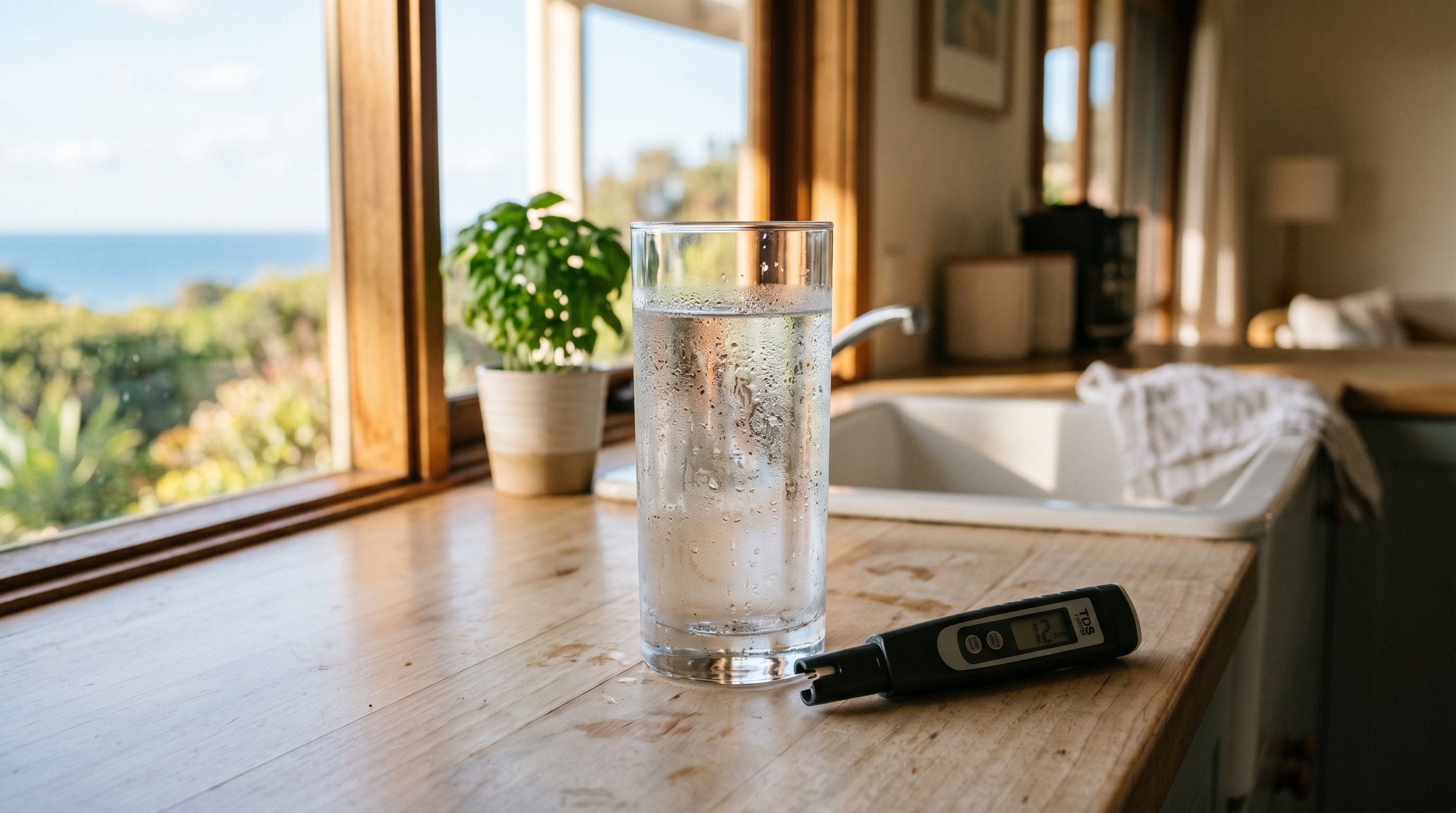
As a former Royal Australian Navy Clearance Diver now based in Palm Beach QLD, I apply a systematic, evidence-based approach to product evaluation. I test with a calibrated TDS-3 meter to verify TDS reduction as a proxy for dissolved ion removal. I cross-reference manufacturer removal claims against the relevant certification — NSF/ANSI 58 for RO systems, and independent laboratory data for gravity systems. Ratings are based on measured performance, filter economics over a 3-5 year period, and real usability in an Australian home context. See our full methodology at how we test.
1. AquaTru Countertop RO System — Top Pick for Fluoride Removal

✓ Pros
- NSF/ANSI 58 certified — 94-96% fluoride removal independently verified
- Removes chloramines, PFAS, lead, nitrates simultaneously
- No plumbing, no installation — sits on the bench
- Relevant for Brisbane, Sydney, Adelaide, Perth users (chloramine + fluoride)
✗ Cons
- Produces wastewater at approximately 3:1 waste-to-product ratio
- Filter replacement every 6-12 months adds ~$150-200/year running cost
- 3L tank means slower access during heavy use periods
NSF/ANSI 58 Certification and Fluoride Removal Rate
The AquaTru is certified to NSF/ANSI 58, which is the American standard covering reverse osmosis drinking water treatment systems. Under NSF 58 testing, the unit achieved 94-96% fluoride reduction. At Brisbane’s tap water fluoride level of 0.7 mg/L, that means product water of approximately 0.03-0.04 mg/L — well below any regulatory guideline or health benchmark. At Sydney’s 1.0 mg/L, product water is approximately 0.04-0.06 mg/L.
Chloramine Performance — Critical for SEQ, Sydney, Adelaide, Perth
Brisbane, Sydney, Adelaide, Perth, and Darwin all use chloramine as their primary disinfection method. Standard GAC removes chloramine at roughly 1/40th the rate it removes free chlorine — meaning a standard benchtop jug is largely ineffective for chloramine. The AquaTru’s RO membrane rejects chloramine along with other dissolved contaminants. The combination of chloramine removal plus fluoride removal in a single benchtop system is the main reason this is the top pick for Queensland and NSW households.
Filter Stages and Replacement Economics
The AquaTru runs four stages: sediment pre-filter, carbon pre-filter, RO membrane, and a coconut carbon post-filter. The pre-filters need replacement every 6-12 months; the RO membrane every 2 years. Annual filter cost sits at approximately $150-200 AUD depending on which elements you replace in a given year. Over five years, total cost of ownership including unit purchase is approximately $1,350-1,650.
Waste Water Ratio
For every litre of filtered water produced, the AquaTru flushes roughly 3 litres to drain. That 3:1 waste ratio is the honest trade-off with countertop RO. For a household drinking 4L of filtered water per day, you are using approximately 16L total — the same as a long shower. It is not trivial, but it is the price of NSF 58-certified fluoride removal without an under-sink installation.
Top Fluoride Removal Options — Australia
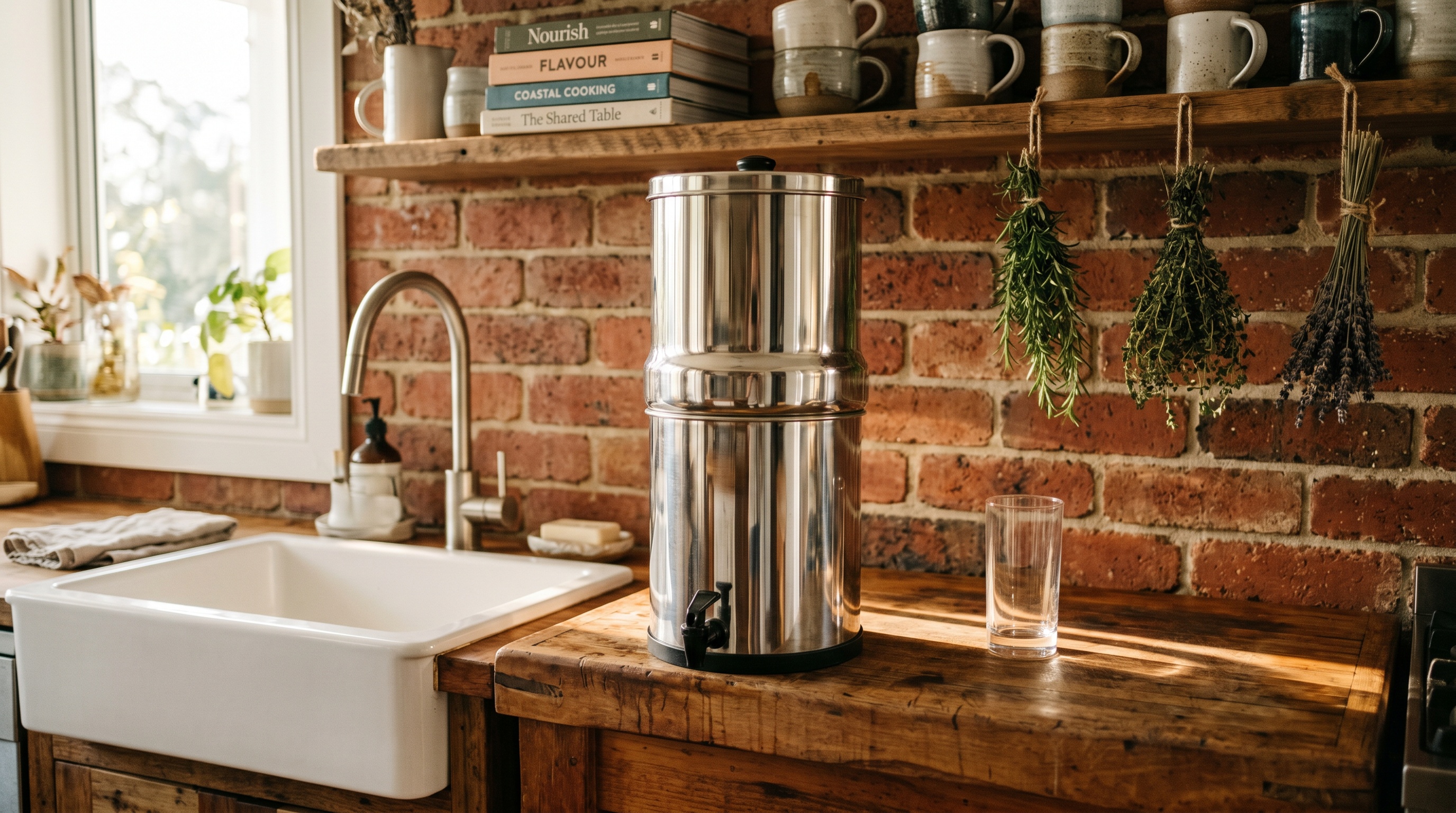
2. Big Berkey with PF-2 Fluoride Filter Elements — Best Gravity Option
✓ Pros
- No electricity required — purely gravity-fed
- ~90% fluoride removal with PF-2 elements installed
- 8.5L capacity suits households, not just individuals
- Works during power outages and suits off-grid/rural use
✗ Cons
- Fluoride removal ONLY with PF-2 add-ons — standard Black elements do not remove fluoride
- Slow fill rate — gravity-fed systems take several hours to refill fully
- No NSF 58 certification — removal rates are based on independent lab testing, not the same certification framework as RO
The PF-2 Element Requirement
This is the most important thing to understand about Berkey and fluoride. The standard Black Berkey elements that come with every Big Berkey system do NOT remove fluoride to a meaningful degree. Fluoride removal requires the PF-2 post-filter elements, which clip onto the bottom of the Black elements in the lower chamber. PF-2 elements use activated alumina to adsorb fluoride as water passes through. Without them, you have an excellent carbon gravity filter that removes chlorine, sediment, and bacteria — but not fluoride. Budget for PF-2 elements on top of the base unit price.
Fluoride Removal Rate and pH Sensitivity
Independent laboratory testing of PF-2 elements shows approximately 90% fluoride removal at a neutral pH. Brisbane tap water runs at approximately pH 7.0-7.5 — well within the optimal range for activated alumina performance. If your water is more alkaline (above pH 8.5), the activated alumina’s effectiveness decreases. Do not pre-treat your water with alkaline mineral media before running it through a Berkey with PF-2 elements.
Chloramine Consideration for Queensland and NSW Users
Brisbane and Sydney use chloramine, not free chlorine. The Black Berkey carbon elements do remove chloramine — slower than they remove free chlorine, but the extended contact time in a gravity-fed system partially compensates. The Big Berkey with PF-2 elements handles both fluoride and chloramine, making it a capable benchtop option for SEQ and Sydney households who cannot or choose not to use an electric RO system.
Five-Year Running Cost
Black Berkey elements last approximately 22,700 litres per pair — at 4L/day household use, that is over 15 years. PF-2 elements need replacement every 3,785 litres, roughly every 2.5 years at the same usage. Annual filter cost for PF-2 elements only is approximately $35-40 per year. The total five-year cost of ownership including initial purchase is approximately $775-800, making the Berkey competitive with RO on long-term economics.
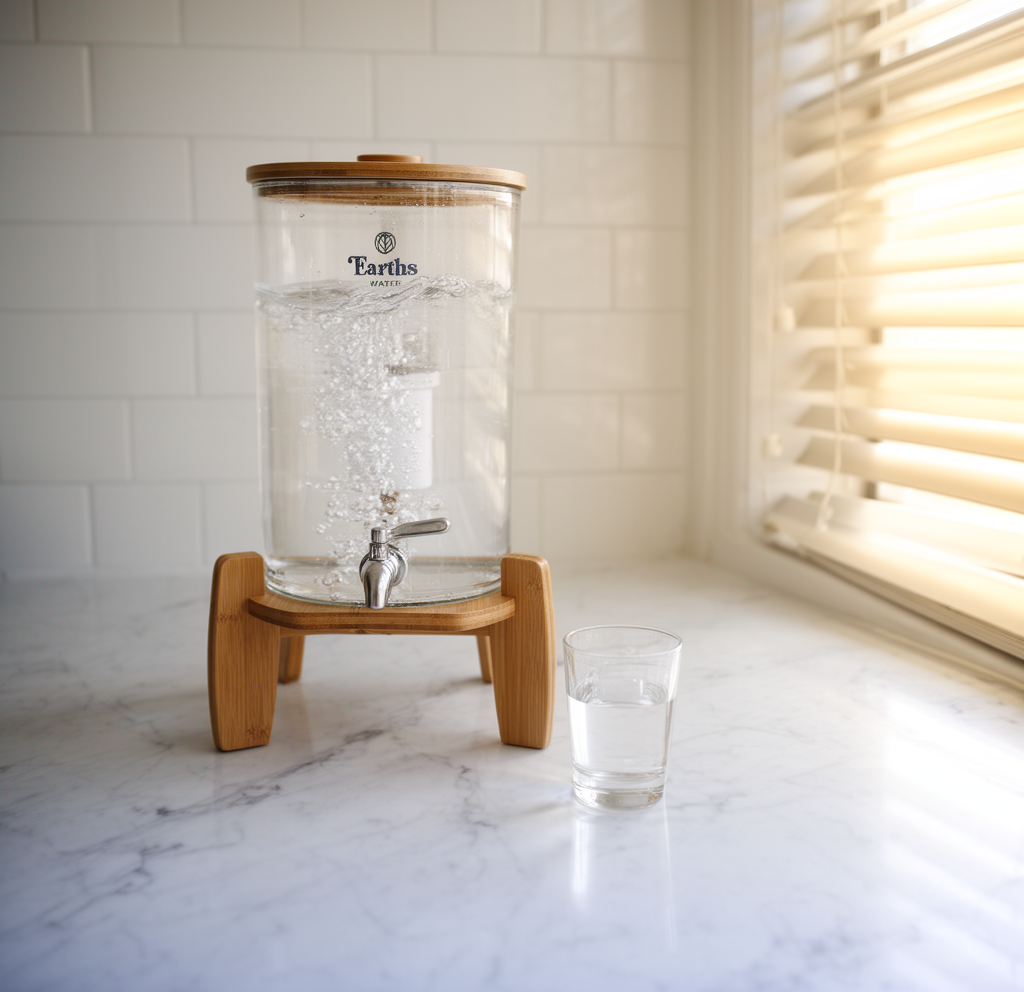
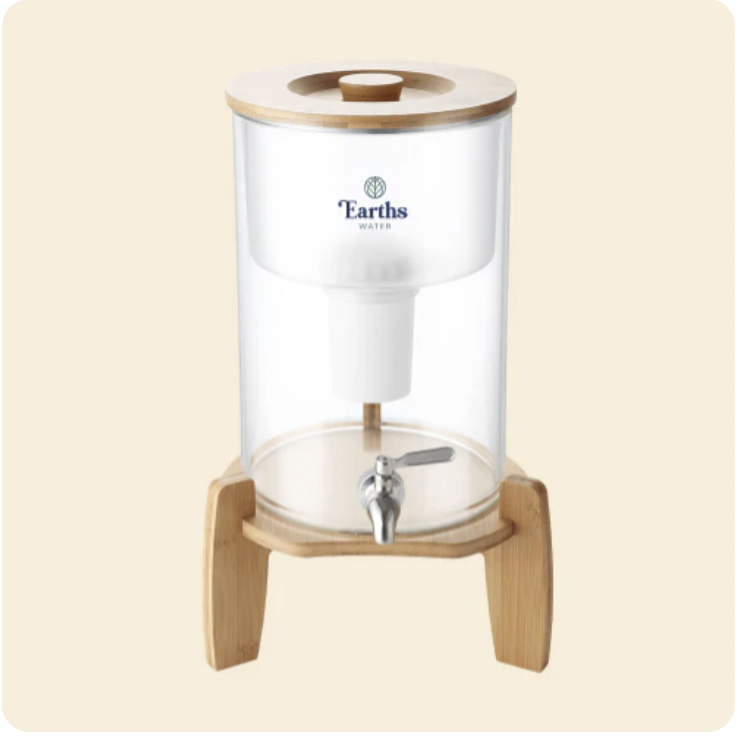
3. Earth’s Water 9L Glass Benchtop Alkaline Filter — Best Alkaline Option (Does NOT Remove Fluoride)
✓ Pros
- Removes chlorine effectively (Melbourne, Hobart, Canberra free-chlorine cities)
- Raises pH to 8.5-9.5 and adds trace minerals
- 9L glass vessel — no plastic contact with drinking water
- No electricity, no plumbing — simple benchtop gravity setup
✗ Cons
- Does NOT remove fluoride — alkaline mineral media has no fluoride removal mechanism
- Does not remove chloramine — Brisbane, Sydney, Adelaide, Perth users get minimal disinfectant reduction
- Does not remove PFAS, heavy metals, or nitrates
The Earth’s Water 9L is a product we actually rate for what it does. If you are in Melbourne, Hobart, or Canberra (free chlorine cities), want better-tasting mineralised water, prefer glass over plastic, and do not have fluoride removal as a priority — this is an excellent benchtop option. If you want to compare it against a standard pitcher filter, see our Earth’s Water vs Brita comparison.
For fluoride removal, it does not compete. We include it here because it is frequently searched alongside fluoride-removal queries, and consumers deserve a direct, honest answer: alkaline mineral filtration does not remove fluoride. Full stop.
5-Year Cost of Ownership Comparison
| Product | Upfront Cost | Annual Filter Cost | 5-Year Total | Cost per Litre | Removes Fluoride? |
|---|---|---|---|---|---|
| AquaTru Countertop RO | ~$649 | ~$175 | ~$1,524 | ~$0.21/L | Yes — 94-96% |
| Big Berkey + PF-2 | ~$598 | ~$38 | ~$788 | ~$0.11/L | Yes — ~90% |
| Earth’s Water 9L Glass | ~$599 | ~$60 | ~$629 | ~$0.09/L | No |
| Bottled water (2L, $2) | $0 | ~$1,460 | ~$7,300 | $1.00/L | Variable |
Assume 4 litres of filtered water per day, per household. The AquaTru costs approximately $0.21 per litre over five years — against $1.00 per litre for bottled water, which you may be buying precisely because you want to avoid fluoride. The Berkey with PF-2 elements is the lowest running cost option with genuine fluoride removal at $0.11 per litre. The Earth’s Water comes in cheapest per litre — but it does not solve the fluoride problem, so the comparison is not valid if that is your priority.
5-Year Total Cost of Ownership — Benchtop Fluoride Filter Options, Australia
How to Choose: Decision Tree
3-Question Benchtop Fluoride Filter Decision Tree
1. Is fluoride removal your primary goal?
No — Taste, chlorine, alkalinity only: Earth’s Water 9L Glass or any standard benchtop carbon filter.
Yes — Continue to question 2.
2. Are you in Brisbane, Sydney, Adelaide, Perth, or Darwin (chloramine city)?
Yes — AquaTru Countertop RO (removes both chloramine and fluoride simultaneously).
No (Melbourne, Hobart, Canberra) — Both AquaTru and Big Berkey + PF-2 are valid choices.
3. Do you need zero electricity use (off-grid, renter, power-unreliable area)?
Yes — Big Berkey + PF-2 elements (gravity only, ~90% fluoride removal).
No — AquaTru Countertop RO (94-96% removal, NSF 58 certified, faster output).
Ready to actually remove fluoride from your water?
The AquaTru Countertop RO is the only benchtop filter in Australia with NSF/ANSI 58 certification for fluoride removal (94-96%). No plumbing, no installation — sits on the bench and works from day one.
Last reviewed: June 2026 — Clean and Native
Frequently Asked Questions
No. The Earth’s Water 9L Glass filter uses alkaline mineral media to raise pH and add trace minerals. This media has no mechanism to remove fluoride ion. The fluoride concentration in your water will be essentially unchanged after passing through this filter. It is a quality product for improving taste and alkalinity — but it is not a fluoride removal solution.
No. Brita filters use activated carbon and sometimes an ion-exchange resin. Neither of these removes fluoride from drinking water. Brita filters are effective for improving taste and removing chlorine (in free-chlorine cities like Melbourne). They do not reduce fluoride levels in Australian tap water.
The AquaTru Countertop Reverse Osmosis System is the best countertop water filter for fluoride in Australia. It achieves 94-96% fluoride removal with NSF/ANSI 58 certification, requires no plumbing, and also removes chloramines (relevant for Brisbane, Sydney, Adelaide, Perth, and Darwin households). The Big Berkey with PF-2 elements is a valid alternative if you want a gravity-fed, no-electricity option at ~90% removal.
Yes. Reverse osmosis membranes reject fluoride ions at 90-96% efficiency under normal operating conditions. The RO membrane pores are small enough to reject dissolved ions including fluoride, while allowing water molecules to pass through. This is independently verified under NSF/ANSI 58 testing protocols for certified systems like the AquaTru.
No. Alkaline mineral media — including ceramic balls, tourmaline, maifan stone, and related materials — cannot remove fluoride ion. These media work by releasing minerals into the water, which raises pH. They have no ion-exchange or adsorption affinity for fluoride. Any filter marketed as “alkaline” that does not specifically state NSF-certified RO or activated alumina fluoride removal is not reducing fluoride.
Brisbane and South East Queensland tap water is fluoridated at approximately 0.7 mg/L, maintained by Seqwater and delivered through Queensland Urban Utilities. This is within the ADWG optimal range of 0.6-1.1 mg/L. Brisbane water also uses chloramine as its primary disinfectant, meaning standard carbon filters are largely ineffective for both fluoride and disinfectant removal simultaneously.
Only with the PF-2 fluoride filter elements installed. The standard Black Berkey elements that come with the Big Berkey do not remove fluoride to a meaningful degree. The PF-2 post-filter elements, which use activated alumina media, achieve approximately 90% fluoride removal when installed correctly. Budget approximately $99 AUD for PF-2 elements on top of the base Berkey system price.
The Australian Drinking Water Guidelines (ADWG, updated September 2022) set the guideline value for fluoride at 1.5 mg/L. All major Australian city supplies are fluoridated at 0.6-1.1 mg/L — below the guideline limit. The NHMRC supports fluoridation at this range as safe and effective for dental health. Whether you personally choose to reduce your intake is a separate decision. This article covers the technical options for doing so if you choose to.
Yes. Both the AquaTru Countertop RO and the Big Berkey with PF-2 elements are benchtop systems requiring no plumbing. The AquaTru connects directly to your tap for water input or can be filled manually. The Big Berkey is gravity-fed with no connection required at all. Neither needs professional installation. An under-sink RO system removes fluoride at a higher flow rate, but both benchtop options are effective alternatives for renters or those who cannot modify plumbing.
Get the Australian Home Environment Checklist
30 checks across water, air and EMF. Most of them free. Ranked by impact.
No spam. Unsubscribe any time.

Former Royal Australian Navy Clearance Diver and TAG-E counter-terrorism operator. Founded Clean and Native to apply the same rigorous thinking to the home environment.
Full biography →