Best Water Softener Perth 2026: Hard Water Solutions for WA Homes
Independently Tested
Jayce Love tests every recommended product personally — with calibrated instruments, no gifted units, and no brand payments. See our testing process →
Perth tap water sits at roughly 180 mg/L calcium carbonate — the hardest of any Australian capital city — and without treatment, that hardness destroys hot water systems, clogs showerheads, and leaves white scale on every fixture in your home within months.
Quick Verdict — Best Water Softener Perth 2026
The PWS Water Softener ($3,295) is the definitive solution for Perth hard water: WaterMark-certified ion exchange that strips calcium and magnesium down to near-zero hardness, protecting your hot water system, extending appliance life, and ending the scale problem permanently. For renters or those who cannot install a plumbed system, an electronic descaler (~$200) reduces scale formation without salt or plumbing.
| Option | Technology | Verdict |
|---|---|---|
| PWS Water Softener | Salt-based ion exchange | Best overall — whole-home protection |
| Electronic Descaler | Electromagnetic field | Best for renters — no install required |
| Salt-free conditioner | Template-assisted crystallisation | Reduces scale — does not remove hardness |
What Makes Perth Water So Hard
Perth’s hardness problem starts underground. The Gnangara groundwater system — a sprawling mound aquifer beneath the northern Swan Coastal Plain — has been the backbone of Perth’s water supply for decades. Groundwater picks up calcium and magnesium as it percolates through limestone and dolomite, arriving at your tap with a hardness reading of 150–200 mg/L CaCO₃ depending on the blend in your suburb.
The Water Corporation now supplements Gnangara with desalinated seawater from the Kwinana and Binningup plants, which together supply roughly 50% of Perth’s total water in drought years. Desalinated water is almost mineral-free — typically under 20 mg/L TDS — so blending it with groundwater should in theory reduce average hardness. In practice, the blend ratio varies by season, location, and reservoir. Homes in Rockingham and Mandurah drawing more heavily from the Binningup-fed network may see somewhat lower hardness than homes in the northern suburbs relying on Gnangara-dominant blends. The average across Perth metro still sits at approximately 170 mg/L TDS, with WaterCorp classifying supply as “moderately hard to hard” by the Australian Drinking Water Guidelines scale.
Perth also uses chloramine as its primary disinfectant — a combination of chlorine and ammonia that is more stable than free chlorine and persists further through the distribution network. This matters if you are also considering a drinking water filter for Perth: standard carbon block filters and GAC cartridges remove free chlorine effectively but strip chloramine at roughly 1/40th the rate. You need catalytic carbon or reverse osmosis for chloramine. A water softener alone does not address chloramine — the two problems require separate solutions.
The Real Cost of Hard Water in Perth Homes
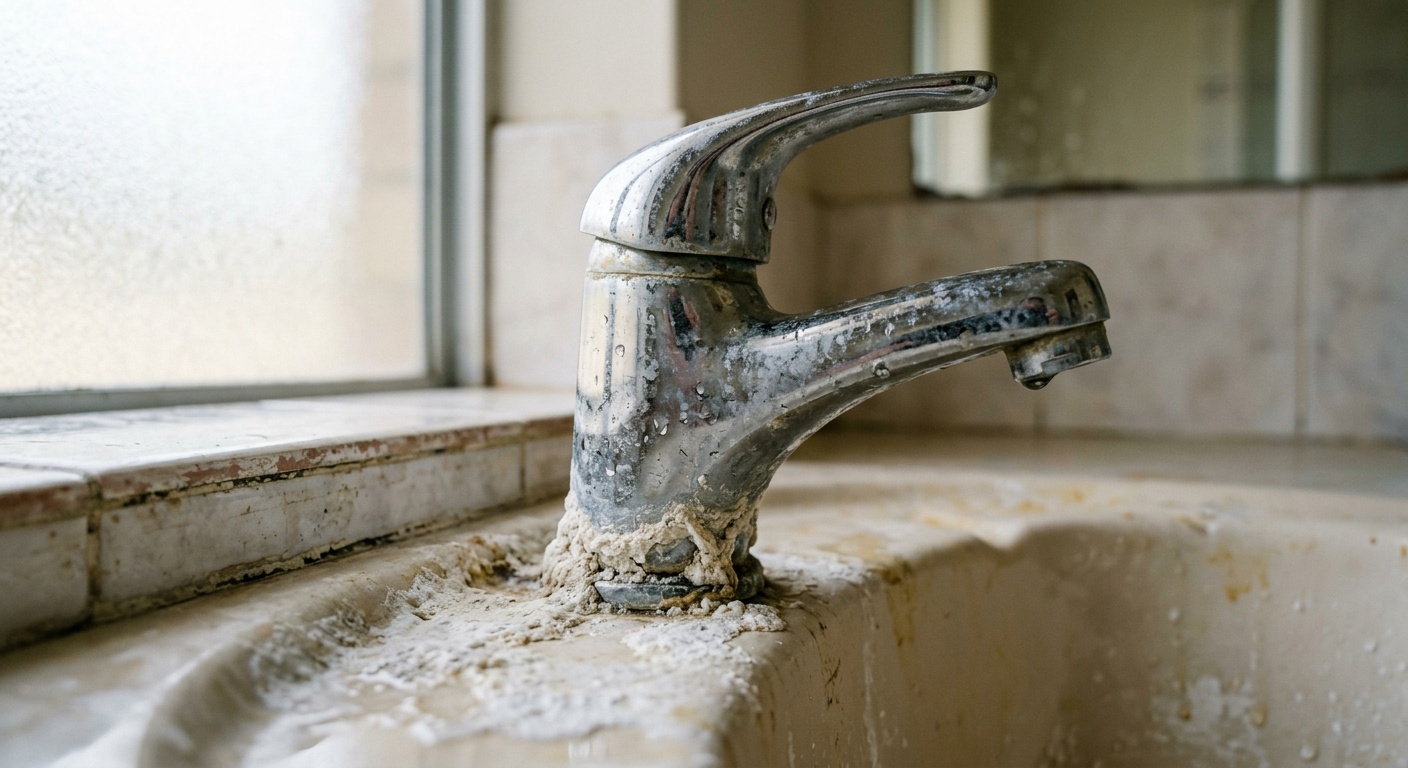
Scale is calcium carbonate precipitating out of solution when water is heated or left to evaporate. At 180 mg/L, Perth water deposits scale aggressively. You see it first on showerheads and tap aerators — a white, crusty build-up that starts within weeks and blocks flow within six to twelve months. You feel it on your skin after showering: the residue that makes soap harder to lather and leaves hair feeling flat.
The damage you do not see is worse. Storage hot water systems operating in Perth typically accumulate enough scale inside the tank and element to reduce heating efficiency by 15–25% within the first three years, according to data from appliance service records across WA. Elements scale over entirely within five to seven years if the water is not treated. A replacement 250L electric hot water system costs $1,200–$1,800 installed. A continuous gas system costs $1,800–$3,500 installed. The WA-specific data on appliance failure rates are not published centrally, but the pattern is consistent: Perth plumbers report scale-related water heater failures far more frequently than their counterparts in Melbourne or Hobart, where hardness sits below 30 mg/L.
Skin and hair are a legitimate concern too. The research on hard water and eczema is not definitive, but a 2016 study in the Journal of Investigative Dermatology found that calcium and magnesium ions in hard water increase skin sensitivity and can worsen atopic dermatitis. If you or your children have eczema, the link between hard water and eczema is worth reading before you decide. Softened water reduces that ionic load directly.
The economic case for softening is simple in Perth. Without treatment: showerhead replacement or descaling every six to twelve months (~$80–$200/year), reduced appliance efficiency adding $100–$200/year to energy bills, and a hot water system replacement every seven to ten years instead of twelve to fifteen. That is $400–$600/year in ongoing costs, compounding. The PWS Water Softener at $3,295 installed pays for itself within five to eight years on appliance savings alone — before you count the time and irritation saved on cleaning.
Salt-Based vs Salt-Free vs Electronic: Which Works for Perth’s 180 mg/L Hardness
Perth’s hardness level is high enough that not all “softener” technologies deliver the same result. The distinction matters. Here is what each technology actually does at 180 mg/L.
Salt-Based Ion Exchange (true softening)
Ion exchange is the only technology that chemically removes calcium and magnesium from the water supply. Hard water passes through a resin bed carrying sodium ions. Calcium and magnesium ions — which cause scale — bond to the resin and displace sodium into the water. The result is actually soft water: typically 0–50 mg/L hardness after treatment, regardless of incoming hardness. The resin regenerates periodically using a salt brine solution, which flushes the captured minerals to drain.
At 180 mg/L incoming hardness, ion exchange is the only approach that reliably solves the problem across the whole house — including the hot water system, washing machine, dishwasher, and showerheads. The PWS Water Softener uses this technology. It is WaterMark certified to AS/NZS 4020, which means it has been independently tested for contact with drinking water in Australia. That certification matters — not every system sold in Australia meets this standard.
The trade-off: installation requires a licensed plumber, a bypass valve for outdoor irrigation (softened water is not ideal for gardens due to sodium content), and ongoing salt purchase (approximately $15–$25 per 20 kg bag, with a typical Perth home using one to two bags per month depending on water use and system settings). Some Perth households choose to keep a separate unsoftened line to the garden and one drinking water tap, then add a reverse osmosis filter at the kitchen sink to reduce sodium and address chloramine.
Salt-Free Conditioners (template-assisted crystallisation)
Salt-free systems — often marketed as “water conditioners” — do not remove calcium or magnesium. Instead, they alter the crystal structure of calcium carbonate so it stays in suspension rather than adhering to surfaces. Hardness minerals remain in the water; they just precipitate differently.
These systems work reasonably well at reducing new scale formation in pipes and appliances, and they require no salt, no electricity, and minimal maintenance. At Perth’s 180 mg/L hardness level, however, the conditioning effect is partial. You will still see some residue on glass and tiles. You will not get the skin and hair benefits of true soft water. For a mildly hard supply (say, Brisbane at 80–120 mg/L), conditioning can be sufficient. For Perth, it is a compromise — better than nothing, but not a complete solution.
Electronic Descalers
Electronic descalers wrap coils around the incoming pipe and emit a pulsed electromagnetic field that affects calcium carbonate crystal formation. The mechanism is similar in concept to TAC conditioning: minerals stay in solution rather than depositing as scale.
The evidence base is thinner than for ion exchange. Independent testing results are mixed — some studies show meaningful reductions in scale deposition, others show marginal or negligible effects. The technology is not water chemistry in the conventional sense: nothing is added or removed from the water.
Where electronic descalers make sense for Perth households is a specific, practical scenario: you rent, you cannot install a plumbed system, and you want to reduce the scale damage to a hot water system or appliances during your tenancy. At ~$200 on Amazon AU, the risk is low. The install is a DIY coil-wrap around the cold water inlet pipe — no plumber required. Manage expectations: this is not softening. It will not change how the water feels on your skin. It may reduce scale accumulation in pipes. For renters in Perth’s hard water suburbs, it is a pragmatic stopgap.
Perth Hard Water Solutions — Quick Links
Our Recommendation: PWS Water Softener for Perth Homes

✓ Pros
- WaterMark certified to AS/NZS 4020 — tested for Australian drinking water contact
- True ion exchange: removes calcium and magnesium to near-zero hardness
- Whole-home protection including hot water system and appliances
- Australian brand with local support — not a grey-market import
- 10% off with code JAYCELOVE at checkout
✗ Cons
- Requires licensed plumber to install — not DIY
- Ongoing salt cost: approximately $25–$50/month for a Perth household
- Not suitable for garden irrigation — requires a bypass line
- Does not remove chloramine or fluoride — add an RO or catalytic carbon filter for drinking water
What Ion Exchange Actually Does at 180 mg/L
At Perth’s incoming hardness, a properly sized ion exchange system brings the treated water down to 0–50 mg/L CaCO₃ — soft by any classification. That is the hardness level where scale stops forming on heating elements, where soap lathers properly, where skin and hair feel different after one shower. The change is immediate and physical, not incremental.
The PWS system regenerates automatically on a scheduled cycle, typically overnight, using a measured brine solution that flushes captured minerals to the drain. Regeneration uses approximately 50–80 litres of water per cycle — a consideration for Perth under its summer watering restrictions, though the overall water savings from not needing to run longer showers or re-wash scale-filmed laundry often offset this.
Installation in Perth: What to Expect
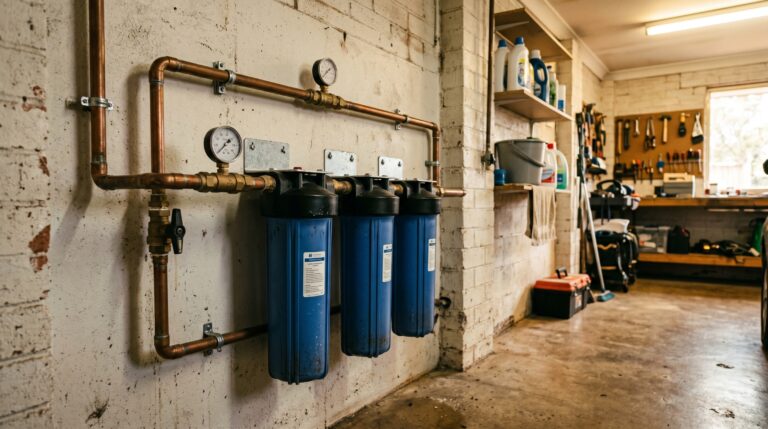
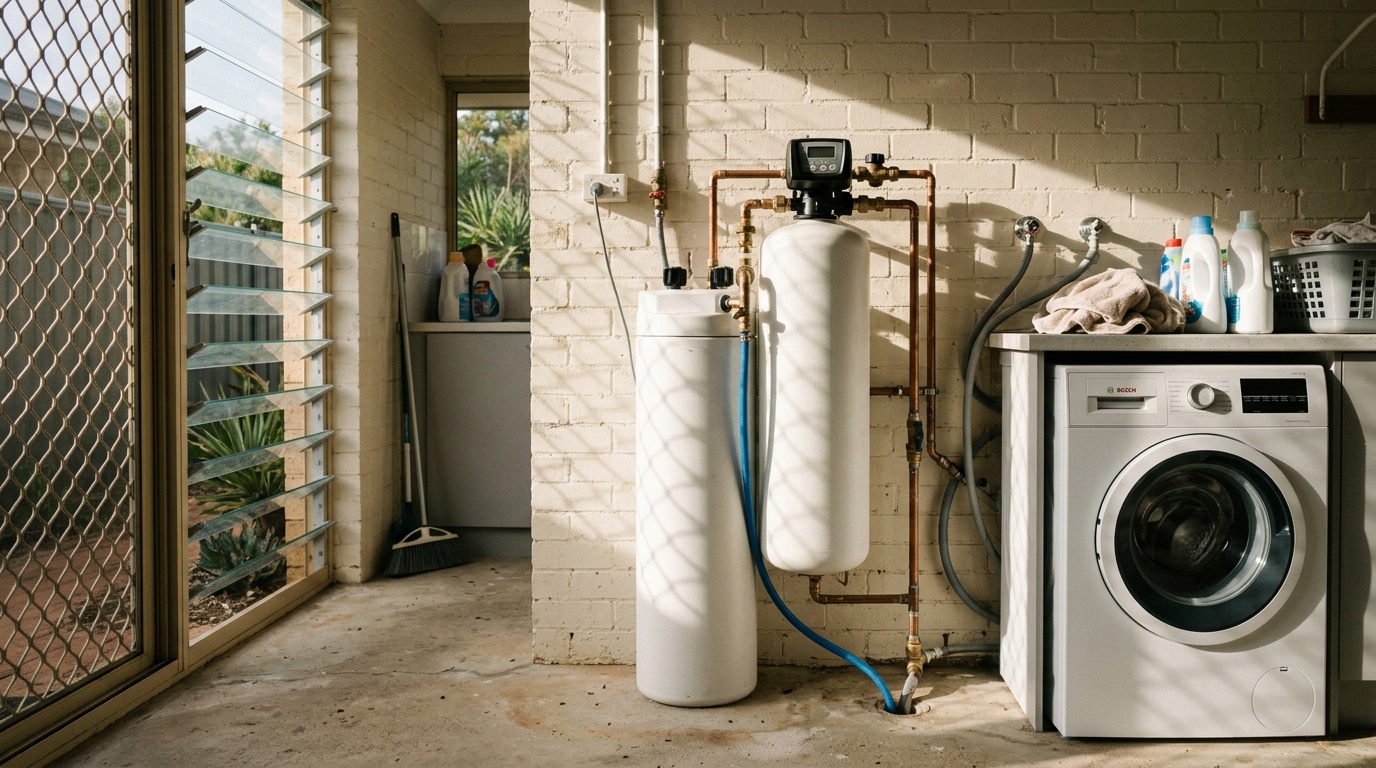
A salt-based softener installs on the main cold water supply line entering your home, before the hot water system. In a standard Perth metro house, installation involves a bypass valve assembly, a drain connection for regeneration discharge, and connection to a power point for the control head. Installation typically takes two to four hours for a licensed plumber.
Perth plumbers experienced with water treatment systems include operators across the northern and southern suburbs — Pure Water Systems can advise on recommended local installers when you purchase. Budget $400–$700 for Perth metro installation labour on top of the unit price, depending on your existing plumbing configuration. Homes with older galvanised steel pipe work may require additional preparation.
The Drinking Water Question
A water softener solves your scale problem. It does not solve your drinking water quality concerns. Softened water carries sodium ions in place of calcium and magnesium — typically 100–200 mg/L sodium at Perth’s incoming hardness — which is within ADWG guidelines (250 mg/L) but worth noting if you are on a sodium-restricted diet. Perth tap water also contains chloramine and fluoride at approximately 0.7–1.0 mg/L.
The standard setup for Perth homes serious about water quality is a softener on the whole-house supply, with a dedicated reverse osmosis filter under the kitchen sink for drinking and cooking water. RO removes sodium added by the softener, reduces chloramine to near-zero, and removes 90–97% of fluoride. If you are considering this combination, the best water filter for Perth guide covers the drinking water side in detail.
Perth Suburb Hardness Variation: Does Your Location Change the Equation
Perth’s water supply is blended across multiple sources, and hardness is not perfectly uniform across the metro area. Homes in the northern suburbs — Joondalup, Wanneroo, Ellenbrook — draw more heavily from the Gnangara groundwater mound and typically see hardness at the higher end of the range, closer to 180–210 mg/L. Homes in Fremantle, Rockingham, and Mandurah are supplied through pipelines that carry a higher proportion of desalinated water from the Kwinana plant, and may see somewhat lower hardness, possibly 130–170 mg/L in some blending periods.
None of these variations change the recommendation. Even at 130 mg/L — which ADWG classifies as “moderately hard” — scale formation is significant enough to warrant treatment for anyone concerned about appliance longevity. The northern suburb households at 180–210 mg/L have the strongest economic case. If you want a precise reading for your address, WaterCorp publishes historical water quality data by suburb at their online water quality portal, or you can test your own supply with a calibrated TDS meter for under $20.
The desalination factor introduces one new consideration for 2026: as the Water Corporation increases desalinated water’s share of supply during dry years — which Western Australia’s drying climate makes increasingly common — average hardness across Perth may gradually shift downward over the coming decade. That does not mean softening becomes unnecessary. At any hardness above 100 mg/L, scale damage is real and ongoing. It means Perth households may eventually need a smaller resin tank or less frequent regeneration cycles, not that the problem disappears.
Ready to solve Perth’s hard water problem?
The PWS Water Softener is WaterMark certified, Australian-supported, and purpose-built for Perth’s 180 mg/L groundwater. Use code JAYCELOVE at checkout for 10% off the $3,295 unit price.
Last reviewed: May 2026 — Clean and Native
Frequently Asked Questions
Yes. Perth tap water averages approximately 180 mg/L CaCO₃, making it the hardest of any Australian capital city. The Water Corporation classifies it as “moderately hard to hard.” The hardness comes primarily from the Gnangara groundwater system, which draws minerals from limestone and dolomite formations beneath the Swan Coastal Plain.
A whole-home salt-based ion exchange softener like the PWS Water Softener is priced at $3,295 (use code JAYCELOVE for 10% off). Add $400–$700 for licensed plumber installation in Perth metro, bringing the total to approximately $3,700–$4,000 installed. Ongoing costs are roughly $25–$50/month in salt. Electronic descalers for renters cost around $200 and require no installation cost beyond a DIY coil-wrap.
Hard water does not directly cause eczema, but calcium and magnesium ions in hard water can impair skin barrier function and worsen existing atopic dermatitis, according to research published in the Journal of Investigative Dermatology (2016). Perth’s 180 mg/L hardness is high enough that softening the whole-home supply is a reasonable measure for households where eczema or dry skin is a persistent problem. Read more in our guide to hard water and eczema in Australia.
No. Ion exchange softeners remove calcium and magnesium — the minerals that cause hardness and scale — but they do not remove chloramine. Perth uses chloramine as its primary disinfectant. To address chloramine in drinking water, you need a catalytic carbon filter or a reverse osmosis system at the kitchen tap. Many Perth households run a softener on the whole-house supply and an RO filter specifically for drinking water.
A plumbed ion exchange softener is not suitable for renters unless the landlord agrees to installation. For renters, an electronic descaler (~$200 on Amazon AU, ASIN B095PBNZWD) wraps around the incoming pipe without any plumbing modification. It reduces scale formation in pipes and the hot water system, though it does not provide the skin, hair, and full-appliance benefits of true ion exchange softening.
Not in the near term. While desalinated water is very low in minerals, it is blended with groundwater before distribution, and the overall average hardness across Perth metro remains approximately 170–180 mg/L. Homes in Rockingham and Mandurah may see slightly lower readings from higher desalination blending, but the supply is still classified as moderately hard to hard by Water Corporation. A softener remains appropriate for any Perth home where appliance protection and scale management are priorities.
Yes, softened water is safe to drink for most people. The softening process replaces calcium and magnesium with sodium, typically adding 100–200 mg/L sodium to Perth tap water. This is within the Australian Drinking Water Guidelines limit of 250 mg/L. If you are on a low-sodium diet for medical reasons, run the softened supply to all outlets except the kitchen drinking tap, or add an RO filter at the sink to remove the added sodium before drinking.
Regular use of softened water on garden beds is not recommended. Sodium ions that replace calcium and magnesium in the softening process can accumulate in soil over time, degrading soil structure and affecting plant health. The standard approach is a bypass valve on the outdoor tap, leaving the garden on unsoftened mains water. This is a standard part of any professional softener installation.
Get the Australian Home Environment Checklist
30 checks across water, air and EMF. Most of them free. Ranked by impact.
No spam. Unsubscribe any time.

Former Royal Australian Navy Clearance Diver and TAG-E counter-terrorism operator. Founded Clean and Native to apply the same rigorous thinking to the home environment.
Full biography →