Earth’s Water vs Brita Australia 2026: Which Water Filter Is Actually Worth It?
Earth’s Water and Brita are not the same type of filter — one alkalises and mineralises your drinking water, the other just makes tap water taste less like a swimming pool. Here is the head-to-head breakdown every Australian buyer needs before spending a dollar.
Quick Verdict — Earth’s Water vs Brita Australia 2026
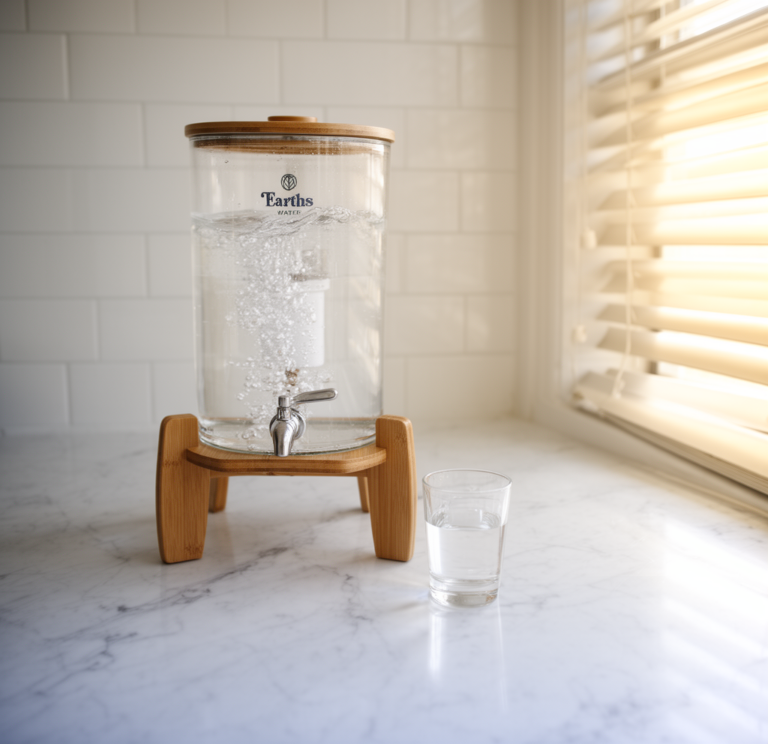
Earth’s Water 9L Glass Benchtop delivers alkalised, mineralised water at pH 8.5-9.5 from a glass body with a 3,000L filter life — Brita Marella XL offers neutral-pH chlorine taste reduction in a plastic jug at half the upfront cost but higher annual running costs per litre filtered.
| Criterion | Earth’s Water 9L | Brita Marella XL |
|---|---|---|
| What it does | Alkalises + mineralises | Reduces chlorine taste |
| Verdict | Best for households wanting premium water quality | Best for renters on a tight budget |
What Each Filter Actually Does
Most comparison articles treat Earth’s Water and Brita as if they compete for the same job. They do not. Understanding what each filter is engineered to do is the single most important fact in this article — because buying the wrong one means spending money to not solve your problem.
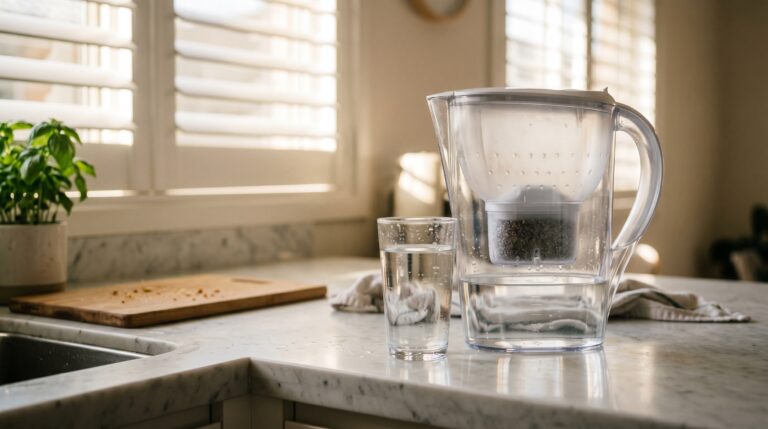
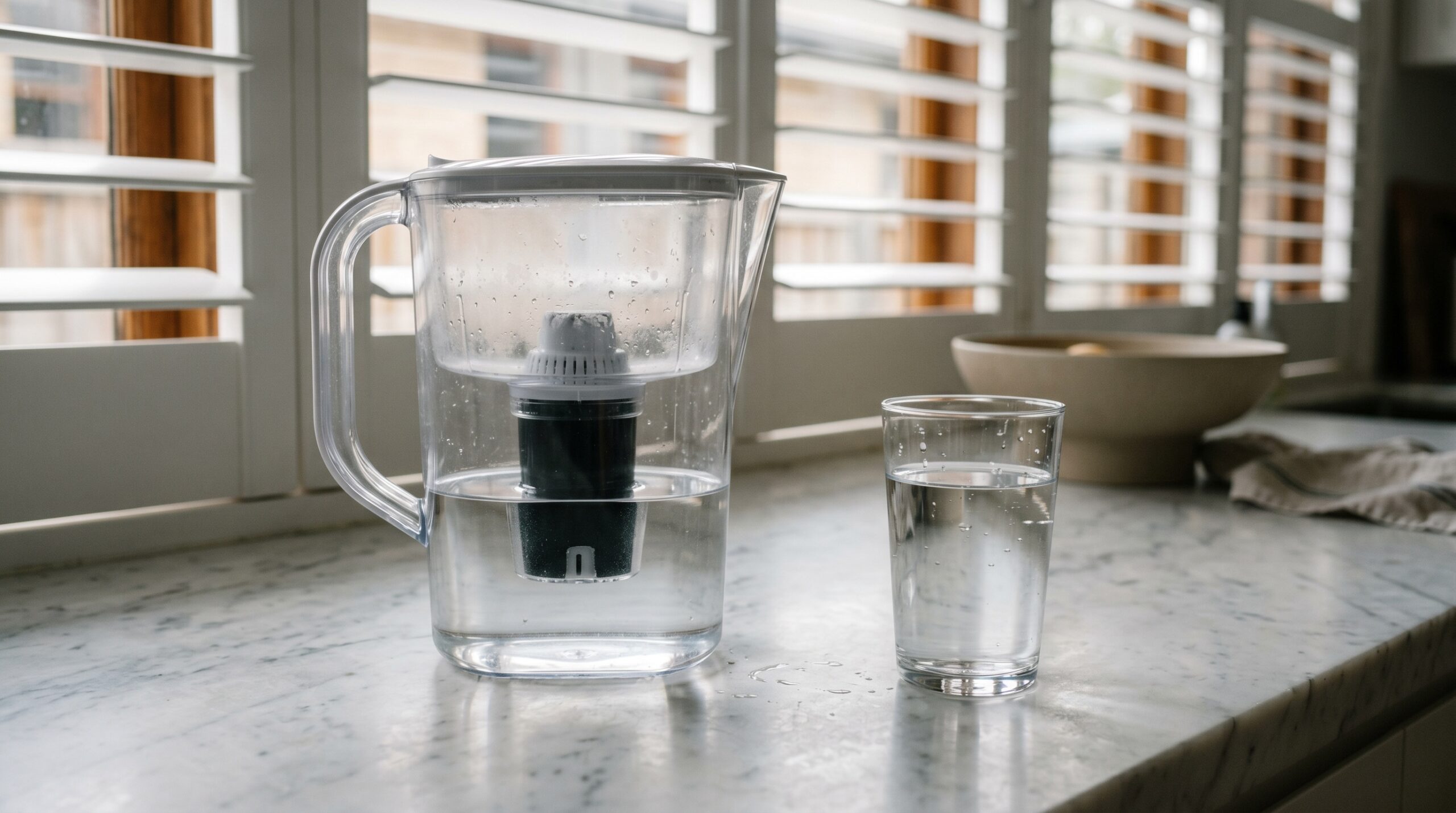
Brita is a granular activated carbon (GAC) filter. Carbon adsorbs free chlorine, reduces some heavy metals, and improves taste and odour. That is what it does. It does not change your water’s pH, does not add minerals, and does not touch fluoride. It brings moderately bad-tasting tap water to neutral, drinkable tap water. For most Melbourne and Hobart households — where tap water uses free chlorine as the disinfectant — a Brita works perfectly well for its intended purpose.
Here is where Australian buyers need to pay attention. Brisbane, Sydney, Adelaide, Perth, and Darwin all treat mains water with chloramine — a chlorine-ammonia compound that is 40 times harder to remove than free chlorine using standard GAC. A Brita Marella will remove a fraction of the chloramine in your Brisbane or Sydney tap water. It is not a failure of the product — it is a chemistry mismatch. This is the gap no competitor article explains.
Earth’s Water is a gravity-fed multi-stage alkaline filter. Water passes through several filter media — typically activated carbon, mineral stones (maifan stone, tourmaline, far-infrared ceramic), and an alkaline ionisation stage. The result is water at pH 8.5-9.5 with elevated levels of minerals like magnesium, calcium, and potassium. The 9L glass benchtop model holds a full day’s drinking water for a family of four and uses no electricity. It will also reduce chlorine taste, though for chloramine-heavy cities, its catalytic carbon stage outperforms standard GAC.
Does alkaline water deliver the health benefits sometimes claimed for it? The honest answer is that the evidence is limited and contested. What is measurable and real is this: the water tastes distinctly different — cleaner, slightly sweet — and the mineral content is a genuine addition, not marketing language. Whether the pH elevation matters to your body is a separate question from whether the water quality improves.
Australian Tap Water Context — Why It Matters Here
Australian tap water is safe to drink by ADWG (Australian Drinking Water Guidelines) standards. It is not, however, uniform. According to a Choice Australia analysis, Australian tap water commonly contains detectable levels of hydrogen sulphide, iron, zinc, copper, and lead (particularly from older plumbing), as well as pH imbalance depending on the catchment. The ADWG 2022 update includes guideline values for PFAS compounds, though removal of these requires reverse osmosis — not GAC and not alkaline filter stones.
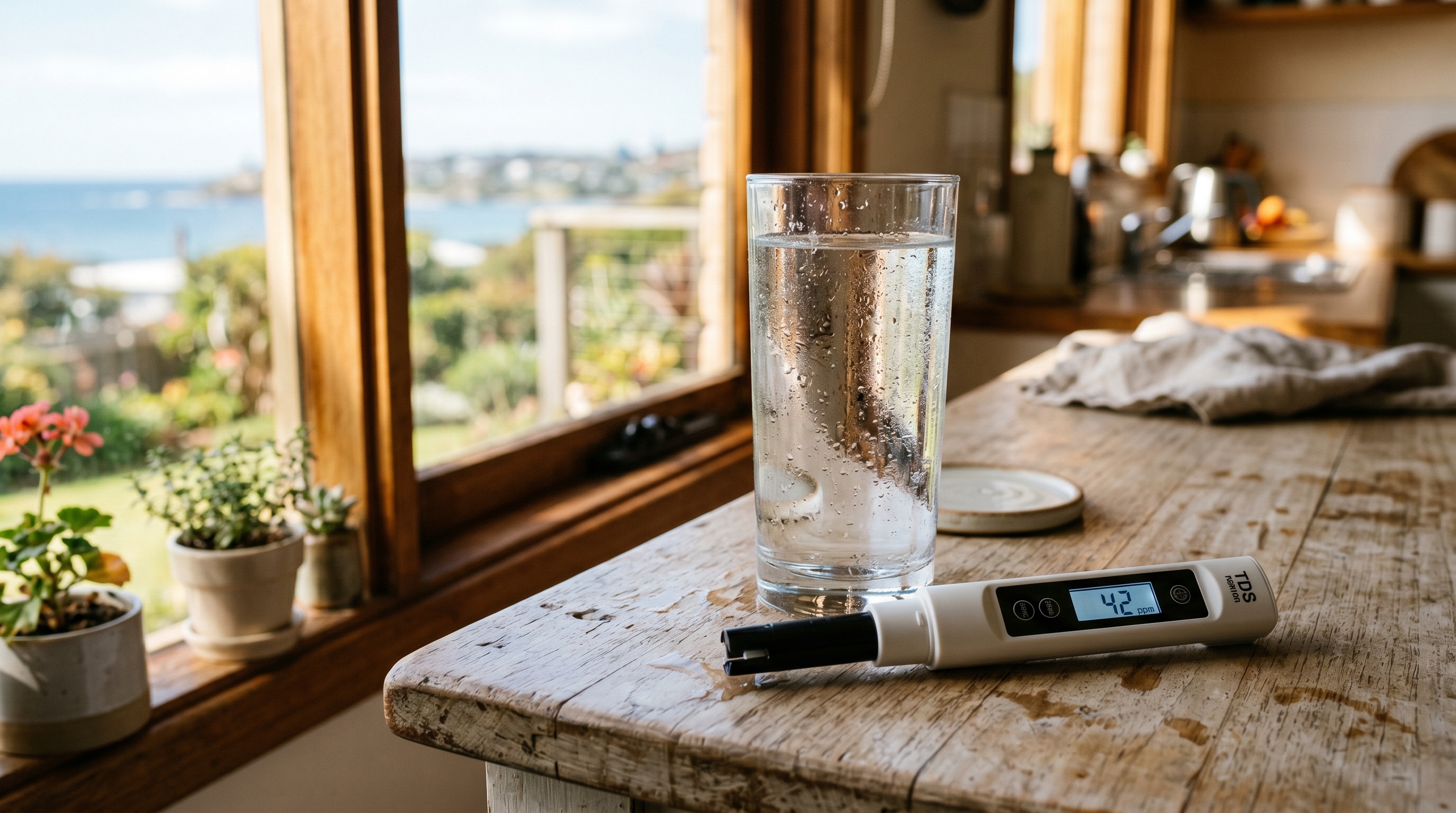
Hardness varies dramatically by city. Melbourne’s Yarra Valley catchment produces very soft water at roughly 25 mg/L CaCO3 (TDS around 60 mg/L). Brisbane’s water sits at 80-120 mg/L CaCO3. Adelaide and Perth households deal with actually hard water — Adelaide at around 140 mg/L and Perth up to 180 mg/L CaCO3. Hard water accelerates limescale build-up on filter housings and reduces flow through any gravity filter over time.
Perth households face the hardest mains water in Australia at ~180 mg/L CaCO3. For Perth buyers, the Earth’s Water mineral stones are less impactful because the source water is already mineral-rich — but the alkalisation and carbon filtration stages still serve a genuine purpose. A Brita in Perth will fill up with scale deposits faster than its rated 150L capacity suggests, which is part of why the advertised filter life is rarely achieved in Australian conditions.
That Brita filter lifespan issue deserves direct attention. In the United States, Brita rates filters at roughly 150-200L or two months. In Australia, buyers in harder-water cities — Adelaide, Perth, Brisbane — regularly find filters losing effectiveness at 4-6 weeks, not eight. This is a consistent pattern in Australian consumer reviews and it directly affects your annual running cost calculation.
Head-to-Head Specifications
| Feature | Earth’s Water 9L Glass | Brita Marella XL |
|---|---|---|
| Upfront price | ~$599 AUD | ~$49 AUD |
| Annual filter cost | ~$80-100/yr | ~$100-120/yr |
| 2-year total cost | ~$779 | ~$249 |
| Capacity | 9L | 3.5L |
| Body material | Glass (BPA-free) | Plastic |
| pH output | 8.5-9.5 (alkaline) | 7.0-7.5 (neutral) |
| Reduces chlorine | ✓ Yes | ✓ Yes (free chlorine only) |
| Adds minerals | ✓ Yes | ✗ No |
| Removes fluoride | ✗ No | ✗ No |
| Filter life | 3-6 months / 3,000L | ~1 month / 150L |
| Design | Premium benchtop countertop | Fridge jug |
| Chloramine removal | Better (multi-stage carbon) | Poor (standard GAC) |
2-Year Total Cost of Ownership
Brita looks cheap at $49. Over two years, that changes fast. At one filter per month at $8.50 each, you are spending $102 per year on replacement filters alone. Add the upfront cost and your 2-year total is approximately $249. That covers 3,600L of filtered water — at roughly $0.07 per litre.
Earth’s Water costs $599 upfront. Filter replacements run $80-100 per year, with each filter rated to 3,000 litres — meaning one or two replacements per year depending on household consumption. Over two years, your total sits at approximately $779. That covers around 6,000 litres — at roughly $0.08 per litre. Barely more per litre than Brita, and that is before you account for the fact that Brita users in hard-water cities are replacing filters every three to four weeks, not four to five.
2-Year Total Cost of Ownership — Gravity Filter Jugs, Australia
Assumes 4L/day household, filter replacements at manufacturer-rated capacity (adjusted for Australian hard-water conditions on Brita).
The bottom line on cost: Earth’s Water is not as expensive as it first appears when you spread the cost over two years. And the Brita is not as cheap as it first appears once you factor in Australian filter replacement frequency. The real gap is what you get for that money — and on that measure, Earth’s Water delivers significantly more.
Our Top-Rated Gravity Filters for Australian Homes
Product Cards — Earth’s Water vs Brita
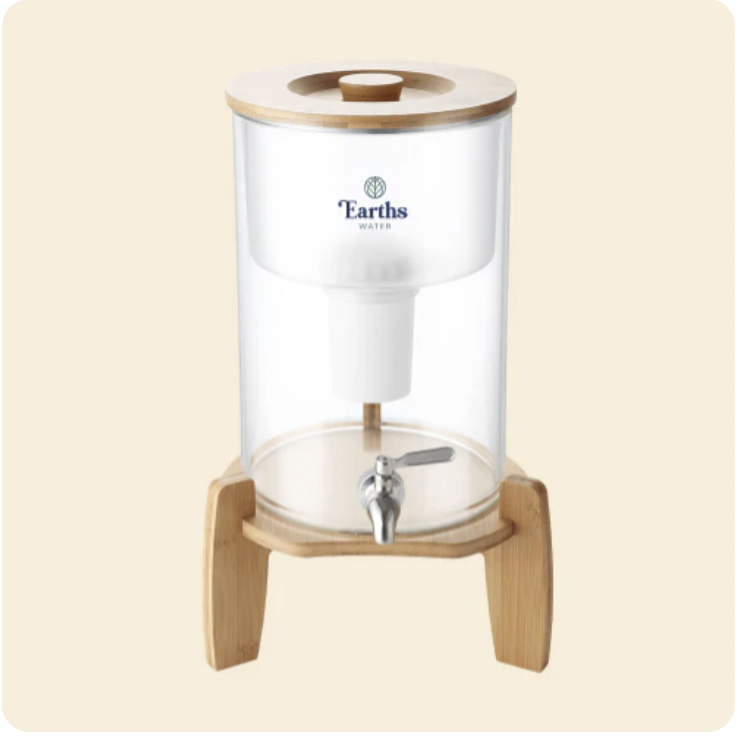
✓ Pros
- Glass body — no plastic leaching, no microplastics risk
- pH 8.5-9.5 alkaline output verified by Earth’s Water testing
- 3,000L filter life vs Brita’s 150L — far fewer replacement costs
- Multi-stage mineral addition (magnesium, calcium, potassium)
- 9L capacity covers full day’s drinking for 2-4 people without refilling
✗ Cons
- $599 upfront — significant compared to a $49 Brita jug
- Does not remove fluoride (only RO or activated alumina can do that)
- Glass body is heavy when full — benchtop placement is fixed
- No NSF/ANSI third-party certification listed on product page
The Earth’s Water 9L Glass Benchtop is the filter for Australian households that are serious about water quality and aren’t already running reverse osmosis. The 9L capacity means you’re not constantly refilling, and the gravity-fed design needs no electricity, no installation, no plumber. The glass body is the real differentiator: under alkaline conditions (pH 8.5-9.5), plastic leaches detectable levels of BPA. Glass does not. That is chemistry, not marketing.
The honest limitation is price. At $599, this is a significant investment for a water filter. Filter replacements add around $80-100 per year. But over two years, the per-litre cost works out lower than Brita once you account for Brita’s 150L filter life versus this filter’s 3,000L capacity. For households drinking 2 litres or more per day, the maths favour Earth’s Water.
One thing I want to be clear about: this filter does not remove fluoride, and no pitcher or benchtop gravity filter does. If fluoride removal is your priority, reverse osmosis is the only consumer-grade option. Earth’s Water does what it says it does — alkalise and mineralise your tap water — and it does it well.
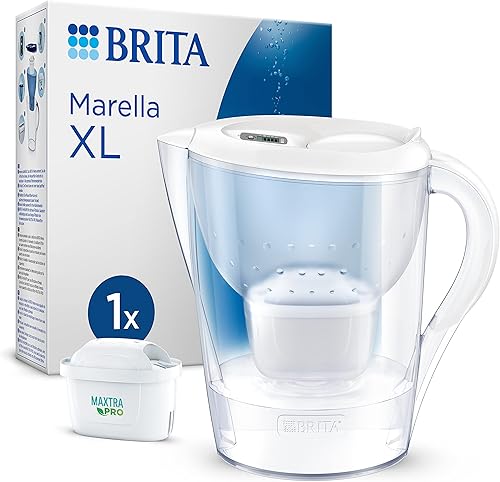
✓ Pros
- $49 upfront — lowest barrier to entry of any filter option
- Works well in Melbourne and Hobart (free chlorine cities)
- Fits in a standard fridge door — convenient for cold drinking water
- Replacement filters widely available at Coles, Woolworths, Amazon AU
✗ Cons
- Standard GAC fails to remove chloramine — ineffective in Brisbane, Sydney, Adelaide, Perth, Darwin
- Filter life rated at 150L but depletes faster in hard-water Australian cities
- Plastic body — microplastics leaching risk over time
- Does not add minerals, does not alkalise, does not remove fluoride
The Brita Marella XL does exactly one thing: it reduces the taste of chlorine in your tap water. If you are in Melbourne, Hobart, Canberra, Toowoomba, Cairns, or Townsville — cities using free chlorine rather than chloramine — and your main complaint is tap water taste, this is a rational $49 fix. It fits in a fridge door, replacement filters are in every supermarket, and it works.
Where it falls short for most Australians is chemistry. Brita’s MAXTRA+ cartridge is optimised for European water — high calcium hardness, free chlorine. It does not alkalise water, it does not add minerals, and it has limited effectiveness against chloramine, which is used in Brisbane, Sydney, Adelaide, Perth, and Darwin. If you are in one of those cities, Brita gives you marginally better-tasting water but does not address the disinfectant your water authority actually uses.
The annual running cost is also worth noting. At roughly $100-120 per year in replacement filters for a 2-person household, Brita is cheaper upfront but more expensive per litre filtered over time versus the Earth’s Water benchtop. The right choice depends entirely on what you need the filter to do.
Who Should Buy Which Filter
✓ Buy Earth’s Water 9L If You Are…
- A household of 2+ people who want alkaline, mineralised drinking water daily
- Based in Brisbane, Sydney, Perth, Adelaide, or Darwin (chloramine cities) where Brita underperforms
- Concerned about plastic leaching and want a glass body
- Willing to spend more upfront for lower cost per litre over 2+ years
- Already reading the full Earth’s Water 9L review and want the deep-dive specs
× Buy Brita If You Are…
- In Melbourne or Hobart (free chlorine — GAC actually works)
- Renting short-term and unwilling to spend more than $100 on water filtration
- A single person consuming under 2L of filtered water per day
- Only wanting to reduce limescale taste and improve smell — no other goals
- Aware that fluoride and PFAS removal requires reverse osmosis, which neither of these provide
How They Compare to RO Filtration
Both Earth’s Water and Brita share one important limitation: neither removes fluoride. This is not a flaw — it is simply physics. Fluoride ions are too small to be captured by activated carbon or mineral stones. The only gravity filter media that touches fluoride is activated alumina (at 80-95% removal), and neither of these products use it. Reverse osmosis removes 90-97% of fluoride and is the only reliably effective method at the household level.
The same applies to PFAS (per- and polyfluoroalkyl substances). DCCEEW’s national PFAS contamination register lists over 700 confirmed or suspected sites across Australia as of 2024. Neither Earth’s Water nor Brita removes PFAS. If you are on town water near a defence base, airport, or industrial site in Queensland, NSW, or Victoria, a gravity jug is not your primary tool. You need an under-sink RO system. See our full guide to fluoride and PFAS removal in Australia.
Where Earth’s Water holds a clear advantage over Brita is in the gap between “removes bad stuff” and “adds good stuff.” Most gravity filters are purely subtractive — they take things out. Earth’s Water adds measurable mineral content back into the filtered water. For a household drinking 8-10 glasses per day, that mineral contribution is not trivial.
Last reviewed: June 2026 — Clean and Native
Last reviewed: June 2026 — Clean and Native
Ready to choose?
Earth’s Water 9L Glass Benchtop is the better filter for most Australian households — alkalised, mineralised water from a glass body with a 3,000L filter life. Brita is the entry point for Melbourne and Hobart renters on a strict budget.
Frequently Asked Questions
Yes — Earth’s Water’s multi-stage mineral filter stages (maifan stone, tourmaline, alkaline ceramic) raise pH measurably above neutral. The 8.5-9.5 range is the brand’s stated output. This is verifiable with a basic pH meter, and real-world user testing generally confirms it. pH output can vary slightly depending on your source water’s starting pH and mineral content.
No. Standard granular activated carbon (GAC) — the filter media Brita uses — removes free chlorine effectively but removes chloramine at approximately 1/40th the rate. Brisbane, Sydney, Perth, Adelaide, and Darwin all use chloramine as the primary water disinfectant. A Brita jug will not meaningfully reduce chloramine in those cities. You need catalytic carbon, compressed carbon block, or reverse osmosis for chloramine removal.
No. Earth’s Water uses activated carbon and mineral stones — neither removes fluoride. Fluoride ions pass through carbon media. The only household filter methods that remove fluoride are reverse osmosis (90-97% removal) and activated alumina (80-95%). If fluoride removal is your goal, you need a dedicated RO system. See our guide to the best water filters for fluoride removal in Australia.
Brita rates filters at 150 litres or one month — a figure calibrated to European water conditions, which tend to be softer than Australian tap water in cities like Adelaide (~140 mg/L CaCO3) and Perth (~180 mg/L CaCO3). Harder water loads the carbon and ion-exchange resin faster, reducing effective filter life. Australian buyers in hard-water cities commonly report filters depleting in three to four weeks. Budget for 13-14 replacements per year rather than 12 if you are in Adelaide or Perth.
For most buyers, yes. Glass does not leach BPA, BPS, or microplastics — plastics that have been detected in filtered water from plastic-bodied jugs in independent testing. The Earth’s Water 9L glass body also does not absorb odours or stain over time the way plastic jugs do. The trade-off is weight — a full 9L glass unit is heavy and is not portable the way a Brita fridge jug is.
Melbourne uses free chlorine as its disinfectant (not chloramine), which means standard GAC — including Brita — actually works as advertised. Melbourne’s Yarra Valley source water is also very soft at ~25 mg/L CaCO3, so filter media lasts longer there than in hard-water cities. A Brita is a reasonable choice for Melbourne renters wanting basic taste improvement. Earth’s Water is the better choice for Melbourne households who want the mineral addition and glass body upgrade.
Earth’s Water does not currently list NSF/ANSI third-party certification on their product pages. This is a legitimate consideration for buyers who want independently verified performance claims. The brand is Australian and has a strong customer base, but the absence of NSF certification means performance figures rely on brand testing rather than independent laboratory verification. For fully certified filtration, under-sink RO systems with NSF/ANSI 58 certification are the benchmark.
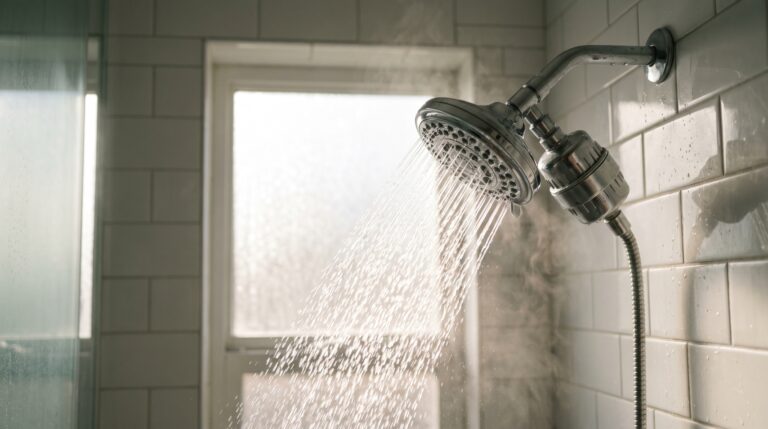
Earth’s Water also makes a shower filter — a separate product designed to reduce chlorine and chloramine exposure during bathing. It is not related to the 9L benchtop unit reviewed here. For a full breakdown of how shower filters work in Australian chloramine cities, see our Earth’s Water shower filter review.
Neither Earth’s Water nor Brita removes fluoride. For alkaline water plus fluoride removal, you need a reverse osmosis system (which removes fluoride at 90-97%) combined with a post-RO alkaline remineralisation stage — a configuration available in systems like the AquaTru Classic or multi-stage under-sink RO units. See our best alkaline water filter guide for Australia for the full comparison.
Get the Australian Home Environment Checklist
30 checks across water, air and EMF. Most of them free. Ranked by impact.
No spam. Unsubscribe any time.

Former Royal Australian Navy Clearance Diver and TAG-E counter-terrorism operator. Founded Clean and Native to apply the same rigorous thinking to the home environment.
Full biography →