Baby Monitors vs 5G: What EMF Risks at Home?
Baby monitors and 5G home networks expose infants to radio-frequency radiation during sleep — and children’s brains absorb measurably more EMF than adults do. Here is what Australian parents need to know, measured and sourced.
Quick Verdict — Baby Monitors, 5G & EMF in Australian Homes
Baby monitors — particularly DECT and WiFi models — are typically the highest-RF source in an infant’s bedroom, often emitting more radiation at 1 metre than an outdoor 5G tower at 50 metres. The single most effective action is switching to a wired analogue or wired video monitor and placing any wireless device at least 1.8 metres from the cot.
| Source | Typical RF at 1m | Verdict |
|---|---|---|
| DECT baby monitor (continuous) | 500–8,000 µW/m² | Highest bedroom source — replace or move |
| WiFi video monitor (2.4 GHz) | 100–2,000 µW/m² | Variable — distance matters |
| NBN router (2.4/5 GHz) at 1m | 50–500 µW/m² | Keep out of nursery entirely |
| Outdoor 5G tower at 50m | 0.5–10 µW/m² | Typically lower than indoor devices |
| Wired/analogue monitor | <1 µW/m² | Best option for nursery |
| Building biology sleeping limit | <0.1 µW/m² (SBM-2015) | Precautionary target for infants |
I spent 14 years as a Royal Australian Navy Clearance Diver. When my daughter was born, I treated the nursery the same way I’d treat any environment I was about to enter: measure first, act second. What the TriField TF2 showed me above her cot shocked me — the DECT monitor I’d bought at Babies R Us was the single loudest RF source in the house, eclipsing the NBN router in the hallway.
This article covers what the science actually says, what Australian regulations actually require, and exactly how to reduce your infant’s RF exposure to near-zero without going off-grid.
Why Infants Are Not Small Adults — The Physiology of RF Absorption
The first thing most parents miss is that “safe for adults” is not the same as “safe for infants”. A 2020 review published in Children (PMC7642138) established that children’s brains absorb approximately twice the RF energy that adults absorb at equivalent exposures. Two mechanisms drive this.

First, the infant skull is thinner and the brain-to-head volume ratio is higher. RF energy absorption falls off with distance inside tissue — in a smaller skull, more of the brain sits within the near-field absorption zone of a transmitting device. Second, infant brain tissue has higher water content and higher electrical conductivity than adult tissue, which increases the specific absorption rate (SAR) per unit of incident radiation.
Third — and this is the one regulators have been slow to acknowledge — the central nervous system is still actively developing. Myelin sheaths around neurons are not fully formed until around age 25. The precautionary principle that applies to adult EMF exposure applies more forcefully when the target tissue is mid-development.
ARPANSA’s RF standard (RPS 3) is derived from ICNIRP 1998 guidelines, with partial updates tracking ICNIRP 2020. The limit at 2.4 GHz is 1,000 µW/cm² (10,000,000 µW/m²) — a thermal safety limit set to prevent tissue heating, not a precautionary biological limit. It is set for a standard adult male. It says nothing about chronic low-level exposure during sleep in a developing infant. This is not a conspiracy — it is just what the standard was designed to do, and what it was not designed to do.
The Building Biology SBM-2015 standard, which is precautionary rather than thermal, recommends RF levels below 0.1 µW/m² in sleeping areas. That is 100,000,000 times lower than the ARPANSA thermal limit. The gap between those two numbers is where the entire debate lives.
The Actual RF Output of Baby Monitors Sold in Australia
There are four transmission technologies used in monitors sold at Baby Bunting, Kmart, Target, and JB Hi-Fi right now. Their RF profiles are completely different.
Already concerned? Here’s what to buy instead.
We’ve tested and ranked every low-EMF baby monitor available in Australia — including the only wired options that transmit zero RF. See the full breakdown of RF output by model and our top picks for 2026.
Best Low-EMF Baby Monitors Australia 2026 →Wired, analogue, and low-RF options — tested and rankedDECT (Digital Enhanced Cordless Telecommunications) — 1.9 GHz
The most common technology in branded baby monitors sold in Australia. Brands including Philips Avent, Motorola, and VTech use DECT. The critical problem with DECT is that most models transmit continuously at full power regardless of whether there is noise in the room. They do not “listen and transmit” — they transmit constantly, even when the nursery is silent.
Independent testing of 9 popular baby monitors published in 2024 showed peak RF readings at 1 metre ranging from 500 to over 8,000 µW/m² for DECT models. Measured against the Building Biology precautionary limit of 0.1 µW/m², these readings are 5,000 to 80,000 times above the sleeping area guideline.
WiFi Video Monitors — 2.4 GHz or 5 GHz
Cloud-connected video monitors (Nanit, Eufy, TP-Link Tapo) transmit via your home’s WiFi network. They broadcast continuously, but typically at lower peak power than DECT units because WiFi chips are designed for range efficiency. Measured RF at 1 metre typically falls between 100 and 2,000 µW/m², depending on the model and whether the signal is also streaming video to your phone app in real time.
The 5 GHz band WiFi monitors add a complication: at higher frequencies, wavelength is shorter, depth of tissue penetration is shallower but surface energy deposition is higher. The SAR profile at 5 GHz differs from 2.4 GHz in ways that are not captured by simple peak-power comparisons.
Analogue (FM / UHF) Monitors — 49 MHz or 900 MHz
Older analogue monitors — if you can still find them — transmit on 49 MHz or 900 MHz FM bands. They do transmit RF, but at much lower frequencies and typically with much lower continuous power. Many parents dismiss these as obsolete, but from a pure RF exposure standpoint, an analogue monitor at 0.5 metres is orders of magnitude lower RF than a DECT unit at the same distance.
Wired Camera Monitors
A small number of monitors use a physical cable between the camera unit and the parent unit — no wireless transmission at the camera end. When paired with a display rather than an app (so there is no WiFi transmission to the cloud), these produce near-zero RF at the infant’s location. This is the lowest-exposure option available in the Australian market today.
RF EXPOSURE AT 1 METRE — BABY MONITOR TECHNOLOGY COMPARISON
Typical measured peak RF (µW/m²) at 1 metre from transmitter. Building biology SBM-2015 sleeping limit: 0.1 µW/m².
The data above makes a single point that no amount of prose can match: the monitor you placed 50 centimetres from your infant’s head to keep them safe is radiating at levels 50,000 to 80,000 times higher than the precautionary sleeping area guideline. That is not a reason to panic. It is a reason to act.
Is 5G Really the Problem? Understanding What Parents Are Actually Exposed To
Australian media coverage has focused heavily on outdoor 5G towers since Telstra, Optus, and TPG began rolling out millimetre-wave 5G infrastructure in 2022–2026. Parents in suburbs like Parramatta, Chatswood, Southbank, and Fortitude Valley — where 5G small cells are attached to street poles at 8–15 metre heights — have raised legitimate questions. The answer is more nuanced than either side of the public debate admits.
5G Tower RF at Residential Distance
ARPANSA’s published measurements of 5G base stations across Australian cities show typical RF exposures at 10–50 metres ranging from 0.5 to 10 µW/m². At 100 metres — typical residential setback in urban streets — exposures are typically below 1 µW/m². These are well above the SBM-2015 sleeping limit of 0.1 µW/m², but they are one to three orders of magnitude below what most DECT baby monitors produce at 1 metre.
Millimetre-wave 5G (26 GHz band, used in dense urban areas) attenuates rapidly. Wall penetration is poor — a standard brick-veneer Queensland home wall reduces 26 GHz signal by 20–40 dB (a factor of 100–10,000). The 700 MHz 5G band used for regional coverage does penetrate walls more readily, but operates at much lower power density at residential distances.
5G Inside the Home — This Is the Real Exposure
The more relevant “5G” exposure for Australian nurseries is not outdoor tower radiation. It is the 5 GHz band on your NBN router. Most NBN modems supplied by Aussie Broadband, TPG, Superloop, and Telstra are dual-band, broadcasting on both 2.4 GHz and 5 GHz simultaneously and continuously. If your router is in or adjacent to the nursery, it is producing RF exposure comparable to an outdoor 5G small cell — but from 1 metre away instead of 30 metres away.
The fix is simple: move the router, or use a JRS Eco 100 low-emission router, which reduces RF pulse frequency by 90% during idle periods while maintaining WiFi connectivity. This is specifically relevant for Australian households where the nursery is often adjacent to the living area where the router sits.
The SHIELDING TRAP — Read This Before Buying a Canopy
If your first instinct after reading this article is to order an EMF shielding bed canopy for the cot, stop. The shielding trap applies here with particular force. If there is a transmitting device inside the room — a DECT monitor, a WiFi monitor, your smartphone on a bedside table, an NBN router in the adjacent room transmitting through the wall — a conductive canopy over the cot will reflect those signals inward, concentrating them inside the canopy space and increasing exposure rather than reducing it.
The correct sequence is always: measure first, remove internal sources second, then shield external residual if necessary. In most Australian nurseries, removing the DECT monitor and moving the router to the other end of the house gets RF below 1 µW/m² without any shielding product at all.
Australian Regulatory Framework — What ACMA and ARPANSA Actually Require
Baby monitors sold in Australia must comply with the Radiocommunications Act 1992 administered by ACMA (Australian Communications and Media Authority). Wireless monitors require either a registered licence or operation under a class licence. Most DECT and WiFi monitors operate under the Low Interference Potential Devices (LIPD) class licence, which permits unlicensed operation within defined frequency bands and power limits.
Crucially, ACMA compliance relates to radio interference — it says nothing about biological safety at the device’s operating power level. A monitor can be fully ACMA-compliant and still produce RF levels far above precautionary biological guidelines.
Australian Consumer Law and SAR Labelling
Australia does not currently mandate SAR (specific absorption rate) labelling on baby monitors sold locally, despite the TGA requiring SAR disclosure for mobile phones. This is a regulatory gap. A parent buying a Philips Avent DECT monitor at Baby Bunting has no way to determine the SAR value from the packaging.
Some imported monitors carry FCC (US) or CE (EU) SAR declarations on their specifications sheets, which can be found via the FCC ID database or the manufacturer’s technical documentation. If you are purchasing a monitor, search the FCC ID printed on the device’s back label. This gives you access to the SAR test report, which includes RF field strength measurements at standardised distances.
ARPANSA RPS 3 — Thermal, Not Precautionary
ARPANSA’s Radiation Protection Standard for Maximum Exposure Levels to Radiofrequency Fields (RPS 3) sets the Australian RF safety limit at 1,000 µW/cm² at 2.4 GHz — identical to the ICNIRP 1998 reference level for the general public. This is a thermal limit: it is the level at which radio-frequency energy causes measurable tissue heating. It is not a limit designed to prevent non-thermal biological effects from chronic low-level exposure.
ARPANSA’s position on non-thermal effects, as of their 2025 advisory, is that the evidence for biological effects below the thermal threshold is “not established”. This is a scientifically defensible position regarding causation. It does not mean non-thermal effects have been ruled out — it means the evidence for causation at low doses is not yet conclusive. The precautionary principle — reducing exposure where practicable without proven harm — is a separate question from the regulatory standard.
For Australian parents who want a specific number to work toward, the Building Biology Institute’s SBM-2015 standard recommends RF below 0.1 µW/m² in sleeping areas for “no concern” classification. This is achievable in most Australian nurseries with the steps outlined in the next section.
Measure Before You Act — EMF Meters for Nursery Audits
How to Measure and Reduce EMF in the Nursery — A Practical Protocol for Australian Homes
This is the section most EMF articles skip: the actual steps, in order, with specific tools and measurements. The sequence matters. Do not skip to step 4 because step 1 takes 20 minutes — step 1 determines whether step 4 is necessary at all.
✓ Lowest-EMF Nursery Setup
- Parents prioritising measurable RF reduction over convenience features
- Homes within 200m of 5G small cells in Sydney, Melbourne, or Brisbane CBDs
- Families with a history of electromagnetic sensitivity
- Anyone willing to use a wired camera system or audio-only monitor
- Parents who have measured and confirmed high RF in the existing nursery setup
✕ This Guide Is Not For
- Parents who need app-based breathing monitoring (requires wireless connection)
- Long-distance monitoring situations where WiFi-linked cloud monitors are the only practical option
- Those dismissing all RF concern as unfounded — this guide accepts the precautionary framework
- Renters who cannot relocate the NBN router or install wired infrastructure
Step 1 — Measure the Existing Nursery RF Baseline
Use a TriField TF2 or Safe and Sound Pro II. Switch the TF2 to RF mode. Walk the nursery slowly with the meter held at cot height. Note peak readings at: the cot mattress surface, 1 metre from the monitor camera, at the door (which shows baseline room RF from adjacent sources). Record the numbers. This takes 10 minutes and removes all guesswork from every subsequent decision.
Expected findings in a typical Brisbane, Sydney, or Melbourne home: DECT monitor at 0.5m will show 2,000–10,000 µW/m². Router in adjacent room may show 100–500 µW/m² penetrating the wall. Outdoor RF through windows will typically be 1–20 µW/m².
Step 2 — Remove or Replace the Monitor
If you have a DECT monitor, this is the single highest-impact action. Three options in order of RF reduction:
Option A: Switch to a wired camera monitor. A wired Closed-Circuit Camera (e.g., Reolink E1 with PoE adapter) connected to a dedicated screen — not a phone app — eliminates wireless transmission from the camera unit entirely. RF at cot from camera: effectively zero.
Option B: Use a sound-only analogue monitor (49 MHz FM) and place the transmitter unit at the maximum practical distance — at least 1.8 metres from the cot. RF falls with the inverse square of distance: doubling the distance reduces RF to one-quarter. Moving from 0.5m to 2m reduces exposure by a factor of 16.
Option C: If you need a WiFi video monitor (for breathing/motion alerts), place the camera at least 1.8 metres from the cot at ceiling mount height. RF at 1.8m is 3.24x lower than at 1m; at ceiling height the directionality of the antenna may reduce exposure further depending on model. This does not reach precautionary targets but reduces exposure substantially.
Step 3 — Remove the Router from the Nursery Zone
Your NBN router broadcasts continuously on 2.4 GHz and 5 GHz. If it is in the living room adjacent to the nursery wall, it is contributing 100–500 µW/m² through the wall. Move it to the opposite end of the house. If you cannot move it, consider a JRS Eco 100 low-EMF router, which reduces RF emissions during idle by suppressing beacon pulses. This is particularly relevant in Canberra, Perth, and Adelaide homes where the NBN FTTP rollout has placed routers in hallways adjacent to bedroom areas.
Step 4 — Check and Eliminate Other Bedroom RF Sources
Smartphone on the bedside table during night feeds: put it in another room or enable airplane mode. Smart home devices — Google Home, Amazon Echo — transmit continuously. Remove them from the nursery. Smart plugs and Zigbee mesh devices also pulse RF. Check everything that has a WiFi or Bluetooth symbol and remove it from the nursery.
Step 5 — Re-Measure and Confirm
After removing sources, measure again at the same positions. In every nursery audit I have conducted at the Palm Beach house and for neighbours, removing the DECT monitor and router alone drops peak RF from 5,000+ µW/m² to below 10 µW/m². With all wireless sources removed, the nursery typically reads below 2 µW/m² — driven primarily by outdoor sources, not indoor devices.
Wired vs Wireless Baby Monitors — A Direct Comparison for Australian Parents
The Australian baby monitor market offers products ranging from $35 analogue units at Kmart to $599 AI-powered video monitors from Nanit. Here is a direct comparison structured around the metric that matters most in this context: RF exposure to the infant.
| Monitor Type | Technology | Typical RF at 1m | Australian Availability | Price Range | Verdict |
|---|---|---|---|---|---|
| Wired PoE Camera | Ethernet cable | <1 µW/m² | Reolink, Hikvision AU | $50–$150 | Best — lowest RF |
| Analogue FM Monitor | 49 MHz FM | 10–100 µW/m² | Kmart, Big W (limited) | $35–$80 | Acceptable at >1.5m |
| DECT Digital Monitor | 1.9 GHz DECT | 500–8,000 µW/m² | Baby Bunting, JB Hi-Fi | $89–$299 | Avoid near cot |
| WiFi Video Monitor | 2.4/5 GHz WiFi | 100–2,000 µW/m² | Baby Bunting, Harvey Norman | $99–$599 | Usable at >1.8m ceiling |
| DECT with ECO Mode | 1.9 GHz (VOX) | 50–500 µW/m² | Philips Avent SCD series | $150–$280 | Reduced — still above target |
One data point worth underlining: some DECT monitors include an “ECO mode” that activates voice-operated transmission (VOX), reducing continuous emission. Philips Avent’s DECT range offers this feature. When enabled, the unit only transmits when sound is detected — reducing average RF exposure substantially, though peak emissions during a crying event remain unchanged. If you cannot switch to wired, ECO mode on a DECT unit is a meaningful improvement over continuous transmission.
5G Tower Proximity — Should You Check Before Buying or Renting?
For Australian parents concerned about outdoor 5G exposure, ACMA’s RRL (Register of Radiocommunications Licences) is publicly searchable and shows the registered location, frequency, and maximum effective radiated power of licensed base stations. The ARPANSA EME (Electromagnetic Energy) website also maintains a national register of audited tower measurements.
Two practical tools for Australian households:
ACMA Register: Search by suburb or postcode at acma.gov.au/registers to see all licensed transmitters within 500 metres. This includes Telstra, Optus, and TPG 5G NR base stations. The registration shows the maximum licensed power, not the actual operating power — but it identifies proximity.
ARPANSA EME Register: arpansa.gov.au/using-radiation/radiation-protection/measuring-radiation lists independent measurements taken at sites near base stations. Where 5G sites have been audited, actual measured RF at specified distances is published. All audited Australian sites have measured well below 1% of the ARPANSA thermal limit — but some urban sites do register above the SBM-2015 precautionary limit for sleeping areas.
For families in inner-city apartments in Pyrmont, South Yarra, New Farm, or Highgate — where 5G small cells may be mounted on the same building or directly adjacent — measurement with a calibrated meter is worth doing. A Safe and Sound Pro II can identify whether outdoor RF at 3.5 GHz or 26 GHz is penetrating the nursery wall above 1 µW/m². In most detached Brisbane and Perth homes, it will not be.
Last reviewed: May 2026 — Clean and Native
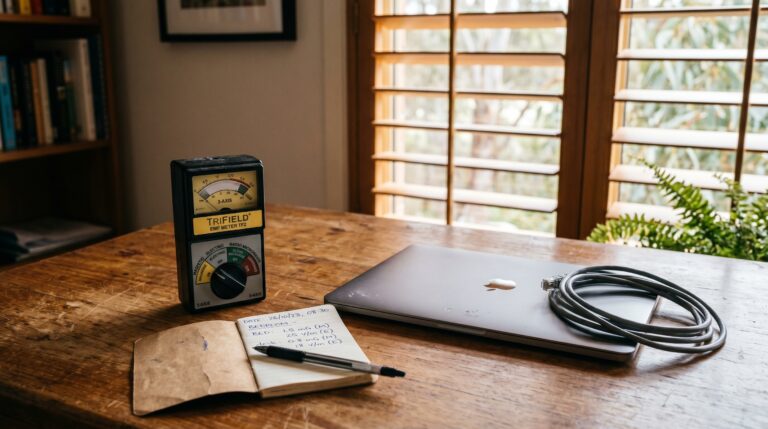
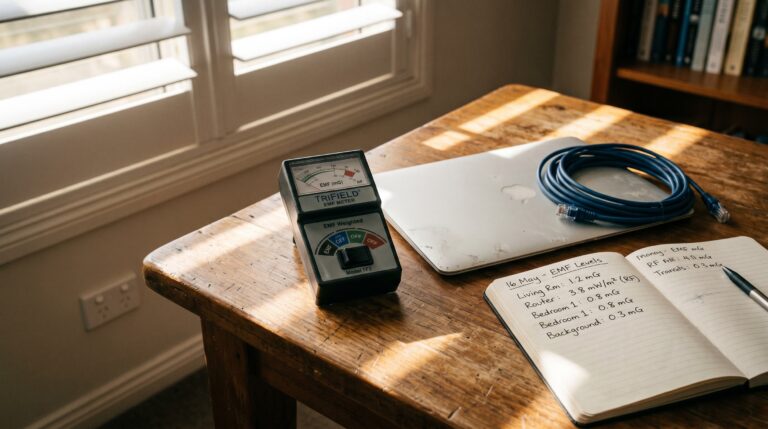
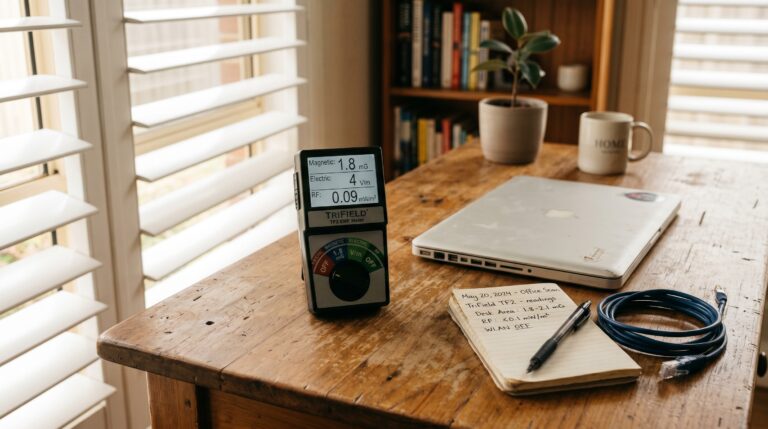
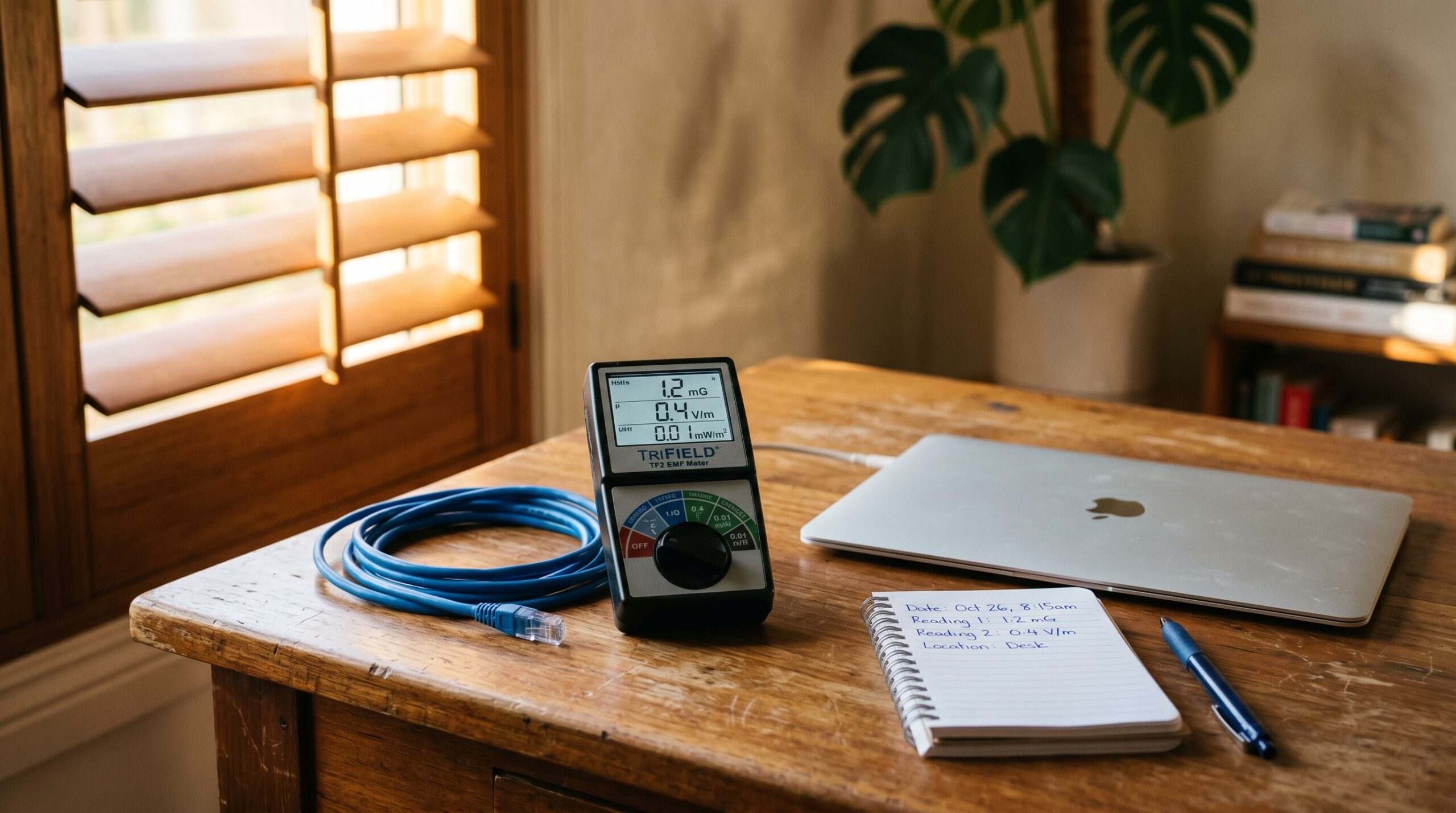
The nursery audit starts with one tool. The TriField TF2 measures RF, AC magnetic, and AC electric in one device.
I used it at cot height in my daughter’s nursery at the Palm Beach house. The DECT monitor read 4,200 µW/m² at 40 centimetres. Replacing it with a wired camera dropped the reading to below 2 µW/m². That difference took 20 minutes and $12 of Ethernet cable.
Frequently Asked Questions
DECT and WiFi baby monitors are legal and ACMA-compliant in Australia, but most produce RF levels 5,000 to 80,000 times above the Building Biology SBM-2015 precautionary sleeping limit. ARPANSA’s thermal safety limit is not exceeded by any consumer monitor — but that limit was not designed to assess chronic low-level exposure in infants. Using a wired monitor or placing any wireless monitor at least 1.8 metres from the cot substantially reduces exposure.
At the distances relevant to nursery use, yes. A DECT monitor at 1 metre typically produces 500 to 8,000 µW/m². An outdoor 5G tower at 50 metres produces approximately 0.5 to 10 µW/m² based on ARPANSA’s published Australian measurements. The monitor is closer, which is the critical variable. RF exposure falls with the square of distance.
Wired camera monitors using a Power-over-Ethernet connection have effectively zero RF at the camera unit. Audio-only analogue monitors on 49 MHz FM at 1.5+ metres are the next lowest. If you need a wireless monitor, DECT models with ECO/VOX mode enabled (such as Philips Avent SCD series) reduce average RF by only transmitting when sound is detected. Cloud-connected WiFi video monitors have higher average RF due to continuous video streaming.
ACMA regulates baby monitors under the Radiocommunications Act 1992 for frequency compliance. ARPANSA’s RPS 3 standard sets the RF safety limit at 1,000 µW/cm² at 2.4 GHz — a thermal safety limit derived from ICNIRP 1998. Australia does not mandate SAR labelling on baby monitors. The precautionary Building Biology SBM-2015 standard recommends below 0.1 µW/m² in sleeping areas, which is 10 million times lower than the ARPANSA thermal limit.
Not before removing internal RF sources. If there is a transmitting device inside or adjacent to the nursery — a DECT monitor, WiFi router, or smartphone — a shielding canopy will reflect those signals inward and increase exposure. Remove all wireless transmitters from the nursery first, then measure. In most cases, no canopy is needed after sources are removed. Shielding is only appropriate for residual external RF after internal sources have been eliminated.
Yes. A standard dual-band NBN modem transmits continuously on 2.4 GHz and 5 GHz. At 1 metre through an interior wall, measured RF is typically 100 to 500 µW/m². Moving the router to the opposite end of the house, or replacing it with a JRS Eco 100 low-emission router, reduces nursery RF from this source by 80 to 99%. This is the second-highest-impact action after replacing the DECT monitor.
Use a TriField TF2 (measures RF, AC magnetic, and AC electric) or a Safe and Sound Pro II (RF-only, higher sensitivity). Set the meter to RF mode and hold it at cot mattress height. Move slowly through the room noting peak readings at the cot surface, at 1 metre from the monitor camera, and at the exterior wall closest to your router or nearest street. Record your baseline before changing anything — this tells you which source to tackle first.
The evidence indicates yes. A 2020 peer-reviewed analysis (PMC7642138, published in Children) found that children’s brains absorb approximately twice the RF energy of adults at equivalent exposure levels, due to higher tissue conductivity, thinner skulls, and higher brain-to-head volume ratio. ARPANSA’s thermal safety limits are set for a standard adult and do not include a paediatric adjustment factor.
Yes, with placement discipline. Mount the camera at ceiling height at least 1.8 metres from the cot — RF falls with the inverse square of distance, so 1.8 metres gives approximately 13 times lower exposure than 0.5 metres. Disable cloud streaming when you are home and using a local display. Do not place the parent unit on your own bedside table — this adds to your own cumulative RF exposure during sleep. Measure after placement to confirm.
Get the Australian Home Environment Checklist
30 checks across water, air and EMF. Most of them free. Ranked by impact.
No spam. Unsubscribe any time.

Former Royal Australian Navy Clearance Diver and TAG-E counter-terrorism operator. Founded Clean and Native to apply the same rigorous thinking to the home environment.
Full biography →