Best Water Filters for Coffee in Australia 2026: Espresso, Pour Over, and Cold Brew
The best water filter for coffee in Australia is not the one that removes the most — it is the one that removes chlorine and chloramine while keeping calcium (75-175 mg/L) and magnesium (10-30 mg/L) intact. Which filter that is depends entirely on your city’s water chemistry, and every major Australian city is different.
I have not personally tested the water filters recommended here (TAPP EcoPro, BWT Mg2+, Waters Co Bio 500, Brita Marella); this assessment is based on published manufacturer specifications, independent certification, and Australian water utility data, not first-hand measurement. The only products I measure first-hand are the EcoHero 5-Stage RO, TriField TF2, and Coway Airmega 150.
Quick Verdict — Coffee Water Filters by City 2026
Melbourne and Hobart water is already close to the Specialty Coffee Association’s ideal mineral range — a basic carbon block is all you need. Brisbane and Sydney run chloramine, which destroys standard carbon jugs; you need catalytic carbon. Perth and Adelaide water is so hard it will scale your espresso machine within months — partial softening, not full RO. Zero TDS water from a ZeroWater or full RO is the single worst thing you can do to espresso extraction.
| City | Water Type | Best Approach | Top Pick |
|---|---|---|---|
| Melbourne / Hobart | Soft, free chlorine, TDS 20-60 | Carbon block — minerals already ideal | Brita Marella Classic |
| Brisbane / Sydney | Moderate TDS, chloramine | Catalytic carbon — removes chloramine, keeps minerals | TAPP EcoPro Benchtop |
| Perth / Adelaide | Hard, high TDS, scale risk | Partial softening + carbon — protect machine | BWT Mg2+ Penguin Pitcher |
| Any city — gravity option | All water types | Mineral-retaining ceramic + carbon gravity | Waters Co Bio 500 |
Why Your City’s Water Chemistry Is the Most Important Coffee Variable You Are Ignoring
I spent eight years as a Royal Australian Navy Clearance Diver working in some of the harshest water environments on the planet. I understand contamination, filtration, and the chemistry of what dissolves in water. When I started getting serious about espresso, I compared the published water quality reports for half a dozen Australian cities and the spread is enormous — from Melbourne’s 20-60 mg/L right up to Adelaide’s 400 mg/L TDS. That gap does not just affect taste. It affects extraction efficiency, crema stability, boiler scale accumulation, and the long-term health of your machine.
Most coffee content tells you to “filter your water.” That is not useful advice. A Brita jug in Brisbane removes almost nothing because Brisbane runs chloramine — a chlorine-ammonia compound that standard granular activated carbon (GAC) removes at roughly 1/40th the rate of free chlorine. So you could be running what looks like a filtered setup and still be brewing with chloramine-laden water that kills aromatic compounds and tastes medicinal. The disinfection type in your city is the single most important fact to establish before you buy anything.
Then there is the mineral side. The Specialty Coffee Association’s Water Quality Handbook specifies a target of 150 mg/L total dissolved solids, calcium hardness at 75-175 mg/L CaCO3, and a target magnesium level of 10-30 mg/L. These numbers exist because calcium and magnesium are not just flavour contributors — they are the ionic carriers that pull soluble compounds out of ground coffee during extraction. Strip them out with a full reverse osmosis system and you get flat, thin, under-extracted espresso with zero crema and a distinctly sour profile. Full RO water is aggressive and corrosive. It will leach metals from your boiler and portafilter over time.
The goal for coffee water is selective filtration: remove the bad (chlorine, chloramine, sediment, heavy metals if present) and keep the good (calcium, magnesium, bicarbonate buffering). Every product recommendation in this article is built around that principle.
Australian City Water Chemistry — What You Are Actually Brewing With
Before recommending anything, here is the baseline data. These figures are drawn from published annual water quality reports from each city’s water utility — Melbourne Water, SEQ Water (Brisbane), Sydney Water, SA Water, and Water Corporation WA.
| City | Approx. TDS (mg/L) | Hardness (mg/L CaCO3) | Disinfection Type | Scale Risk | Best Filter Approach |
|---|---|---|---|---|---|
| Melbourne | 20-60 | ~25 | Free chlorine | Low | Standard carbon block — minerals already near SCA ideal |
| Hobart | ~40 | ~20 | Free chlorine | Very low | Carbon block — may benefit from mineral supplementation |
| Canberra | ~70 | ~40 | Free chlorine | Low | Carbon block sufficient |
| Brisbane | 80-115 | ~80-120 | Chloramine | Moderate | Catalytic carbon — removes chloramine, keeps minerals |
| Sydney | ~100 | ~60-80 | Chloramine | Moderate | Catalytic carbon — standard Brita ineffective |
| Adelaide | ~400 | ~140 | Chloramine | High | Partial ion-exchange softening + chloramine removal |
| Perth | ~170 | ~180 | Free chlorine | High | Partial softening — BWT Mg2+ pitcher or Brita Purity inline |
A few things jump out from this table. Melbourne’s water at TDS 20-60 and hardness around 25 mg/L CaCO3 is already close to the SCA’s target range — it just needs chlorine removed. You do not need to spend $200 on anything. At the other extreme, Adelaide’s TDS of around 400 mg/L puts it well above the SCA’s recommended ceiling of 250 mg/L. Brewing espresso with unfiltered Adelaide tap water will produce thick, chalky extraction profiles and start scaling your group head within weeks.
Brisbane and Sydney sit in an interesting middle ground. The mineral content is workable — actually close to ideal for espresso. The problem is chloramine, which produces an astringent, medicinal off-note that is immediately detectable in pour-over and black espresso. Standard GAC filters (Brita Marella Classic, generic jugs, fridge filters) remove chloramine at about 1/40th the efficiency of free chlorine removal. By the time your Brita jug has finished its cycle, chloramine concentration has barely shifted. You need catalytic carbon. That fact alone is worth the price of this article.
The Five Best Water Filters for Coffee in Australia 2026
1. TAPP EcoPro Benchtop — Best for Brisbane and Sydney (Chloramine Cities)

✓ Pros
- Catalytic carbon block removes chloramine — the correct technology for Brisbane, Sydney, Adelaide, Gold Coast
- Retains calcium and magnesium — no mineral stripping
- No plumbing required, installs on bench tap in minutes
- Refillable cartridge system reduces plastic waste (TAPP’s EcoPro refill program)
✗ Cons
- Does not remove fluoride (requires RO for that)
- Does not soften water — Perth/Adelaide may still need additional hardness management
- Tap adaptor may not suit all Australian tap fittings without included adaptors
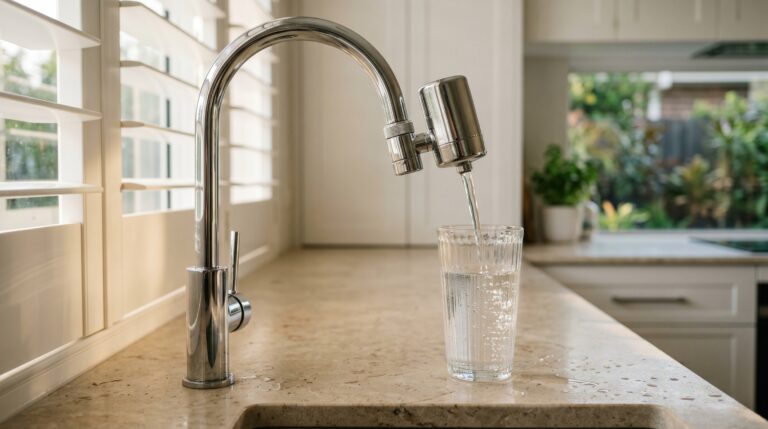
If you are in Brisbane or Sydney and currently running a standard Brita jug, you are not filtering chloramine out of your coffee water. You are filtering some sediment and perhaps reducing free chlorine slightly, but chloramine — the compound your utility uses for its longer residual in the distribution network — passes through GAC at roughly 1/40th the removal rate of free chlorine. The TAPP EcoPro uses a compressed catalytic carbon block. Catalytic carbon has a modified surface chemistry that catalyses the decomposition of chloramine molecules rather than just adsorbing them. It is not the same material as standard activated carbon, and the difference in your espresso cup is not subtle.
At a flow rate that suits benchtop use, the EcoPro lets you fill a kettle or a moka pot reservoir in under a minute. The catalytic carbon does not strip calcium or magnesium — those ions pass through freely. Brisbane tap water at TDS 80-115 and moderate hardness is actually a reasonable starting point for espresso once you eliminate the chloramine. Western Sydney suburbs like Penrith and Parramatta, where Sydney Water data shows slightly elevated hardness compared to inner-city supplies, sit in a similar bracket. Filter out the disinfectant and you are working with water close to the SCA target range without any mineral manipulation.
2. BWT Mg2+ Penguin Pitcher — Best for Perth and Adelaide (Hard Water Cities)

✓ Pros
- Ion-exchange resin reduces calcium scale without stripping TDS to zero
- Actively adds magnesium — measurably improves espresso sweetness and clarity
- Endorsed by World Barista Championship competitors
- No installation required — countertop pitcher
✗ Cons
- Standard BWT cartridge uses GAC — effective for free chlorine but not chloramine (Adelaide is a chloramine city; Perth metro uses free chlorine)
- Does not remove fluoride
- Replacement cartridges are more expensive than Brita (approx. $15-20 per cartridge)
Perth households face the hardest tap water in Australia at roughly 180 mg/L CaCO3. Adelaide is close behind at around 140 mg/L. Run either of those unfiltered through a domestic espresso machine and you will descale every four to six weeks. The scale is not just a maintenance issue — calcium carbonate deposits on the heating element raise boiler temperatures, alter extraction pressure, and shorten machine lifespan. The BWT Mg2+ addresses this through a partial ion-exchange process. Hard calcium ions are exchanged for magnesium ions. This reduces total hardness (and therefore scale risk) while simultaneously increasing the magnesium concentration in the filtered water.
Why does magnesium matter? Published coffee-chemistry research has found that magnesium ions extract different flavour compounds from roasted coffee than calcium, with magnesium associated with greater extraction of larger organic molecules linked to sweetness, acidity, and floral notes. The BWT Mg2+ pitcher is used by competitors in the World Barista Championship and the World Brewers Cup for this reason. It is not marketing — there is a peer-reviewed mechanism behind it.
The important caveat for Adelaide: the BWT Mg2+ cartridge includes GAC for chlorine removal, but Adelaide is a chloramine city, and GAC removes chloramine at approximately 1/40th the rate of free chlorine. Perth metro, by contrast, uses free chlorine, which GAC removes effectively. If chloramine off-notes are a concern — and in espresso, they absolutely are detectable — you should either stack a catalytic carbon pre-filter or look at a Waters Co Bio 500 as an alternative that handles both mineral balance and chloramine more effectively.
Top Coffee Water Filters — Australia 2026
3. Waters Co Bio 500 — Best Gravity Filter for All Australian Cities

✓ Pros
- Multi-stage filtration including ceramic pre-filter and catalytic carbon — handles chloramine cities
- Bio-ceramic stage retains beneficial minerals rather than stripping them
- Large 10L capacity — suits households brewing multiple coffee methods daily
- No installation, no electricity, no ongoing plumbing costs
✗ Cons
- Gravity filtration is slow — not suitable for on-demand espresso machine filling
- Does not remove fluoride
- Larger bench footprint than a pitcher-style filter
The Waters Co Bio 500 is the gravity filter I would put in any Australian coffee household that needs a countertop option without tap connections. The multi-stage cartridge system is the key differentiator from cheaper gravity jugs: a ceramic outer shell captures sediment and some biological contaminants, catalytic carbon handles chloramine (making it effective in Brisbane, Sydney, Adelaide, Gold Coast, and Darwin), and a bio-ceramic mineral-enhancing stage re-introduces beneficial trace minerals into ultra-soft water.
For Hobart households where tap water TDS sits around 20-40 mg/L — below even Melbourne’s already soft supply — the Bio 500’s mineral enhancement stage is useful. Hobart water filtered through a standard carbon block can have very low mineral content. The Bio 500 brings it closer to the SCA’s 150 mg/L TDS target. That matters for extraction. Very low TDS water is under-mineralised and extracts coffee unevenly, producing inconsistent shot-to-shot results.
The practical limitation is flow rate. Gravity filters do not produce water on demand fast enough to fill a boiler or reservoir mid-session. The solution is simple: fill the Bio 500 reservoir the night before and draw from it the next morning. For a household doing two to three V60s or a double shot before work, the 10-litre capacity is more than adequate.
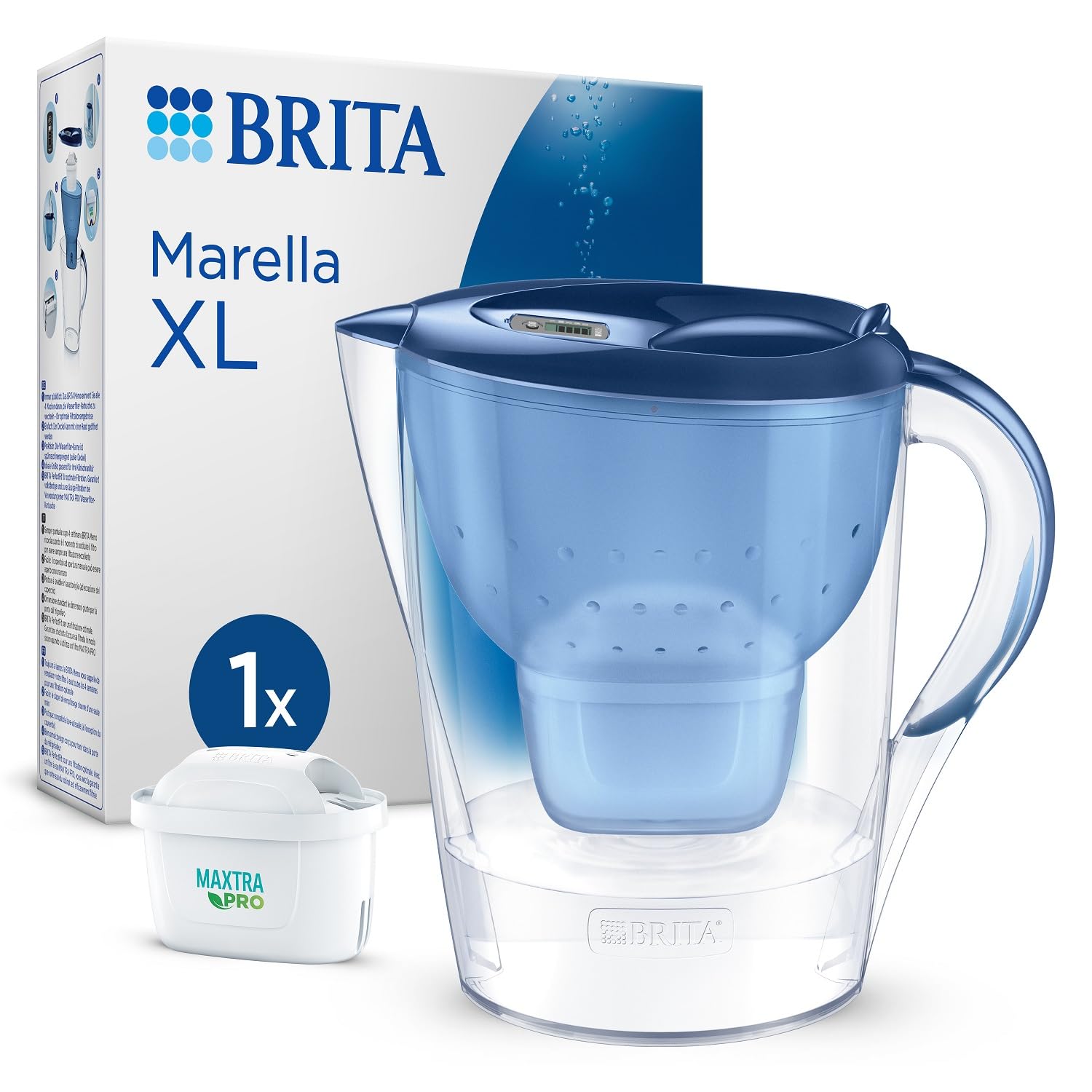
4. Brita Marella Classic — Best Entry Option for Melbourne and Hobart
✓ Pros
- Effectively removes free chlorine — the disinfection method used by Melbourne Water and TasWater
- Widely available at Coles, Woolworths, Target — no specialty order required
- Low upfront cost (~$30-40)
- Does not strip minerals — Melbourne’s moderate hardness is preserved
✗ Cons
- Completely ineffective for chloramine — do NOT use in Brisbane, Sydney, Adelaide, Gold Coast, or Darwin
- Does not add magnesium (BWT Mg2+ does)
- Does not remove fluoride
The Brita Marella Classic is the right tool for the right job, narrowly defined. Melbourne coffee drinkers using free-chlorine water with TDS around 25-60 mg/L and hardness around 25 mg/L CaCO3 have water that is already very close to what specialty roasters and cafe equipment technicians consider ideal for espresso. The Yarra Valley catchment that supplies most of Melbourne produces some of the softest, cleanest municipal water in the country. The primary filtration need is chlorine removal. Standard GAC does that effectively.
The mistake is using a Brita Marella in Brisbane or Sydney. This is not a minor issue — GAC removes approximately 2-3% of chloramine per contact cycle compared to 80-95% of free chlorine. That means your Brita-filtered Brisbane tap water contains nearly as much chloramine as unfiltered tap water. Every espresso shot brewed with it carries that medicinal, astringent note. If you are in a chloramine city and you own a Brita, it needs to be replaced with catalytic carbon technology.
Nespresso and Pod Machine Water Filters Australia
Nespresso machines extract from sealed pods at high pressure, so the water’s flavour contribution is less critical than in an open-basket espresso machine — but scale is an even bigger problem. Nespresso boilers are small and heat fast, which accelerates mineral deposition. An unscaled Nespresso machine loses pressure efficiency within weeks in Perth or Adelaide.
Most Nespresso Original Line machines (Essenza Mini, Pixie, CitiZ, Inissia) do not have an internal filter slot — you must filter the water before it enters the tank. For these machines, the BWT Mg2+ pitcher or a TAPP EcoPro benchtop unit upstream of the tank is the correct approach in hard water cities.
Some models (Lattissima, Expert, Creatista by Breville, Gran Lattissima) have a BWT Intenza filter cartridge slot built into the water tank. The Intenza reduces calcium hardness using ion-exchange resin — scale protection, not chloramine removal. If you are in Brisbane or Sydney, the Intenza will not address chloramine off-notes in your lungo or americano. Pair it with a catalytic carbon pre-filter or use the Waters Co Bio 500 to fill the tank.
Nespresso & Pod Machine — Filter by City 2026
| Machine | City | Recommended Filter | Why |
|---|---|---|---|
| Nespresso Original (no internal slot) | Perth / Adelaide | BWT Mg2+ Penguin Pitcher | Ion-exchange reduces calcium scale, protects small boiler |
| Nespresso Original (no internal slot) | Brisbane / Sydney | TAPP EcoPro Benchtop | Catalytic carbon removes chloramine from your lungo and flat white |
| Nespresso Creatista / Lattissima / Expert (BWT Intenza slot) | All cities | BWT Intenza (built-in) + TAPP EcoPro upstream in Brisbane/Sydney | Intenza handles scale; catalytic carbon upstream removes chloramine |
| Nespresso Vertuo / VertuoPlus | Melbourne / Hobart | Brita Marella Classic | Free chlorine city — standard carbon sufficient for scale and taste |
Why Full RO and ZeroWater Are Wrong for Coffee — The Mineral Extraction Science
This is the section that runs counter to most filtration content. Reverse osmosis is the gold standard for drinking water purity. For coffee, it is the wrong tool applied to the wrong problem.
RO membranes reject 90-97% of dissolved solids, producing water with TDS often in the range of 5-20 mg/L. ZeroWater pitchers push TDS to near zero — their marketing makes that the explicit goal. For heavy metal removal, PFAS elimination, and fluoride reduction, that level of filtration is exactly what you want. For espresso extraction, it produces measurably worse results.
The extraction chemistry
Coffee solubles are extracted by water molecules and transported out of the grounds by ion-mediated diffusion. Calcium and magnesium ions in water bind to different polyphenolic compounds than sodium or bicarbonate ions. Published coffee water chemistry research indicates that magnesium-rich water preferentially extracts higher concentrations of compounds associated with sweetness and brightness. Remove magnesium entirely with RO and you extract a flatter, less complex flavour profile.
The corrosion issue
Zero TDS water is aggressive. It is thermodynamically hungry for ions. When you run near-zero TDS water through a stainless steel boiler, brass group head, or copper heat exchanger, it pulls metal ions out of those surfaces. Over time, this is a machine longevity problem. It is also a reason some espresso machine manufacturers explicitly state in their warranty documentation that water below a specified minimum TDS voids coverage.
The extraction stability issue
The Australian Drinking Water Guidelines (ADWG 2022 update) note that very low TDS water can be corrosive to distribution infrastructure. The same principle applies at the machine level. The SCA Water Quality Handbook specifies a minimum TDS of 75 mg/L for this reason — not just because of flavour, but because of equipment protection.
If you have purchased an RO system for health reasons — PFAS removal, fluoride reduction, heavy metals — and you want to use that water for espresso, the correct approach is remineralisation. A purpose-built remineralisation cartridge (commonly a post-filter stage that adds calcium and magnesium bicarbonate) brings RO permeate back into the SCA target range. Products like the Waterdrop RO systems offer remineralisation as a post-stage option. That is a valid setup. Running raw RO permeate through your Breville or DeLonghi is not.
True Cost of Ownership — Filter Running Costs for Coffee Households
A $25 Brita jug feels cheap until you realise you are replacing cartridges every four weeks at $8 each — $96/year — and getting zero chloramine removal for it. Here is the honest five-year cost comparison for the recommended filters, assuming a household using approximately 2 litres of filtered water per day for coffee.
| Filter | Upfront Cost | Annual Filter Cost (est.) | 5-Year Total | Cost Per Litre | Removes Chloramine? |
|---|---|---|---|---|---|
| TAPP EcoPro Benchtop | ~$80-100 | ~$80-100 (refill cartridges) | ~$480-600 | ~$0.13-0.18/L | Yes — catalytic carbon |
| BWT Mg2+ Penguin | ~$60-80 | ~$80-120 (cartridges every 4-6 wks) | ~$460-680 | ~$0.12-0.19/L | No — GAC only |
| Waters Co Bio 500 | ~$250-300 | ~$80-120 (cartridge replacement) | ~$650-900 | ~$0.18-0.25/L | Yes — catalytic stage |
| Brita Marella Classic | ~$30-40 | ~$80-100 (cartridges every 4 wks) | ~$430-540 | ~$0.12-0.15/L | No — GAC only |
| Bottled spring water (2L/day) | $0 | ~$365-730 (2L bottle $1-2/day) | ~$1,825-3,650 | $0.50-1.00/L | N/A |
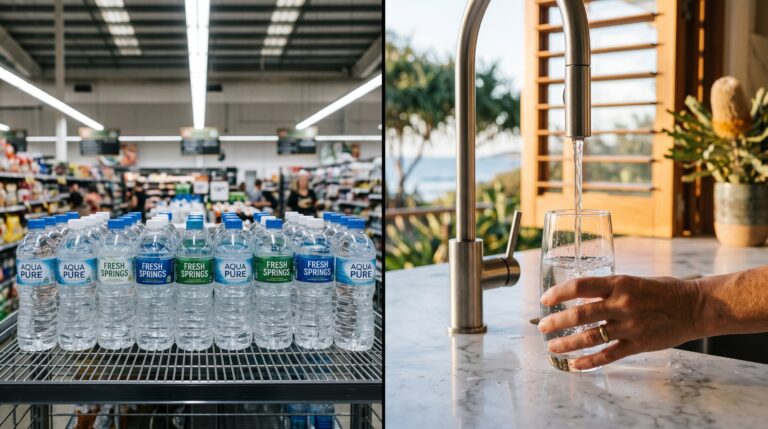
The cost-per-litre comparison makes the bottled water habit look expensive fast. At $1/litre for a 2-litre bottle of decent spring water, you spend $730/year for coffee water alone. The TAPP EcoPro at $0.13-0.18/L costs roughly one-sixth of that, removes chloramine effectively, and produces water that is consistently better for extraction than any bottled spring water whose mineral content you cannot verify.
The NSF International certification database notes that coffee machine water filter components require replacement every three filtration cycles or once per hour of machine operation to maintain certified performance — a figure that reflects commercial espresso environments rather than domestic use. For home use, follow the manufacturer’s litre-based replacement schedule rather than time-based intervals. The TAPP EcoPro cartridge, for example, is rated for approximately 1,200 litres before catalytic carbon performance degrades. At 2 litres/day coffee use, that is 600 days — just under two years per cartridge. Actual replacement costs at that interval are modest.
Annual Filter Replacement Cost — Coffee Water Filters, Australia
Estimated annual cartridge replacement cost for 2L/day coffee household; AUD pricing from Australian retailers.
Annual cartridge cost estimated from manufacturer/retailer published prices, 2L/day usage. Bottled water = 730 litres at $1/2L. Bar fill: #3A8A5A = our top pick (TAPP EcoPro); #1A3326 = peer products; #999999 = benchmark. Sources: TAPP Water AU, Waters Co AU, BWT AU, Brita AU.
Final Verdict: Which Coffee Water Filter for Your City
Three questions. Answer them in order and you have your filter.
Question 1: What city are you in?
Melbourne or Hobart: your water uses free chlorine and is already soft. A standard carbon pitcher removes chlorine without disturbing your mineral balance. The Brita Marella Classic is sufficient. You do not need to spend more unless you want the magnesium enhancement of the BWT Mg2+ for espresso quality improvement.
Brisbane, Sydney, Adelaide, Gold Coast, or Darwin: your water uses chloramine. Standard carbon filters are not effective. You need catalytic carbon (TAPP EcoPro, Waters Co Bio 500) as a minimum.
Canberra: free chlorine, moderate TDS around 40-70. Standard carbon block is fine.
Question 2: How hard is your water?
If you are in Perth (hardness ~180 mg/L CaCO3) or Adelaide (~140 mg/L), scale accumulation in your espresso machine is a real risk. Ion-exchange softening — the BWT Mg2+ pitcher or a Brita Purity C inline system — is the correct tool. Do not use full RO. Partial softening targets the hardness while preserving TDS in the extraction-friendly range.
If you are in Brisbane or Sydney (hardness 60-120 mg/L), you are in the workable middle range. Catalytic carbon alone is sufficient — you do not need softening.
Question 3: What brewing method?
Espresso: water hardness matters most. Scale accumulates in boilers and on heating elements. Use the BWT Mg2+ in hard water cities, TAPP EcoPro in moderate-hardness chloramine cities.
Pour-over and filter coffee: chloramine removal is the priority. Chloramine off-notes are highly detectable in black filter coffee and long brew methods. TAPP EcoPro or Waters Co Bio 500.
Cold brew: cold extraction is slower and less efficient. Mineral content matters more than in hot brewing methods. The BWT Mg2+ or Waters Co Bio 500 produces water with the mineral profile that supports cold extraction. Avoid full RO for cold brew — flat, under-extracted cold brew is the predictable result.
Water Filter by Machine Type — Quick Reference
Your machine type determines which filtration property matters most — scale protection, chloramine removal, or mineral balance for open-basket extraction.
| Machine | Perth / Adelaide Hard water, chloramine |
Brisbane / Sydney Moderate, chloramine |
Melbourne / Hobart Soft, free chlorine |
|---|---|---|---|
| Breville Barista Express / Pro | BWT Mg2+ Penguin | TAPP EcoPro Benchtop | Brita Marella Classic |
| Breville Dual Boiler / Oracle | BWT Mg2+ + catalytic pre-filter | TAPP EcoPro or Waters Co Bio 500 | Brita Marella Classic or BWT Mg2+ |
| DeLonghi La Specialista / Dedica | BWT Mg2+ Penguin | TAPP EcoPro Benchtop | Brita Marella Classic |
| Nespresso Original (Essenza, Pixie, CitiZ) | BWT Mg2+ Penguin | TAPP EcoPro Benchtop | Brita Marella Classic |
| Nespresso Creatista / Lattissima (BWT Intenza slot) |
BWT Intenza cartridge | BWT Intenza + TAPP EcoPro upstream | BWT Intenza cartridge |
| Moka pot / stovetop | BWT Mg2+ Penguin | TAPP EcoPro or Waters Co Bio 500 | Brita Marella Classic |
| Pour-over / AeroPress / Chemex | Waters Co Bio 500 | TAPP EcoPro or Waters Co Bio 500 | Brita Marella Classic |
Ready to dial in your coffee water?
The TAPP EcoPro Benchtop is the top-rated coffee water filter for Brisbane and Sydney households — catalytic carbon removes chloramine, retains the minerals your extraction needs, and costs under $0.18 per litre filtered.
Last reviewed: June 2026 — Clean and Native
Frequently Asked Questions
Melbourne tap water from the Yarra Valley catchment has TDS around 20-60 mg/L and hardness approximately 25 mg/L CaCO3 — already close to the Specialty Coffee Association’s target mineral range. Melbourne Water uses free chlorine (not chloramine), which a standard carbon block removes effectively. A basic carbon pitcher like the Brita Marella Classic is sufficient for Melbourne coffee households. Full RO is unnecessary and counter-productive for espresso.
Brisbane and Sydney use chloramine as their disinfection method, not free chlorine. Standard granular activated carbon (GAC) in Brita jugs removes free chlorine efficiently but removes chloramine at approximately 1/40th that rate. Your Brita is removing almost no chloramine from Brisbane or Sydney tap water. You need a catalytic carbon filter — the TAPP EcoPro or Waters Co Bio 500 — which uses modified carbon chemistry to break down chloramine molecules directly.
Full RO water with TDS below 50 mg/L is aggressive and corrosive. It will leach metal ions from boilers, group heads, and heat exchangers over time. The Specialty Coffee Association Water Quality Handbook specifies a minimum TDS of 75 mg/L to protect machine components. Some espresso machine manufacturers void warranties on machines operated with sub-specification low-TDS water. If you use an RO system, add a remineralisation post-stage to bring TDS back into the 75-175 mg/L range before using it for espresso.
The Specialty Coffee Association’s Water Quality Handbook specifies a target TDS of 150 mg/L (acceptable range 75-250 mg/L), calcium hardness of 75-175 mg/L CaCO3, and a target magnesium level of 10-30 mg/L. Total alkalinity (bicarbonate buffering) should sit around 40-70 mg/L as CaCO3. These figures reflect the ionic environment that optimises extraction of aromatic compounds, sweetness, and acidity while protecting machine components from corrosion and scale.
Published coffee water chemistry research indicates magnesium ions extract different coffee compounds than calcium, with magnesium-rich water associated with higher concentrations of compounds linked to sweetness and aromatic complexity. The BWT Mg2+ filter uses ion exchange to add magnesium while reducing calcium hardness. This is not marketing — there is a peer-reviewed extraction mechanism behind the product’s design. It is widely used by World Barista Championship competitors.
Unfiltered Perth tap water at approximately 180 mg/L CaCO3 hardness will cause significant scale accumulation in espresso machine boilers, heating elements, and group heads. Perth households can expect to descale every four to six weeks without filtration. Partial softening via a BWT Mg2+ pitcher or an inline Brita Purity C system is the recommended approach — reducing hardness to the 75-140 mg/L range without stripping TDS to zero. Full RO is not recommended for the reasons above. Perth metro water uses free chlorine, which the BWT standard GAC cartridge removes effectively; catalytic carbon is not required for chloramine in Perth.
ZeroWater reduces TDS to near zero — typically below 10 mg/L. This strips out the calcium and magnesium that carry extraction compounds out of ground coffee during brewing. The result in pour-over is a flat, under-extracted cup with reduced sweetness and complexity. ZeroWater is designed for drinking water where zero TDS is the goal. For coffee, it is the wrong technology. Use a catalytic carbon filter that retains minerals instead.
Follow the manufacturer’s litre-based replacement schedule rather than time-based intervals. TAPP EcoPro catalytic carbon cartridges are rated for approximately 1,200 litres before performance degrades. At 2 litres/day for coffee, that equates to roughly 600 days per cartridge. Brita Maxtra cartridges are rated for 150 litres (approximately 4 weeks at 4-6 litres/day household use). BWT Mg2+ cartridges are rated for 120 litres. NSF International guidance for commercial espresso applications specifies cartridge replacement every three filtration cycles for certified performance, though this reflects high-volume commercial environments rather than domestic use.
Cold brew extraction is slower and less solvent-efficient than hot brewing, making water mineral content more critical. Use water in the 100-175 mg/L TDS range with meaningful magnesium content. The BWT Mg2+ pitcher or Waters Co Bio 500 both produce water in this range. Avoid full RO water for cold brew — under-extraction is the predictable result. For Brisbane and Sydney cold brew enthusiasts, remove chloramine first with catalytic carbon; chloramine off-notes are detectable even in cold extracted coffee.
Get the Australian Home Environment Checklist
30 checks across water, air and EMF. Most of them free. Ranked by impact.
No spam. Unsubscribe any time.

Former Royal Australian Navy Clearance Diver and TAG-E counter-terrorism operator. Founded Clean and Native to apply the same rigorous thinking to the home environment.
Full biography →