Best Grounding Shoes Australia 2026: Earth Runners, Barefoot, and What Actually Works
Only footwear with a conductive sole actually grounds you — standard rubber-soled minimalist shoes, no matter how thin, insulate you from the earth completely. Earth Runners solve this with a copper plug and conductive lace system, and they are the only grounding sandal sold through Australian stockists with documented conductive pathways.
Quick Verdict — Best Grounding Shoes Australia 2026
The best grounding shoes in Australia in 2026 are the Earth Runners Circadian — the only widely available sandal with a verified copper conductive plug and conductive lace that completes an electrical pathway from foot to soil. Most barefoot and minimalist shoes use standard rubber soles and provide zero earthing benefit regardless of how thin or flexible they feel.
| Product | Best For | Verdict |
|---|---|---|
| Earth Runners Circadian | Daily walking, errands, casual outdoor | Top pick — verified conductive pathway |
| Earth Runners Alpha | Trail, hiking, rugged terrain | Best for outdoor activity |
| Children’s Earth Runners | Kids who play outside barefoot anyway | Solid gift option |
Why Most “Barefoot Shoes” Don’t Ground You
This is the single most important thing to understand before you spend $150 on a pair of “natural” sandals. Earthing — the practice of direct electrical contact with the earth’s surface — requires a conductive pathway from your foot to the ground. That pathway is blocked the moment any insulating material sits between skin and soil.
Rubber is an insulator. Leather is an insulator. EVA foam is an insulator. The thickness of the sole is almost irrelevant — a 3mm rubber sole is as electrically isolating as a 30mm one. The peer-reviewed research on earthing, including the 2012 review published in the Journal of Environmental and Public Health by Chevalier et al., consistently defines “earthing” as direct skin-to-ground contact or connection via a conductive medium. A standard minimalist shoe — Vibram Five Fingers, Luna Sandals, Xero Shoes, Merrell Vapor Gloves — provides zero grounding benefit regardless of how ground-like the experience feels underfoot.
Several brands market “grounded” or “earthing” shoes with brass rivets pressed through the sole. This can work — if the rivet actually contacts both skin and the earth’s surface simultaneously, and if the metal is not corroded or painted over. The critical variable is continuity. Earth Runners use a copper plug set into the midsole that protrudes slightly through the outsole, connected to a conductive lace threaded between the toes. When the lace touches bare skin and the plug contacts moist ground, the circuit is complete. That is a real conductive pathway.
Brands like Bahé (€149, roughly AUD $245) and Harmony 783 (approximately AUD $270 after currency conversion) market themselves on similar principles, but neither is stocked by Australian retailers and both carry significant currency risk and international shipping costs for Australian buyers. The Australian-stocked option with documented conductive design is Earth Runners, available through Earthing Oz.
✓ Who This Is For
- Adults already practising barefoot earthing who want outdoor mobility
- Brisbane, Cairns, and coastal QLD residents with year-round outdoor lifestyle
- People who spend meaningful time on grass, beach sand, or damp earth daily
- Those who have already tried grounding mats and want to extend practice outdoors
- Hikers and trail walkers who want grounding during active movement
× Who It Is Not For
- Anyone expecting EMF shielding — grounding shoes do not block RF radiation
- Office workers on concrete floors — concrete blocks conductivity unless damp
- People walking primarily on asphalt or sealed pavement — no grounding occurs
- Those wanting an indoor grounding solution — a grounding mat is more practical indoors
- Buyers expecting these to replace other EMF reduction measures in the bedroom
#1 Earth Runners Circadian — Best Grounding Sandal for Everyday Wear

✓ Pros
- Documented copper conductive plug — verified electrical pathway to earth
- Conductive lace threads between toes for direct skin contact
- Australian stockist (Earthing Oz) — no international shipping, currency risk, or customs delays
- Leather upper ages well in QLD humidity; sandal construction breathes in summer heat
✗ Cons
- Conductivity drops significantly on dry concrete, sealed asphalt, or dry sand — surface moisture is required
- Sandal format not suited to cold southern states (Melbourne, Hobart) through winter months
- No formal third-party conductivity rating published — relies on manufacturer’s stated design
How the Conductive System Works
The Circadian’s copper plug is pressed into the midsole foam and protrudes fractionally through the outsole rubber at the ball of the foot — the contact point with the ground. The conductive lace runs from this plug up between the first and second toe, completing the circuit when bare skin touches the lace. In practice, this means the earthing connection is active only when the plug contacts a conductive surface. Dry, sealed, or heavily trafficked surfaces break the circuit.
Surface Conductivity in Australian Conditions
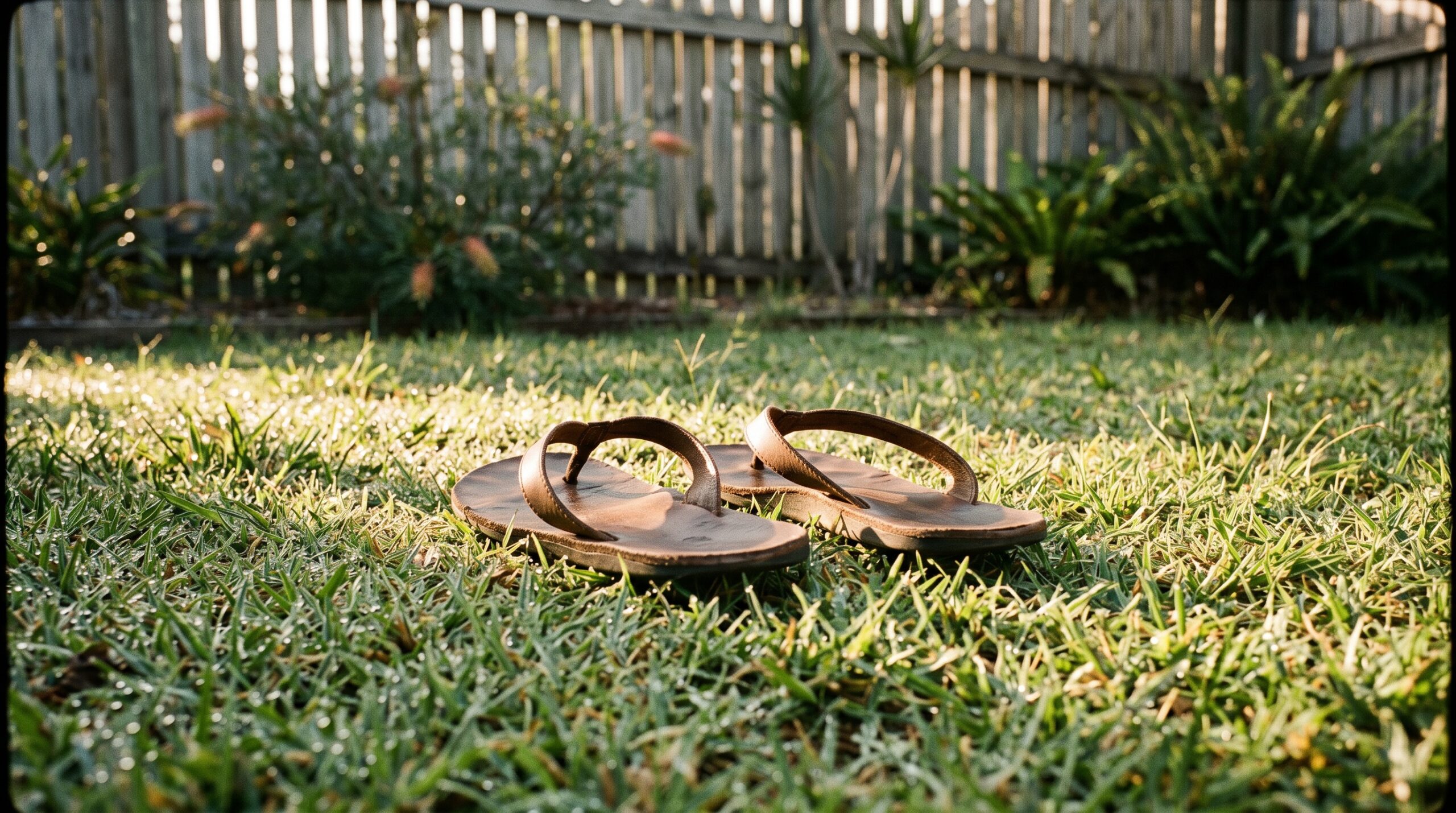
Morning dew on grass — which covers virtually every Queensland backyard between April and October — provides excellent conductivity. Damp beach sand is highly conductive. Dry sandy soil in Perth or inland Queensland is significantly less conductive, particularly in summer. The practical implication: grounding shoes work best in coastal environments with regular rainfall, which aligns well with Brisbane, Cairns, Darwin, and coastal NSW. Perth in summer and inland Victoria in dry periods will deliver less consistent earthing contact.
Sole Thickness and Ground Feel
The Circadian uses a 6mm Vibram Cherry outsole — thin enough that you feel terrain variation clearly underfoot, thick enough to handle most suburban and coastal trail surfaces without discomfort on gravel. This sits in the barefoot shoe category by most definitions (under 8mm stack height). For comparison, a standard New Balance runner runs 25-35mm stack height; the Circadian at 6mm actually changes proprioceptive feedback when walking on natural surfaces.
Running Cost Over 5 Years
Earth Runners Circadian sits at approximately AUD $140-$180 per pair through Earthing Oz. The leather upper and Vibram outsole are both repairable — replacement laces cost under $20 and Earth Runners stocks them. With basic care (rinse after beach use, occasional leather conditioning), a pair should last 3-5 years of regular daily wear. That works out to roughly $36-$60 per year, or under $5 per month — less than a single takeaway coffee per week for daily outdoor earthing practice.
#2 Earth Runners Alpha — Best for Trail and Active Outdoor Use

✓ Pros
- Thicker Vibram outsole handles sharp gravel, root-laced trails, and rocky terrain
- Same verified copper conductive system as the Circadian
- Aggressive tread increases grip on wet bush trail surfaces — relevant in QLD rainforest
- Nylon straps are more durable than leather in wet/muddy conditions
✗ Cons
- Heavier sole than Circadian — slightly less ground feedback on casual walking
- Overkill for urban or suburban daily use where Circadian is sufficient
- Higher price point than the Circadian — confirm current pricing at Earthing Oz before purchase
Who the Alpha Is Actually For
If you are walking the Gold Coast Hinterland trails, the Blue Mountains, or doing the Bibbulmun Track sections in WA, the Circadian’s lighter sole will show wear faster and offer less protection on sharp shale and rocky creek beds. The Alpha’s thicker Vibram lug sole handles that terrain without compromising the conductive pathway — the copper plug still protrudes through the outsole at the ball of the foot.
Wet Weather Performance in Australian Conditions
Northern Queensland rainforest trails, coastal NSW national parks, and the Wet Tropics all involve stream crossings and sustained mud. The Alpha’s nylon webbing straps dry fast and resist stretch when wet. Leather straps (as on some Circadian variants) can stiffen when repeatedly saturated and dried. For anyone hiking in high-rainfall zones — Cairns hinterland, Daintree, or the Atherton Tablelands — the Alpha’s materials hold up better over a full day of wet terrain.
Conductivity on Trail Surfaces
Wet leaf litter, damp clay, and mossy rock are all highly conductive surfaces that activate the copper plug effectively. Dry sandstone, granite slabs, and sealed fire trails are not conductive. The practical reality of trail hiking is that you are constantly crossing between conductive and non-conductive surfaces, so earthing on a trail walk is intermittent rather than continuous — but meaningful contact time still accumulates over a multi-hour walk.
Grounding Footwear — Earthing Oz AU
Children’s Earth Runners — Grounding Sandals for Kids

✓ Pros
- Same verified conductive copper plug system as adult models
- Gives foot protection on gravel and rough surfaces without blocking the grounding connection
- Practical for school holidays and outdoor play in QLD and coastal NSW conditions
- Gifts well — a differentiated, purposeful gift for parents invested in natural health
✗ Cons
- Children grow fast — sizing lifespan may be under 12 months for younger children
- Conductive lace between toes requires correct fit to maintain skin contact — check sizing carefully
- Not appropriate for formal school footwear requirements in most Australian states
#4 earthinglife Grounding Clogs — Best Option on Amazon AU

The earthinglife Grounding Clogs use graphene-enhanced rubber rather than a copper plug, making them a closed-toe option suitable for cooler months in southern states where sandals aren’t practical year-round. Graphene conducts electricity and makes direct skin contact at the footbed. The adjustable heel strap keeps the fit snug enough to maintain footbed contact during walking. Available on Amazon AU with standard Prime delivery across Australia — no customs delays or international shipping.
Where Grounding Shoes Actually Work — Surface Conductivity Guide
This is the part most grounding shoe articles skip entirely. A conductive sole is necessary but not sufficient. The ground beneath the plug must also conduct electricity. Dry surfaces — sealed concrete, asphalt, hardwood decking, ceramic tiles — are insulators regardless of what you are wearing. The following table covers the surfaces most Australian buyers will encounter.
| Surface | Conductivity | Notes for Australian Conditions | Grounding Shoes Work? |
|---|---|---|---|
| Damp grass (morning dew) | Excellent | Reliable in QLD, coastal NSW, and NT most of the year | Yes |
| Wet beach sand | Excellent | Saltwater-saturated sand is one of the most conductive surfaces available | Yes |
| Damp soil / clay | Good | Garden beds, creek banks, rainforest trail — highly effective | Yes |
| Wet leaf litter / mud | Good | Common on QLD and NSW bush trails after rain | Yes |
| Dry sand (Perth summer) | Moderate | Dry quartz sand has low conductivity — above the tideline in summer | Inconsistent |
| Dry grass / lawn (no dew) | Low | Common in Melbourne and Adelaide summer afternoons | Unreliable |
| Sealed concrete (outdoor) | Very low | Sealed and cured concrete is an effective insulator when dry | No |
| Asphalt / bitumen | None | Petroleum-based binder — fully insulating regardless of moisture | No |
| Timber decking | None | Treated pine and hardwood decking are insulators — common in QLD outdoor areas | No |
| Rocky granite / sandstone | None when dry | Common on Blue Mountains and WA trails — no grounding when dry | No (dry) |
The practical takeaway for Australian buyers: if you live in coastal Queensland, the Northern Territory, or coastal NSW, morning grass and beach sand give you consistent grounding opportunities almost year-round. Melbourne and Adelaide residents will find the window narrower — early morning damp grass works, but summer dry conditions reduce effectiveness significantly. Perth buyers should focus on beach access (highly conductive wet sand) rather than relying on suburban lawn.
Grounding Shoes vs Grounding Mat — Which Gives You More Earthing Time?
This question matters because most people overestimate how much outdoor earthing time they actually accumulate, and underestimate how much time they spend stationary indoors. The research that supports earthing — including the Chevalier 2012 review and Oschman et al. 2015 in the Journal of Inflammation Research — focuses on sustained contact, typically measured in 30-minute plus sessions. A five-minute walk to the car does not move the needle.
Grounding shoes give you earthing during natural movement on conductive surfaces. That has real value, particularly for people who already take regular beach walks, do gardening, or spend meaningful outdoor time in coastal environments. But the grounding contact is intermittent — you step on and off conductive surfaces constantly during a walk, and on most suburban footpaths and roads you are fully insulated the whole time.
A grounding mat used at a desk for four to eight hours per day delivers more total contact time than most people accumulate with grounding shoes in a week. The two are not competing — they serve different contexts. Grounding shoes are the outdoor mobility option. A mat is the indoor stationary option. If you have to choose one on a budget, the mat typically delivers more measurable earthing hours per day for most Australians who work indoors.
| Factor | Grounding Shoes (Earth Runners) | Grounding Mat (Indoor) |
|---|---|---|
| Upfront cost | ~AUD $140-$180 | ~AUD $80-$180 |
| 5-year cost | ~$180-$360 (2 pairs, minor lace replacement) | ~$80-$180 (mat may last 5+ years with care) |
| Average daily contact (Australian indoor worker) | 20-60 min (conductive surface dependent) | 2-8 hours (desk or sleep use) |
| Requires outdoor access | Yes | No |
| Works in all weather | No (dry surfaces = no grounding) | Yes |
| Works in apartment / no yard | Limited | Yes (plugged into grounded wall outlet) |
| Also provides foot protection | Yes | No |
| Best for | Active outdoor lifestyles, coastal living | Indoor workers, apartment dwellers, year-round use |
The honest answer for most Australian buyers: start with a grounding mat if you work indoors more than four hours per day and want the most earthing contact time per dollar. Add grounding shoes if you already have a regular outdoor routine — beach walking, park runs, gardening — where you can accumulate meaningful time on conductive surfaces. See the full grounding mats guide for indoor options reviewed for Australian conditions.
International Grounding Shoe Brands — What About Bahé, Harmony 783, and Hemp Haven?
Three international brands come up repeatedly in online grounding shoe discussions. Here is the factual situation for Australian buyers as of mid-2026.
Bahé (UK/Europe) prices at approximately €149, which converts to roughly AUD $245 at current rates. They are not stocked in Australia. International shipping adds $30-60, and any warranty claim requires returning the product to the UK. Their claimed conductive system uses a carbon-infused rubber outsole — a legitimate approach — but no third-party conductivity data is publicly available for their specific formulation.
Harmony 783 (Vietnam-based) prices at approximately 4,545,000₫ — roughly AUD $270 delivered. Again, no Australian stockist. Currency exposure, international shipping delays, and no local warranty support make this a difficult purchase for most buyers.
Hemp Haven is an Australian-based brand at roughly AUD $115-$120 per pair. They use natural hemp canvas and leather, which is appealing from a materials standpoint. Their conductivity claim is based on a brass rivet system pressed through the outsole. The rivet approach can work — but the exposed brass surface area is small, and the rivet location may not correspond to consistent skin contact depending on foot shape. No independent conductivity verification is published. For Australian buyers, Hemp Haven’s local availability and pricing is actually competitive with Earth Runners — it is worth investigating their current sizing and construction specs directly before making a decision.
Earth Runners’ advantage for Australian buyers is primarily logistical: stocked by Earthing Oz, shipped domestically, and with a documented conductive design that has been in production long enough to have accumulated real-world user data internationally.
A Note on Grounding Shoes and EMF Reduction
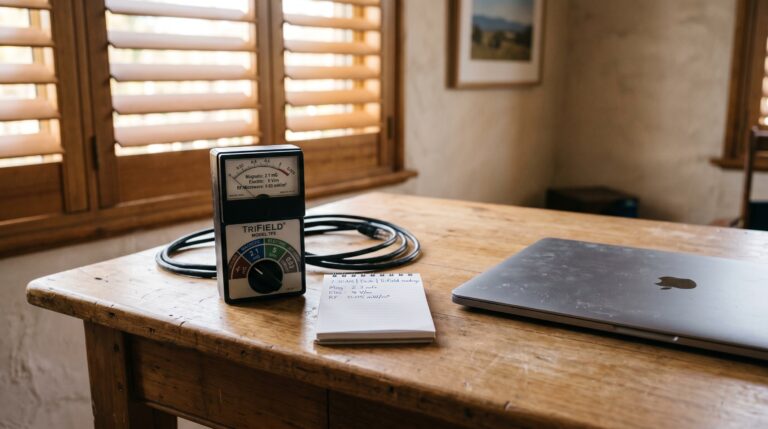
Be direct here: grounding shoes do not reduce your exposure to radiofrequency (RF) radiation from mobile phones, Wi-Fi, or smart meters. They do not shield you from electric or magnetic fields. The ARPANSA RF limit at 2.4 GHz is 1,000 microwatts per square centimetre — a safety threshold based on thermal effects, not a precautionary standard. Grounding shoes do not affect your RF exposure at all.
Earthing is a separate practice from EMF reduction. The proposed mechanisms are different: earthing is about electron transfer from the earth’s negative charge gradient to the body; EMF reduction is about reducing the amplitude of external electromagnetic fields reaching you. These are distinct physical phenomena and require different interventions.
If your primary concern is RF exposure in the bedroom, start with the highest-impact low-cost interventions: a Jackson 24-hour mechanical timer (ASIN B0DCGPPK5H, approximately $20 on Amazon AU) to cut your Wi-Fi router overnight, and your phone in airplane mode while sleeping. These two actions cost under $25 combined and address the sources closest to you during sleep. Grounding shoes are a complementary wellness practice, not a substitute for source reduction. See the complete earthing products guide for the full picture.
Last reviewed: June 2026 — Clean and Native
Final Verdict
The Earth Runners Circadian is the best grounding sandal available to Australian buyers in 2026. It is the only widely stocked option with a documented copper conductive plug system, available domestically through Earthing Oz without international shipping complexity. For trail and active outdoor use, the Alpha is the same conductive system in a more durable package. Both earn their place in a serious outdoor earthing practice.
Buy the Circadian if you spend regular time on damp grass, beach sand, or bush trails in coastal QLD, NSW, or the NT. Buy the Alpha if your terrain is rugged — national park trails, river crossings, bush camping. If you are primarily indoors or live in a dry inland climate, a grounding mat will deliver more total earthing hours per dollar — check the grounding mats guide before spending on footwear.
One honest caveat before you purchase: the research on earthing is promising but not conclusive at the level required to make specific health outcome claims. The Chevalier 2012 review and subsequent small trials show interesting physiological signals. None of this is peer-reviewed at the scale of pharmaceutical trials. Buy grounding shoes because you enjoy spending time outdoors barefoot and want foot protection — not because you are expecting a documented clinical outcome.
The Circadian is the practical choice for most Australian buyers.
Documented copper conductive system, Australian stockist, sandal construction suited to the Queensland and coastal NSW climate. If you walk on damp grass or beach sand regularly, this is the grounding footwear that will actually work.
Frequently Asked Questions
Grounding shoes work if and only if two conditions are met: the sole contains a verified conductive element (copper plug, carbon-infused rubber, or metal rivet), and the surface you are walking on is conductive (damp grass, wet sand, moist soil). Standard rubber-soled barefoot shoes — regardless of how thin the sole is — do not ground you. Earth Runners use a documented copper plug system that satisfies the first condition; surface selection satisfies the second.
Dry sealed concrete is an insulator and does not allow earthing. Damp, unsealed concrete can be mildly conductive, but most suburban footpaths and driveways are sealed and provide no grounding benefit. For most Australian suburban environments, grounding shoes work on grass, soil, and beach sand — not footpaths or roads.
Both use the same copper conductive plug and conductive lace system. The Circadian has a lighter 6mm Vibram Cherry sole suited to casual walking, beach use, and urban outdoor environments. The Alpha has a thicker, more aggressive tread Vibram sole designed for trail hiking, rocky terrain, and wet bush conditions. Choose the Circadian for everyday use; choose the Alpha for hiking and active outdoor activity.
No. Grounding shoes do not reduce radiofrequency (RF) radiation exposure, nor do they shield electric or magnetic fields. Earthing and EMF reduction are separate practices addressing different physical phenomena. If RF exposure is your concern, source reduction — turning off Wi-Fi at night, using phone on airplane mode during sleep — is the effective intervention.
Yes. Earth Runners are stocked by Earthing Oz, an Australian retailer, which means domestic shipping, no currency conversion risk, and local warranty support. International brands like Bahé (UK) and Harmony 783 (Vietnam) are not available through Australian stockists as of mid-2026 and involve significantly higher landed costs and longer shipping times.
They serve different purposes. Grounding shoes deliver earthing during outdoor movement on conductive surfaces. A grounding mat delivers sustained indoor contact hours while seated at a desk or sleeping. For most Australians who work indoors, a mat provides more total daily earthing contact than shoes worn on suburban surfaces. The two are complementary rather than competing.
With normal care — rinsing after beach use, occasional leather conditioning — Earth Runners Circadian sandals should last 3-5 years of regular daily wear. The Vibram outsole is durable and the leather upper handles Queensland humidity well. Replacement conductive laces are available from Earth Runners for under $20, extending the life of the sandal if the lace wears before the sole.
Dry sand above the tideline has low conductivity and provides unreliable grounding. Wet sand at and below the tideline — saturated with seawater — is one of the most conductive natural surfaces available, and grounding shoes work well in this zone. For beach use, walk in the wet sand zone rather than the dry upper beach for consistent earthing contact.
Hemp Haven is an Australian-based brand offering grounding sandals at approximately AUD $115-$120 using a brass rivet conductive system. They are not manufactured in Australia but are sold and shipped domestically. Earth Runners are an American brand stocked in Australia through Earthing Oz. No grounding footwear is currently manufactured in Australia as of mid-2026.
Get the Australian Home Environment Checklist
30 checks across water, air and EMF. Most of them free. Ranked by impact.
No spam. Unsubscribe any time.

Former Royal Australian Navy Clearance Diver and TAG-E counter-terrorism operator. Founded Clean and Native to apply the same rigorous thinking to the home environment.
Full biography →