Best Water Distillers Australia 2026: Ranked by Fluoride, PFAS and Running Cost
Drafted with AI assistance and checked against published specifications and certifications. First-hand measurements appear only where stated. How we make content
Disclosure: Clean and Native earns a commission on qualifying purchases at no extra cost to you. Our picks are based on independent research and our documented testing methodology — we never recommend products we wouldn’t use ourselves. Full disclosure policy →
A countertop water distiller removes 99%+ of fluoride, PFAS, heavy metals, bacteria, viruses, chloramine, and microplastics from Australian tap water — outperforming every residential filter technology on total dissolved solids removal. The Megahome MH943S is the best water distiller available in Australia in 2026, combining a 316 marine-grade stainless steel boiling chamber with a 4-litre borosilicate glass collection jug and an activated carbon post-filter for volatile organic compound capture, backed by a dedicated Australian dealer for approximately AU$786.
A 2025 peer-reviewed study published in ACS ES&T Water found 31 PFAS chemicals in Sydney drinking water — 21 of which had never been reported in Australian water before. According to the DCCEEW national register, PFAS contamination has been confirmed at 700+ sites across Australia, and Australia’s PFOA guideline limit remains 140 times higher than the US EPA maximum contaminant level set in 2024. Distillation is the only countertop purification method that eliminates fluoride to near-zero concentrations, removes the full spectrum of PFAS compounds, and requires zero plumbing modification — making it the strongest option for renters and homeowners in fluoridated, chloramine-treated cities including Brisbane, Sydney, Adelaide, and Gold Coast. Distillation reliably produces the lowest TDS output of any residential purification method available in Australia, because its phase-change process leaves dissolved solids behind in the boiling chamber rather than passing water through a filter medium (see our methodology). — Jayce Love, Navy Clearance Diver (retired), Clean and Native
Quick Verdict — Best Water Distillers Australia 2026
If you want the deepest contaminant removal available for an Australian home — one system that handles fluoride, PFAS, heavy metals, bacteria, viruses, chloramine, and microplastics in a single phase-change process — a countertop water distiller does what no filter can match. The tradeoff is time: a 4-litre batch takes 5–6 hours, so you run it overnight or while at work. Running cost at the Australian average electricity rate of 30c/kWh is approximately $0.24 per litre.
- Best Overall: Megahome MH943S — 316 marine-grade stainless chamber, 4L borosilicate glass jug, activated carbon post-filter, full AU dealer support (~AU$786)
- Budget Pick: Waterwise 4000 — identical distillation purity, stainless steel collection vessel, lowest upfront cost, no AU dealer (~AU$93–$150)
- AU Retailer Budget: Ace Water Shop 4L — cheapest AU-stocked option, basic build quality, AU-based returns (~AU$199–$220)
✓ Who Should Buy a Water Distiller
- Renters who cannot install under-sink RO or modify plumbing
- Anyone who wants 99%+ fluoride removal — higher than RO’s 90–97% range
- Households in PFAS-affected areas (Western Sydney, Williamtown, Oakey, Katherine) wanting maximum removal without membrane replacement
- Off-grid properties, caravans, and tiny homes with limited plumbing
- People who distrust filter replacement schedules and want a system with no membrane to fail
× Who Should Choose Something Else
- Families needing 10+ litres per day — an under-sink RO system produces water on demand without batch-waiting
- Anyone who only wants chlorine or chloramine removal — a catalytic carbon filter costs a fraction and works instantly
- Buyers unwilling to run a 5–6 hour cycle or plan water usage in advance
- Hard water areas (Adelaide at ~400 TDS, Perth at ~170 TDS) where heavy scale buildup means weekly descaling rather than monthly
How Water Distillation Works — And Why It Outperforms Filtration in 2026
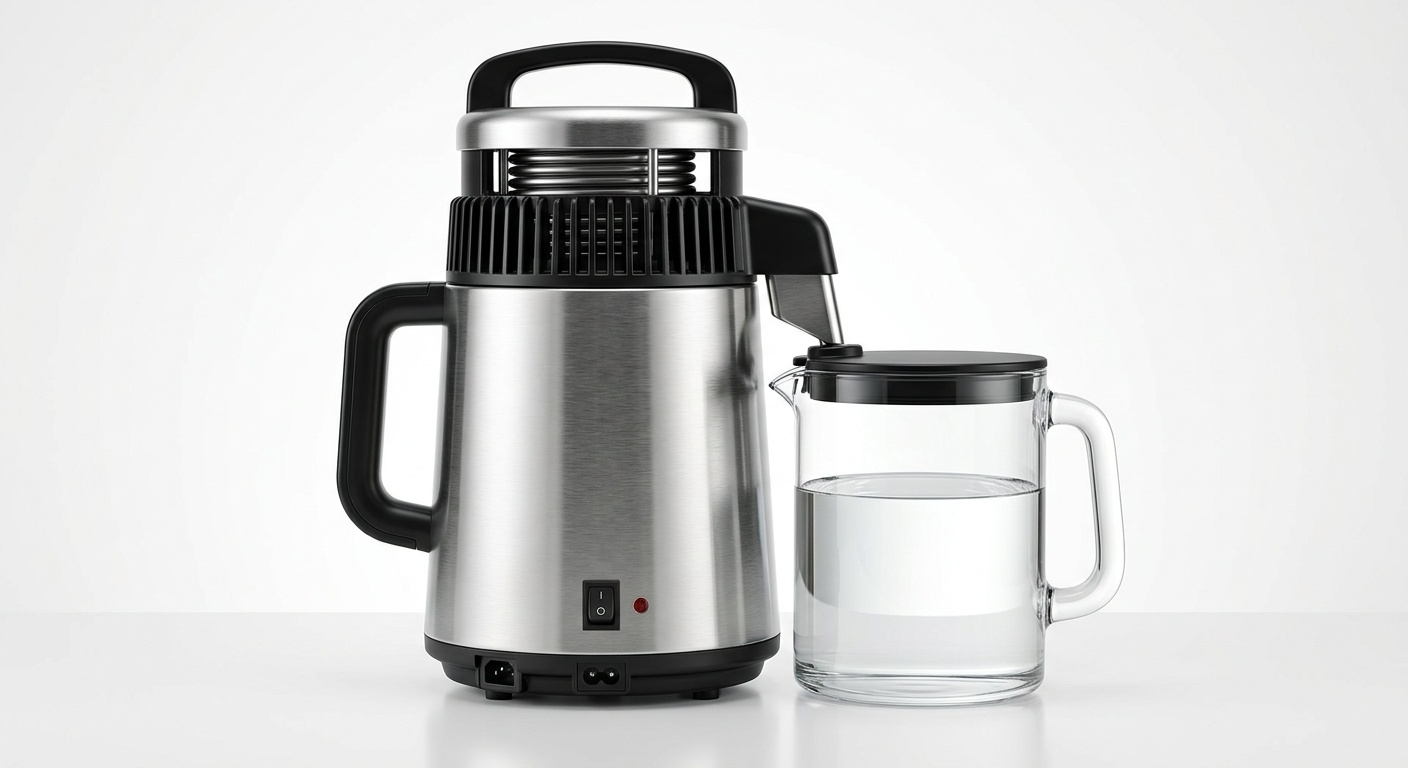
Distillation is a phase-change process, not a filter. Tap water enters the stainless steel boiling chamber and is heated to 100°C. The steam rises through a vent, passes through a condensation coil cooled by a fan, and collects as liquid water in a separate glass or stainless steel vessel. Every contaminant that does not evaporate at or below 100°C stays behind in the boiling chamber as a visible residue — and that includes fluoride (boiling point 1,695°C), PFAS compounds, lead, mercury, arsenic, nitrates, bacteria, viruses, cysts, and microplastics.
What you collect is essentially re-created rainwater: H₂O with a TDS reading at or near zero. The boiling chamber accumulates a visible mineral and contaminant residue after each cycle, which is the physical proof that the process works. You rinse or scrub it out, refill, and run the next batch.
Water distillation is the process of boiling water and condensing the steam back into liquid form, leaving behind dissolved solids, heavy metals, and biological contaminants. It is the oldest and simplest water purification method, predating every modern filter technology by centuries.
The VOC Exception — Why the Carbon Post-Filter Matters
Volatile organic compounds (VOCs) are the one category that can cross into distillate. VOCs have boiling points at or below 100°C, which means they evaporate alongside the water and condense into the collection vessel. Trihalomethanes (THMs), formed when chlorine or chloramine reacts with organic matter in municipal water, are common VOCs in Australian tap water. According to the ADWG 2025 update, THMs are regulated at 250 µg/L — a limit that some water quality advocates consider too permissive compared to the US EPA limit of 80 µg/L.
The Megahome MH943S addresses this with an activated carbon sachet that sits in the collection jug’s nozzle. Steam passes through the carbon on its way into the glass vessel, adsorbing VOCs before they reach your drinking water. The Waterwise 4000 and Ace Water units use similar carbon inserts. These sachets need replacing every 30 days or roughly every 30 cycles — whichever comes first.
Why Australians Need to Think About Fluoride, PFAS, and Chloramine in 2026
Every major Australian capital city adds fluoride to its water supply at concentrations between 0.6 and 1.0 mg/L, according to NHMRC guidelines. Standard carbon filters — including Brita jugs, ZeroWater pitchers, and benchtop gravity systems — remove zero fluoride. Reverse osmosis removes 90–97% of fluoride according to NSF/ANSI 58 (2023 revision) testing. Distillation removes 99%+ of fluoride because fluoride’s boiling point (1,695°C) means it cannot cross into steam at 100°C.
PFAS contamination is the more urgent concern. According to ABS environmental data, PFAS contamination has been confirmed at 700+ sites across Australia according to the DCCEEW national register. The 2025 ACS ES&T Water study found 31 PFAS chemicals in Sydney drinking water, including 21 previously unreported compounds. Australia’s PFOA guideline limit of 560 ng/L is 140 times higher than the US EPA maximum contaminant level of 4 ng/L set in 2024. Neither standard carbon filters nor gravity systems hold NSF/ANSI P473 certification for PFAS removal. Distillation eliminates PFAS because these compounds do not volatilise at 100°C.
Chloramine treatment complicates the picture further. Brisbane, Sydney, Adelaide, Gold Coast, and Darwin use chloramine (combined chlorine-ammonia) as the primary disinfectant. Standard granular activated carbon (GAC) removes chloramine at approximately 1/40th the rate it removes free chlorine, according to WQA technical data. This means a Brita jug correctly sized for Melbourne’s free chlorine lets most of Brisbane’s chloramine pass straight through. Distillation eliminates chloramine entirely — it cannot survive the boiling process.
Distiller vs RO vs Gravity Filter — Which Technology Should You Choose?
Every residential water purification technology involves a tradeoff. The decision tree below clarifies which system fits your situation. If you need a deeper comparison of reverse osmosis systems specifically, see our best reverse osmosis system Australia 2026 guide.
| Factor | Water Distiller | Reverse Osmosis (Under-Sink) | Gravity Filter (Big Berkey Style) |
|---|---|---|---|
| Fluoride removal | 99%+ ✓ | 90–97% ✓ | 0% ✗ |
| PFAS removal | 99%+ ✓ | >98% (NSF P473) ✓ | Unverified / limited ✗ |
| Chloramine removal | 100% ✓ | 95%+ (catalytic carbon pre-filter) ✓ | Poor — GAC at 1/40th rate ✗ |
| Heavy metals | 99%+ ✓ | >95% ✓ | Partial (lead only with some filters) |
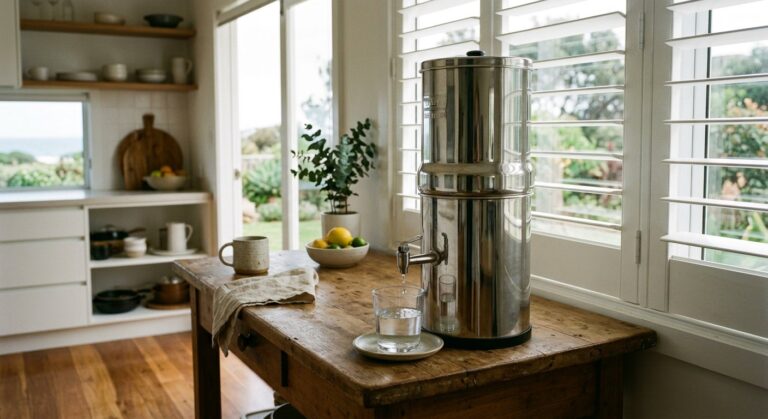
| Plumbing required? | No — plug in and pour ✓ | Yes — under-sink installation | No — countertop ✓ |
| Flow rate | 4L per 5.5 hours (batch) | On-demand (~0.5L/min) | Slow drip (~2L/hour) |
| Running cost per litre | ~$0.24 (electricity) | ~$0.04–$0.08 (filters + waste water) | ~$0.02–$0.05 (filters only) |
| Renter-friendly? | Yes ✓ | Depends on landlord / lease | Yes ✓ |
| Best for | Maximum purity, small households, renters | Families, on-demand drinking + cooking | Basic chlorine removal, non-fluoridated areas |
1. Megahome MH943S — Best Overall Water Distiller in Australia (2026)
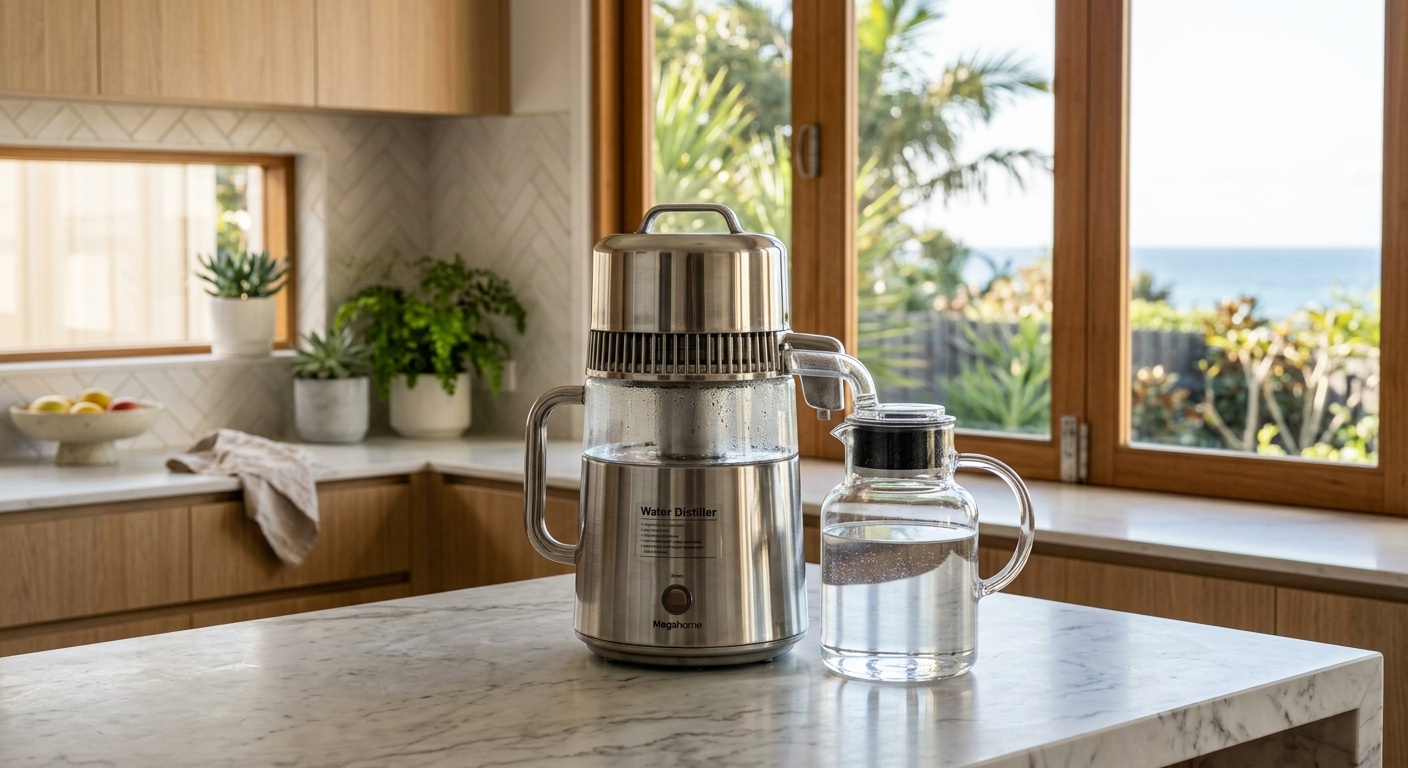
The Megahome MH943S has been the reference-grade countertop water distiller for Australian buyers for over a decade, and in 2026 it remains unchallenged at the top. The unit is manufactured in Taiwan using 316 marine-grade stainless steel for the boiling chamber — the same alloy used in marine hardware and surgical instruments — which resists the corrosive residue that accumulates during distillation cycles far better than 304 stainless alternatives.
The 4-litre borosilicate glass collection jug is the single most important design advantage over cheaper distillers. Borosilicate glass (the same material as Pyrex laboratory equipment) does not leach chemicals into distilled water, whereas stainless steel or plastic collection vessels can introduce trace metals or BPA/BPS into water that has just been stripped of every contaminant. When you have gone to the trouble of producing near-zero TDS water, the last thing you want is to contaminate it with the collection vessel.
What the Megahome Removes
Because distillation is a phase-change process, the Megahome does not rely on filter certifications to demonstrate contaminant removal. Every non-volatile substance in the source water stays in the boiling chamber. The phase-change process produces the following removal profile:
| Contaminant | Removal Rate | Why |
|---|---|---|
| Fluoride | 99%+ | Boiling point 1,695°C — cannot enter steam |
| PFAS (full spectrum) | 99%+ | PFAS compounds do not volatilise at 100°C |
| Lead | 99%+ | Boiling point 1,749°C |
| Mercury | 99%+ | Boiling point 357°C — stays in chamber |
| Arsenic | 99%+ | Boiling point 614°C |
| Chloramine | 100% | Decomposes at boiling temperature |
| Bacteria & viruses | 100% | Killed at boiling temperature, cannot enter steam |
| Microplastics | 99%+ | Solid particles — remain in chamber |
| VOCs / THMs | Addressed by carbon post-filter | Volatiles may cross — carbon sachet adsorbs them |
Running Cost Breakdown — Megahome MH943S
The Megahome draws 580W and runs for approximately 5.5 hours per 4-litre batch. At the Australian average electricity rate of 30c/kWh (AER 2024 residential benchmark), each cycle costs approximately $0.96 in electricity, or $0.24 per litre. That is more expensive per litre than reverse osmosis (~$0.04–$0.08/L) but dramatically cheaper than bottled water at $2–$5 per litre. If you produce one 4L batch per day, your monthly electricity cost is approximately $28.80.
Replacement carbon sachets cost approximately $25–$35 for a 12-pack from the Australian dealer, lasting roughly 12 months at one-batch-per-day usage. No membranes, no multi-stage filter cartridges, no pressure tanks — the ongoing cost is electricity and carbon sachets only.
The One Limitation — Batch Production
The Megahome produces 4 litres every 5.5 hours. That is the rate-limiting factor. A household of two drinking 4 litres per day runs one batch overnight and has water ready by morning. A family of four needing 8 litres would need to run two batches per day — one overnight, one during the workday. If you need more than 8–10 litres per day or require on-demand filtered water for cooking, an under-sink reverse osmosis system is the better fit.
2. Waterwise 4000 — Best Budget Water Distiller on Amazon AU
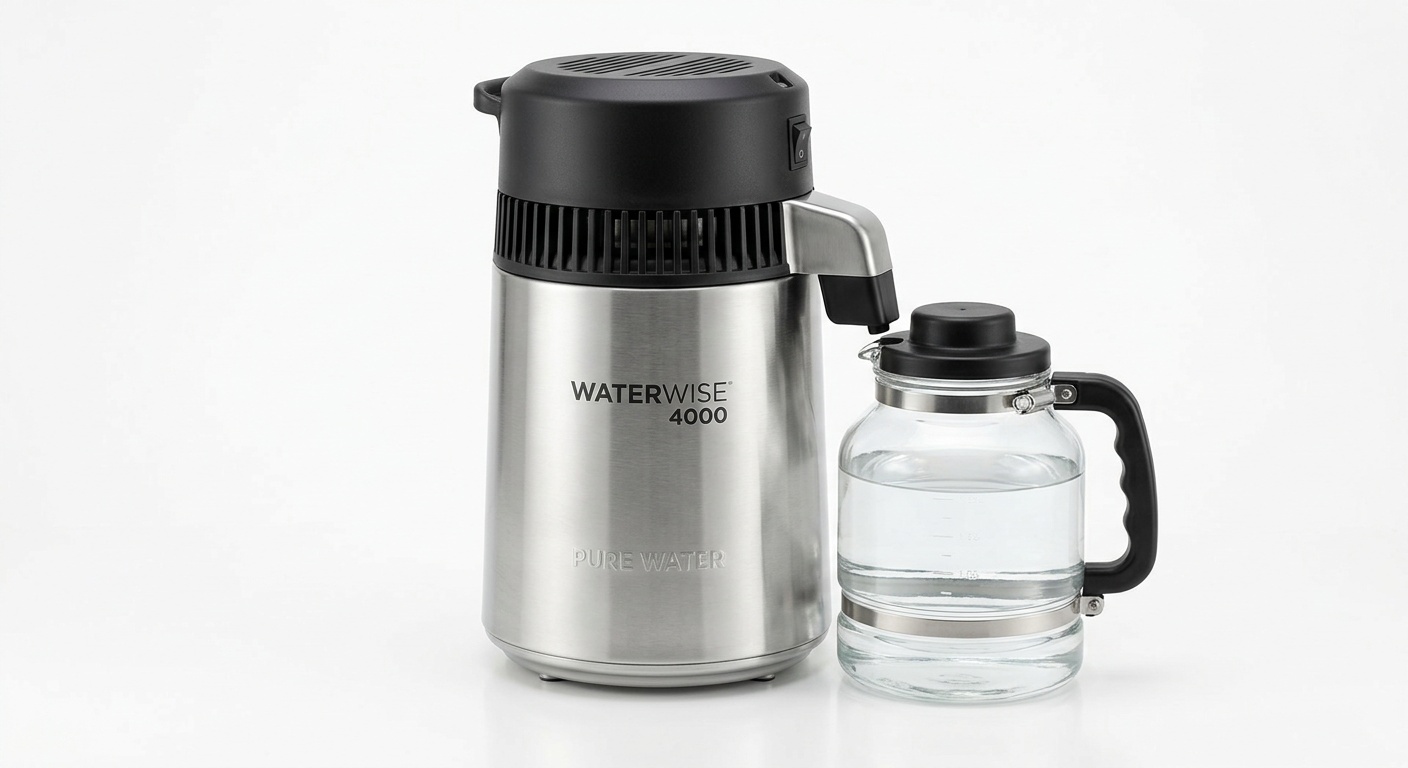
The Waterwise 4000 produces identical-purity distilled water as the Megahome — because the distillation process itself is physics, not engineering. Boiling water and condensing steam produces near-zero TDS water regardless of whether the unit costs $150 or $786. The differences between the two are entirely in materials, build quality, and after-sales support.
The most significant difference is the collection vessel. Where the Megahome uses a borosilicate glass jug (chemically inert), the Waterwise 4000 collects distillate in a stainless steel carafe. Stainless steel is food-safe and far better than plastic, but it is not as chemically inert as borosilicate glass. For water that has been stripped to near-zero TDS, this distinction matters — distilled water is aggressive and will leach trace amounts of whatever it contacts. The practical health difference is minimal, but if you are distilling specifically to achieve maximum purity, glass collection is objectively superior.
Why the Price Varies So Much on Amazon AU
The Waterwise 4000 listing price on Amazon AU fluctuates between AU$93 and AU$150 depending on stock availability and whether it ships from a US-based or AU-based fulfilment centre. At the lower end, it represents extraordinary value — a functional distiller for less than a quarter of the Megahome’s price. At the higher end with international shipping delays, the value proposition weakens.
There is no dedicated Australian dealer for the Waterwise 4000. Replacement parts (heating element, carbon filters, collection vessel) must be sourced through Amazon or US-based suppliers. If the unit develops a fault, there is no local warranty claim process — you rely on Amazon AU’s standard returns policy. For a product that should last 5–10+ years, this lack of local support is the Waterwise’s most meaningful disadvantage.
Clean Water
The right filter removes what this article describes.
Reverse osmosis is the only residential technology that reliably removes PFAS, fluoride, chloramine, and heavy metals. Our guide covers the top-rated options for Australian homes — tested, certified, and ranked.
See the Top-Rated Water Filters →3. Ace Water Shop 4L — Budget AU-Stocked Option
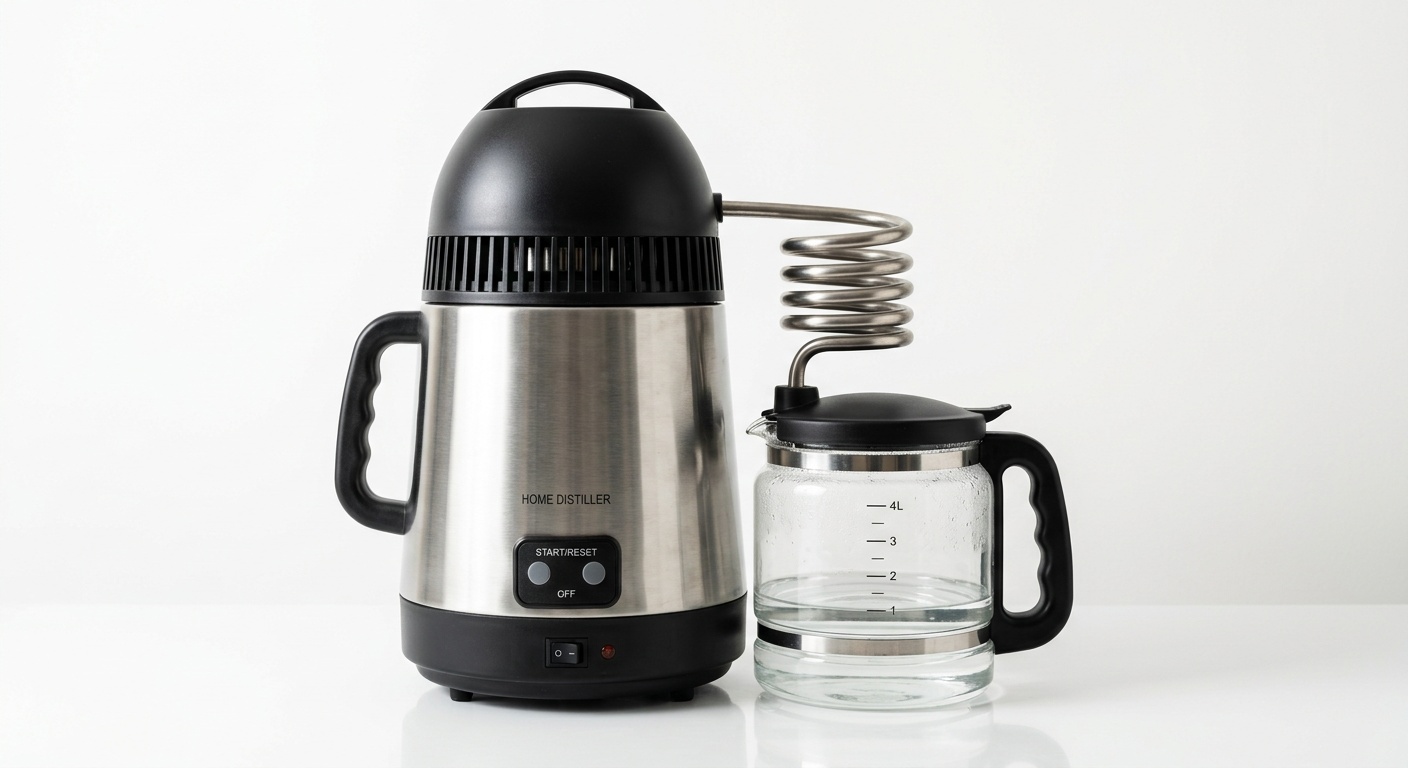
The Ace Water Shop 4L distiller sits in the middle ground — cheaper than the Megahome, more expensive than the Waterwise, but with the practical advantage of being stocked by an Australian online retailer. That means Australian Consumer Law protections, AU-based returns, and a local business you can phone if something goes wrong.
The distilled water output is identical in purity to the Megahome and Waterwise because the distillation process is the same. You boil water, condense steam, collect liquid — physics does not discriminate by brand. The differences are in build quality and collection vessel material.
The Ace Water distiller uses standard (not marine-grade) stainless steel for the boiling chamber. This is adequate for normal Australian tap water but may corrode faster in hard water areas like Adelaide (TDS ~400 mg/L according to SA Water data) or Perth (TDS ~170 mg/L), where mineral scale is aggressive. The collection vessel material varies by production batch — some versions ship with a stainless steel carafe, others with a BPA-free plastic jug. If you order, confirm the vessel material with Ace Water before purchasing.
Honest Assessment
The Ace Water distiller is a generic white-label unit sold under the Ace Water brand. It is functionally similar to dozens of unbranded distillers available on Amazon and eBay. The primary value proposition is buying from an Australian business with Australian consumer protections. If that matters to you — and it should, for a product you will use daily for years — the ~$50–$70 premium over the Waterwise 4000 on Amazon AU buys peace of mind that a marketplace returns policy does not.
That said, at AU$199–$220, you are roughly $570 cheaper than the Megahome. If budget is the overriding constraint and you want local retailer support, the Ace Water is a rational choice. If budget is the overriding constraint and you do not care about local support, the Waterwise 4000 at ~$93–$150 via Amazon is cheaper and has better-documented build quality.
Head-to-Head Comparison — All Three Distillers Ranked
| Feature | Megahome MH943S | Waterwise 4000 | Ace Water 4L |
|---|---|---|---|
| Price (AUD) | ~$786 | ~$93–$150 | ~$199–$220 |
| Chamber material | 316 marine-grade stainless | Stainless steel | Standard stainless steel |
| Collection vessel | Borosilicate glass | Stainless steel | Stainless or plastic (varies) |
| Batch size | 4 litres | 4 litres | 4 litres |
| Cycle time | ~5.5 hours | ~5–6 hours | ~5–6 hours |
| Wattage | 580W | ~800W | ~750W |
| Running cost/litre | ~$0.24 | ~$0.33 | ~$0.31 |
| Carbon post-filter | Yes (sachets included) | Yes (insert included) | Yes (basic insert) |
| AU dealer? | Yes — megahomewaterdistillers.com.au | No — Amazon AU only | Yes — acewatershop.com.au |
| Warranty / support | AU dealer warranty + parts | Amazon returns only | AU retailer + ACL |
5-Year Cost of Ownership — Distiller vs Bottled Water vs RO
Price anchoring matters here. Every glass of unfiltered Australian tap water in a chloramine-treated city (Brisbane, Sydney, Adelaide, Gold Coast) contains measurable disinfection byproducts that standard carbon jugs cannot touch. The alternative most Australians default to — bottled water — costs $2–$5 per litre. A distiller’s electricity cost of $0.24/L looks very different when you frame it against what you are currently spending.
Assumptions for the 5-year cost table: 4 litres per day (1,460 litres per year), electricity at 30c/kWh (AER 2024 residential benchmark), carbon sachet replacement every 30 cycles (~$30 per 12-pack).
| Cost Category | Megahome MH943S | Waterwise 4000 | Ace Water 4L | Bottled Water ($2/L) |
|---|---|---|---|---|
| Upfront cost | $786 | $150 | $210 | $0 |
| Electricity (5 years) | $1,752 | $2,409 | $2,263 | $0 |
| Carbon sachets (5 years) | $150 | $150 | $150 | $0 |
| Water purchase | $0 | $0 | $0 | $14,600 |
| 5-YEAR TOTAL | $2,688 | $2,709 | $2,623 | $14,600 |
| Cost per litre | $0.37/L | $0.37/L | $0.36/L | $2.00/L |
At 4 litres per day over 5 years, all three distillers converge to roughly the same total cost — approximately $2,600–$2,700. The Megahome’s higher upfront cost is partially offset by its lower wattage (580W vs ~800W), which means lower electricity costs per cycle. The Waterwise’s lower purchase price is offset by higher running costs from the more powerful heating element. Either way, you are paying $0.36–$0.37 per litre of distilled water versus $2.00+ per litre of bottled water — an 82% reduction.
How to Maintain a Water Distiller in Australian Conditions
Distillers require periodic descaling of the boiling chamber. The mineral residue that accumulates during each cycle is the physical proof that the system is working — you are looking at the contaminants that would otherwise be in your drinking water. The frequency of cleaning depends on your local water hardness.
Descaling Frequency by Australian City
D6B0;”>As you can see, Perth and Adelaide residents will need to descale their water distillers significantly more often than those in Melbourne or Hobart. If you live in a hard water area, you may want to consider using a mixture of white vinegar and water (50/50) or a dedicated citric acid descaling solution after each batch — or at minimum every few weeks. Simply fill the boiling chamber with the solution, let it soak for several hours or overnight, then rinse thoroughly before your next distillation cycle.
Beyond descaling, the other key maintenance task is replacing the activated carbon post-filter. Most manufacturers recommend changing these every one to three months depending on usage. The carbon filter is responsible for catching any volatile organic compounds (VOCs) that may carry over with the steam, so keeping it fresh is essential for the highest quality output. Replacement filters are inexpensive — typically $5–$15 for a pack of six — and take less than a minute to swap out.
It is also worth wiping down the interior of the collection jug or glass carafe weekly to prevent any biofilm from forming. If your distiller has a stainless steel condenser coil, it generally does not require separate cleaning, but you should inspect it every six months for any mineral deposits. Following these simple maintenance steps will ensure your distiller runs efficiently, uses minimal extra energy, and continues to produce water at 99%+ purity for years to come.
Frequently Asked Questions
How does a water distiller work?
A water distiller works by mimicking the natural hydrological cycle. Tap water is heated in a stainless steel boiling chamber until it turns to steam. The steam rises, leaving behind contaminants such as heavy metals, minerals, bacteria, and dissolved solids that have higher boiling points than water. The steam then travels into a condenser coil where it is cooled and converted back into liquid water. This distilled water is collected in a separate glass or stainless steel jug. Most countertop distillers also include an activated carbon post-filter to capture any volatile organic compounds that may have carried over with the steam.
Does a water distiller remove fluoride?
Yes. Water distillation is one of the most effective methods for removing fluoride from drinking water. Because fluoride salts (such as fluorosilicic acid used in Australian municipal water treatment) have a much higher boiling point than water, they remain in the boiling chamber as the water evaporates. Distillation typically removes 99%+ of fluoride. This makes distillers a popular choice for Australians who wish to avoid fluoridated water, unlike standard carbon filters or basic jug filters which remove little to no fluoride.
What are the running costs of a water distiller in Australia?
The running cost of a water distiller in Australia depends on your local electricity tariff and how much water you distil. A typical benchtop distiller uses between 0.75 kWh and 1 kWh to produce one litre of distilled water. At an average Australian electricity rate of around $0.30–$0.35 per kWh (as of 2026), that works out to roughly $0.25–$0.35 per litre. If your household distils four litres per day, you are looking at approximately $30–$42 per month in electricity. This is still considerably cheaper than buying bottled distilled water and produces a higher purity result than most filtration systems.
How much electricity does a water distiller use?
Most countertop water distillers draw between 580 W and 750 W during operation. A standard four-litre batch takes approximately four to six hours to complete, consuming around 3–4.5 kWh of electricity per full cycle. Running one batch daily would add roughly 90–135 kWh to your monthly electricity consumption. If you are on a time-of-use tariff, you can reduce costs by running the distiller overnight during off-peak hours — many models feature an automatic shut-off so you can set it before bed and wake up to a full jug of distilled water.
What does distilled water taste like?
Distilled water has a very clean, neutral taste — some people describe it as “flat” or “empty” because it lacks the dissolved minerals found in tap or spring water. If you are used to mineral-rich water (for instance, Adelaide or Perth tap water which has higher total dissolved solids), you may notice the difference immediately. Many people grow to prefer the clean taste. If you find it too bland, you can add a pinch of Himalayan salt or use mineral drops to reintroduce trace minerals. Running the water through the activated carbon post-filter also improves taste by removing any residual volatile organic compounds.
Should I remineralise distilled water?
This is a personal choice. Distillation removes virtually all dissolved minerals including calcium, magnesium, and potassium. While most of your mineral intake should come from a balanced diet rather than water, some people prefer to add trace minerals back for taste and potential health benefits. You can remineralise distilled water by adding liquid mineral drops, a pinch of unrefined sea salt, or by passing the water through a remineralisation filter cartridge. If you eat a varied diet rich in fruits, vegetables, nuts, and whole grains, the mineral content of your drinking water is unlikely to make a significant nutritional difference.
How does a water distiller compare to reverse osmosis (RO)?
Both distillation and reverse osmosis produce very high purity water, but they work in fundamentally different ways. A distiller uses heat to evaporate water and leave contaminants behind, while an RO system forces water through a semi-permeable membrane at pressure. Distillers are simpler — no plumbing installation required, no water line connection, and no wastewater generated (RO systems typically waste 2–4 litres for every litre of purified water produced). However, distillers are slower and use more electricity. RO systems produce water on demand and are more energy-efficient, but they require membrane replacement, professional installation in most cases, and ongoing water waste. For most Australian households wanting a simple, portable, and highly effective benchtop solution, a water distiller is the better choice. For high-volume demand or whole-house purification, RO may be more practical.
Is distilled water safe for making baby formula?
Yes, distilled water is widely considered one of the safest options for preparing infant formula. Because it is free from bacteria, heavy metals, chlorine, fluoride, and other contaminants, it provides a clean and consistent base for mixing formula. The Australian Government Department of Health advises that water used for infant formula should be boiled and cooled — distilled water has already undergone a process that exceeds this requirement. However, because distilled water lacks fluoride, infants who exclusively consume formula made with distilled water will not receive fluoride from their drinking water. Consult your paediatrician about whether supplemental fluoride is appropriate for your child.
This article was last reviewed and updated on 17 July 2026 by Jayce Love. We regularly review product specifications, verify pricing, and update our recommendations to ensure this guide reflects the best water distillers available in Australia. If you have questions or feedback, feel free to reach out to the Clean and Native team.
Get the Australian Home Environment Checklist
30 checks across water, air and EMF. Most of them free. Ranked by impact.
No spam. Unsubscribe any time.

Former Royal Australian Navy Clearance Diver and TAG-E counter-terrorism operator. Founded Clean and Native to apply the same rigorous thinking to the home environment.
Full biography →