5G EMF Exposure in Australia: What Physics Shows
Drafted with AI assistance and checked against published specifications and certifications. First-hand measurements appear only where stated. How we make content
Measured 5G radiofrequency EMF exposure across Australian cities remains far below ARPANSA’s safety limit of 1,000 µW/cm² at 2.4 GHz, and peer-reviewed data from Bhatt et al. (2024) confirms the 5G rollout produced “no or little effect on total RF-EMF exposure” in background environments. The physics of millimetre-wave 5G actually works in your favour — higher frequencies mean shorter range, lower penetration through building materials, and lower power density at typical residential distances than the 4G infrastructure already surrounding your home.
Australian 5G towers operate at power densities thousands of times below ARPANSA’s thermal safety threshold. According to Bhatt et al. (2024), total background RF-EMF exposure has not meaningfully increased since the 5G rollout began. Your phone on the bedside table, your Wi-Fi router, and your smart meter each produce more RF exposure in your bedroom than a 5G tower 200 metres away. The highest-impact action is not shielding against 5G — it is removing or managing the RF sources already inside your home.
Key catches
- ARPANSA’s RF limit (1,000 µW/cm²) is a thermal safety threshold — not a precautionary biological standard
- Building Biology SBM-2015 recommends sleeping-area RF below 0.1 mW/m² — a far stricter benchmark
- Your phone in active use produces 100–1,000x more RF exposure to your body than a distant 5G tower
- Shielding products sold as “5G protection” can increase internal RF exposure if sources are inside the shielded zone
What 5G Actually Is — Frequencies, Power, and Australian Bands
Before you can evaluate whether 5G poses a risk, you need to understand what it physically is. “5G” is not a single frequency. It is the fifth generation of mobile telecommunications standards, and in Australia it operates across three distinct frequency bands — each with different physics, different power levels, and different penetration characteristics. Treating them as one thing is the first mistake most commentary makes.
Australia’s 5G deployment, managed by carriers Telstra, Optus, and TPG/Vodafone, primarily uses the 3.6 GHz (sub-6 GHz) band. This is the workhorse. It offers a balance between coverage range and data throughput. According to ACMA spectrum allocation records, the 3.6 GHz band carries the vast majority of Australian 5G traffic in 2026. The physics here is simple: 3.6 GHz sits between existing 4G frequencies (700 MHz–2.6 GHz) and older Wi-Fi (2.4 GHz and 5 GHz). It is not exotic. It is not new physics. It is radiofrequency electromagnetic radiation in a band that has been used for satellite communications and radar for decades.
The second band is low-band 5G at 700–850 MHz — the same frequencies already used by 4G LTE. Carriers refarmed this spectrum to deliver 5G coverage in regional areas. If you live in rural NSW, Victoria, or Queensland, the 5G signal reaching your home is likely on 700 MHz — physically identical to the 4G signal it replaced. Your RF exposure from this band has not changed.
The third band is millimetre-wave (mmWave) at 26 GHz, which is deployed in very limited locations in Australia — primarily CBD precincts in Sydney and Melbourne for high-density data. This is the frequency that generates the most fear, and ironically, it is the least concerning for residential exposure. Here is why: mmWave signals are absorbed by building materials, foliage, rain, and even humid air. According to ARPANSA’s RF EME exposure assessments, 26 GHz signals struggle to penetrate standard Australian brick veneer or double-glazed windows. A single wall blocks most of the signal. The range of a mmWave small cell is typically 100–300 metres line-of-sight, and power output per cell is lower than a traditional macro tower.
The inverse square law governs all RF exposure: double your distance from a source, and power density drops to one quarter. A 5G small cell antenna mounted on a street pole 15 metres up and 50 metres from your bedroom wall produces a tiny fraction of the power density your phone generates when pressed against your head during a call. This is not opinion. It is the physics of electromagnetic wave propagation, measurable with a calibrated RF meter.
What Bhatt et al. (2024) Actually Measured — And Why It Matters
The single most relevant piece of evidence for Australians concerned about 5G exposure is the Bhatt et al. (2024) study referenced by ARPANSA. This was not a theoretical model or an industry-funded estimate. Researchers conducted systematic environmental RF-EMF measurements before and after 5G network rollout, comparing real-world exposure levels in populated areas.
The finding, as stated by ARPANSA: the 5G network rollout had “no or little effect on total RF-EMF exposure.” Total background RF-EMF — the combined signal from all telecommunications sources including 4G, 3G, Wi-Fi, FM radio, smart meters, and now 5G — did not meaningfully increase. The 5G signal contributed so little to the overall RF environment that it was barely distinguishable from measurement noise in most locations.
Why? Three reasons. First, 5G base stations use beamforming technology that directs energy toward active user devices rather than broadcasting omnidirectionally like older towers. When no devices are actively communicating with a 5G cell, its emissions drop dramatically. Second, the deployment of 5G small cells often replaces or supplements existing macro cells, so the total number of high-power transmitters has not increased proportionally. Third, and most importantly, the dominant RF sources in any residential environment — your Wi-Fi router, your phone, your smart meter, your neighbours’ devices — were already there before 5G arrived and continue to dominate the exposure profile.
For context, ARPANSA sets Australia’s RF exposure limit at 1,000 µW/cm² at 2.4 GHz (the reference frequency for general public exposure under the ARPANSA RF Standard). This is a thermal safety limit — it prevents tissue heating. Typical measured 5G exposure at street level near a base station ranges from 0.001 to 0.1 µW/cm², according to international measurement campaigns including those from ARPANSA’s own survey program. That is 10,000 to 1,000,000 times below the safety limit.
The Building Biology SBM-2015 standard, used by building biologists in Australia and internationally, recommends sleeping-area RF exposure below 0.1 mW/m² (equivalent to 0.01 µW/cm²). This is a precautionary biological guideline, not a thermal safety limit, and it is far stricter than ARPANSA’s standard. Even under this more conservative benchmark, a 5G tower 200 metres from your home is unlikely to push your bedroom above the threshold — but your Wi-Fi router in the hallway almost certainly does. The question of whether your bedroom meets Building Biology sleep guidelines has almost nothing to do with 5G towers and almost everything to do with what is plugged in inside your walls.
5G vs 4G: Actual Exposure Comparison in Australian Cities
If you are concerned about RF exposure from telecommunications, the honest comparison is not “5G versus nothing” — it is “5G versus the 4G infrastructure that was already there.” And when you make that comparison with a calibrated meter, the results are not what the fear-based narrative predicts.
A standard 4G macro cell tower in suburban Sydney, Brisbane, Melbourne, or Perth operates at 20–60 watts per carrier per sector on frequencies from 700 MHz to 2.6 GHz. These towers are typically mounted 25–40 metres high and cover a radius of 1–5 kilometres. At a residential distance of 200 metres, the power density from a 4G tower is typically 0.01–0.5 µW/cm², depending on antenna orientation, terrain, and obstructions.
A 5G small cell on the 3.6 GHz band operates at lower radiated power per cell (typically 5–20 watts effective radiated power per beam), but there are more cells deployed closer together. However, the beamforming characteristic of 5G NR (New Radio) means that power is directed in narrow beams toward active devices, not broadcast across the entire coverage area. When you walk past a 5G small cell and your phone is not actively downloading data, the beam is not pointed at you. The ambient power density contribution from that cell to your general environment is minimal.
In practical terms, here is what changes when a 5G cell is added to a street pole in inner Sydney suburbs like Surry Hills or Newtown, or Brisbane suburbs like West End or Paddington:
- Background RF-EMF: Increases by approximately 0.001–0.01 µW/cm² in most measurement studies — a change that requires laboratory-grade instrumentation to detect reliably
- Peak RF-EMF: Brief spikes during active data transmission can reach 0.1–1.0 µW/cm² at close range (directly below the antenna), but these are millisecond-duration bursts
- Time-averaged exposure: Remains dominated by the existing 4G and Wi-Fi infrastructure
Compare this to the RF exposure from your phone. When your phone connects to a 5G tower and begins downloading data, the phone’s own transmitter operates at up to 200 milliwatts — and it is in your hand or against your head, not 50 metres away on a pole. The inverse square law means that source-to-body distance matters enormously. A 200 mW source at 2 centimetres from your skull delivers vastly more RF energy to your tissue than a 20 W tower at 200 metres. This is not a 5G problem — it has been true since the first mobile phone call.
Australian smart meters, operating at 900 MHz and installed on the side of homes in Victoria, south-east Queensland, and parts of NSW, transmit in short bursts that produce peak RF readings of 100–1,000 times higher than their time-averaged readings. If you hold a calibrated RF meter next to your smart meter during a transmission burst, you will typically see a peak reading far exceeding anything you will measure from a 5G tower across the street. The smart meter is closer, and proximity is the dominant factor in RF exposure.
For residents of suburbs near major 5G deployment zones — Parramatta and Macquarie Park in Sydney, South Brisbane and Fortitude Valley in Brisbane, Docklands and Southbank in Melbourne, or the Perth CBD — the addition of 5G to the existing RF environment is measurably real but physically trivial in comparison to the RF sources you carry, sleep next to, and plug into your walls every day.
The Shielding Trap: Why “5G Protection” Products Often Make Things Worse
Here is where the 5G fear economy costs you money and potentially increases your RF exposure. A search for “5G protection” on Amazon AU returns dozens of products: phone stickers, pendants, “scalar energy” discs, EMF-blocking paint, Faraday bed canopies, and router “harmonisers.” Some of these are physically inert scams. Others are legitimate shielding products being marketed for the wrong application. The difference matters.
This article contains affiliate links. We may earn a commission at no extra cost to you.
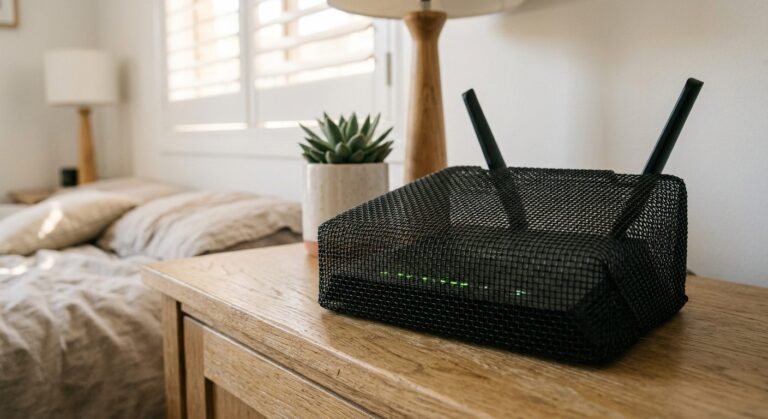
A Faraday bed canopy — a real shielding product made from silver-threaded fabric — does attenuate RF signals. A quality canopy like the silver cotton 42 dB canopy from SaferEMF AU can reduce incoming RF by 99.99% within its enclosure. That is real physics, verified by shielding effectiveness testing. But here is the critical trap that no “5G protection” marketer tells you:
If the primary RF source is inside the shielded enclosure, the canopy reflects that energy back and increases your exposure.
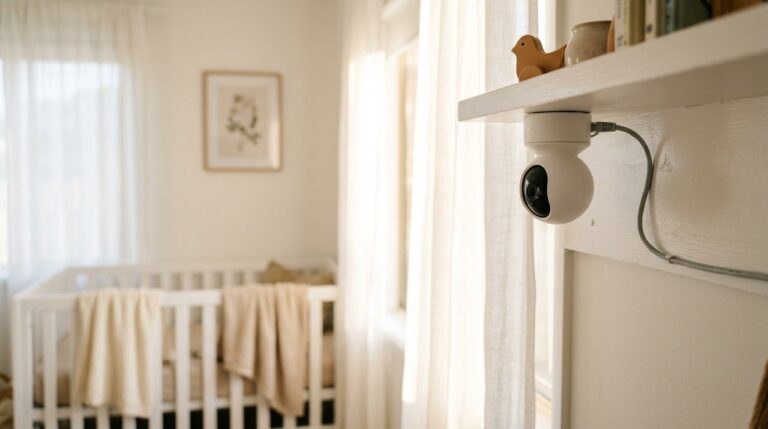
If you sleep inside a Faraday canopy with your phone on the nightstand (not in airplane mode), a Wi-Fi-connected baby monitor, or a Bluetooth-enabled fitness tracker on your wrist, the canopy bounces that RF energy back and forth inside the enclosure instead of letting it dissipate into the room. You have built yourself a microwave resonance chamber. Your exposure goes up, not down. This is not conjecture — it is electromagnetic wave behaviour confirmed by any RF engineer.
The correct sequence for reducing bedroom RF exposure is always: Measure → Remove internal sources → Shield external residual only.
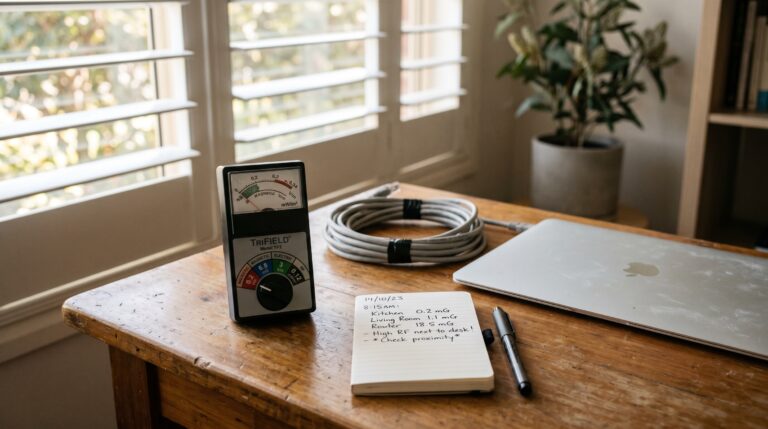
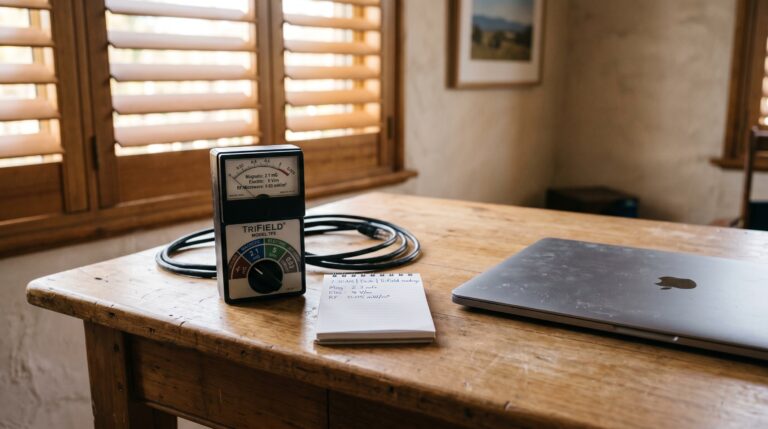
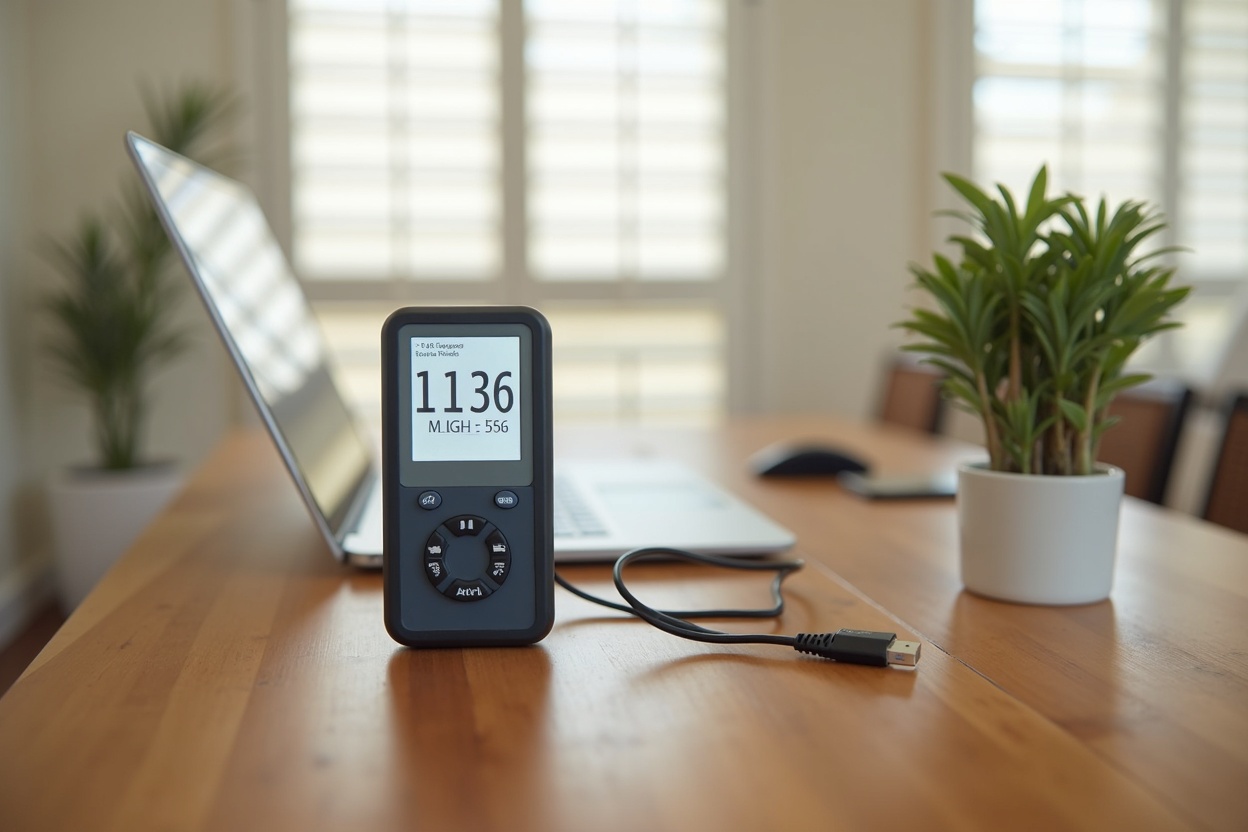
Step one: measure your actual bedroom RF environment with a calibrated meter. The TriField TF2 measures RF, AC magnetic, and AC electric fields in one device. Walk through your bedroom with it. You will almost certainly discover that your Wi-Fi router, your phone, and your smart meter are the dominant sources — not the 5G tower down the road.
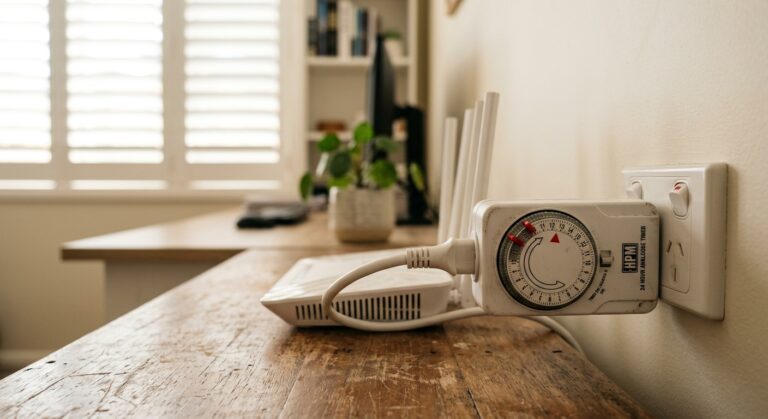
Step two: remove or disable the internal sources. Put your phone in airplane mode at night (free). Plug your Wi-Fi router into a HPM 24 Hour Analog Timer (~$20) to kill it overnight. Move Bluetooth devices out of the bedroom. These two actions alone — costing $20 total — typically reduce bedroom RF exposure by 80–95%, because the dominant sources are now off.
Step three: if you have measured and confirmed that external RF from a cell tower, smart meter, or neighbours’ devices is still above Building Biology SBM-2015 thresholds (0.1 mW/m² for sleeping areas), then shielding is appropriate. A bed canopy or RF-shielding paint on the wall facing the source makes sense at this point, because you have already eliminated internal sources.
Products that claim to “harmonise” or “neutralise” 5G frequencies without any measurable attenuation mechanism — stickers, pendants, crystals, USB dongles — are not supported by any known physics. ARPANSA does not endorse any such products. If a product cannot demonstrate shielding effectiveness in decibels when tested with a calibrated spectrum analyser, it does not reduce your exposure. Period.
For residents concerned about smart meter exposure — particularly in Victoria where AMI meters are near-universal, or in south-east Queensland where smart meters are deployed across the Energex network — the same principle applies. Your smart meter transmits at 900 MHz in bursts. The peak readings are high but the time-averaged exposure is low. If it is mounted on a bedroom wall, the most effective solution is to request the meter be relocated (contact your distributor) or to add RF-shielding paint to the interior of that specific wall section after confirming the smart meter is the dominant source with a meter reading.
The Practical 5-Step Protocol for Reducing Bedroom RF Exposure
Forget 5G-specific protection products. What actually reduces your nighttime RF exposure is a systematic protocol that addresses all sources by measured contribution, starting with the largest. As a former Navy Clearance Diver, I can tell you the military approach to any environmental risk is the same: measure, prioritise, eliminate in order of magnitude, verify. That is exactly what works here.
Step 1: Baseline measurement. Use the TriField TF2 or Safe and Sound Pro II to take readings at your pillow position, at 1 metre above the bed, and at each wall of the bedroom. Record peak and average RF readings. Note which direction produces the highest reading — that tells you where the dominant source is. Do this at night when you would normally be sleeping, with all your usual devices in their normal positions.
Step 2: Phone to airplane mode. Switch your phone to airplane mode and repeat the measurement at pillow position. In most bedrooms, this single action drops RF by 50–90%. Your phone, even when “idle,” maintains active connections to cell towers, Wi-Fi, and Bluetooth. It transmits positioning data, checks for notifications, and maintains registration with the network. Every transmission is a burst of RF energy centimetres from your head.
Step 3: Wi-Fi router on a timer. Plug your router into a HPM 24 Hour Analog Timer and set it to cut power from 10 PM to 6 AM (or whatever your sleep window is). This eliminates the 2.4 GHz and 5 GHz Wi-Fi signal entirely during sleep. If you need overnight connectivity for security cameras, consider a JRS Eco 100 low-EMF router, which reduces Wi-Fi transmission power by 90% and eliminates beacon pulses when no devices are active.
Step 4: Demand switch on bedroom circuit. This addresses AC electric fields from house wiring — a separate EMF type from RF, but equally important for sleep environment optimisation per Building Biology SBM-2015 guidelines (target: below 5 V/m and below 0.2 µT). A licensed electrician installs a demand switch (~$100–150 for the part plus installation) on the circuit feeding your bedroom. When no current is being drawn (all devices off), the switch cuts voltage to the wiring, eliminating the AC electric field from cables in the walls, ceiling, and floor. This is a permanent, passive solution that requires no ongoing action from you.
Step 5: Measure again and assess external sources. After completing steps 2–4, repeat your baseline measurements. If readings at pillow position are now below the Building Biology SBM-2015 sleeping-area target of 0.1 mW/m² for RF, below 0.2 µT for AC magnetic, and below 5 V/m for AC electric, you are done. No shielding products needed. If external RF remains above threshold — typically from a very close cell tower (within 50 metres) or a smart meter on the bedroom wall — then targeted shielding of that specific wall or window is the appropriate next step.
This five-step protocol costs between $20 (steps 2–3) and $300 (adding a demand switch and meter verification). It addresses the actual sources of RF exposure in your sleeping environment rather than the imagined threat of a 5G tower that, according to Bhatt et al. (2024), has not measurably changed your background exposure.
ARPANSA’s Position and What “No Substantiated Evidence” Means
ARPANSA — the Australian Radiation Protection and Nuclear Safety Agency — is the Commonwealth authority responsible for setting RF exposure limits and assessing health risks from electromagnetic radiation in Australia. Their position on 5G, as stated in their radiation literature survey, is clear: “There is no substantiated evidence that RF-EMF exposure below safety limits, including from 5G, causes harm to human health.”
What does “no substantiated evidence” actually mean in scientific terms? It means that across the body of published peer-reviewed research — including animal studies, epidemiological studies, and in-vitro cell studies — no consistent, reproducible, dose-response relationship between sub-thermal RF exposure and adverse health outcomes has been established. Individual studies have reported effects, but these findings have not been replicated consistently across independent laboratories, which is the threshold for scientific substantiation.
This does not mean “RF is proven safe.” That is an important distinction. Science does not prove negatives. What ARPANSA’s position means is that the current body of evidence does not support the claim that 5G — or any sub-thermal RF exposure — causes cancer, neurological damage, immune dysfunction, or any other specific health outcome. The IARC (International Agency for Research on Cancer) classified RF-EMF as Group 2B (“possibly carcinogenic to humans”) in 2011, based primarily on limited evidence from heavy mobile phone use studies. Group 2B also includes pickled vegetables, talcum powder, and coffee — it indicates “limited evidence” warranting further research, not a confirmed hazard.
The practical implication for you: ARPANSA’s thermal safety limit of 1,000 µW/cm² protects against the one established mechanism of harm from RF — tissue heating. It does not address potential non-thermal biological effects, which remain an open area of research. If you want to apply the precautionary principle, the Building Biology SBM-2015 guidelines (0.1 mW/m² for sleeping areas) provide a far more conservative target that accounts for potential non-thermal effects. Meeting those guidelines in your bedroom is achievable through the protocol described above — and the dominant sources to address are your own devices, not 5G infrastructure.
Anyone telling you 5G is “proven dangerous” is not supported by ARPANSA, the WHO, or the current evidence base. Anyone telling you 5G is “proven safe” is overstating what science can demonstrate. The evidence-based position is: measured exposure levels from 5G infrastructure are extremely low, no consistent harm mechanism has been established at those levels, and the precautionary approach is to minimise total RF exposure in your sleeping environment by managing the sources you control — which are not 5G towers.
What About Children, Pregnancy, and Vulnerable Groups?
This question deserves a straight answer. Children have thinner skulls and higher tissue water content than adults, which means RF energy penetrates deeper into paediatric brain tissue per unit of exposure. The ARPANSA RF Standard already accounts for this — the general public exposure limits incorporate safety margins that are intended to protect children and vulnerable populations. However, the thermal safety limit was not designed with 8-hour nightly exposure to bedside devices in mind for developing brains.
If you have children sleeping with phones, tablets, or Wi-Fi-connected devices near their heads, the precautionary principle applies regardless of what you think about 5G towers. A child’s phone on a nightstand produces RF exposure to their developing brain at close range for 8–10 hours every night. The 5G tower 300 metres away produces a tiny fraction of that exposure. The action that protects your child is removing the phone from the bedroom or switching it to airplane mode — not buying a “5G-blocking” phone case.
For pregnancy, the same logic applies. ARPANSA’s exposure limits include safety margins for pregnant women. No specific evidence links sub-thermal RF exposure to adverse pregnancy outcomes. But if you want to apply precaution, the action items are identical to the protocol above: phone in airplane mode during sleep, Wi-Fi on a timer, Bluetooth devices out of the nursery. These are free or near-free actions that reduce RF exposure from the dominant sources — your own devices.
The pattern is the same for anyone with electrohypersensitivity (EHS) symptoms. ARPANSA acknowledges that some people report symptoms they attribute to EMF exposure, while noting that blinded provocation studies have not consistently demonstrated a causal link between RF exposure and reported symptoms. Whether or not the mechanism is established, reducing measurable RF exposure in the sleeping environment through the five-step protocol addresses the concern without requiring you to take a position on disputed science.
Final Verdict: 5G Is Not Your Biggest RF Problem
The physics is clear. The measurement data is clear. The Bhatt et al. (2024) study referenced by ARPANSA is clear. The 5G rollout across Australian cities has not meaningfully increased your background RF-EMF exposure. The 5G signal from a tower down the street contributes a fraction of the RF energy that your phone, your Wi-Fi router, and your smart meter deliver to your body every day — particularly during the 8 hours you spend sleeping.
If you are spending money on “5G protection” products before you have put your phone in airplane mode at night and plugged your router into a $20 timer, you are spending money on the wrong problem. Start with measurement. Confirm your actual exposure profile. Address the dominant sources — which are inside your home, under your control, and cost almost nothing to fix.
The 5G fear economy profits from confusion about physics. The inverse square law, beamforming, frequency-dependent absorption, and the Bhatt et al. data all point to the same conclusion: your bedroom RF environment is shaped by what is plugged in inside your walls, not by what is mounted on a pole down the street. Act on what the measurements show, not on what the marketing claims.
Last reviewed: July 2026 – Clean and Native
Start with measurement. The TriField TF2 is the only meter you need.
Measures AC magnetic, AC electric, and RF in one device. Without real readings, every EMF decision is a guess.
Frequently Asked Questions
Does 5G cause cancer in Australia?
According to ARPANSA, there is no substantiated evidence that RF-EMF exposure below the Australian safety limits — including from 5G — causes cancer. The IARC classifies RF-EMF as Group 2B (possibly carcinogenic), which indicates limited evidence warranting further research, not a confirmed hazard. Measured 5G exposure levels in Australian cities are thousands of times below ARPANSA’s thermal safety limit.
How much RF exposure does a 5G tower produce at 200 metres?
Typical measured RF power density from a 5G base station at 200 metres is 0.001–0.05 µW/cm², according to international measurement campaigns and ARPANSA assessments. ARPANSA’s general public exposure limit is 1,000 µW/cm² at 2.4 GHz. The 5G contribution is less than 0.01% of the safety limit at typical residential distances.
Is 5G more dangerous than 4G?
No. Australian 5G primarily operates on 3.6 GHz, which sits between existing 4G bands (700 MHz–2.6 GHz) and standard Wi-Fi (2.4/5 GHz). Bhatt et al. (2024), referenced by ARPANSA, found the 5G rollout produced “no or little effect on total RF-EMF exposure.” Beamforming technology in 5G means power is directed at active devices rather than broadcast omnidirectionally, reducing ambient exposure compared to older systems.
What frequency does Australian 5G use?
Australian 5G operates across three bands: low-band (700–850 MHz, same as 4G), mid-band (3.6 GHz, the primary band for most deployments), and millimetre-wave (26 GHz, limited to CBD areas in Sydney and Melbourne). The 3.6 GHz band carries the majority of Australian 5G traffic in 2026.
Can 5G signals penetrate walls and buildings?
Mid-band 5G at 3.6 GHz penetrates standard Australian brick veneer and timber frame walls with significant attenuation — typically 6–15 dB of signal loss per wall. Millimetre-wave 5G at 26 GHz is largely blocked by a single wall, window, or even foliage. Low-band 5G at 700 MHz penetrates buildings similarly to existing 4G signals. Higher frequency equals lower penetration.
Do 5G protection stickers and pendants actually work?
No. Products claiming to “harmonise,” “neutralise,” or “block” 5G frequencies through stickers, pendants, crystals, or USB dongles have no measurable shielding effectiveness when tested with a calibrated RF meter. ARPANSA does not endorse any such products. Legitimate RF shielding is measured in decibels of attenuation — if a product cannot demonstrate measurable dB reduction on a spectrum analyser, it does not reduce your exposure.
What is the cheapest way to reduce RF exposure while sleeping?
Put your phone in airplane mode (free) and plug your Wi-Fi router into a HPM 24 Hour Analog Timer (~$20 from Amazon AU) set to cut power during your sleep window. These two actions eliminate the dominant RF sources in most Australian bedrooms and typically reduce measured RF exposure by 80–95%.
Is the ARPANSA safety limit strict enough to protect health?
ARPANSA’s RF limit of 1,000 µW/cm² at 2.4 GHz is a thermal safety threshold designed to prevent tissue heating. It is not a precautionary biological limit. The Building Biology SBM-2015 standard recommends sleeping-area RF below 0.1 mW/m² (approximately 0.01 µW/cm²) — roughly 100,000 times lower than ARPANSA’s limit. If you want a precautionary target, the Building Biology guideline is the stricter benchmark to aim for in your bedroom.
Should I be worried about 5G small cells on street poles near my house?
Measured RF exposure from 5G small cells at typical residential distances (30–100 metres) ranges from 0.001 to 0.1 µW/cm² — well below both ARPANSA’s limit and typically below Building Biology sleeping-area targets for indoor spaces. Your Wi-Fi router inside your home produces more RF at your pillow than a small cell on a street pole outside. Measure your actual bedroom RF profile with a calibrated meter before drawing conclusions.
Does a Faraday bed canopy protect against 5G?
A quality Faraday bed canopy (e.g., silver cotton 42 dB rated) blocks up to 99.99% of incoming RF, including 5G frequencies. However, if any RF source is inside the canopy — phone not in airplane mode, Bluetooth device, smartwatch — the canopy reflects that energy back, increasing your exposure. Always remove internal RF sources before using any shielding enclosure. The correct sequence is: measure, remove internal sources, then shield external residual only.
Get the Australian Home Environment Checklist
30 checks across water, air and EMF. Most of them free. Ranked by impact.
No spam. Unsubscribe any time.
Former Royal Australian Navy Clearance Diver and TAG-E counter-terrorism operator. Founded Clean and Native to apply the same rigorous thinking to the home environment.
Full biography →