Best Water Filter for Eczema Brisbane 2026
Brisbane tap water uses chloramine disinfection — not free chlorine — and that distinction matters more for eczema than anything else in your water supply. According to the SEQ Water Annual Report 2023-24, monochloramine is the standard secondary disinfectant across the south-east Queensland grid, which means standard shower filters (KDF-55) and Brita-style jugs cannot remove it. If you or your child has eczema and you live anywhere from the Gold Coast to the Sunshine Coast, chloramine is the chemical trigger you need to address — and only catalytic carbon or vitamin C filtration will do it.
For Brisbane eczema sufferers, a vitamin C or catalytic carbon shower filter is the highest-impact single purchase — not a water softener. Brisbane’s hardness at 80-120 mg/L CaCO₃ sits well below the 200+ mg/L threshold associated with increased eczema risk in epidemiological studies. The real irritant is chloramine, which standard KDF-55 shower filters and Brita pitchers cannot remove. A vitamin C shower filter neutralises chloramine on contact. For drinking water, a countertop RO system like the AquaTru Classic removes chloramine, fluoride, and PFAS in one unit.
Key catches
- KDF-55 shower filters (the majority sold on Amazon AU) are ineffective against chloramine — they only work in free chlorine cities like Melbourne
- Water softeners address mineral hardness, not chemical disinfectants — Brisbane’s moderate hardness is unlikely to be your eczema trigger
- Vitamin C cartridges need replacing every 2-3 months at typical Brisbane shower frequency — factor in ongoing cost
Brisbane Water Chemistry: Why Chloramine Is Your Eczema Variable
You are probably reading this because your dermatologist told you to “avoid irritants” and you want to know whether Brisbane tap water qualifies. It does — but not for the reason most shower filter marketing claims.
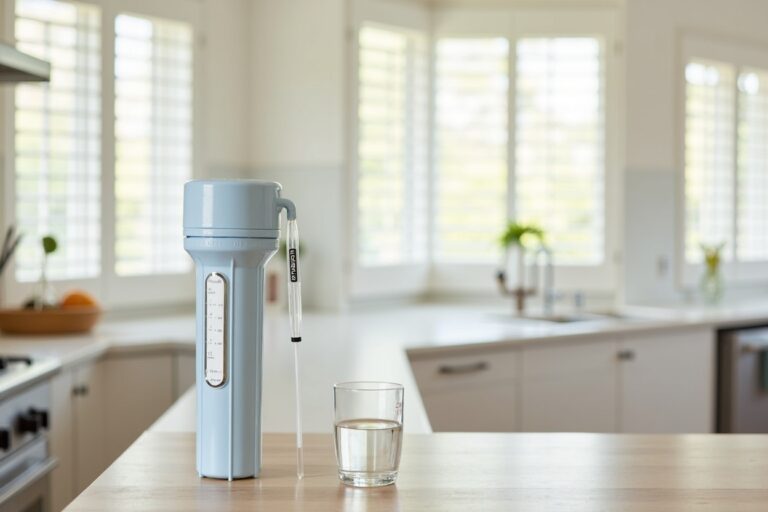
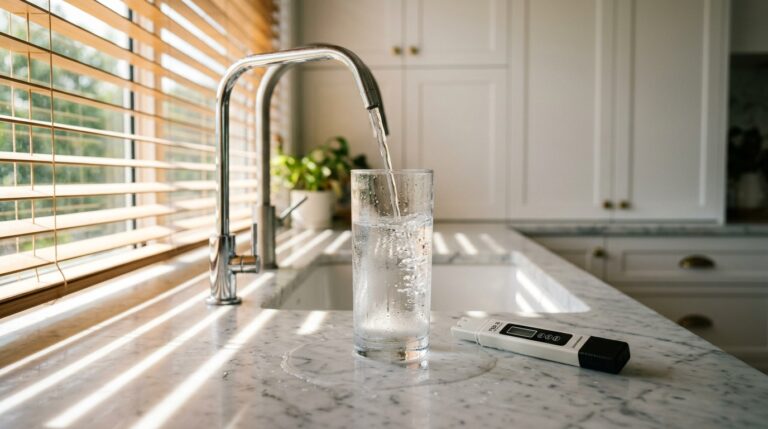
Most eczema-and-water content online lumps all Australian cities together, or focuses exclusively on water hardness. That advice is built for Adelaide (hardness ~140 mg/L CaCO₃) and Perth (~180 mg/L). Brisbane sits at 80-120 mg/L CaCO₃ — classified as moderate by Australian Drinking Water Guidelines (ADWG 2024). TDS readings across the SEQ grid typically range from 80-115 mg/L. For reference, a calibrated TDS-3 meter reading at Palm Beach on the SEQ grid returned 69 ppm — comfortably within the soft-to-moderate range. That level of mineral content is not the problem.
The problem is monochloramine. According to the SEQ Water Annual Report 2023-24, chloramine is the standard secondary disinfectant used across the entire south-east Queensland drinking water grid. This affects every suburb from Ipswich and Logan through to Redcliffe, Caboolture, and the Gold Coast hinterland. Chloramine is a compound of chlorine and ammonia (NH₂Cl), deliberately used because it persists longer in the pipe network than free chlorine — which is exactly why it is harder to remove from your shower water.
If you live in a free chlorine city — Melbourne, Hobart, Canberra, Townsville, Cairns, Toowoomba — a standard KDF-55 or GAC shower filter handles disinfectant removal adequately. But Brisbane, Sydney, Adelaide, Gold Coast, and Darwin all use chloramine, and the filter technology required is fundamentally different. Every shower filter recommendation in this article is specific to Brisbane’s chloramine chemistry. If you are looking for broader Brisbane water filter guidance, that pillar page covers drinking water systems in detail.
How Chloramine Damages Eczema-Prone Skin
Your skin barrier is not a passive wall. It is an active lipid bilayer made of ceramides, cholesterol, and fatty acids, regulated by a protein called filaggrin. In eczema (atopic dermatitis), this barrier is already compromised — either through genetic filaggrin mutations or inflammatory damage. Every shower exposes that damaged barrier to litres of chloramine-treated water. Here is why that matters.
Chloramine is more lipophilic than free chlorine. That means it dissolves into and penetrates the lipid bilayer of the stratum corneum more effectively. According to Jabbar-Lopez ZK et al. (2020, PubMed 33259122), the relationship between water hardness, chlorine-based disinfectants, and atopic dermatitis has been evaluated in multiple epidemiological studies. The evidence suggests that both water hardness and chlorination are associated with eczema prevalence, but the mechanisms differ. Hardness deposits calcium and magnesium on the skin, which may interact with surfactants (soap residues) to form irritant precipitates. Chloramine, by contrast, directly oxidises the skin’s lipid barrier components.
In practical terms, chloramine strips the very lipids your eczema-prone skin is already struggling to maintain. Free chlorine evaporates relatively quickly — it has a half-life of minutes in warm shower water. Chloramine does not. It persists through your entire shower duration, maintaining continuous oxidative contact with your skin. For a 10-minute shower at 9 L/min, that is 90 litres of chloramine exposure that a standard shower filter cannot address.
The NHMRC’s position on eczema prevention (NHMRC evidence review) emphasises that effective eczema management requires environmental trigger removal — not just topical treatment. If chloramine is a trigger and you are only treating the symptom (dry, inflamed skin) without removing the cause (chloramine in every shower), you are managing a cycle rather than breaking it.
Why a Water Softener Is the Wrong Purchase for Brisbane Eczema
If you have been Googling “eczema water filter Brisbane”, you have almost certainly seen water softener companies claiming their product will fix your eczema. Let me save you $2,000-$5,000. A water softener removes dissolved calcium and magnesium (hardness minerals) through ion exchange. It does nothing to chloramine. These are completely different classes of water contaminant requiring completely different technologies.
The confusion comes from UK-based research. The SWET trial (Softened Water Eczema Trial, Thomas KS et al. 2011) and subsequent UK studies were conducted in regions with very hard water — 200-350 mg/L CaCO₃. At those hardness levels, the calcium-surfactant precipitate problem is significant. Brisbane sits at 80-120 mg/L. That is roughly half the hardness level where softening studies have shown benefit. For context, Melbourne’s water is ~25 mg/L (very soft), and Brisbane’s is closer to Melbourne than to the UK hard-water regions studied.
A water softener in Brisbane addresses a variable that is not your primary problem while ignoring the variable that is. At $2,000-$5,000 installed plus ongoing salt costs, it is an expensive misdirection. The correct purchase for Brisbane eczema is a chloramine-removing shower filter at $60-$120, with replacement cartridges every 2-3 months.
There is one exception. If you live in an older SEQ suburb with galvanised pipes feeding harder bore water (some properties in Ipswich, Logan, or peri-urban Gold Coast hinterland), your localised hardness may exceed the SEQ grid average. In that case, get a TDS reading first. If your reading exceeds 200 mg/L, a softener may add value in addition to a chloramine-removing shower filter — never instead of one. For most Brisbane households, the shower filter alone is the correct first step.
Shower Filter Technologies: What Works for Brisbane Chloramine
Not all shower filters are equal. In a chloramine city, most shower filters sold on Amazon AU are functionally decorative. Here is the breakdown by technology.
| Technology | Chloramine Removal | Free Chlorine | Hardness | Brisbane Verdict |
|---|---|---|---|---|
| KDF-55 (most Amazon filters) | ✗ Fails | ✓ Yes | ✗ No | Do not buy for Brisbane |
| Standard GAC | ✗ ~1/40th rate | ✓ Yes | ✗ No | Do not buy for Brisbane |
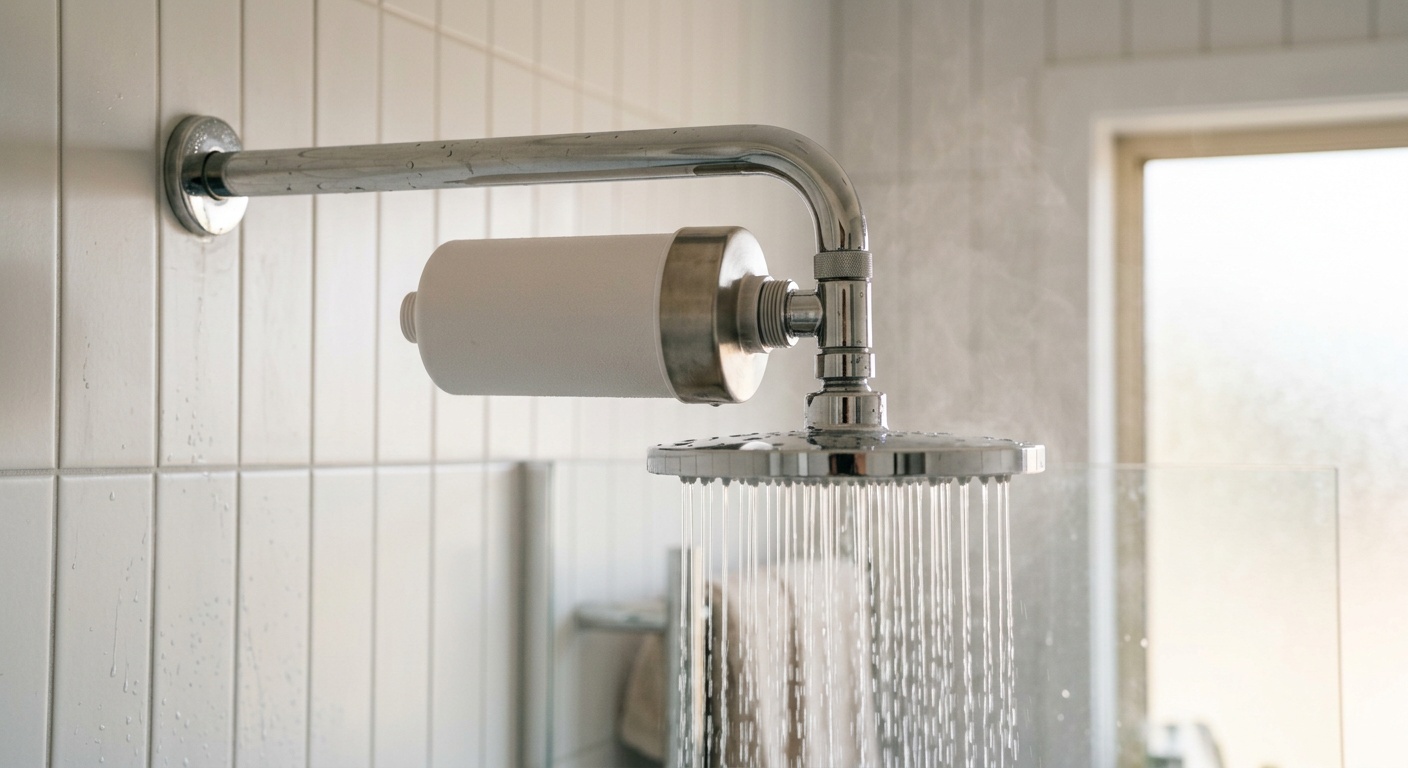
| Vitamin C (ascorbic acid) | ✓ Excellent | ✓ Yes | ✗ No | Recommended for Brisbane |
| Catalytic carbon | ✓ Yes | ✓ Yes | ✗ No | Recommended for Brisbane |
| Water softener (ion exchange) | ✗ No | ✗ No | ✓ Yes | Wrong technology for Brisbane eczema |
Vitamin C Shower Filters: The Best Technology for Brisbane Chloramine
Vitamin C (ascorbic acid) neutralises chloramine through a direct chemical reaction. It does not rely on contact time the way carbon filtration does — the reaction occurs almost instantly as water passes through the cartridge. This makes it uniquely suited to the high flow rates and warm temperatures of a shower, where contact time is limited to fractions of a second.
The Philips Premium Shower Filter uses vitamin C as its primary chloramine-neutralisation medium and is specifically marketed for Australian chloramine cities. The unit fits standard Australian shower arms (15mm BSP thread) and requires cartridge replacement every 2-3 months depending on shower frequency. For a household with two adults showering daily, expect 8-10 weeks per cartridge at typical Brisbane usage. Replacement cartridges typically run $30-$45 each, putting annual cartridge cost at approximately $120-$200.
The PWS (Pure Water Systems) shower filter uses catalytic carbon, which also addresses chloramine effectively but requires slightly longer contact time than vitamin C. Both technologies are appropriate for Brisbane. The choice between them comes down to whether you prefer a chemical neutralisation approach (vitamin C) or an adsorption approach (catalytic carbon).
Drinking Water: Countertop RO for Chloramine, Fluoride, and PFAS
A shower filter addresses dermal exposure. But if you are also drinking Brisbane tap water (and most SEQ households are), you are ingesting chloramine with every glass. A reverse osmosis system removes chloramine (along with fluoride at 90-97% and PFAS at >98%) through membrane separation. Carbon block filters — even catalytic carbon — cannot remove fluoride. Brisbane’s fluoride level sits at 0.6-0.8 mg/L per SEQ Water data. If fluoride removal matters to you, RO is the only benchtop technology that achieves it.
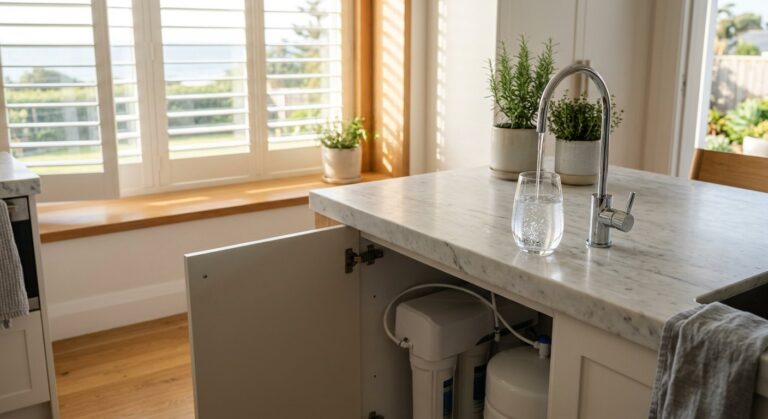
The AquaTru Classic Smart Alkaline is a countertop RO unit that requires zero plumbing modification — relevant for renters across Brisbane, the Gold Coast, and SEQ. It removes chloramine, fluoride, PFAS, lead, and heavy metals. At approximately $699 upfront with annual filter costs around $120-$150, the 5-year cost works out to roughly $0.04 per litre — compared to $2-$5 per litre for bottled water. For a household drinking 4L/day, that is $1,460+ in bottled water savings over five years.
5-Year Cost Comparison: Shower Filter vs Water Softener for Brisbane Eczema
Cost matters because eczema is chronic. You are not making a one-off purchase — you are committing to an ongoing system. Here is the honest cost comparison between the two approaches most commonly recommended for eczema.
| Solution | Upfront | Annual Cost | 5-Year Total | Chloramine Removal |
|---|---|---|---|---|
| Vitamin C shower filter | $60-$120 | $120-$200 | $660-$1,120 | ✓ Yes |
| Vitamin C shower + AquaTru RO | $760-$820 | $240-$350 | $1,960-$2,570 | ✓ Shower + drinking |
| Whole-house water softener | $2,000-$5,000 | $150-$300 (salt) | $2,750-$6,500 | ✗ No |
| KDF-55 shower filter | $30-$60 | $40-$80 | $230-$460 | ✗ No |
The cheapest option (KDF-55) does not work for Brisbane. The most expensive option (water softener) addresses the wrong contaminant. The vitamin C shower filter is the cost-effective, chemically correct choice. Add a countertop RO system if you want to address drinking water chloramine and fluoride as well — the combined 5-year cost is still lower than a water softener alone, and you actually remove the contaminant that matters.
The Brisbane Humidity Factor: Mould, Dust Mites, and Compounding Triggers
Water chemistry is not the only environmental trigger for eczema in Brisbane and SEQ. Brisbane’s subtropical climate — summer humidity regularly exceeding 70-80% RH — creates ideal conditions for two potent eczema triggers that most water filter content ignores entirely.
House dust mites thrive above 60% relative humidity. Brisbane and coastal SEQ suburbs from Redcliffe through to Burleigh Heads consistently exceed this threshold from October through April. Dust mite allergens (Der p 1 and Der p 2) are among the most well-documented eczema aggravators in atopic individuals. No amount of water filtration addresses this.
Mould spores are the other humidity-driven trigger. Bathrooms, laundries, and poorly ventilated bedrooms in older Queensland homes (particularly Queenslander-style raised timber construction) accumulate mould through summer. Aspergillus, Cladosporium, and Alternaria species all release spores that deposit on skin and bedding. According to the NEPM (National Environment Protection Measure) ambient air quality standards, indoor mould spore counts should remain below outdoor ambient levels — but many Brisbane bedrooms exceed this during summer.
If you have addressed shower water chemistry and your eczema persists, the next variable to investigate is indoor air quality. A HEPA air purifier rated for Brisbane conditions captures dust mite allergens and mould spores at 99.97% efficiency at 0.3 micrometres. The Breville Protect Max and Levoit Core 400S are both sized for Brisbane bedrooms. Our air quality guide covers the full selection criteria.
Decision Framework: Three Questions for Brisbane Eczema Households
Eczema trigger identification is a process of elimination. Here is the systematic approach, starting with the highest-impact, lowest-cost intervention and working upward.
1. Are you filtering chloramine from your shower? If no, this is your first purchase. A vitamin C or catalytic carbon shower filter is $60-$120 and addresses the most direct chemical contact your skin has with Brisbane tap water. If you currently have a KDF-55 filter, it is not removing chloramine. Replace it.
2. Is your local water hardness above 200 mg/L? For most SEQ households, no. The grid average is 80-120 mg/L. If you are on tank or bore water, or in an older suburb with galvanised pipes, test with a TDS meter first. Only consider a water softener if your reading exceeds 200 mg/L — and even then, install it alongside a chloramine shower filter, not instead of one.
3. Have you addressed indoor air quality? If your shower filter is handling chloramine and your eczema persists, the next variable is airborne allergens — dust mites and mould spores. A HEPA air purifier in the bedroom reduces nighttime allergen exposure. Brisbane’s humidity and mould season make this relevant from September through April.
Final Verdict
Brisbane eczema is a chloramine problem, not a hard water problem. The SEQ Water grid delivers monochloramine to every suburb from Ipswich to the Gold Coast, and standard shower filters (KDF-55, standard GAC) let it through. Vitamin C or catalytic carbon shower filters are the only technologies that remove chloramine at shower flow rates. A water softener addresses the wrong contaminant for Brisbane’s moderate hardness profile and costs 20-40x more for zero chloramine reduction.
Start with a chloramine-rated shower filter. Add a countertop RO for drinking water if you want to address fluoride and PFAS as well. And if symptoms persist, investigate your indoor air quality — Brisbane’s humidity makes dust mites and mould a compounding factor that no water filter can fix.
Last reviewed: July 2026 – Clean and Native
Ready to remove chloramine from your Brisbane shower?
For drinking water, the AquaTru Classic RO removes chloramine, fluoride, and PFAS without plumbing modification.
Frequently Asked Questions
Does Brisbane tap water cause eczema?
Brisbane tap water contains chloramine, a disinfectant that penetrates and oxidises the skin’s lipid barrier. According to Jabbar-Lopez ZK et al. (2020, PubMed 33259122), chlorine-based disinfectants are associated with increased eczema prevalence. Chloramine does not cause eczema in isolation but can trigger flares in people with a compromised skin barrier.
Does Brisbane have hard water that causes eczema?
Brisbane water hardness is 80-120 mg/L CaCO₃, classified as moderate by the ADWG. This is well below the 200+ mg/L threshold associated with increased eczema risk in UK epidemiological studies. Chloramine, not hardness, is the more relevant eczema trigger in Brisbane.
Do Brita filters remove chloramine from Brisbane water?
No. Brita jugs use standard granular activated carbon (GAC), which removes chloramine at approximately 1/40th the rate of free chlorine. For Brisbane’s chloramine-treated water, a Brita filter provides minimal chloramine reduction. A reverse osmosis or catalytic carbon system is required.
What type of shower filter removes chloramine in Brisbane?
Only vitamin C (ascorbic acid) or catalytic carbon shower filters effectively remove chloramine. KDF-55 filters, which are the most commonly sold type on Amazon AU, do not work for chloramine. Always check whether a shower filter specifies chloramine removal, not just chlorine removal.
Do I need a water softener for eczema in Brisbane?
Unlikely. Water softeners remove dissolved calcium and magnesium (hardness minerals), but Brisbane’s hardness at 80-120 mg/L is below the threshold where softening has shown eczema benefit in clinical trials. A water softener also does not remove chloramine, which is Brisbane’s primary chemical irritant.
How often do vitamin C shower filter cartridges need replacing?
Every 2-3 months for a household with two adults showering daily. The ascorbic acid is consumed by the chemical reaction with chloramine, so replacement frequency depends directly on water volume. Replacement cartridges typically cost $30-$45 each, or approximately $120-$200 per year.
Can a HEPA air purifier help with eczema in Brisbane?
Yes, indirectly. Brisbane’s subtropical humidity promotes house dust mites (above 60% RH) and mould growth, both of which produce airborne allergens that aggravate eczema. A HEPA air purifier captures 99.97% of particles at 0.3 micrometres, including dust mite allergens (Der p 1) and mould spores. It addresses a different trigger than water filtration.
Does chloramine or free chlorine affect eczema more?
Chloramine is more lipophilic than free chlorine, meaning it penetrates the skin’s lipid bilayer more effectively. Free chlorine evaporates within minutes in warm shower water, while chloramine persists for the entire shower duration. Both are associated with eczema aggravation, but chloramine provides longer and deeper skin contact per shower.
What is the TDS of Brisbane tap water?
Brisbane and SEQ tap water TDS typically ranges from 80-115 mg/L. A calibrated TDS-3 meter reading at Palm Beach on the SEQ grid returned 69 ppm, which sits at the lower end of the range and reflects the relatively soft source water from the SEQ Water grid catchments.
Does reverse osmosis remove chloramine from Brisbane tap water?
Yes. Reverse osmosis systems remove chloramine through membrane separation, along with fluoride (90-97%), PFAS (>98%), lead, and heavy metals. Most RO systems also include a pre-filter carbon stage that addresses chloramine before the membrane. The AquaTru Classic is a countertop RO unit that requires no plumbing modification, making it suitable for Brisbane renters.
Get the Australian Home Environment Checklist
30 checks across water, air and EMF. Most of them free. Ranked by impact.
No spam. Unsubscribe any time.

Former Royal Australian Navy Clearance Diver and TAG-E counter-terrorism operator. Founded Clean and Native to apply the same rigorous thinking to the home environment.
Full biography →