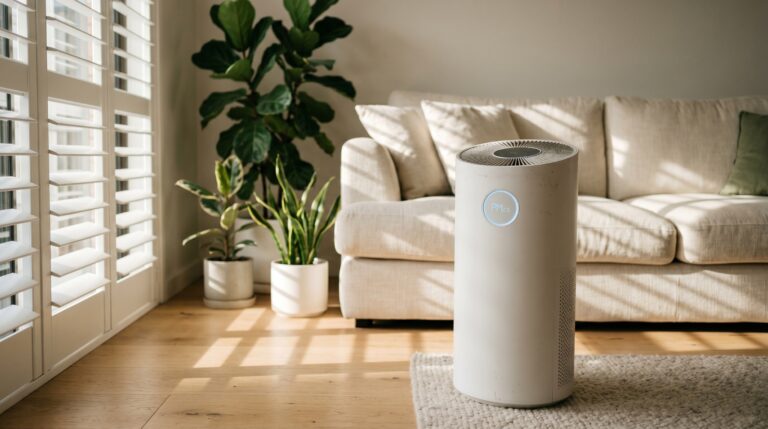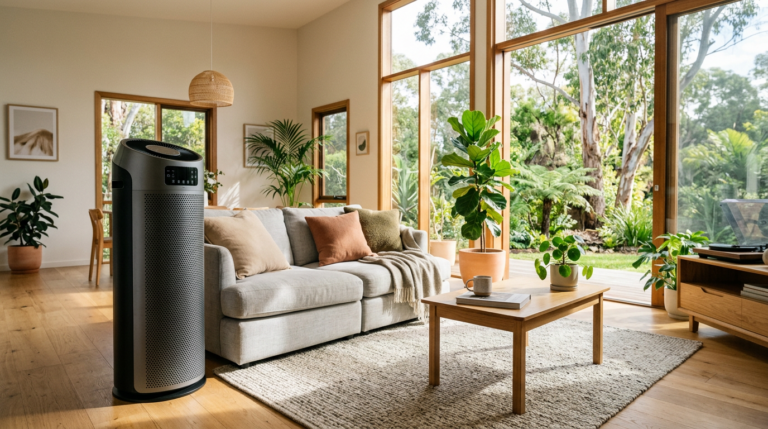
Sensibo Pure Air Purifier Review Australia
The Sensibo Pure is a smart-home-focused HEPA air purifier priced at $229-$249 AUD that integrates with Apple HomeKit, Google Home, and Amazon Alexa — but its 110 CADR and compact filter limit it to rooms under 18 m². We analysed it against manufacturer specifications, certified test data, and verified Australian listings using our documented methodology to determine whether it delivers genuine value for Australian households dealing with bushfire smoke, pollen, and urban PM2.5.
The Sensibo Pure is the best smart-home integration air purifier in Australia — but it is a mediocre air purifier. Its HomeKit, Google Home, and Alexa compatibility is actually excellent, and the app-based air quality monitoring is a useful feature for automation-heavy households. However, the 110 CADR is roughly one-third of what the Breville Protect Max delivers at a similar price point, and the H11 HEPA class filter captures significantly fewer fine particles than the H13 standard used by serious competitors. For a bedroom under 18 m² where smart-home control matters more than raw filtration power, it works. For anything larger — or for bushfire smoke protection — it is outclassed.
Key catches
- 110 CADR is rated for rooms up to ~18 m² — that is a single bedroom, not a living area
- H11 HEPA filter (95% at 0.3 µm) is two classes below the H13 standard (99.97% at 0.3 µm) used by Breville and Levoit
- Australian stock is inconsistent — currently listed as “Sold out” at Ample Air Warehouse ($229 AUD), with limited Amazon AU availability
- No activated carbon VOC stage — relies on a basic carbon pre-filter, not a dedicated gas-phase filter
✓ Who This Is For
- Smart-home enthusiasts who want native HomeKit, Google Home, or Alexa integration without workarounds
- Renters or apartment dwellers needing a compact purifier for a single bedroom under 18 m²
- Users who value app-based air quality monitoring and automated scheduling over raw CADR performance
- Households already invested in the Sensibo ecosystem (e.g., Sensibo Air for AC control) wanting a unified app experience
× Who It Is Not For
- Anyone needing bushfire smoke protection — 110 CADR cannot keep up with PM2.5 ingress during smoke events in NSW, Victoria, or QLD
- Open-plan living areas over 18 m² — the Breville Protect Max covers 3x the area at a similar price
- Allergy or asthma sufferers who need H13 HEPA (99.97% at 0.3 µm) — the H11 filter leaves a measurable gap
- Users who want strong VOC/odour removal — no dedicated activated carbon stage
- Buyers who need immediate availability — AU stock has been inconsistent through 2025-2026
The Smart-Home Problem Most Air Purifiers Ignore
Here is the frustration that drives people toward the Sensibo Pure: you have spent $1,000+ building a HomeKit or Google Home setup in your house, and every air purifier on the market either has no smart features at all, or forces you through a proprietary app that does not talk to your existing ecosystem. The Levoit Core 400S has Wi-Fi and an app, but no native HomeKit support. The Breville Protect Max has no app at all. The Dyson models work with Alexa but require the Dyson Link app as a middleman.
Sensibo built its reputation on smart AC controllers — small devices that retrofit split-system air conditioners with app control, scheduling, and HomeKit/Google/Alexa integration. The Sensibo Pure applies that same philosophy to air purification: the air purifier is almost secondary to the smart platform it connects to. That is both its genuine strength and its fundamental limitation.
If you live in a smart-home household and you want your air purifier to respond to automations — turn on when the Sensibo Air detects your AC is running, or activate when a HomeKit sensor reads PM2.5 above a threshold — the Sensibo Pure is currently the only consumer air purifier in Australia that does this natively. No hacks, no HomeKit bridges, no IFTTT workarounds.
The question is whether that smart-home convenience compensates for the filtration compromises you are making. Let us look at the specifications.
Product Specifications: What the Numbers Actually Say
The Sensibo Pure’s specification sheet reveals a device designed for small rooms, not whole-home purification. Every number here comes from Sensibo’s published product data and should be evaluated against what competitors deliver at the same price point.
| Specification | Sensibo Pure | What It Means |
|---|---|---|
| CADR | 110 m³/h | Effective for rooms up to ~18 m² (using AHAM 2/3 rule). A small bedroom. |
| HEPA class | H11 (EN 1822) | 95% capture at 0.3 µm. Two classes below H13 (99.97%). 5% of the most penetrating particle size passes through. |
| Filter stages | Pre-filter + carbon layer + H11 HEPA | No dedicated activated carbon stage for VOCs/gases. Carbon is integrated into the pre-filter. |
| Room coverage | ~18 m² (manufacturer claim: “up to 20 m²”) | Equivalent to a single bedroom. Not suited for open-plan living spaces. |
| Noise level | 25-55 dB(A) | 25 dB on lowest setting is actually quiet for sleep. 55 dB on max is audible across a room. |
| Smart integration | Apple HomeKit, Google Home, Amazon Alexa, Sensibo app | Native support — no bridge, no workaround. The standout feature. |
| Built-in sensors | PM2.5, temperature, humidity | Real-time PM2.5 readings in-app. Useful for triggering automations. |
| Filter life | ~6-12 months (depending on usage) | Replacement filters ~$60-80 AUD. Availability in AU can be inconsistent. |
| Power consumption | 5-30 W | Low energy draw. At 30W max, running 24/7 costs ~$25/year at AU electricity rates. |
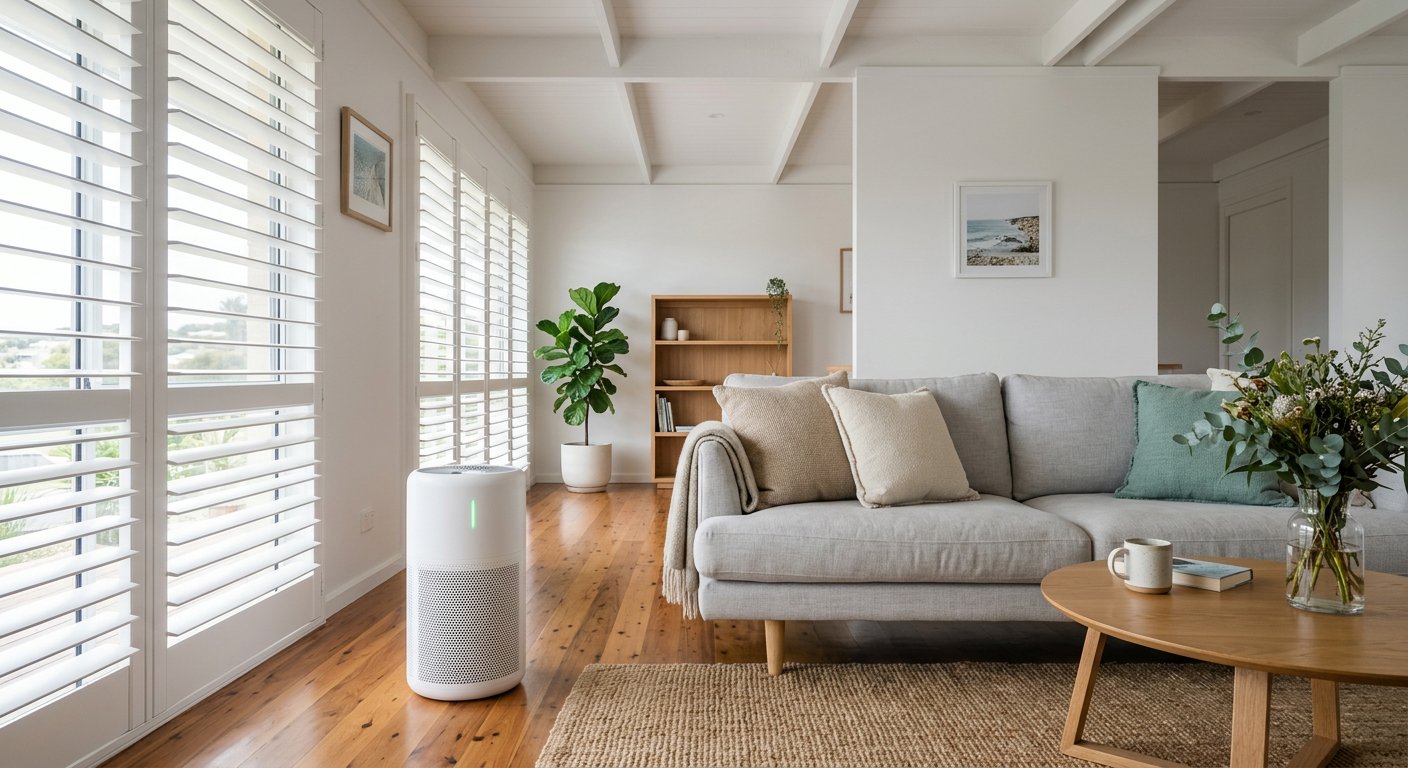
| Dimensions | 240 × 240 × 370 mm | Compact. Fits on a bedside table or desk. |
| Weight | ~3.5 kg | Light enough to move between rooms easily. |
| AU price | $229-$249 AUD | Competitive pricing, but check availability — AU stock has been spotty. |
| Amazon AU rating | 4.0/5 (171 reviews) | Solid, not exceptional. Common complaints: filter availability, CADR limitations. |
The H11 vs H13 HEPA Gap
This is the specification that matters most, and most buyers overlook it. The EN 1822 HEPA classification system is not linear — the difference between H11 and H13 is substantial. An H11 filter captures 95% of particles at the most penetrating particle size (MPPS, typically 0.1-0.3 µm). An H13 filter captures 99.97%. That sounds like a small gap in percentage terms, but in practice it means the H11 filter lets through 50 times more of the most dangerous fine particles than an H13 filter does.
For context: the particles that matter most during NSW and Victorian bushfire season (October-March) are PM2.5 and smaller. These are the particles that bypass your nasal passages and deposit directly in lung tissue. According to NSW Health data, PM2.5 concentrations during the 2019-2020 Black Summer exceeded 200 µg/m³ in western Sydney suburbs like Penrith and Campbelltown — more than 8 times the NEPM standard of 25 µg/m³ (24-hour average). At those concentrations, the 5% leakage through an H11 filter is not trivial.
If you live in an area affected by bushfire smoke, pollen season, or industrial particulates — inner Sydney, western Melbourne, Brisbane’s south side near the industrial corridor, or Perth’s Kwinana belt — an H13 filter is the minimum standard. The Sensibo Pure’s H11 is acceptable for mild, day-to-day particulate management. It is not acceptable as your primary defence during a smoke event.
Smart-Home Integration: Where the Sensibo Pure actually Excels
Forget the filtration specs for a moment. The Sensibo Pure’s smart-home integration is, according to Sensibo’s published documentation, the most comprehensive of any consumer air purifier available in Australia. Here is what it does that competitors do not.
Native HomeKit Support
The Sensibo Pure appears as a native HomeKit accessory. No bridge device required, no third-party app as a middleman, no cloud dependency for basic on/off control. You can add it to HomeKit scenes and automations directly. If you have a HomePod or Apple TV as a home hub, you can control it remotely and via Siri voice commands. According to Sensibo’s documentation, this extends to reading the built-in PM2.5 sensor data within the Home app.
This matters because HomeKit is the most restrictive ecosystem to get into. Google Home and Alexa are relatively open — many purifiers offer Alexa skills or Google Home actions. But native HomeKit support without a HomeKit bridge? That is currently unique to the Sensibo Pure in the Australian air purifier market.
Google Home and Alexa
Both integrations work as expected based on Sensibo’s documentation. Voice commands for on/off, speed adjustment, and status checks. The Sensibo app acts as the configuration layer, and Google Home/Alexa handle voice control. The Levoit Core 400S also offers Alexa and Google Home support via the VeSync app, but — and this is the key difference — the Levoit does not expose its PM2.5 sensor data to those platforms. The Sensibo Pure does.
The Sensibo App and Automations
The Sensibo app provides real-time PM2.5, temperature, and humidity readings from the unit’s built-in sensors. According to Sensibo, you can set automations based on these readings — for example, turning the purifier to high speed when PM2.5 exceeds a threshold, or activating it when humidity drops below a set point (indicating dry, dusty conditions common in Perth during summer).
For households already using the Sensibo Air (their smart AC controller), the app becomes a unified climate management platform. Your AC and air purifier respond to the same triggers, appear in the same app, and coordinate via the same automations. According to Sensibo’s product literature, this is the intended use case — the Pure is not a standalone product but part of an ecosystem.
The Sensibo app servers are cloud-based, with Sensibo operating out of Israel. Australian users should be aware that control depends on internet connectivity and Sensibo’s server infrastructure. Local control (e.g., HomeKit with HomePod hub) works without internet, but app-based automations and remote access require Sensibo’s cloud servers to be operational.
Price vs Performance: The Sensibo Pure Against Australian Competitors
At $229-$249 AUD, the Sensibo Pure sits in the same price bracket as the Levoit Core 400S ($349) and significantly below the Breville Protect Max (~$468). But price-per-dollar is not the right comparison here. The right comparison is CADR per dollar — how much clean air you actually get for your money.
| Model | AU Price | CADR (m³/h) | HEPA Class | Room Coverage | CADR per $100 AUD | Smart Home |
|---|---|---|---|---|---|---|
| Sensibo Pure | $229-$249 | 110 | H11 (95%) | ~18 m² | 44-48 | HomeKit + Google + Alexa |
| Levoit Core 400S | $349 | 350 | H13 (99.97%) | ~40 m² | 100 | Alexa + Google (no HomeKit) |
| Winix 5500-2 | ~$399 | 300 | H13 (99.97%) | ~33 m² | 75 | None |
| Breville Protect Max | ~$468 | 550 | H13 (99.97%) | ~60 m² | 117 | None |
The numbers are stark. The Breville Protect Max delivers 117 CADR per $100 AUD spent. The Sensibo Pure delivers 44-48. You are paying roughly 2.5x more per unit of clean air delivery with the Sensibo. And the Breville does it with H13 HEPA filtration and a dedicated activated carbon stage for VOCs and cooking odours.
The Levoit Core 400S is the most instructive comparison. At $349, it costs $100-$120 more than the Sensibo Pure but delivers 3.2x the CADR, H13 HEPA filtration, a larger activated carbon filter, and app-based control via VeSync with Alexa and Google Home support. It covers a 40 m² room — more than double the Sensibo’s effective coverage. The only thing the Levoit lacks is native HomeKit support.
If HomeKit is not a requirement for you, the value equation is not close. The Levoit Core 400S or Breville Protect Max are objectively better air purifiers for Australian conditions. Full stop.
Total Cost of Ownership: 3-Year Comparison
| Model | Upfront | Annual Filter Cost | 3-Year Total | CADR You Get |
|---|---|---|---|---|
| Sensibo Pure | $229-$249 | ~$80-$120 | $469-$609 | 110 m³/h (H11) |
| Levoit Core 400S | $349 | ~$80-$100 | $589-$649 | 350 m³/h (H13) |
| Breville Protect Max | $468 | ~$90-$120 | $738-$828 | 550 m³/h (H13) |
Over three years, the Sensibo Pure costs only $80-$180 less than the Levoit Core 400S, while delivering one-third the CADR with a lower-grade filter. The Breville costs more — but delivers 5x the CADR with H13 filtration. If you are spending $469+ over three years on air purification anyway, spending $120 more for 3x the performance seems like the obvious choice.
One additional cost factor specific to Australian buyers: replacement filter availability. Sensibo filters are not stocked by Australian retailers like Officeworks, JB Hi-Fi, or major department stores. You are dependent on Amazon AU availability (which has been inconsistent) or ordering directly from Sensibo’s online store with international shipping times. Levoit and Breville replacement filters, by contrast, are readily available on Amazon AU with Prime delivery.
Australian Air Quality Context: Where 110 CADR Falls Short
Air purifier CADR ratings exist in a vacuum (literally). Manufacturers test in sealed chambers under controlled conditions. Australian homes face real-world air quality challenges that push small purifiers beyond their limits.
Bushfire Smoke Season (October-March)
During the 2019-2020 Black Summer, according to DPIE NSW air quality monitoring data, PM2.5 levels in greater Sydney exceeded 200 µg/m³ on multiple days. The NEPM standard for 24-hour PM2.5 is 25 µg/m³. That is 8x the guideline. Melbourne’s western suburbs, Brisbane’s south side, and Canberra all recorded hazardous readings. Perth recorded PM2.5 AQI readings of 55 (moderate) in recent monitoring data from AQICN — and that is outside major fire events.
At 110 CADR, the Sensibo Pure achieves approximately 4-5 air changes per hour in its rated 18 m² room. During a smoke event where PM2.5 is 8x the guideline, you need a purifier that can maintain clean air despite infiltration through door gaps, window seals, and HVAC systems. A 110 CADR unit in a leaky Australian home (most homes built before 2010) is being overwhelmed faster than it can filter.
The Breville Protect Max at 550 CADR handles this. Even in a 40 m² open-plan living space, it delivers enough air changes per hour to maintain acceptable indoor PM2.5 during moderate smoke events. The Sensibo Pure cannot make this claim. If bushfire smoke is your primary concern — and if you live anywhere in NSW, Victoria, the ACT, or south-east Queensland, it should be — the Sensibo Pure is insufficient as a primary defence.
Pollen Season and Humidity
Brisbane and south-east QLD pollen season peaks September-November, with grass pollen counts frequently exceeding 100 grains/m³ according to Brisbane Pollen Count data. Pollen particles are relatively large (10-100 µm), and even the Sensibo Pure’s H11 filter captures them effectively at that size. For pollen alone, in a single bedroom, the Sensibo Pure works acceptably.
However, Brisbane, Cairns, and coastal NSW also contend with high humidity levels that promote mould spore production. Mould spores range from 2-20 µm, and the H11 filter handles them. But the Sensibo Pure’s lack of a dedicated activated carbon stage means it does nothing about the musty VOCs that accompany mould growth. In a coastal Queensland or northern NSW home where mould is an ongoing concern, a purifier with a proper carbon filter — like the Winix 5500-2 with its dedicated activated carbon stage — addresses both the particulates and the odour. The Sensibo Pure addresses only the particulates.
Australian Availability and Support Reality
This is a practical consideration that no manufacturer’s spec sheet covers, and it matters more than most buyers realise until they need a replacement filter at 11 PM on a Sunday during bushfire season.
As of mid-2026, the Sensibo Pure’s Australian distribution is limited. Ample Air Warehouse — one of the few Australian stockists — lists the unit at $229 AUD but currently shows it as “Sold out.” Amazon AU has listings (ASIN B08QJNTMJL), but stock availability has been inconsistent. This is not a product you can walk into JB Hi-Fi or Harvey Norman and buy off the shelf.
Replacement filter availability is the bigger concern. When your Sensibo Pure filter needs replacing (every 6-12 months), you are dependent on either Amazon AU having stock or ordering directly from Sensibo with international shipping. During bushfire season, when demand for air purifier filters spikes across Australia, this supply chain vulnerability becomes a genuine problem. Breville replacement filters are available through their Australian service network, Harvey Norman, and Amazon AU. Levoit Core 400S filters are readily stocked on Amazon AU with Prime delivery.
Sensibo’s warranty support operates from Israel. Australian consumer law (ACL) provides mandatory warranty protections regardless of where the manufacturer is based, but pursuing a warranty claim with an overseas company is more complex than walking into a Breville service centre. This is a practical consideration, not a deal-breaker — but it is worth knowing before you buy.
What Works Well
- Smart-home integration is actually best-in-class. Native HomeKit, Google Home, and Alexa without bridges or workarounds. No other air purifier in Australia offers this.
- Built-in PM2.5 sensor with app access. Real-time air quality data on your phone and exposed to smart-home platforms for automation triggers.
- Compact form factor. At 240 × 240 × 370 mm and 3.5 kg, it fits on a bedside table or desk without dominating the room.
- Low noise on lowest setting. 25 dB(A) is actually quiet for overnight use in a bedroom. Quieter than many competing models at their lowest speeds.
- Low energy consumption. 5-30 W means running costs are minimal — approximately $25/year at Australian electricity rates running 24/7.
- Unified ecosystem. If you already use Sensibo Air for AC control, the Pure integrates into the same app and automation framework.
What Could Be Better
- 110 CADR is insufficient for Australian conditions. During bushfire season, this unit cannot protect a living room. It is a bedroom-only device, and even then, a well-sealed bedroom.
- H11 HEPA is two classes below the H13 standard. 95% capture at MPPS vs 99.97%. For allergy and asthma sufferers, this gap is clinically relevant. Asthma Australia recommends HEPA air purifiers for asthma management — but does not distinguish by HEPA class, leaving consumers to assume all HEPA is equal. It is not.
- No dedicated activated carbon stage. The basic carbon pre-filter provides minimal VOC and odour removal compared to the Winix 5500-2’s dedicated carbon filter or the Breville Protect Max’s activated carbon stage.
- Australian stock and filter availability is unreliable. The unit and its replacement filters have been inconsistently stocked on Amazon AU and Australian retailers throughout 2025-2026.
- Cloud dependency for advanced features. Automations, remote access, and app-based monitoring require Sensibo’s cloud servers (based in Israel) to be operational. Basic HomeKit local control works without internet, but the full smart feature set does not.
- 4.0/5 stars on Amazon AU (171 reviews) suggests consistent minor complaints. Common themes in user reviews include filter replacement difficulty, app connectivity issues, and CADR limitations in larger rooms.
How It Compares: Decision Framework
There are three buying scenarios, and the correct choice depends entirely on which scenario describes you.
Scenario 1: Smart-Home Integration Is Non-Negotiable
If you are deeply invested in Apple HomeKit and you want your air purifier to appear as a native HomeKit accessory — no bridge, no workaround, no third-party app dependency — the Sensibo Pure is currently your only option in Australia. Buy it for the smart features, accept the filtration limitations, and use it in a bedroom under 18 m². If your room is larger than that, you need a second unit or a different approach entirely.
Scenario 2: You Want Smart Features AND Good Filtration
The Levoit Core 400S is the answer. 350 CADR, H13 HEPA, app control via VeSync, Alexa and Google Home support — no HomeKit, but everything else. At $349, it costs $100-$120 more than the Sensibo Pure and delivers more than 3x the CADR with a better filter. This is the best value smart air purifier for most Australian households.
Scenario 3: You Want Maximum Filtration Performance
The Breville Protect Max delivers 550 CADR with H13 HEPA and a proper activated carbon stage. No smart features, no app, no voice control — just raw air cleaning performance. At ~$468, it costs roughly double the Sensibo Pure but delivers 5x the CADR. For bushfire smoke protection in open-plan living areas across Sydney, Melbourne, Brisbane, and Perth, this is the benchmark. Read our best air purifier for Sydney guide for detailed city-specific recommendations.
Final Verdict
The Sensibo Pure is a smart-home device that happens to purify air — not an air purifier that happens to be smart. That distinction matters. If your primary buying motivation is “I want my air purifier in HomeKit automations,” this is the only product in Australia that delivers it natively. Buy it for that specific purpose, use it in a bedroom under 18 m², and accept the H11 HEPA and 110 CADR limitations.
If your primary buying motivation is “I want the cleanest air possible in my home” — especially during bushfire season in NSW, Victoria, QLD, the ACT, or during Perth’s moderate PM2.5 days — the Sensibo Pure is not the right tool. The Levoit Core 400S at $349 or the Breville Protect Max at ~$468 deliver dramatically more filtration per dollar, with H13 HEPA that captures 99.97% of fine particles compared to the Sensibo’s 95%.
Who should buy it: HomeKit-committed households, small-bedroom-only use, Sensibo ecosystem users.
Who should look elsewhere: Anyone prioritising air filtration performance, open-plan living spaces, bushfire smoke protection, or long-term filter supply reliability.
Last reviewed: August 2026 – Clean and Native
Still considering the Sensibo Pure?
Check current pricing and availability on Amazon AU. If stock is unavailable, the Levoit Core 400S is the strongest alternative with smart features and 3x the CADR at H13 HEPA — available now.
Frequently Asked Questions
Does the Sensibo Pure work with Apple HomeKit in Australia?
Yes. According to Sensibo’s product documentation, the Sensibo Pure supports native Apple HomeKit without requiring a bridge device. It appears as a HomeKit accessory and can be added to HomeKit scenes and automations. It is currently the only consumer air purifier sold in Australia with native HomeKit support.
Is the Sensibo Pure effective for bushfire smoke?
Not for moderate to heavy smoke events. Its 110 CADR is rated for rooms up to approximately 18 m², and its H11 HEPA filter captures 95% of particles at 0.3 µm — compared to 99.97% for H13 HEPA filters. During the 2019-2020 Black Summer, PM2.5 in Sydney exceeded 200 µg/m³ according to DPIE NSW data. A 110 CADR unit cannot maintain safe indoor air quality under those conditions.
What is the difference between H11 and H13 HEPA filters?
Under the EN 1822 standard, H11 captures 95% of particles at the most penetrating particle size (MPPS), while H13 captures 99.97%. In practical terms, an H11 filter lets through approximately 50 times more of the finest particles than an H13 filter. For allergy and asthma management, H13 is the preferred standard.
How much does it cost to run the Sensibo Pure per year in Australia?
At 5-30 W power draw, the Sensibo Pure costs approximately $25 AUD per year in electricity when running 24/7 at average Australian electricity rates. Replacement filters cost an estimated $80-120 AUD per year depending on usage intensity and filter availability, bringing total annual running costs to approximately $105-145 AUD.
Can I buy Sensibo Pure replacement filters in Australia?
Replacement filters are available through Amazon AU (subject to stock availability) and through Sensibo’s online store with international shipping. As of mid-2026, Australian brick-and-mortar retailers like JB Hi-Fi and Harvey Norman do not stock Sensibo filters. Stock has been inconsistent on Amazon AU, so purchasing a spare filter when buying the unit is advisable.
How does the Sensibo Pure compare to the Levoit Core 400S?
The Levoit Core 400S costs approximately $349 AUD and delivers 350 CADR with H13 HEPA filtration — 3.2x the CADR of the Sensibo Pure with a higher-grade filter. The Levoit supports Alexa and Google Home via its VeSync app but does not offer native HomeKit support. For air filtration performance, the Levoit is significantly superior. For HomeKit integration, only the Sensibo Pure delivers.
Does the Sensibo Pure remove VOCs and cooking odours?
The Sensibo Pure has a basic carbon pre-filter layer, but it does not have a dedicated activated carbon stage. Its VOC and odour removal capacity is limited compared to purifiers with dedicated carbon filters, such as the Winix 5500-2 or the Breville Protect Max. For households where cooking odours, paint fumes, or chemical off-gassing are concerns, a dedicated activated carbon filter is the better choice.
What size room is the Sensibo Pure suitable for?
The Sensibo Pure is suitable for rooms up to approximately 18 m² based on its 110 CADR rating (using the AHAM 2/3 rule). Sensibo claims “up to 20 m²” in its marketing materials. In practice, this covers a single bedroom or small study. It is not suitable for open-plan living areas, which in Australian homes typically range from 30-60 m².
Does the Sensibo Pure have a warranty in Australia?
Sensibo provides a manufacturer warranty, and Australian Consumer Law (ACL) provides mandatory consumer guarantee protections regardless of where the manufacturer is based. However, Sensibo operates from Israel, so warranty claims may involve international communication and longer resolution times compared to Australian-based brands like Breville, which have local service centres.
Get the Australian Home Environment Checklist
30 checks across water, air and EMF. Most of them free. Ranked by impact.
No spam. Unsubscribe any time.

Former Royal Australian Navy Clearance Diver and TAG-E counter-terrorism operator. Founded Clean and Native to apply the same rigorous thinking to the home environment.
Full biography →