How to Read Australia’s Air Quality Index 2026
Australia‘s Air Quality Index measures six pollutants — PM2.5, PM10, ozone, nitrogen dioxide, sulphur dioxide, and carbon monoxide — against the National Environment Protection Measure (NEPM) standards, producing a single number from 0 upward where anything above 100 means at least one pollutant has exceeded its national standard. According to NEPM reporting data, over 437 monitoring stations across Australia feed real-time AQI readings that directly determine whether the air you breathe indoors and outdoors is safe for your family.
Australia’s AQI uses a 0-200+ scale where 0-33 is “Good”, 34-66 is “Fair”, 67-99 is “Poor”, 100-149 is “Very Poor”, and 150+ is “Hazardous” — any reading above 66 means you should reduce outdoor exertion and run a HEPA air purifier indoors. The AQI is calculated from whichever of the six NEPM pollutants scores highest at a given monitoring station, so one bad pollutant drives your entire reading. During the Black Summer bushfires of 2019-2020, Canberra recorded PM2.5 AQI readings above 2,000 — roughly 20 times the “Hazardous” threshold. You do not need to wait for a bushfire to act: even “Fair” readings (34-66) expose sensitive groups to elevated PM2.5 according to the enHealth guidelines.
| AQI BAND | RANGE | WHAT TO DO |
|---|---|---|
| Good | 0-33 | No action needed — open windows |
| Fair | 34-66 | Sensitive groups run HEPA purifier |
| Poor | 67-99 | Run HEPA purifier, reduce outdoor time |
| Very Poor | 100-149 | Close windows, run HEPA, avoid outdoors |
| Hazardous | 150+ | Seal home, HEPA on max, stay indoors |
Key catches
- AQI scales differ between states — NSW and Victoria use slightly different breakpoints, so always check the source app
- PM2.5 is the dominant health-risk pollutant in Australian smoke events, but the AQI reports whichever pollutant is highest
- Indoor PM2.5 without filtration typically reaches 50-70% of outdoor levels within 1-2 hours of an outdoor smoke event
What the AQI Actually Measures: The Six NEPM Pollutants
Most Australians glance at an AQI number without understanding what it represents. That single number is not a direct measurement of anything — it is a calculated index derived from whichever of six National Environment Protection Measure (NEPM) pollutants scores the worst at your nearest monitoring station. Miss this and you miss the entire point: a “Good” AQI does not mean zero pollution. It means no single pollutant exceeded 33% of its NEPM standard.
The six NEPM pollutants, and why each one matters to you:
PM2.5 (particles under 2.5 micrometres). These are the ones that bypass your nose, throat, and upper airways to lodge deep in lung tissue and enter your bloodstream. According to the WHO’s 2021 Global Air Quality Guidelines, no safe threshold for PM2.5 exposure exists. The NEPM standard is 25 µg/m³ over 24 hours (as of the 2021 variation), but the WHO recommends 15 µg/m³. During the 2019-2020 Black Summer bushfires, Sydney’s western suburbs — Penrith, Parramatta, Campbelltown — recorded 24-hour PM2.5 averages above 200 µg/m³. That is eight times the national standard.
PM10 (particles under 10 micrometres). Larger than PM2.5 but still inhalable. Think dust storms, construction sites, and pollen. The NEPM standard is 50 µg/m³ over 24 hours. Perth and Adelaide regularly see elevated PM10 from easterly dust events. PM10 does not penetrate as deeply into lung tissue as PM2.5, but it triggers asthma and upper-respiratory irritation — relevant to the 2.7 million Australians that Asthma Australia reports live with the condition.
Ozone (O₃). Ground-level ozone is not emitted directly — it forms when nitrogen oxides and volatile organic compounds react in sunlight. Sydney’s western suburbs (Penrith, Richmond, Campbelltown) consistently record the highest ozone levels in Australia because prevailing sea breezes push precursors west where they cook in afternoon heat. The NEPM standard is 0.10 ppm over 1 hour or 0.08 ppm over 4 hours.
Nitrogen dioxide (NO₂). A traffic pollutant. If you live within 200 metres of a major arterway — the M1 in Brisbane, Parramatta Road in Sydney, the Monash Freeway in Melbourne — your NO₂ exposure is measurably higher. The NEPM standard is 0.12 ppm over 1 hour.
Sulphur dioxide (SO₂). Industrial emission. Relevant to communities near coal-fired power stations (Hunter Valley NSW, Latrobe Valley VIC) and smelters (Kwinana WA, Port Pirie SA). The NEPM standard is 0.20 ppm over 1 hour.
Carbon monoxide (CO). An odourless gas from incomplete combustion. Rarely the dominant AQI driver outdoors in Australian cities, but relevant during direct bushfire smoke exposure. The NEPM standard is 9.0 ppm over 8 hours.
Now you know what is being measured. The next question: how do those measurements become the number on your phone screen?
How the AQI Number Is Calculated — And Why State Scales Differ
Here is where most Australians get confused. There is no single, uniform national AQI scale. The NEPM sets air quality standards (the legal pollutant limits), but each state EPA calculates and presents AQI numbers using slightly different scales, breakpoints, and colour coding. You cannot compare a “65” in NSW directly against a “65” in Victoria without understanding the underlying system.
The general principle is consistent: each pollutant concentration is expressed as a percentage of its NEPM standard. If PM2.5 is at 12.5 µg/m³ and the standard is 25 µg/m³, the PM2.5 sub-index is 50 (that is, 50% of the standard). If ozone is at 0.05 ppm and the standard is 0.10 ppm, the ozone sub-index is also 50. The overall AQI at that station is whichever sub-index scores highest. One pollutant drives your number.
This means a station could report PM2.5 at 10 µg/m³ (well below standard) and ozone at 0.09 ppm (near the standard), and the AQI would appear “Poor” — driven entirely by ozone. If you only look at the AQI number and assume it is about smoke or particulates, you make the wrong decision about how to protect yourself. Always check which pollutant is the dominant contributor. The NSW EPA app and EPA Victoria’s AirWatch both show this breakdown if you tap into a station’s detail.
State-by-State AQI Scales
| BAND | NSW EPA | EPA VICTORIA | QLD DES | ACTION |
|---|---|---|---|---|
| Good | 0-33 | 0-33 | 0-33 | Normal activity. Open windows. |
| Fair | 34-66 | 34-66 | 34-66 | Sensitive groups reduce prolonged outdoor exertion. |
| Poor | 67-99 | 67-99 | 67-99 | Run HEPA purifier. Limit outdoor exercise. |
| Very Poor | 100-149 | 100-149 | 100-149 | Close windows. HEPA on medium/high. Avoid outdoors. |
| Hazardous | 150-199 | 150-199 | 150+ | Seal home. HEPA on max. No outdoor activity. |
| Emergency* | 200+ | 200+ | – | Maximum indoor protection. P2 mask if outdoors. |
*Not all states use a formal “Emergency” band. During Black Summer, NSW EPA added an extended scale above 200 to communicate severity.
The critical number is 100. At AQI 100, at least one pollutant has reached 100% of its NEPM standard. That is the legal limit for air quality. Every point above 100 means you are breathing air that exceeds the national standard designed to protect public health.
But here is what the official guidelines do not emphasise enough: you should not wait for AQI 100 to act. The enHealth advisory notes that sensitive populations — children, elderly, anyone with asthma or cardiovascular disease — can experience health effects at PM2.5 concentrations well below the NEPM standard. If you are in a “Fair” zone (34-66) during a smoke event, that already represents measurable PM2.5 exposure above the WHO’s 2021 guideline of 15 µg/m³ over 24 hours.
So now you understand the scale. Let us look at where to actually get your local readings.
Where to Check Your AQI: Apps, Websites, and Live Data Sources
Your AQI number is only useful if it reflects your actual location. A single monitoring station reading from the CBD tells you nothing about conditions in Penrith (50 km west) or on the Gold Coast (80 km south of Brisbane’s monitors). Here are the sources ranked by accuracy and usefulness for Australian households.
Government Sources (Most Reliable)
NSW EPA Air Quality (airquality.nsw.gov.au). The gold standard for NSW. Shows real-time data from 34+ monitoring stations across the state. Includes station-level pollutant breakdowns and 24-hour trend graphs. Covers Sydney (including western Sydney — Liverpool, Prospect, Richmond, Campbelltown), the Hunter Valley, Illawarra, and regional NSW. Use this as your primary source if you live in NSW.
EPA Victoria AirWatch (epa.vic.gov.au/airwatch). Real-time data from stations across metropolitan Melbourne (including Alphington, Footscray, Brooklyn, Dandenong) and regional Victoria. Critical during the Latrobe Valley brown coal mine fire events and Gippsland bushfire smoke. The app shows forecasts for the following day — useful for planning outdoor exercise.
Queensland Department of Environment and Science (apps.des.qld.gov.au/air-quality). Covers Brisbane CBD, South Brisbane, Rocklea, Flinders View (Ipswich corridor), and Gladstone industrial area. If you live in Logan, Ipswich, or the western Lockyer Valley, the nearest station might be 15-30 km away — factor that distance into your reading during smoke events.
AirRater (airrater.org). Originally developed by the University of Tasmania for Hobart (where winter wood smoke inversions regularly push PM2.5 above “Poor”), now expanded to cover ACT, Tasmania, and parts of Victoria. Free app that combines government monitoring data with personal symptom tracking. Particularly useful in Canberra and Hobart where wood heater smoke is a local driver during May-August.
International Aggregators (Useful Supplements)
IQAir (iqair.com/au/australia) aggregates data from 437+ monitoring stations across 270 contributors in Australia, including government stations and low-cost sensor networks. Provides both AQI readings on the US EPA scale (which differs from the Australian NEPM-based scale) and raw PM2.5 µg/m³ readings. Catch: IQAir uses the US EPA AQI scale, where breakpoints are different. A reading of “Unhealthy for Sensitive Groups” at 101-150 on the US scale does not map exactly to 100-149 on the Australian scale. Always note which scale you are reading.
BOM (Bureau of Meteorology) does not publish AQI directly, but provides wind, temperature, and humidity forecasts that predict when smoke or pollution will worsen. During bushfire season, cross-reference BOM fire weather maps with your EPA app for a complete picture. A northerly wind shift in Sydney, for example, reliably drags Hunter Valley smoke over the CBD within hours.
| SOURCE | SCALE USED | COVERAGE | BEST FOR |
|---|---|---|---|
| NSW EPA | Australian NEPM | NSW (34+ stations) | Sydney, Hunter, Illawarra |
| EPA Victoria | Australian NEPM | VIC (20+ stations) | Melbourne, Gippsland, Latrobe |
| QLD DES | Australian NEPM | QLD (12+ stations) | Brisbane, Ipswich, Gladstone |
| AirRater | Australian NEPM | ACT, TAS, parts of VIC | Canberra, Hobart wood smoke |
| IQAir | US EPA AQI | National (437+ stations) | National overview, raw PM2.5 µg/m³ |
| BOM | No AQI (weather data) | National | Wind/smoke trajectory forecasting |
Knowing where to check is step one. The real question is: what do you do when the number climbs?
What to Do at Each AQI Level: Your Action Protocol
This is where every other AQI guide stops. They explain the bands, they tell you “reduce outdoor activity”, and then they leave you standing in your kitchen wondering what that actually means. Here is a concrete action protocol for each AQI band, based on the NEPM standards and enHealth advisory data.
AQI 0-33 (Good): Normal Operations
Air quality is well below all NEPM standards. Open your windows. Ventilate your home. This is the time to flush out accumulated indoor pollutants — cooking particulates, VOCs from furniture and paint, CO₂ from overnight sleeping. If you run a HEPA air purifier, you can switch it to the lowest setting or off entirely and let natural ventilation do the work.
AQI 34-66 (Fair): Alert Mode for Sensitive Groups
This is the range most people ignore — and it is a mistake. At AQI 50, PM2.5 is at 50% of the NEPM standard, which means approximately 12-13 µg/m³ over a 24-hour period. That is already close to the WHO’s 2021 guideline of 15 µg/m³. According to enHealth, sensitive populations should begin reducing prolonged outdoor exertion. If anyone in your household has asthma, chronic obstructive pulmonary disease (COPD), cardiovascular disease, is pregnant, or is under 5, close windows on the side of the house facing the pollution source and run your HEPA purifier on a low-to-medium setting.
For Brisbane, Sydney, and Gold Coast households, “Fair” is common during spring prescribed burning season (August-November) when back-burning operations send smoke over suburban areas. You smell it before the AQI apps catch up — trust your nose.
AQI 67-99 (Poor): Active Filtration
At least one pollutant is approaching its NEPM standard. This is the threshold where indoor air quality degrades measurably if you do not act. Close all windows and doors. Run your HEPA air purifier on medium.
If you exercise outdoors, move your session indoors or reschedule. Exercising at elevated breathing rates during “Poor” AQI increases your PM2.5 dose by 4-6 times compared to resting, according to respiratory physiology data published in the European Respiratory Journal.
AQI 100-149 (Very Poor): Maximum Indoor Protection
The NEPM standard has been exceeded. This is not a “sensitive groups” situation — this is everyone. Close every window. Seal any visible gaps around doors with wet towels or draft stoppers. Run your HEPA purifier on high. If you have multiple rooms, prioritise the bedroom — you spend 7-9 hours there every night. A single HEPA purifier in a sealed bedroom creates a clean-air refuge even when the rest of the house has poor air quality.
Avoid using gas stoves, which produce NO₂ and PM2.5 indoors. Avoid vacuuming (unless you have a HEPA-filter vacuum) as it resuspends settled particles. This is the AQI level where the Breville Protect Max — with its H13 HEPA filtration rated to capture 99.95% of particles at 0.3 µm — justifies its price. The difference between a unit that actually filters to H13 standard and a marketing claim of “HEPA-type” is the difference between breathing clean air and breathing marketing.
AQI 150+ (Hazardous): Emergency Protocol
Air quality is dangerous. Canberra hit AQI readings above 2,000 during Black Summer — a number so extreme the standard scale could not display it. At these levels, indoor PM2.5 without filtration can exceed 100 µg/m³ within an hour. Seal your home. Run every HEPA purifier you own on maximum. If you must go outside, wear a P2/N95 respirator — not a surgical mask, which does not seal and provides negligible PM2.5 protection.
If you do not own a HEPA air purifier and hazardous conditions hit, the temporary DIY measure is a box fan with a MERV-13 furnace filter taped to the intake side. Research from the University of Michigan published in the journal Indoor Air confirmed this reduces PM2.5 by approximately 60-80%, which is significantly less than a proper H13 HEPA unit (99.95%) but better than nothing.
PM2.5: The Pollutant That Matters Most — And What Your AQI Does Not Tell You
If you take one thing from this article, take this: PM2.5 is the single most health-relevant pollutant measured by the AQI, and the standard AQI number can mask dangerous PM2.5 levels.
Here is why. The AQI reports whichever pollutant scores highest. On a sunny day with moderate traffic and no smoke, ozone might be the dominant pollutant driving an AQI of 55. The PM2.5 sub-index might be 20 — perfectly clean. But during a bushfire event, PM2.5 dominates everything. The problem is that both scenarios show “Fair” AQI in the same colour and same band. The health implications are entirely different.
According to the WHO’s 2021 Global Air Quality Guidelines, long-term PM2.5 exposure above 5 µg/m³ annual average is associated with increased mortality. Australia’s NEPM standard of 25 µg/m³ over 24 hours is five times the WHO annual guideline. The WHO itself has noted that no Australian state has fully aligned its standards with the updated global guidelines. This gap is not academic — it means your AQI reading of “Good” (0-33) could still represent PM2.5 levels that the WHO considers harmful for long-term exposure.
How to Read Raw PM2.5 Numbers (Not Just AQI)
| PM2.5 (µg/m³) | WHO ASSESSMENT | AUSTRALIAN AQI | YOUR ACTION |
|---|---|---|---|
| 0-5 | Within WHO annual guideline | ~0-20 (Good) | Open windows, ventilate |
| 5-15 | Above WHO annual, within 24h guideline | ~20-60 (Good/Fair) | Normal for most. Sensitive groups monitor. |
| 15-25 | Exceeds WHO 24h guideline | ~60-100 (Fair/Poor) | Run HEPA purifier indoors |
| 25-50 | Exceeds NEPM 24h standard | 100-200 (Very Poor/Hazardous) | Seal home, HEPA on high |
| 50-200+ | Emergency exposure | 200+ (Emergency/off-scale) | Maximum indoor protection. P2 mask outside. |
The practical lesson: look at the raw PM2.5 µg/m³ number, not just the AQI band. IQAir and most state EPA apps now show raw PM2.5 alongside the AQI. When you see PM2.5 above 15 µg/m³, that is your trigger to close windows and start your HEPA purifier — regardless of what the overall AQI band says.
When to Run Your Air Purifier: AQI-Based Decision Protocol
Most air purifier owners either run their unit 24/7 on auto mode (unnecessary cost and filter wear) or forget about it entirely until the sky turns orange (too late — indoor PM2.5 has already climbed). Here is a practical protocol based on AQI readings.
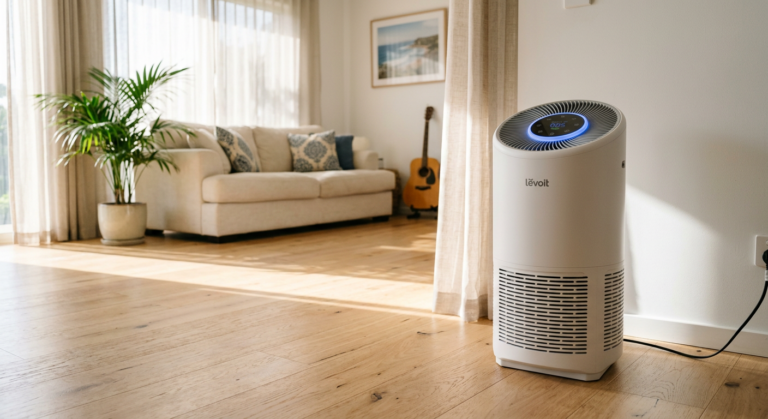
AQI below 33 (Good). Open windows. Run the purifier on its lowest setting if you want background VOC and dust removal, or switch it off. Natural ventilation is more effective at this level. Electricity cost at idle: roughly $5-10 per year for a unit like the Levoit Core 400S at 10 watts on Sleep Mode.
AQI 34-66 (Fair) and PM2.5 above 10 µg/m³. Close windows on the side of the house facing the smoke or pollution source. Run the purifier on low-to-medium.
AQI 67-99 (Poor). Close all windows. Run the purifier on medium-to-high. Prioritise the room where you spend the most time. If you own one purifier and have a family, put it in the main bedroom at night and the living area during the day. A 40 m² living room needs a purifier with a CADR (Clean Air Delivery Rate) of at least 240 m³/h to achieve 4 air changes per hour. The Breville Protect Max delivers a CADR above 300 m³/h — adequate for rooms up to 50 m².
AQI 100+ (Very Poor / Hazardous). Maximum filtration. Every purifier you own on high. Seal the bedroom as a clean-air refuge: close the door, block the gap under it with a rolled towel, and run the purifier on maximum. You will reduce PM2.5 to near-zero in a sealed, well-filtered room within 30-60 minutes even when outdoor PM2.5 exceeds 100 µg/m³.
The cost of running a HEPA purifier on high during a smoke event? Approximately 50-70 watts for a mid-size unit. That is roughly $0.02 per hour at average Australian electricity rates (around 30c/kWh). Compare that against a single GP visit for smoke-exacerbated asthma ($85-120 out-of-pocket) and the equation closes itself.
Bushfire Smoke Season: The AQI Event That Defines Australia
If you live in NSW, Victoria, or QLD, bushfire smoke season (October-March) is the argument that closes the air purifier purchase. This is not speculation — it is pattern recognition.
During the 2019-2020 Black Summer, the ANU Centre for Social Research and Methods estimated that 80% of the Australian population was affected by bushfire smoke. Canberra’s AQI exceeded 2,000 on multiple days. Sydney recorded its worst air quality in recorded history. Melbourne experienced smoke haze that reduced visibility to below 1 km. These were not isolated events — the Royal Commission into National Natural Disaster Arrangements concluded that bushfire seasons are becoming longer and more intense due to climate change.
What this means for you: if you do not already own a HEPA air purifier, the next smoke event will cost you more than the purifier itself. The Department of Health estimated that Black Summer smoke caused 417 excess deaths across the eastern seaboard, along with 1,124 hospitalisations for cardiovascular conditions and 2,027 hospitalisations for respiratory conditions. Those numbers represent real Australians in real hospitals.
The highest-impact purchase you can make before October is a single H13 HEPA air purifier for your bedroom. At $349 for the Levoit Core 400S — less than a single after-hours GP visit — it creates a clean-air refuge where your family breathes filtered air for 7-9 hours every night. At $0.02/hour running costs, the annual electricity bill for daily overnight use is under $60.
For households in bushfire-prone areas — Blue Mountains in NSW, Dandenong Ranges in Victoria, Scenic Rim in QLD, Adelaide Hills in SA — consider a second unit for the living area. The Breville Protect Max covers rooms up to 50 m² and includes an activated carbon filter for smoke odour as well as H13 HEPA for particulate removal. The total cost for two units (bedroom + living) is less than $900 — less than $15/month amortised over 5 years.
Indoor vs Outdoor AQI: What Most Australians Get Wrong
The biggest misconception about air quality is that closing your windows keeps smoke out. It does not. Without active filtration, indoor PM2.5 reaches 50-70% of outdoor levels within 1-2 hours, even in a well-sealed modern home. Older homes with poor sealing can reach 80-90% within the same timeframe.
According to a CSIRO study on indoor air quality during bushfire events, Australian homes exchange their entire air volume with outdoor air approximately once every 2-3 hours through natural infiltration (gaps around windows, doors, exhaust fans, and subfloor vents). Newer homes built to NCC energy efficiency standards achieve better sealing, but even these are not airtight.
This is precisely why a HEPA air purifier matters. It is not filtering already-clean indoor air — it is continuously removing PM2.5 that infiltrates through the building envelope. Think of it as bailing water from a leaky boat: the leak does not stop, so the pump runs continuously. A purifier with a CADR of 240+ m³/h in a sealed 20 m² bedroom recirculates and filters the room air 5+ times per hour, keeping PM2.5 below 5 µg/m³ even when outdoor readings exceed 100 µg/m³.
The practical implication: checking the outdoor AQI is necessary but insufficient. Without a purifier running, your indoor AQI follows the outdoor AQI with a 1-2 hour delay. With a purifier running, your indoor AQI stays in the “Good” range regardless of what is happening outside. That gap — between unfiltered indoor air and filtered indoor air — is the entire value proposition of owning a HEPA purifier in Australia.
Last reviewed: August 2026 – Clean and Native
Ready to protect your home from smoke season?
The Breville Protect Max is the top-rated HEPA air purifier for Australian homes — H13 filtration capturing 99.95% of particles at 0.3 µm, activated carbon for smoke odour, and coverage up to 50 m². The Levoit Core 400S is the best value alternative at roughly half the price.
Frequently Asked Questions
What is a safe AQI level in Australia?
According to the NEPM-based Australian AQI scale, 0-33 is “Good” and considered safe for all populations. However, the WHO 2021 guidelines suggest health effects can occur at PM2.5 concentrations below the “Fair” threshold. Sensitive groups (asthma, COPD, children, elderly) should monitor from AQI 34 upward.
What does AQI 100 mean in Australia?
AQI 100 means at least one of the six NEPM-monitored pollutants has reached 100% of the national air quality standard. It is the legal ceiling for acceptable outdoor air quality. All individuals — not just sensitive groups — should reduce outdoor exposure and run a HEPA air purifier indoors.
Does the Australian AQI use the same scale as the US AQI?
No. The Australian AQI is based on the NEPM standards and uses a different scale with different breakpoints. For example, Australia’s “Very Poor” starts at 100, while the US EPA’s equivalent “Unhealthy for Sensitive Groups” starts at 101 but with different underlying PM2.5 thresholds. IQAir reports on the US scale, while state EPA apps use the Australian scale. Always check which scale you are reading.
Which app should I use to check air quality in Sydney?
Use the NSW EPA air quality website (airquality.nsw.gov.au) or app as your primary source. It reports on the Australian NEPM scale from 34+ monitoring stations including western Sydney suburbs like Prospect, Liverpool, and Campbelltown. IQAir is a useful supplement for raw PM2.5 µg/m³ readings but uses the US AQI scale.
Can a HEPA air purifier protect against bushfire smoke indoors?
Yes. An H13 HEPA filter captures 99.95% of particles at 0.3 micrometres, which includes the PM2.5 particles that dominate bushfire smoke. In a sealed bedroom with a properly sized HEPA purifier, indoor PM2.5 drops below 5 µg/m³ within 30-60 minutes, even when outdoor readings exceed 100 µg/m³. Units with activated carbon also reduce smoke odour.
Does closing windows keep smoke out of my house?
Not fully. According to CSIRO research, indoor PM2.5 reaches 50-70% of outdoor levels within 1-2 hours even with all windows closed, due to natural air infiltration through gaps, exhaust fans, and subfloor vents. Closing windows slows infiltration but only a HEPA air purifier actively removes the PM2.5 that enters through the building envelope.
What AQI level should I start running my air purifier?
For sensitive groups (asthma, children under 5, elderly, pregnant), start at AQI 34 (“Fair”). For the general population, AQI 67 (“Poor”) is the action threshold. Check the raw PM2.5 µg/m³ reading — if it exceeds 15 µg/m³, which is the WHO 2021 24-hour guideline, run your purifier regardless of the AQI band.
How much does it cost to run a HEPA air purifier during bushfire season?
Roughly $0.02 per hour on high for a mid-size unit (50-70 watts) at average Australian electricity rates (~30c/kWh). Run daily overnight for a full year at that rate and the electricity cost stays under $60 — far less than a single GP visit for smoke-exacerbated asthma.
Get the Australian Home Environment Checklist
30 checks across water, air and EMF. Most of them free. Ranked by impact.
No spam. Unsubscribe any time.
Former Royal Australian Navy Clearance Diver and TAG-E counter-terrorism operator. Founded Clean and Native to apply the same rigorous thinking to the home environment.
Full biography →