Best Air Purifier Australia 2026: HEPA, VOCs & Bushfire Smoke Tested
23 min read
What HEPA Actually
Means in Practice
Every air purifier marketed in Australia claims to clean the air. The specifications that determine whether it actually does — HEPA grade, CADR, room sizing, and filter media — are frequently misrepresented or omitted.
Air purifier marketing optimises for shelf appeal. The actual performance numbers are HEPA grade, CADR, and ACH.
The indoor air quality industry has a terminology problem. “HEPA-type,” “HEPA-style,” and “99% HEPA” are marketing terms that describe no regulated standard. True HEPA filtration is defined by performance against a specific particle size at a specific efficiency — and the grade determines how far above that baseline the filter performs.
In the Australian market, this matters particularly because of two conditions that differ from other markets: the extreme fine particulate events produced by bushfire smoke, and the high humidity in coastal subtropical regions that increases indoor biological contaminant load. An air purifier sized for a US or European apartment using European efficiency assumptions may not perform adequately in a Brisbane summer or a Canberra bushfire event.
Three numbers determine whether a purifier will actually clean your room: HEPA grade (H11, H12, H13, H14), CADR (Clean Air Delivery Rate in m³/hr), and ACH (Air Changes per Hour). Understanding how they interact is the entire purchase decision.
HEPA grades: what H11, H12, H13, and H14 actually mean
HEPA (High Efficiency Particulate Air) is defined by the EN 1822 standard in Europe (referenced by most reputable manufacturers globally). The grade is determined by the filter’s removal efficiency at MPPS — the Most Penetrating Particle Size, which is 0.3 micrometres for most HEPA media.
H11 removes 95% of particles at MPPS. H13 removes 99.95%. H14 removes 99.995%. The difference between H11 and H13 is not 5 percentage points — it is a 20x improvement in particle penetration. At H11, 1 in 20 particles at the most challenging size passes through. At H13, 1 in 2,000 does.
Most consumer purifiers sold in Australia use H13 filters when they specify True HEPA. Products marketed as “HEPA-type” or “HEPA-style” have no standardised performance requirement. Medical-grade applications use H14. For residential bushfire smoke and PM2.5 scenarios, H13 is the appropriate minimum specification.
95% at MPPS
99.5% at MPPS
99.95% at MPPS
99.995% at MPPS
0.3 µm (EN 1822)
No standard — unverified
0.1 — 2.5 µm
0.5 — 10 µm (varied)
CADR and ACH: the two numbers that determine whether it works in your room
CADR (Clean Air Delivery Rate) measures the volume of clean air a purifier delivers per hour, at its stated efficiency. It is expressed in m³/hr (or CFM in US specifications). A unit with a CADR of 300 m³/hr delivers 300 cubic metres of filtered air every hour.
ACH (Air Changes per Hour) is calculated from CADR and room volume. A 40m² room with 2.7m ceilings has 108m³ of air. A purifier with CADR of 300 m³/hr produces 300 / 108 = 2.8 ACH in that room. For routine air quality maintenance, 2–3 ACH is adequate. During bushfire smoke events or for allergy management, 5 ACH is recommended.
The critical mistake with CADR: most manufacturers state room size at 2 ACH. Their “covers up to 40m²” claim means 2 air changes per hour — fine for everyday use, inadequate during high-pollution events. For bushfire season, size for 5 ACH: divide your CADR by 5 rather than 2 to get the effective room size.
Clean Air Delivery Rate in m³/hr (from manufacturer spec sheet, not box marketing)
Room floor area (m²) × ceiling height (m). Standard Australian ceiling: 2.4–2.7m
Air changes per hour. Target: 2–3 ACH for routine use, 5 ACH for bushfire/allergy season
Room: 15m² × 2.5m = 37.5m³
CADR required for 5 ACH: 37.5 × 5 = 188 m³/hr
Most bedroom-sized purifiers (IQAir, Levoit Core 400S): 250–350 m³/hr ✓
Particle sizing and the bushfire smoke problem
Bushfire smoke is distinct from standard urban particulate pollution. Understanding the particle size distribution determines which filter specification is actually required.
| Particle / Pollutant | Size Range | H13 HEPA | Activated Carbon | UV-C | Ioniser |
|---|---|---|---|---|---|
| PM2.5 (fine particles) | 0.1 — 2.5 µm | 99.95%+ | No | No | Partial (deposits) |
| PM10 (coarse particles) | 2.5 — 10 µm | 99.99%+ | No | No | Partial |
| Bushfire smoke (fine fraction) | 0.1 — 1 µm | H13: 99.95%+ | Gases only | No | Inadequate |
| Smoke VOCs / acrolein | Molecular (gas) | No | Yes (activated carbon) | No | No |
| Mould spores | 2 — 10 µm | 99.99%+ | No | Inactivates (in-unit) | No |
| Bacteria | 0.5 — 5 µm | 99.95%+ captured | No | Inactivates (in-unit) | No |
| VOCs (formaldehyde, benzene) | Molecular (gas) | No | Activated carbon only | No | No |
| Pollen | 10 — 100 µm | 100% (size exclusion) | No | No | No |
| Pet dander | 0.5 — 10 µm | 99.95%+ | No | No | Partial |
| Ozone (O₃) | Molecular (gas) | No | Activated carbon | No — may produce | Produces ozone |
UV-C effectiveness in consumer units is highly variable and depends on exposure time. Ionisers may deposit particles on surfaces rather than removing them from air. Ozone-generating units are not recommended for occupied spaces.
VOC removal versus particulate removal: why one filter cannot do both
The fundamental limitation of HEPA filtration is that it captures particles but cannot capture gases. VOCs — volatile organic compounds from paint, furniture off-gassing, cleaning products, cooking, and bushfire smoke — are molecular in size and pass straight through HEPA media.
HEPA: mechanical capture of particles
HEPA filters use three mechanisms to capture particles: interception (particle contacts a fibre), impaction (particle can’t follow airstream around fibre), and diffusion (Brownian motion causes sub-0.1µm particles to collide with fibres). The interaction of these three mechanisms creates a minimum efficiency at 0.3µm — which is why H13 efficiency is specified at this size. HEPA has no mechanism for capturing gas molecules.
Activated carbon: adsorption of gases and odours
Activated carbon captures VOCs through adsorption — gas molecules bind to the enormous surface area of the carbon matrix (500–1,500 m² per gram). Carbon weight matters significantly: a thin carbon pre-filter (10–50g) has limited capacity and becomes saturated quickly. Effective VOC removal requires dedicated carbon beds of 1–3kg or more. Activated carbon does not capture particles.
Bushfire smoke requires both: particles and gases simultaneously
Bushfire smoke contains fine particulate matter (PM2.5, PM1) AND a complex mix of gases and VOCs including acrolein, formaldehyde, benzene, and carbon monoxide. An H13 HEPA filter alone addresses the particulate fraction but not the chemical fraction. A purifier with H13 HEPA + substantial activated carbon bed addresses both. This is why carbon bed weight matters in bushfire-prone regions.
Running a purifier sized for everyday use during a smoke event produces false reassurance
A purifier with CADR of 200 m³/hr achieving 2 ACH in a 40m² room will not adequately filter PM2.5 during a bushfire smoke event with outdoor AQI above 200. At 5 ACH (the recommended rate for high-pollution events), that same room requires a CADR of 270 m³/hr minimum. The unit may be running on maximum and the PM2.5 inside may still be rising.
“If it has a HEPA filter,
why does it say HEPA-type?”
Because “HEPA-type” is a marketing term with no regulatory definition. It is used by manufacturers who want the HEPA association without meeting the H13 specification. A filter labelled “HEPA-type” at 95% efficiency is an H11 filter — which allows 1 in 20 PM0.3 particles through, compared to 1 in 2,000 for H13. In a bushfire smoke event, this difference is not marginal.
The standard response to this is simple: look for the specific HEPA grade (H13 minimum), verify the CADR rating, calculate ACH for your room, and check that the carbon bed weight is stated in grams or kilograms.
What this means when choosing a purifier
Specification over marketing. CADR and HEPA grade over brand recognition.
The air purifier market has a high signal-to-noise ratio problem. Significant marketing spend from major brands produces impressive-looking packaging with vague efficiency claims. Three pieces of verifiable data cut through it: the HEPA grade (H13 minimum), the CADR at the HEPA filter (not total airflow), and the carbon bed weight.
For Australian conditions specifically: the combination of bushfire smoke seasons and high subtropical humidity means that a unit performing adequately in a European climate test may be undersized for Queensland in summer or Canberra in November. Size for your worst-case scenario — a smoke event — not your everyday average.
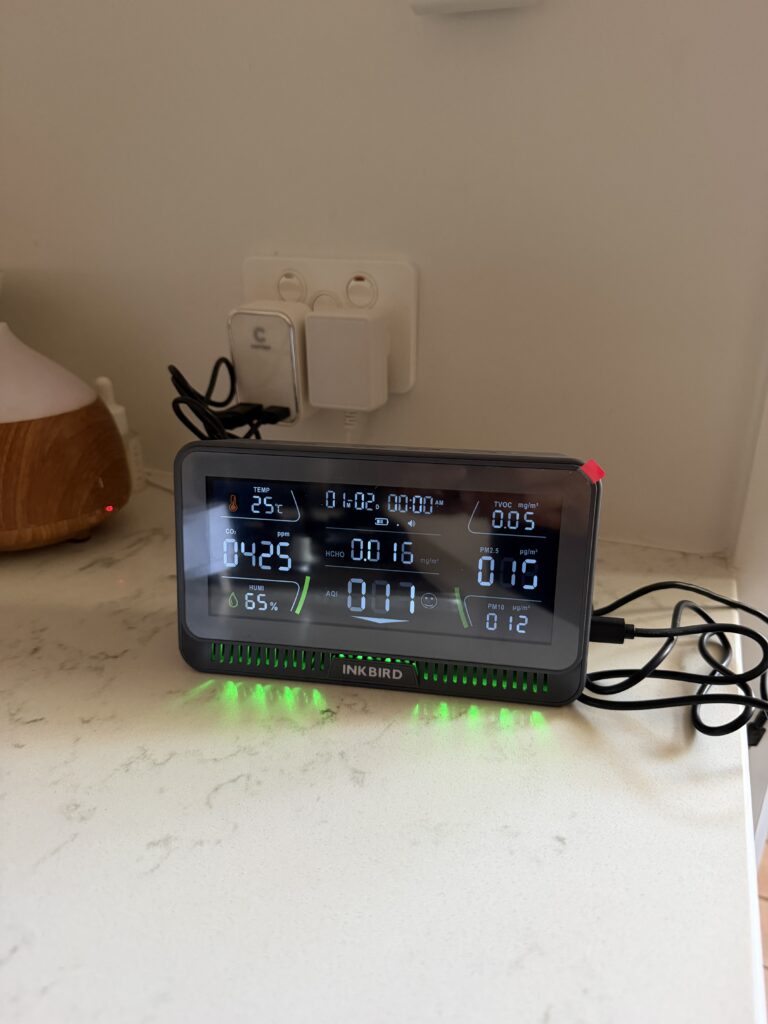
An air quality monitor is as important as the purifier. Without measurement, you cannot verify whether the purifier is doing its job. A calibrated PM2.5 sensor in the room tells you whether indoor levels are responding to the purifier running.
-
H13 is the minimum — not H11, not “HEPA-type”
H13 removes 99.95% of particles at MPPS (0.3µm). H11 removes 95%. For PM2.5, bushfire smoke, and mould spores this difference is not theoretical. -
Size for 5 ACH in the occupied room, not the stated “coverage area”
Most stated room sizes assume 2 ACH. Divide the manufacturer’s coverage area by 2.5 to get the effective room size at 5 ACH for smoke events. -
Carbon bed weight determines VOC performance
A thin carbon pre-filter (under 100g) provides minimal VOC removal. Look for a stated carbon bed weight of 500g or more for meaningful gas-phase performance. -
Measure to verify
A PM2.5 air quality monitor in the room gives real-time confirmation that the purifier is working. Without a baseline and ongoing measurement, you are operating on assumption.
The articles below apply this framework to specific purifier choices for Australian conditions.
Each review below applies H13 HEPA grade, CADR, ACH calculation, and carbon bed weight as the primary evaluation criteria. Bushfire season performance and subtropical humidity are specifically addressed for relevant models.
Air quality guides.
Spec-first, not brand-first.
Every article below leads with HEPA grade, CADR, and room-sizing calculation before any product recommendation. Bushfire season performance and subtropical humidity are addressed for the Australian context.
This article contains affiliate links. We may earn a commission at no extra cost to you.
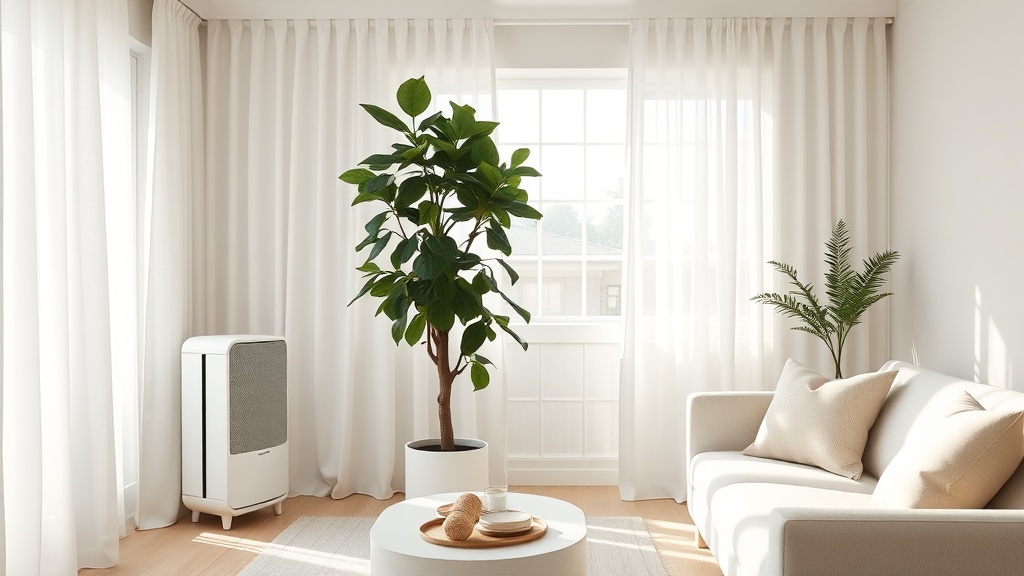
Most Australians spend over 90% of their time indoors. CSIRO research consistently shows indoor air in Australian homes can be 2–5 times more polluted than outdoor air — a fact that feels counterintuitive until you consider the sources: off-gassing from furniture and flooring, cooking fumes, mould spores, pet dander, and during bushfire season, fine particle concentrations that can reach genuinely dangerous levels. An air purifier with the right specifications is the most direct intervention available. This guide covers the best options for Australian conditions in 2026.
Why Indoor Air Quality Matters More Than Most Australians Realise
The indoor air quality problem in Australia has specific characteristics that differ from other markets:
- Bushfire smoke: PM2.5 (fine particles 2.5 microns or smaller) from bushfires penetrates homes readily through gaps, ventilation and opening doors. During the 2019–20 fires, Sydney recorded PM2.5 levels 11 times higher than WHO guidelines. A good air purifier running on high can reduce indoor PM2.5 by 80–90% during smoke events.
- High humidity zones: In tropical and subtropical parts of Australia (QLD, NT, northern WA), humidity creates ideal mould growth conditions. HEPA filters capture mould spores; activated carbon handles mycotoxins.
- New construction VOCs: Australian homes use adhesives, engineered timber products, paints and synthetic carpets that off-gas VOCs (volatile organic compounds) — including formaldehyde — for months after installation. Activated carbon is the only filter technology that addresses these.
- Pollen and allergens: Australia has some of the highest asthma rates in the world. HEPA filtration captures pollen, dust mite particles and pet dander — the primary airborne triggers for most allergy and asthma sufferers.
Read more about indoor air quality in Australian homes.
Air Purification
Ventilation handles the source. A HEPA filter handles what is already in the air.
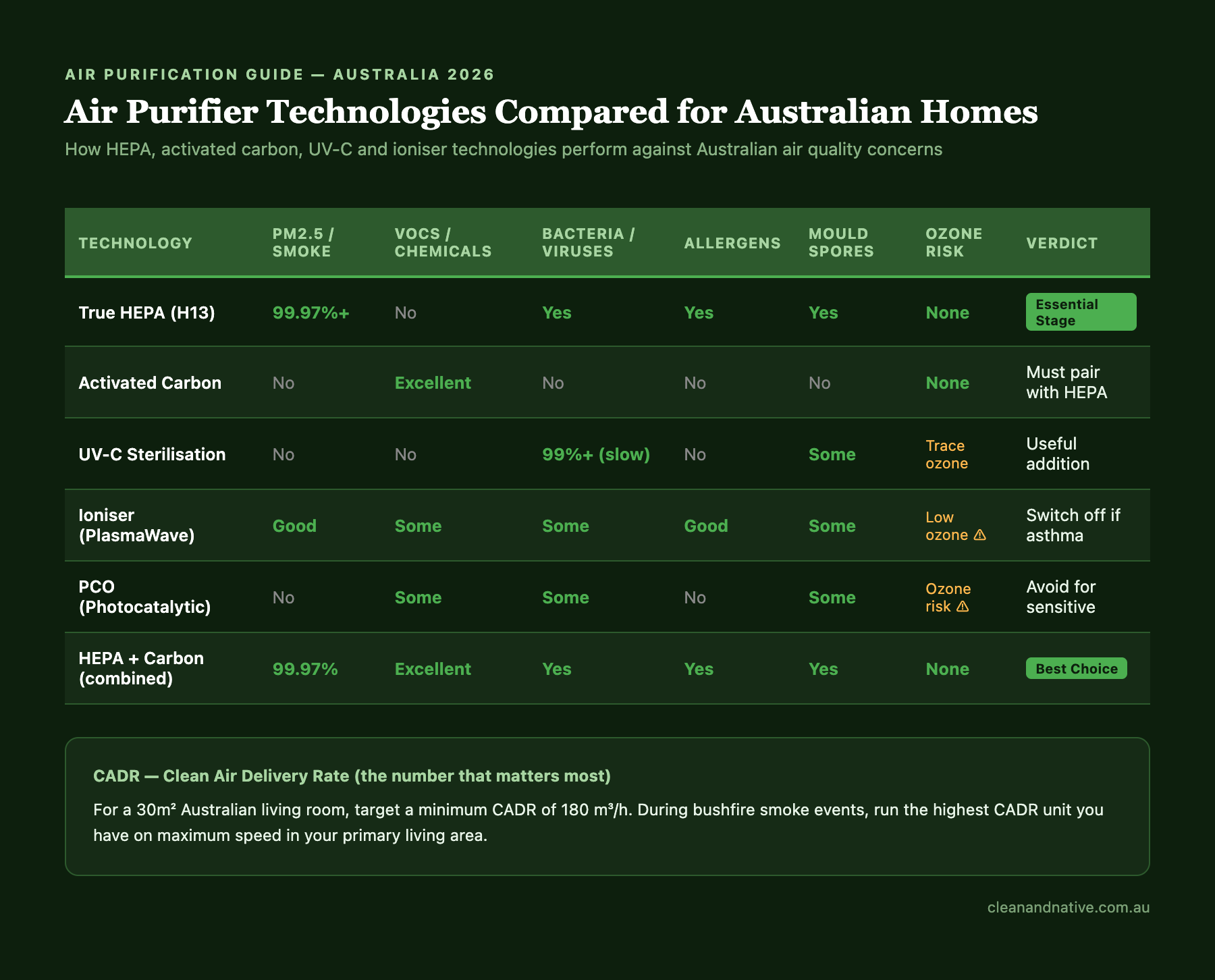
For particulates, VOCs, and bushfire smoke, a HEPA air purifier sized correctly for your room is the most reliable active intervention. We have ranked the top options for Australian homes.
What to Look for in an Air Purifier (Australian-Specific Criteria)
CADR (Clean Air Delivery Rate): The single most important number. CADR measures how many cubic metres of clean air the unit delivers per hour. For a standard 25–30m² Australian living room, you need a minimum CADR of 180 m³/h — ideally 250+. For open-plan layouts (common in modern Australian homes), you need considerably more.
True HEPA vs “HEPA-type”: True HEPA (H13 or H14) captures 99.97% of particles at 0.3 microns. “HEPA-type” or “HEPA-style” filters have no standardised performance requirement and are significantly less effective. Only buy units stating True HEPA or HEPA 13/14.
Activated carbon filter: Essential if you have new furniture, live in a bushfire-affected area, cook frequently, or are concerned about VOCs. The more activated carbon by weight, the better — look for dedicated thick carbon stages rather than a thin carbon coating over the HEPA filter.
Ioniser: Some units include an ioniser (PlasmaWave, Plasmacluster, etc.). Ionisers help precipitate particles but produce trace ozone — a lung irritant. If anyone in the household has asthma, buy a unit where the ioniser can be switched off separately, or avoid it entirely.
Best Air Purifiers in Australia 2026
| Model | HEPA Grade | Coverage (m²) | CADR (m³/h) | Carbon Filter | Auto Mode | Price AUD |
|---|---|---|---|---|---|---|
| IQAir HealthPro 250 | HyperHEPA | 100m² | 450 | Yes (thick) | Yes | ~$1,799 |
| Winix Zero Pro | True HEPA | 99m² | 360 | Yes | Yes | ~$699 |
| Breville Protect Max | HEPA 13 | 138m² | 550 | Yes | Yes | ~$899 |
| Blueair Blue Pure 311i Max | HEPASilent | 61m² | 270 | Yes | Yes | ~$449 |
| Levoit Core 400S | True HEPA | 42m² | 230 | Yes | Yes | ~$299 |
Best Air Purifier for Bushfire Smoke Australia
Bushfire smoke is primarily PM2.5 — fine particles that bypass the respiratory system’s natural defences and penetrate deep into the lungs. During smoke events, you want the highest CADR you can run continuously in your main living space.
The Breville Smart Air Vital Protect Max is the pick here: 138m² coverage, 550 m³/h CADR, HEPA 13 rated, and CHOICE’s top-rated air purifier in Australia for 2026. Its Auto Mode uses a particulate sensor to automatically ramp up when smoke levels rise — useful during events when conditions change rapidly.
The IQAir HealthPro 250 uses IQAir’s proprietary HyperHEPA filtration, which captures particles down to 0.003 microns — catching ultrafine particles that standard HEPA misses. At $1,799, it’s the premium choice for people with respiratory conditions or genuine sensitivity to ultrafine particles.
During active smoke events: close all windows and doors, run the purifier on its highest setting, and consider a second unit in the bedroom if you have one. A CADR of 300+ in a typical bedroom will clean the air approximately every 15–20 minutes.
Best Air Purifier for Allergies and Asthma Australia
Australia has the third highest prevalence of asthma in the world. For allergy and asthma management, the priorities are: high HEPA efficiency (catches pollen, dust mite particles, pet dander), low noise (so you’ll actually run it at night), and no ioniser ozone production.
The Winix Zero Pro ticks all three: True HEPA, PlasmaWave ioniser that can be switched completely off, quiet at low speeds (~25dB), and one of the best CADR-to-price ratios in the Australian market. Read our dedicated asthma-specific air purifier guide for more depth.
The Blueair Blue Pure 311i Max is the quietest option at low speeds, uses a washable fabric pre-filter, and its HEPASilent technology combines electrostatic and mechanical filtration for high efficiency at lower noise and energy use than equivalent HEPA units.
Best Air Purifier for Large Open-Plan Homes Australia
Modern Australian homes — especially builds from 2010 onward — frequently use open-plan kitchen/dining/living layouts of 50–80m². A single mid-range unit won’t keep up. Your options:
Option 1: One large unit centrally placed. The Breville Protect Max (138m² rated) or IQAir HealthPro 250 (100m² rated) can handle large open-plan spaces as a single unit.
Option 2: Two mid-range units positioned at opposite ends of the space. Two Levoit Core 400S units (~$600 total) covering 42m² each provides better coverage distribution than one large central unit, and the total CADR is higher.
For mould-specific concerns in your home, see our guide to the best air purifiers for mould.
What to do about your indoor air.
Our indoor air quality guide covers the hierarchy of fixes — from free (ventilation) to practical (air purifiers) — ranked by impact and cost for Australian homes.
Frequently Asked Questions
How long does it take an air purifier to clean a room?
Divide the room’s volume (length × width × height in cubic metres) by the unit’s CADR in m³/h, then multiply by 60 for minutes per cycle. A 30m² room with 2.7m ceilings has 81m³ of air. A 300 m³/h CADR unit would clean it in about 16 minutes. Most air quality guidelines recommend 4–6 air changes per hour for effective particulate reduction.
Should I run my air purifier 24/7?
Yes, ideally on a low or auto setting continuously. Air quality changes throughout the day — cooking, cleaning, outdoor conditions all affect indoor air. Running continuously on auto mode uses less energy than you might think (most quality units use 15–50W on low) and maintains consistent air quality rather than playing catch-up after pollution events.
Do air purifiers help with bushfire smoke?
Significantly yes. A quality HEPA air purifier running on high in a sealed room can reduce indoor PM2.5 from dangerous levels to safe levels within 30–60 minutes during a smoke event. The key is acting early — close windows before smoke enters, not after, and run the unit on maximum speed throughout the event.
What is the difference between HEPA 13 and True HEPA?
True HEPA (also called HEPA H11 or H12) captures 99.95% of particles at 0.3 microns. HEPA 13 captures 99.97% and HEPA 14 captures 99.995%. For bushfire smoke, allergies and general indoor air quality, True HEPA is sufficient. HEPA 13 provides a meaningful step up for ultrafine particles and is worth paying for if respiratory health is a priority.
Are cheap air purifiers worth it?
Budget units under $100 AUD typically use “HEPA-type” filters rather than certified True HEPA, have insufficient CADR for any room larger than a small bedroom, and often don’t include a real activated carbon stage. They can reduce dust and odours somewhat, but for meaningful air quality improvement — particularly bushfire smoke or serious allergen reduction — invest in a unit from a reputable brand with certified HEPA and a CADR matched to your room size.
Get the Australian Home Environment Checklist
30 checks across water, air and EMF. Most of them free. Ranked by impact.
No spam. Unsubscribe any time.
Former Royal Australian Navy Clearance Diver and TAG-E counter-terrorism operator. Founded Clean and Native to apply the same rigorous thinking to the home environment.
Full biography →