Does Earthing Actually Work? An Honest Look at the Science for Australian Sceptics (2026)
The scientific evidence for earthing (grounding) suggests the effect is probably real and probably modest — measurable changes in body voltage, cortisol, and blood viscosity have been observed in peer-reviewed studies, but most trials involve fewer than 40 participants and several have industry ties.
Quick Verdict — Does Earthing Work?
Early-stage science. Not fraud. Low cost, low risk — evidence justifies trying it.
The best studies show electrically-verified effects on body voltage and statistically significant changes in cortisol and inflammation markers. ARPANSA’s position (no established evidence for harm from household EMF) is about harm from power lines — not a dismissal of grounding physiology. Both statements can be simultaneously true.
| Evidence area | What the studies show | Verdict |
|---|---|---|
| Body voltage reduction | Electrically verified; body voltage drops to near-zero when grounded (Brown 2010) | Confirmed, physics-based |
| Cortisol and sleep | Significant rhythm normalisation in Ghaly & Teplitz 2004 (n=12, industry-funded) | Promising, needs replication |
| Blood viscosity / inflammation | Zeta potential improvement in Chevalier 2012 (n=40); PMC 2023 review supports mechanism | Plausible mechanism, small trials |
What Earthing Claims to Do
The earthing hypothesis is simple physics wrapped in biology. Your body, when insulated from the ground by rubber-soled shoes and timber floors, accumulates an electrical potential relative to the earth. In a typical Australian home, that potential can reach 1-4 volts AC, induced by the 50 Hz electrical fields from household wiring (per AS/NZS 3000 wiring standards, which accept this as normal). Walking barefoot on grass or soil, or sleeping on a conductive sheet connected to the earth pin of your wall outlet, brings that body voltage to near-zero by allowing electrons to flow freely between your body and the earth.
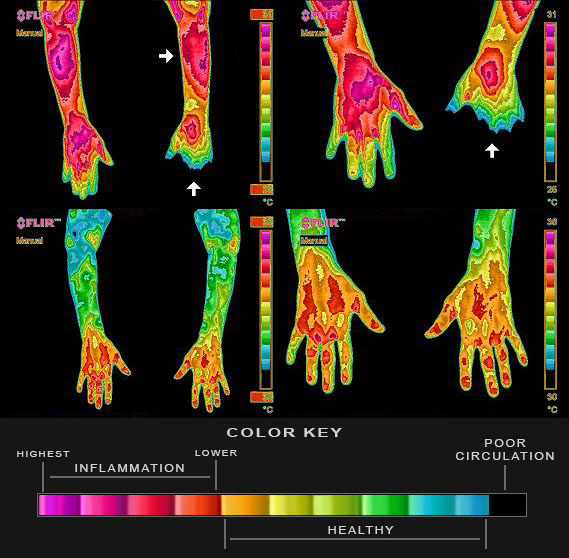
The biological claims built on top of that physics are where it gets contested. Proponents argue that free electrons donated from the earth act as antioxidants, neutralising reactive oxygen species (free radicals) that drive inflammation. The Journal of Environmental and Public Health published a 2012 integrative review by Chevalier et al. summarising this mechanism across multiple physiological systems — cardiovascular, neurological, muscular, and immune. A 2023 review hosted on PMC/NIH (PMC10105031) expanded on this framework, calling earthing “a simple, accessible and promising strategy for reducing chronic inflammation.”
Critically, earthing makes two distinct claims and you need to keep them separate. The first is electrical: grounding reduces body voltage. This is not a health claim — it is a measurable, reproducible electrical phenomenon anyone can verify with a multimeter. The second is biological: reduced body voltage (and/or increased electron flow) produces health benefits. This second claim is where the evidence is preliminary and where honest scrutiny is warranted.
The Best Evidence For Earthing
The strongest individual study is probably Chevalier et al. 2012, published in the peer-reviewed Journal of Environmental and Public Health. It is not a single trial — it is an integrative review pulling together 21 peer-reviewed studies and reports across sleep, pain, cortisol, cardiovascular markers, and inflammation. One of the most striking findings was from a 2013 study (Chevalier) measuring red blood cell zeta potential — the electrical charge that keeps cells from clumping together — in 40 participants after 2 hours of grounding. Zeta potential increased significantly, suggesting reduced blood viscosity. If this replicates at scale, the cardiovascular implications are non-trivial.

Ghaly and Teplitz (2004), published in the Journal of Alternative and Complementary Medicine, ran a controlled study of 12 participants sleeping on grounded carbon fibre mats for 8 weeks. They measured 24-hour cortisol profiles via saliva samples. The results showed normalisation of cortisol secretion patterns — lower night-time cortisol and higher morning cortisol — along with reported improvements in sleep quality, pain, and stress. Sample size is small. The industry connection (Teplitz was involved in grounding product development at the time) is a legitimate flag. But the cortisol measurement was objective, not self-reported, and the design was controlled.
Brown et al. 2010, published in the European Biology and Bioelectromagnetics journal, is the most electrically rigorous study in this field. It directly measured body voltage in participants connected to earth versus disconnected, using calibrated instrumentation. The finding — that body voltage drops to near-zero when grounded and returns when disconnected — is simply a description of Ohm’s Law in a biological context. This is not a health study. It is an electrical physics study. But it matters because it confirms the mechanism claimed by the biological studies is physically real and quantifiable.
The 2023 PMC review (Menigoz et al. expanded framework, PMC10105031) synthesised subsequent research on earthing’s anti-inflammatory effects, wound healing acceleration in animal models, and autonomic nervous system modulation. The reviewers concluded the evidence base is sufficient to justify formal large-scale randomised controlled trials — which is a measured, scientifically accurate position. It is not a green light. It is a “this deserves serious investigation.”
The Honest Limitations
You deserve a straight count. Of the studies in Chevalier’s 2012 integrative review, the majority involved fewer than 40 participants. Most trial durations were under 12 weeks. Several of the most-cited studies — including Ghaly and Teplitz 2004 — were conducted or funded by researchers with commercial interests in grounding products. That does not automatically invalidate the findings, but it does mean the effect sizes reported have not been independently replicated under clean conditions.
There is no large randomised controlled trial (RCT) on earthing as of mid-2026. In pharmacology or medical device research, you would not market a product on this evidence base. The absence of a 200+ participant, double-blind, independent RCT is the single biggest gap in this field. Double-blinding is also actually difficult — participants typically know whether they are using a grounded mat or a sham mat, which introduces placebo effects that are hard to control.
ARPANSA — Australia’s radiation and nuclear safety authority — states on its website: “there is no established scientific evidence that the electric and magnetic fields from household appliances, power lines, electrical wiring, or other electrical equipment in homes and offices cause health problems.” This is the official Australian regulatory position. It is important and worth reading carefully. ARPANSA is making a statement about harm from ambient EMF exposure — not a statement about the health effects of deliberately connecting to earth ground. Those are different questions. A person can reasonably accept both ARPANSA’s position on power line exposure risk AND the preliminary earthing evidence without contradiction.
The physics-based criticism circulated in sceptical forums (and occasionally in outlets like ABC Science) goes like this: the earth’s electron supply is vast but not infinitely replenishable at a single point; the resistance of soil varies by moisture content; the contact resistance through skin is high; therefore the actual electron transfer is trivial. This is a legitimate engineering critique. The counterargument from earthing researchers is that the biologically relevant signal is not the electron quantity transferred but the equalization of electrical potential — specifically the elimination of the body voltage differential created by proximity to household AC wiring. Both positions have merit. Neither definitively settles the question.
What the Sceptics Get Right — and Wrong
The sceptics are right about four things. First: “promising early-stage evidence” is not the same as “proven.” Anyone selling a grounding product by citing Chevalier 2012 as though it is settled medicine is overstating the case. Second: industry-funded research has a well-documented tendency to produce positive findings. A 2011 meta-analysis in the British Medical Journal found industry-funded trials were significantly more likely to report favourable results than independently-funded trials. Third: the absence of a double-blind RCT matters. Fourth: testimonials — no matter how many — are not data.
Where the sceptics overreach is in the jump from “not proven” to “definitely does nothing.” The absence of definitive evidence is not evidence of absence. The electrical mechanism is real and measurable. The anti-inflammatory antioxidant hypothesis has a plausible molecular basis. Several peer-reviewed studies report statistically significant effects. The 2023 PMC review received no industry funding and still concluded the evidence justifies further investigation. Dismissing this as pseudoscience requires ignoring a body of published, peer-reviewed, physiology-based research — and that is its own form of confirmation bias.
There is also a risk-framing problem in the sceptic position. The question “does it work?” needs to be paired with “at what cost?” A grounding mat connected to your wall outlet’s earth pin costs under $150 and carries no documented adverse effects. The earth pin in Australian wall outlets (compliant with AS/NZS 3112) carries zero current under normal conditions — it is a protective earth conductor, not a live connection. Using it for grounding is electrically safe in any properly-wired Australian home. If the effect is real, you gain it. If it is not, you lose $150 and a few minutes of setup. The risk-benefit calculation is unusual for health interventions.
The sharpest critique from the physics side — that body voltage from household wiring is too low to cause harm and therefore too low to matter when eliminated — actually deserves direct engagement. The human nervous system operates on millivolt-scale signals. A 1-4V AC body voltage induced by household wiring is, at minimum, several orders of magnitude above the threshold for neurological signal interference. Whether this interference is clinically meaningful is the open question. But it is not physically absurd to hypothesise that it might be.
Earthing Products — Australia
How to Try Earthing Yourself
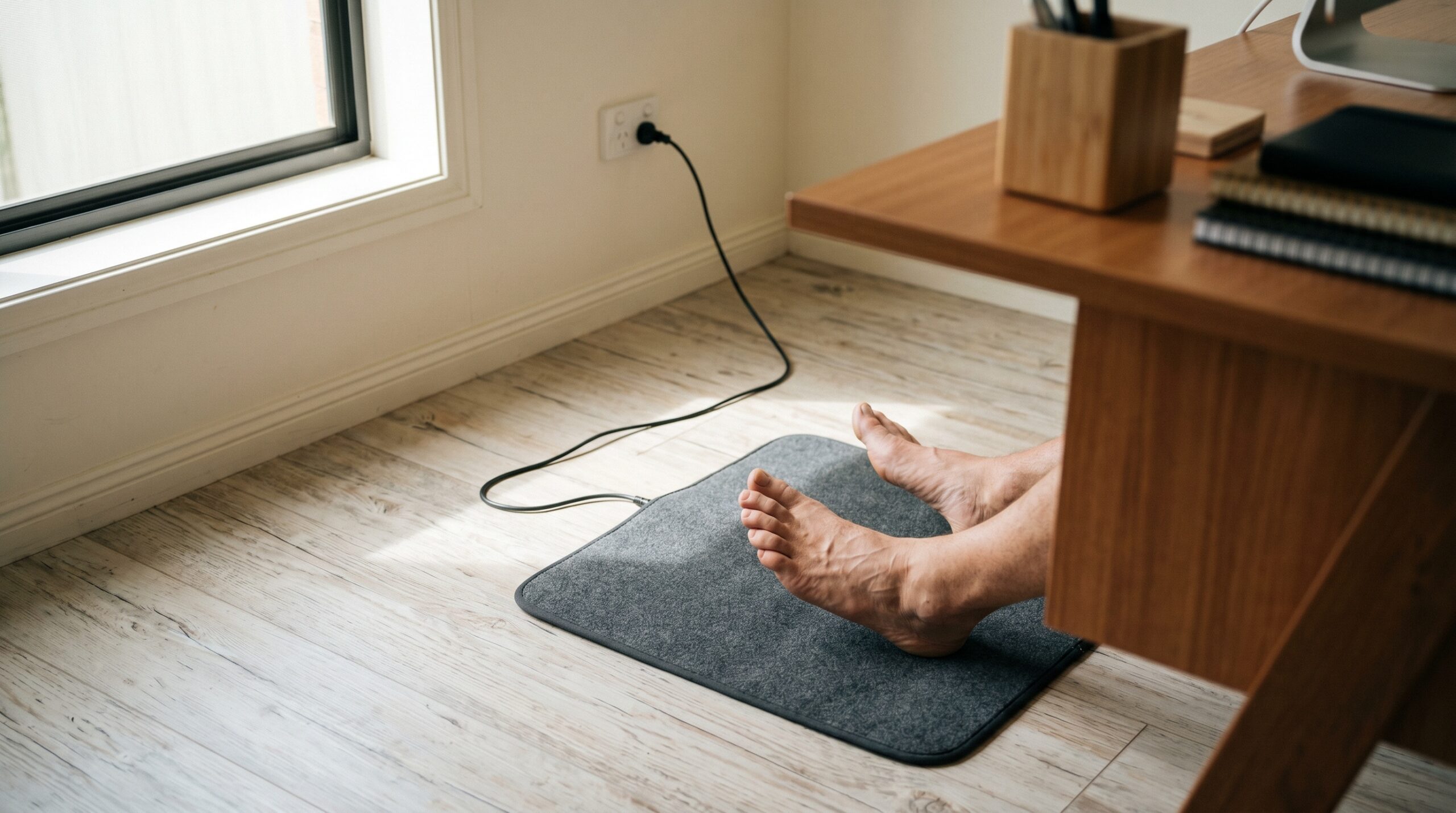
If you want to run your own experiment, the methodology matters. The most controlled approach is an indoor grounding mat or sheet connected to the earth pin of a standard Australian GPO (general purpose outlet). Every compliant Australian wall outlet wired to AS/NZS 3000 has an earth pin — the top pin in the standard three-pin layout. Under normal, correctly-wired conditions, the earth conductor carries zero current. Plugging a grounding mat into it does not expose you to live voltage. If you have any doubt about your home’s wiring, test the outlet with a socket tester (available at Bunnings for under $15) before connecting anything.
Barefoot outdoor grounding is free and achieves the same electrical connection. Grass, soil, sand, and unsealed concrete all conduct well. Timber decks, synthetic turf, and rubber-soled shoes do not. Thirty minutes of barefoot contact with soil or grass is sufficient to produce the body voltage reduction documented in Brown 2010. The problem is consistency — an indoor mat lets you run an 8-week sleep experiment with measurable, repeatable contact time every night.

To run a genuine self-experiment: measure two baselines first. Sleep quality (using a free sleep tracking app or a dedicated device) and morning energy levels rated on a consistent 1-10 scale over two weeks without grounding. Then introduce the grounding sheet and track the same metrics for eight weeks. Eight weeks is the duration used in Ghaly and Teplitz 2004, which is long enough for cortisol pattern changes to manifest. If nothing changes, you have your answer. If something changes, you have a data point worth taking seriously — even if it is a sample of one.

✓ Pros
- Connects to standard AS/NZS 3112 earth pin — no rewiring required
- Silver-thread construction is conductive and washable
- Free shipping to Australia above order threshold
- Low-cost, low-risk 8-week self-experiment possible
✗ Cons
- Biological health benefits not confirmed by large-scale RCT
- Requires a correctly-wired, earthed outlet — verify first with a socket tester
- Silver threading degrades with repeated washing if bleach is used
One additional note for anyone in a newer apartment building or home with RCBO-protected circuits: the earth pin in Australian GPOs is isolated from the live and neutral conductors under normal conditions. Your grounding sheet draws no current and trips no RCD. It behaves identically, electrically, to the earth wire inside your appliance power cords — which are also permanently connected to earth without incident.
Our Verdict
Earthing is not pseudoscience in the dismissive sense of the word — it has a physically measurable mechanism, multiple peer-reviewed studies, and a plausible biological pathway via antioxidant electron transfer. It is also not established medicine. The evidence base does not support the kind of strong therapeutic claims you sometimes see on product pages.
The honest position, informed by what the research actually shows, is this: probably real, probably modest, early-stage, not fully independent, worth a personal experiment. ARPANSA’s statement about no established harm from household EMF is accurate and relevant — but it addresses a different question than whether grounding has positive physiological effects. Both can be true simultaneously.
For the cost of a grounding sheet and eight weeks of consistent use, you can run the experiment yourself under conditions comparable to the best published trials. That is a better answer than waiting for a large RCT that may not arrive for another decade.
If you want to try it, the Premium Grounding Sheet is the simple starting point — conductive silver-thread cotton, ships free to Australia, connects directly to your existing wall outlet. If you want outdoor grounding, it costs nothing: thirty minutes of barefoot contact with grass or soil produces the same electrical connection the research measures. Start there first if cost is a factor.
Last reviewed: June 2026 — Clean and Native
Want to run the experiment? Start with the right sheet.
The Premium Grounding Sheet connects to the earth pin of any correctly-wired Australian wall outlet. Free shipping above the order threshold. Eight weeks of tracked sleep data will tell you more than any product page.
Frequently Asked Questions
No, in the strict sense. Earthing has a physically measurable mechanism (body voltage reduction, confirmed by electrical measurement in Brown 2010) and multiple peer-reviewed studies reporting physiological effects. Calling it pseudoscience requires ignoring published, peer-reviewed research. The accurate description is “early-stage science with a plausible mechanism but insufficient large-scale RCT evidence.”
ARPANSA states there is “no established scientific evidence that electric and magnetic fields from household appliances, power lines, or wiring cause health problems.” This statement addresses harm from ambient EMF exposure — not the physiological effects of deliberately connecting to earth ground. It is not a specific assessment of grounding therapy and should not be read as one.
The published studies report group averages, not universal effects. Individual responses vary. The most honest answer is: the studies suggest a statistically significant average effect across participants, but there is no data to predict individual response. An eight-week self-experiment is the only reliable way to answer this question for yourself.
The electrical effect (body voltage reduction) is immediate and measurable within seconds of contact. The biological effects reported in studies — cortisol normalisation, reduced inflammation markers — were measured after 6-8 weeks of nightly grounding in the published trials. Ghaly and Teplitz 2004 used an 8-week protocol. Expect nothing in the first week and assess at 6-8 weeks.
Yes, provided your home’s wiring is correctly earthed to AS/NZS 3000 standards. The earth pin in a standard Australian three-pin GPO carries zero current under normal conditions. Grounding mats draw no current — they only equalise electrical potential. Verify your outlet is correctly wired using a socket tester (available at Bunnings for under $15) before connecting.
Electrically, yes — both establish contact with the earth’s reference potential. Practically, consistency differs. A grounding sheet allows 7-8 hours of nightly contact during sleep. Most people cannot maintain 7-8 hours of barefoot outdoor contact daily. The studies reporting the strongest effects used overnight indoor grounding for this reason.
Several of the most-cited studies — including Ghaly and Teplitz 2004 — involve researchers with commercial grounding product interests. This is a legitimate concern. Chevalier’s 2013 blood viscosity study and the 2023 PMC integrative review (PMC10105031) are more independent. The honest position is: industry-adjacent funding flags a risk of positive-result bias, and independent replication is needed.
Ghaly and Teplitz 2004 found cortisol pattern normalisation and participant-reported sleep improvement after 8 weeks of grounded sleep. The sample was 12 people. That is not sufficient evidence to claim earthing treats insomnia. It is sufficient evidence to justify an 8-week trial if you have disrupted sleep and are looking for low-risk interventions to test alongside standard sleep hygiene.
A grounding mat is typically a smaller conductive pad placed under your feet or hands at a desk. A grounding sheet is a full or half-sized bed sheet with conductive silver threads woven through the fabric, designed for continuous nightly contact during sleep. For the sleep-focused cortisol and inflammatory outcomes reported in the literature, a sheet provides more consistent and prolonged skin contact than a mat.
Get the Australian Home Environment Checklist
30 checks across water, air and EMF. Most of them free. Ranked by impact.
No spam. Unsubscribe any time.

Former Royal Australian Navy Clearance Diver and TAG-E counter-terrorism operator. Founded Clean and Native to apply the same rigorous thinking to the home environment.
Full biography →