Best Air Purifier for Bushfire Smoke Australia 2026: What the Health Departments Say
Drafted with AI assistance and checked against published specifications and certifications. First-hand measurements appear only where stated. How we make content
How this assessment was made. I own and run one purifier in this guide: the Coway Airmega 150 in my bedroom in Palm Beach, QLD. I have not measured particle levels during a smoke event, so the recommendations here rest on the health departments’ published advice, each manufacturer’s smoke CADR and the test standard behind it, and their Amazon Australia listings. Room sizes use the US EPA’s two-thirds rule. Prices were checked on 19 October 2026. Clean and Native may earn a commission on some links.
The best air purifier for bushfire smoke is a HEPA unit sized on its smoke CADR, running in one closed room. For a living area, the Coway Airmega 400 (about $799 on Amazon AU) has a published smoke CADR of 328 cfm, enough for about 46 m². For a bedroom clean room, the Coway Airmega 150 (about $254) handles about 21 m² and is the one I run at home. NSW Health, the Australian Government Department of Health and EPA Victoria all give the same core advice: HEPA filter, small well-sealed room, doors and windows shut.
Smoke is the clearest case for an air purifier in an Australian home, and the one where buying wrong costs most. In the Navy you planned for the threat you could not see; bushfire smoke is mostly fine particles that pass straight through a fly screen and a closed but leaky house. Ionisers, humidifiers and odour absorbers do not deal with them. A correctly sized HEPA purifier in a sealed room does.
Pick one room, seal it, and run a HEPA purifier sized to it on high for as long as smoke is in the area.
| Pick | Best for | Price (19 Oct 2026) |
|---|---|---|
| Coway Airmega 400 | Best for living areas; ~46 m² by the 2/3 rule | ~$799 |
| Coway Airmega 150 | Best bedroom clean room; ~21 m²; tested at home | ~$254 |
| Philips PureProtect 3200 | Open living areas; no ions or ozone | ~$382 |
| Levoit Core 300 | Budget small room | ~$169 |
✓ Plan for smoke if
- You live near bushland or in a region that gets hazard-reduction burns
- Someone in the house has asthma, a heart or lung condition, or is pregnant
- You have young children or older relatives at home
- Smoke reached your suburb in a previous season
× A purifier will not
- Clean a whole open-plan house with windows open
- Remove the gases in smoke, such as carbon monoxide
- Replace evacuation or emergency advice
- Protect you outdoors (that needs a fitted P2/N95 mask)
What the health departments say
NSW Health: “consider using an air purifier with a high efficiency particle air (HEPA) filter to remove smoke from your indoor air”, and “to work well, the purifier must be used in small, well-sealed areas.” It also advises closing windows and doors, switching the air conditioner to recirculate, and, if your home is smoky, spending time in air-conditioned venues such as libraries and shopping centres, or at the home of a friend or relative with less smoke.
The Australian Government Department of Health says to “seal the room and match the air purifier to the size of the room it is in.” EPA Victoria adds that portable air cleaners “are more effective in rooms smaller than the maximum room size specified by the manufacturer”. All three say humidifiers, negative ion generators and odour absorbers do not remove the fine particles in smoke.
How to set up a clean room
1. Pick the room. Usually a bedroom: small, with a door, and where you spend the longest unbroken stretch. 2. Seal it. Close windows and doors, and use a rolled towel along the bottom of the door if there is a gap. 3. Air conditioner on recirculate, if it has the setting, so it is not pulling outside air in. 4. Run the purifier on high. The US EPA’s wildfire advice is to run it continuously on the highest fan setting while smoke is around. 5. Keep the room clean of other sources. No candles, incense or frying in the clean room. 6. Check the air quality outside on your state’s air quality site, such as NSW Air Quality or EPA AirWatch in Victoria, and only air the house out when it improves.
Sizing for smoke
Use the smoke CADR, the purifier’s tested delivery of clean air against the finest particles. The US EPA rule: smoke CADR in cubic feet per minute of at least two-thirds of the room’s floor area in square feet. At a 2.4 m ceiling that is roughly 12 m³/h per square metre (my arithmetic from the EPA table).
| Room | Floor area | Smoke CADR needed | Fits |
|---|---|---|---|
| Bedroom, 3.5 x 4 m | 14 m² | ~100 cfm | Airmega 150 |
| Main bedroom, 4 x 5 m | 20 m² | ~145 cfm | Airmega 150 |
| Lounge, 5 x 6 m | 30 m² | ~215 cfm | Airmega 400 |
| Open living, 6 x 7.5 m | 45 m² | ~320 cfm | Airmega 400 |
Ignore the “covers up to” figure on the box. Coway’s own US page, for example, lists the Airmega 400 at 1,560 square feet for two air changes an hour, about three times the room the two-thirds rule gives it. For smoke, size up, not down. More detail in our CADR calculator.
The best air purifiers for bushfire smoke
1. Coway Airmega 400: best for living areas
 Large rooms and smoke328 cfmsmoke CADR (Coway US)
Suits ~46 m² by the EPA 2/3 rule | 2 pre-filters + 2 Max2 carbon/HEPA filters | 22 to 52 dB(A) | 66 W | Sensitive Choice approved | ~$799 (19 Oct 2026)
Check the Airmega 400 Price on Amazon →If the family is going to sit out a smoky week in the lounge, this is the one. Coway publishes a smoke CADR of 328 cfm, the highest verified figure in this guide, which covers about 46 m² by the EPA rule. It draws air through two sides, each with a pre-filter and a Max2 filter combining carbon and HEPA, at 66 W. It has no ioniser and is Sensitive Choice approved. Coway rates the filter set at about a year, or 6 to 12 months depending on use; a heavy smoke season sits at the short end. About $799 on Amazon AU, sold by Coway Australia.
✓ Pros
- Highest verified smoke CADR here (328 cfm)
- No ioniser
- Sold by Coway Australia
× Cons
- About $799
- 66 W on high
- Two filter sets to replace
Buy this if…
you need to keep a main living area breathable through a smoke event.
2. Coway Airmega 150: best bedroom clean room
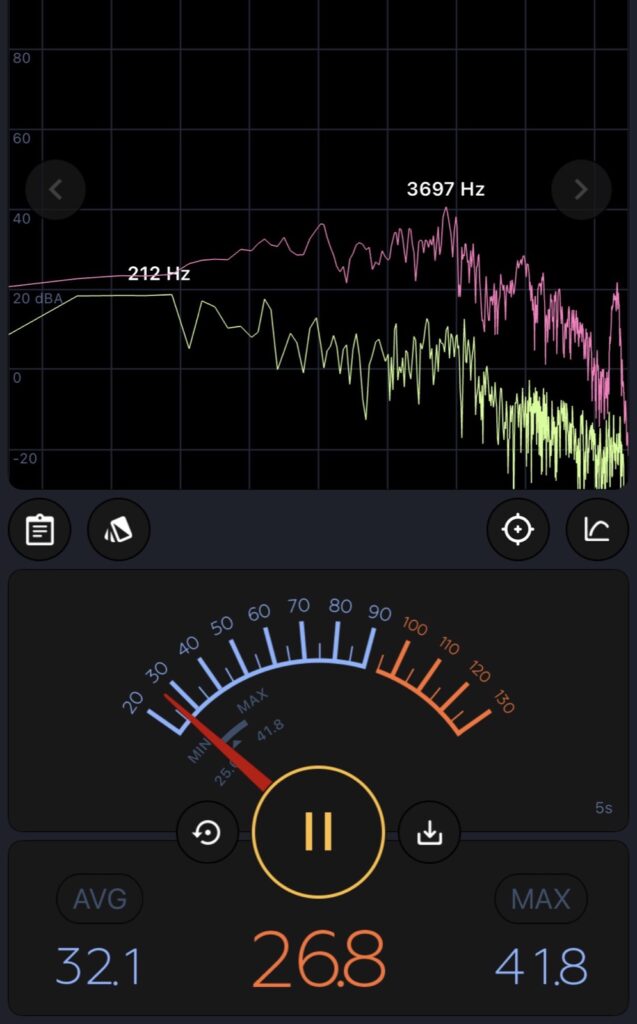
 Tested at home32.1 dBASilent mode at 1 m (my reading)
Smoke CADR 153 cfm (Coway US) | Suits ~21 m² by the EPA 2/3 rule | Pre-filter + carbon + HEPA | 35 W | Sensitive Choice approved | ~$254 (19 Oct 2026)
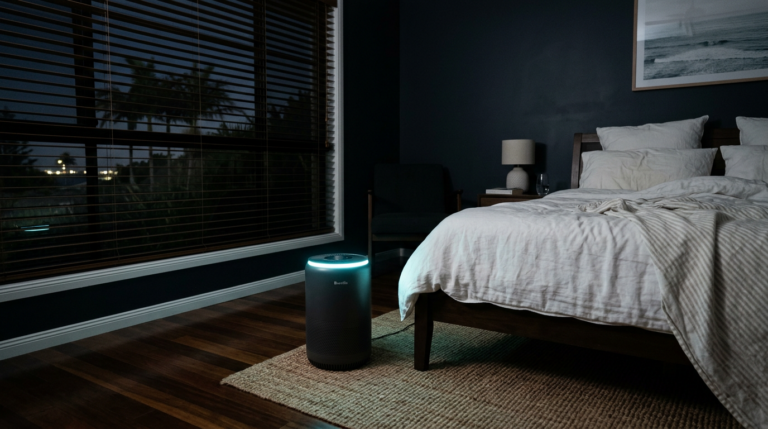
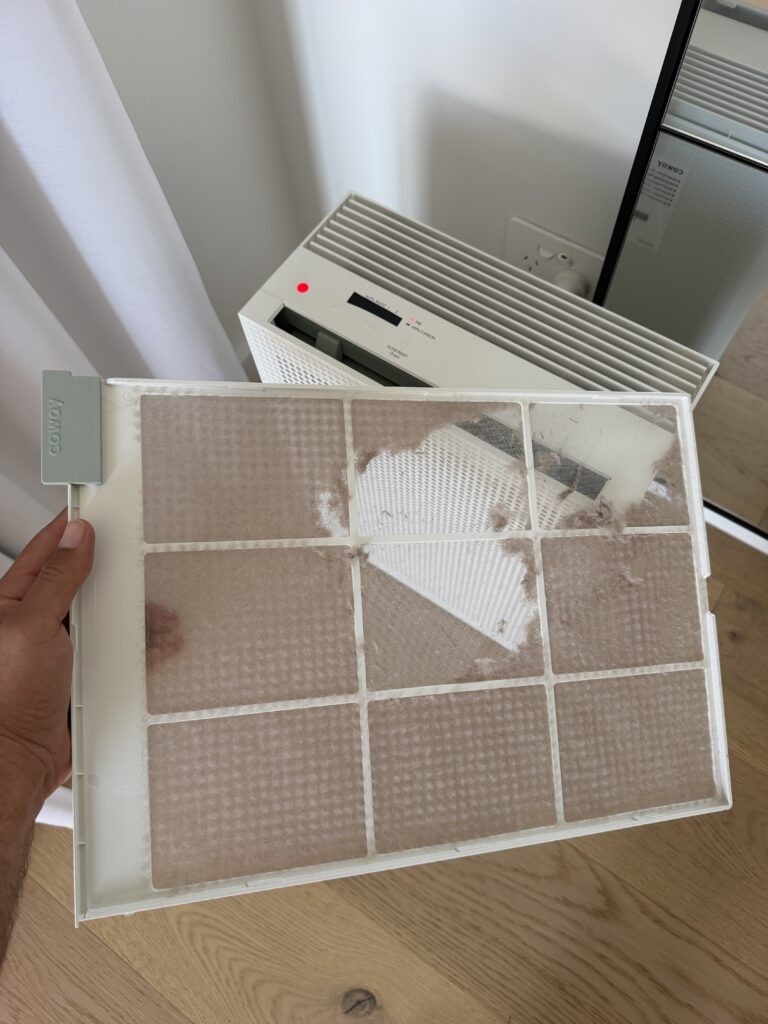
Check the Airmega 150 Price on Amazon →The health departments’ advice points to a small sealed room, and for most households that is a bedroom. The Airmega 150’s smoke CADR of 153 cfm covers about 21 m². It is the purifier in my own bedroom: on Silent I measured 32.1 dBA at a metre on a phone app, so it is quiet enough to sleep beside, though on smoke nights you want it on a higher setting. No ioniser, Sensitive Choice approved, 35 W. About $254 on Amazon AU.
✓ Pros
- Sized for a real bedroom
- Quiet beside the bed (my reading)
- About $254
× Cons
- Too small for a living area
- Deodorisation filter every 6 months
- Needs a higher setting than Silent during smoke
Buy this if…
you are setting up a bedroom as the household’s clean room.
3. Philips PureProtect 3200: open living areas
 Living areas520 m³/hCADR, GB/T test (Philips)
HEPA NanoProtect + carbon | No ions or ozone emitted (Philips) | 15 to 47.5 dB(A) | 36 W | Filter ~1 year | ECARF certified | ~$382 (19 Oct 2026)
Check the Philips 3200 Price on Amazon →Philips quotes 520 m³/h of CADR on the Chinese GB/T test and a maximum room of 135 m². The test standard differs from Coway’s AHAM figures, so you cannot apply the two-thirds rule directly, but it is clearly a living-room class unit at 36 W. Philips states it emits no ions or ozone, which matters for smoke because ionisers do not remove the fine particles. About $382 on Amazon AU.
✓ Pros
- High airflow for the price
- No ions or ozone (Philips)
- Sold by Amazon AU
× Cons
- CADR on a different test standard
- Not Sensitive Choice listed
- Few Amazon AU ratings so far
Buy this if…
you want a living-area purifier for less than the Airmega 400.
4. Levoit Core 300: budget small room
 Budget$169sold by Levoit’s AU distributor
3-stage pre-filter + carbon + HEPA | CADR 187 m³/h (Levoit AU listing) | No ioniser | Sold by VeSync (Levoit) | ~$169 (19 Oct 2026)
Check the Levoit Core 300 Price on Amazon →For a small bedroom or study on a tight budget, the Core 300 is a three-stage HEPA unit with no ioniser, sold by Levoit’s distributor VeSync. The Australian listing quotes a CADR of 187 m³/h without naming the test standard, so keep it to a small room and close the door. About $169.
✓ Pros
- About $169
- No ioniser
- Small footprint
× Cons
- CADR standard not stated
- Small rooms only
- Keep the door closed; small-room unit
Buy this if…
you need one small room covered and the budget is tight.
Also consider: the Winix Zero (about $279) is a capable mid-size unit, but its PlasmaWave stage generates ions. Winix says it can be switched off; for smoke, switch it off, because ion generators do not remove the fine particles. See the best air purifiers in Australia for the full range.
Comparison table
| Spec | Airmega 400 | Airmega 150 | Philips 3200 | Levoit Core 300 |
|---|---|---|---|---|
| Smoke CADR | 328 cfm | 153 cfm | 520 m³/h (GB/T) | 187 m³/h (listing) |
| Room (2/3 rule) | ~46 m² | ~21 m² | Not comparable | Small rooms |
| Ions or ozone | No | No | No (Philips) | No |
| Power | 66 W | 35 W | 36 W | Not verified |
| Price (19 Oct 2026) | ~$799 | ~$254 | ~$382 | ~$169 |
What does not work
NSW Health, the Department of Health and EPA Victoria all say humidifiers, negative ion generators and odour absorbers do not remove the fine particles in bushfire smoke. The US EPA adds that ozone generators sold as air cleaners have not been approved by any federal agency for occupied spaces, and that ozone can damage the lungs. Surgical and cloth masks do not protect you from smoke either, according to NSW Health. If a product’s main selling point is ions, plasma or ozone, it is the wrong tool for smoke. More in ionisers vs HEPA.
No purifier yet? A box fan with a filter taped to it, known as a Corsi-Rosenthal box, is a recognised stopgap; see our build guide.
Masks and going out
Indoors, the purifier does the work. Outdoors, NSW Health says to consider a P2/N95 mask if you cannot avoid the smoke, and that it “must fit properly with an air-tight seal to work well.” Check the air quality before outdoor exercise or opening up the house. The AirRater app, developed in Australia, was used widely during the 2019 to 2020 fires to track smoke and symptoms.
After the smoke clears
Open up and air the house once outdoor air quality improves. Then check the purifier: vacuum or wash the pre-filter, and expect the HEPA and carbon filters to be closer to replacement than the calendar suggests, because a smoke event loads them fast. If the room still smells of smoke while the particle reading looks fine, the carbon is probably spent. See our filter replacement guide.
Which should you buy?
Protect the living area: Coway Airmega 400. Bedroom clean room: Coway Airmega 150. Open living area for less: Philips 3200. Small room, tight budget: Levoit Core 300. Several rooms: one sized unit per room beats one big unit in the hallway. For bedrooms specifically, see the best bedroom air purifiers.
Final verdict
For bushfire smoke, size on smoke CADR and seal the room. The Coway Airmega 400 is the best air purifier for a smoky living area, and the Airmega 150 the best for a bedroom clean room. Whatever you buy, follow the health departments: HEPA, small sealed room, air conditioner on recirculate, and a fitted P2/N95 mask if you have to go out.
Prices change. Check Amazon AU before buying.
Frequently asked questions
What is the best air purifier for bushfire smoke in Australia?
A HEPA purifier sized on its smoke CADR. For living areas, the Coway Airmega 400 (smoke CADR 328 cfm, about 46 m²); for a bedroom clean room, the Coway Airmega 150 (153 cfm, about 21 m²).
Do air purifiers work for bushfire smoke?
Yes, if they have a HEPA filter and run in a small, well-sealed room. That is the advice of NSW Health, the Australian Government Department of Health and EPA Victoria.
What size air purifier do I need for smoke?
A smoke CADR in cfm of at least two-thirds of the room’s floor area in square feet (US EPA). Roughly 12 m³/h per square metre at a 2.4 m ceiling.
Do ionisers help with bushfire smoke?
No. NSW Health, the Department of Health and EPA Victoria all say negative ion generators do not remove the fine particles in bushfire smoke.
Should I run my air conditioner during bushfire smoke?
Yes, on recirculate if it has that setting, with windows and doors closed (NSW Health).
Do masks protect against bushfire smoke?
A P2/N95 mask can, if it fits with an air-tight seal. Surgical and cloth masks do not, according to NSW Health.
How long should I run an air purifier during smoke?
Continuously on the highest setting while smoke is in the area, as the US EPA advises, with the room sealed.
Do I need to change filters after a smoke event?
Check them. Smoke loads HEPA and carbon filters quickly, so they may need replacing sooner than the maker’s interval.
Can I use a DIY box fan filter for smoke?
A Corsi-Rosenthal box is a recognised stopgap until you can buy a properly sized HEPA purifier.
- NSW Health: protect yourself from bushfire smoke
- Australian Government Department of Health: bushfire smoke fact sheet
- EPA Victoria: smoke and portable indoor air cleaners (publication 1809)
- US EPA: how to create a cleaner air room (2/3 CADR rule)
- US EPA: guide to air cleaners in the home
- US EPA: ozone generators that are sold as air cleaners
- AHAM Verifide: air cleaner CADR and the 2/3 rule
- Coway: Airmega 400 specifications
- Coway: Airmega 150 specifications (CADR, power, noise, filter life)
- Philips: PureProtect 3200 (AC3220) specifications
- Winix America: PlasmaWave FAQ (switching it off, Sleep mode, CARB)
- Sensitive Choice: approved Coway air purifiers
- NSW Government: air quality near you
- EPA Victoria: EPA AirWatch and emergency air quality information
- ACU: the AirRater app during the 2019-20 fires (case study)
Get the Australian Home Environment Checklist
30 checks across water, air and EMF. Most of them free. Ranked by impact.
No spam. Unsubscribe any time.

Former Royal Australian Navy Clearance Diver and TAG-E counter-terrorism operator. Founded Clean and Native to apply the same rigorous thinking to the home environment.
Full biography →