True HEPA vs H13 vs HEPASilent Explained
Drafted with AI assistance and checked against published specifications and certifications. First-hand measurements appear only where stated. How we make content
How this assessment was made. This guide is based on the standards themselves (EN 1822-1:2019 as reproduced by filter manufacturers, the US DOE HEPA specification and AS 4260-1997), US EPA and CARB documents, Australian government health guidance, and each brand’s own published claims. I have not laboratory-tested any filter, and where a figure is a manufacturer’s claim rather than a certified result the article says so. Amazon prices were checked on 19 October 2026. Clean and Native may earn a commission on some links; that does not change what the standards say.
H13 is a European filter class under EN 1822 that requires at least 99.95% efficiency at the most penetrating particle size, with every H13 filter individually leak-tested and serial-numbered. “True HEPA” usually refers to the US benchmark of 99.97% at 0.3 microns, but no regulator checks “True HEPA” claims on consumer purifiers. HEPASilent is Blueair’s system that charges particles with an ioniser so a less dense filter can catch them; it is not an EN 1822 H13 filter. All three can clean air well. For an Australian home, the filter label matters less than a credible clean air delivery rate (CADR) for your room.
Once you know what the label means, my best air purifier Australia guide applies it to five HEPA picks sized by room.
Those three sentences undo most of the marketing on the shelf. The rest of this guide shows where each one comes from, so you can check any purifier’s claim yourself in five minutes.
Treat H13 as the most clearly defined label, “True HEPA” as a usually-good but unpoliced claim, and HEPASilent as a different design that relies on an ioniser. Then look past the label to CADR and room size. If you just want a sound buy, the Coway Airmega Mighty and Levoit Core 400S are well-priced filter purifiers sold on Amazon AU. For five purifiers checked against these labels, see the best HEPA air purifiers in Australia.
| Label | What it means | How much it tells you |
|---|---|---|
| H13 (EN 1822) | ≥99.95% at the most penetrating particle size; each filter leak-tested | Most clearly defined |
| "True HEPA" | Usually means 99.97% at 0.3 µm (US DOE benchmark); not regulated for consumer products | Good, if the spec backs it up |
| HEPASilent (Blueair) | Ioniser charges particles; a less dense filter captures them | Brand claim; not EN 1822 classified |
| "HEPA-type" / "HEPA-style" | No definition and no published efficiency data | Treat as unverified |
✓ Look for this
- A named filter class (H13 or H14) or a stated test basis, such as 99.97% at 0.3 µm
- A published CADR, ideally certified under AHAM Verifide
- A room size that matches your room at about five air changes an hour
- Replacement filters you can actually buy in Australia
× Do not rely on this
- "HEPA-type", "HEPA-style" or "HEPA-like" with no numbers
- A percentage with no particle size or test method
- Ion, plasma or ozone features sold as a substitute for filtration
- Room sizes based on one air change per hour
Why the labels are confusing
As a Navy Clearance Diver, every piece of breathing equipment I used came with a specification, a test standard and a service interval. If the paperwork did not say what it was rated to, you did not dive with it. Air purifier boxes rarely meet that bar. One says “True HEPA”, the next “H13 HEPA”, another “HEPASilent”, and a fourth “HEPA-type”. They all sit in the same $250 to $700 band, and none of them explains the difference.
The root problem is that there is no single consumer HEPA rule. The US Environmental Protection Agency puts it plainly in its 2018 technical summary on residential air cleaners: “there is no widely accepted definition of HEPA performance in consumer products.” Europe has a detailed filter classification standard, EN 1822. Australia has its own HEPA standard, AS 4260-1997, but no regulator tests or certifies the filtration claims made for home purifiers. Purifiers here must meet electrical safety rules, not filtration ones.
EN 1822 classes: E10 to U17
EN 1822-1:2019 is the current European standard for high-efficiency air filters. It classifies filters by their efficiency at the most penetrating particle size (MPPS), the particle size the filter is worst at catching, which for typical glass-fibre media sits roughly between 0.1 and 0.3 microns. Testing at the worst-case size is what makes the classes meaningful: the filter does better on particles that are larger or smaller.
| Class | Group | Overall efficiency at MPPS | Local (leak) efficiency at MPPS |
|---|---|---|---|
| E10 | EPA | ≥85% | Not required |
| E11 | EPA | ≥95% | Not required |
| E12 | EPA | ≥99.5% | Not required |
| H13 | HEPA | ≥99.95% | ≥99.75% |
| H14 | HEPA | ≥99.995% | ≥99.975% |
| U15 | ULPA | ≥99.9995% | ≥99.9975% |
| U16 | ULPA | ≥99.99995% | ≥99.99975% |
| U17 | ULPA | ≥99.999995% | ≥99.9999% |
Three details matter for buyers. First, the classes once called H10, H11 and H12 were renamed E10, E11 and E12 (EPA, for efficient particulate air) in the 2009 revision, so a filter sold as “H11” today is using an out-of-date label. Second, only H13 and above are true HEPA classes under EN 1822. Third, every H13 and H14 filter is individually leak-tested and given a serial number and test report; EPA classes (E10 to E12) do not need individual testing. The 2019 edition also points to the international ISO 29463 series for the test methods.
Read the efficiency numbers as particles passing through, because that is what you breathe. An E11 filter can let through 5 in every 100 particles at its worst size. An H13 filter lets through no more than 5 in every 10,000. That is a hundred-fold difference in what gets past the filter on each pass.
What “True HEPA” means
“HEPA” began as a US specification for nuclear and laboratory filtration. The US Department of Energy’s current HEPA standard, DOE-STD-3020-2015, requires “a minimum efficiency of 99.97% when tested with an aerosol of 0.3 micrometer diameter.” That is a procurement specification for DOE contractors, not a consumer rule, but it is where the familiar “99.97% at 0.3 microns” comes from.
“True HEPA” is marketing shorthand for that US benchmark. It is not defined in any statute or standard I could find, and as the EPA notes, nobody polices it on consumer products. In practice, a “True HEPA” claim backed by a stated 99.97% at 0.3 microns usually describes a high-efficiency filter; the EPA’s technical summary says HEPA-designated home filters typically perform at levels comparable to a MERV 16 filter or better. The problem is the claims that stop at the words “True HEPA” with no number or test behind them.
H13 vs True HEPA: different tests, not a ranking
The most common question is whether H13 is better than True HEPA. The honest answer is that they are measured differently, so the numbers cannot be compared directly.
| H13 (EN 1822) | True HEPA (US benchmark) | |
|---|---|---|
| Efficiency | ≥99.95% | ≥99.97% |
| Measured at | The most penetrating particle size for that filter | 0.3 µm |
| Individual filter testing | Yes: every filter leak-tested and serialised | Not required for consumer claims |
| Who checks consumer claims | No regulator in Australia | No regulator in Australia |
| Also has a local (leak) limit | Yes, ≥99.75% | No |
Because H13 is tested at the filter’s weakest particle size, a filter that genuinely meets H13 will usually also meet 99.97% at 0.3 microns, and vice versa for good media. Neither number makes one clearly better than the other. What H13 adds is a defined classification and an individual leak test for every filter, which is why it is the most informative label you will see. A claim of “HEPA-13” or “H13” that then quotes 99.97% at 0.3 microns, as some brands do, is mixing the two systems; treat it as a True HEPA claim unless the brand names EN 1822.
H14: hospital grade, and rarely needed at home
H14 filters must reach at least 99.995% at MPPS, letting through ten times fewer particles than H13. They are used in operating theatres, pharmaceutical cleanrooms and similar critical environments. In a home, a purifier is cleaning the same room air over and over, so the room’s particle level depends far more on how much air is moved through the filter (CADR) than on the gap between H13 and H14 on any single pass.
You will often read that H14 is noisier and costlier to run because the denser media resists airflow more. It is not that simple. In Camfil’s published data for one industrial filter design at the same size and airflow, the H14 version had a starting resistance of 290 Pa against 250 Pa for the H13. But another Camfil H14 panel is rated at 70 Pa, lower than a different H13 panel at 115 Pa. Media design and pleat area matter more than the class number. I could not find independent data on noise or energy penalties in consumer purifiers, so I will not give you a figure.
HEPASilent: how Blueair’s system works
Blueair’s HEPASilent is a different approach. Blueair says it “specifically and strategically uses an ionizer to electrostatically charge particles inside the air purifier”, and those charged particles are then captured by a filter that is more open than a dense mechanical HEPA filter. The more open filter lets more air through for the same fan effort, which is the basis of Blueair’s claims of quieter running and lower energy use.
The efficiency claims Blueair publishes vary. A 2023 Blueair release claims capture of at least 99.97% of airborne particles down to 0.1 microns, measured in a 30 m³ room rather than as a filter-media test; a Blueair article claims 99.99% efficiency at 0.3 microns; and Blueair’s Australian filter page simply says 99.97%. I found no Blueair claim that HEPASilent filters are classified under EN 1822, so do not describe them as H13.
On ozone, California’s Air Resources Board lists Blueair models in its “electronic” category (devices that ionise or otherwise generate charge) rather than “mechanical”. Blueair says all its purifiers are CARB certified, meaning they meet CARB’s 0.050 ppm ozone limit, and that several models received third-party “Zero Ozone” verification at 5 parts per billion or less. Blueair does not describe them as ozone-free, and neither should anyone else. Blueair recommends replacing the filter about every six months, more often than many mechanical HEPA filters.
For balance: EPA Victoria’s fact sheet on portable air cleaners recommends a True HEPA filter and states that negative ion generators do not reduce indoor air pollution, and WA Health’s guidance advises avoiding units that include ionisers. Blueair’s design uses the ioniser to help a filter capture particles, which is different from an ion-only gadget, but the guidance shows why some buyers, especially people with asthma, prefer a purely mechanical filter.
“HEPA-type” and “HEPA-style”: unverified until proven
“HEPA-type”, “HEPA-style” and “HEPA-like” have no definition in any standard. I could not find published test data that puts a reliable number on how these filters perform, so I am not going to invent one. That is the point: if a seller cannot tell you the efficiency and the particle size it was measured at, you have nothing to go on.
The fix is simple. If a listing says “HEPA-type”, look for a stated efficiency, a particle size and a test basis. If none is given, treat the filter as unknown and move on. The same goes for listings that quote “99%” with no particle size.
Australian standards and guidance
Australia does have a HEPA standard: AS 4260-1997, High efficiency particulate air filters (HEPA) – Classification, construction and performance, reconfirmed in 2018. It is cited in some government advice, but it is not a consumer certification scheme, and no Australian regulator tests or certifies the filtration claims on home purifiers. The RCM mark on a purifier tells you it meets electrical safety requirements, not how well it filters.
Government health advice consistently points to HEPA filtration and away from ion gimmicks:
NSW Health advises considering an air purifier with a HEPA filter during bushfire smoke, used in a small, well-sealed room. EPA Victoria’s fact sheet on smoke and portable indoor air cleaners recommends a True HEPA filter and says negative ion generators and odour absorbers do not reduce indoor air pollution. The Australian Government Department of Health says HEPA air purifiers can reduce fine particles indoors. WA Health’s advice on air cleaners recommends HEPA units compliant with AS 4260-1997 and says to avoid units that include ionisers, plasma, ozone or photocatalytic stages.
One more local signal: the National Asthma Council Australia’s Sensitive Choice program approves some purifiers, including models from Coway and Winix. It is not a filtration standard, but it is an Australian program that looks at products for people with asthma and allergies. For more, see air purifiers and the Sensitive Choice program.
Check all seven rooms, not just this one
38 checks, 29 free, ranked by impact. Sent as a 32-page PDF.
We'll email you the audit and a short series of practical guides. Unsubscribe in one click, any time. Privacy.
Sent. Taking you to your download...
What the brands actually claim
This table shows each brand’s own filter wording, not a reviewer’s summary. It is the clearest way to see which labels are backed by a named standard.
| Brand / model | Filter wording (manufacturer) | Named standard? | Published CADR |
|---|---|---|---|
| Dyson purifiers | "HEPA H13", 99.95% of particles as small as 0.1 µm; whole machine "sealed to HEPA H13" | Yes: EN 1822 aerosol, in Dyson’s own whole-machine test | Not published |
| Breville Smart Air Viral Protect Max | "AntiViral HEPA-13", 99.97% down to 0.3 µm | No standard cited | Up to 530 m³/h |
| Levoit Core 400S | True HEPA (Australian listings) | No H13 claim on Levoit’s US page | 433 m³/h (AU listing) |
| Winix Zero (AU) | "Hospital-grade True HEPA", 99.97% at 0.3 µm | No | Not published |
| Philips 2200 / 4200 | "HEPA NanoProtect", 99.97% at 0.003 µm | DIN 71460 (an automotive cabin-filter test), not EN 1822 | 400 / 600 m³/h |
| Coway Airmega Mighty | HEPA, 99.999% down to 0.01 µm (listing) | No | 421 m³/h |
| Blueair HEPASilent | 99.97% down to 0.1 µm (room test) | No EN 1822 claim | Varies by model |
Two things stand out. Only Dyson ties its claim to EN 1822 at all, and even then it is Dyson’s own whole-machine test using the EN 1822 aerosol, not an EN 1822 classification of the machine. And several brands now quote efficiency at particle sizes far smaller than 0.3 microns, which sounds more impressive but uses different test methods. None of that makes these purifiers bad. It means the CADR and the room size are the numbers to compare.
Which matters for Australian conditions
Bushfire smoke
Smoke is the reason most Australians buy a purifier. On 10 December 2019, Sydney’s air quality index peaked above 2,500, and on 1 January 2020 Canberra’s exceeded 4,000. The NSW environment department reported hourly PM2.5 levels of 380 to 790 µg/m³ in Sydney and the Illawarra during the 2019-20 season. For comparison, the national standard for PM2.5 averaged over 24 hours is 25 µg/m³, with a goal of 20 µg/m³ that applies from 2025, and the annual standard is 8 µg/m³, with a goal of 7.
Smoke particles are mostly well under 2.5 microns, right in the range where filter efficiency is lowest, so a genuine high-efficiency filter matters. But in a smoke event the bigger factor is airflow: how many times an hour the purifier can pass the room’s air through that filter. See our bushfire smoke guide for how to set up a clean room.
Respiratory viruses
A 2021 review in Science by Wang and colleagues concluded that most respiratory viruses spread through aerosols, and that viruses are more concentrated in aerosols smaller than 5 microns. A free virus particle is around 0.1 microns, but it travels inside these larger aerosols, which high-efficiency filters capture well. A purifier is a supplement to ventilation, not a replacement for it.
Pet and dust mite allergens
Allergen particles are mostly larger than smoke, which makes them easier for any good filter to catch. A UK study published in Thorax in 1998 found that most airborne cat allergen was carried on larger particles, with about a quarter on particles under 4.7 microns. Any true high-efficiency filter handles these well; CADR and keeping the purifier in the room where you spend your time matter more than the class. See air purifiers for pet hair.
Why CADR matters more than the label
A filter’s class tells you what fraction of particles it stops on one pass. CADR, the clean air delivery rate, tells you how much clean air the purifier delivers per hour, which combines filter efficiency with airflow. For a room, CADR is the number that decides how fast the air gets clean.
The independent check on CADR is AHAM Verifide, a US program that certifies CADR for smoke, dust and pollen. It does not certify filter class. AHAM’s sizing rule is that the smoke CADR in cubic feet per minute should be at least two-thirds of the room’s floor area in square feet, which equates to about 4.8 air changes per hour. In metric terms, aim for a CADR in m³/h of about five times your room’s volume in m³. A 4 m by 5 m room with a 2.4 m ceiling is 48 m³, so look for about 240 m³/h or more. Our CADR calculator does the maths.
An H13 purifier with a small fan in a big room will lose to a well-made True HEPA purifier with twice the airflow. That is the single most useful thing to take from this guide.
Purifiers worth buying
These four are sold on Amazon Australia and each illustrates one of the labels above. All four rely on a filter for capture. The Blueair uses an ioniser to assist its filter, and the Coway has an optional ioniser you can switch off.
1. Coway Airmega Mighty: best value for most homes
 HEPA filter421 m³/hCADR (Coway)
CADR 421 m³/h | Up to 109 m² | HEPA + carbon pre-filter | Air quality sensor and eco mode | Sensitive Choice approved
Check the Coway Price on Amazon →Amazon AU price: $246.00 · as of 20 Nov 2026, 12:29 am AEST DetailsThe Mighty is a long-running Coway design sold on Amazon AU by Coway Australia. The listing gives a CADR of 421 m³/h for rooms up to 109 m², an air quality sensor with automatic and eco modes, and approval under the National Asthma Council’s Sensitive Choice program. It also has an optional ioniser with its own on/off button; leave it off if you want filter-only cleaning. Coway’s listing claims 99.999% capture down to 0.01 microns; that is the brand’s figure, without a named standard. At $319, it is the strongest value here for a living area or large bedroom.
✓ Pros
- High listed CADR (421 m³/h) for the price
- Sensitive Choice approval from the National Asthma Council Australia
- Sold by Coway’s own Australian operation, so filters and support are local
× Cons
- No named filter standard behind the efficiency claim
- Includes an optional ioniser (switchable off)
- No app control on this model
- Wider footprint than cylindrical purifiers
Buy this if…
you want a proven, well-priced filter purifier for a large room, with Australian support.
2. Levoit Core 400S: True HEPA with app control
 True HEPA433 m³/hCADR (listing)
CADR 433 m³/h (listing) | 24 dB listed | 38 W | VeSync app, Alexa | Particle sensor and auto mode
Check the Levoit Price on Amazon →Amazon AU price: $299.00 · as of 19 Nov 2026, 11:43 pm AEST DetailsThe Core 400S is the archetypal “True HEPA” purifier: a cylindrical filter with pre-filter, HEPA and carbon layers, a particle sensor and app control. Australian listings describe it as True HEPA; Levoit’s US product page does not claim an H13 class. The Amazon AU listing, sold by Levoit’s Australian distributor VeSync, gives a CADR of 433 m³/h. Independent testers have measured its quietest setting louder than Levoit’s 24 dB figure, so treat that as a manufacturer claim.
✓ Pros
- Strong listed CADR for the price
- App scheduling, filter tracking and Alexa support
- Very large base of owner ratings
× Cons
- No H13 class claimed by Levoit
- Quiet-mode figure is Levoit’s own
- Listing title wording ("Plasma") is confusing; the model is the standard Core 400S
Buy this if…
you want a well-reviewed True HEPA purifier with app control for a bedroom or living room.
3. Dyson Purifier Big+Quiet Formaldehyde: the H13 premium option
 Sealed H1399.95%at 0.1 µm (Dyson)
Whole machine sealed to HEPA H13 (Dyson) | Formaldehyde sensing and destruction | Gas and particle sensors | App
Check the Dyson Price on Amazon →Amazon AU price: $1,470.00 · as of 19 Nov 2026, 5:29 pm AEST DetailsIf you specifically want an H13 claim tied to the EN 1822 test aerosol, Dyson is the brand that makes it. Dyson states its HEPA H13 filter captures 99.95% of particles as small as 0.1 microns, and that the whole machine, not just the filter, is sealed to HEPA H13, based on its own test using the EN 1822 aerosol in an ASTM test chamber. The Big+Quiet Formaldehyde was sold and shipped by Amazon AU, but its listing showed it as unavailable on 10 Nov 2026.
The catch is value. Dyson publishes no CADR, so you cannot compare its room-clearing speed directly with the others, and the price is three to five times theirs. You are paying for the sealed design, the gas sensing and formaldehyde destruction, and the Dyson ecosystem.
✓ Pros
- The clearest H13 claim on the market, including sealing of the whole machine
- Particle and gas sensing with real-time reporting
- Formaldehyde sensing and destruction for new-build or renovated homes
× Cons
- No published CADR to compare against other brands
- Very expensive
- H13 sealing is Dyson’s own test, not an EN 1822 classification of the machine
Buy this if…
you want the strongest H13 claim and gas sensing, and the price is not the deciding factor.
4. Blueair Blue 3610: the HEPASilent option
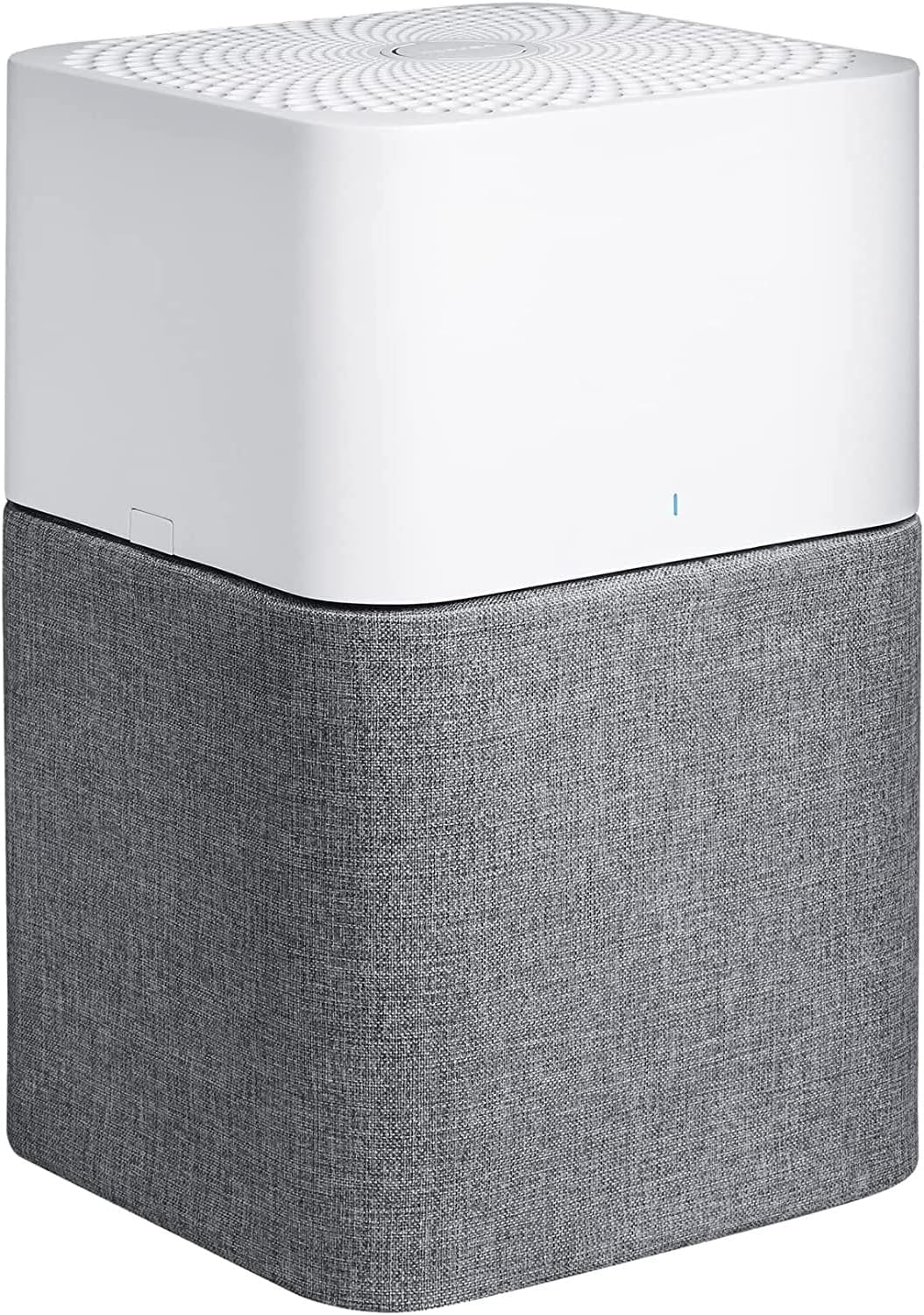 HEPASilent51 m²every 12.5 min (Blueair)
Electrostatic + mechanical filtration | Carbon layer | Washable pre-filter | Air quality sensors, auto mode
Check the Blueair Price on Amazon →Amazon AU price: $803.94 · as of 19 Nov 2026, 8:29 pm AEST DetailsIf you want to try HEPASilent, the Blue 3610 is available on Amazon AU through Australian retailer iBuys. Blueair says it combines electrostatic and mechanical filtration to capture at least 99.97% of airborne particles down to 0.1 microns, and that it cleans a 51 m² room every 12.5 minutes. Expect to change the filter about every six months, per Blueair’s general guidance.
✓ Pros
- Designed for quiet running and lower energy use
- Washable pre-filter and automatic mode with air quality sensing
- Blueair purifiers are CARB certified for ozone
× Cons
- Uses an ionising stage, which some health agencies advise against
- Filter changes more often than many mechanical HEPA filters
Buy this if…
quiet running is your priority and you are comfortable with an ioniser-assisted filter.
Specification comparison
| Spec | Coway Mighty | Levoit Core 400S | Dyson Big+Quiet F | Blueair 3610 |
|---|---|---|---|---|
| Filter type | HEPA + carbon | True HEPA + carbon | Sealed HEPA H13 + carbon | HEPASilent + carbon |
| Named standard | None stated | None stated | EN 1822 aerosol (Dyson test) | None (Blueair claims) |
| Ionising stage | Optional (switchable) | No | No | Yes |
| CADR | 421 m³/h | 433 m³/h (listing) | Not published | Not listed |
| Price (19 Oct 2026) | ~$319 | ~$399 | ~$1,499 | ~$399 |
How to verify a HEPA claim in five minutes
1. Find the number, the size and the test. Look on the specification sheet, not the box. You want an efficiency figure, the particle size it was measured at, and ideally the standard: “H13 to EN 1822”, or “99.97% at 0.3 microns”. If all you find is “True HEPA” or “HEPA-type”, you have not found a claim yet.
2. Check the filter itself. Genuine H13 and H14 filters are individually tested and serial-numbered. The class is often printed on the filter frame or the replacement filter’s listing.
3. Look for a certified CADR. AHAM Verifide certification means the CADR was independently checked. Without it, treat CADR as the manufacturer’s figure and compare brands with caution.
4. Check for an ionising stage. If the purifier has an ioniser, plasma or similar feature, find out whether it can be switched off. CARB’s list shows whether a model is classed as mechanical or electronic.
5. Check filter supply. A great filter you cannot replace in Australia is a short-term purchase. For the replacement cycle, see our filter replacement guide.
Some purifiers pair a HEPA filter with an ion generator. Our Sharp Plasmacluster review looks at what that ion stage adds, and what it does not.
Final verdict
H13 is the most precisely defined label you will see, because EN 1822 tests at the filter’s weakest particle size and requires every H13 filter to be individually leak-tested. “True HEPA” is a perfectly good filter when the spec backs it with 99.97% at 0.3 microns, but nobody checks the claim. HEPASilent is an ioniser-assisted design that Blueair says matches HEPA-level capture at lower noise; it is not an H13 filter. “HEPA-type” tells you nothing.
For an Australian home, put the label second and the CADR first. Buy the Coway Airmega Mighty for the best value, the Levoit Core 400S for app control, the Dyson if you want the clearest H13 claim and can justify the price, or the Blueair if quiet running matters most. For a full ranked list, see the best air purifiers in Australia.
Prices change. Check Amazon AU before buying.
Frequently asked questions
What is the difference between True HEPA and H13?
H13 is a class under the European standard EN 1822: at least 99.95% efficiency at the filter’s most penetrating particle size, with every filter individually leak-tested. "True HEPA" usually means the US benchmark of 99.97% at 0.3 microns, but it is not a regulated term for consumer products. The two are measured differently, so the percentages cannot be compared directly.
Is H13 better than True HEPA?
Not necessarily. Both describe high-efficiency filters. H13 is more precisely defined and includes an individual leak test for every filter, which makes it the more informative label. For a home, a purifier’s CADR and room size matter more than the difference between the two.
Does Blueair HEPASilent meet the HEPA standard?
Blueair does not claim an EN 1822 H13 classification for HEPASilent. Its system uses an ioniser to charge particles so a less dense filter can capture them. Blueair claims at least 99.97% capture of particles down to 0.1 microns in a room test.
Does HEPASilent produce ozone?
Blueair says all its purifiers are CARB certified, meaning they meet California’s 0.050 ppm ozone limit, and several models have third-party "Zero Ozone" verification at 5 parts per billion or less. CARB classes them as electronic devices. Blueair does not describe them as ozone-free.
Is H14 better than H13 for home use?
H14 lets through ten times fewer particles per pass, but in a home the room’s air is filtered over and over, so airflow (CADR) matters far more. H14 is mainly used in hospitals and cleanrooms. Filter resistance depends heavily on media design, not just the class.
What does HEPA-type mean on an air purifier?
"HEPA-type", "HEPA-style" and "HEPA-like" have no definition in any standard. Unless the seller gives an efficiency figure and the particle size it was measured at, treat the filter as unverified.
Does Australia have a HEPA standard?
Yes, AS 4260-1997, which covers the classification, construction and performance of HEPA filters and was reconfirmed in 2018. But no Australian regulator tests or certifies the filtration claims on consumer air purifiers. The RCM mark covers electrical safety only.
Can a HEPA air purifier help with bushfire smoke?
Yes. NSW Health, EPA Victoria and the Australian Government Department of Health all point to HEPA air purifiers for reducing fine smoke particles indoors, used in a closed room. Choose a purifier with enough CADR for the room, about five times the room volume in m³/h.
How do I check whether a filter is really H13?
Look for H13 and EN 1822 named on the specification sheet or the filter itself. Genuine H13 filters are individually tested and serial-numbered. A product that says "HEPA-13" but quotes 99.97% at 0.3 microns is using the US test basis, not EN 1822.
What were H10, H11 and H12 filters?
They were HEPA classes in older editions of EN 1822. Since 2009 they have been called E10, E11 and E12 (EPA filters), with minimum efficiencies of 85%, 95% and 99.5%. Only H13 and above are HEPA classes under the current standard.
- MANN+HUMMEL: EN 1822 filter classification table
- Freudenberg: EN 1822 and individual leak testing
- PharmOut: H10 to H12 renamed E10 to E12
- US DOE-STD-3020-2015: HEPA filter specification
- US EPA: Residential Air Cleaners, A Technical Summary (2018)
- AS 4260-1997 (R2018) HEPA filters standard
- Blueair: how HEPASilent differs from an ioniser
- Blueair: ozone and CARB certification
- Blueair release (2023): HEPASilent performance claims
- California Air Resources Board: certified air cleaning devices
- AHAM Verifide air cleaner certification procedural guide
- Dyson Australia: HEPA H13 and whole-machine filtration claims
- Philips: NanoProtect filter test basis
- Camfil Absolute DE: H13 and H14 pressure drop
- NSW Health: Protect yourself from bushfire smoke
- EPA Victoria: Smoke and portable indoor air cleaners (1809)
- Australian Government Department of Health: Bushfire smoke fact sheet
- WA Health: Information on air purifiers and cleaners
- NSW DPIE: PM2.5 in spring and summer 2019-20
- NSW: national air quality standards and goals
- ACT State of the Environment 2023: air quality
- UC San Diego on Wang et al. 2021, Science

Former Royal Australian Navy Clearance Diver and TAG-E counter-terrorism operator. Founded Clean and Native to apply the same rigorous thinking to the home environment.
Full biography →The 7-Room Home Audit
Air is where most homes have their biggest free fix. The audit walks every room: 38 checks across air, water and EMF, ranked by impact against Australian guidelines.
- The rangehood habit that cuts gas cooking fumes
- Two-minute tests for exhaust fans, mould and stale bedrooms
- When a purifier helps, and the bedroom one I own
We'll email you the audit and a short series of practical guides. Unsubscribe in one click, any time. Privacy.
Sent. Taking you to your download...