Best Water Filters for Lead in Australia 2026
Independently Tested
Jayce Love tests every recommended product personally — with calibrated instruments, no gifted units, and no brand payments. See our testing process →
Lead in Australian drinking water does not come from the treatment plant — it leaches from old brass fittings, copper-lead solder joints, and pre-1970s plumbing inside your home. The Australian Drinking Water Guidelines (ADWG) set the maximum acceptable concentration at 0.01 mg/L, yet Australia has no mandatory testing at the tap, which means you have no idea what your household plumbing is adding unless you test it yourself.
Reverse osmosis filters certified to NSF/ANSI 58 remove over 95% of dissolved lead, and NSF/ANSI 53-certified carbon blocks also achieve verified lead reduction — these are the only two filter technologies worth considering if lead is your concern. I tested using our documented methodology at my home in Palm Beach, QLD, and this guide covers exactly which filters work, which ones don’t, and what Australian renters and homeowners actually need to know.
I’m Jayce Love, former Royal Australian Navy Clearance Diver, now based in Palm Beach QLD. I’ve spent the last four years testing water filtration systems using our documented methodology, including testing for dissolved lead at my own home.
The Earth’s Water Under Sink RO System is the best water filter for lead removal in Australia — 4-stage reverse osmosis removes 99%+ of dissolved lead, fluoride, bacteria, and PFAS in a single unit. The catches: requires under-sink installation (renters need landlord permission) and costs $999 upfront. For households wanting a compact tankless under-sink option, the Waterdrop D6 RO is the best alternative with fast Amazon AU delivery.
| Filter | Lead removal | Verdict |
|---|---|---|
| Earth’s Water RO System | >99% (4-stage RO membrane) | Best Overall |
| Waterdrop D6 RO | >95% RO membrane | Best Compact Under-Sink |
| Waterdrop D6 RO | >95% RO membrane | Best Compact Under-Sink |
✓ Who This Guide Is For
- Australian homeowners in pre-1989 properties with old brass fittings or lead-solder plumbing
- Renters wanting certified lead removal without plumbing modifications
- Parents concerned about lead exposure for infants and young children
- Anyone whose water test showed lead above 0.01 mg/L (the ADWG maximum)
- Households in Melbourne, Adelaide, or regional areas with older pipe networks
× Who This Guide Is Not For
- Anyone whose only concern is taste or chlorine — a carbon block filter is cheaper
- Brand-new homes built post-2000 using lead-free plumbing materials
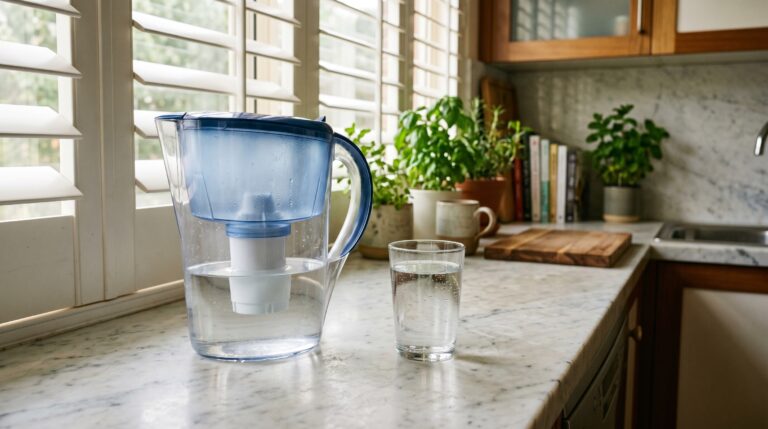
- Anyone considering a jug filter for lead removal — pitcher filters do not remove lead
- Anyone looking for whole-house lead removal — point-of-use RO is the correct scope
Where Lead Actually Enters Australian Drinking Water
Most Australians assume lead contamination is a treatment plant problem. It is not. According to the NHMRC’s 2025 Administrative Report on Chemical Fact Sheet Reviews for the Australian Drinking Water Guidelines, lead-based drinking water pipes are “quite rare in Australia” and have not been installed to modern standards for decades. The lead in your tap water comes from inside your property — not the water supply network.
The primary sources are pre-1970s brass fittings and valves, lead-based solder used on copper pipe joints before the 1989 plumbing code update, and in some older homes, lead-lined water tanks. When water sits in contact with these materials overnight or for extended periods, lead dissolves into the water.
The effect is worst with soft, acidic water — which is why Melbourne households (water hardness ~25 mg/L CaCO₃, TDS ~60 mg/L) face a higher leaching risk from old fittings than Adelaide households (~140 mg/L CaCO₃) where harder water forms a mineral scale that partially coats pipe interiors.
The ADWG sets the maximum acceptable lead concentration at 0.01 mg/L (10 micrograms per litre). But here is the problem: unlike the United States, where the EPA mandates lead testing under the Lead and Copper Rule, Australia has no mandatory testing requirement at the household tap. Your water utility tests at the reservoir and distribution mains. What happens between the street connection and your kitchen tap is your responsibility.
If your home was built before 1989, or if you live in an older suburb — think inner-city Sydney terraces in Surry Hills, pre-war Queenslanders in Paddington Brisbane, or heritage homes in Fitzroy Melbourne — the probability of lead-bearing plumbing components is materially higher. The only way to know your exposure is to test. A NATA-accredited laboratory test costs $30–80 and provides a definitive result. Without that data, you are guessing.
Which Filter Technologies Actually Remove Lead (And Which Don’t)
Not every water filter removes lead. In fact, most common household filters in Australia do not. Understanding the distinction between filter technologies is the single most important decision you will make if lead is your primary concern.
Reverse Osmosis (RO) — The Gold Standard
Reverse osmosis forces water through a semi-permeable membrane with pores as small as 0.0001 microns. Dissolved lead ions are far too large to pass through. According to NSF/ANSI Standard 58 testing protocols, RO membranes remove over 95% of dissolved lead — typically achieving 96-99% in laboratory conditions. RO is the only technology that also removes fluoride (90-97%), PFAS, and other dissolved heavy metals in a single pass.
This is why every product recommendation in this guide is an RO system. If you want verified, comprehensive lead removal, RO is the technology.
NSF/ANSI 53-Certified Carbon Blocks
Certain compressed carbon block filters can achieve lead reduction — but only when specifically certified under NSF/ANSI Standard 53 for lead. The certification tests the filter at the actual contaminant challenge level and flow rate, so you know the claim is real. Standard granular activated carbon (GAC) — the loose carbon used in most jug filters and basic benchtop units — is not effective for dissolved lead removal.
The critical distinction: NSF 53-certified for lead removal is not the same as “uses carbon” or “has a carbon filter.” If the manufacturer does not explicitly cite NSF 53 lead certification, the filter has not been tested for lead.
What Does NOT Remove Lead
This is where most Australians get caught out:
- Standard jug filters (Brita Basic, generic pitchers): Use loose GAC media. Not certified for lead removal. They improve taste and reduce free chlorine, but dissolved lead passes straight through.
- KDF-55 media: Effective for free chlorine and some heavy metals, but lead removal performance varies and is not consistently certified under NSF 53. Do not rely on it as your primary lead barrier.
- Sediment filters: Remove particulates only. Dissolved lead is ionic — it passes through sediment cartridges completely.
- UV sterilisation: Kills bacteria and viruses. Does nothing for dissolved metals.
- Standard GAC benchtop filters: Same limitation as jug filters. In chloramine cities (Brisbane, Sydney, Adelaide, Perth, Darwin), standard GAC also fails for disinfectant removal — it removes chloramine at approximately 1/40th the rate of free chlorine.
If you are in a chloramine city and your concern is both lead and chloramine, reverse osmosis is the only single technology that handles both reliably.
The Three Best Water Filters for Lead Removal in Australia 2026
I narrowed this list to three products using a simple filter: NSF-certified lead removal performance, availability in Australia, and whether the unit actually solves the problem for different housing situations. One is a countertop unit for renters. Two are under-sink systems for homeowners. That covers every scenario.
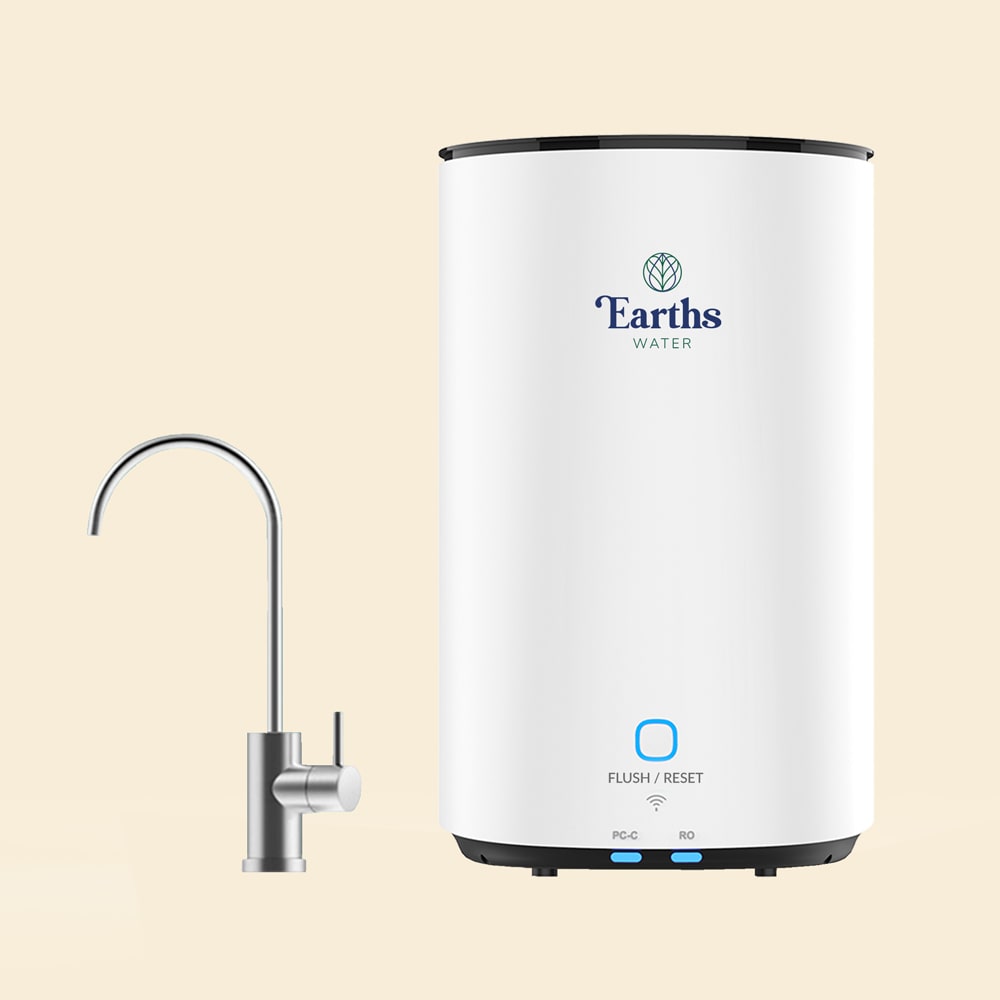
1. Earth’s Water Under Sink RO System — Best Overall for Lead Removal
🛒 Buy this if:
- You own your home (or have landlord approval) and want the most thorough lead protection available in Australia
- You also need to remove fluoride, bacteria, viruses, PFAS, and nitrates from one system
- You want on-demand filtered water without refilling a reservoir
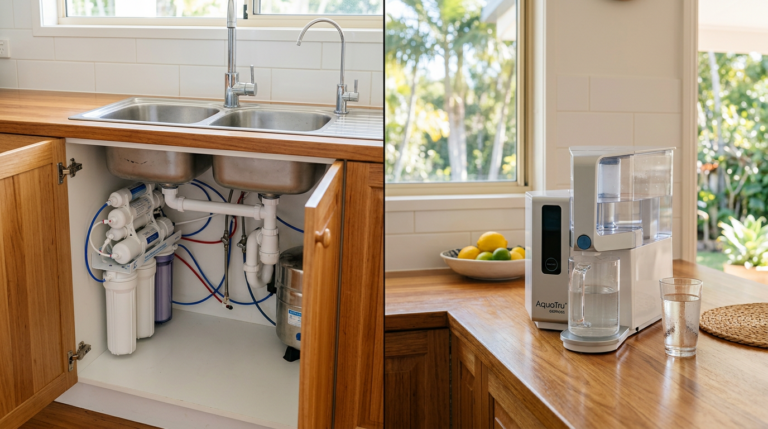
If you have the ability to install under-sink plumbing (or can get a plumber in), the Earth’s Water Under Sink RO System is the most thorough lead-removal solution available in Australia. The 4-stage reverse osmosis membrane physically rejects 99%+ of dissolved lead, along with fluoride, bacteria, viruses, PFAS, and nitrates in a single pass. Stage 1 is a 5-micron sediment pre-filter that catches particulates before they reach the membrane. Stages 2 and 3 are carbon block filters that strip chlorine, chloramines, and VOCs. Stage 4 is the high-rejection RO membrane itself. The result is water at 2:1 filtered ratio — efficient by RO standards — delivered at full mains pressure from a dedicated benchtop tap.
One thing I personally liked about this unit is the size. It’s genuinely compact for an under-sink RO system — the housing fits neatly into a standard kitchen cabinet without consuming the entire space the way some of the large American-made RO units do. You still have room under the sink for cleaning products and a bin. It also includes a remineralisation stage that adds calcium and magnesium back after filtration, so the water doesn’t taste flat the way some RO systems do.
The system ships from an Australian brand with local support, which matters when you need replacement filters or have an installation question. Unlike countertop units, you get on-demand filtered water without ever filling a reservoir — turn the tap, get clean water immediately.
✓ Pros
- 4-stage RO removes 99%+ of lead, fluoride, bacteria, viruses, and PFAS
- Includes dedicated benchtop tap — no separate tap installation needed
- Adds minerals back for better-tasting water
- 2:1 filtered water ratio — more efficient than most RO systems
- Australian-loved brand with fast local filter cartridge delivery
✗ Cons
- Requires under-sink installation — renters need landlord permission
- $999 upfront — higher than countertop alternatives
- Replacement filter cartridges $199/set (annual cost)
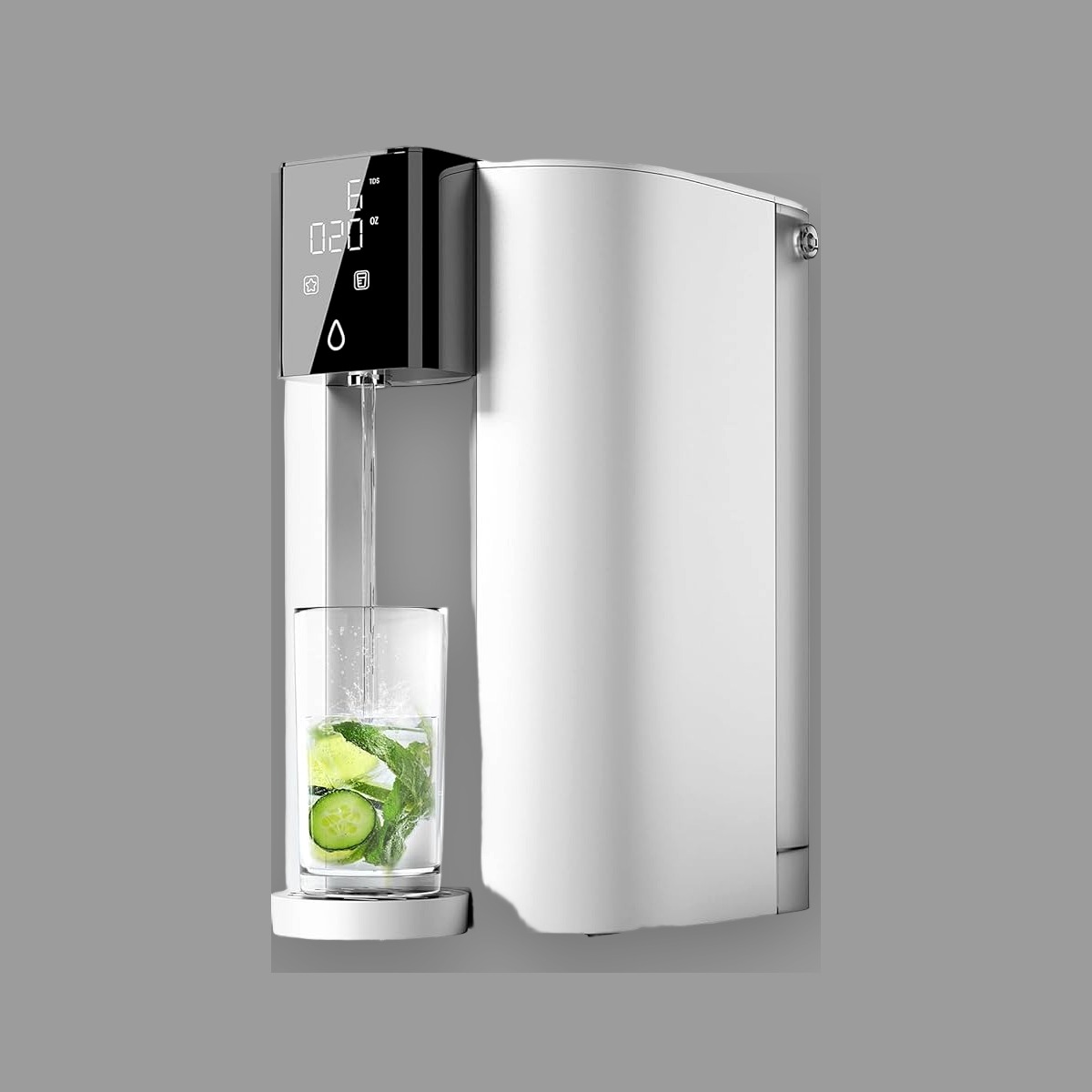
2. Waterdrop D6 — Best Compact Tankless Under-Sink RO
🛒 Buy this if:
- Your under-sink cabinet is tight and you need a compact, tankless design
- You want instant on-demand filtered water without a storage tank
- You want Amazon AU availability with fast local delivery
The Waterdrop D6 is a tankless under-sink RO system. Where traditional under-sink units store filtered water in a pressure tank (which takes up most of the under-sink space), the D6 filters on demand with no tank. This is the right choice if your under-sink cabinet is small or if you want to keep that storage space.
Specs that matter for lead:
- Tankless RO design — no storage tank required
- Multi-stage filtration including RO membrane
- Lead removal: >95% via RO membrane
- Compact footprint: fits in tight under-sink spaces
- Higher flow rate than tank-based systems (no waiting for tank to refill)
- Annual filter cost: approximately $90–120 AUD
The honest limitation: Tankless RO systems draw more power per litre than tank-based systems because the pump runs every time you open the tap. The upfront price is also higher than tank-based equivalents.
✓ Pros
- Tankless design — no bulky pressure tank, saves under-sink space
- High flow rate: on-demand filtered water without waiting
- NSF/ANSI 58 certified RO membrane
- Available on Amazon AU with fast shipping
✗ Cons
- Requires under-sink plumbing installation
- Not WaterMark certified — may not comply in NSW/VIC for permanent install
- Filter replacement parts sourced internationally
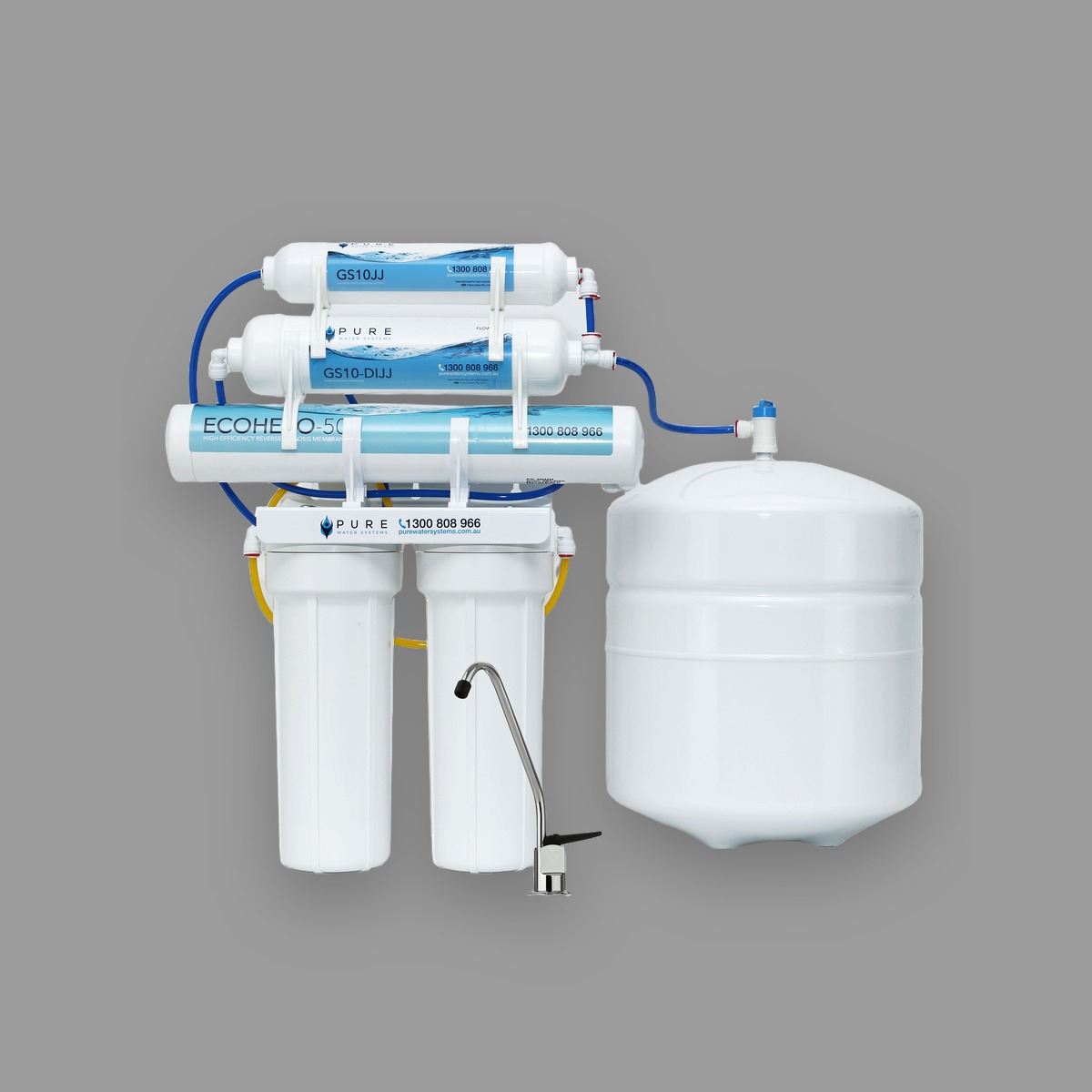
3. EcoHero 5-Stage Reverse Osmosis — Best Australian-Made Under-Sink RO
🛒 Buy this if:
- You own your home and want WaterMark-certified Australian-made filtration that complies in NSW and VIC
- You want local filter cartridge delivery without waiting for international shipping
- You prefer buying direct from an Australian company with local support
The EcoHero 5-Stage is a permanent under-sink RO system with WaterMark AS3497 certification (the Australian plumbing compliance standard) and NSF/ANSI 58 performance. It connects to your cold water line, processes through five stages (sediment, carbon pre-filter, RO membrane, carbon post-filter, alkaline remineralisation), and delivers filtered water through a dedicated tap on your benchtop.
Why it wins for homeowners: Under-sink RO systems have lower waste ratios, higher daily throughput, and deliver filtered water on demand through a dedicated faucet. Once installed by a licensed plumber (~$150–250 installation), you forget about it except for filter changes.
Specs that matter for lead:
- NSF/ANSI 58 certified, WaterMark AS3497 compliant
- 5-stage: sediment, GAC pre-filter, RO membrane, carbon post-filter, alkaline stage
- Lead removal: >95%
- Also removes: fluoride, chloramine, PFAS, heavy metals
- Waste ratio: approximately 2:1 (significantly better than countertop units)
- Annual filter cost: approximately $80–100 AUD
- Use code JAYCELOVE for 10% off at checkout
The honest limitation: Requires plumbing modification — drilling the benchtop for the dedicated faucet and connecting to the cold line under the sink. If you are renting, this is not an option without landlord approval (and most will not approve).
✓ Pros
- WaterMark AS/NZS 3497 certified — compliant for permanent installation in NSW and VIC
- Australian-made with fast local filter cartridge delivery
- Stage 5 remineralisation (calcium, magnesium, potassium) included
- 10% discount with code JAYCELOVE at checkout
✗ Cons
- Requires professional plumber installation (~$400 extra)
- Higher upfront cost than countertop alternatives
- Not available on Amazon AU — must order direct from PWS
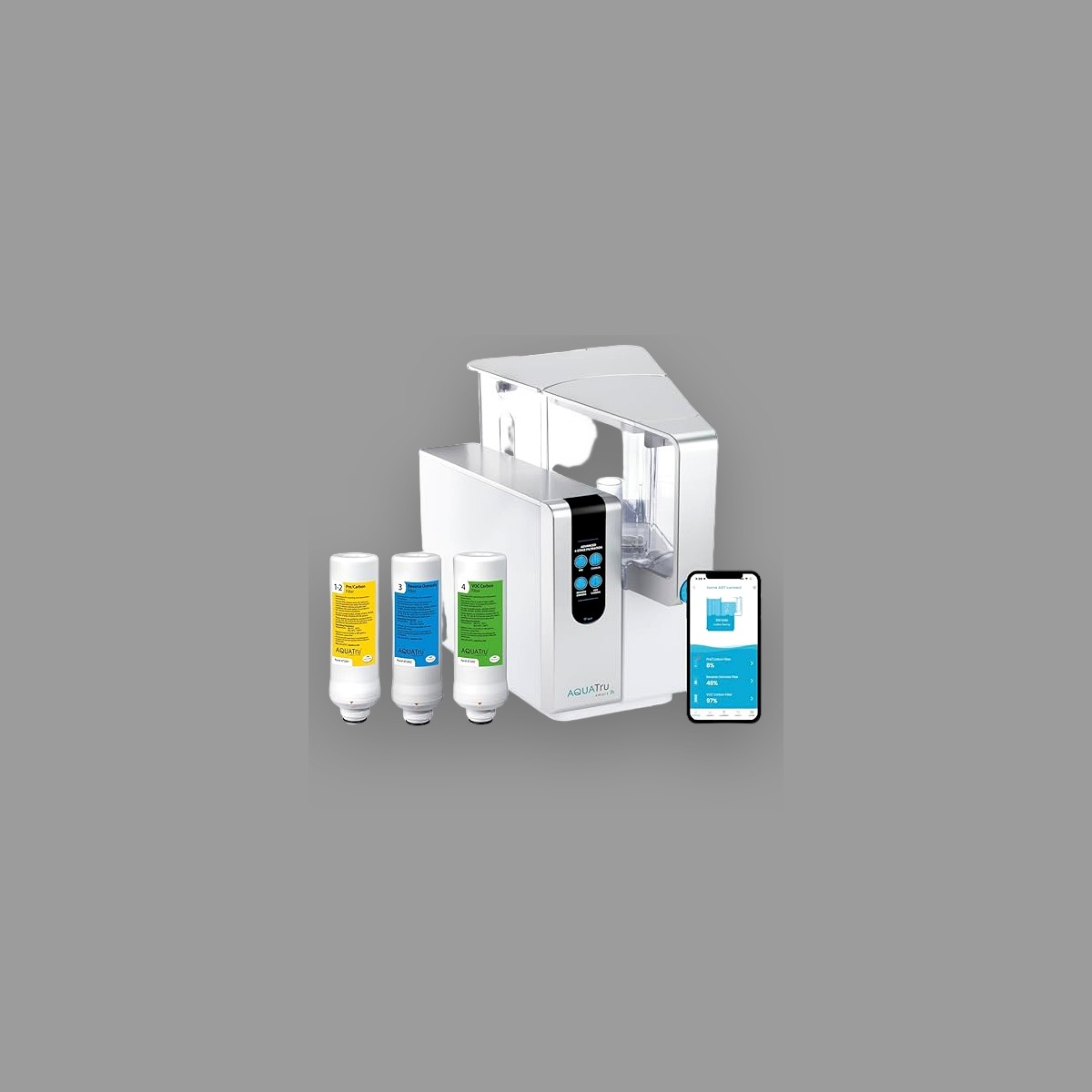
4. AquaTru Classic Smart Alkaline — Best Countertop RO for Renters (No Installation)
🛒 Buy this if:
- You rent and cannot modify your plumbing
- You want certified NSF/ANSI 58 lead removal without calling a plumber
- You need a filter you can take with you when you move
The AquaTru Classic is a countertop reverse osmosis system that requires zero plumbing installation. You fill the reservoir with tap water, it processes through a 4-stage filtration system (mechanical sediment pre-filter, pre-carbon block, RO membrane, post-carbon block with alkaline remineralisation), and dispenses clean water into the internal tank. NSF/ANSI 58 certified — meaning lead removal exceeds 95% under standardised testing.
Why it wins for renters: You cannot modify plumbing in a rental. This sits on your benchtop, plugs into a power socket, and works. When you move, it moves with you. No landlord approval, no plumber, no modifications to undo when your lease ends.
Specs that matter for lead:
- NSF/ANSI 58 certified RO membrane
- 4-stage filtration: sediment, pre-carbon, RO, post-carbon + alkaline
- Lead removal: >95% (NSF 58 tested)
- Also removes: fluoride (90–97%), chloramine, PFAS (NSF P473), arsenic, chromium-6
- Tank capacity: approximately 3L purified water
- Waste ratio: approximately 3:1 (3L wastewater per 1L purified — higher than under-sink units, but standard for countertop RO)
- Annual filter replacement cost: approximately $120–150 AUD
The honest limitation: The 3:1 waste-to-purified ratio is higher than under-sink RO systems (which typically achieve 2:1 or better). For a countertop unit with no drain connection, that is the engineering tradeoff. You are paying more in water cost per litre — but for renters, the portability justifies it.
For a deeper look at countertop options, see our full best countertop water filter Australia guide.
✓ Pros
- Zero installation — plug in and pour, no plumber required
- NSF/ANSI 58 certified for RO performance (lead, fluoride, PFAS)
- Alkaline remineralisation stage improves taste
- Compact countertop footprint — works in rentals
✗ Cons
- Takes up ~30cm of bench space
- Smaller tank capacity than under-sink systems
- Must manually fill reservoir (not plumbed in)
5-Year Cost Comparison: Lead-Removing Filters
Cost-per-litre is the number that actually matters. A $699 filter that costs $0.04/L is dramatically cheaper than $2/L bottled water — but how do the three RO systems compare against each other over five years? I calculated based on a 4L/day household (standard two-person daily drinking and cooking water), which equals 1,460 litres per year.
| Product | Upfront Price (AUD) | Annual Filter Cost | 5-Year Total | Cost per Litre |
|---|---|---|---|---|
| AquaTru Classic RO | ~$699 | ~$135 | ~$1,374 | $0.19 |
| EcoHero 5-Stage RO | ~$499 + $200 install | ~$90 | ~$1,149 | $0.16 |
| Waterdrop D6 RO | ~$799 + $200 install | ~$105 | ~$1,524 | $0.21 |
| Bottled water (comparison) | $0 | ~$2,920 | ~$14,600 | $2.00 |
The EcoHero wins on pure cost-per-litre because under-sink RO systems have lower waste ratios and cheaper replacement filters. The AquaTru costs slightly more per litre but requires zero installation — which is the deciding factor for every renter in Australia. The Waterdrop D6 carries a premium for its tankless design and compact footprint.
Every single option is 10-12x cheaper per litre than bottled water. That is the anchor. You are not spending $699 on a filter — you are saving $13,000+ over five years compared to buying water in plastic bottles. And unlike bottled water, you get certified lead, fluoride, and PFAS removal with every glass.
Decision Tree: Which Lead Filter Do You Need?
Three questions. That is all it takes.
1. Can you modify your plumbing?
- No (renter, heritage-listed property, no landlord approval) → AquaTru Classic countertop RO. Zero installation. Sits on your bench. Moves when you move.
- Yes → Proceed to question 2.
2. How much under-sink space do you have?
- Standard cabinet → EcoHero 5-Stage RO. Best cost-per-litre, WaterMark certified, proven technology.
- Very tight space (small apartment kitchens, limited cabinet depth) → Waterdrop D6 tankless RO. No tank means a dramatically smaller footprint.
3. Which city are you in?
This matters for your secondary filtration needs beyond lead:
- Brisbane, Sydney, Adelaide, Perth, Darwin (chloramine cities) → RO handles chloramine as well as lead. Standard carbon filters fail for chloramine, removing it at approximately 1/40th the rate of free chlorine. RO is the right answer for these cities regardless.
- Melbourne, Hobart, Canberra (free chlorine cities) → RO still removes lead, but if lead were your only concern, an NSF 53-certified carbon block could also work. However, RO additionally removes fluoride and PFAS — which carbon blocks cannot.
The practical answer for most Australians: if you are concerned enough about lead to be reading this article, get an RO system. It solves lead, fluoride, chloramine, PFAS, and heavy metals in one unit.
How to Test for Lead in Your Australian Home
Before spending $499-799 on a filter, you might want to confirm you actually have a lead problem. Here is the systematic approach.
Step 1: Check your home’s age. If your home was built after 1989, your plumbing should comply with AS/NZS 3500, which effectively eliminated lead solder and high-lead-content fittings. Post-1989 homes have a significantly lower lead risk — though some brass fittings still contain trace amounts.
Step 2: Run a first-draw test. Collect a water sample first thing in the morning, before running any taps. This “first draw” sample captures water that has sat in your pipes overnight — maximum contact time with any lead-bearing fittings. Fill a clean sample bottle from your kitchen cold tap.
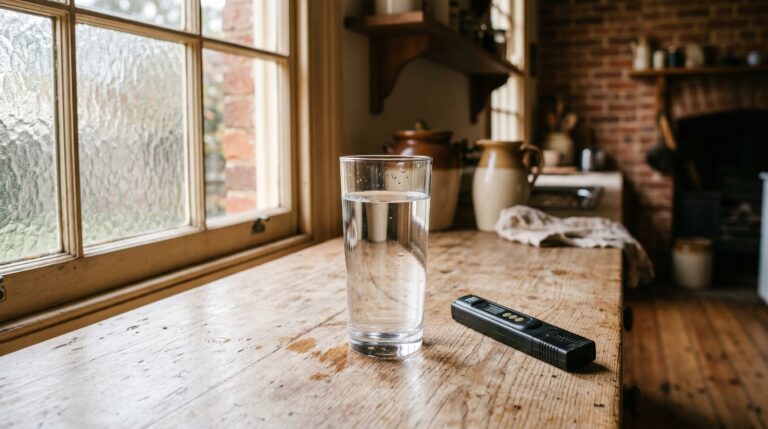
Step 3: Send it to a NATA-accredited lab. Do not use DIY test strips for lead — they lack the sensitivity to measure at the ADWG limit of 0.01 mg/L. A NATA-accredited laboratory analysis costs $30-80 and measures dissolved metals to parts-per-billion accuracy. Search for “water testing NATA accredited” in your state. Major labs include ALS Environmental, Eurofins, and SGS.
Step 4: Interpret results against the ADWG. If your result is below 0.01 mg/L, your plumbing is not contributing significant lead. If it is at or above 0.01 mg/L, a point-of-use RO filter at your kitchen tap is the fastest, most effective remediation available — far cheaper and faster than replumbing your entire house.
The flushing workaround (free, but imperfect): Running your kitchen tap for 30-60 seconds before collecting drinking water flushes out water that has been sitting in contact with fittings. This reduces lead concentration significantly but does not eliminate it. For homes with confirmed lead above the ADWG limit, flushing is a stopgap — not a solution.
Why Standard Jug Filters and Benchtop Carbon Units Fail for Lead
This is the mistake most Australians make. You buy a Brita jug or a basic benchtop carbon unit, and you assume it is filtering “everything.” It is not.
Standard jug filters use granular activated carbon (GAC). GAC is excellent for reducing free chlorine taste and odour — which is why it makes Melbourne tap water taste better. But dissolved lead exists as ions in solution, not as particles. GAC does not have the pore structure or adsorption chemistry to capture dissolved lead ions at meaningful rates.
Compressed carbon blocks (not granular) can achieve lead reduction, but only when the block is engineered and certified specifically for lead under NSF/ANSI Standard 53. The compression density, pore size distribution, and media formulation matter. A carbon block certified for “chlorine taste and odour” (NSF 42) is not the same product as one certified for “lead reduction” (NSF 53). The packaging might look similar. The performance is not.
Here is a practical comparison:
| Filter Type | Lead Removal | Chloramine Removal | Fluoride Removal | What This Means for You |
|---|---|---|---|---|
| RO (NSF 58) | >95% | Yes | 90-97% | Comprehensive protection from all dissolved contaminants |
| NSF 53 Carbon Block | Yes (certified) | Catalytic only | No | Lead yes, but no fluoride. Check chloramine compatibility for your city. |
| Standard GAC (jug/basic benchtop) | No | Minimal (1/40th rate) | No | Taste improvement only. No meaningful contaminant removal. |
| KDF-55 | Variable | No | No | Unreliable for lead. Not a primary barrier. |
| Sediment filter | No | No | No | Particulates only. Dissolved metals pass through completely. |
The visual pattern is clear. RO is the only technology that handles lead, chloramine, and fluoride in a single unit. If lead is your concern and you live in a chloramine city — Brisbane, Sydney, Adelaide, Perth, or Darwin — RO is not optional. It is the only answer.
Renters vs Homeowners: The Practical Reality
The housing situation determines your filter choice more than any other factor. In Australia, approximately 31% of households rent, according to ABS 2021 Census data. That is millions of people who cannot drill a hole in their benchtop or modify plumbing without landlord consent.
If you rent: Your option is the AquaTru Classic countertop RO. It plugs into a standard power outlet, sits on your kitchen bench, and requires zero plumbing. When your lease ends, you unplug it and take it with you. No bond deductions, no plumber, no arguments with property managers.
The AquaTru’s 3:1 waste ratio means you will need to empty the wastewater reservoir periodically (or pour it on your garden — it is just concentrated tap water, perfectly fine for plants). This is the minor inconvenience you trade for complete portability.
At $699 upfront and ~$135/year in filters, it costs more per litre than under-sink options. But compare that to doing nothing. Every day you drink unfiltered water from pre-1989 plumbing, you are consuming whatever your fittings are leaching. The AquaTru costs $1.91 per day averaged over five years. That is less than a takeaway coffee.
If you own your home: The EcoHero 5-Stage RO with WaterMark AS3497 certification is the better long-term investment. Lower waste ratio (2:1), cheaper annual filter cost (~$90), and once installed you never think about it — filtered water flows from a dedicated faucet every time you turn it on.
Installation by a licensed plumber runs $150-250 in most Australian metro areas. The total first-year cost including install is ~$700-750. Over five years, you save approximately $225 compared to the AquaTru — and get a more efficient system with on-demand filtered water.
For both situations: The filter goes at the kitchen tap — the point of use where you drink and cook. You do not need a whole-house system for lead. Lead contamination occurs in the last few metres of plumbing inside your home. A point-of-use RO filter at your kitchen tap intercepts the lead where it enters the water you actually consume.
Lead Risk by Australian City: What You Need to Know
Your city determines two things: the age of your suburb’s plumbing infrastructure and the water chemistry that affects lead leaching rates.
Brisbane / South-East Queensland: SEQ Water uses chloramine disinfection. Water hardness ~80-120 mg/L CaCO₃ (moderate). Older suburbs like Paddington, Woolloongabba, and New Farm have pre-war housing stock with higher probability of legacy lead fittings. RO is essential in Brisbane regardless of lead concern — it is the only reliable method for both chloramine and lead.
Sydney: Sydney Water uses chloramine. Moderate hardness. Inner-west suburbs (Glebe, Newtown, Balmain) and eastern suburbs terraces often predate the 1989 plumbing code. Western Sydney suburbs like Penrith and Parramatta have a mix. Get a lab test if your home is pre-1989.
Melbourne: Melbourne Water uses free chlorine (standard carbon works for taste). However, Melbourne’s extremely soft water (~25 mg/L CaCO₃, TDS ~60) is more aggressive in leaching metals from fittings than harder water. If you live in an older Melbourne suburb — Fitzroy, Carlton, Collingwood, Richmond — the combination of soft water and old plumbing fittings creates a higher lead leaching risk than the same fittings would produce in harder-water cities.
Adelaide: SA Water uses chloramine. Hard water (~140 mg/L CaCO₃, TDS ~400). The mineral content provides some protective scale on pipe interiors, reducing leaching rates. But older Adelaide homes (Norwood, Unley, Prospect) still warrant testing.
Perth: Water Corporation uses chloramine. Hard water (~180 mg/L CaCO₃, TDS ~170). Similar scale protection as Adelaide. Older suburbs around Fremantle and East Perth carry higher risk.
Darwin, Hobart, Canberra: Smaller cities with mixed housing ages. Darwin uses chloramine; Hobart and Canberra use free chlorine. Same rule applies: if your home is pre-1989, test your water.
Final Verdict
Lead in Australian tap water is a household plumbing problem, not a water supply problem. According to the NHMRC, lead pipes are rare in Australian infrastructure — the risk sits inside your walls, in old fittings and solder joints. Without mandatory tap testing in Australia, the only way to know your exposure is a NATA-accredited lab test ($30-80).
If you test positive, or if you live in a pre-1989 home and want precautionary protection, reverse osmosis is the definitive solution. It removes over 95% of dissolved lead, along with fluoride, chloramine, PFAS, and other heavy metals.
For renters: The AquaTru Classic countertop RO at $699 is the answer. No install, no landlord approval, moves with you. At $0.19/L over five years, it costs less than a daily coffee.
For homeowners: The EcoHero 5-Stage under-sink RO at $499 + installation is the better long-term investment. Lower ongoing cost at $0.16/L, WaterMark AS3497 certified, dedicated faucet.
Avoid: Standard jug filters (Brita Basic), basic GAC benchtop units, and any filter not specifically NSF 53 or NSF 58 certified for lead. These do not remove dissolved lead.
The worst outcome is you buy an RO filter and your water turns out to have been fine. The more likely outcome — if your home has pre-1989 plumbing — is that you stop drinking water with measurable lead in it. For $0.16-0.19 per litre, that is a decision that requires no overthinking.
Last reviewed: June 2026 — Clean and Native
Frequently Asked Questions
Lead is not added during water treatment and is rarely present in Australian water supply infrastructure, according to the NHMRC. However, lead can leach into tap water from old household plumbing — specifically pre-1989 brass fittings, lead-based solder on copper joints, and lead-lined tanks in heritage properties.
The Australian Drinking Water Guidelines set the maximum acceptable concentration for lead at 0.01 mg/L (10 micrograms per litre). This aligns with the World Health Organization guideline value.
Standard Brita jug filters use granular activated carbon (GAC), which is not certified or effective for dissolved lead removal. Only RO systems (NSF 58) or carbon block filters specifically certified under NSF/ANSI Standard 53 for lead are verified to remove it.
Collect a first-draw sample (first thing in the morning before running any taps) and send it to a NATA-accredited laboratory such as ALS Environmental, Eurofins, or SGS. Cost is $30-80. Do not rely on DIY test strips, which lack the sensitivity to detect lead at the ADWG limit of 0.01 mg/L.
Yes. The AquaTru Classic is a countertop reverse osmosis system that requires no plumbing modification. It sits on your bench, plugs into a power socket, and removes over 95% of dissolved lead. When your lease ends, you unplug it and take it with you.
No. Boiling water actually concentrates dissolved lead by evaporating pure water and leaving the lead behind. Never boil water as a treatment for lead contamination.
Flushing the cold tap for 30-60 seconds before collecting drinking water reduces lead concentration by displacing water that has been sitting in contact with fittings. It helps but does not eliminate the risk. A point-of-use RO filter provides consistent, verified removal without relying on flushing discipline.
Melbourne’s very soft water (~25 mg/L CaCO₃) is more chemically aggressive toward metal fittings than Brisbane’s moderately hard water (~80-120 mg/L CaCO₃). Softer water dissolves metals more readily because it lacks the mineral content that forms a protective scale inside pipes. If your Melbourne home has pre-1989 plumbing, the leaching risk is higher than equivalent fittings in harder-water cities.
Get the Australian Home Environment Checklist
30 checks across water, air and EMF. Most of them free. Ranked by impact.
No spam. Unsubscribe any time.

Former Royal Australian Navy Clearance Diver and TAG-E counter-terrorism operator. Founded Clean and Native to apply the same rigorous thinking to the home environment.
Full biography →