
Best Earthing Grounding Band Australia 2026: Wristbands, Ankle Straps, and When to Use Them
Quick Verdict
The Best Earthing Bands Keep You Grounded at Your Desk or in Bed
Wrist and ankle earthing bands work reliably when in direct skin contact with a grounded outlet. Premium Grounding and Earthing Oz are the top AU-stocked options in 2026.
An earthing grounding band is a conductive wristband or ankle strap worn against the skin and connected via a grounding cord to the earth pin of a standard power outlet — allowing electrons from the earth to flow directly into the body. Whether that contact produces measurable physiological effects depends heavily on one factor: whether the band actually maintains skin contact and whether your cord bypasses live current.
I am a former Royal Australian Navy Clearance Diver. I approach this topic the same way I approach any equipment selection: does the mechanism make physical sense, does the product deliver on that mechanism reliably, and what do the numbers show. Here is what I found.
How Earthing Bands Work
The earth beneath you maintains a mildly negative electrical potential. When you stand barefoot on soil or grass, free electrons flow from the earth into your body through direct conductive contact. That is the physical mechanism — documented in published biophysics literature, including a 2015 review in the Journal of Inflammation Research (Oschman, Chevalier, Brown) which measured body voltage reduction in grounded versus ungrounded subjects.
An earthing band replicates that connection indoors. The band itself is conductive — typically a carbon-impregnated rubber or stainless steel weave — and sits directly against your skin at the wrist or ankle. A snap-on cord connects the band to the earth pin of a standard Australian power outlet (the top pin on an AS/NZS 3112 socket). A 100k ohm inline resistor sits inside the cord. That resistor is not optional safety theatre — it limits current flow to microamps in the event of a fault, so a broken appliance on the same circuit cannot push mains voltage through the cord.
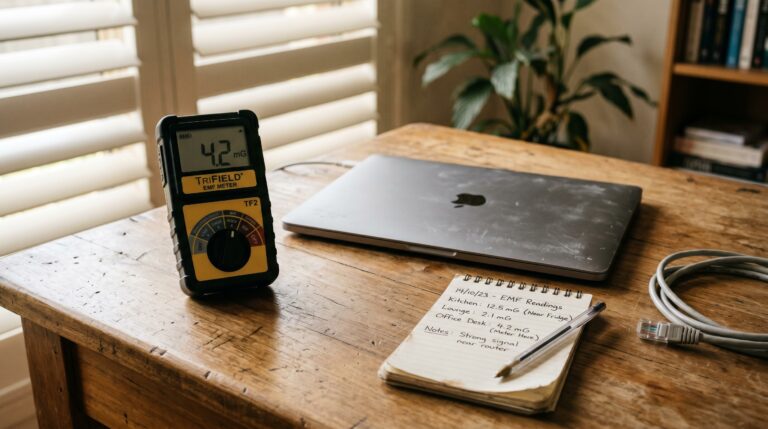
The grounding itself is measurable. With a basic digital multimeter set to AC millivolts, you can measure body voltage: ungrounded in a typical Australian home near wi-fi and power circuits, readings of 500mV to 2,000mV AC are common. Connect the band to ground — and if the connection is good skin-to-conductive-surface contact — that reading drops to 10-50mV in most homes. That is a real, verifiable change. It does not require any biological claim to confirm: the physics is simple Faraday shielding via earth connection.
What happens inside the body after that voltage drop is where the research is still thin. Studies are small and often industry-adjacent. I am not going to present inflammation reduction or cortisol normalisation as settled science. What I will say is: the earth connection itself is physically real, measurable, and the mechanism is sound.
Safety: The One Thing That Matters Before You Buy
Every earthing product sold in Australia should ship with a purpose-built grounding cord that includes a 100k ohm resistor. This is non-negotiable. A bare wire run from wristband to earth pin is a fault-current path. The resistor drops any potential fault current to below 1mA — physiologically imperceptible and not a shock hazard.

Check this before you plug anything in. The easiest way: measure the resistance across the cord with a multimeter. It should read approximately 100,000 ohms (100kΩ). If a cord reads near zero, return it. Better Earthing, Earthing Oz, and Premium Grounding all include compliant cords with their bands and mats. Generic aliexpress bands frequently do not.
The Australian power socket (AS/NZS 3112) places the earth pin at the top of the angled socket configuration. A dedicated earthing cord adapter plugs into only that pin — it cannot be inserted incorrectly into the live or neutral pins because the geometry does not match. Still, use only cords from reputable earthing suppliers, not improvised solutions.
Best Earthing Band — Earthing Oz Wristband

✓ Pros
- Direct skin contact — most reliable body-voltage reduction method
- Portable and travel-friendly — any earthed outlet in Australia or abroad
- Ships with compliant Australian grounding cord (100k ohm resistor included)
- Lower upfront cost than mats or sheets ($60-$80 range)
✗ Cons
- Single contact point — lower surface area than mat or sheet
- Not practical during sleep (cord can tangle or detach)
- Conductive band requires clean, dry skin for consistent conductivity
The Earthing Oz wristband is the most simple grounding option for desk workers and people who want earthing contact during specific activity windows — reading, working at a computer, watching television. The form factor is simple: a conductive band with an adjustable strap that snaps onto a 2.7-metre grounding cord. You plug the cord into the earth pin of any Australian power outlet and you are grounded within seconds of putting it on.
Conductivity and skin contact
The band material needs to maintain contact with bare skin — not over a shirtsleeve or through a jumper. The wrist is a good location because the inner wrist has thinner skin and higher moisture, which reduces electrical resistance. Ankle bands work equally well and are less obtrusive during seated work. Either location should produce the same body voltage result if contact is maintained.
The cord matters as much as the band
Earthing Oz ships a dedicated grounding cord with the wristband. This cord matters more than the band itself. It includes the 100k ohm safety resistor, uses a standard 3.5mm snap connector at the band end, and terminates in an Australian earth-pin adapter. Do not substitute a generic cord. If you travel internationally, you will need an adapter that exposes the earth pin of the local socket — not just a voltage converter.
Measuring the result
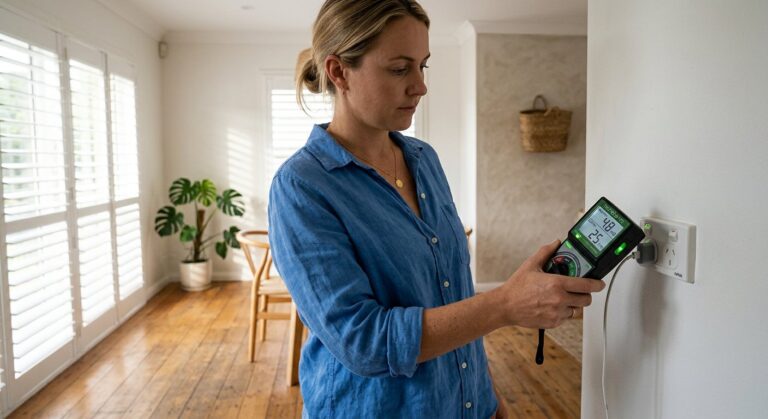
Put on the band, plug in the cord, then hold one probe of a digital multimeter (set to AC mV) in the opposite hand and place the other probe against the earth of the outlet. Your reading should drop from whatever your ambient body voltage is — typically 500-2,000 mV in most Australian bedrooms and home offices near active wiring — down to under 100 mV, often under 50 mV with good contact. If the reading does not drop, check band-to-skin contact first, then check whether the outlet itself is earthed (some older Australian homes have unearthed circuits — a socket tester, under $15 at Bunnings, will confirm this).
Who the band suits
The band suits desk workers who want consistent grounding contact during work hours without covering a large mat surface. It suits travellers because it packs to nothing. It suits children for supervised grounding sessions where a mat might be kicked off. It does not suit anyone who wants passive, set-and-forget grounding during sleep — the cord creates an entanglement risk and the single-point contact means a shift in sleeping position breaks the circuit. For sleep, see the mat and sheet alternatives below.
Earthing & Grounding Products — Australia
See our full earthing guide for Australia →Best Alternative — Premium Grounding Mat (Stainless Steel)

✓ Pros
- Large contact surface — bare feet, forearms, and wrists simultaneously
- Stainless steel surface is durable and easy to clean
- No band required — passive contact while seated at desk or on floor
- Works as both desk mat and floor mat
✗ Cons
- Higher upfront cost than a wristband
- Not portable for travel
- Contact breaks if you shift position away from the mat surface
Where a band restricts grounding to a single point, the Premium Grounding Mat covers a 600mm x 300mm (approximate) surface area of stainless steel mesh. Sit at your desk with bare feet resting on the mat, or rest your forearms on it while typing, and you are earthed across multiple contact points simultaneously. More contact area does not dramatically change the body voltage reading — you are still grounded or not grounded — but it reduces the likelihood of losing contact when you shift position.
Stainless steel surface
The stainless steel construction is a genuine advantage over carbon-rubber mat alternatives. It does not degrade, does not absorb sweat, and can be wiped with a damp cloth. Carbon-rubber mats are cheaper but develop resistance over time as the surface oxidises or builds up skin-oil contamination. A stainless steel surface maintains consistent surface resistance across its life.
Use case: desk setup
The most practical deployment for the Premium Grounding Mat is under a desk, flat on the floor, with your bare feet resting on it while you work. You get continuous grounding throughout the workday without wearing anything or thinking about it. The cord runs from the mat to the earth pin of a nearby power outlet — same mechanism as the band, same safety requirements.
Use case: beside-bed floor mat
A mat placed beside the bed, on the floor where your feet land when you get up, is a low-friction way to add morning grounding without modifying your sleep environment. It is not equivalent to sleeping grounded all night, but it is practical for people who are not ready to commit to a fitted sheet.
Band vs Mat vs Sheet — Which Format Suits Your Situation
There are three practical earthing formats available to Australian consumers. They are not interchangeable — each suits a specific use pattern. Here is the plain breakdown.
| Format | Contact Area | Best Use | Not Suited For | Approx. Cost (AUD) |
|---|---|---|---|---|
| Wristband / Ankle Band | ~5-10 cm² | Desk work, travel, children, seated activity | Sleep, movement-heavy tasks | $60-$80 |
| Mat (desk or floor) | ~600-1,800 cm² | Desk setup, floor use, no-wear grounding | Travel, whole-body sleep contact | $80-$180 |
| Fitted Sheet | Full body surface | Sleep grounding, whole-body contact overnight | Portability, desk use | $120-$250+ |
When to choose a band
Choose a band when you want grounding during specific activity windows — desk work, reading, watching television — and you want a portable option that travels with you. A band is also the right choice for children who will not sit still on a mat, or for rental properties where you cannot modify anything. The cord plugs into any earthed Australian outlet and unplugs again in seconds.
When to choose a mat
Choose a mat when you want passive, continuous grounding during seated work without wearing anything. The mat requires nothing from you once placed — your bare feet or forearms provide the contact automatically. If your goal is reducing body voltage during work hours, the mat is the most reliable format because contact cannot be accidentally broken by a wrist movement the way a band can.
When to choose a sheet
Sleep is where you spend 7-8 consecutive hours in a fixed position — the most logical window for consistent grounding contact. A fitted conductive sheet (like the Earthing Oz sheet or the Premium Grounding Sheet) provides full-body contact throughout the night. The tradeoff is cost and the cord running from the bed to the wall. If you share a bed, both partners are simultaneously grounded. This is the highest-contact, highest-duration format available.
Stacking formats
Some people use a band at the desk during the day and a sheet at night. There is no harm in that combination, but do not assume layering formats multiplies efficacy — you are either earthed or you are not. One properly functioning connection is equivalent to two simultaneous ones for the purpose of body voltage reduction.
5-Year Cost Comparison
| Product | Upfront Cost | Replacement Parts | 5-Year Total | Notes |
|---|---|---|---|---|
| Earthing Oz Wristband | ~$60-$80 | Replacement cord ~$15-$20 if worn | ~$80-$100 | Band itself typically lasts 2-3+ years with daily use |
| Premium Grounding Mat | ~$80-$180 | Minimal — stainless steel does not degrade | ~$80-$180 | Cord replacement only if damaged |
| Earthing Oz Sheet (fitted) | ~$120-$250 | Sheet replacement ~$120-$250 after 2-4 years | ~$240-$500 | Silver thread degrades with washing; hand wash extends life |
| Better Earthing (mat range) | $119-$579 | Varies by product | $150-$650+ | Premium pricing; “longest warranty” claim — no independent verification |
The band is the lowest-cost entry point for earthing, and for most people starting out it is the right place to begin. If you find you actually use it consistently — which the body voltage test will tell you within the first week — then upgrading to a sheet for sleep is the logical next step. The mat sits in the middle: more contact than a band, less commitment than a sheet.
One cost no one discusses: replacement cords. Grounding cords have a 3.5mm snap connector that gets pulled at from an angle repeatedly. Budget for one cord replacement over a five-year period, particularly for bands used daily at a desk.
What the Research Actually Says (and What It Does Not)
There is peer-reviewed research on earthing — and there is a lot of wellness marketing that overstates it. These are different things. Here is where the evidence actually sits as of 2026.
The 2015 Oschman, Chevalier, and Brown review in the Journal of Inflammation Research aggregated multiple smaller studies and proposed mechanisms for how electron transfer from the earth might modulate inflammatory pathways. A 2012 study by Chevalier published in the same journal measured cortisol diurnal patterns in grounded versus ungrounded sleepers (n=12) and found alignment of cortisol curves with normal diurnal secretion in the grounded group. Sample sizes are small. Most studies are from a small cluster of researchers. These are honest caveats.
What the research does support, reliably: that grounding reduces AC body voltage. That is not a wellness claim — it is basic physics. The biological consequences of that voltage reduction over years of daily exposure are what remains incompletely characterised.
No Australian health authority (TGA, NHMRC) has approved therapeutic claims for earthing products. These are sold as wellness accessories, not medical devices. Do not buy an earthing band expecting it to treat a diagnosed condition. Buy it if you want to reduce your body’s ambient AC voltage exposure and you find the mechanism compelling.
How to Verify Your Band Is Actually Working
You do not have to take anything on faith here. A $20 digital multimeter from Bunnings gives you a direct measurement. Here is the exact procedure.
Set the multimeter to AC millivolts (ACV, 200mV or 2,000mV range). Place one probe against the earth pin of a power outlet — or clip it to any known earth point. Hold the other probe in your hand or press it against your wrist, on bare skin. Read the number. That is your body voltage.
Now put on the grounding band, clip on the cord, plug into the earth-pin adapter. Wait 15 seconds. Take the same reading. The number should drop substantially — from hundreds of millivolts to tens of millivolts in most Australian homes.
If the reading does not drop:
- Check that the band is in direct contact with skin, not over clothing
- Check that the outlet is earthed — use a Bunnings socket tester (~$13) to confirm
- Measure the cord with the multimeter on resistance mode — should read ~100k ohms, not open circuit
- In older Australian homes (pre-1970s), some circuits are two-wire with no earth — a socket tester will show this immediately
This test takes four minutes. Every person who buys an earthing product should do it before assuming the band is doing anything at all.
Final Verdict
For most Australians starting with earthing, the Earthing Oz wristband is the right first purchase. It costs under $80, ships with a compliant Australian grounding cord, delivers measurable body voltage reduction you can confirm with a multimeter, and works from any earthed outlet in the country. Start there.
If you prefer passive, no-wear grounding at a desk — or if a band feels restrictive during work — the Premium Grounding Mat is the better format. Stainless steel construction means it will last the life of your desk setup without degrading. Both products use the same earth-connection mechanism; the difference is contact area and convenience, not efficacy.
For overnight whole-body grounding, step up to a fitted conductive sheet. The Earthing Oz sheet range covers single through to king sizes and is the logical upgrade after you have confirmed you use a band or mat consistently.
One point I will make plainly: do not pay $1,169+ for “quantum earthing” products (Barefoot Healing’s premium tier). The mechanism of earthing is direct electron conduction through a grounded conductor — it does not change at luxury price points. The physics does not care about the brand name on the cord.
Last reviewed: June 2026 — Clean and Native
Frequently Asked Questions
Yes — in the measurable, physical sense. A properly worn grounding band connected to an earthed outlet reduces body AC voltage from the 500-2,000 mV range to under 100 mV in most Australian homes. You can verify this yourself with a $20 digital multimeter. Whether that voltage reduction produces specific health outcomes is supported by small-sample studies but not yet by large-scale randomised controlled trials.
Yes. The band must make direct contact with bare skin to conduct electrons. Wearing it over a sleeve or sock breaks the electrical circuit. The inner wrist and ankle are the preferred contact points — both have thinner skin and higher moisture content, which reduces contact resistance and improves conductivity.
Technically yes, but it is not the recommended format for sleep. A band with a cord attached creates a tangle risk and the connection is easily broken by movement during sleep. For overnight grounding, a fitted conductive sheet is the better format — it maintains contact across your whole body surface regardless of sleeping position.
Yes, provided the cord includes a 100k ohm inline safety resistor. All reputable Australian earthing suppliers (Earthing Oz, Premium Grounding, Better Earthing) include this resistor in their cords. It limits any fault current to under 1 mA — not physiologically perceptible. You can verify it with a multimeter on resistance mode: the cord should read approximately 100,000 ohms across its length. Do not use a bare wire or generic cord without a resistor.
Many pre-1970s Australian homes have two-wire circuits with no earth conductor. A socket tester from Bunnings (~$13) will confirm whether your outlets are earthed. If they are not, grounding cords connecting to the outlet will not work — you would need either an outdoor earth stake (a copper rod driven into the soil) with a direct connection, or an electrician to add earthing to the circuit.
No minimum duration is established by research. Most earthing studies used sessions of 30 minutes to overnight. The practical answer is: use it during whatever activity you are already doing at a desk or at rest. Consistency matters more than duration. Daily use of 30-60 minutes is a reasonable starting point.
Electrically, there is no difference — both connect the same way to a grounding cord and produce the same body voltage reduction. The choice is comfort and practicality. Wristbands are more visible and can interfere with typing. Ankle straps are less obtrusive during desk work. Either works; choose based on where you want the contact point during your typical activity.
Yes. Children’s skin resistance is lower than adults’, which typically produces effective grounding contact more easily. Use a correctly sized band with proper skin contact, use the standard compliant cord with 100k ohm resistor, and supervise use to prevent cord pull. The band and cord combination poses no electrical hazard when the safety resistor is present.
For desk use, a grounding mat is more reliable — it provides continuous contact across a larger surface area without requiring you to wear anything, and contact is not broken by wrist or hand movements. A wristband wins on portability and cost. For the same earthed-outlet grounding mechanism, both produce equivalent body voltage reduction when contact is maintained.
Best Earthing Products Australia 2026: Mats, Sheets, Pillowcases & Bands
Compare every earthing product category tested in Australia →Get the Australian Home Environment Checklist
30 checks across water, air and EMF. Most of them free. Ranked by impact.
No spam. Unsubscribe any time.

Former Royal Australian Navy Clearance Diver and TAG-E counter-terrorism operator. Founded Clean and Native to apply the same rigorous thinking to the home environment.
Full biography →