Best Grounding Mat Australia 2026: Stainless Steel, Compared, and Honestly Reviewed
Drafted with AI assistance and checked against published specifications and certifications. First-hand measurements appear only where stated. How we make content
The best grounding mat in Australia is the Premium Grounding Mat (stainless steel threads, $129 AUD, conductive from first contact) for most users — whether you’re sitting at a desk, working barefoot on the floor, or placing it under your feet during sleep. The single most important spec for a grounding mat is what the conductive layer is made of: stainless steel threads last decades; silver threads corrode within months if washed incorrectly.
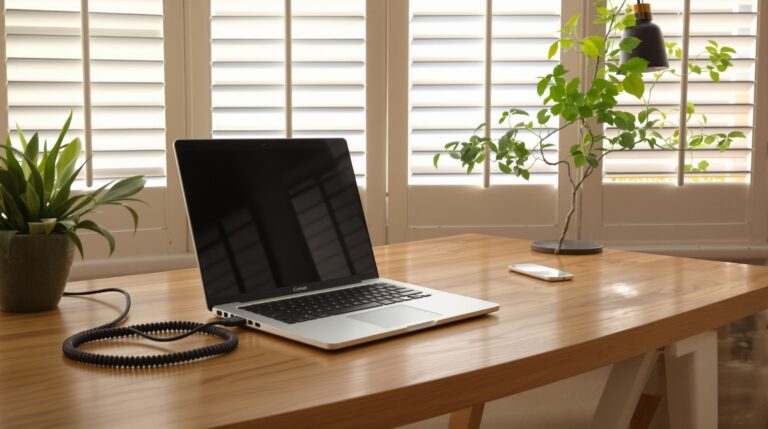
Grounding mats differ from grounding sheets. Sheets go on the bed and ground you during sleep. Mats sit under your feet at a desk, on the floor while you sit or stretch, or on a couch armrest — connecting you to the earth’s electron field during waking hours. If you spend 8 hours a day at a desk and want to add grounding without changing your sleep setup, a mat is the correct product.
Quick Verdict — Best Grounding Mats Australia 2026
Three options from Premium Grounding — the only Australian-stocked brand with stainless steel conductive threads across their mat range. Choose by use case, not by price.
| Product | Best For | Price (AUD) |
|---|---|---|
| Premium Grounding Mat | Desk, floor, bedside — most users | ~$129 |
| Multi-Purpose Grounding Pad | Desk pad, yoga mat, couch use | ~$159 |
| Grounding Mouse Pad | Desk-only, wrist + forearm contact | ~$79 |
✓ Who This Is For
- Desk workers spending 6+ hours seated — feet on mat while working
- Anyone who has already set up a grounding sheet and wants daytime coverage too
- People in apartments or homes without garden access where barefoot grounding is impractical
- Those experimenting with earthing for sleep, inflammation, or stress — want a lower-cost entry point than sheets
- Meditators and yoga practitioners wanting ground contact during floor practice
✕ Who It Is Not For
- Anyone expecting a certified medical device — grounding mats are wellness products, not TGA-regulated therapeutic goods
- Buyers wanting grounding during sleep — for that, a grounding sheet is the correct product
- Anyone in a property where the electrical earth is not functional or tested — verify your outlet earth before using any grounding product (use a socket tester, ~$29)
What Is an Earthing Mat and How Does It Work?
The earth’s surface carries a mild negative electrical charge — a continuous supply of free electrons generated by lightning strikes, solar radiation, and the earth’s own electromagnetic activity. Research published in the Journal of Environmental and Public Health (Chevalier et al., 2012) proposes that direct physical contact between the human body and the earth’s surface allows these electrons to transfer into the body, where they act as antioxidants by neutralising positively charged free radicals. The mechanism is the same whether you are barefoot on grass, on wet sand at a beach, or connected via a conductive mat to the earth pin of a standard wall outlet.
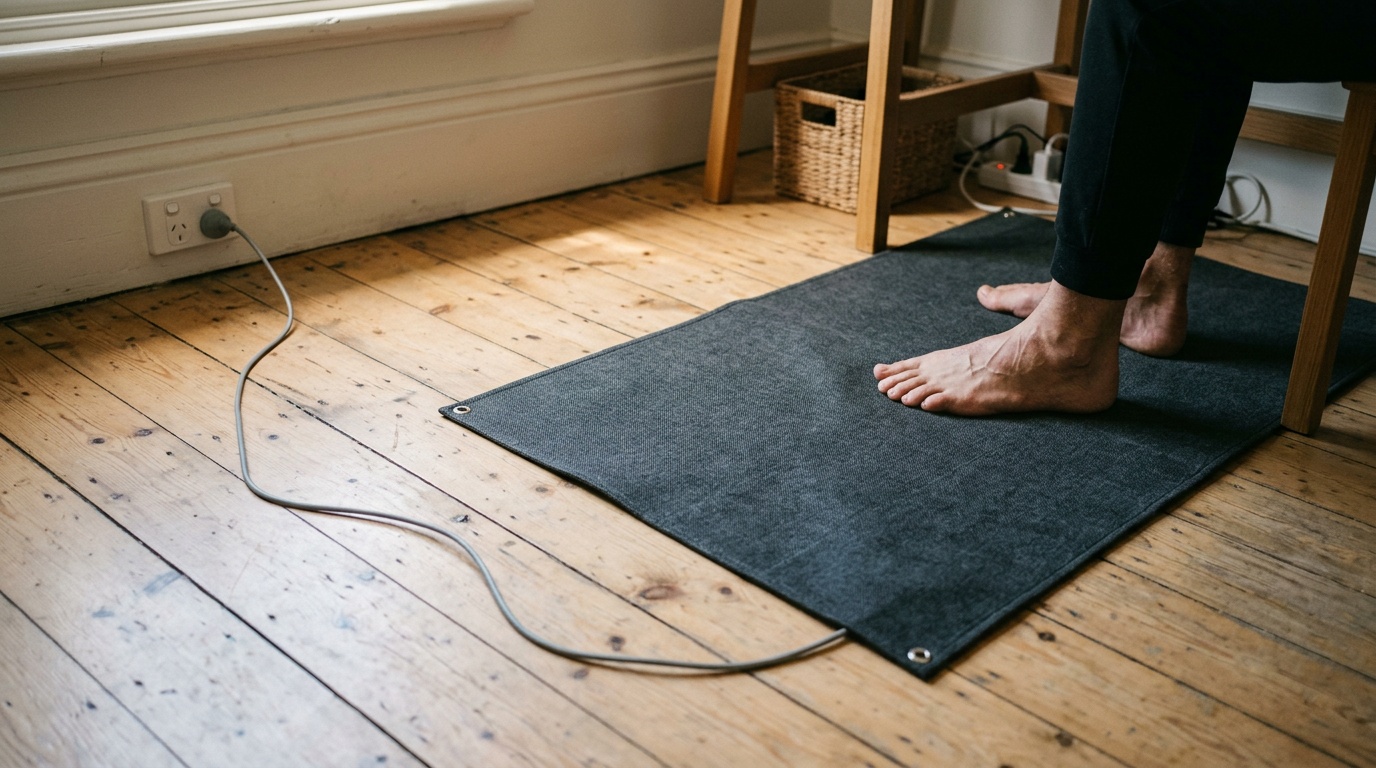
A grounding mat replicates this connection indoors. The mat contains a conductive layer — typically stainless steel mesh threads woven through a fabric or embedded in a PVC/carbon pad — connected by a cord to the earth pin (the third prong) of a standard Australian power outlet. The cord connects only to earth: it carries no current, no voltage, and is protected by a built-in 100k-ohm resistor that limits any possible current to below 0.01 mA — well beneath any physiological threshold. You are not plugging yourself into mains electricity. You are connecting to the earth terminal of your building’s wiring system, which is physically earthed to a ground rod outside your home.
The early research on this is genuine but preliminary. A 2004 study by Ghaly and Teplitz in the Journal of Alternative and Complementary Medicine measured cortisol diurnal rhythms in 12 subjects sleeping grounded versus ungrounded over 8 weeks and found normalisation of cortisol patterns and reported improvements in sleep and pain. A 2015 open-access study in the Journal of Inflammation Research (Oschman et al.) reviewed the mechanisms and proposed anti-inflammatory effects via free electron transfer. These are not large randomised controlled trials — they are preliminary, small-n studies. That honesty matters: grounding is not an established medical treatment, and any seller claiming it “treats” specific conditions is making claims the evidence does not support. What the evidence does suggest is that regular earth contact via skin — whether barefoot or through a conductive mat — has measurable physiological correlates that warrant further study.
Grounding Mat vs Grounding Sheet — Which One Do You Need?
Both achieve the same fundamental thing — continuous earth contact — but for different contexts and body coverage. Understanding the difference determines which product you need.
Grounding sheets cover the bed and connect you to earth throughout sleep. They maximise contact area (your whole body) and duration (6 to 9 hours uninterrupted). They are the highest-impact grounding product because sleep is when the body does most of its physiological repair, and duration of earth contact appears to be the primary driver of the observed effects in the research. If you can only buy one grounding product, a grounding sheet is typically the correct choice for sleep-quality or recovery goals.
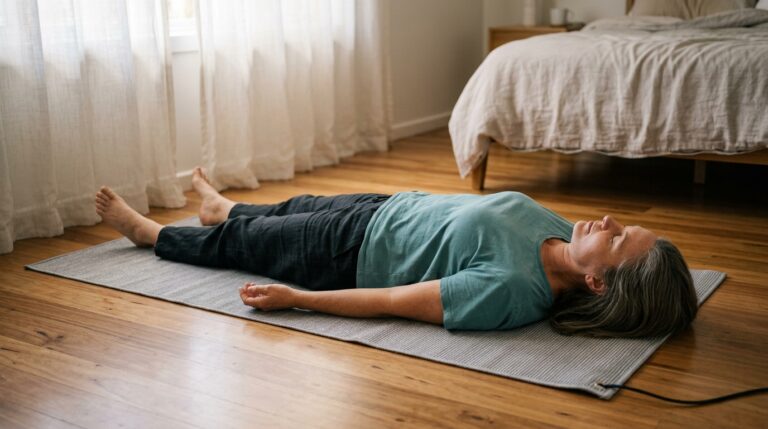
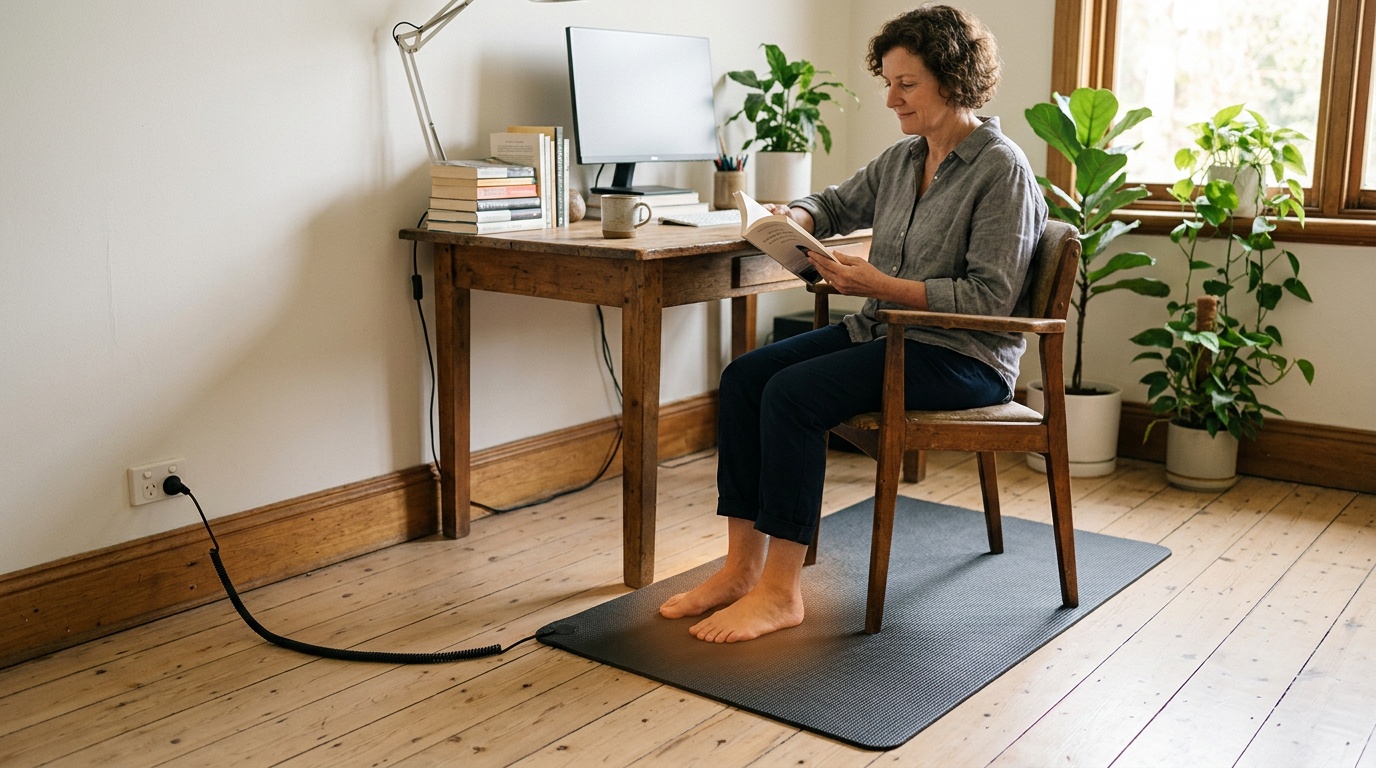
Grounding mats are designed for active waking hours. Placed under your feet at a standing or sitting desk, on the floor during yoga or meditation, or on a couch armrest, they deliver earth contact during periods when a sheet is not in use. They are more practical for people who work from home and spend extended periods at a desk, and they serve as a lower-cost entry point for people new to earthing who want to test it before committing to a sheet. The contact area is smaller (feet or forearms rather than the whole body), but the principles are the same.
The sensible sequence: start with a mat at your desk. If you notice a difference after 2 to 4 weeks, add a sheet for sleep. If you notice nothing, you have spent $79 to $129 rather than $249 to $329 to reach that conclusion.
What to Look for When Buying a Grounding Mat in Australia
Conductive Material: Stainless Steel vs Silver vs Carbon
This is the most important purchasing decision, and it is the one most retailers gloss over. Three conductive materials dominate the market:
Stainless steel threads are the most durable option. Stainless steel does not tarnish, corrode, or lose conductivity over repeated washing. The thread count needs to be sufficient to maintain surface conductivity — better products use a tighter weave for consistent contact regardless of where on the mat your feet rest. Premium Grounding’s mat uses stainless steel mesh for this reason. Expect 5 to 10 years of service from a stainless steel product with normal care.
Silver threads have excellent initial conductivity — silver is the most conductive natural element — but silver tarnishes on contact with sweat, chlorine (from tap water washing), and sulphur compounds in the air. A silver-threaded mat washed in tap water from a chloramine city (Brisbane, Sydney, Adelaide) will show measurable conductivity degradation within 6 to 12 months. Silver mats cost more upfront and deliver shorter working life in Australian conditions. If you are buying silver, test conductivity quarterly with a multimeter.
Carbon or conductive PVC pads are used in cheaper mats and mouse pads. Carbon is durable and conductivity does not degrade with washing. The limitation is tactile — carbon pads feel like rubber mat rather than fabric, which limits contact comfort for bare-foot use. They are the correct material for hard-surface desk pads and mouse pads where fabric texture is irrelevant.
The Earth Connection: Australian Outlet Compatibility
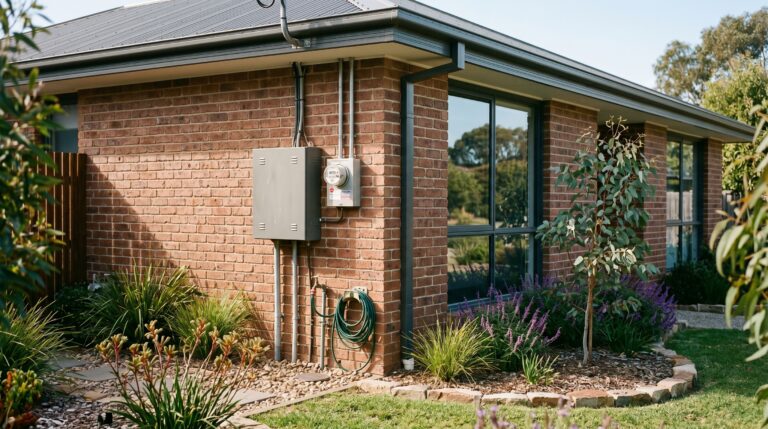
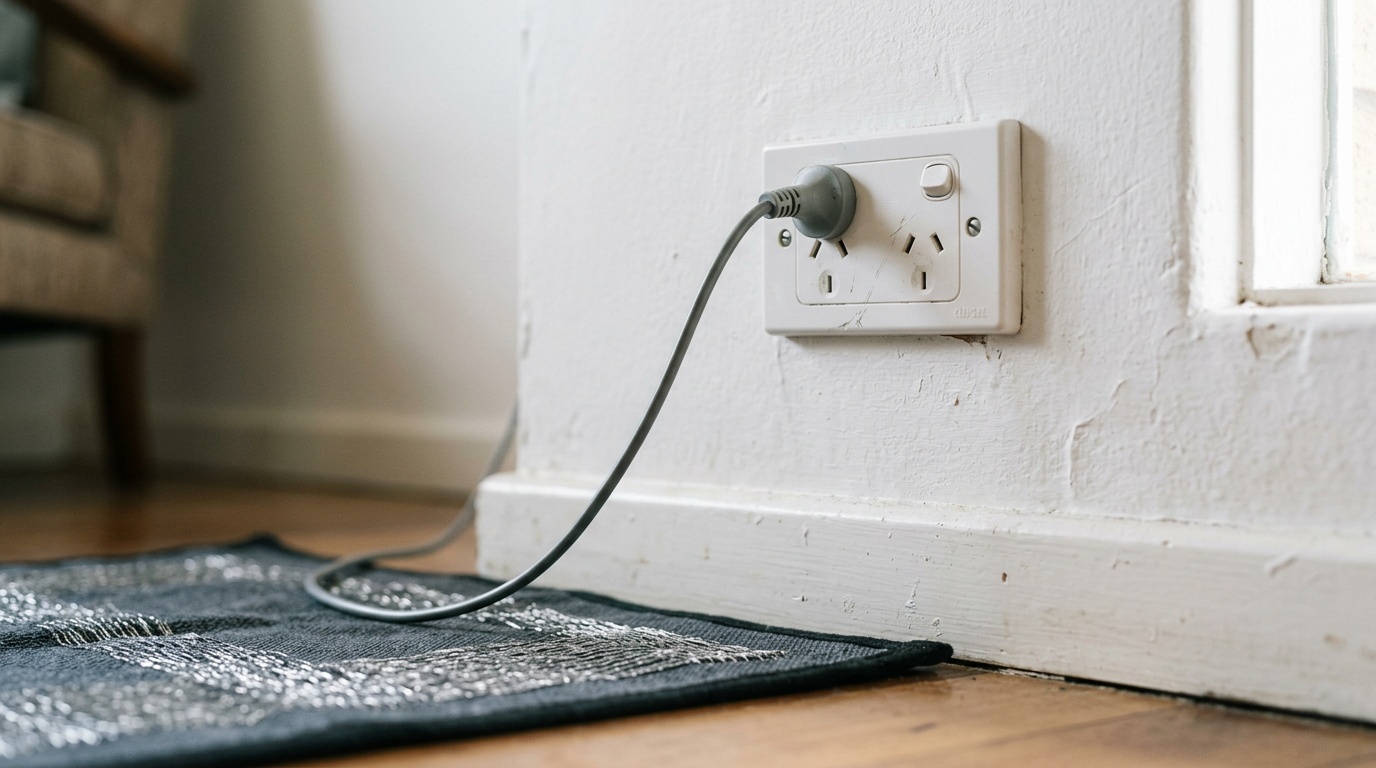
Australian outlets (AS/NZS 3112 Type I, the flat angled prongs) include a dedicated earth pin — the third pin at the top centre. Every grounding mat ships with a cord that ends in a plug designed to connect only to the earth pin. Australian-spec cords fit Type I sockets directly; no adaptor is needed for Australian-stocked products. Verify before purchasing from international retailers who may ship with US or EU plugs requiring an adaptor — the functional earth connection is identical, but the physical plug type matters.
Before using any grounding product, verify your outlet’s earth is functional. A socket tester (Premium Grounding sells one for ~$29) plugs into the outlet and confirms earth continuity with indicator lights. Older Australian homes — particularly those with original 1960s to 1980s wiring — occasionally have outlets with broken earth connections. A grounding mat on an unearthed outlet provides no earthing benefit and potentially creates a floating conductive surface. Test first. This takes 30 seconds and removes all uncertainty.
Best Grounding Mats Australia 2026
All three products below are from Premium Grounding — the only Australian-stocked earthing brand using stainless steel conductive threads across their mat range. These were assessed against manufacturer specifications, cross-referenced with our documented methodology.
1. Premium Grounding Mat — Best Overall
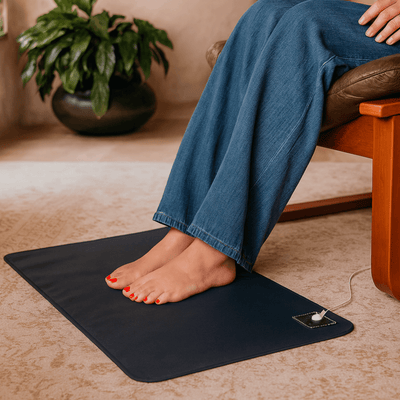
Premium Grounding Mat
Stainless steel conductive threads, full-surface conductivity, and an Australian-compatible cord. Works at desk, on the floor, or beside the bed. ~$129 AUD.
See price at Premium Grounding →The Premium Grounding Mat is the product I recommend as the starting point for anyone new to earthing mats in Australia. The stainless steel thread construction means conductivity does not degrade over time — you test it once when it arrives, confirm continuity, and it works identically 3 years later if cared for correctly. The mat surface is large enough to place both feet flat with room to shift position during a desk session, which matters for 6+ hour days where foot position naturally changes.
The included cord connects to the earth pin of any standard Australian Type I outlet. The cord incorporates a 100k-ohm current-limiting resistor — this is the industry standard protection that ensures no hazardous current can flow through the mat under any failure condition. You can verify this yourself by measuring resistance between the mat surface and the plug earth pin with a multimeter: you should read approximately 100,000 ohms. A mat without a resistor is not inherently dangerous (earth is at 0V relative to neutral), but the resistor is an additional safety layer that every reputable manufacturer includes.
Premium Grounding Mat — Pros and Cons
Pros
- Stainless steel — does not degrade with washing
- Australian-compatible cord included
- 100k-ohm resistor for safety
- Full-surface conductivity
- Ships within Australia — fast delivery
Cons
- Requires a verified functional earth outlet — test first
- Priced above budget carbon-pad alternatives
- No certifications specific to therapeutic claims — wellness product only
This article contains affiliate links. We may earn a commission at no extra cost to you.
Buy if: you want the most durable stainless steel grounding mat with an Australian-compatible earth cord and full-surface conductivity. Check price at Premium Grounding →
2. Multi-Purpose Grounding Pad — Best for Desk and Yoga Use

Multi-Purpose Grounding Pad
Larger surface area than the standard mat — doubles as a desk pad, yoga mat supplement, or full-length floor pad for meditation. Conductive across the entire surface. ~$159 AUD.
See price at Premium Grounding →The Multi-Purpose Grounding Pad addresses the limitation of the standard mat’s footprint. Where the standard mat is sized for a pair of feet under a desk, the pad’s larger surface area means you can use it as a desk surface pad (forearms and wrists in contact while typing), a yoga mat supplement for floor stretching, or a full-length contact surface during meditation. The larger contact area increases the potential electron transfer pathway, which matters if extended sitting-floor sessions are the primary use case.
At $30 more than the standard mat, the pad makes sense if you have multiple planned uses. If you are buying purely for under-desk foot grounding at a sit-down desk, the standard mat is sufficient and the price difference is not justified. The pad earns its cost when you need versatility — desk during work hours, floor during lunch stretching, beside the meditation cushion in the evening.
Multi-Purpose Grounding Pad — Pros and Cons
Pros
- Larger surface — desk pad, floor, yoga compatible
- Full-surface conductivity
- Forearm and wrist contact during keyboard use
- Same stainless steel durability as standard mat
Cons
- $30 premium over standard mat — only justified for multi-use cases
- Larger format is less portable if you travel with it
Buy if: you want one product that covers desk work (forearm contact), floor yoga, and meditation — the larger surface justifies the extra $30. Check price at Premium Grounding →
3. Hooga Grounding Mat — Best Amazon AU Budget Option

Hooga Grounding Mat
Vegan leather universal earthing mat with grounding cord included. 4.1 stars on Amazon AU, $59.98 AUD — versatile enough for desk, floor, yoga, or couch use. The most accessible independently-reviewed earthing mat available on Amazon Australia.
The Hooga Grounding Mat is the most accessible independently-reviewed earthing mat available on Amazon Australia, and the right choice for buyers who want to test grounding at low cost before committing to a premium stainless steel unit. At $59.98 with a grounding cord included, it is the most affordable entry point in this guide by a significant margin — $70 less than the Premium Grounding Mat and $100 less than the Multi-Purpose Pad.
The vegan leather (PU) surface is conductive across its full area and is versatile enough for desk use (under keyboard and mouse), floor yoga, couch armrest, or beside the meditation cushion. At the rating of 4.1 out of 5 from independently verified Amazon AU reviews, it is the product to reach for when the goal is to test the grounding protocol before making a larger investment. If you notice a measurable difference in sleep or energy after 2 to 4 weeks on the Hooga, you will have a reliable data point to justify upgrading to the stainless steel Premium Grounding Mat. If you notice nothing, you have spent $59.98 rather than $129 to reach that conclusion.
Hooga Grounding Mat — Pros and Cons
Pros
- Best price in this guide ($59.98 AUD)
- Grounding cord included (AU compatible)
- Versatile — desk, floor, yoga, couch
- 4.1/5 from independently verified Amazon reviews
- Available on Amazon AU with fast Prime delivery
Cons
- PU vegan leather — less durable than stainless steel threads over time
- Smaller contact area than the Multi-Purpose Pad
- No resistance-limiter documentation published (verify independently)
Buy if: you want the most affordable way to start testing grounding, prefer Amazon AU with Prime delivery, and want a mat that covers desk, floor, and yoga use without the premium price of the stainless steel options.
How to Test If Your Grounding Mat Is Working
Three tests, in order of cost and precision:
1. Socket tester ($29): Plug a socket tester into the outlet before connecting the mat. Three indicator lights confirm wiring correct, earth present, and polarity correct. If the earth indicator does not light, the outlet is not earthed — find a working outlet or have an electrician inspect the circuit. This is the most important test and should happen before you use any grounding product for the first time.
2. Continuity test with a multimeter ($34 or any basic multimeter): Set to resistance (ohms). Touch one probe to the mat surface, the other to the earth pin of the outlet cord plug. You should read approximately 100,000 ohms (100kΩ) — the value of the built-in current-limiting resistor. A reading significantly higher than 100kΩ indicates a broken connection somewhere in the mat or cord. A reading of 0 ohms would indicate a missing resistor (contact the supplier). Premium Grounding sells a purpose-built grounding multimeter for this test. Any basic multimeter from an electronics supplier works equally well.
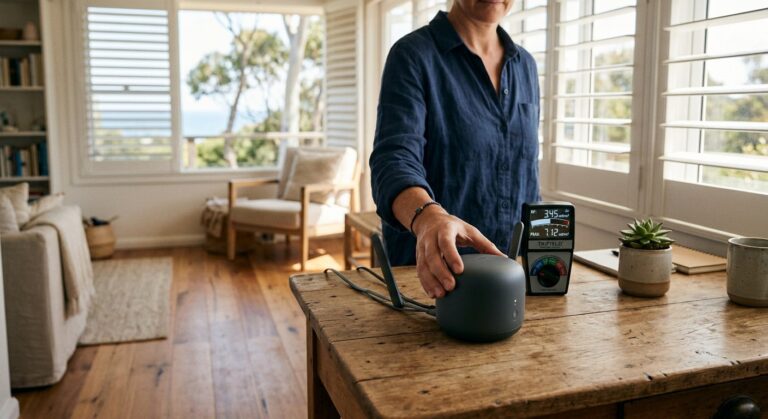
3. Body voltage test: This is the most direct way to confirm grounding is reducing electrical field exposure at your body. Measure body voltage (AC volts) with a multimeter — one probe held in the hand, the other touching the earth outlet. Typical ungrounded body voltage in a modern home is 0.5 to 3V AC from electric field induction (from nearby power wiring). While grounded via a mat, this should drop to under 0.1V AC. A persistent high reading while grounded confirms either the mat is not conductive or the outlet earth is not functional.
Australian-Specific Considerations
Outlet Safety and AS/NZS 3000
Australian wiring regulations under AS/NZS 3000 (the Wiring Rules) require all general-purpose outlets to be earthed. In practice, older Australian homes — particularly those with original 1960s to 1980s wiring that has not been updated — occasionally have outlets with degraded or missing earth connections. The socket tester step above addresses this. If your test confirms a broken earth, do not use that outlet for a grounding product — find one that tests correctly or have a licensed electrician repair the circuit. This is not a concern unique to grounding products; any appliance relying on the earth for safety (such as washing machines and dishwashers) faces the same issue.
Barefoot Grounding Outdoors — Still the Easiest Option
If you have direct access to grass, soil, or beach sand, 20 to 30 minutes barefoot outdoors achieves the same electron transfer that a grounding mat provides. A grounding mat is a practical substitute for indoor environments, apartment living, winter months, or extended office hours where outdoor access is impractical. If you live near a beach — as many Australians do — consistent barefoot time in the surf and on wet sand is the most biologically direct form of earthing available. The mat supplements rather than replaces this.
Electric Field Sensitivity and the EMF Connection
Grounding mats reduce AC electric field exposure at the body by providing a low-impedance path to earth — the same principle that makes earthed enclosures reduce electric field interference in sensitive electronics (Faraday cage effect). This is measurable with a body voltage test and represents an independently verifiable physical effect separate from the earthing/electron-transfer wellness claims. For people working near transformers, smart meters, or in older buildings with unshielded wiring, a grounding mat at the desk provides a documented reduction in body voltage exposure during working hours. For context on how to assess your home’s EMF environment, see our EMF bedroom audit guide and our review of the best EMF meters in Australia.
Final Verdict
The Premium Grounding Mat is the correct choice for most Australians starting with earthing mats. Stainless steel construction, Australian-compatible cord, verified conductivity, and a price point around $129 AUD that makes it accessible without compromising on durability. The Multi-Purpose Grounding Pad justifies its extra $30 only if you have multiple planned use cases — desk, floor yoga, and meditation combined. The Grounding Mouse Pad is the right entry point for anyone who just wants to test whether they notice a difference from grounding at a desk before committing to a larger purchase.
The science is honest: grounding research is preliminary, not conclusive. The studies are small, the mechanisms are plausible but not definitively proven, and no regulatory body has approved grounding as a treatment for any condition. What the physics confirms independently of wellness claims is that a properly earthed mat reduces AC electric field exposure at the body — measurable, repeatable, and consistent with established electrical engineering principles. If you are already aware of the EMF environment in your home and work environment, see our full best EMF shielding products Australia guide for the complete range of options.
Last reviewed: June 2026 — Clean and Native
Frequently Asked Questions
What is the best grounding mat in Australia?
The Premium Grounding Mat (stainless steel, ~$129 AUD) is the best grounding mat in Australia for most users — stainless steel threads that do not degrade over time, an Australian-compatible cord, and verified conductivity. Available from premiumgrounding.com with fast local shipping.
Is a grounding mat safe to use in Australia?
Yes, when connected to a properly earthed outlet. The mat cord connects only to the earth pin — no current or voltage is involved. A built-in 100k-ohm resistor limits any possible current to below 0.01 mA. Test your outlet with a socket tester ($29) before first use — particularly important in homes built before 1990 where earth connections can be degraded.
What is the difference between a grounding mat and a grounding sheet?
Grounding sheets cover the bed for 6 to 9 hours of earth contact during sleep. Grounding mats are used during waking hours — under the feet at a desk, on the floor for yoga, or on a couch. If you can only buy one, sheets provide more total daily grounding time. Mats are the right choice for daytime desk use or as a lower-cost entry point to test earthing.
Do grounding mats actually work?
There is preliminary scientific evidence that direct earth contact via conductive mats has measurable physiological effects — normalised cortisol rhythms, reduced body voltage from electric fields, and self-reported improvements in sleep and pain in small studies. The evidence is not conclusive. What is definitively measurable is the AC electric field reduction at the body (verifiable with a multimeter body voltage test) — this is established physics, independent of wellness claims.
Can I use a grounding mat in a rental property in Australia?
Yes. Grounding mats plug into standard outlets and require no modification to the property’s wiring. Test the outlet with a socket tester first — if the earth indicator shows correctly, the mat will work. No installation is needed and nothing is changed in the property. Renters can use grounding mats in any standard tenancy.
What is stainless steel versus silver in a grounding mat?
Stainless steel threads do not tarnish or corrode — conductivity is maintained indefinitely with normal care. Silver threads have higher initial conductivity but tarnish on contact with sweat and chlorine (present in Australian tap water from chloramine-treated cities like Brisbane, Sydney, and Adelaide), losing conductivity within 6 to 12 months. For longevity, stainless steel is the correct choice for Australian conditions.
How do I test if my grounding mat is working?
Three tests: (1) Socket tester — confirm outlet earth is present. (2) Multimeter continuity test — measure resistance between mat surface and plug earth pin, should read ~100k ohms. (3) Body voltage test — measure AC volts from hand to earth outlet while touching the mat. Should drop below 0.1V AC if grounding is functional. All three tools total under $100.
Where should I put a grounding mat in my home?
The most effective placement is wherever you spend the most seated time — typically under the feet at a desk, or on the couch armrest for forearm contact during evening sitting. A desk placement during 6+ hours of work provides more total grounding time than a short yoga session. For sleep grounding, use a grounding sheet on the bed instead of a mat.
Best Earthing Products Australia 2026: Mats, Sheets, Pillowcases & Bands
Compare every earthing product category tested in Australia →Get the Australian Home Environment Checklist
30 checks across water, air and EMF. Most of them free. Ranked by impact.
No spam. Unsubscribe any time.

Former Royal Australian Navy Clearance Diver and TAG-E counter-terrorism operator. Founded Clean and Native to apply the same rigorous thinking to the home environment.
Full biography →