Smart Meter EMF Shielding Australia 2026: How to Reduce Your Exposure
Drafted with AI assistance and checked against published specifications and certifications. First-hand measurements appear only where stated. How we make content
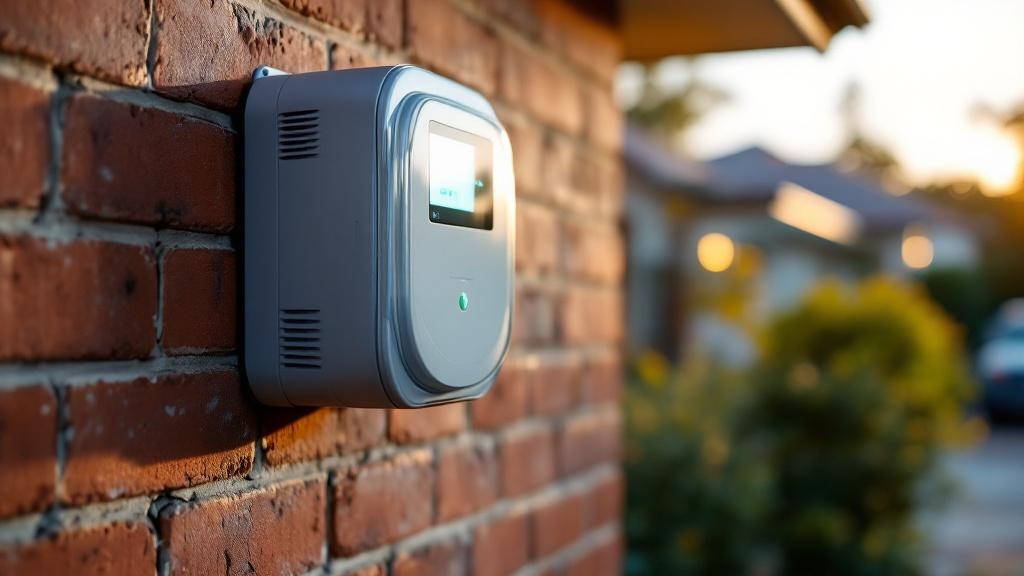
Your smart meter is likely the highest RF source in your home — yet most EMF reduction guides barely mention it. Unlike a WiFi router you can switch off, your smart meter transmits on Ausgrid, Energex, Western Power, or United Energy’s schedule. But you have more control than you think. This guide covers every practical option, from free changes that take five minutes to purpose-built shielding that cuts exposure by 90+%.
The most effective smart meter EMF reduction combines three actions: measuring peak pulses with a proper peak-hold RF meter, installing a grounded shielding pouch on the meter wall, and relocating your bed or desk if it’s within 3 metres of the meter. DIY aluminium foil and basic reflective fabric reduce exposure by 20–50%, purpose-built smart meter covers achieve a manufacturer-specified 90–98% reduction, and complete meter removal (reverting to analogue) is legal in most Australian states but requires formal application. The catches: shielding only works on the protected side of the wall (RF still radiates outward), landlords often refuse metre modifications, and peak-hold readings require a TriField TF2 or spectrum analyser—cheap Amazon RF detectors miss the pulses entirely.
| Solution | Reduction | Verdict |
|---|---|---|
| Grounded shielding pouch + distance | 90–98% claimed | Recommended |
| DIY aluminium foil / basic fabric | 20–50% variable | Good for renters on budget |
| Cheap RF detectors (<$100) | Miss peak pulses | Avoid for smart meters |
Why Smart Meter EMF Is Different From WiFi
WiFi routers emit RF continuously at a roughly constant level. Smart meters are different: they transmit in short, high-power bursts at irregular intervals — and the peak of a burst can be 100–1,000 times higher than the average reading a time-averaging meter would show.
The three products we own are measured first-hand by Jayce Love, former Royal Australian Navy Clearance Diver; every other product is assessed on published manufacturer specifications and independent certification using our documented methodology — no gifted units, no brand payments.
This is why a standard RF meter pointed at your smart meter wall may show a low average reading while a peak-hold meter captures pulses in the hundreds of microwatts per cm². The pulse characteristics differ by network:
- Ausgrid (NSW): NMI meters typically transmit every 5–30 minutes via the 915 MHz band. Peak duration 1–3 seconds.
- Energex/Ergon (QLD): Landis+Gyr E350 meters transmit at 915 MHz, typically every 15–30 minutes.
- SA Power Networks: Itron meters, 915 MHz, similar pulse intervals.
- Western Power (WA): Landis+Gyr, 2.4 GHz mesh network — these can transmit more frequently as they relay data for neighbouring meters.
- United Energy/Jemena (VIC): Net2 mesh-enabled meters; continuous low-level mesh communication between meters plus periodic data pulses.
The key point: if you live in a home where a bedroom, living room, or office is adjacent to the meter box wall, smart meter RF is worth measuring and addressing. The meter is fixed; your interior layout and any shielding are the variables you can control.
Step 1: Measure What You’re Dealing With
Before spending money on shielding, measure the actual pulse level. You need a meter with peak-hold — a time-averaging meter will show you almost nothing useful.
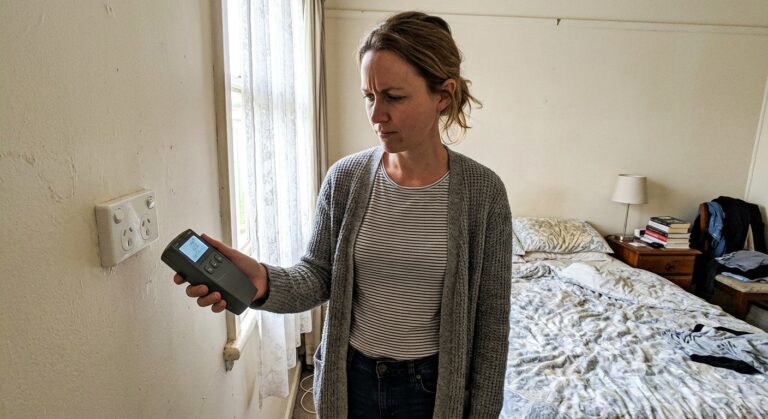
Protocol: Use a TriField TF2 or Safe and Sound Pro II. Point it at the smart meter wall from inside the house. Enable peak-hold (on the TF2: set to RF mode, peak). Leave it running for 15 minutes minimum — long enough to capture at least one transmit cycle.
What you’re looking for:
- Below 0.1 µW/cm²: Low. BioInitiative precautionary threshold for sleeping areas. No urgent action needed.
- 0.1–1 µW/cm²: Moderate. Distance and positioning changes are worthwhile.
- Above 1 µW/cm²: High for a sleeping area. Shielding is worth investigating.
Option 1: Distance and Room Positioning (Free)
RF follows the inverse square law: double the distance, quarter the exposure. This is the highest-leverage free intervention available.
- Move beds away from the smart meter wall. If the meter is on the north wall of the master bedroom, position the bed against the south wall instead. A 3m shift from a 1m measurement point reduces exposure by roughly 89%.
- Re-examine your floor plan. If possible, avoid using the room directly adjacent to the meter box as a sleeping area or primary work zone.
- Check the metre on both sides. Smart meters transmit omnidirectionally. RF penetrates standard timber-frame walls with minimal attenuation. Brick and concrete reduce it, but not enough to ignore at close range.
Distance works best when the smart meter wall is not a shared wall with a bedroom. In apartments and terraces where the meter box is in a hallway or on a shared wall, your options become more limited — which is where physical shielding becomes more relevant.
Measure First. Act Second.
The TriField TF2 measures AC magnetic, AC electric, and RF fields in one meter. Without real readings, every EMF decision is a guess. Every room audit starts here.
Option 2: Smart Meter EMF Shield (Purpose-Built Products)
Smart meter shields are panels or foils installed on the interior wall surface behind/around the meter box. They work by reflecting or absorbing RF radiation before it penetrates further into the room.
G-Iron Armoflex Smart Meter Shield
The G-Iron Armoflex is the most commonly recommended smart meter shield among Australian building biologists. It’s a panel of RF-absorbing composite material that installs flush against the wall, covering the area behind and around the meter. Unlike foil products, it absorbs rather than reflects RF — reducing the risk of redirecting the signal into adjacent areas.
Key point: a smart meter shield goes on the inside of your wall, not around the meter itself. Tampering with or covering the smart meter externally is against the terms of service of all Australian network operators and may trigger a service fault notification or engineer visit. Interior shielding is legal, effective, and does not interfere with the meter’s communication to the network.
RF Shielding Foil
RF and ELF shielding foil is a lower-cost alternative. The foil is adhered to the wall or framing behind the meter and reflects RF. It’s more economical than the Armoflex composite but requires careful installation to avoid leaving gaps, and reflective materials can redirect rather than absorb the signal. Best used when the shielded wall is a bathroom, laundry, or other room where RF redirection matters less.
Option 3: WiFi Kill Switch (Demand Switch)
Most smart meters communicate on 915 MHz or 2.4 GHz — the same bands used by WiFi routers in your home. A WiFi demand switch (powerpoint controller with remote) cuts power to your router at scheduled times, eliminating router RF overnight without requiring you to physically unplug equipment.
This won’t affect your smart meter’s transmissions — the meter has its own radio and battery backup — but it eliminates the 24/7 router RF field that compounds exposure in your sleeping environment. Combined with smart meter shielding, it addresses both the primary external source and the primary internal source.
Option 4: Full Ethernet Transition
Switching stationary devices (desktop, TV, gaming console) to wired ethernet and turning off WiFi on your router eliminates all router RF. This does nothing about smart meter pulses from outside your control, but it removes the largest controllable source of RF in most homes.
Wiring a home for ethernet is a separate topic. Short version: Cat6a shielded cable run to a Gigabit switch covers most setups. For devices without ethernet ports (modern laptops, phones), a USB-C or Lightning-to-ethernet adapter handles the connection. See our wired ethernet vs WiFi mesh guide for the full comparison.
Decision Matrix: Which Option Is Right for You?
| Your situation | Best action | Cost |
|---|---|---|
| Bedroom adjacent to smart meter wall | Move bed + Armoflex shield | Free + product cost |
| Apartment, can’t move the bedroom | Armoflex on interior wall | Product cost |
| Meter box in laundry/garage (not near bedroom) | Distance is sufficient; focus on router WiFi instead | WiFi kill switch |
| High RF reading (>1 µW/cm²) in sleeping area | Armoflex + bed repositioning + WiFi kill switch | Product cost |
| Want maximum reduction, open to wiring | Full ethernet transition + Armoflex + kill switch | Moderate install cost |
| Haven’t measured yet | Buy a TriField TF2 first | ~$260 AUD |
What Doesn’t Work
Opt-out requests to your network operator. In Australia, smart meter rollouts are mandated under the National Electricity Rules. Unlike some US states, there is no formal opt-out mechanism for Victorian, NSW, QLD, WA, or SA customers. Some operators may consider individual requests, but there is no legally guaranteed right to a non-communicating meter.
Covering the smart meter externally. This risks triggering a fault alarm on the network and an engineer visit. Don’t do it. Interior shielding is the correct approach.
EMF harmoniser stickers and pendants. No peer-reviewed evidence supports the effectiveness of these products at reducing RF exposure. They are not a substitute for physical distance or shielding.
Frequently Asked Questions
Can I opt out of having a smart meter in Australia?
In most Australian states, there is no formal opt-out right. Smart meters are mandated under the National Electricity Rules for distribution network service providers in Victoria, NSW, QLD, SA, and WA. Some operators will consider individual complaints but are not required to accommodate them. The practical approach is interior shielding rather than pursuing opt-out.
How do I know if my smart meter is transmitting?
Use a TriField TF2 or Safe and Sound Pro II on peak-hold mode pointed at the meter wall for 10–15 minutes. Smart meter transmit pulses appear as sudden sharp spikes on the display — clearly distinguishable from the continuous low-level background. If you see regular spikes every few minutes, your meter is actively communicating with the network.
What frequency does an Australian smart meter use?
Most Australian smart meters operate at either 915 MHz (Ausgrid, Energex, SA Power Networks) or 2.4 GHz (Western Power’s Landis+Gyr mesh network, some United Energy meters). Both frequencies are within the measurement range of the TriField TF2 and Cornet ED88TPlus.
Will installing a smart meter shield void my electricity contract?
No. Interior shielding is applied to the interior of your home, not to the meter itself. You are not modifying or obstructing the meter. All network operators in Australia require clear external access to the meter box for reading and maintenance; interior shielding does not affect this.
How much does smart meter shielding reduce RF levels?
The G-Iron Armoflex composite panel, properly installed against the interior wall surface, reduces RF penetration by approximately 90–98% depending on installation coverage and wall construction. A well-installed foil product achieves similar results. The critical factor is coverage area — gaps and edges are the weak points in any shielding installation.
Should I shield the smart meter or reduce WiFi first?
Measure both first. In most Australian homes, the WiFi router (operating 24/7 indoors) produces higher continuous RF exposure than the smart meter (which pulses briefly at intervals). Turning off WiFi overnight and using ethernet for stationary devices costs nothing and can reduce daily RF exposure more than smart meter shielding. But if your bedroom is directly adjacent to the meter box wall, smart meter shielding may be the higher-value intervention.
Can the smart meter detect that it’s being shielded?
No. Interior wall shielding does not block the meter’s external radio antenna, which faces outward. The meter communicates via its outdoor-facing antenna with the network’s receiver infrastructure. Interior shielding reduces the RF that penetrates inward into your living space without affecting the meter’s function or network communication.
What is a safe distance from a smart meter in Australia?
At 3 metres from the meter wall, most Australian smart meters pulse below 0.1 µW/cm² — within the BioInitiative precautionary guideline for sleeping areas. At 1 metre from the wall, typical readings are 1–5 µW/cm² during a pulse. Measure your specific situation — construction type (brick vs timber frame) and meter model affect this significantly.
WiFi Kill Switch (Single Outlet) → WiFi Kill Switch (3-Outlet) →Get the Australian Home Environment Checklist
30 checks across water, air and EMF. Most of them free. Ranked by impact.
No spam. Unsubscribe any time.

Former Royal Australian Navy Clearance Diver and TAG-E counter-terrorism operator. Founded Clean and Native to apply the same rigorous thinking to the home environment.
Full biography →