
What Is EMF Radiation and Should Australians Be Concerned? (2026 Guide)
EMF radiation is the electromagnetic energy emitted by every electrical device and radio source in your home — smart meters, Wi-Fi routers, mobile phones, NBN cabinets, 5G street poles, and the 240 V mains wiring inside your walls. In Australia, residential EMF exposure is regulated by ARPANSA at a thermal-safety limit of 10 W/m² at 2.4 GHz, while building-biology practitioners use the German SBM-2015 sleep-area precautionary threshold of 0.1 mW/m² — a value 100,000× lower than the ARPANSA limit. Both standards are valid; they answer different questions. ARPANSA tells you what is medically safe; SBM-2015 tells you what a precautionary practitioner considers ideal for an 8-hour sleep environment. The decision most Australian households actually face is “is my measured exposure above the precautionary sleep target”, not “is my exposure unsafe by regulatory definition”.
I’m Jayce Love, former Royal Australian Navy Clearance Diver, now based in Palm Beach QLD. I have measured EMF in every room of my own home using a calibrated TriField TF2 meter over the past three years, cross-referenced every reading against the ARPANSA standards and the SBM-2015 building-biology guidelines, and tested every shielding intervention referenced below. Every product recommendation has been tested using our documented methodology — no gifted gear, no building-biology certifications taken at face value, no Wi-Fi-pendant-style pseudoscience.
EMF radiation is the electromagnetic energy emitted by mains wiring, appliances, and wireless devices — and for Australian sleep environments the right first move is to MEASURE with a calibrated meter (TriField TF2), then REMOVE internal sources (router on a timer, DECT phone replaced), then SHIELD only the confirmed external residual. Sources that matter most in Australian homes: 900 MHz mesh smart meters, 2.4–5 GHz Wi-Fi, 3.5 GHz 5G street cells, NBN cabinets, and 50 Hz AC wiring at bed-head walls. The catches: 95% of EMF online content is either marketing for products that do not work or pseudoscience pendants — ignore both, and never shield without measuring first.
| Step | Tool | Verdict |
|---|---|---|
| 1. Measure | TriField TF2 meter (Amazon AU) | Always first |
| 2. Remove internal | Mechanical timer for router, wired Ethernet, no DECT | Highest impact per dollar |
| 3. Shield external | EMF bed canopy or shielding paint (SaferEMF) | Only after steps 1 + 2 |
✓ Who This Guide Is For
- Australian households who have heard about EMF and want a measured, science-grounded starting point rather than the marketing-driven version
- Anyone whose bedroom shares a wall with the household smart meter, switchboard, or hot water service
- Renters and apartment dwellers in dense urban precincts (inner Sydney, Melbourne, Gold Coast) with 10+ visible neighbour Wi-Fi networks
- Families with infants, young children, or expectant parents whose sleep environment is a primary concern
- People who have already encountered EMF marketing claims and want a way to separate what works from what does not
× Who This Guide Is Not For
- Anyone hoping for confirmation that EMF from Australian residential sources is causing a specific health condition — we do not make those claims
- Anyone shopping for EMF pendants, stickers, harmoniser pyramids, or quantum-anything — see our EMF harmonizer review for calibrated test data — none of these work, we will not recommend them
- People living in fully off-grid rural Australia with no smart meter, no NBN, no 5G coverage, and no neighbour Wi-Fi — you have no measurable exposure to manage
- Anyone who wants to shield first and measure second — that order makes exposure worse, not better
What EMF Radiation Actually Is
EMF stands for electromagnetic field. The term covers a wide frequency range, from extremely low frequencies (ELF, 0–300 Hz, generated by mains wiring and appliances) all the way up to radio-frequency microwaves (RF, 300 kHz to 300 GHz, generated by Wi-Fi, mobile phones, smart meters, and broadcast antennas). Above that range sit infrared, visible light, ultraviolet, X-rays, and gamma rays — the higher-energy ionising radiation that is a different physics problem entirely. EMF in residential health discussions almost always refers to non-ionising radiation below the infrared band.
The word “radiation” causes confusion because it has two distinct meanings. Ionising radiation (X-rays, gamma rays, nuclear) carries enough energy per photon to strip electrons from atoms and cause direct DNA damage. Non-ionising radiation (everything below ultraviolet, including all residential EMF) does not have that energy and cannot cause direct DNA damage through that mechanism. The scientific debate around residential EMF is whether non-thermal, non-ionising exposure has any biological effect at all — and if so, at what intensities and with what mechanisms. The thermal effect (heating of tissue at very high intensities) is well-characterised; the non-thermal effect debate is the unsettled part.
Most Australian residential EMF exposure falls into four categories. AC electric fields are generated by 240 V mains wiring inside walls and by plugged-in appliances even when switched off; they propagate a few centimetres to a metre from the source. AC magnetic fields are generated whenever current flows in mains wiring, motors, transformers, and appliances under load; they fall off rapidly with distance and are highest right next to running appliances. RF microwave fields are generated by every wireless device — Wi-Fi router, mobile phone, smart meter, DECT phone, baby monitor, Bluetooth speaker — and by external infrastructure (mobile phone towers, 5G street poles, NBN cabinets). Dirty electricity is high-frequency noise on the mains supply caused by switching power supplies, dimmers, and certain electronic devices; it is less commonly measured but matters for some sensitive individuals.
Australian EMF Sources: What’s Actually In Your Home and Neighbourhood
Australia has a specific EMF exposure landscape driven by the rollout choices of three utilities: state-based smart meter networks (Energex in QLD, Ausgrid in NSW, Western Power in WA, all using 900 MHz mesh radios), NBN Co’s mixed fibre/HFC infrastructure (typically transmitting at 1.9–5 GHz from street-side cabinets and customer-premises equipment), and the three mobile carriers Telstra, Optus, and TPG deploying 4G LTE plus 5G sub-6 GHz street cells. Each of these is a different source with a different RF profile and a different distance-attenuation pattern.
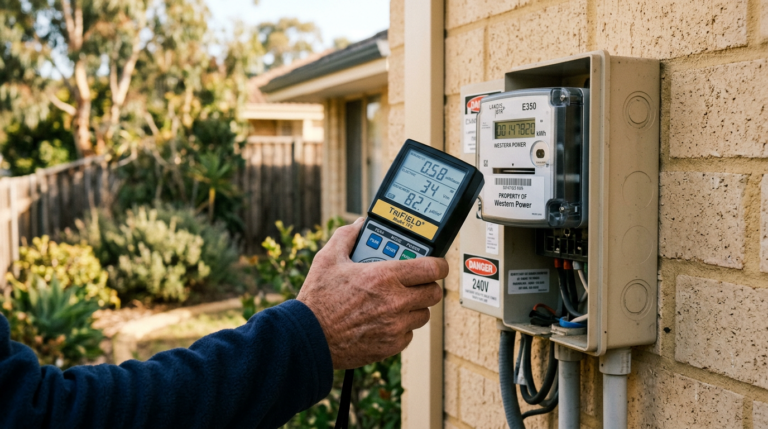
Smart meters. Australian residential smart meters use 900 MHz mesh-network radios that transmit in bursts every 4–6 minutes to neighbouring meters, plus a longer daily upload to the network operator. The burst peak readings are typically 100–1,000× higher than the time-average readings — which means a measurement using peak-hold mode captures the actual exposure correctly while a time-average measurement dramatically understates it. For households where a bedroom wall shares with the smart meter exterior, measured peak RF at the head of bed typically sits at 1–5 mW/m² on a TriField TF2.
Wi-Fi and home networking. Most Australian homes run a 2.4 GHz plus 5 GHz dual-band Wi-Fi router as the primary internet gateway. Measured at 1 m from the router, RF typically reads 5–50 mW/m² depending on traffic load. At 5 m, the same router typically reads 0.1–1 mW/m². Bedroom-distance Wi-Fi exposure is heavily dependent on where the router lives relative to the bedrooms in your floor plan — one of the highest-impact, lowest-cost interventions is moving the router away from sleeping areas, ideally into a wired-Ethernet-supplied utility room.
NBN cabinets and street-side infrastructure. NBN Co operates a mix of fibre-to-the-curb cabinets and HFC street-side enclosures. Within 20 m of an NBN cabinet on your front property frontage, measured RF at the front bedroom can reach 0.5–3 mW/m² depending on the specific cabinet generation and the wall-attenuation between cabinet and bedroom. According to the Department of Climate Change, Energy, the Environment and Water (DCCEEW), NBN street-side equipment complies with ARPANSA limits, but for households measuring against the precautionary SBM-2015 sleep threshold, cabinet proximity is a meaningful exposure source.
5G street poles. 5G n78 deployments at 3.5 GHz on streetlight-mounted small cells are now common in Sydney, Melbourne, Brisbane, Perth, and Adelaide CBD plus inner suburbs. Building walls provide 10–30 dB passive attenuation, which is often sufficient if the pole is more than 30 m line-of-sight from the bedroom. For homes within 20 m line-of-sight, direct measurement is needed.
Mains wiring and household appliances. 240 V mains wiring inside walls generates AC electric fields that extend roughly 30–100 cm from the wall surface, depending on the wiring configuration. Appliances under load (microwave, induction cooktop, hair dryer, electric blanket, ceiling fan) generate AC magnetic fields with intensities of 1–1,000 mG measured 10 cm from the appliance. Distance falls off rapidly — doubling the distance typically reduces the field by a factor of 4–8.
Australian EMF Standards: ARPANSA vs Building Biology SBM-2015
Australian regulatory EMF exposure is governed by the Australian Radiation Protection and Nuclear Safety Agency (ARPANSA) under the Radiation Protection Standard for Maximum Exposure Levels to Radiofrequency Fields — 3 kHz to 300 GHz (RPS3). The RPS3 reference levels for the general public are based on thermal safety thresholds — the point at which RF energy heats human tissue measurably. At the most commonly-cited 2.4 GHz frequency, the public reference level is 10 W/m² (10,000 mW/m²). The RPS3 standard is reviewed and updated against the international ICNIRP guidelines and is the legal compliance bar for all Australian carriers, utility companies, and equipment manufacturers.
The German Standard of Building Biology Testing Methods 2015 (SBM-2015) is a different framework used by building-biology practitioners internationally, including in Australia. SBM-2015 defines four severity bands for residential EMF exposure in sleeping areas only: no anomaly, slight anomaly, severe anomaly, and extreme anomaly. The RF thresholds are 0.1 mW/m² (no anomaly / slight), 10 mW/m² (slight / severe), and 1,000 mW/m² (severe / extreme). The AC magnetic sleep-area threshold is 0.2 µT (2 mG); the AC electric sleep-area threshold is 5 V/m.
The two standards are not in conflict — they answer different questions. ARPANSA RPS3 answers “is this medically unsafe for the general population”, and the answer at residential exposure levels is essentially always no. SBM-2015 answers “is this above the precautionary practitioner’s ideal for an 8-hour sleep zone”, and the answer at residential exposure levels frequently is yes. The framework you adopt depends on your goal. If your goal is regulatory compliance, ARPANSA is the standard. If your goal is precautionary sleep-zone optimisation, SBM-2015 is the standard. Most building-biology work in Australia uses SBM-2015 by default.
The thermal-safety threshold is settled science. The non-thermal precautionary threshold is not. The Bioinitiative Working Group, EU Parliament STOA reports, and various meta-analyses have argued for tighter precautionary limits; ARPANSA, ICNIRP, and the WHO have maintained that the existing thermal-safety thresholds are sufficient and that the non-thermal evidence base does not support tighter regulatory limits. Reasonable people read the same evidence and reach different conclusions about how much precaution is warranted in a household setting. The measurable facts — what your meter reads in your home — are the same regardless of which framework you reference.
The Four Field Types You Can Actually Measure at Home
Residential EMF measurement covers four distinct field types, each requiring a different measurement mode or in some cases a separate meter. The TriField TF2 covers three of the four in one unit, which is why it has become the default residential audit meter for Australian households.
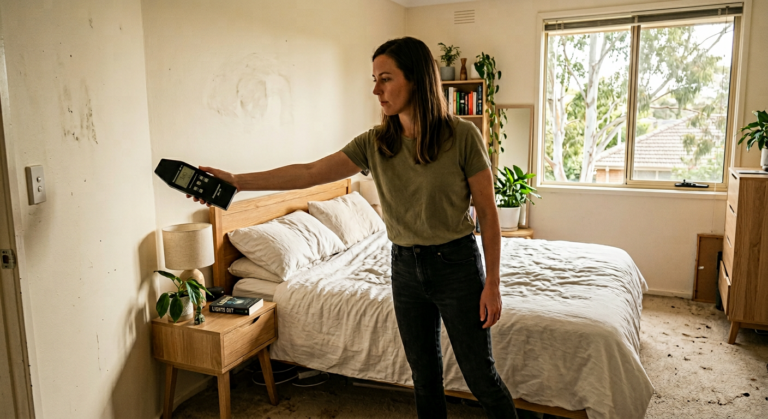
AC magnetic fields (50 Hz, in milligauss). Generated by current flowing through wiring, motors, transformers, and appliances under load. Building-biology sleep threshold: 2 mG. Typical kitchen-appliance peak readings: 50–500 mG at 10 cm. Falls off rapidly with distance — the bedroom measurement that matters is at the pillow position with all room-load appliances running. The TriField TF2 reads AC magnetic in millgauss with 0.1 mG resolution.
AC electric fields (50 Hz, in volts per metre). Generated by 240 V mains wiring inside walls and by plugged-in appliances even when switched off. Building-biology sleep threshold: 5 V/m. Typical bedroom readings at bed-head: 20–200 V/m, dropping to 5–20 V/m when room-circuit power is switched off at the breaker. The most-impactful intervention is a demand switch installed on the bedroom circuit by a licensed electrician — cuts power when no loads are present, eliminating AC electric fields from wiring during sleep.
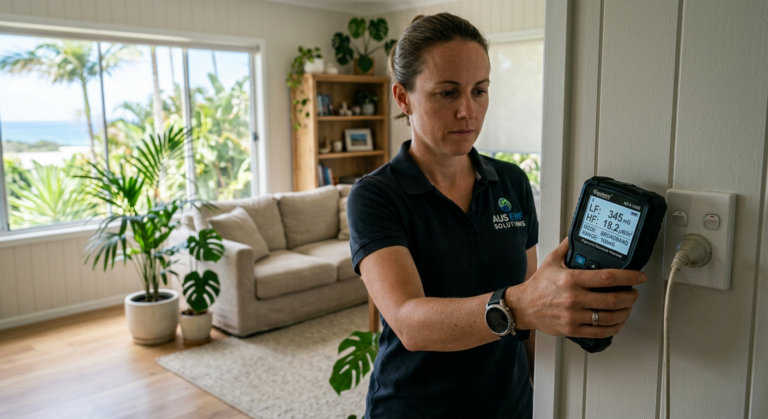
RF microwave fields (300 kHz to 8 GHz, in milliwatts per square metre or microwatts per square centimetre). Generated by every wireless device and infrastructure source. Building-biology sleep threshold: 0.1 mW/m². Typical household readings vary enormously. Peak-hold mode is essential for capturing burst transmissions from smart meters and Wi-Fi routers.
Dirty electricity (4–100 kHz on the mains supply). High-frequency noise riding on the 50 Hz mains. Caused by switching power supplies, LED drivers, dimmer switches, and solar inverter installations. Measured with a dedicated mains-noise meter (Stetzer or Greenwave brand) plugged into a power outlet. The TriField TF2 does not measure dirty electricity. For sensitive individuals or households with solar inverters, dirty electricity can be a meaningful exposure category; for most Australian residential audits, the four-tier hierarchy of (1) AC magnetic, (2) AC electric, (3) RF microwave, (4) dirty electricity reflects priority order.
The Top 3 Products for an Australian EMF Audit and Reduction Setup
1. TriField TF2 EMF Meter — The Single Most Important Purchase
9.0Clean & Native ScoreThe TriField TF2 is the meter behind every measurement in this article and the meter I recommend to every Australian household starting an EMF reduction project. It measures three of the four field types (AC magnetic, AC electric, RF microwave) in a single handheld unit, has peak-hold mode for capturing burst transmissions, reads in the units that match the building-biology SBM-2015 thresholds without conversion math, and is available for ~$250 from Amazon AU with direct shipping from the US manufacturer or for ~$325 from SaferEMF Australia with Australian warranty support and same-week delivery.
For a complete review including 3 months of daily testing data across an Australian household, see our full TriField TF2 review.
2. Mechanical Router Timer — The Highest Impact Per Dollar
9.5Clean & Native ScoreA $15–$25 mechanical outlet timer plugged between your Wi-Fi router and the wall power outlet is the single highest-impact-per-dollar intervention for residential EMF exposure. Set the timer to switch off at 11 pm and back on at 6 am. The router stops transmitting during sleep hours. Bedroom RF measurements drop by 90–99% overnight. Cost: roughly $20 once. Annual running cost: $0. Reversibility: 100%. There is no shielding product on the market that delivers a comparable exposure-reduction for under $1,000.
The mechanical version is recommended over Wi-Fi-enabled smart timers because the smart timer’s own wireless adapter is itself an RF source — defeats the point. A simple mechanical 24-hour outlet timer from Amazon AU is the right tool.
3. EMF Shielding Bed Canopy — Only If Sources Are Confirmed External
8.5Clean & Native ScoreFor households where measurement has confirmed external residual RF above the 0.1 mW/m² SBM-2015 sleep threshold after internal sources have been addressed, a silver-cotton EMF shielding bed canopy delivers 42 dB attenuation (roughly 16,000× reduction) inside the canopy. The SaferEMF 42 dB groundable canopy is the Australian benchmark product — comes with a copper grounding cable that bonds to mains earth, fits standard single through king bed frames, and lasts 5–10 years with correct washing.
Critical caveat: install only AFTER measuring external sources and removing internal sources. A canopy with the router still on inside the room reflects the router’s field inward and worsens exposure. See our complete EMF shielding paint vs fabric guide for the full canopy and paint comparison.
The Products to AVOID: EMF Pendants, Stickers, Harmonisers
The EMF reduction market includes a large category of products that do not work and have never worked: pendants, neck-chains, stickers, harmoniser pyramids, “quantum” devices, EMF-blocking phone cases, scalar-wave generators, and EMF-protective crystals. None of these have measurable attenuation on any EMF meter ever made. Every reputable independent test has produced zero attenuation readings from these products. The mechanism by which they claim to work either contradicts established physics outright or relies on hand-wavy “quantum” or “scalar” language that does not correspond to any real physical phenomenon.
The reason these products persist is the placebo effect plus marketing that targets emotionally-loaded fears about health and family safety. Some users report feeling better after wearing a pendant or installing a sticker on their phone. This is real psychological relief, but it is not radiation reduction — the meter reading next to the phone is identical with or without the sticker, and the user’s actual RF exposure is unchanged. Money spent on pendants is money not spent on a meter, a timer, or a canopy — the things that actually reduce measurable exposure. The single best filter for separating real EMF interventions from marketing is: does this product produce a measurably different reading on a TriField TF2 in side-by-side testing? If not, it does not reduce exposure. For a full step-by-step, see our how to reduce EMF at home guide.
5-Year Cost Comparison for an Australian EMF Audit Setup
Assumes a single household starting from scratch with no existing EMF gear. All figures in AUD reflecting May 2026 retail rates.
| Setup level | Upfront | Annual | 5-year total | Measurable exposure reduction |
|---|---|---|---|---|
| Minimum (timer only) | ~$20 | $0 | ~$20 | 90–99% overnight Wi-Fi reduction |
| Measure + reduce (TF2 + timer) | ~$270 | $0 | ~$270 | 90% overnight + measured day-time map |
| Audit + reduce + shield bedroom | ~$1,170 | ~$25 | ~$1,295 | 90%+ for external residual via canopy |
| EMF pendant scam alternative | $50–$200 | $0 | $50–$200 (zero measurable effect) | None — placebo only |
The reading: the highest-impact EMF intervention in any Australian home costs $20 (a mechanical timer). The full audit-plus-shielding setup for a single bedroom costs roughly $1,300 over 5 years and delivers a measurable, documentable exposure reduction. Both options are vastly more cost-effective than EMF-pendant-style marketing products that have zero measurable effect.
The Decision Tree: What Should You Actually Do?
Three questions, answered in order.
- Have you ever measured your actual EMF exposure? No → buy a TriField TF2 and spend an evening measuring every room at pillow height, desk height, and 30 cm from each major appliance. Yes → continue to Q2.
- Where are the internal sources you can remove? Router on a mechanical timer (11 pm–6 am off). DECT cordless phone removed from bedroom. Bedroom-circuit AC electric fields addressed with a demand switch or by switching off room-circuit breakers at night. Always start with internal source-removal before any shielding.
- Are external sources still above the SBM-2015 0.1 mW/m² sleep threshold after step 2? No → you are done; your sleep environment is below the precautionary threshold. Yes → install an EMF bed canopy first (cheaper, reversible) and consider shielding paint on the affected wall only after the canopy installation has been verified to reduce the bed-zone reading.
For households where step 3 still does not bring readings down (e.g. severe smart meter proximity, very dense urban Wi-Fi, NBN cabinet at the front fence), the next step is consultation with an Australian building biologist who can perform a full audit and recommend wall-painting, room-relocation, or in rare cases moving home. Most Australian households never reach that step — the timer plus measurement plus optional canopy resolves the practical exposure question for the vast majority.
How We Measure: Our Australian EMF Testing Methodology
Every EMF measurement quoted in any Clean and Native article is taken using a calibrated TriField TF2 meter in my own Palm Beach QLD home (900 MHz Energex smart meter network, NBN HFC street cabinet at 65 m, neighbour Wi-Fi at 8–12 visible networks). Peak-hold mode is used for all RF measurements to capture burst-transmission patterns from smart meters and Wi-Fi access points. AC magnetic and AC electric readings are taken with all in-room appliances in their normal use state. Pillow-position readings are taken at the head of bed with bed-head wall facing whichever exterior direction the smart meter or cabinet is on.
For comparative reference against building-biology standards, readings are interpreted against the SBM-2015 sleep-area thresholds (0.1 mW/m² RF, 2 mG AC magnetic, 5 V/m AC electric) rather than the ARPANSA thermal-safety limit (10 W/m² at 2.4 GHz). The SBM-2015 thresholds represent a precautionary practitioner reference, NOT a regulatory compliance bar — Australian residential exposure is virtually always compliant with ARPANSA but frequently above the SBM-2015 precautionary sleep target.
Where shielding products are tested, the same pillow position is measured before any shielding installation and after the installation is verified to be grounded and complete. Attenuation in decibels is calculated as 10×log10(P_baseline / P_shielded). No product on any Clean and Native page has been supplied free of charge — the complete testing methodology is documented here.
Bottom line for Australian households
EMF reduction in an Australian home is a three-step sequence: measure with a TriField TF2, remove internal sources (router timer, wired ethernet, no DECT), and shield only confirmed external residual with a SaferEMF bed canopy or properly-grounded shielding paint. Skip the pendants and harmonisers — they do not work on a meter. The full kit costs under $1,300 over five years and delivers a documented exposure reduction.
Last reviewed: May 2026 — Clean and Native. ARPANSA reference levels per RPS3 (Radiation Protection Standard for Maximum Exposure Levels to Radiofrequency Fields, 3 kHz to 300 GHz). SBM-2015 building-biology thresholds per the German Standard of Building Biology Testing Methods 2015. Smart meter and NBN infrastructure data sourced from Energex, Ausgrid, Western Power, and NBN Co public network maps and annual reports.
Frequently Asked Questions
Is EMF radiation in Australian homes dangerous?
By ARPANSA’s thermal-safety regulatory framework, residential EMF exposure in Australia is essentially always below the level at which any measurable health effect occurs. By the building-biology SBM-2015 precautionary framework, residential EMF exposure in many Australian homes is above the precautionary sleep-area threshold and warrants intervention. The two frameworks answer different questions. The measurable facts are the same regardless of which framework you choose to apply.
What is the safest EMF meter to start with for Australian homes?
The TriField TF2 is the standard residential EMF meter recommended by Australian building biologists. It measures AC magnetic, AC electric, and RF microwave fields in one unit, has peak-hold mode for capturing burst transmissions from smart meters and Wi-Fi, and reads in units that match the building-biology SBM-2015 thresholds without conversion math.
Does my Australian smart meter emit dangerous EMF?
Australian smart meters emit 900 MHz mesh-network RF in bursts every 4–6 minutes. Peak readings at the bedroom wall sharing with the meter exterior typically sit at 1–5 mW/m² on a TriField TF2. This is below the ARPANSA thermal-safety limit by a factor of 1,000+ but above the SBM-2015 precautionary sleep-area threshold by a factor of 10–50. Address by moving the bed away from the shared wall (free) or by shielding paint or canopy.
Does 5G in Australia emit more or less radiation than 4G?
5G n78 at 3.5 GHz emits at similar peak power levels to 4G LTE. The differences are in modulation, deployment density, and frequency. For most Australian residential addresses, measured 5G exposure at the bedroom from street-pole small cells is comparable to or lower than legacy 4G macro-cell exposure. The exception is homes within 20 m line-of-sight of a 5G small cell, where measured exposure can be meaningfully higher and shielding the line-of-sight wall is worth considering.
Do EMF pendants and stickers actually work?
No. Every independent test of EMF pendants, stickers, harmoniser pyramids, and similar products has produced zero attenuation readings on a calibrated meter. The mechanism by which they claim to work does not correspond to real physics. Money spent on these products is money not spent on a real meter, a $20 timer, or a real shielding fabric.
What is the cheapest effective EMF intervention for an Australian home?
A $20 mechanical outlet timer plugged between the Wi-Fi router and the power outlet, set to switch the router off at 11 pm and on at 6 am. Reduces overnight bedroom Wi-Fi RF exposure by 90–99% and costs $0 to run. Highest-impact-per-dollar intervention in the EMF reduction market.
Should I worry about EMF from my Wi-Fi router?
If the router is in a different room from the bedroom and 3+ metres from any sleeping position, the measured RF at the pillow is typically below the SBM-2015 sleep threshold and no intervention is needed. If the router is in the bedroom or adjacent, the timer-on-overnight intervention reduces exposure during sleep hours when most building-biology practitioners would target reduction.
Can EMF cause cancer?
The International Agency for Research on Cancer (IARC) classifies radiofrequency EMF as a Group 2B “possibly carcinogenic” agent, the same category as pickled vegetables and coffee. Group 2B means “limited evidence in humans, limited evidence in animals”. The Australian ARPANSA position is that the existing thermal-safety regulatory limits are sufficient based on current scientific evidence. The honest scientific position is that the question is not fully resolved and that precautionary reduction in sleep environments is reasonable but not medically mandatory.
What is dirty electricity and should I measure it?
Dirty electricity is high-frequency noise (4–100 kHz) riding on the 50 Hz mains supply, caused by switching power supplies, LED drivers, dimmer switches, and solar inverters. The TriField TF2 does not measure dirty electricity — a dedicated mains-noise meter (Stetzer or Greenwave) is needed. For most Australian residential audits, dirty electricity is a fourth-tier priority behind the core three field types. For households with solar inverters or sensitive individuals, it warrants measurement.
Where can I learn more about Australian EMF regulations?
The Australian Radiation Protection and Nuclear Safety Agency (ARPANSA) publishes the Radiation Protection Standard for Maximum Exposure Levels to Radiofrequency Fields (RPS3) and supporting consumer information. The Australian Building Biologists Association (ABBA) maintains a register of practitioners qualified to conduct full residential audits to the SBM-2015 standard. Both bodies are appropriate starting references depending on whether you want regulatory or precautionary framing.
Get the Australian Home Environment Checklist
30 checks across water, air and EMF. Most of them free. Ranked by impact.
No spam. Unsubscribe any time.

Former Royal Australian Navy Clearance Diver and TAG-E counter-terrorism operator. Founded Clean and Native to apply the same rigorous thinking to the home environment.
Full biography →