Puratap Review Australia 2026: Is the Subscription Worth It for Adelaide Homes?
Drafted with AI assistance and checked against published specifications and certifications. First-hand measurements appear only where stated. How we make content
The Puratap GI-2600 is Adelaide’s most-recognised under-sink water filter, and it earns that reputation for one specific job: making chlorinated SA mains water taste and smell better. After reviewing the system’s certifications, running costs, and 219 customer reports on ProductReview, our assessment is that Puratap is a reasonable fit for Adelaide households whose primary concern is chlorine taste — but it is the wrong choice for anyone worried about fluoride, PFAS, or the chloramine that SA Water actually uses as its primary disinfectant. For a full explanation of how we evaluate and score water filters, see our testing and scoring methodology. I have not personally tested the Puratap GI-2600; this assessment is based on published manufacturer specifications, WaterMark and NSF/ANSI certification records, and 219 published ProductReview customer reports, not first-hand measurement. The only water product I measure first-hand is the EcoHero 5-Stage RO.
Puratap is the right choice for Adelaide households wanting better-tasting chlorinated mains water with zero maintenance effort — but it is the wrong choice for anyone with fluoride, PFAS, or chloramine concerns. The GI-2600 system holds WaterMark Level 1 and NSF/ANSI 53 certification and costs approximately $659 over five years all-in. Adelaide Water uses chloramine as its primary disinfectant; activated carbon reduces chloramine at roughly 1/40th the rate of free chlorine, meaning residual disinfectant still passes through.
Key catches
- SA service coverage only — not available in any other state
- No fluoride removal — activated carbon cannot touch fluoride
- Chloramine reduction is partial — Adelaide’s main disinfectant requires catalytic carbon or RO
- No DIY filter replacement — annual technician visit mandatory
✓ Who This Is For
- Adelaide SA households wanting better-tasting mains water
- Renters or homeowners comfortable with an annual technician visit
- Households where chlorine taste (not fluoride or PFAS) is the primary concern
- Anyone wanting a set-and-forget system with a 30-year support track record in SA
× Who It Is Not For
- Anyone outside South Australia — service and installation not available elsewhere
- Households wanting fluoride removal — consider EcoHero 5-Stage RO instead
- Households near SA PFAS-affected sites (Pt Augusta, Whyalla) — RO required
- Anyone wanting DIY filter replacement — Puratap requires mandatory annual technician visits
How Puratap Works: The GI-2600 Activated Carbon System
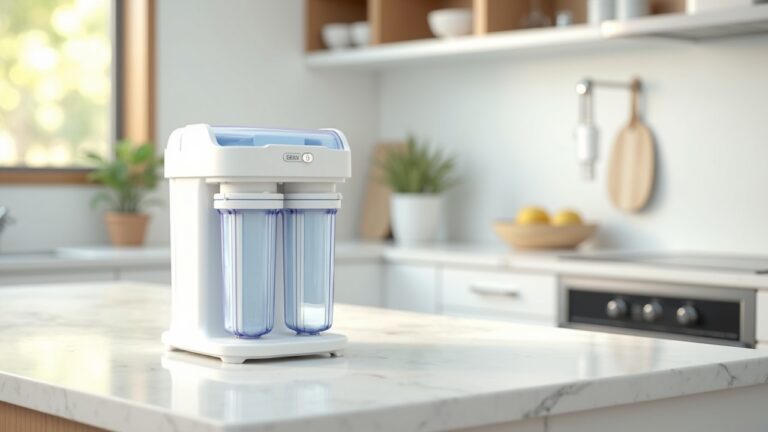
The Puratap GI-2600 is an under-sink, point-of-use water filter connected to a dedicated chrome tap installed alongside your existing kitchen mixer. Water from the mains passes through a sealed granular activated carbon (GAC) cartridge before reaching the outlet. The carbon adsorbs organic compounds responsible for taste and odour — primarily free chlorine and a portion of chloramine — through a physical process in which contaminants bond to the porous carbon surface as water flows through at normal household pressure.
Installation is handled entirely by a Puratap technician; the homeowner requires no plumbing knowledge or tools. The filter cartridge is rated to 2,000 litres or 12 months of use, whichever comes first. At typical household drinking and cooking consumption of four to six litres per day, both thresholds align closely, making the annual service visit a logical replacement interval. Once the cartridge is exhausted, it must be replaced by a licensed Puratap technician — the company does not supply replacement cartridges for consumer purchase through any retail channel.
Certifications held by the GI-2600 include WaterMark Level 1, confirming compliance with Australian plumbing product standards, and NSF/ANSI 53, which covers reduction of health-effect contaminants including cysts, lead, and specific chlorination by-products. NSF/ANSI 53 is not applicable to fluoride removal — that falls under NSF/ANSI 58, which applies only to reverse osmosis systems capable of removing dissolved solids through membrane filtration. The GI-2600 does not hold NSF/ANSI 58 certification because it is not an RO system.
What Puratap Actually Filters — and What It Misses in Adelaide Water
SA Water’s primary disinfection method is chloramination — the combination of chlorine and ammonia to produce monochloramine — rather than simple free-chlorine dosing. Chloramine is more chemically stable than free chlorine, which makes it preferable for Adelaide’s extended distribution network where residual disinfectant must remain active over greater distances. The practical consequence for carbon filtration is significant: activated carbon removes chloramine at approximately 1/40th the rate it removes free chlorine. A standard GAC cartridge will substantially reduce free chlorine at any realistic household flow rate; its reduction of chloramine is materially lower, and that performance declines further as the cartridge ages and active adsorption sites become saturated.
Fluoride is added to Adelaide’s reticulated water supply at between 0.6 and 1.0 mg/L, within the Australian Drinking Water Guidelines 2022 maximum of 1.5 mg/L. Activated carbon is chemically incapable of removing fluoride — the fluoride ion does not adsorb onto carbon surfaces under normal pH and flow conditions. Reducing fluoride from mains water requires a reverse osmosis membrane, typically achieving 90–97% reduction, or a dedicated alumina or bone-char adsorption stage. The Puratap GI-2600 incorporates neither.
PFAS contamination is a documented concern in several SA localities, particularly near Pt Augusta and Whyalla, where legacy use of AFFF firefighting foam has been associated with groundwater and distribution network contamination. Granular activated carbon offers partial reduction for some PFAS compound classes, but the contact time, media volume, and specific cartridge specification required for reliable PFAS reduction exceed what a standard domestic GAC cartridge delivers. Households served by SA Water sources near confirmed PFAS-affected areas should use a reverse osmosis system with a certified membrane, not activated carbon alone.
Annual Running Cost and 5-Year Total: Puratap vs Alternatives
Puratap operates on a service-contract model rather than an outright purchase. Installation is typically bundled into the first year of service. The annual fee, covering the technician visit and cartridge replacement, is approximately $80. With no emergency call-out fees, the all-in five-year cost is approximately $659 — making it the lowest-cost permanently installed option available in South Australia.
The EcoHero 5-Stage RO from Pure Water Systems retails at approximately $599 installed, with annual five-stage filter replacement kits costing approximately $150. Over five years, the total reaches approximately $1,349 — roughly double the Puratap cost. That $690 premium buys NSF/ANSI 58-rated fluoride removal (90–97% reduction), reliable chloramine removal via the system’s multi-stage carbon and membrane process, PFAS reduction, and DIY filter replacement that eliminates technician scheduling entirely. Standard pitcher filters (Brita equivalents) cost around $400 over five years in cartridges but deliver negligible chloramine reduction and zero fluoride removal. Bottled water at current prices runs approximately $5,475 over five years and generates significant plastic waste per household.
| Filter System | 5-Year Cost | Fluoride Removal | Chloramine |
|---|---|---|---|
| Puratap GI-2600 | ~$659 | ✗ None | Partial only |
| EcoHero 5-Stage RO | ~$1,349 | ✓ 90–97% | ✓ Full removal |
| Standard Brita/carbon | ~$400 | ✗ None | ✗ Minimal |
| Bottled water (2L/day) | ~$5,475 | Varies | Varies |
The Service Model: Annual Technician Visit, No DIY Option
Puratap operates a fully closed service model: the company supplies and installs the filter system exclusively through its own technician network in South Australia, and replacement cartridges are not available to consumers through any retail channel. Unlike virtually every other domestic water filter on the Australian market, the GI-2600 cannot be self-serviced. Replacement requires booking a Puratap technician who visits the property, replaces the cartridge, checks the installation, and charges the annual service fee.
For time-poor households or renters unwilling to manage filter maintenance themselves, this has genuine value. You schedule one appointment per year, a technician handles everything, and the system operates without further input from the occupant. Puratap has been running this model in South Australia for over 30 years and has established service routes across metropolitan Adelaide and a number of regional areas. That operational track record is a legitimate and verifiable selling point.
The limitations of the closed model become apparent across several real scenarios. If you relocate interstate, the system has no ongoing support network — Puratap does not operate outside SA and the cartridge cannot be sourced elsewhere. If the technician reschedules your appointment — which ProductReview data suggests occurs with some frequency — you may be running on an exhausted or near-exhausted cartridge for weeks before a new booking is available. Any issue arising between annual visits — a leak, reduced flow rate, an unusual taste change — requires a separate call-out at additional cost. The model suits households who value managed simplicity; it does not suit those who value flexibility or self-sufficiency.
What 219 Adelaide Customers Say on ProductReview
Puratap holds a 4.0-star rating from 219 customer reviews (brand-listed) on ProductReview.com.au, making it one of the more-reviewed domestic water filter products on the platform. The volume and consistency of the review set lend the rating credibility — this is not a product padded by a handful of five-star entries from launch week. The majority of positive reviews emphasise improved water taste, reliable long-term scheduling, and the ease of a fully managed service that requires nothing from the homeowner between annual visits.
Negative reviews cluster around three operational themes. First, scheduling advance: several reviewers report being contacted to book the annual service at the 10-month mark rather than 12 months, which over time effectively compresses the service interval and increases the annual cost beyond what the advertised fee implies. Second, post-service leaks: a subset of reviews describe water leaks under the sink discovered after the annual visit, most attributed to cartridge housing not being fully tightened by the attending technician. Third, in-visit upselling: reviewers report being encouraged to upgrade to newer Puratap models or add ancillary filtration products during the service call.
Notably absent from the negative reviews is any complaint about filtration performance. No reviewer disputes that the water tastes and smells better following installation. The concerns are concentrated entirely in service logistics, technician quality variance, and the commercial practices embedded in the closed service model. This pattern is consistent with a product that performs its core function — chlorine taste and odour reduction — while operating a service infrastructure that generates mixed customer experience at the account management level.
Our Verdict: Puratap in 2026
Puratap earns a mixed result in the Clean and Native assessment framework. Strong marks for certification integrity (NSF/ANSI 53 and WaterMark Level 1), operational convenience for households who value managed simplicity, and a 30-year SA service track record are offset by significant deductions for chloramine limitation, zero fluoride removal capability, SA-only geographic coverage, and a closed service model that creates long-term dependency on a single provider’s scheduling and pricing.
If your primary concern is chlorine taste in Adelaide mains water and you have no interest in fluoride, chloramine, or PFAS removal, Puratap is a defensible choice. The annual service fee is modest relative to the alternatives, installation is professionally managed, and the company has decades of local operating history. For households in that specific situation — Adelaide address, chlorine taste concern, preference for zero-maintenance convenience — Puratap is a defensible choice.
For any household wanting a filter that addresses Adelaide’s full contaminant picture — the chloramine that is SA Water’s actual primary disinfectant, the fluoride added at up to 1.0 mg/L, and any PFAS risk from proximity to affected SA Water sources — reverse osmosis is the only suitable technology. The EcoHero 5-Stage RO from Pure Water Systems is our top-rated alternative: WaterMark AS3497 certified, NSF/ANSI 58 rated for fluoride removal, with DIY filter replacement and availability across all Australian states and territories.
Get Fluoride-Free Adelaide Water Without a Service Contract
The EcoHero 5-Stage RO removes 95%+ of TDS, 90–97% of fluoride, and reliably addresses PFAS from any SA mains water supply. WaterMark AS3497 certified. DIY filter replacement. No annual technician scheduling.
Frequently Asked Questions
Does Puratap remove fluoride from Adelaide water?
No. Puratap uses granular activated carbon, which cannot remove fluoride ions from water. SA Water adds fluoride to Adelaide’s reticulated supply at 0.6–1.0 mg/L. To remove fluoride from Adelaide mains water, you require a reverse osmosis system certified to NSF/ANSI 58.
Is Puratap available outside South Australia?
No. Puratap operates exclusively in South Australia. Installation, filter replacement, and annual servicing are all conducted by the company’s own technician network, which does not extend to any other Australian state or territory. Relocating interstate means losing access to ongoing service and cartridge replacement entirely.
Does Puratap remove chloramine from Adelaide mains water?
Only partially. SA Water uses chloramine as its primary disinfectant. Activated carbon removes chloramine at approximately 1/40th the rate it removes free chlorine. The GI-2600 will reduce chloramine levels but will not eliminate them. Households wanting reliable chloramine removal require a system with catalytic carbon media or a reverse osmosis membrane.
How much does the Puratap annual service cost?
The annual technician visit, including cartridge replacement and installation check, costs approximately $80. The five-year all-in cost including initial installation is approximately $659, assuming no emergency call-out visits between scheduled services.
Can I replace the Puratap filter myself?
No. Puratap does not supply replacement cartridges through any consumer retail channel. The filter must be replaced by a licensed Puratap technician during the scheduled annual service visit. This is a deliberate design feature of the company’s service model and applies to all GI-2600 installations.
What is the difference between Puratap and a reverse osmosis system?
Puratap uses a single-stage granular activated carbon filter to reduce taste and odour compounds and holds NSF/ANSI 53 certification. A reverse osmosis system forces water through a semi-permeable membrane, removing dissolved solids including fluoride (90–97%), heavy metals, nitrates, and PFAS, and holds NSF/ANSI 58 certification. RO systems cost more to install and waste a proportion of water during filtration, but they address a far broader range of contaminants.
Is Puratap NSF certified?
Yes, to NSF/ANSI 53, which covers reduction of health-effect contaminants including cysts, lead, and specific disinfection by-products. The GI-2600 does not hold NSF/ANSI 58 certification — that standard covers fluoride removal via reverse osmosis and is not applicable to activated carbon systems.
How long does the Puratap filter last?
The GI-2600 cartridge is rated for 2,000 litres or 12 months, whichever comes first. At typical household drinking and cooking usage of four to six litres per day, both thresholds align to approximately the 12-month service interval. Filter replacement must be performed by a Puratap technician — it cannot be done by the homeowner.
What do Adelaide customers say about Puratap?
Puratap holds a 4.0-star rating from 219 customer reviews (brand-listed) on ProductReview.com.au. Positive reviews consistently cite improved water taste, long-term service reliability, and the convenience of fully managed maintenance. Negative reviews focus on early service scheduling (technicians calling at 10 months rather than 12), occasional post-service leaks under the sink, and upselling during annual visits. No reviewer disputes the taste improvement itself.
What is the best alternative to Puratap for fluoride removal?
The EcoHero 5-Stage RO from Pure Water Systems is the Clean and Native top-rated alternative. It is WaterMark AS3497 certified, rated to NSF/ANSI 58 for fluoride removal (90–97% reduction), reliably addresses PFAS from SA mains water sources, and allows DIY filter replacement with no annual technician requirement. Five-year all-in cost is approximately $1,349. Available across all Australian states and territories.
Get the Australian Home Environment Checklist
30 checks across water, air and EMF. Most of them free. Ranked by impact.
No spam. Unsubscribe any time.

Former Royal Australian Navy Clearance Diver and TAG-E counter-terrorism operator. Founded Clean and Native to apply the same rigorous thinking to the home environment.
Full biography →