Parramatta Tap Water Quality 2026: Chloramine, PFAS and What Filters Actually Work
Drafted with AI assistance and checked against published specifications and certifications. First-hand measurements appear only where stated. How we make content
Affiliate disclosure: Clean and Native earns a commission if you purchase through links on this page. This does not affect our editorial position — products are recommended based on performance data and certification only.
Parramatta’s tap water is treated with chloramine (not just chlorine), which means standard activated carbon filters like Brita pitchers or basic benchtop units will not effectively remove the chemical taste or odour. The water itself is safe and soft (48–52 mg/L hardness), meets Australian Drinking Water Guidelines for PFAS, and contains ~1.0 mg/L fluoride. The catches: you need catalytic carbon or reverse osmosis to remove chloramine, and Sydney Water’s PFAS testing is quarterly, not continuous.
| Filter type | Chloramine removal | Verdict |
|---|---|---|
| Reverse osmosis | Yes (plus PFAS, fluoride) | Recommended |
| Catalytic carbon | Yes (not fluoride/PFAS) | Good for taste only |
| Standard carbon | No | Avoid for Parramatta |
Quick answer
The three products we own are measured first-hand by Jayce Love, former Royal Australian Navy Clearance Diver; every other product is assessed on published manufacturer specifications and independent certification using our documented methodology — no gifted units, no brand payments.
Parramatta’s tap water comes from Warragamba Dam via Sydney Water’s Prospect Water Treatment Plant. It is safe to drink, soft (48-52 mg/L hardness), and meets all Australian Drinking Water Guidelines. The critical fact for filtration decisions: Sydney Water uses chloramine in the Parramatta distribution zone — not just chlorine. Standard activated carbon filters (Brita pitchers, basic under-sink carbon blocks) do not effectively remove chloramine. If you have one of these filters and still notice a chemical taste, this is why. Catalytic carbon or reverse osmosis is required.
Soft
Not just chlorine
NSW mandated
June 2025
If you have ever bought a water filter for your Parramatta home and found it did not fully resolve the chemical taste, there is a specific technical reason: Parramatta sits in a chloramine treatment zone. Standard carbon filtration — which is what most tap filters, pitcher filters, and basic under-sink units use — is designed to remove free chlorine, not chloramine. This guide covers what Sydney Water’s testing data shows for the Prospect/Parramatta supply zone, why chloramine changes your filtration requirements, the PFAS situation for Warragamba Dam catchment, and what filters are actually appropriate.
Where Parramatta’s water comes from
Parramatta is served by Sydney Water’s Prospect Water Treatment Plant — one of the largest water treatment facilities in the Southern Hemisphere. The plant processes water sourced primarily from Warragamba Dam, which supplies over 80% of Greater Sydney’s drinking water. The Warragamba catchment covers 9,053 km2 of the Blue Mountains and Southern Highlands, feeding into the Hawkesbury-Nepean River system. Additional supply comes from the Upper Canal system connecting the Upper Nepean scheme.
Warragamba Dam sits on sandstone geology — relatively low in calcium and magnesium compared to limestone catchments. This geological characteristic is why Sydney’s water is soft across the entire network. The Prospect WTP processes the raw water through coagulation, flocculation, sedimentation, filtration, and then disinfection before distribution into the Parramatta, Blacktown, Liverpool, and Sydney CBD zones.
During drought conditions — most notably the 2017-2019 drought which pushed Warragamba to below 43% capacity — the Kurnell desalination plant provides supplementary supply. Desalinated water has near-zero TDS and a different mineral profile to dam water, meaning water quality characteristics can shift seasonally depending on the blend in the network.
Parramatta water quality — what the data shows
| Parameter | Parramatta (Prospect zone) | ADWG guideline | Filtration relevance |
|---|---|---|---|
| Hardness | 48-52 mg/L CaCO3 (soft) | No health guideline | Good. Minimal scale. No softener required. |
| Disinfection | Chloramine (chlorine + ammonia) | 3 mg/L (health) | Critical: Standard carbon filters do NOT remove chloramine. Catalytic carbon or RO required. |
| Fluoride | ~1.0 mg/L | 1.5 mg/L (health) | NSW mandated. RO removes 93%+ if priority. |
| PFAS | Low-level detections, below ADWG | Updated June 2025 | PFOA ~0.53 ppt, PFOS ~0.82 ppt. Well below limits. RO removes >99%. |
| pH | 7.0-8.0 | 6.5-8.5 (aesthetic) | Within range. No action required. |
| THMs (disinfection byproducts) | Monitored, within ADWG | 250 µg/L (health) | Chloramine produces fewer THMs than free chlorine — one advantage of chloramine treatment. |
Chloramine: the most important fact for Parramatta filtration
Chloramine is a compound formed by combining chlorine with ammonia. Sydney Water uses it in significant parts of the distribution network — including the Prospect zone that supplies Parramatta — because chloramine persists further through distribution pipes than free chlorine alone, providing a longer-lasting disinfection residual across Sydney’s extensive pipe network.
For filtration, this creates a specific technical problem that most consumers are unaware of. Standard activated carbon — the filtration medium in Brita pitchers, most benchtop filters, and basic under-sink units — works by adsorption: contaminants stick to the porous carbon surface. Free chlorine bonds strongly to activated carbon and is removed in seconds of contact time. Chloramine has a much weaker affinity for standard carbon and requires either:
Catalytic carbon — a specially manufactured carbon media with enhanced surface properties that accelerates chloramine breakdown. Contact time still matters — catalytic carbon needs adequate flow restriction to work. A fast-flowing tap with a thin carbon layer may still pass chloramine through.
Reverse osmosis — the membrane rejects chloramine along with all other dissolved compounds. RO does not rely on adsorption kinetics and effectively removes chloramine regardless of concentration or flow rate.
What does NOT remove chloramine from Parramatta tap water:
- Standard activated carbon (Brita, basic pitcher filters)
- Standard carbon block under-sink filters not rated for chloramine
- Ceramic filters
- Basic benchtop gravity filters
What does work: Catalytic carbon-certified filters (NSF 42 tested for chloramine removal), or reverse osmosis systems.
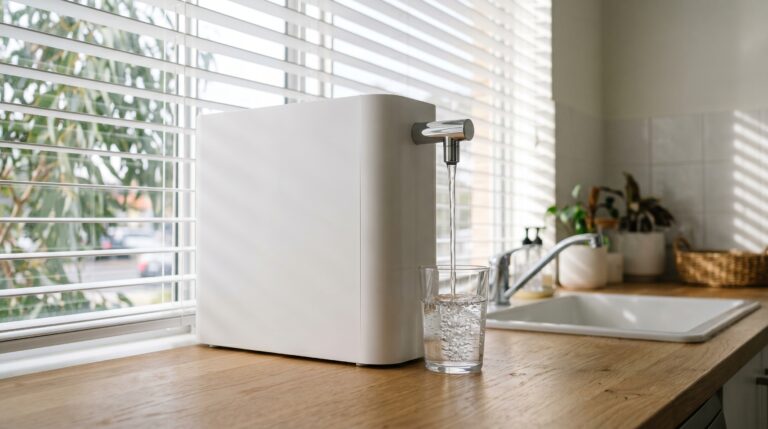
This is why the TAPP EcoPro is specifically relevant for Sydney and Parramatta — it uses catalytic carbon media and is independently certified to remove both chlorine and chloramine. Most filter brands marketed as “water filters” in Australian supermarkets are not tested for chloramine removal and will leave most of it in your water.
PFAS in Parramatta’s water supply
A 2025 UNSW study — the most comprehensive analysis of PFAS in Sydney tap water to date — tested 32 samples across the Sydney basin and found 31 different PFAS compounds, including 21 not previously recorded in Australian tap water. For the Prospect/Warragamba catchment zone that includes Parramatta, the key results were: PFOA at approximately 0.53 ppt (parts per trillion), PFHxS at approximately 0.64 ppt, and PFOS at approximately 0.82 ppt.
Context is essential here. The updated June 2025 ADWG guideline for PFOS is 8 ppt. The Parramatta/Prospect zone PFOS reading of 0.82 ppt is approximately 10% of that limit. PFOA’s new guideline is 4 ppt; the detected level of 0.53 ppt is about 13% of the limit. The NSW Government confirmed all Sydney Water supplies meet the updated guidelines. These are real detections at very low levels — not zero like Canberra, but well within the regulatory framework and not a cause for alarm for most people.
The elevated PFAS situation that attracted significant media attention in 2024 was at the Cascade Water Treatment Plant serving the Blue Mountains — a different catchment and distribution zone to Parramatta. That issue has been substantially addressed through blending with Oberon Dam water. Parramatta residents are served by the Prospect/Warragamba catchment, which has consistently lower PFAS levels.
For Parramatta residents who want to address PFAS at the household level regardless of the compliant levels, reverse osmosis achieves greater than 99% removal. For a full explanation of PFAS in Australian water, see our PFAS in Australian drinking water guide.
What filtration actually works for Parramatta
Primary concern: chloramine taste and odour
An NSF 42-certified catalytic carbon filter removes chloramine, chlorine, and taste compounds. The filter must specifically use catalytic carbon media — not standard activated carbon — and must be certified for chloramine removal. Check the certification before buying; most supermarket filters are not rated for chloramine.
Recommended: TAPP EcoPro — catalytic carbon, NSF 42 + 53 certified for chloramine
Comprehensive: PFAS, fluoride, chloramine, TDS
A 5-stage reverse osmosis system removes chloramine (via the membrane), PFAS (99%+), fluoride (93.6%), and all dissolved compounds in one system. For Parramatta households concerned about multiple parameters simultaneously, RO is the appropriate technology. No catalytic carbon dependency — the membrane handles everything.
Recommended: EcoHero 5-Stage RO — WaterMark + NSF 58 certified
See the EcoHero RO System →Parramatta vs other Sydney zones
Not all Sydney suburbs have identical water quality. The supply zone determines which treatment plant your water comes from and — critically — whether chloramine or free chlorine is used.
| Supply zone | Treatment plant | Hardness | Disinfection | Filter requirement |
|---|---|---|---|---|
| Parramatta / Blacktown / Liverpool | Prospect WTP | 48-52 mg/L | Chloramine | Catalytic carbon or RO. Standard carbon insufficient. |
| Penrith / St Marys / Kingswood | Orchard Hills WTP | ~57 mg/L (slightly harder) | Chloramine | Catalytic carbon or RO. |
| Blue Mountains | Cascade WTP | ~40-50 mg/L | Chlorine | Standard carbon works. PFAS was elevated 2024 (resolved). |
| Northern Beaches / Manly | Potts Hill / Ryde | ~48-52 mg/L | Chloramine | Catalytic carbon or RO. |
To confirm your exact supply zone and disinfection method, Sydney Water’s What’s in Your Water tool lets you enter your address for specific water quality data. The chloramine vs chlorine distinction is the most important variable for filter selection.
Not sure which filter is right for your Parramatta home? Answer four questions including whether you are renting or own, your main concern, and your budget at our water filter quiz. For a full breakdown of all filter options, see the best water filters Australia guide.
Frequently asked questions
Is Parramatta water hard or soft?
Parramatta water is soft at approximately 48–52 mg/L as CaCO3, sourced from Warragamba Dam’s sandstone catchment. No scale issues and no need for a water softener.
Can I drink Parramatta tap water without filtering?
Yes. Parramatta tap water meets all ADWG health guidelines from Sydney Water’s Prospect Water Treatment Plant. Filtration is a personal preference for taste or trace contaminant reduction — not a health necessity.
What is the TDS of Parramatta tap water?
TDS in Parramatta (Prospect supply zone) is typically 60–80 mg/L — low by Australian standards, reflecting Warragamba Dam’s soft, low-mineral catchment.
Is Parramatta tap water safe to drink?
Yes. Parramatta is served by Sydney Water’s Prospect Water Treatment Plant, which processes water from Warragamba Dam. Sydney Water’s supply meets all Australian Drinking Water Guidelines and is safe to drink without filtration. Chloramine disinfection, fluoride, and low-level PFAS (well below ADWG limits) are present but within regulatory standards.
Does Parramatta water have chloramine?
Yes. Sydney Water uses chloramine in the Prospect supply zone that includes Parramatta, Blacktown, Liverpool, and Sydney CBD. Chloramine is a combination of chlorine and ammonia used for its longer-lasting disinfection residual in distribution pipes. Standard activated carbon filters (most pitcher filters and basic under-sink units) do not effectively remove chloramine. Catalytic carbon or reverse osmosis is required.
PFAS in Parramatta?
Low-level detections (PFOA 0.53 ppt, PFOS 0.82 ppt) — well below June 2025 ADWG limits. Different catchment to the Blue Mountains issue. NSW Gov confirmed compliance.
Best filter for Parramatta?
Catalytic carbon (TAPP EcoPro, NSF 42 chloramine-certified) for taste and chloramine. RO (EcoHero 5-stage) for chloramine + PFAS + fluoride comprehensively.
Is Parramatta water hard?
No. Parramatta water is soft at approximately 48-52 mg/L as CaCO3, consistent with the rest of Sydney’s supply from Warragamba Dam’s sandstone catchment. This is well below the aesthetic guideline of 200 mg/L. There is minimal scale on appliances, no need for a water softener, and easy soap lathering.
Get the Australian Home Environment Checklist
30 checks across water, air and EMF. Most of them free. Ranked by impact.
No spam. Unsubscribe any time.

Former Royal Australian Navy Clearance Diver and TAG-E counter-terrorism operator. Founded Clean and Native to apply the same rigorous thinking to the home environment.
Full biography →