Best Water Filter for Hiking Australia 2026: What Parks Say and 5 Picks
Drafted with AI assistance and checked against published specifications and certifications. First-hand measurements appear only where stated. How we make content
How this guide was made. I have not field-tested these filters for this guide. It is built from the water advice published by Australian parks agencies and health departments, the US CDC’s backcountry water treatment guidance, the makers’ own specification pages and labels, and OutdoorGearLab’s published flow tests. Amazon AU prices update automatically. Where a figure is a manufacturer claim, the article says so.
The best water filter for hiking in Australia for most walkers is a 0.1 micron hollow-fibre squeeze filter such as the Sawyer Squeeze, carried with a pack of chlorine dioxide tablets as a backup. It removes the Giardia, Cryptosporidium and bacteria that Australian parks agencies warn about, weighs about 85 g, and can be backflushed on the track. For groups, a 4 L gravity filter is faster at camp; for overseas treks, where viruses are a risk, carry a purifier rated for viruses, such as a pump purifier or a carbon press bottle.
The first thing to know is that the official advice in Australia is blunt. Tasmania’s Parks and Wildlife Service says water from the Overland Track’s hut tanks “needs to be boiled or treated prior to drinking”. The Bibbulmun Track Foundation says to treat even the campsite tanks. Every major track authority we checked says the same thing in its own words, so a treatment method is part of the kit, not an optional extra.
| Pick | Best for | Treats | Price |
|---|---|---|---|
| Sawyer Squeeze | Most walkers, day to multi-day | Protozoa, bacteria | $75.63at Amazon AU · as of 19 Nov 2026, 11:29 pm AEST Details |
| Platypus QuickDraw | Fast refills, trail runners | Protozoa, bacteria | $54.04at Amazon AU · as of 19 Nov 2026, 11:29 pm AEST Details |
| Platypus GravityWorks 4 L | Groups and base camps | Protozoa, bacteria | Currently unavailable on Amazon AUas of 19 Nov 2026, 11:29 pm AEST Details |
| MSR Guardian | Overseas treks, groups, doubtful water | Protozoa, bacteria, viruses | Not stocked on Amazon AU (Nov 2026) |
| GRAYL GeoPress | One-bottle purifier for travel and day walks | Protozoa, bacteria, viruses; carbon for taste | Currently unavailable on Amazon AUas of 19 Nov 2026, 11:29 pm AEST Details |
| Chlorine dioxide tablets | Backup, freezing nights, viruses | Bacteria, viruses, Giardia (4 h contact time) | Varies by retailer |
What Australian parks tell you to do
Before choosing gear, it helps to see what the people who manage the tracks actually say. The pattern is consistent: tank water at huts and campsites is untreated rainwater, and creek water should be treated too.
| Track or agency | What it says |
|---|---|
| Overland Track (Tasmania Parks and Wildlife Service) | Water from the hut rainwater tanks “needs to be boiled or treated prior to drinking”. |
| Larapinta Trail (NT Parks) | For the ranger-maintained tanks: “boil the water, use sterilising tablets or a filter as the quality of the water can’t be guaranteed.” If you must use surface water, treat it first by boiling or filtering if possible. |
| Bibbulmun Track Foundation (WA) | “Drink only treated water”, including water from the campsite tanks. |
| NSW National Parks, alpine areas (Kosciuszko) | If you cannot carry enough water, purify all stream water before drinking: boil for at least 5 minutes or use treatment tablets, a filter or UV, and collect water upstream from toilets, huts and campsites. |
| Parks Victoria | Bring water to a rolling boil, or use chlorine or iodine tablets, handheld UV units, microfilters or purifiers, following the maker’s instructions. Boiling may not make water safe if it is contaminated with chemicals or heavy metals. |
| NSW Health (giardiasis) | “Do not drink untreated water from rivers or lakes.” Hikers and campers are listed among the groups at risk. |
What is actually in trail water
The organisms that matter on an Australian bushwalk fall into three groups, and they are very different sizes. That size difference is the whole reason one filter covers some risks and not others.
- Protozoa: Giardia and Cryptosporidium, the parasites behind most “bad creek water” stories. NSW Health lists hikers and campers among the people at risk of giardiasis. They are also the toughest to kill with ordinary chlorine.
- Bacteria: carried in animal and human faecal contamination, more likely below huts, campsites and grazing land.
- Viruses: mostly a risk where human sewage reaches the water. They are far smaller than bacteria and pass straight through a standard hiking filter.
Why a 0.1 micron filter stops Giardia but not viruses
The parasites hikers worry about are 20 to 200 times wider than a hollow-fibre filter’s pores. Viruses are far smaller, which is why only a purifier rated for them, boiling or a chemical step covers them.
Log scale: each step to the right is ten times larger. Organism sizes from the US CDC; pore sizes are the makers’ figures. CDC advises that filters with an absolute pore size of 0.3 µm or smaller remove protozoa and bacteria, but not viruses.
The practical conclusion: in a remote Australian catchment, a 0.1 to 0.2 µm hollow-fibre filter covers the main risks. Where human contamination is likely, below huts, popular campsites or farms, or overseas, add a chemical step or carry a purifier rated for viruses.
Five ways to treat water, compared
This summary follows the US CDC and the Minnesota Department of Health ratings for the common backcountry methods, which are the clearest guides to what each method does and does not cover.
| Method | Protozoa | Bacteria | Viruses | Catch |
|---|---|---|---|---|
| Hollow-fibre filter (0.1 to 0.2 µm absolute) | Removes | Removes (MDH rates it moderate) | No | Clogs in silty water; can be damaged by freezing |
| Purifier rated for viruses | Removes | Removes | Removes | Heavier and dearer |
| Boiling | Kills | Kills | Kills | Fuel and time; does not remove chemicals or algal toxins |
| Chlorine dioxide tablets (e.g. Micropur MP1) | Kills Giardia; only partly effective on Cryptosporidium | Kills | Kills | Slow: the US label says 4 hours |
| Chlorine tablets (e.g. Aquatabs) | Poor on Giardia; not effective on Cryptosporidium | Kills | Kills | Cheap and light, but not an answer to protozoa |
| UV pen (e.g. SteriPEN) | Kills | Kills | Kills | Clear water only; needs charge; MDH notes limited independent testing |
Two details from the labels are worth knowing. The US label for Micropur MP1 chlorine dioxide tablets says one tablet treats 1 L and needs 4 hours in an opaque container or in the dark before drinking. For creek or lake water, the US label for 49 mg Aquatabs doses one tablet per 0.75 L, mixed for 10 minutes and then left for 30 minutes, and carries the statement “Not tested against cryptosporidium”. Other packs say one tablet per 1 L of clear water, or two for cloudy or cold water. Always follow the dose and contact time on the pack you buy.
For boiling, CDC advice is a rolling boil for 1 minute, or 3 minutes above about 2,000 m. NSW National Parks asks for at least 5 minutes in the alpine areas, so on the Main Range, follow the local rule.
Trail water planner
Pick your water source, trip type and overnight temperatures for a recommended setup.
The picks
Amazon AU prices are shown live in the table above and under each button.
1. Sawyer Squeeze: best for most Australian walkers
 Absolute pore0.1 µmBackflush in the field
Hollow fibre, 0.1 µm absolute | About 85 g filter only (Sawyer: 3 oz) | Bacteria and protozoa, not viruses | Backflush plunger included | Lifetime limited warranty
Check the Sawyer Squeeze price →Amazon AU price: $75.63 · as of 19 Nov 2026, 11:29 pm AEST DetailsThe Sawyer Squeeze is one of the most widely used hiking filters, and it is easy to see why. Sawyer rates its 0.1 µm absolute hollow-fibre membrane to remove bacteria and protozoa, it screws onto the pouches it comes with and onto many standard bottles, and it can be backflushed with the included cleaning plunger when the flow slows. Sawyer backs it with a lifetime limited warranty.
It is not the fastest. OutdoorGearLab measured about 50 seconds a litre, and noted that without regular backflushing the flow drops after only a few fills. Like every hollow-fibre filter, it can be damaged by freezing, and Sawyer says there is no definitive way to tell if that has happened.
✓ Pros
- 0.1 µm absolute, the finest pore here outside the purifier
- Backflushes in the field, so silty creeks are recoverable
- Light and simple; lifetime limited warranty
× Cons
- About 50 s a litre in OutdoorGearLab’s test
- Must be kept from freezing; damage cannot be checked
Buy this if…
you want one filter for day walks and multi-day tracks, and you will carry tablets as a backup.
2. Platypus QuickDraw: faster squeezing
 Squeeze flow3 L/minMaker figure
Hollow fibre, 0.2 µm | 69 g filter only (83 g total) | Bacteria and protozoa, not viruses | Shake to clean, backflush every 10 L | Rated 1,000 L | Integrity check after a fall or freezing
Check the QuickDraw price →Amazon AU price: $54.04 · as of 19 Nov 2026, 11:29 pm AEST DetailsThe QuickDraw is the pick if refill speed matters, such as for trail runners or anyone filtering at every creek. Platypus rates it at up to 3 L a minute when squeezed, and it took about 27 seconds a litre in OutdoorGearLab’s test, roughly half the Sawyer’s 50 seconds. Its 0.2 µm pore still removes bacteria and protozoa.
The catch is murky water: OutdoorGearLab found it did not perform well in turbid sources. Platypus also publishes an integrity check to run after a fall or a freeze, which is useful peace of mind.
✓ Pros
- About 27 s a litre in OutdoorGearLab’s test, against 50 s for the Sawyer
- Integrity check after drops or freezing
- Light
× Cons
- Struggles in turbid water
- 0.2 µm rather than 0.1 µm
- Rated for 1,000 L (Sawyer publishes no litre rating)
Buy this if…
you refill often from clear creeks and want quicker squeezing than the Sawyer.
3. Platypus GravityWorks 4 L: best for groups and base camps
 Gravity flow1.75 L/minHands-free
Hollow fibre, 0.2 µm | 326 g | Bacteria and protozoa, not viruses | Backflush in the field | Rated 1,500 L
Check the GravityWorks price →At camp, gravity beats squeezing. You fill the 4 L dirty bag at the creek, hang it, and it drains through the filter into the clean bag while you pitch the tent. Platypus rates it at up to 1.75 L a minute and 1,500 L of filter life. For two or more walkers it removes the most tedious job of the evening.
Platypus warns that the wet fibres can freeze and break, and suggests keeping the filter near your body or in your sleeping bag in freezing conditions. OutdoorGearLab found it prone to clogging in murky water, so let silty water settle before filling the dirty bag.
✓ Pros
- Hands-free: filters while you set up camp
- Enough volume for a group
- Field backflush
× Cons
- Heavier than a squeeze filter (326 g)
- Needs something to hang from
- Clogs in murky water without pre-settling
Buy this if…
you walk as a pair or group, or camp at one site for several nights.
4. MSR Guardian: when viruses are on the table
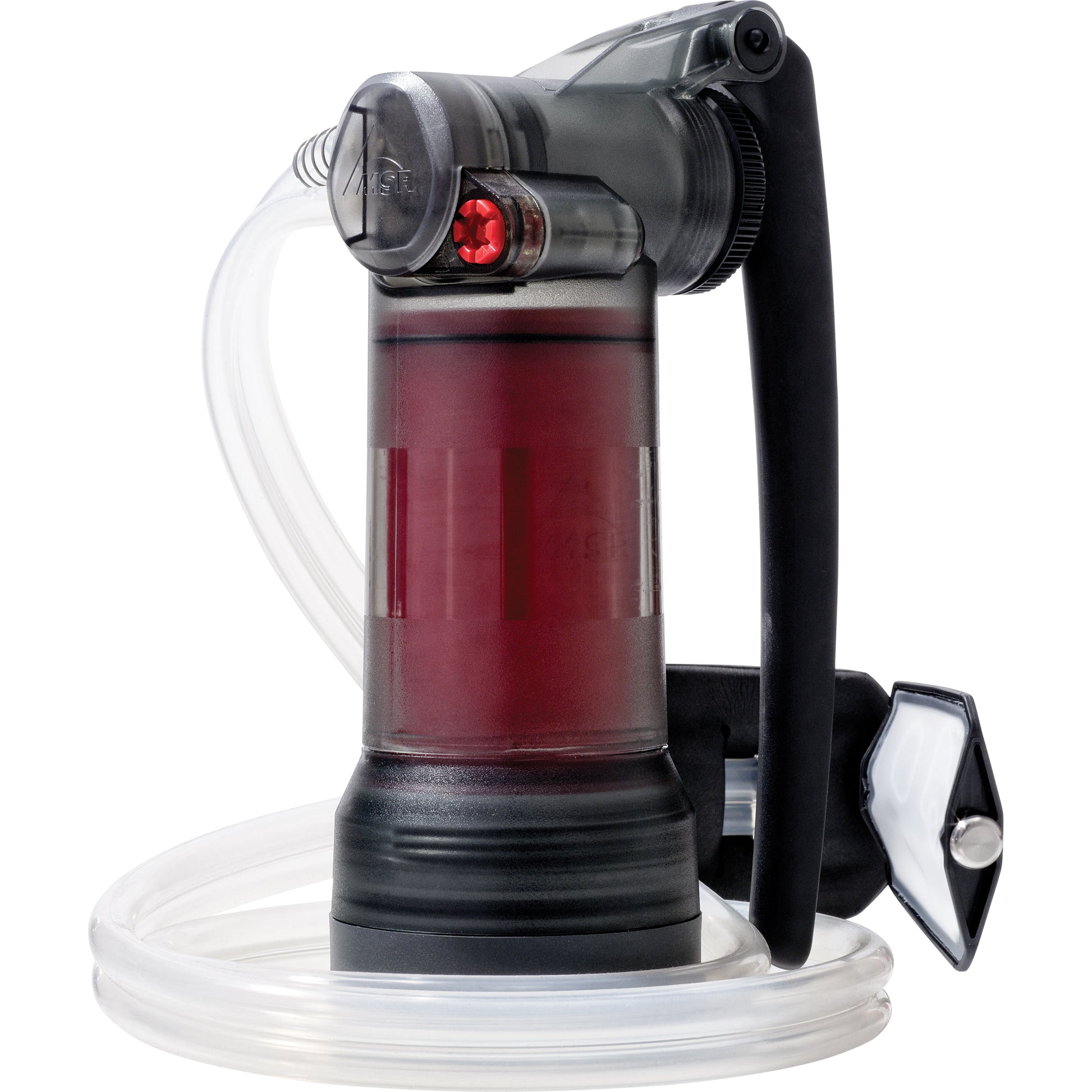 Purifier pore0.02 µmRated for viruses
0.02 µm pump purifier | 490 g | Viruses, bacteria, protozoa (meets NSF P248) | 2.5 L/min | Self-cleans with every stroke | Rated 10,000+ L | Built to withstand freezing
See the Guardian at MSR →The Guardian is a purifier, not just a filter: its 0.02 µm hollow fibres are rated to remove viruses as well as bacteria and protozoa, and MSR says it meets the NSF P248 protocol. It cleans itself on every pump stroke, pumps up to 2.5 L a minute, and MSR says it is engineered to withstand freezing, which sets it apart from every hollow-fibre filter here.
It is also by far the heaviest and dearest pick. For most Australian tracks that is overkill; for trekking in Nepal or South America, for water below busy campsites, or for leading groups, it is the one device that covers everything.
✓ Pros
- Covers viruses as well as bacteria and protozoa
- Self-cleaning, handles dirty water
- Built to withstand freezing
× Cons
- 490 g
- Much dearer than a filter
- Pumping is hands-on work; gravity filters while you do other jobs
Buy this if…
you trek overseas, lead groups, or regularly draw water where human contamination is likely.
5. GRAYL GeoPress: the carbon press purifier
A press purifier works like a coffee plunger in reverse. You scoop creek water into an outer cup, then push an inner press down through it, forcing the water up through a cartridge into the part you drink from. GRAYL says the GeoPress cartridge combines electroadsorption media with activated carbon, and rates it to remove 99.99% of viruses, 99.9999% of bacteria and 99.9% of protozoan cysts. It also says the bottle was independently tested to meet or exceed NSF/ANSI 42 and 53 protocols and the US EPA guide standard for microbiological purifiers.
- 1. ScoopThe hiker kneels at the creek and fills the outer cup to the fill line with untreated water. The dark specks stand for dirt and microbes.
- 2. Seat the pressPull the inner press out, then set it into the top of the full outer cup. Open the small vent cap on the lid first so air can escape.
- 3. PressThe hiker stands, puts the bottle on a flat rock and pushes the press down with body weight. Water is forced up through the cartridge at the base of the press. The maker says a press takes about 8 seconds.
- 4. What the cartridge doesThe cartridge combines electroadsorption media, which the maker rates to remove viruses, bacteria and protozoa, with activated carbon, which improves taste and adsorbs some chemicals.
- 5. Drink, and know when to replace itClose the vent cap and drink from the inner press. The maker rates the cartridge for about 250 L (350 presses) or 3 years, and says to replace it when a press takes about 25 seconds. Discard the dirty water left in the outer cup, and do not let it touch the drinking spout.
Schematic, not to scale. Specifications are the maker’s claims for the GRAYL GeoPress; other press purifiers differ.
The trade-offs are weight and capacity. The GeoPress holds 710 ml and weighs 450 g, and GRAYL rates each cartridge for 350 presses (about 250 L) or 3 years from first use, so it suits one person on day walks and overseas travel more than a group on a long track. OutdoorGearLab timed it at about 35 seconds a litre. GRAYL makes no statement about freezing, so on cold nights treat it like any other wet cartridge and keep it warm.
This article contains affiliate links. We may earn a commission at no extra cost to you.
Check the GRAYL GeoPress price →
Buy this if…
you want one bottle that also covers viruses, for travel or day walks, and do not mind the weight.
6. The backup: chlorine dioxide tablets
Whatever filter you choose, carry a strip of chlorine dioxide tablets such as Katadyn Micropur MP1. They weigh almost nothing, cannot freeze or clog, and add virus coverage when you use them after filtering. Give them the full contact time on the pack; the US Micropur MP1 label says 4 hours. Cheaper chlorine tablets such as Aquatabs work faster but do little against Giardia or Cryptosporidium, so use them after a filter, not instead of one.
If your trip is as much about city taps and travel as creeks, our portable water filter guide covers filter bottles such as the Katadyn BeFree and LifeStraw Go.
Check all seven rooms, not just this one
38 checks, 29 free, ranked by impact. Sent as a 32-page PDF.
We'll email you the audit and a short series of practical guides. Unsubscribe in one click, any time. Privacy.
Sent. Taking you to your download...
Specification comparison
| Spec | Sawyer Squeeze | Platypus QuickDraw | GravityWorks 4 L | MSR Guardian | GRAYL GeoPress |
|---|---|---|---|---|---|
| Type | Squeeze filter | Squeeze filter | Gravity filter | Pump purifier | Press purifier bottle |
| Pore size | 0.1 µm absolute | 0.2 µm | 0.2 µm | 0.02 µm | Electroadsorption plus carbon |
| Viruses | No | No | No | Yes | Yes |
| Weight | About 85 g (filter) | 69 g filter only (83 g total) | 326 g | 490 g | 450 g |
| Maker flow rate | Not stated | Up to 3 L/min | Up to 1.75 L/min | Up to 2.5 L/min | 710 ml in about 8 s |
| OutdoorGearLab time per litre | About 50 s | About 27 s | About 60 s | About 30 s | About 35 s |
| Rated life | Not stated (lifetime limited warranty) | 1,000 L | 1,500 L | 10,000+ L | 250 L (350 presses) or 3 years |
| Freezing | Can damage; replace if suspected | Keep from freezing; run integrity check if it may have | Keep warm; can break | Built to withstand | Not stated |
| Price | $75.63at Amazon AU · as of 19 Nov 2026, 11:29 pm AEST Details | $54.04at Amazon AU · as of 19 Nov 2026, 11:29 pm AEST Details | Currently unavailable on Amazon AUas of 19 Nov 2026, 11:29 pm AEST Details | Not stocked on Amazon AU (Nov 2026) | Currently unavailable on Amazon AUas of 19 Nov 2026, 11:29 pm AEST Details |
OutdoorGearLab’s times come from its own tests and depend on water clarity and how hard you squeeze; treat them as a comparison, not a promise.
Cold nights and frozen filters
This is the failure most Australian walkers do not expect. Hollow-fibre filters stay wet inside after use, and if that water freezes it can crack the fibres without any visible sign. Sawyer says there is no definitive way to tell whether a filter has been damaged by freezing and recommends replacing it if you suspect it has. Platypus says the fibres “can freeze and break”. LifeStraw says ice can damage the membrane by expanding the pores.
On the Overland Track, the Australian Alps or any winter trip, keep the filter in a zip-lock bag inside your sleeping bag at night and in an inside jacket pocket by day. If it may have frozen, stop trusting it and switch to tablets or boiling. Katadyn publishes a simple test for its BeFree filters: wet the filter fully by pushing at least 2 L of clear water through it, then blow air through it for at least 5 seconds. A few pea-sized bubbles are normal; a steady stream of fine bubbles means it is damaged.
A field routine based on parks and maker advice
- Collect upstream of huts, toilets and campsites, as NSW National Parks advises.
- Settle and pre-filter murky water. Let silt drop in a pot or bag, then pour through a bandana or coffee filter. Silt is what kills flow rates.
- Keep dirty and clean separate. Do not let drips from the dirty bag or the filter inlet touch your clean bottle threads.
- Backflush or shake as the maker says, before the flow drops too far.
- Add tablets after filtering where human contamination is likely.
- Carry a backup. A filter can clog, crack or freeze; tablets weigh a few grams.
If you collect rainwater at a holiday house or a remote property between walks, see our guide to drinking rainwater safely in Australia, and for vans and camper trailers, the best caravan water filters.
Blue-green algae: the one thing to walk away from
No hiking filter is a fix for blue-green algae. The Queensland Government warns that boiling will not destroy the toxins and can release more of them into the water, and Victoria’s Better Health Channel says not to use untreated algae-affected water for drinking. The Minnesota Department of Health says backcountry treatment devices are not able to destroy or remove the toxins. If a lake, dam or still pool looks green or scummy, or has an algae warning, find another source.
Final verdict
For most Australian walkers, the Sawyer Squeeze plus a strip of chlorine dioxide tablets is the setup to buy: it handles the Giardia, Cryptosporidium and bacteria the parks agencies warn about, weighs very little, and has a backup built in. If speed matters most, the Platypus QuickDraw is the quickest squeeze; for groups, the GravityWorks 4 L does the work while you make camp; and for overseas treks or doubtful water, the MSR Guardian is the purifier that also covers viruses. If you want that virus coverage in a single bottle for travel or day walks, the GRAYL GeoPress press purifier does it at 450 g.
I served as a Navy Clearance Diver, and one rule that carried over is never to rely on a single piece of kit without a backup. On the track, that means a filter and a backup, and treating every source, including the hut tank.
Frequently asked questions
What is the best water filter for hiking in Australia?
For most walkers, a 0.1 micron hollow-fibre squeeze filter such as the Sawyer Squeeze, carried with chlorine dioxide tablets as a backup. It removes the protozoa and bacteria Australian parks agencies warn about, is light, and can be backflushed on the track. Groups suit a gravity filter, and overseas treks a purifier rated for viruses.
Do I need to treat water from hut and campsite tanks?
Yes. Tasmania Parks and Wildlife Service says Overland Track tank water needs to be boiled or treated, NT Parks says the same for Larapinta Trail tanks, and the Bibbulmun Track Foundation says to treat campsite tank water. It is untreated rainwater.
Does a hiking water filter remove viruses?
Most do not. Hollow-fibre filters with 0.1 to 0.2 micron pores remove bacteria and protozoa but not viruses. For viruses, use a purifier rated for them such as the MSR Guardian or the GRAYL GeoPress, boil the water, or add chlorine dioxide tablets after filtering.
Is boiling water enough when hiking?
Boiling kills protozoa, bacteria and viruses. The US CDC advises a rolling boil for 1 minute, or 3 minutes above about 2,000 m, and NSW National Parks asks for at least 5 minutes in its alpine areas. Boiling does not remove chemicals or algal toxins, and it uses fuel and time.
Do water purification tablets kill Giardia and Cryptosporidium?
Chlorine dioxide tablets such as Micropur MP1 kill Giardia, but CDC rates them only partly effective on Cryptosporidium, and the US label requires 4 hours before drinking. Ordinary chlorine tablets such as Aquatabs work poorly on Giardia and do not work on Cryptosporidium, so pair them with a filter.
What happens if my water filter freezes?
Ice can crack hollow fibres without visible damage, letting germs through. Sawyer says there is no definitive way to tell, and recommends replacing a filter you suspect has frozen. Keep it in your sleeping bag on cold nights and switch to tablets or boiling if it may have frozen.
Can a filter make blue-green algae water safe?
No. Queensland and Victorian health advice says boiling does not remove algal toxins and that algae-affected water should not be drunk, and the Minnesota Department of Health says no backcountry treatment device removes them. Find another water source.
- Tasmania Parks and Wildlife Service: Overland Track walk notes
- NT Parks: Larapinta Trail water
- Bibbulmun Track Foundation: health, hygiene and safety
- NSW National Parks: alpine safety
- Parks Victoria: drinking water
- NSW Health: giardiasis fact sheet
- Queensland Government: blue-green algae and health
- Better Health Channel (Vic): harmful algal blooms
- Minnesota Department of Health: backcountry water treatment
- US CDC: water treatment when hiking, camping or travelling
- US CDC DPDx: Giardia
- US CDC DPDx: Cryptosporidium
- Katadyn Micropur MP1: US EPA label
- Aquatabs 49 mg: US EPA label
- Sawyer: filtration FAQs (freezing, integrity)
- Sawyer: Squeeze specifications
- Platypus: QuickDraw
- Platypus: GravityWorks
- MSR: Guardian Purifier
- LifeStraw: temperature guidance
- Katadyn: BeFree integrity test
- GRAYL: GeoPress technical specifications
- OutdoorGearLab: best backpacking water filters (flow tests)

Former Royal Australian Navy Clearance Diver and TAG-E counter-terrorism operator. Founded Clean and Native to apply the same rigorous thinking to the home environment.
Full biography →The 7-Room Home Audit
Your tap water is one room. The audit covers all seven: 38 checks across water, air and EMF, 29 of them free, ranked by impact against Australian guidelines.
- Morning tap flush: the free lead fix most homes skip
- How to read your utility's water quality report
- Renting or owning: the two reverse osmosis filters I use at home
We'll email you the audit and a short series of practical guides. Unsubscribe in one click, any time. Privacy.
Sent. Taking you to your download...