Best Caravan Water Filter Australia 2026: What Each Type Stops
Drafted with AI assistance and checked against published specifications and certifications. First-hand measurements appear only where stated. How we make content
How this assessment was made. I have not personally tested these caravan water filters. This assessment is based on manufacturer and retailer specification sheets, the Australian Drinking Water Guidelines (NHMRC), state health department guidance and Australian pricing checked on 18 October 2026. Where a claim comes from the manufacturer and is not backed by a named certification, the article says so. Clean and Native may earn a commission on some links. That does not change which products are assessed or what the specifications say.
The best caravan water filter for most Australian travellers is a 1 micron inline carbon filter on the fill hose, such as the Australian-made B.E.S.T. inline filter (about $113 to $155) or the Puretec CR20 (about $155). Both cut sediment, chlorine taste and odour from caravan park and town water before it reaches your tank. Neither is a purifier. If you fill from bores, creeks, dams or unsigned campground taps, a carbon inline filter will not reliably stop Giardia, Cryptosporidium or bacteria, and you need a second barrier: boiling, UV, or a filter with a verified cyst claim.
That second sentence is the one most caravan filter guides skip, and it is the one that matters when you are three days from a hospital.
For park-to-park touring on treated water, buy a 1 micron inline carbon filter and a drinking-water-rated hose, and stop there. For outback and free-camping trips, add a pathogen barrier for any water you cannot vouch for. The filter improves taste. Your choice of tap decides whether the water is safe.
| Pick | Best for | Price (18 Oct 2026) |
|---|---|---|
| B.E.S.T. inline filter | Most vans on park and town water. Australian made, back-flushable. | ~$113 to $155 |
| Puretec CR20 | Higher rated capacity (7,500 L) from a major Australian filter brand. | ~$155 |
| Puretec CR45 dual | Silty or bore-affected fills. Washable sediment stage protects the carbon. | ~$206 to $299 |
✓ An inline filter is for you if
- You mostly fill at caravan parks and towns on treated mains water
- Your tank water tastes of chlorine, plastic or hose
- You want to keep sediment out of the tank, pump and taps
- You want a cheap, no-install upgrade that lives in the hose locker
× It is not enough if
- You fill from creeks, dams, bores or taps with no drinking-water sign
- Anyone travelling is pregnant, elderly or immunocompromised
- Your water source has known chemical issues such as nitrate or arsenic in some bores
- You expect it to remove fluoride or dissolved salts (that needs reverse osmosis)
Identify the water before you choose the filter
As a former Navy Clearance Diver, I was trained to assess the hazard before picking the equipment. You do not choose a breathing set until you know the depth, the gas and the contaminants in the water. Caravan water works the same way. The question is not “which filter is best”. It is “what is coming out of this tap, and what does it take to stop it”.
There are four kinds of water a caravan realistically fills from in Australia, and they carry very different risks:
| Source | Main risk | Minimum barrier |
|---|---|---|
| Town mains / signed park drinking tap | Taste, chlorine or chloramine, sediment, hose and tank contamination | Inline carbon filter + drinking-water hose |
| Campground rainwater tank | Bird and animal droppings on the roof, poorly maintained tanks | Filter plus boil or UV unless signed as drinking water |
| Bore water | Iron, hardness, salts, some sites nitrate or arsenic, possible microbes | Sediment + carbon, pathogen barrier, and local advice on chemistry |
| Creek, river or dam | Giardia, Cryptosporidium, bacteria, algae, livestock runoff | Pre-filter, then boil or UV. Avoid if blue-green algae is present |
Victoria’s health department guidance for private water supplies covers caravan parks and camping grounds, and it is blunt: water that cannot be guaranteed safe should carry a sign reading “Water not suitable for drinking”. If a campground tap has that sign, or no sign at all, treat it as untreated water regardless of how clean it looks. Clear water is not the same as safe water.
What a caravan filter can and cannot stop
The inline caravan filters assessed here are built around the same core: activated carbon behind one or more sediment membranes, usually rated at 1 micron. That design does three jobs well. It traps sand, rust and silt. It adsorbs chlorine and the compounds that make water taste of pool or plastic. And it stops the hose and tank grit that wears out pumps and tap cartridges.
What it does not do reliably is stop microorganisms. The Australian Drinking Water Guidelines put Cryptosporidium oocysts at 4 to 6 micrometres and describe them as extremely resistant to chlorine. A filter labelled 1 micron sounds like it should catch something that size, but a nominal micron figure is not a pathogen removal claim. Without testing against a certified cyst reduction standard, there is no way to know what fraction gets through. One major caravan retailer’s own listing for the B.E.S.T. filter makes the same point: the micron rating alone does not establish reliable removal of bacteria, and the filter should not be relied on for microbiologically unsafe water.
The “SilverSafe” and “SilverPlus” features you will see on caravan filters are silver treatments on the media. Their stated job is to inhibit bacteria growing inside the filter between uses, which is a genuine problem for a cartridge that sits wet in a hot hose locker for weeks. Treat silver as a hygiene feature for the filter itself, not as disinfection for the water passing through.
The caravan filters assessed
1. B.E.S.T. inline caravan filter: best for most vans
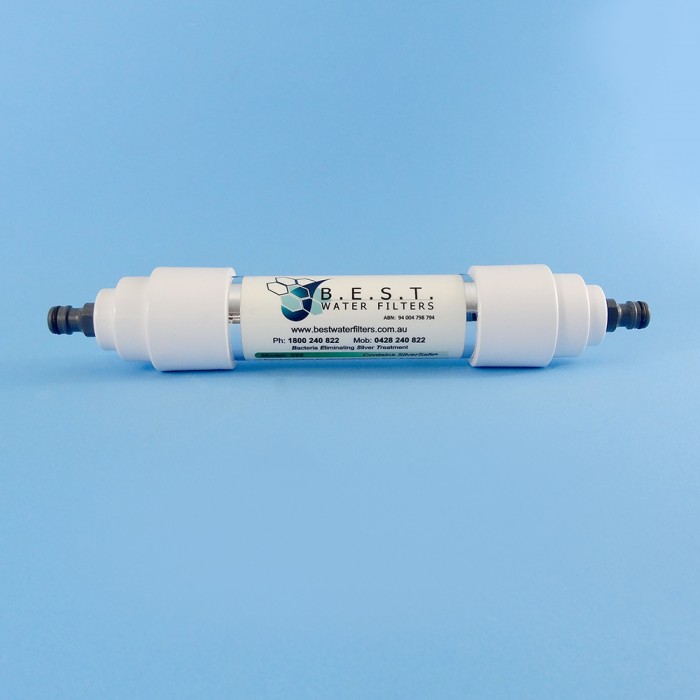 Inline carbon1 µm5,000 L min. life
Inline carbon | 5 µm + 1 µm membranes | SilverSafe carbon | 5,000 L minimum life | Back-flushable | Made in Australia
Check the B.E.S.T. Price →The B.E.S.T. is stocked by Australian caravan retailers, and its case rests on simplicity. It is made in Australia and sold in several variants, including plastic or brass hose fittings and a 1/2 inch BSP version for fixed plumbing.
Specifications from the retailer: dual 5 micron and 1 micron membranes at each end, an activated carbon bed with SilverSafe treatment, and a minimum life of 5,000 litres of chlorinated water. It is a sealed unit with no replacement cartridges, so you replace the whole filter. It can be back-flushed to clear build-up, which suits silty fills. Rated flow is up to 15 litres per minute depending on pressure, and the retailer lists a minimum pump pressure of 35 psi.
B.E.S.T. also says its carbon blend removes chloramine as well as chlorine, which matters if you fill in areas whose supply is disinfected with chloramine. That is a manufacturer claim and no certification is cited for it. B.E.S.T. itself says plain coconut carbon cannot do this, so treat the chloramine claim as plausible but unverified. Which cities use chloramine
Limitations: no NSF or AS/NZS performance certification is listed, no cyst claim, and no fixed replacement interval beyond the 5,000 litre minimum. Price checked: about $113 to $155 depending on fittings and retailer.
✓ Pros
- Made in Australia, sold with plastic or brass hose fittings and a 1/2 inch BSP version for fixed plumbing
- Back-flushable, which helps on silty fills
- Dual 5 micron and 1 micron membranes either side of an activated carbon bed
× Cons
- No NSF or AS/NZS performance certification listed, and no cyst claim
- Sealed unit: no replacement cartridges, so you replace the whole filter
- Chloramine removal is a manufacturer claim with no certification cited
Buy this if…
you tour park to park on treated water and want an Australian-made filter you can back-flush.
2. Puretec CR20: the higher-capacity alternative
 Inline carbon7,500 L1 µm rating
Inline carbon | 1 µm | SilverPlus treatment | 7,500 L capacity | 0 to 20 L/min | 200 to 520 kPa | Garden hose fittings
Check the Puretec CR20 Price →Puretec is an Australian residential filtration brand, and the CR20 is its portable inline filter for caravans, camper trailers, boats and motorhomes. The spec sheet lists a 1 micron rating, carbon media with SilverPlus antibacterial treatment, a 7,500 litre capacity, flow of 0 to 20 litres per minute and an operating pressure range of 200 to 520 kPa with standard garden hose fittings.
The 7,500 litre figure is 50 per cent higher than the B.E.S.T. minimum, which matters if you are on the road full time. The pressure ceiling of 520 kPa on the spec sheet is the number to watch (one retailer lists 860 kPa, so work to the lower figure): mains pressure varies from park to park, and a pressure regulator ahead of the filter keeps it inside its rated range (more on that below).
Limitations: no certification is listed on the spec sheet or the retailer page, no cyst claim, and the spec sheet’s height dimension is inconsistent (305 mm in the text, 355 mm on the diagram). Price checked: about $155.
✓ Pros
- 7,500 litre rated capacity, 50 per cent above the B.E.S.T. minimum
- Up to 20 litres per minute flow
- From an established Australian residential filtration brand, with a published spec sheet
× Cons
- No certification listed on the spec sheet or retailer page, and no cyst claim
- 520 kPa pressure ceiling: run a regulator ahead of it on high-pressure park taps
- Spec sheet height is inconsistent (305 mm in the text, 355 mm on the diagram)
Buy this if…
you live on the road or fill high volumes and want the larger rated capacity.
3. Puretec CR45 dual: for silty and bore-affected fills
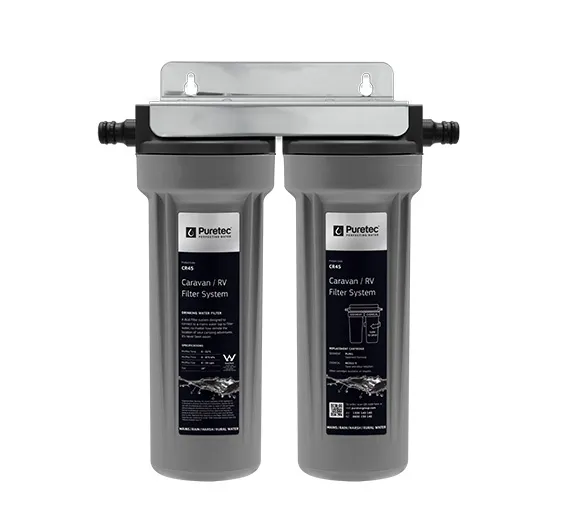 Two-stage5 + 1 µmWashable pre-filter
Two-stage | 5 µm washable pleated sediment + 1 µm silver carbon | 0 to 20 L/min | 200 to 520 kPa
Check the Puretec CR45 Price →The CR45 splits the job into two stages: a 5 micron pleated sediment cartridge first (sold as washable by retailers), then a 1 micron silver-impregnated moulded carbon cartridge. The advantage is practical. Muddy or iron-stained water clogs a single carbon cartridge quickly, and a separate washable pre-filter takes that load so the carbon lasts longer. Rated flow is 0 to 20 litres per minute at 200 to 520 kPa.
Puretec’s CR45 page claims 99.9% removal of Giardia and Cryptosporidium cysts. That is the only cyst claim among the three filters here, but the page names no certification or test standard behind it, and the 1 micron rating is listed as nominal. Treat it as a manufacturer claim: a useful extra layer, not a reason to skip boiling or UV on untreated water. Price checked: $206 at one caravan retailer (sold out on 18 October), against a Puretec recommended retail price of about $299.
✓ Pros
- Washable sediment stage takes the load from muddy or iron-stained water so the carbon lasts longer
- The only one of the three with a Giardia and Cryptosporidium cyst claim (99.9%, manufacturer)
- Same 0 to 20 L/min flow as the CR20
× Cons
- The cyst claim names no certification or test standard, and the 1 micron rating is nominal
- Highest price of the three (about $206 to $299)
- Sold out at one caravan retailer when checked on 18 October 2026
Buy this if…
your fills are often silty or bore-affected, and you will still boil or UV-treat any water you cannot vouch for.
Specification comparison
| Spec | B.E.S.T. inline | Puretec CR20 | Puretec CR45 |
|---|---|---|---|
| Stages | Single sealed unit, membranes both ends | Single | Two (5 µm pleated sediment + 1 µm carbon) |
| Micron rating | 5 and 1 µm membranes | 1 µm | 1 µm |
| Rated capacity | 5,000 L minimum | 7,500 L | Not listed |
| Flow | 0 to 15 L/min | 0 to 20 L/min | 0 to 20 L/min |
| Pressure | Min 35 psi; maker says pressure tested to 3,200 kPa for 72 hours | 200 to 520 kPa | 200 to 520 kPa |
| Antibacterial media | SilverSafe | SilverPlus | Silver-impregnated carbon |
| Back-flushable | Yes | Not stated | Sediment stage washable |
| Certified cyst reduction | No | No | Maker claims 99.9%, no standard named |
| Made in | Australia | Not stated | Not stated |
| Price (18 Oct 2026) | ~$113 to $155 | ~$155 | ~$206 to $299 |
Bore, creek and unsigned taps: the second barrier
Once you are filling from water nobody has treated, the inline filter becomes the first stage of a system, not the system. The Australian Drinking Water Guidelines recommend a multiple-barrier approach from catchment to tap for protozoa. You cannot protect a creek’s catchment, so in a caravan that leaves three practical barriers.
Boil it. Boiling deals with bacteria, viruses and protozoa, which is why Victoria’s guidelines offer “boil water before drinking” as a supplementary warning sign. It costs gas and time, and it does nothing about chemicals or blue-green algae toxins. For a couple drinking a few litres a day, a kettle on a rolling boil is still the most reliable tool you own.
UV disinfection. The NHMRC guidelines describe UV as effective against both Giardia and Cryptosporidium, and Cryptosporidium is extremely resistant to chlorine. The catch is that UV only works on clear water. Victoria’s guidance for private supplies says filtration usually needs to come first (to 1 NTU or less), the unit needs reliable power, and lamps need replacing at least every six months or as the maker specifies (the stricter of the intervals the guideline gives). In a van that means a sediment and carbon stage ahead of the UV unit, and a 12V or 240V unit sized to your system. How UV steriliser sizing works
A filter with a verified cyst claim. Some portable and point-of-use filters carry independent certification for cyst reduction. If you go this route, look for the certification on the product or the certifier’s listing, not a retailer bullet point. Portable filters compared
Bore water adds a chemistry problem on top of the microbial one. Iron, manganese and hardness are common, and some regional bores carry nitrate or arsenic. A carbon inline filter does not reliably remove dissolved salts or most metals. If a station or roadhouse tells you their bore is fine for washing but not drinking, believe them. Bore and tank water filtration
Setup that matters more than the filter
Most caravan water problems are not caused by the filter choice. They come from the hose, the pressure and a tank nobody has cleaned since the van was built. Fix these first; they matter more than the filter price.
1. Use a drinking-water hose. A garden hose left in the sun can taint water and harbour biofilm. Buy a hose sold as compliant with AS/NZS 4020, the Australian standard for products in contact with drinking water. Keep it capped and coiled off the ground.
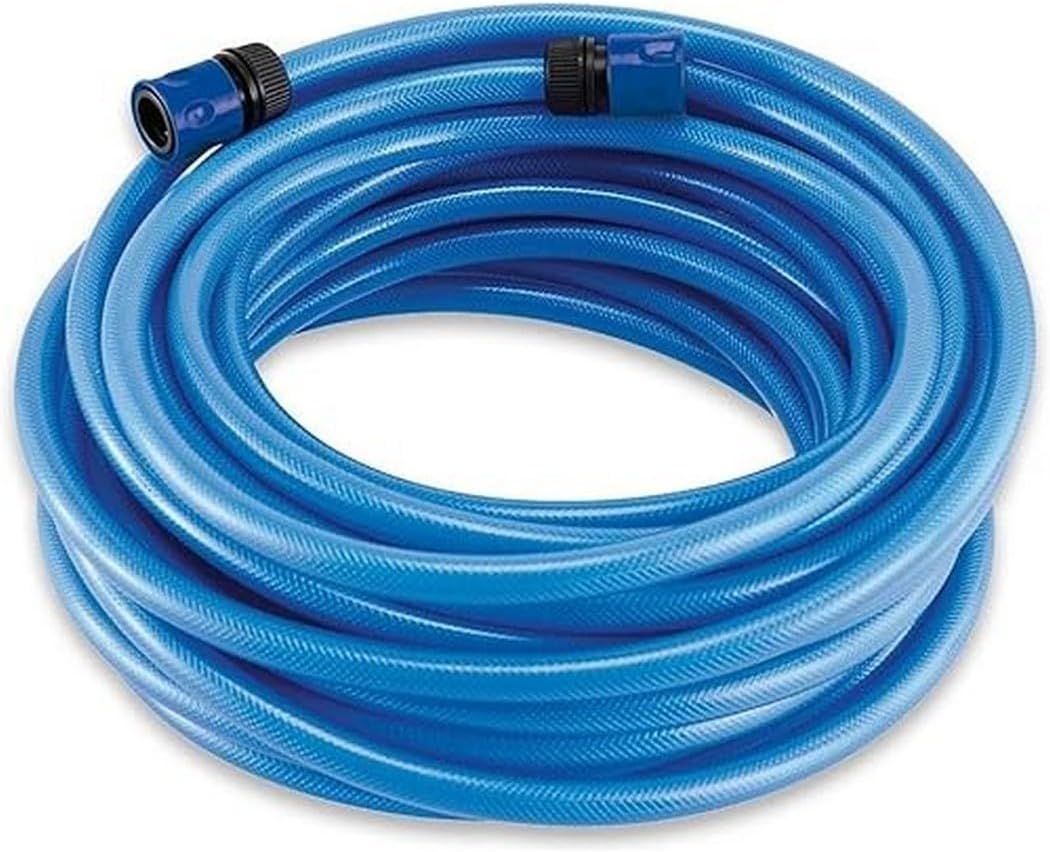 Drinking hose10 mAS/NZS 4020 (listed)
16 mm | BPA-free | Plastic quick-connect fittings | Listed as AS/NZS 4020 compliant | ~$34 (18 Oct 2026)
Check the Companion Hose Price →AS/NZS 4020 compliance is stated on the Amazon AU listing. It is the seller’s claim, not something Clean and Native has tested. A 20 metre version is sold for parks where the tap is a long way from your site.
2. Regulate the pressure. The Puretec inline filters are rated to 520 kPa. Fit a pressure-limiting valve at the tap end so park mains pressure cannot blow fittings or push water through the media faster than it was designed for. The Puretec units also list a 200 kPa minimum, so do not set the regulator below that. It protects the van’s own plumbing too.
 Pressure regulator40-50 psiabout 275-345 kPa
Brass | Factory set 40 to 50 psi (about 275 to 345 kPa) | Fits 3/4 inch BSP taps | ~$33 (18 Oct 2026)
Check the MEASUREMAN Price →A fixed 40 to 50 psi setting sits inside the Puretec 200 to 520 kPa operating range and above the B.E.S.T. 35 psi minimum. It has only a handful of ratings on Amazon AU so far, so check the thread suits your taps before you rely on it on the road.
3. Filter on the fill, not after the tank. Running the inline filter on the fill hose keeps sediment out of the tank and pump. Some owners also fit a second, fixed filter under the sink feeding a dedicated drinking tap. That second stage catches anything that grows or settles in the tank between fills.
4. Flush a new filter before use. New carbon sheds fine dust. Run a few litres through it before connecting to the van, and bring it up to pressure gradually. The B.E.S.T. retailer instructions specifically warn against full pressure on first use.
5. Sanitise the tank. A tank that has sat with stale water needs disinfecting before you trust anything in it. SA Health’s guidance for disinfecting a contaminated drinking-water tank uses 40 mL of 12.5% liquid pool chlorine per 1,000 litres, mixed in a bucket of water first, then standing for at least one hour (overnight if possible). Scale that to your tank: a 100 litre van tank is 4 mL. Follow the safety directions on the chlorine label, run the dosed water through every tap so the lines are treated too, then let it stand, drain, refill through the filter and flush. Tank water hygiene basics
6. Replace on volume, not hope. Work out roughly how many litres you put through per trip. Two people filling a 150 litre tank twice a week will push about 15,600 litres a year through the hose. At the rated capacities, that is just over three B.E.S.T. units (5,000 litre minimum) or just over two CR20s (7,500 litres). If water slows to a trickle or the taste comes back, the carbon is done, whatever the calendar says.
How to fit an inline caravan filter
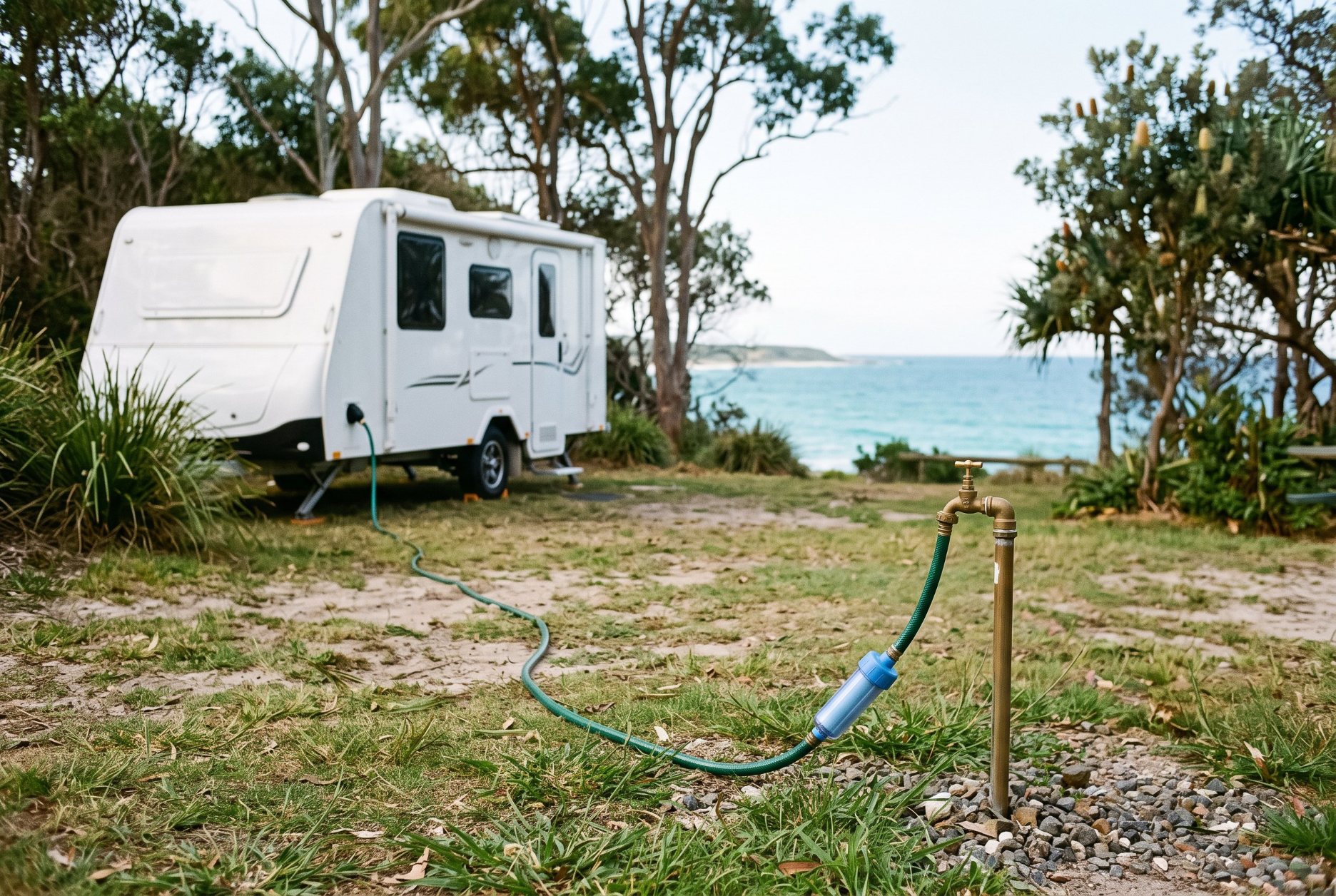
An inline filter takes five minutes to fit, and the order of the parts matters more than the brand. The sequence that protects everything downstream is: tap, pressure regulator, drinking-water hose, filter, van inlet.
Regulator at the tap. Screw the regulator straight onto the park tap so every part after it, hose included, sees controlled pressure. A fitting that lets go overnight and empties your tank across the site is a pressure problem, not a filter problem.
Filter at the van end of the hose. Fitted at the van inlet, the filter also catches what the hose adds: grit in the fittings, biofilm, and the plastic taste of a hose that has been cooking in a hot locker. Fit it at the tap instead and the hose becomes the last thing your water touches before the tank.
Follow the flow arrow. Inline filters are marked with a flow direction. Check that it points towards the van before you tighten anything. A filter run the wrong way is not working to the rating on its label.
Support the weight. A full filter hanging off the van’s inlet puts leverage on a fitting that was never designed to carry it. Rest the filter on something clean on the ground, or use a short flexible tail between the filter and the inlet.
Flush, then fill. Run water to waste through a new filter until it runs clear, bringing the pressure up gradually, then connect to the van. Once the tank is full, run the pump and check every joint for drips.
Adding a second filter for a drinking tap
An inline filter on the fill hose protects the tank. It cannot do anything about what happens inside the tank between fills: warm water sitting for days, sediment settling, and a film building up on the tank walls and in the lines. That is why some owners add a second, fixed filter under the sink feeding a separate drinking tap.
The principle is simple. A tee off the cold line after the pump feeds a filter housing, and the filter outlet runs to a small dedicated tap at the sink. The shower and the main tap stay on unfiltered tank water, so the cartridge only handles the litres you drink and cook with, and it lasts far longer.
Check three things before you buy one. First, pressure: a 12V caravan pump usually runs below typical mains pressure, so compare the filter’s minimum operating pressure with your pump’s rated output. Second, access: the cartridge has to come out without dismantling the cupboard. Third, certification: the same rule applies as with any filter. Look for the claim on the product or on the certifier’s listing, not in a retailer’s bullet points.
Plumbing changes to a caravan should follow the van maker’s specification. If you are not confident with fittings, have a caravan service centre do it. A joint that weeps inside a cabinet can do more damage on a corrugated road than a poor filter ever will.
A fixed drinking-tap filter does not replace the second barrier either. If the tank was filled from water you cannot vouch for, boil it or UV-treat it, whatever is under the sink.
What filtered water costs per litre
Inline filters are cheap per litre, which is the best argument against stretching one past its rating. Using the prices checked on 18 October 2026 and each maker’s rated capacity:
| Filter | Price (18 Oct 2026) | Rated capacity | Cost per 1,000 L |
|---|---|---|---|
| B.E.S.T. inline | ~$113 to $155 | 5,000 L minimum | about $23 to $31 |
| Puretec CR20 | ~$155 | 7,500 L | about $21 |
| Puretec CR45 dual | ~$206 to $299 | Not listed | Cannot be calculated |
At the 15,600 litres a year worked out above for two people filling twice a week, that is roughly $350 to $480 a year for the B.E.S.T. and about $320 for the CR20. Those figures assume clean, chlorinated town water. Silty or iron-rich fills use up the media faster, so treat the rated capacity as the best case, not the expected one.
The easiest saving is not a cheaper filter. It is not running filtered water where you do not need it. Washing down the van or hosing out the annexe does not need carbon-filtered water, and every one of those litres comes off the filter’s life. A Y-splitter after the regulator, with the filter on the drinking-water side only, is a few dollars well spent.
Pre-trip water checklist
In the Navy we checked our equipment before every dive, however routine the dive was. Caravan water deserves the same discipline, because a fault you find in the driveway is a fault you do not find 400 kilometres from the next town.
- Filter life. Estimate the litres it has done since it was fitted. If it is close to its rating, or nobody can remember when it went in, replace it now. Write the fitting date on the housing with a marker.
- Hose condition. Check the drinking hose for cracks and kinks, and that both end caps are there. If it was stored uncapped, flush it before use.
- Regulator and fittings. Check the regulator, washers and quick-connects are in the kit and seal properly. Spare washers weigh nothing.
- Tank status. If water has sat in the tank since the last trip, drain it. If it has sat for weeks or smells stale, sanitise it using the dose in the setup section above before you refill.
- Route water plan. Look at where you will refill. Note which stops have signed drinking water and which do not, and pack your second barrier (kettle and gas, or a UV unit) for the stretches that do not.
- Reserve water. Carry some drinking water in separate sealed containers, so a contaminated tank or a failed pump does not leave you without safe water.
Between trips, drain the filter, cap both ends and store it out of direct sun. A cartridge left full of water in a hot locker is exactly the situation the silver treatments are meant to slow down. They do not prevent it.
Final verdict
For most Australian caravanners, the right setup is the B.E.S.T. or Puretec CR20 on an AS/NZS 4020 drinking hose, behind a pressure regulator, filling a tank you sanitise at the start of each season. That combination handles what treated park and town water actually throws at you: taste, chlorine, sediment and hose contamination.
Choose the B.E.S.T. if you want Australian manufacture and the option to back-flush. Choose the CR20 if you do high volumes and want the larger rated capacity. Step up to the CR45 if your fills are often silty.
And if your route takes you past the last signed drinking tap, carry a second barrier. A carbon filter makes good water taste better. It does not make bad water safe.
Prices change. Check the retailer before buying.
Frequently asked questions
Do I need a water filter for my caravan?
If you only fill from treated town water, a filter is about taste, sediment and protecting your pump rather than safety. If you fill from rainwater tanks, bores, creeks or unsigned taps, you need a filter plus a disinfection step such as boiling or UV, because standard caravan filters are not certified to remove Giardia or Cryptosporidium.
Will an inline caravan filter make creek water safe to drink?
No. A 1 micron carbon inline filter is not a certified pathogen barrier. The Australian Drinking Water Guidelines describe Cryptosporidium as extremely resistant to chlorine, recommend a multiple-barrier approach, and describe UV as effective against it. Pre-filter creek water, then boil it or run it through a correctly sized UV unit, and avoid water with visible algae.
How often should I replace a caravan water filter?
Replace on volume. The B.E.S.T. is rated for a minimum of 5,000 litres of chlorinated water and the Puretec CR20 for 7,500 litres. Silty or iron-rich water shortens that. Replace sooner if flow drops sharply or the chlorine taste returns.
Does a caravan water filter remove chloramine?
Ordinary activated carbon removes free chlorine well and chloramine poorly. B.E.S.T. says its carbon blend handles chloramine, but no certification is cited for that claim. If you fill mainly in chloramine areas, judge it by taste and replace the filter early.
What hose should I use to fill a caravan water tank?
Use a hose sold as compliant with AS/NZS 4020, the Australian standard for materials in contact with drinking water. Keep it capped, coiled and off the ground, and do not use it for anything else.
How do I sanitise a caravan water tank?
SA Health’s tank disinfection guidance uses 40 mL of 12.5% liquid pool chlorine per 1,000 litres, premixed in a bucket of water, left to stand for at least one hour. That works out to 4 mL for a 100 litre tank. Drain, refill with filtered water and flush every tap before drinking.
Should the caravan water filter go at the tap or at the van?
At the van end of the hose, with a pressure regulator fitted at the tap. That way the filter also catches grit and taste picked up in the hose, and the hose, filter and van plumbing all sit behind the regulator.
Is caravan park tap water safe to drink?
A tap signed as drinking water on a town supply is treated water, and a filter there is mainly about taste and sediment. Victoria’s guidance for private supplies at caravan parks says water that cannot be guaranteed safe should be signed as not suitable for drinking. If a tap carries that sign, or no sign at all, treat the water as untreated and boil it or use UV.
How much does a caravan water filter cost to run?
At prices checked in October 2026, the B.E.S.T. works out at about $23 to $31 per 1,000 litres of rated capacity and the Puretec CR20 at about $21. Two people filling a 150 litre tank twice a week would spend roughly $320 to $480 a year, depending on the filter.
- NHMRC, Australian Drinking Water Guidelines: Cryptosporidium
- NHMRC, Australian Drinking Water Guidelines: Giardia
- Victorian Department of Health, Guidelines for private drinking water supplies at commercial and community facilities
- SA Health, Cleaning rainwater tanks impacted by floodwater
- Puretec CR20 specification sheet
- Puretec CR45 twin stage filter page
- Caravansplus, Puretec CR20 listing
- What’s Up Down Under, B.E.S.T. variants and prices
- Caravansplus, B.E.S.T. inline drinking water filter listing
- CaravanMods, Puretec CR45 listing
- Caravan World, B.E.S.T. RV inline filter
- Holman, Pureflow drinking water hose (AS/NZS 4020:2018)
Get the Australian Home Environment Checklist
30 checks across water, air and EMF. Most of them free. Ranked by impact.
No spam. Unsubscribe any time.

Former Royal Australian Navy Clearance Diver and TAG-E counter-terrorism operator. Founded Clean and Native to apply the same rigorous thinking to the home environment.
Full biography →