Best Portable Water Filters Australia 2026: Creek, Tap and Travel Water Compared
Drafted with AI assistance and checked against published specifications and certifications. First-hand measurements appear only where stated. How we make content
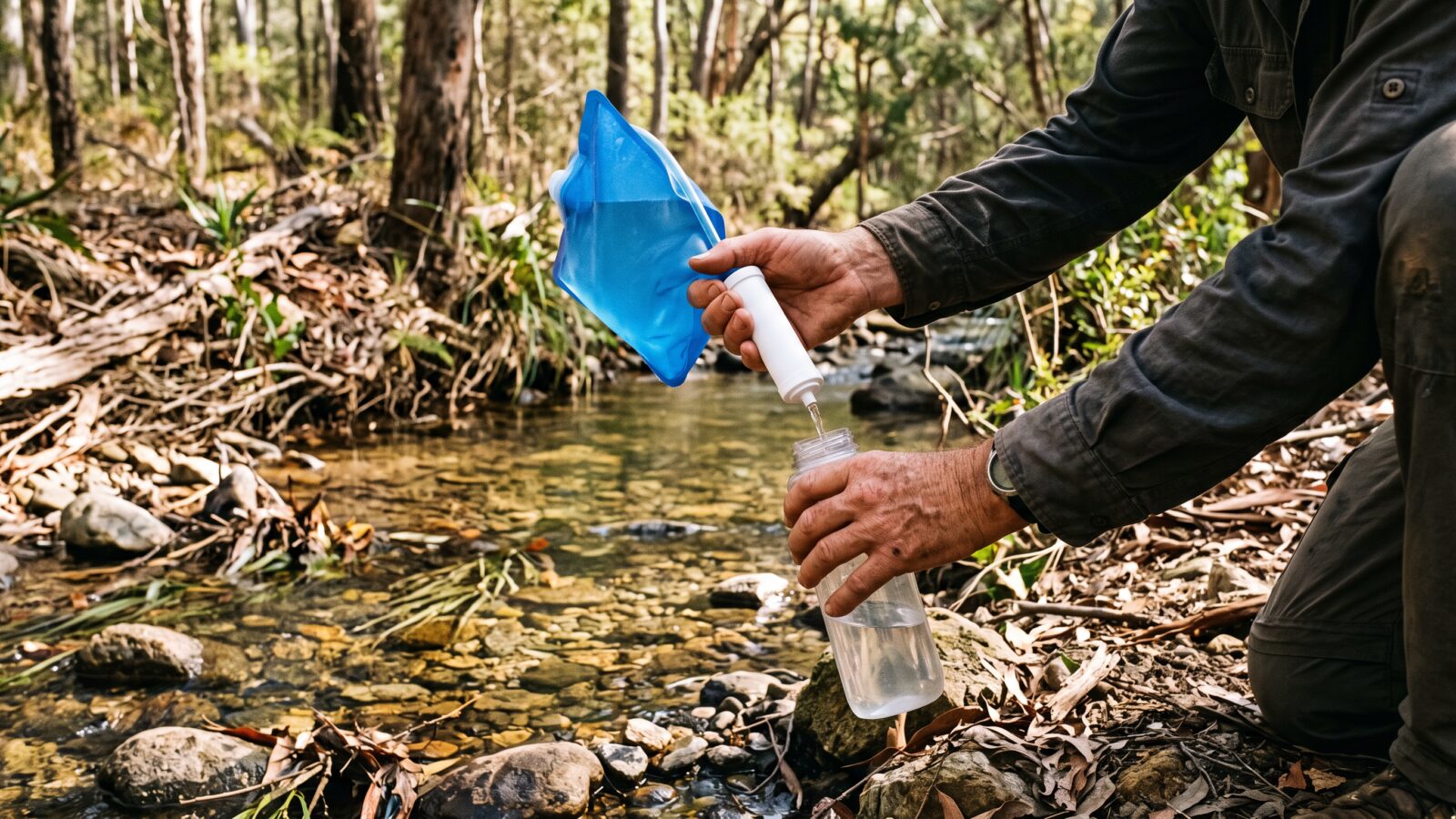
The best portable water filter in Australia depends on the water you are filtering. For creek and tank water on a bushwalk, a 0.1 micron hollow-fibre filter such as the Sawyer Squeeze removes bacteria and protozoa. For a bottle that covers both city taps and the trail, the LifeStraw Go 2.0 adds a carbon stage for chlorine taste. For travel where viruses are a risk, only a purifier such as the GRAYL GeoPress covers them. For city tap water alone, a Brita Fill&Go improves taste but does not treat untreated water.
Most portable filter roundups skip that first question. A filter bottle is a different tool depending on what goes into it. Treated mains water in Brisbane or Melbourne has already been disinfected, so a bottle there is about taste. A creek in the Blue Mountains or a rainwater tank at a camp has not, so the bottle is the only thing between you and Giardia. Water in parts of Southeast Asia can carry viruses, which most filters let straight through.
| Use | Pick | What it stops | Price |
|---|---|---|---|
| City tap plus trail | LifeStraw Go 2.0 (1 L) | Bacteria, protozoa, microplastics; carbon for chlorine taste | $73.75at Amazon AU · as of 19 Nov 2026, 5:29 pm AEST Details |
| Bushwalking | Sawyer Squeeze | Bacteria, protozoa, microplastics (0.1 µm absolute) | $75.63at Amazon AU · as of 19 Nov 2026, 11:29 pm AEST Details |
| Trail running, fast refills | Katadyn BeFree 1.0 L | Bacteria, protozoa (0.1 µm) | $59.00at Amazon AU · as of 19 Nov 2026, 5:29 pm AEST Details |
| Overseas travel | GRAYL GeoPress | Viruses, bacteria, protozoa; carbon for taste and some chemicals | Currently unavailable on Amazon AUas of 19 Nov 2026, 11:29 pm AEST Details |
| City tap only, budget | Brita Fill&Go Vital | Chlorine taste, some PFAS; not microbes | Brita and supermarkets |
First Question: What Water Are You Filtering?
There are three jobs a portable filter gets asked to do, and they need different hardware.
| Water source | Main risk | What you need |
|---|---|---|
| Treated mains tap (home, office, hotel, caravan park) | Taste of chlorine or chloramine; microbes already treated | Carbon stage for taste. A membrane adds little. |
| Australian creek, river, dam or rainwater tank | Bacteria and protozoa (Giardia, Cryptosporidium) from animal and human waste | Hollow-fibre membrane rated 0.2 µm or finer |
| Overseas tap or surface water where sanitation is poor | Viruses as well as bacteria and protozoa | A purifier, or a filter plus UV or chemical disinfection |
The US Centers for Disease Control and Prevention sets it out plainly in its guidance for hiking, camping and travel: a filter with an absolute pore size of 1 micron or smaller removes parasites; one of 0.3 micron or smaller removes bacteria and parasites, but not viruses; and reverse osmosis removes parasites, bacteria and viruses. Everything in this guide follows from those three lines.
How a Portable Water Filter Works
Almost every portable filter sold for drinking from creeks uses the same core part: a bundle of hollow plastic fibres, each thinner than a strand of spaghetti, with walls full of microscopic pores. Water is pushed or sucked through the fibre walls. Anything bigger than the pores stays on the dirty side. Bottles aimed at city use add a carbon stage that adsorbs chlorine and other taste compounds.
Inside a sip-through filter bottle
Magnified: the fibre wall
- Intake. You suck on the mouthpiece (or squeeze a pouch, or press a plunger). The pressure difference pulls untreated water into the filter cartridge.
- Membrane stage. Water passes through the walls of the hollow fibres. Pores of 0.1 to 0.2 µm hold back protozoan cysts, bacteria and microplastic particles on the dirty side. Most viruses are smaller than these pores.
- Carbon stage. In two-stage bottles, filtered water then runs through activated carbon, which adsorbs chlorine, odours and some organic chemicals. The carbon is the part that changes how tap water tastes, and it wears out much sooner than the membrane.
- Out. Clean water leaves through the mouthpiece or outlet. Nothing touches it after the filter, which is why keeping the clean side clean matters (see using one properly).
A purifier like the GRAYL GeoPress works differently: instead of hollow fibres, it pushes water through a dense cartridge that combines electroadsorption media with powdered activated carbon. The charged media is what catches viruses that slip through ordinary pores.
Pore Size vs What Is in the Water
Filter claims are easiest to judge when you put the pore size next to the size of the thing you are trying to stop. This chart uses published dimensions and a log scale, because the organisms span four orders of magnitude.
What a 0.1 µm, 0.2 µm and 15 µm filter can stop
Size in micrometres (µm), log scale. Anything wider than a filter’s rated pore size is held back; anything smaller can pass.
- 0.1 µm: Sawyer Squeeze (absolute) and Katadyn BeFree
- 0.2 µm: LifeStraw Go 2.0 membrane
- 15 µm: Brita MicroDisc particle rating
- Bacteria and protozoa
- Viruses
Sizes: Giardia cysts 8 to 19 µm and Cryptosporidium oocysts 4.2 to 5.4 µm (CDC DPDx); Leptospira about 0.1 µm thick and 6 to 20 µm long (Levett, Clinical Microbiology Reviews, 2001); E. coli about 0.5 µm wide and 1 to 2 µm long; enteric viruses roughly 0.02 to 0.1 µm. Filter ratings from the manufacturers.
Three things stand out:
- Protozoa are easy. Giardia and Cryptosporidium are roughly 40 to 190 times larger than a 0.1 µm pore. Any genuine hollow-fibre filter stops them.
- Viruses are the gap. They sit at or below every hollow-fibre line. That is why the CDC says filters alone are not effective against viruses, and why the GRAYL uses a different mechanism.
- Leptospira is the edge case. The bacterium behind leptospirosis is a thin spiral about 0.1 µm thick, right at the line. Queensland Health links it to creeks and floodwater and advises treating or boiling water that may be flood affected. In Far North Queensland after the wet, I would use a 0.1 µm absolute filter plus disinfection, or a purifier.
The dotted 15 µm line explains why a city bottle is not a creek filter. Brita rates its MicroDisc to reduce particles of 15 µm and larger. Cryptosporidium, bacteria and viruses are all smaller than that.
Heading out on an overnight or multi-day walk? Australian track managers say to treat hut and campsite tank water as well as creeks. Our best water filter for hiking guide covers what each track authority says, gravity filters for groups and what to do on freezing nights.
The 5 Best Portable Water Filters for Australia in 2026
1. LifeStraw Go 2.0 (1 L)
Best all-rounder: city tap and trailThe LifeStraw Go 2.0 is the one bottle in this guide that does both jobs. A 0.2 µm hollow-fibre membrane handles creek and tank water, and a carbon capsule under the lid takes the chlorine edge off city tap water. You fill it, screw on the lid and drink through the mouthpiece. No pumping, no pouches.
- Membrane
- 0.2 µm hollow fibre
- Claimed removal
- 99.999999% bacteria, 99.999% parasites, 99.999% microplastics
- Carbon reduces
- Chlorine, odours, organic chemical matter
- Filter life
- Membrane 4,000 L; carbon 100 L
- Capacity / weight
- 1 L / about 268 g (plastic version)
- Viruses
- Not removed
Who it suits
- People who want one bottle for the office and the weekend walk
- Day hikes with reliable creeks
- Caravanners on mixed tap and tank water
Who should look elsewhere
- Multi-day walkers counting grams (the Sawyer is lighter)
- Travel where viruses are a risk
- Anyone expecting fluoride or chloramine removal
The catch: the carbon capsule is rated for 100 L, roughly seven weeks at 2 L a day. Most people keep using it long after the carbon is spent. The membrane is still protecting you from microbes at that point, but the taste benefit has gone.
2. Sawyer Squeeze
Best for bushwalkingThe Sawyer Squeeze is small, it threads onto the included pouches and onto common soft-drink bottles, and its 0.1 µm absolute rating is the finest in this guide. Fill the dirty pouch from the creek, screw on the filter, squeeze into your clean bottle. It can also run inline on a hydration bladder or as a gravity setup.
- Membrane
- 0.1 µm absolute hollow fibre
- Claimed removal
- 99.99999% bacteria, 99.9999% protozoa, 100% microplastics
- Carbon stage
- None
- Filter life
- No defined end of life (Sawyer’s FAQ cites 100,000 US gal); lifetime limited warranty
- Weight
- About 85 g for the filter (Sawyer’s figure)
- In the kit
- Filter, two 1 L (32 oz) pouches, cleaning plunger and adapters (contents vary by kit)
Who it suits
- Overnight and multi-day walkers
- Anyone drawing from tanks at huts and campsites
- Groups who want one filter feeding several bottles
Who should look elsewhere
- City use (no carbon, so no taste change)
- Anyone who will not backflush it; flow drops as it clogs
- Travel where viruses are a risk
The catch: soft pouches are the weak link of any squeeze system, so carry a spare or use a sturdy bottle as the dirty container.
3. Katadyn BeFree 1.0 L
Fastest flow, lightestThe BeFree is a soft flask with a filter built into the cap. Dip it in the creek, screw it shut and drink, or squeeze it into a pot. Katadyn rates it at up to 2 L a minute, and the whole thing weighs about 63 g. When flow slows you clean it by shaking or swishing it in clean water rather than backflushing.
- Membrane
- 0.1 µm hollow fibre
- Removes
- Bacteria, protozoa (cysts) and sediment
- Carbon stage
- None in the standard model
- Filter life
- Tested to 1,000 L, depending on water quality
- Flow / weight
- Up to 2 L/min / about 63 g
- Viruses
- Not removed
Who it suits
- Trail runners and fastpackers
- Walkers who want water now, not after a squeeze session
- Ultralight kits
Who should look elsewhere
- Silty or tannin-heavy water, which clogs it quickly
- Long trips without resupply; 1,000 L is less than a Sawyer
- City tap use
The catch: the flask itself is soft and can be punctured, and the filter cartridge is not as tolerant of murky water as a backflushable Sawyer. Pre-settle or pre-filter cloudy water through a bandana first.
4. GRAYL GeoPress
Best for overseas travel: removes virusesThe GeoPress is a purifier, not just a filter, and it is the only product here that deals with viruses. It works like a coffee plunger: fill the outer cup, press the inner bottle down through it, and the cartridge does the rest in about eight seconds. GRAYL says it removes 99.99% of viruses, 99.9999% of bacteria and 99.9% of protozoan cysts, and that the cartridge is independently tested to NSF/ANSI 42 and 53 and to the US EPA guide standard for microbiological purifiers.
- Technology
- Electroadsorption plus powdered activated carbon
- Claimed removal
- 99.99% viruses, 99.9999% bacteria, 99.9% protozoan cysts
- Also reduces
- Silt, microplastics; carbon for chemicals, taste, odour
- Cartridge life
- 350 presses (about 250 L), or 3 years after first use
- Capacity / weight
- 710 ml / 450 g
- Speed
- About 8 seconds per fill
Who it suits
- Travel to places where tap water is not safe to drink
- Anyone who wants one device for tap, creek and overseas water
- Flood-affected or uncertain water where you cannot boil
Who should look elsewhere
- Multi-day walkers: it is heavy and holds only 710 ml
- High daily volume; 250 L cartridges get expensive
- People who want to drink while walking without stopping
The catch: GRAYL’s spec page does not list the specific chemicals, metals or PFAS compounds it reduces, so treat its carbon stage as a taste improvement rather than a chemical treatment.
5. Brita Fill&Go Vital
Budget pick for city tap water onlyThe Fill&Go Vital is a plain squeeze bottle with a small carbon MicroDisc in the lid. It is cheap, the discs are easy to find, and in a city where you mostly dislike the chlorine taste it does that job. Brita says the coconut-shell carbon reduces chlorine, some pesticides and hormones, and PFAS (at least 80% of PFOS and PFOA in its lab test), and keeps calcium and magnesium in the water.
- Filter
- Activated coconut-shell carbon MicroDisc
- Reduces
- Chlorine, taste compounds, PFAS (≥80% PFOS/PFOA), particles ≥15 µm
- Disc life
- 60 L or about 4 weeks in a bottle
- Capacity
- 600 ml
- Microbes
- Not removed; treated tap water only
- Where to buy
- Brita’s online store and supermarkets
Who it suits
- Gym, desk and commute on treated tap water
- Anyone who will actually swap the disc monthly
Who should look elsewhere
- Anyone drinking creek, tank or overseas water
- Chloramine areas expecting a big change in taste
The catch: it is not a safety device. If the water has not already been treated, this bottle does not make it safe.
Why the Waterman Black is no longer on this list. Earlier versions of this page included the Waters Co Waterman Black. Retailers list it as a 600 ml portable filter (not a bottle) claiming up to 99% fluoride removal using activated carbon, plus bacteria reduction. Activated carbon is not a fluoride treatment, and we could not find a published test report for this model. Until one is published, we are not ranking it.
Side-by-Side Specs
| Filter | Type | Pore / media | Bacteria + protozoa | Viruses | Carbon | Rated life |
|---|---|---|---|---|---|---|
| LifeStraw Go 2.0 | Sip bottle | 0.2 µm + carbon | Yes | No | Yes | 4,000 L / 100 L carbon |
| Sawyer Squeeze | Squeeze / inline | 0.1 µm absolute | Yes | No | No | No defined end of life |
| Katadyn BeFree | Soft flask | 0.1 µm | Yes | No | No | 1,000 L |
| GRAYL GeoPress | Press purifier | Electroadsorption + carbon | Yes | Yes | Yes | 250 L |
| Brita Fill&Go Vital | Squeeze bottle | Carbon disc | No | No | Yes | 60 L |
How Long Each Filter Lasts at 2 Litres a Day
Litre ratings mean little until you turn them into calendar time. At 2 L a day, every day:
| Part | Rated life | At 2 L/day |
|---|---|---|
| Brita MicroDisc | 60 L | 30 days |
| LifeStraw Go carbon capsule | 100 L | 50 days |
| GRAYL GeoPress cartridge | 250 L (or 3 years) | 125 days |
| Katadyn BeFree | 1,000 L | 500 days |
| LifeStraw Go membrane | 4,000 L | 2,000 days (about 5.5 years) |
| Sawyer Squeeze | No defined end of life (100,000 US gal cited) | Replace if flow will not recover after backflushing, or if it may have frozen |
Rated life assumes reasonably clear water. Silty creek water or tannin-stained coastal water clogs membranes faster, and carbon fills up faster in heavily chlorinated water.
Check all seven rooms, not just this one
38 checks, 29 free, ranked by impact. Sent as a 32-page PDF.
We'll email you the audit and a short series of practical guides. Unsubscribe in one click, any time. Privacy.
Sent. Taking you to your download...
Chloramine: What a Bottle Can and Cannot Do in City Tap Water
Australian utilities disinfect mains water with either free chlorine or chloramine (chlorine combined with ammonia). Sydney Water adds both chlorine and ammonia. Urban Utilities in Brisbane and Ipswich says it uses either chlorine or chloramine. The disinfectant can change from suburb to suburb, so check your utility’s drinking water quality report rather than relying on a city list. Our chloramine vs chlorine guide covers how to read one.
The difference matters for carbon. Activated carbon breaks down free chlorine quickly. Chloramine is more stable and needs much longer contact time, or specially treated catalytic carbon, to break down. Water spends only seconds in a bottle’s carbon. None of the makers in this guide publish chloramine reduction figures, so in a chloramine area expect a smaller taste improvement than in a chlorine area.
Chloramine in treated mains water is within the Australian Drinking Water Guidelines, so this is a taste and preference question, not a safety one. If you want it out of your water at home, that is a job for a fixed system with catalytic carbon or reverse osmosis. See our best water filters for chloramine.
What These Portable Filters Do Not Remove
- Fluoride. None of the five filters here claim to reduce fluoride, and most ordinary activated carbon does not remove it. Reverse osmosis and activated alumina do. See fluoride filters and how reverse osmosis works.
- Dissolved salts, nitrates and hardness. Hollow-fibre membranes and carbon do not touch dissolved ions. Brackish bore water stays brackish. Nitrate needs reverse osmosis or ion exchange (nitrate filters).
- Viruses, except with the GRAYL GeoPress. Add UV or chemical disinfection if you use a hollow-fibre filter where viruses are a risk.
- Heavy chemical contamination. Water near mines, industrial sites or blue-green algae blooms needs avoiding, not filtering. Blue-green algae toxins are not something a bottle filter is rated for.
- PFAS, beyond the Brita lab claim for PFOS and PFOA. If you live near a known PFAS site, a fixed PFAS filter is the answer.
Using a Portable Filter So It Actually Works
- Keep dirty and clean apart. A drop of creek water on the clean outlet or mouthpiece undoes the filter. Use a separate dirty pouch or cup, and do not dip the drinking end in the creek.
- Do not let a wet filter freeze. Ice can crack hollow fibres without any visible sign. In alpine Victoria, New South Wales or Tasmania in winter, keep it in your sleeping bag or a jacket pocket. If you think it has frozen, replace it.
- Pre-filter murky water. Let silt settle, or pour through a bandana. Your membrane lasts longer and flows faster.
- Backflush or shake clean. Sawyer uses a syringe to push clean water backwards through the filter. Katadyn’s BeFree is cleaned by shaking or swishing. Do it when flow slows, not when it stops.
- Prime the bottle. LifeStraw’s manual says to fill the bottle, screw the lid on so the filter is submerged, let it soak for 10 minutes, then take a few quick, strong sips to start the flow.
- Track the carbon. Carbon stages wear out by volume and give no warning. Note the date you fitted a new disc or capsule.
- Choose water carefully. Collect upstream of camps, stock and huts, from flowing rather than stagnant water. In flood-affected areas, follow your state health department’s advice to boil or treat.
How We Chose
As a former Navy Clearance Diver, I treat any water I cannot verify as contaminated until proven otherwise. That is the bar for this list: the filter has to state what it removes and what standard or method backs the claim, and it has to be sold in Australia.
We have not lab-tested these portable filters ourselves. The picks are based on manufacturers’ published specifications, their stated test standards, CDC and Australian health guidance, and current Australian availability. At home I run a five-stage reverse osmosis system under the sink and a Waterdrop C1S, so a portable filter is what covers the gap away from that tap. Our full process is on the how we test page.
If you are kitting out a van rather than a backpack, see our best caravan water filters. For drinking from a home rainwater tank, see rainwater drinking safety.
Frequently Asked Questions
What is the best portable water filter in Australia?
For bushwalking, the Sawyer Squeeze: 0.1 µm absolute, light and backflushable. For one bottle that covers city taps and the trail, the LifeStraw Go 2.0, which adds a carbon stage. For overseas travel, the GRAYL GeoPress, because it also removes viruses.
Can a portable water filter make creek water safe to drink in Australia?
A hollow-fibre filter rated 0.2 µm or finer removes the bacteria and protozoa such as Giardia and Cryptosporidium that are the main risks in Australian creeks and tanks. It does not remove viruses, chemicals or blue-green algae toxins. In flood-affected water, boil or disinfect as well.
Do portable water filters remove viruses?
Most do not. Viruses are about 0.02 to 0.1 µm, smaller than the pores in hollow-fibre filters. Of the filters in this guide, only the GRAYL GeoPress purifier claims virus removal (99.99%). Otherwise, add UV or chemical disinfection.
Does a filter bottle remove chloramine from tap water?
Not much. Chloramine needs longer contact time with carbon, or catalytic carbon, than a bottle gives it, and none of the bottle makers in this guide publish chloramine reduction figures. For real chloramine removal, use a fixed catalytic carbon or reverse osmosis system.
Can a portable water filter remove fluoride?
None of the filters in this guide claim to, and most ordinary activated carbon does not remove fluoride. Reverse osmosis and activated alumina do, and both are normally fixed systems.
How long does a portable water filter last?
It depends on the part. A Brita MicroDisc lasts 60 L (about a month), the LifeStraw Go carbon capsule 100 L, the GRAYL cartridge about 250 L, the Katadyn BeFree 1,000 L and the LifeStraw Go membrane 4,000 L. Sawyer gives the Squeeze no defined end of life and cites a 100,000 US gallon rating.
Is a Brita filter bottle safe for creek water?
No. The Brita Fill&Go MicroDisc is a carbon filter for treated tap water. It is rated to reduce particles of 15 µm and larger, which does not cover bacteria, Cryptosporidium or viruses.
Sources
- CDC, About Water Treatment Options When Hiking, Camping, or Traveling
- CDC DPDx, Giardiasis and Cryptosporidiosis
- Levett PN, Leptospirosis, Clinical Microbiology Reviews, 2001
- Queensland Health, Queensland experiences spike in leptospirosis cases
- NHMRC, Australian Drinking Water Guidelines: chloramines
- Sydney Water, What’s in your water
- LifeStraw Go user manual; GRAYL, GeoPress tech specs; Sawyer, Squeeze water filter system; Brita Australia, MicroDisc
Last updated: November 2026. Prices shown are live from Amazon AU and change often.

Former Royal Australian Navy Clearance Diver and TAG-E counter-terrorism operator. Founded Clean and Native to apply the same rigorous thinking to the home environment.
Full biography →The 7-Room Home Audit
Your tap water is one room. The audit covers all seven: 38 checks across water, air and EMF, 29 of them free, ranked by impact against Australian guidelines.
- Morning tap flush: the free lead fix most homes skip
- How to read your utility's water quality report
- Renting or owning: the two reverse osmosis filters I use at home
We'll email you the audit and a short series of practical guides. Unsubscribe in one click, any time. Privacy.
Sent. Taking you to your download...