Geelong Tap Water Quality 2026: What Barwon Water’s Testing Data Shows
Affiliate disclosure: Clean and Native earns a commission if you purchase through links on this page. This does not affect our editorial position — products are recommended based on research and testing only.
Geelong tap water meets all Australian Drinking Water Guidelines and is safe to drink unfiltered. Barwon Water uses chlorine disinfection (not chloramine), making it easier to filter than Melbourne’s supply if you want to remove taste/odour or PFAS detections. Hardness sits at moderate ~130 mg/L, TDS around 200 mg/L, and fluoride dosing has been offline since May 2025 due to Wurdee Boluc works. The catches: PFAS has been detected in 43% of samples (below guideline limits but present), and chlorine residual can produce noticeable taste/odour.
| Concern | Barwon Water Status | Verdict |
|---|---|---|
| Chlorine taste/odour | Chlorine used (not chloramine) | Carbon filter removes easily |
| PFAS detections | 43% samples positive, below guidelines | RO if you want elimination |
| Regulatory compliance | 100% ADWG compliant | Unfiltered water is safe |
Quick answer
The three products we own are measured first-hand by Jayce Love, former Royal Australian Navy Clearance Diver; every other product is assessed on published manufacturer specifications and independent certification using our documented methodology — no gifted units, no brand payments.
Geelong’s tap water, supplied by Barwon Water, meets all Australian Drinking Water Guidelines and is safe to drink. The key characteristics relevant to filtration decisions: disinfection is by chlorine (not chloramine — simpler to filter than Melbourne), TDS runs around 200 mg/L, hardness is moderate to hard at approximately 130 mg/L as CaCO3, and fluoride is normally added at 0.9 mg/L but has been offline since May 2025 due to Wurdee Boluc reservoir upgrade works. Barwon Water’s PFAS testing has shown positive detections in 43% of samples, though at levels below current Australian guidelines.
Most Geelong residents give little thought to their tap water beyond taste and smell. But if you are considering a filter — or already have one — understanding what Barwon Water’s supply actually contains determines which technology is appropriate and what you are realistically removing. This guide covers what the official testing data shows, what is specific to Geelong’s supply compared to other Victorian cities, and what filtration options make sense given those specific characteristics.
Where Geelong’s water comes from
Barwon Water sources Geelong’s drinking water from three primary inputs: surface water from catchments treated at the Moorabool Water Treatment Plant and Wurdee Boluc Water Treatment Plant, and the Melbourne-Geelong Pipeline (MGP), which supplements supply particularly during dry periods. Each source has different quality characteristics that blend in the distribution system.
Surface catchment water typically carries higher organic load than groundwater — natural organic matter from vegetation and soil that reacts with chlorine during disinfection to form trihalomethanes (THMs) and other disinfection byproducts. Barwon Water monitors and reports THM concentrations annually. The MGP water originates from Melbourne’s supply system, which is itself sourced from protected mountain catchments.
Barwon Water operates under Victoria’s Safe Drinking Water Act 2003 and maintains a HACCP (Hazard Analysis and Critical Control Points) certified drinking water quality management system — one of the more rigorous quality assurance frameworks available for water utilities.
What Barwon Water’s testing data shows
| Parameter | Typical Geelong level | ADWG guideline | Filtration relevance |
|---|---|---|---|
| TDS | ~200 mg/L | 500 mg/L (aesthetic) | Moderate. Noticeable taste at this level. RO reduces to <10 mg/L. |
| Hardness | ~130 mg/L as CaCO3 | No health guideline | Moderate-hard. Scale on appliances. RO removes effectively. |
| Fluoride | Normally 0.9 mg/L — offline since May 2025 | 1.5 mg/L (health) | Currently not present. RO removes 93%+ when dosing resumes. |
| Disinfection | Free chlorine | 5 mg/L (health) | Good news vs Melbourne: chlorine (not chloramine) is removed by standard carbon filtration. |
| pH | ~7.8 | 6.5-8.5 (aesthetic) | Within range. Slightly alkaline. No filtration action required. |
| THMs (disinfection byproducts) | Monitored, reported annually | 250 µg/L (health) | Carbon filtration reduces THMs. RO removes effectively. |
| PFAS | 43% of samples show positive detections (below ADWG limits) | Updated June 2025 | RO achieves >99% removal per ADWG. Standard carbon filters ineffective. |
The chlorine advantage — why Geelong is easier to filter than Melbourne
This is the most practically significant water quality fact for Geelong residents considering filtration. Barwon Water uses free chlorine for disinfection. Melbourne’s water authorities use chloramine — a chlorine-ammonia compound — in significant parts of the distribution system.
The difference matters because standard activated carbon filtration removes free chlorine effectively. Chloramine requires a much longer contact time with carbon media, or catalytic carbon specifically designed for chloramine, to be removed. Geelong residents using a basic carbon block filter will achieve effective chlorine removal. A Melbourne resident in a chloramine zone with the same filter will not achieve the same result.
If taste and chlorine odour are your primary concern, a simple benchtop or under-sink carbon filter resolves this for Geelong tap water. If your concerns extend to PFAS, lead, fluoride, or TDS reduction, reverse osmosis is the relevant technology.
Not sure which filter suits your situation? Answer four questions and get a matched recommendation for your home — based on your water source, concern, and setup.
Our Top-Rated Water Filters
Reverse osmosis is the only residential technology that reliably removes PFAS, fluoride, chloramine, and heavy metals — the four contaminants most Australians are most exposed to.
PFAS in Geelong’s water supply
PFAS (per- and polyfluoroalkyl substances) deserve specific attention in the Geelong context. The Hydroco State of Water Report (June 2025) noted that 43% of Barwon Water testing results showed positive PFAS detections — meaning that while concentrations are reported to be below current Australian guideline values, PFAS is measurably present in portions of the distribution system.
Geelong’s position as a regional city near multiple defence and industrial sites relevant to PFAS contamination makes this worth monitoring. The PFAS situation in nearby areas — Fiskville firefighting training centre in southern Victoria showed PFAS at up to 275,000 ng/L — demonstrates the regional contamination landscape. Barwon Water publishes PFAS monitoring results in its annual drinking water quality report.
For Geelong residents who want to address PFAS specifically, the Australian Drinking Water Guidelines confirm that reverse osmosis achieves greater than 99% removal of longer-chain PFAS including PFOA and PFOS. Standard carbon filters are not rated for PFAS removal. For more detail on PFAS in Victorian water supplies, see our comprehensive guide to PFAS in Australian drinking water.
Hard water in Geelong: what it actually means
At approximately 130 mg/L as CaCO3, Geelong’s water sits in the moderate-to-hard range. The calcium and magnesium that create hardness are not a health concern — they are the same minerals found in any mineral water. The practical issues are scale formation on kettle elements, shower screens, and hot water systems, and soap efficiency (hard water requires more soap to produce lather).
For households specifically concerned about scale, a whole-house water softener addresses hardness at the inlet. For those wanting cleaner drinking water with hardness removal alongside other contaminants, RO removes hardness minerals as part of the same membrane process that removes PFAS, fluoride, and dissolved solids.
The fluoride situation: currently offline
Geelong’s fluoride dosing has been offline since May 2025 due to upgrade works at Wurdee Boluc Clear Water Storage, which supplies most of Geelong and the Bellarine Peninsula. Barwon Water expects dosing to recommence in the second half of 2025. During this period, fluoride is not being added to the Geelong supply — though naturally occurring background fluoride from catchment sources remains.
When fluoride dosing is active, Barwon Water targets 0.9 mg/L — the upper end of the Victorian Department of Health’s recommended range and above the 0.7 mg/L national target used in Queensland. This is relevant for households who choose to filter fluoride: at 0.9 mg/L, reverse osmosis removes approximately 0.05 mg/L — effectively negligible output concentration.
Lead: plumbing is the risk, not the water supply
Barwon Water’s treated supply meets ADWG lead guidelines at the treatment plant. However, Greater Geelong Council identified elevated lead above ADWG guidelines in 80 public drinking fountains — a result of ageing fountain infrastructure, not the water supply itself. This is the same mechanism that creates lead risk in older residential homes: plumbing fixtures, solder, and internal pipes can dissolve lead into water that has been sitting in contact with them.
For homes built before 1989 (when lead solder was phased out in Australian plumbing), flushing the cold tap for 30-60 seconds after any period of non-use is the free, immediate measure. For confirmed concern about lead in drinking water, reverse osmosis achieves 98.6% lead removal (NSF 58 certified).
What filtration makes sense for Geelong homes
If your main concern is taste and chlorine
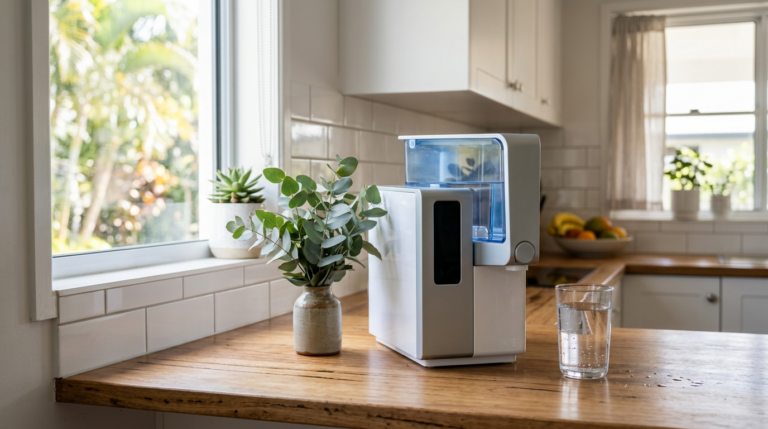
A benchtop or under-sink carbon block filter removes free chlorine and improves taste. Geelong’s chlorine (not chloramine) disinfection means standard carbon works — no need for the catalytic carbon required in chloramine-treated areas like parts of Melbourne.
Best fit: TAPP EcoPro or similar NSF 42-certified carbon filter
If your concerns include PFAS, TDS, fluoride or lead
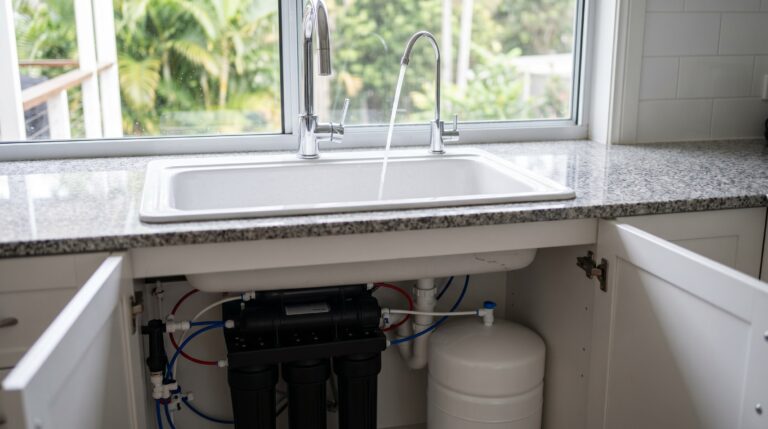
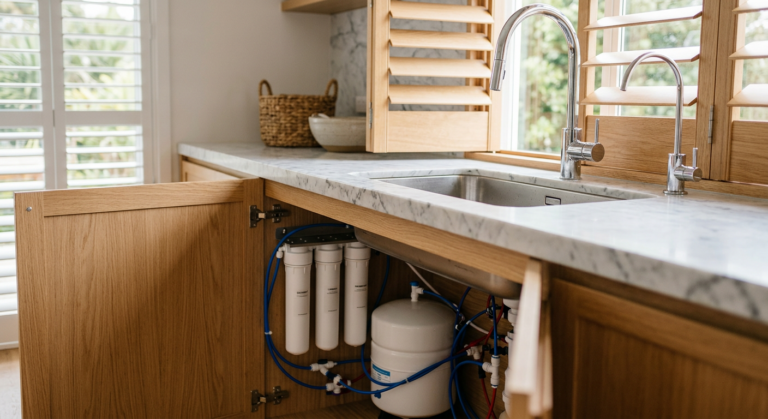
Reverse osmosis is the appropriate technology. A 5-stage under-sink RO system reduces TDS from ~200 mg/L to below 10 mg/L, removes greater than 99% of PFAS, 93%+ of fluoride, and 98.6% of lead — all confirmed by NSF 58 certification.
Best fit: EcoHero 5-Stage RO (WaterMark + NSF 58 certified)
See the EcoHero RO System →For a full comparison of filtration options and what each removes from Australian tap water, see our guide to the best water filters in Australia — which covers benchtop, under-sink, and whole-house options across all price points.
How Geelong compares to other Victorian cities
| City | TDS | Disinfection | Hardness | Key filtration note |
|---|---|---|---|---|
| Geelong | ~200 mg/L | Chlorine | Moderate-hard (~130) | Standard carbon removes chlorine. RO for comprehensive filtration. |
| Melbourne (west) | ~100-150 mg/L | Chloramine | Soft (~50-80) | Requires catalytic carbon for chloramine. Standard carbon insufficient. |
| Palm Beach QLD | 69 mg/L (measured) | Chlorine | Soft | Low TDS. Post-RO: 3 mg/L (95.7% reduction). |
If you want to understand what a reverse osmosis system actually achieves on your specific water, the most reliable approach is a TDS meter test before and after installation. See our guide to reverse osmosis filters in Australia for how RO systems work and what to look for in an Australian-market unit.
Frequently asked questions
Can I drink Geelong tap water without filtering?
Yes. Geelong tap water meets all ADWG health standards and is safe to drink without filtration. Filtration is a personal choice — activated carbon for taste, or RO for comprehensive PFAS, fluoride, and hardness reduction.
What is the TDS of Geelong tap water?
Geelong TDS is typically 120–200 mg/L depending on reservoir conditions. Higher than Melbourne but within ADWG aesthetic guidelines.
Does Geelong use chloramine or free chlorine?
Geelong uses free chlorine for disinfection, not chloramine. This means standard activated carbon filters effectively remove chlorine taste and odour — unlike Sydney, Brisbane, or Ipswich which require catalytic carbon for their chloramine.
Is Geelong tap water safe to drink?
Yes. Geelong’s drinking water is supplied by Barwon Water, which operates under Victoria’s Safe Drinking Water Act 2003 and maintains a HACCP-certified quality management system. Annual testing confirms compliance with Australian Drinking Water Guidelines. The water is safe to drink without further treatment for the general population.
Does Geelong water have fluoride?
Normally yes, at 0.9 mg/L. However, fluoride dosing has been offline since May 2025 due to upgrade works at the Wurdee Boluc Clear Water Storage facility. Barwon Water expects dosing to recommence in the second half of 2025. During this period, fluoride is not being added to most of Geelong’s supply, though naturally occurring background fluoride from catchment sources remains present.
Is Geelong water hard or soft?
Geelong water is moderate to hard, with hardness approximately 130 mg/L as CaCO3. This is calcium and magnesium from surface catchments — not a health issue, but causes scale on kettle elements, shower screens, and appliances. Reverse osmosis removes hardness minerals effectively. Water softeners address scale specifically if that is the primary concern.
Does Geelong water have fluoride?
Normally yes, at 0.9 mg/L. However, fluoride dosing has been offline since May 2025 due to upgrade works at the Wurdee Boluc Clear Water Storage facility. Barwon Water expects dosing to recommence in the second half of 2025. During this period, fluoride is not being added to most of Geelong’s supply, though naturally occurring background fluoride from catchment sources remains present.
Best filter for Geelong?
Carbon block for chlorine and taste only. RO (EcoHero 5-stage) for PFAS, lead, fluoride, TDS, and hardness comprehensively.
Get the Australian Home Environment Checklist
30 checks across water, air and EMF. Most of them free. Ranked by impact.
No spam. Unsubscribe any time.

Former Royal Australian Navy Clearance Diver and TAG-E counter-terrorism operator. Founded Clean and Native to apply the same rigorous thinking to the home environment.
Full biography →