Raw Water Trend: Risks vs Safe Filtered Alternatives
Raw water — unfiltered, untreated water consumed directly from springs, streams, or rainwater tanks — carries documented risks of waterborne pathogens, agricultural chemicals, and PFAS contamination that no amount of “natural” framing removes. For Australian households, the NHMRC’s 2024 public consultation on PFAS in drinking water confirms these risks extend well beyond the obvious, affecting catchments that raw water advocates treat as pristine.
What Is the Raw Water Trend and Why Is It Growing in Australia?
The raw water movement holds that untreated water from natural sources — springs, streams, rainwater tanks, even dew-collection systems — is nutritionally superior to treated municipal supply because treatment destroys beneficial minerals and introduces disinfectants. Advocates point to chloramine and fluoride in treated water as their primary grievances. Some sell raw spring water in glass bottles for $40-60 per litre.
The trend arrived in Australia mostly via US wellness media around 2017-2019, and has gained a second wind through social media communities advocating “ancestral living”. In Queensland, New South Wales, and Victoria, there is a measurable subset of households either sourcing water from unmonitored springs or choosing to bypass tank-water treatment on rural properties. It sounds appealing. The problem is that “natural” and “safe” are not synonyms — they have never been synonyms — and Australian water sources carry specific contamination risks that the raw water community consistently ignores.

The legitimate underlying concern — that municipal treatment introduces substances people would rather not drink — is valid. Chloramine is a real disinfection by-product. Fluoride is a real additive. PFAS contamination of municipal sources is a real and under-addressed problem. But the solution to those concerns is targeted filtration, not abandoning treatment and exposing yourself to pathogens and agricultural chemicals that treatment was designed to remove.
The Actual Risks of Raw Water in the Australian Context
Most global coverage of raw water risks focuses on pathogens — Cryptosporidium, Giardia, E. coli, Campylobacter. These are real and serious. Australia has had documented outbreaks: the 1998 Sydney water contamination event (Cryptosporidium and Giardia in a treated supply that temporarily failed), and ongoing gastroenteritis cases in communities relying on unmonitored bores and rainwater tanks, documented in Queensland Health and NSW Health annual reports. But in 2026, the pathogen risk is actually the second most important story for Australian raw water advocates. The first is PFAS.
PFAS: The Contamination the Raw Water Movement Ignores
Per- and polyfluoroalkyl substances (PFAS) are synthetic chemicals used in firefighting foam, non-stick cookware coatings, and industrial processes since the 1950s. They do not break down in the environment — hence the label “forever chemicals”. In Australia, the Department of Climate Change, Energy, the Environment and Water (DCCEEW) national PFAS site register has confirmed contamination at over 700 sites across the country. Many of these are near airports, defence bases, and industrial zones — but PFAS migrate through groundwater over decades, meaning contamination extends well beyond the immediate source site.
The NHMRC’s October-November 2024 public consultation on PFAS in Australian drinking water confirmed that health risks from PFAS exposure are significant and that existing Australian Drinking Water Guidelines (ADWG) may not be adequately protective against emerging PFAS compounds. The consultation submissions include data from affected communities in the ACT, Darwin, Williamtown NSW, Katherine NT, and Oakey QLD — all areas near RAAF bases where PFAS-containing firefighting foam was used. People collecting “raw” spring or bore water near any of these sites face PFAS exposure that no boiling, UV treatment, or mineralisation can address. PFAS is removed only by reverse osmosis (90-97% rejection) or activated carbon block at high contact time — neither of which is present in unfiltered source water.
Pathogens in Australian Source Water: The Documented Record
Cryptosporidium oocysts and Giardia cysts are present in Australian surface water catchments at measurable levels, particularly after rainfall events that increase runoff from agricultural land. The 2017 NSW outbreak investigation documented Cryptosporidium in a water supply serving approximately 1.2 million people in western NSW — this was treated water with a temporary treatment failure, not raw water. Raw surface water carries higher loads. Queensland Health’s 2023 annual drinking water quality report flagged ongoing E. coli detections in tank water systems across rural and remote Queensland.
Campylobacter is the most common cause of acute waterborne gastroenteritis in Australia according to the Australian Institute of Health and Welfare (AIHW) 2023 communicable disease data. Most cases are attributable to consuming untreated or inadequately treated water. These are not hypothetical risks for people drinking raw creek or spring water — they are the documented statistical outcome.
Pesticides and Agricultural Chemicals: The Testing Blind Spot
Friends of the Earth Australia’s published analysis of the Australian drinking water quality framework identifies a critical testing gap: many pesticides and agricultural chemicals are sampled in raw (pre-treatment) water only if raw water levels exceed guideline trigger thresholds. Below those thresholds, the same compounds are not routinely sampled in treated water. This creates a systematic blind spot — low-level pesticide contamination that falls below the raw water trigger may pass into treated supply untested, and the same compounds are present at higher concentration in unfiltered raw water.
Atrazine, simazine, and organophosphate residues are detected in Australian catchments in agricultural zones across Victoria’s irrigation districts, the Darling Basin, and coastal QLD. People collecting raw water from streams in these catchments have no basis to assume contamination is absent. The ADWG guidelines (2022 edition, updated 2025) set health guideline values for these compounds, but those guidelines exist to inform treatment decisions — not to certify that raw water below the threshold is safe to consume without treatment.
State-by-State Risk Assessment: Where Raw Water Is Most Dangerous in Australia
The raw water risk is not uniform across Australia. Source, geography, and proximity to contamination sites all matter. Here is a realistic assessment by state — not to suggest any raw source water is safe, but to help readers understand relative risk levels.
| State / Territory | Primary Raw Water Risk | Known Contamination Hotspots | PFAS Risk Level |
|---|---|---|---|
| QLD | Agricultural chemicals (Darling Downs, Lockyer Valley), E. coli in tank water | Oakey (RAAF base PFAS), Logan/Ipswich bore water | High (Oakey confirmed) |
| NSW | Cryptosporidium in surface catchments, pesticide residues | Williamtown RAAF (Newcastle), Penrith western Sydney bore water | High (Williamtown confirmed) |
| VIC | Agricultural chemical runoff (irrigation districts), Giardia in alpine catchments | East Sale RAAF, industrial Geelong corridor | Moderate-High |
| SA | Hard water (140 mg/L CaCO3), agricultural chemicals, high TDS (~400 mg/L) | Edinburgh RAAF (north Adelaide), Murray River catchment contamination | Moderate-High |
| WA | High hardness (180 mg/L CaCO3), agricultural chemicals (South West), bore water quality variation | Pearce RAAF (Bullsbrook), Kwinana industrial corridor groundwater | Moderate |
| NT | PFAS in Darwin groundwater, tropical pathogen load (wet season) | Darwin RAAF (Katherine PFAS confirmed, 123 µg/L PFOS in bore water 2016) | Critical (Katherine) |
| ACT | PFAS in treated supply (NHMRC 2024 consultation cited ACT submissions) | ACT Water Supply — PFAS detections documented in 2024 consultation | High |
| TAS | Relatively lower PFAS burden, but Cryptosporidium in highland catchments | RAAF East Sale spillover; mining legacy contamination in NW Tasmania | Lower (relative) |
Katherine, NT deserves specific mention. In 2016, bore water PFOS concentrations of 123 micrograms per litre were confirmed near the Katherine RAAF base — a figure 2,460 times the current ADWG health guideline value of 0.05 µg/L for PFOS. Residents were on alternative water supply for years. Anyone collecting bore or spring water within a 20-kilometre radius of any Australian defence base or airport should treat PFAS contamination as a baseline assumption, not a remote possibility.
What the Raw Water Advocates Are Partially Right About
Credibility requires acknowledging what the raw water community gets right. Brisbane, Sydney, Adelaide, Gold Coast, and Darwin all use chloramine as their primary disinfectant — a combination of chlorine and ammonia introduced in the 1990s to reduce trihalomethane (THM) by-products. Chloramine is more persistent than free chlorine, which is useful for distribution systems but means the disinfectant reaches your tap at measurable concentrations. Melbourne, Hobart, Canberra, and Townsville still use free chlorine.
Chloramine is not acutely toxic at drinking water concentrations. The ADWG 2022 guideline sets a maximum of 3 mg/L as monochloramine. But it does produce disinfection by-products including haloacetic acids (HAAs) and cyanogen chloride, and its presence at the tap is a legitimate reason to filter. Fluoride is added at 0.6-1.0 mg/L in most Australian municipal supplies as a public dental health measure — the ADWG health guideline value is 1.5 mg/L. Whether you want to drink it is a personal decision; the point is that the concern is not irrational.
The mistake the raw water movement makes is treating the solution as binary: municipal chloraminated supply OR unfiltered raw water. That is a false choice. Reverse osmosis removes chloramine (greater than 95% rejection), fluoride (90-97%), PFAS (90-97%), agricultural chemicals, heavy metals, and pathogens simultaneously. You can address every legitimate concern about municipal water with a certified filtration system — without replacing those concerns with Cryptosporidium and PFAS.
Why Standard Carbon Filters Are Not Enough for Most Australian Cities
Before we get to the RO solutions, it is worth being direct about the products most Australians currently use: carbon jug filters (Brita, Bobble, PureGuard) and standard granular activated carbon (GAC) undersink filters. For households in Brisbane, Sydney, Adelaide, Gold Coast, and Darwin — all chloramine cities — these products are largely ineffective at removing the primary disinfectant in their water.
Standard GAC removes free chlorine effectively because it is a fast chemical reaction. It removes chloramine at approximately 1/40th the rate. To remove chloramine adequately, you need either catalytic carbon (which has a modified surface structure that accelerates the chloramine reaction), a solid carbon block with long contact time, or reverse osmosis. A Brita jug in a Brisbane kitchen is doing almost nothing to address the actual disinfectant in SEQ water. That is not a brand criticism — it is a chemistry fact based on chloramine kinetics documented in NSF/ANSI 42 certification testing data.
For fluoride and PFAS removal, carbon filtration — including catalytic carbon — cannot remove either compound. Fluoride requires reverse osmosis (90-97% rejection) or activated alumina (80-95%). PFAS removal requires RO or high-contact-time carbon block at sub-micron ratings. Anyone using a standard jug filter and believing it is addressing PFAS contamination is misinformed.
The Two Filters That Actually Address Australian Water Concerns
Safe Filtered Alternatives: What to Use Instead of Raw Water
As a former Royal Australian Navy Clearance Diver, I have a particular lack of tolerance for unquantified risk. Raw water is an unquantified risk. Here is what actually works, matched to Australian water chemistry and contamination profiles.
Option 1: Countertop Reverse Osmosis (Best for Renters and Units)

✓ Pros
- NSF/ANSI 58 certified — tested for 80+ contaminants including PFAS
- No plumber or under-sink installation — renters and units can use it
- 97% fluoride rejection confirmed in NSF testing data
- Alkaline remineralisation stage addresses the “stripped water” concern of raw water advocates
✗ Cons
- 3:1 waste-to-product water ratio (standard for countertop RO)
- Slower flow than tap — fills a 1L jug in approximately 12-15 minutes
- Filter costs approximately $120-150 AUD per year for full filter replacement
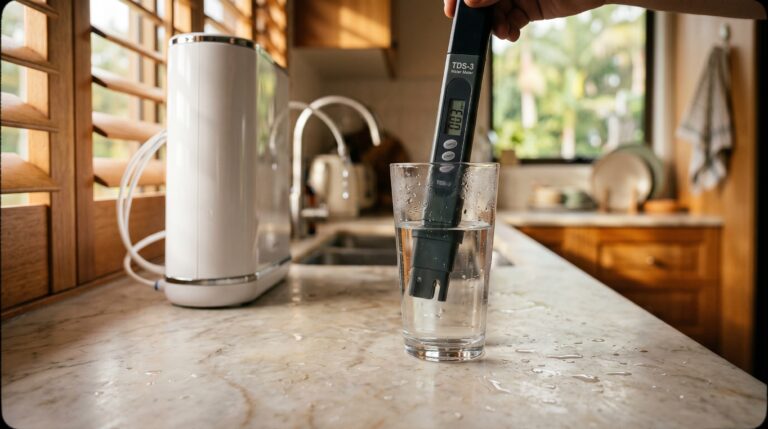
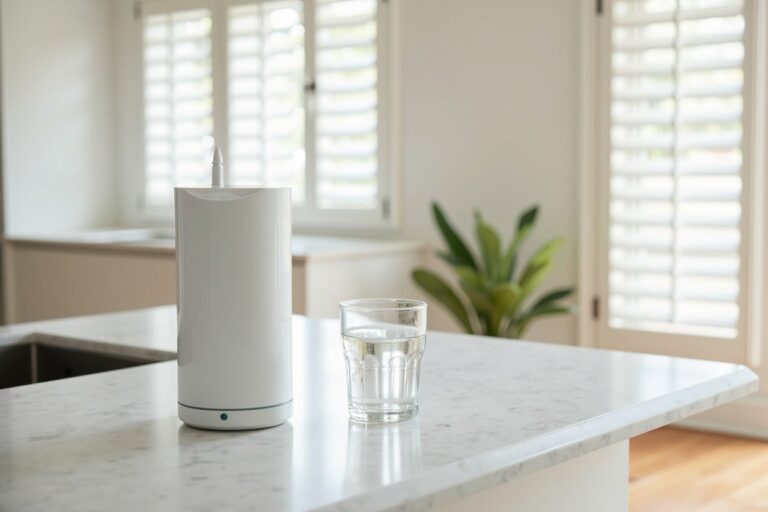
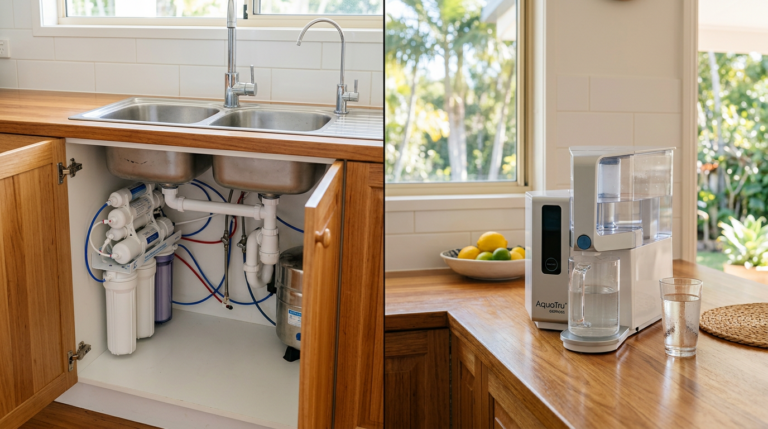
The AquaTru addresses the exact concerns that drive people toward raw water — chloramine, fluoride, and now PFAS — without requiring a plumber, a lease modification, or faith in an unmonitored spring. At approximately $0.04 per litre over a five-year period, it undercuts bottled spring water by a factor of 50 to 100. For renters in Brisbane, Sydney, Adelaide, Gold Coast, and Darwin where chloramine is the disinfectant, this is the clearest upgrade from the current norm.
Option 2: Under-Sink Reverse Osmosis (Best Permanent Installation)

✓ Pros
- WaterMark AS3497 certified — legally compliant for Australian plumbing installations
- 5-stage filtration: sediment, two carbon stages, RO membrane, post-carbon polish
- Australian company — local technical support and fast filter replacement shipping
- Handles all Australian mains water types including high-TDS Adelaide supply (~400 mg/L)
✗ Cons
- Requires licensed plumber for installation (AS/NZS 3500 compliance)
- Not suitable for tank or bore water without pre-treatment (high sediment loads can damage membranes)
- Does not remineralise by default — an alkaline post-filter can be added
WaterMark certification is not optional in Australia for plumbing-connected water treatment products — it is the mandatory Australian standard under AS3497. Products without it are not legally compliant for permanent installation. Any under-sink filter you buy should carry the WaterMark tick. The PWS EcoHero does. Many cheaply imported under-sink RO units sold on Amazon AU do not — check before you buy.
The 5-Year Cost Reality Check
Raw water advocates often cite the cost of bottled spring water as evidence that their approach is economical. It is not. But neither is buying an RO filter and ignoring the filter replacement costs. Here is the honest five-year cost comparison for a standard four-person Australian household consuming approximately 4 litres of drinking water per day.
| Water Source | Upfront Cost | Annual Running Cost | 5-Year Total | Cost Per Litre |
|---|---|---|---|---|
| Raw spring water (delivered) | $0 | ~$2,920 (at $2/L avg) | ~$14,600 | $2.00 |
| Bottled water (supermarket) | $0 | ~$876 (at $0.60/L avg) | ~$4,380 | $0.60 |
| Standard carbon jug (chloramine cities) | ~$50 | ~$80 (cartridges) | ~$450 | $0.06 (but ineffective) |
| AquaTru Classic RO (countertop) | ~$699 | ~$140 (filter set) | ~$1,259 | $0.17 |
| PWS EcoHero 5-Stage RO (under-sink) | ~$1,009 + install | ~$100 (filters) | ~$1,759 incl. install | $0.04 |
Delivered raw spring water at $2 per litre costs over eleven times more than the PWS EcoHero over five years — and the EcoHero produces water that is verifiably free of PFAS, pathogens, fluoride, and chloramine, which no spring water can guarantee. The cost comparison alone should end the debate.
What “Natural Minerals” Arguments Miss About RO Water
The most common objection to RO filtration from raw water advocates is mineral loss. Reverse osmosis removes calcium, magnesium, and other dissolved minerals alongside contaminants. This is true. The claim that this makes RO water harmful is not supported by the evidence.
The World Health Organisation’s 2011 review of demineralised water concluded that water contributes approximately 5-20% of daily mineral intake for calcium and magnesium in populations consuming an adequate diet. The remaining 80-95% comes from food. A person eating a normal Australian diet is not at risk of mineral deficiency from drinking RO-filtered water. If you want to remineralise, the AquaTru Classic’s alkaline stage raises pH and adds back calcium and magnesium. A pinch of pink salt per litre also works.
More practically: the minerals present in raw Australian spring water are not consistent or predictable. Bore water in the Pilbara has dissolved mineral levels ten times higher than coastal QLD spring water. “Natural minerals” in Katherine bore water includes PFAS. The mineral content argument for raw water collapses the moment you apply it to a specific Australian source rather than an abstract ideal.
Decision Framework: What Filter Do You Actually Need?
Three questions determine the right filter for your household. Answer them in order.
Filter Selection Decision Tree
1. Can you modify your plumbing?
No (renting, unit, or want portability) — Use countertop RO: AquaTru Classic. No plumber, no installation.
Yes (owner-occupier, townhouse, house) — Proceed to question 2.
2. What city are you in?
Brisbane, Sydney, Adelaide, Gold Coast, Darwin — Chloramine present. Standard carbon filters do not work. You need RO or catalytic carbon minimum. For PFAS or fluoride concerns: RO only.
Melbourne, Hobart, Canberra, Townsville, Cairns — Free chlorine. Catalytic carbon handles taste and chlorine. For PFAS or fluoride: RO only.
3. What is your primary concern?
PFAS, fluoride, or raw water risk — Reverse osmosis only. PWS EcoHero 5-Stage under-sink.
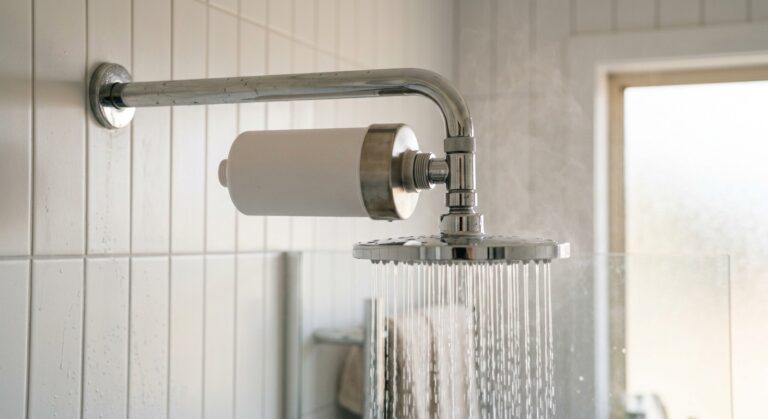
Taste, chloramine, or chlorine only — Catalytic carbon block under-sink or countertop.
Bacteria or tank water — UV system combined with RO or catalytic carbon pre-filter.
Last reviewed: June 2026 — Clean and Native
Final Verdict
Final Verdict: This article is most relevant for health-conscious consumers curious about raw water, with the key takeaway being that while raw water carries significant contamination risks, properly filtered water offers the same purity benefits without the dangers. The most important action is to invest in a high-quality water filtration system from a trusted provider at See Pure Water Systems rather than consuming untreated water.
Frequently Asked Questions
Collecting water from natural sources for personal consumption is not prohibited in Australia, but selling or supplying untreated water commercially is regulated under state food safety laws and the Australian Drinking Water Guidelines. NSW Health and Queensland Health have both issued advisories against drinking untreated surface or spring water due to pathogen and chemical contamination risks.
No. Boiling water removes or reduces biological contaminants (bacteria, viruses, Giardia) but does not remove PFAS compounds. PFAS are heat-stable synthetic chemicals — boiling concentrates them slightly by reducing the water volume. Reverse osmosis is the only consumer technology that achieves meaningful PFAS reduction (90-97% rejection rate at the membrane).
Australian rainwater tanks can contain Cryptosporidium, Giardia, Campylobacter, E. coli (from bird and animal faeces on roof catchments), lead (from roof flashing and gutters on older homes), and asbestos fibres (from asbestos-cement roofing still present on pre-1990 homes). Queensland Health recommends treating tank water with UV disinfection and filtration before drinking.
Brisbane and south-east Queensland, Sydney and metropolitan NSW, Adelaide, Gold Coast, and Darwin all use chloramine (a combination of chlorine and ammonia) as their primary disinfectant. Melbourne, Hobart, Canberra, Townsville, and Cairns still use free chlorine. Standard carbon jug filters like Brita remove free chlorine effectively but remove chloramine at approximately 1/40th the rate — making them largely ineffective in chloramine cities.
No. Brita and standard granular activated carbon (GAC) filters cannot remove fluoride. Fluoride removal requires reverse osmosis (90-97% rejection) or activated alumina media (80-95%). This applies to all carbon filters including catalytic carbon — catalytic carbon improves chloramine removal but has no effect on fluoride. If fluoride removal is your goal, an NSF/ANSI 58 certified RO system is the only validated consumer option.
The NHMRC’s October-November 2024 public consultation on PFAS in Australian drinking water confirmed significant health risks from PFAS exposure and noted that existing ADWG guidelines may not be adequately protective for all PFAS compounds. The DCCEEW national register lists over 700 confirmed PFAS contamination sites across Australia. The highest confirmed contamination was Katherine NT bore water at 123 µg/L PFOS — 2,460 times the ADWG guideline value of 0.05 µg/L.
Not necessarily. According to a WHO 2011 review of demineralised water, drinking water contributes 5-20% of daily calcium and magnesium intake for people eating a standard diet. The remaining 80-95% comes from food. RO water is not harmful for people eating normally. If you want to remineralise, the AquaTru Classic includes an alkaline post-filter stage, or you can add a small amount of mineral salt per litre.
WaterMark certification under AS3497 is the mandatory Australian standard for plumbing products and water treatment systems that connect permanently to your mains supply. Under AS/NZS 3500, a licensed plumber installing an under-sink filter is required to use WaterMark-certified components. Filters without WaterMark certification are not compliant for permanent installation, regardless of their filtration performance claims.
The safest alternative to raw water in Australia is NSF/ANSI 58 certified reverse osmosis filtration of mains municipal water. Municipal water is pre-treated to remove pathogens — RO then removes disinfection by-products (chloramine), fluoride, PFAS, heavy metals, and pesticide residues. This produces water that is verifiably cleaner than any Australian raw source water, at a fraction of the cost of bottled or delivered spring water.
Get the Australian Home Environment Checklist
30 checks across water, air and EMF. Most of them free. Ranked by impact.
No spam. Unsubscribe any time.

Former Royal Australian Navy Clearance Diver and TAG-E counter-terrorism operator. Founded Clean and Native to apply the same rigorous thinking to the home environment.
Full biography →