Removing Iron and Manganese from Bore Water
Drafted with AI assistance and checked against published specifications and certifications. First-hand measurements appear only where stated. How we make content
Dissolved iron and manganese are the two most common contaminants in Australian bore water, and a standard sediment filter will not remove them — you need an oxidation step first, then filtration through iron-specific media. According to the NHMRC Australian Drinking Water Guidelines (ADWG), manganese must be below 0.05 mg/L and iron below 0.3 mg/L for aesthetic acceptability, with manganese carrying additional health-based concern at chronic exposure above 0.5 mg/L.
The correct treatment sequence for iron and manganese in Australian bore water is: test → oxidise → filter → polish. Skipping the oxidation step is the single biggest mistake bore owners make — dissolved (ferrous) iron passes straight through sediment cartridges and carbon blocks because it is invisible and in solution. You must convert it to ferric iron (the solid, filterable form) before any mechanical filter can catch it. For most residential bores with iron below 10 mg/L and manganese below 2 mg/L, an aeration or chlorination pre-treatment stage followed by a Birm or greensand media filter delivers ADWG-compliant water at a 10-year cost well below bottled or trucked supply.
| Treatment Method | What It Does | Verdict |
|---|---|---|
| Aeration + Birm/Greensand Filter | Oxidises dissolved iron/Mn to solid form, then filters it mechanically | Recommended — best residential approach |
| Chlorination + Sediment Filter | Chemical oxidation followed by carbon polishing to remove chlorine residual | Effective but adds chemical handling |
| Sediment Cartridge Only | Catches particulate (ferric) iron but passes dissolved (ferrous) iron completely | Avoid as primary — misses the problem |
Key catches
- A water test (iron, manganese, pH, hardness) is non-negotiable before buying anything — treatment media selection depends on pH and concentration ranges
- Birm media requires pH above 6.8 for iron removal and above 7.5 for manganese — if your bore is acidic, you need pH correction upstream
- Iron bacteria (slimy orange biofilm) require chlorine shock treatment, not filtration — filtration alone will not solve a bacterial iron problem
Signs You Have an Iron and Manganese Problem
You already know something is wrong. The toilet bowl has an orange-brown ring that no amount of scrubbing removes. The shower screen has dark staining that looks almost black. Hot water smells metallic or faintly like rotten eggs. These are not cosmetic annoyances — they are physical evidence that your bore water carries dissolved metals above the ADWG aesthetic guideline values of 0.3 mg/L for iron and 0.05 mg/L for manganese.
Here is how to identify which metal you are dealing with, because the treatment approach differs depending on concentration, pH, and whether the metals are dissolved or already oxidised.
Iron signs: Orange, rust-coloured staining on fixtures, sinks, and laundry. Water may run clear from the tap initially (dissolved ferrous iron) then turn orange after sitting in a glass for 15-30 minutes as it oxidises on contact with air. Metallic taste. At concentrations above 0.3 mg/L, according to the ADWG, water becomes noticeably discoloured and unpalatable. Many Australian bores, particularly in Western Australia’s Pilbara and Goldfields regions, South Australia’s Adelaide Plains, and Queensland’s Darling Downs, carry iron at 1-15 mg/L — 3 to 50 times the guideline.
Manganese signs: Black or dark brown staining, particularly on white porcelain and in dishwashers. Manganese staining is often mistaken for mould. The NHMRC guideline value is 0.05 mg/L for aesthetic quality, with a health-based guideline of 0.5 mg/L — manganese is the stricter target of the two metals. At concentrations above 0.1 mg/L, laundry develops grey-black marks that are nearly impossible to remove. Bore water across the Murray-Darling Basin, Perth’s northern coastal aquifers, and parts of rural Tasmania commonly exceeds 0.1 mg/L manganese.
Combined iron + manganese: Most problematic bores contain both. The staining gradient runs from orange (iron-dominant) through brown (mixed) to near-black (manganese-dominant). If you see both orange and dark staining, you have both metals, and your treatment system must handle each one’s specific oxidation and filtration requirements.
Why Standard Sediment Filters Do Not Remove Dissolved Iron
This is where most bore owners waste money. They buy a 20-micron or even 5-micron sediment cartridge, install it on the bore line, and expect the staining to stop. It does not. The water still runs clear from the cartridge but turns orange in the sink. They replace the cartridge. Same result. They go down to 1 micron. Same result.
The reason is chemistry, not filtration rating. Iron in bore water exists in two forms, and only one of them is a particle.
Ferrous iron (Fe²⁺) — dissolved, invisible. This is the form that exists in oxygen-deprived groundwater. It is in true solution, the same way salt dissolves in water. A sediment filter cannot catch it because there is nothing to catch — it is not a particle. It passes through 1-micron, 0.5-micron, and even 0.1-micron filters. It passes through carbon blocks. It passes through everything that works by mechanical filtration alone.
Ferric iron (Fe³⁺) — oxidised, visible, filterable. When ferrous iron contacts oxygen (or another oxidising agent), it converts to ferric iron — the orange rust you see. This IS a particle, typically 1-50 microns in size, and a sediment filter can catch it. But if you are filtering bore water before it has been exposed to oxygen, you are filtering water that contains only the dissolved form.
Manganese follows the same principle. Dissolved manganous (Mn²⁺) is invisible and in solution. Oxidised manganic (Mn⁴⁺) forms black particles. But manganese is harder to oxidise than iron — it requires a higher pH (above 7.5 with Birm media, above 9.5 with simple aeration) or a stronger oxidising agent like potassium permanganate or chlorine.
This is why the correct bore water treatment sequence always starts with oxidation, not filtration. Without oxidation, you are filtering water that looks clean at the point of filtration and turns orange in your house. The filter did its job — the problem is that you asked it to do the wrong job.
Treatment Methods: The Correct Sequence
Every effective iron and manganese treatment system follows the same logic: test → oxidise → filter → polish. The specific equipment changes depending on your iron/manganese concentrations, pH, and whether you are treating for a single household or a small farm operation. But the sequence does not change.
Step 1: Laboratory Water Test (Non-Negotiable)
Before you spend a dollar on equipment, you need a laboratory test covering at minimum: total iron, total manganese, pH, total dissolved solids (TDS), hardness, and hydrogen sulfide (H₂S). Optional but recommended: iron bacteria culture, alkalinity, and a full dissolved metals panel.
In Australia, NATA-accredited laboratories such as ALS Environmental, Eurofins, and state government labs (e.g. ChemCentre in WA, Queensland Health Forensic and Scientific Services) offer bore water analysis panels for $80-$250 depending on the scope. Your local council or state health department may subsidise testing in some regions. Many rural water supply retailers also offer free test kits with prepaid lab submission — ask before paying retail.
Why this matters: Birm media requires pH ≥ 6.8 for iron removal and ≥ 7.5 for manganese removal. If your bore water pH is 5.5 (common in WA sandy aquifers and parts of the NSW tablelands), Birm will not work without upstream pH correction. Greensand requires potassium permanganate regeneration and works across a wider pH range (6.2+), but adds chemical handling. Without the test, you are guessing — and guessing costs more than the test.
Step 2: Oxidation (Converting Dissolved Metals to Filterable Particles)
There are four practical oxidation methods available for Australian residential bore owners. The choice depends on your iron/manganese concentration, pH, and tolerance for chemical handling.
Aeration (air injection). The simplest approach. An air-injection system (venturi or compressor) introduces atmospheric oxygen into the water line upstream of the filter tank. Iron oxidises on contact with dissolved oxygen. Effective for iron concentrations up to approximately 7-10 mg/L and where pH is above 7.0. Aeration alone struggles with manganese unless pH is above 9.5, which is rare in Australian bore water. No chemicals required. Typical residential air-injection heads cost $400-$800 installed on the bore line.
Chlorination (sodium hypochlorite dosing). A small chemical dosing pump injects a dilute sodium hypochlorite (bleach) solution into the bore line, typically into a contact tank that provides 20-30 minutes of contact time. Chlorine is a strong oxidiser that handles both iron (effective at pH 7+) and manganese (effective at pH 8+, often with a higher dose). The ADWG permits a chlorine residual of up to 5 mg/L but recommends below 0.5 mg/L at the tap for taste. A carbon polishing stage downstream removes residual chlorine. Chemical dosing pumps run $300-$600; contact tanks add $200-$500. You will need to handle and store sodium hypochlorite (typically 12.5% pool-grade), which has a shelf life of 3-6 months in Australian summer heat.
Potassium permanganate (KMnO₄) dosing. A powerful oxidiser used in conjunction with greensand (manganese dioxide coated) filter media. The permanganate regenerates the greensand’s oxidising capacity. Effective across a wider pH range (6.2+) and handles higher manganese concentrations (up to 3-5 mg/L) than aeration alone. However, KMnO₄ is a controlled substance in some Australian jurisdictions, stains everything it touches purple, and requires careful dosing — overdosing produces pink water. Best suited to properties with prior water treatment experience or professional installation.
Ozone injection. Ozone (O₃) is the strongest practical oxidiser, handling iron and manganese at virtually any pH and concentration encountered in residential bores. However, ozone systems cost $2,000-$5,000 for residential units, require electricity, and produce a gas that must be properly vented. Generally only justified for high-iron bores (>10 mg/L) or where pH correction is impractical. Rarely used in Australian residential applications but available through specialist water treatment suppliers.
Step 3: Filtration Through Iron-Removal Media
After oxidation, the water contains suspended ferric iron and manganic oxide particles. These need to be mechanically filtered out. Standard sediment cartridges CAN work at this stage (because the iron is now particulate), but dedicated iron-removal media provide better performance, longer service life, and self-cleaning capability through backwash.
Birm (Burgess Iron Removal Media). The most common iron-removal media in Australian residential systems. Birm is a lightweight granular media with a manganese dioxide coating that acts as both a catalyst for oxidation and a filter. It does not consume chemicals — the manganese dioxide coating is not depleted during normal operation. Birm requires: pH ≥ 6.8 for iron, ≥ 7.5 for manganese; dissolved oxygen present (aeration upstream or naturally aerated water); no hydrogen sulfide (H₂S kills the catalytic surface). Backwashes with raw water every 1-3 days depending on loading. Media life: 3-7 years depending on water quality and backwash discipline. A standard 10″ x 54″ Birm tank treats a 3-bedroom household at typical bore flow rates of 20-40 L/min.
Greensand (manganese greensand). A heavier media coated with manganese dioxide, used with potassium permanganate regeneration. Handles higher iron (up to 15 mg/L) and manganese (up to 5 mg/L) than Birm. Works at lower pH (6.2+). Requires periodic regeneration with KMnO₄ solution — either continuous-feed via a dosing pump or intermittent batch regeneration. Greensand is more robust than Birm for challenging water but adds chemical handling complexity. Media life: 5-10 years with proper regeneration.
Katalox Light. A newer catalytic media (manganese dioxide on zeolite) that provides higher oxidation capacity than Birm without chemical regeneration. Handles iron up to 15 mg/L and manganese up to 3 mg/L at pH 6.2+. Lighter than greensand, requiring less backwash water. Gaining traction in Australian rural supply channels. Higher upfront media cost ($300-$500 per fill vs $150-$250 for Birm) but longer projected media life (7-10 years).
Step 4: Polishing (Point-of-Use Filtration)
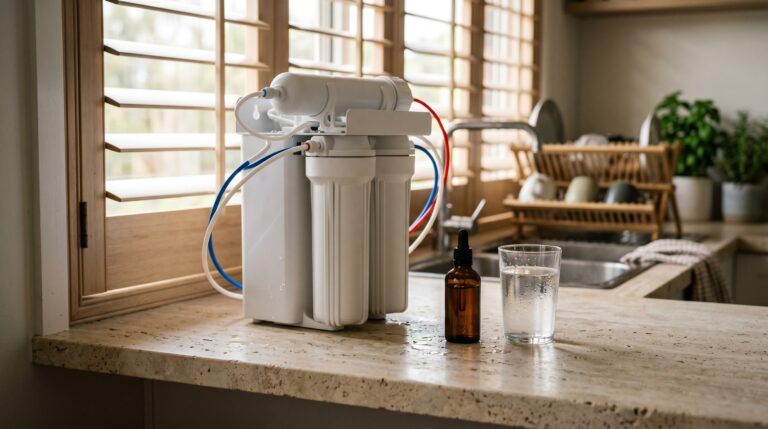
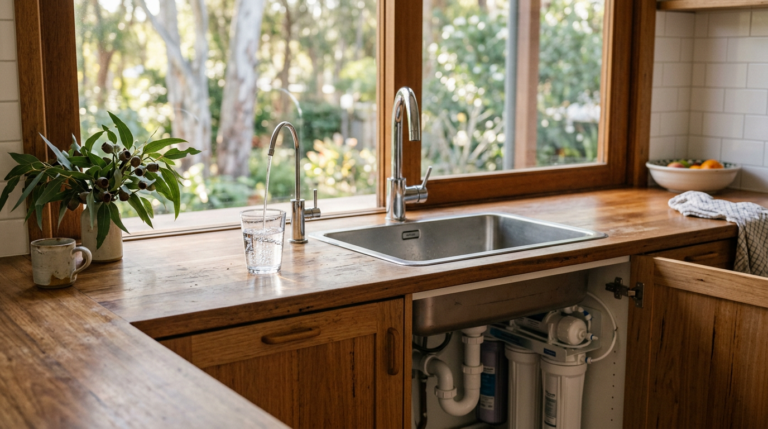
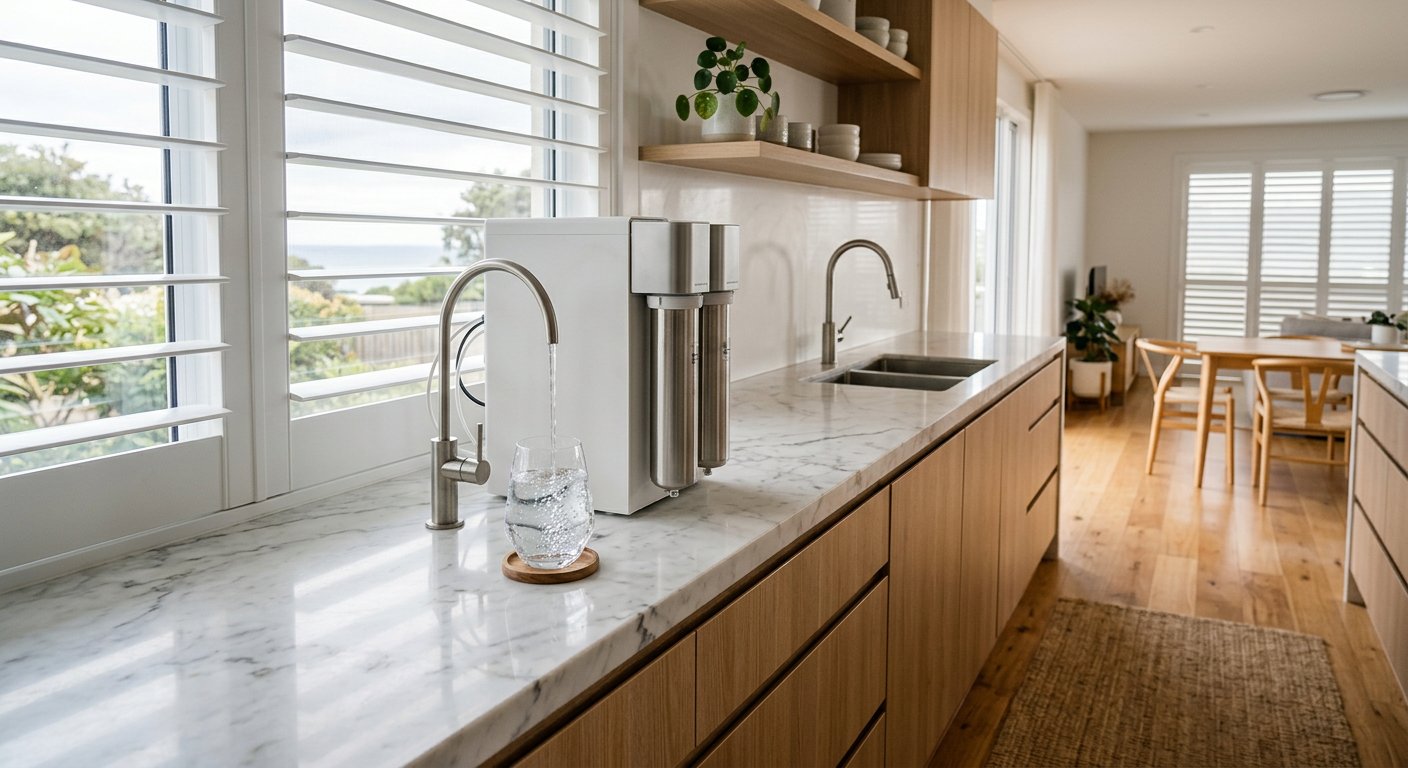
After the whole-of-house oxidation and media filtration system, a point-of-use (POU) filter at the kitchen tap provides final polishing for drinking water. This is where a quality under-sink or countertop system adds genuine value. A reverse osmosis unit like the removes any residual metals that passed the media filter, plus addresses other bore water concerns like nitrates, TDS, and potential bacterial contamination. For bore water, the RO stage is not the primary iron/manganese treatment — it is the safety net.
Treatment Technology Comparison: Cost, pH Requirements, and Capacity
Choosing between Birm, greensand, and Katalox Light is not a preference decision — it is determined by your water test results. The table below maps each media’s operating envelope against the parameters that matter for Australian bore owners.
| Parameter | Birm | Greensand + KMnO₄ | Katalox Light |
|---|---|---|---|
| Min pH (iron) | 6.8 | 6.2 | 6.2 |
| Min pH (manganese) | 7.5 | 6.8 (with KMnO₄) | 7.0 |
| Max iron (mg/L) | ~10 | ~15 | ~15 |
| Max manganese (mg/L) | ~2 | ~5 | ~3 |
| Chemical regeneration | None (backwash only) | KMnO₄ required | None (backwash only) |
| H₂S tolerance | No — damages media | Yes (oxidises H₂S) | Limited |
| Media fill cost (10″x54″ tank) | $150-$250 | $200-$350 + KMnO₄ | $300-$500 |
| Media life (years) | 3-7 | 5-10 | 7-10 |
| Backwash water per cycle | ~200-400 L | ~300-500 L | ~150-300 L |
| Best for | Standard residential bores, pH 7+ | High iron/Mn, low pH, H₂S present | Higher capacity without chemicals |
Decision logic: If your water test shows iron below 10 mg/L, manganese below 2 mg/L, pH above 7.0, and no hydrogen sulfide — Birm is the default. It is the lowest-maintenance, lowest-cost option, available from every rural water supply retailer in Australia, and requires nothing beyond periodic backwashing. If your pH is below 6.8, your iron exceeds 10 mg/L, or you have H₂S (rotten egg smell), greensand with KMnO₄ is the proven workhorse. Katalox Light occupies the middle ground — higher capacity than Birm, no chemicals like greensand — but availability through Australian rural supply channels is still building.
For properties in Western Australia’s sandy coastal aquifers (Perth northern suburbs through to Geraldton), bore pH commonly sits at 5.5-6.5 with iron at 2-8 mg/L. Birm will not work here without a calcite contactor upstream to raise pH above 6.8. In contrast, bores across the Darling Downs in Queensland and the Murray-Darling Basin in NSW and Victoria often deliver pH 7.2-8.0 with moderate iron (1-5 mg/L) — ideal Birm territory.
Australian Rural Supply and Sourcing
Finding iron-removal equipment in Australia is simple if you know where to look. The major rural water treatment suppliers stock Birm, greensand, and complete iron-removal tank systems. Here are the primary channels.
Specialist rural water treatment retailers. Companies like Aqua-Pure Ventures (QLD/NSW), Water Treatment Solutions (VIC), Clark Tanks/Wet Earth (national), and Pacific Water Technology (WA) stock complete iron-removal systems including air-injection heads, media tanks, control valves (typically Clack or Fleck brand), and media fills. Expect to pay $1,500-$3,500 for a complete residential iron/manganese removal system (air injection + media tank + control valve) before installation. Many offer phone consultation based on your lab test results — bring the report.
Online water treatment suppliers. National suppliers like Water Filters Australia, Filter Systems Australia, and The Water Shop carry individual components. You can source a media tank, valve head, and Birm fill separately if you are comfortable with DIY assembly. This route typically saves 20-30% over a pre-assembled system but requires basic plumbing knowledge and a correct system sizing calculation based on your flow rate and iron loading.
Local bore drillers and pump installers. Your bore driller often has a working relationship with a water treatment installer. In many regional areas, the bore driller is the best referral source for a treatment installer who understands local water chemistry. Ask for a referral when you commission the bore or during pump servicing.
Agricultural supply stores. Elders, Landmark, and CRT stores in some regions carry basic water treatment components, particularly sediment filter housings and cartridges. For the specialised iron-removal media and control valves, you will generally need a dedicated water treatment supplier.
For the point-of-use polishing stage, a countertop RO system like the works for drinking water without any plumbing modification. For a permanent under-sink installation, the provides multi-stage reverse osmosis polishing downstream of your whole-of-house iron treatment. Both are available on Amazon AU with delivery to regional addresses. For the full hardware comparison, see our bore and tank water filter roundup.
When to Test, How Often, and What to Ask For
Testing is not a one-time event. Bore water chemistry changes seasonally, with aquifer drawdown, and with changes in surrounding land use (fertiliser, septic, mining activity). Here is the testing protocol that protects you from both under-treatment and over-treatment.
Before installing any treatment system: Full analysis. Request a NATA-accredited laboratory panel covering total iron, dissolved iron (ferrous), total manganese, pH, alkalinity, hardness, TDS, hydrogen sulfide (field test — H₂S degasses quickly), electrical conductivity, and total coliforms/E. coli. This panel costs $150-$250 and is the foundation of every equipment decision. Without it, you are guessing.
Six months after installation: Retest iron, manganese, and pH at the treated water tap. This confirms the system is performing to specification. If iron or manganese remains above ADWG guidelines (0.3 mg/L and 0.05 mg/L respectively), the system needs adjustment — flow rate, backwash frequency, oxidation contact time, or media condition.
Annually thereafter: Iron, manganese, and pH at both the bore head and the treated water tap. This catches changes in source water quality before they overwhelm the treatment system. If source iron increases from 5 mg/L to 12 mg/L over a year, your Birm system may need upsizing or conversion to greensand.
After any significant rainfall event or extended drought: Both conditions shift aquifer chemistry. Heavy rain can introduce surface contamination (bacteria, nitrates) through bore head seals. Extended drought concentrates dissolved minerals as the water table drops. A $100 retest after these events is cheap insurance.
Where to test: NATA-accredited laboratories accepting direct public submissions include ALS Environmental (offices in all capital cities and major regional centres), Eurofins (national), National Measurement Institute (NMI, Canberra), and state government labs. Many regional TAFE campuses also offer basic water testing at lower cost, though NATA accreditation may not apply to all parameters.
How to sample correctly: Run the bore pump for 5-10 minutes before collecting (purge standing water from the casing). Use laboratory-supplied sample bottles — do not use recycled containers. Fill with no headspace (to prevent oxidation in transit). Keep samples cold (esky with ice packs) and deliver to the lab within 24 hours. For H₂S, test on-site with a field kit — the gas dissipates within minutes of exposure to air and cannot be reliably measured from a bottled sample.
Iron Bacteria: The Problem Filtration Cannot Solve
If your bore water produces slimy, orange-brown biofilm in toilet cisterns, hot water systems, and pipe fittings — and the slime has a swamp-like or oily sheen — you may be dealing with iron bacteria (Gallionella, Leptothrix, Sphaerotilus species), not just dissolved iron. Iron bacteria metabolise dissolved ferrous iron as an energy source and produce a sticky, gelatinous biofilm that clogs pipes, ruins fixtures, and cannot be removed by any filtration media.
The correct treatment for iron bacteria is chlorine shock treatment of the bore itself (typically 200 mg/L chlorine concentration held for 12-24 hours, then purged), followed by ongoing low-level chlorination or UV disinfection. Birm, greensand, and Katalox Light will not solve an iron bacteria problem — the biofilm coats the media surface and destroys its catalytic capacity within weeks.
If your lab test identifies iron bacteria (request a specific culture test if you suspect biofilm), treat the bacterial problem first, then address dissolved iron through the standard oxidation-filtration sequence. Many bore drillers and pump service companies offer chlorine shock treatment as a standard service for $200-$500 depending on bore depth and diameter.
Cost Breakdown: 10-Year Ownership for a Residential Bore System
Here is what a complete residential iron/manganese treatment system costs over a 10-year ownership period, based on current Australian pricing for a 3-bedroom household using approximately 800 L/day from a bore with iron at 5 mg/L and manganese at 0.3 mg/L.
| Cost Component | Birm System | Greensand System |
|---|---|---|
| Air injection head / dosing pump | $500 | $400 |
| Media tank + control valve | $1,200 | $1,400 |
| Initial media fill | $200 | $300 |
| Installation (licensed plumber) | $400-$800 | $400-$800 |
| Upfront total | $2,300-$2,700 | $2,500-$2,900 |
| Media replacement (10yr, 2× Birm / 1× GS) | $400 | $300 |
| KMnO₄ chemical (10yr) | $0 | $300-$500 |
| Electricity (valve/pump, 10yr) | $100 | $150 |
| Water testing (initial + annual × 9) | $1,200 | $1,200 |
| 10-Year Total | $4,000-$4,400 | $4,450-$5,050 |
| Cost per day | $1.10-$1.20 | $1.22-$1.38 |
That is $1.10-$1.40 per day for ADWG-compliant water from your own bore. Compare that to trucked water at $150-$300 per 10,000L delivery (variable by region), which for 800 L/day works out to roughly $4.40-$8.80 per day. A bore treatment system pays for itself within 12-18 months versus trucked water. Even against town water connection fees (where available — often $5,000-$15,000 in rural areas plus ongoing usage charges), the bore treatment system is competitive within 3-5 years.
Decision Tree: Which System Do You Need?
Use this three-question framework to narrow your options before speaking to a supplier. Bring your water test results.
Question 1: What is your bore water pH?
- pH 7.0 or above → Birm is your default media. Proceed to Question 2.
- pH 6.2 to 6.9 → Birm will not work reliably. Choose Katalox Light (no chemicals) or greensand + KMnO₄ (proven, handles high concentrations). Alternatively, install a calcite contactor upstream to raise pH above 7.0 and then use Birm.
- pH below 6.2 → You need pH correction first (calcite or soda ash injection), then media filtration. Consult a water treatment specialist — this is not a DIY project.
Question 2: What are your iron and manganese concentrations?
- Iron < 5 mg/L, manganese < 0.5 mg/L → Standard Birm system with air injection. Simplest, lowest cost.
- Iron 5-10 mg/L, manganese 0.5-2 mg/L → Birm with enhanced aeration (larger contact tank) or Katalox Light. May need oversized media tank.
- Iron > 10 mg/L or manganese > 2 mg/L → Greensand with KMnO₄, or chlorination + contact tank + media filter. Higher capacity required.
Question 3: Is hydrogen sulfide (rotten egg smell) present?
- No → Birm or Katalox Light are fine. Proceed with air injection + media tank.
- Yes → Greensand with KMnO₄ is the correct choice (oxidises H₂S as well as iron/Mn). Alternatively, chlorination handles H₂S but requires carbon polishing downstream. Birm CANNOT be used where H₂S is present — the gas destroys Birm’s catalytic coating.
For the full range of bore and tank filter hardware recommendations — including specific product picks for the polishing stage — see our best bore and tank water filter Australia 2026 roundup.
Ready to treat your bore water?
Start with a NATA-accredited water test, then match your results to the decision tree above. For the polishing stage at your kitchen tap, the Waterdrop D6 under-sink RO handles residual metals, TDS, and bacteria that pass the whole-of-house system.
Last reviewed: August 2026 – Clean and Native
Frequently Asked Questions
What is the ADWG guideline for iron in drinking water?
The NHMRC Australian Drinking Water Guidelines set an aesthetic guideline of 0.3 mg/L for iron. Above this level, water develops a metallic taste and causes orange-brown staining on fixtures, laundry, and appliances. There is no separate health-based guideline for iron — the aesthetic threshold is the primary reference.
What is the ADWG guideline for manganese in drinking water?
The NHMRC sets an aesthetic guideline of 0.05 mg/L for manganese (staining, taste) and a health-based guideline of 0.5 mg/L for chronic exposure. Manganese has a tighter aesthetic threshold than iron, making it harder to treat to compliance.
Can a sediment filter remove iron from bore water?
Only if the iron is already oxidised (ferric/particulate form). Dissolved ferrous iron, which is the form present in most bore water, passes through sediment filters of any micron rating because it is in solution, not in particle form. You must oxidise the iron first using aeration, chlorination, or another oxidising agent before sediment filtration will work.
Does a carbon filter remove iron and manganese?
No. Carbon filters (GAC, catalytic carbon, carbon block) do not remove dissolved iron or manganese. Carbon is designed for chemical adsorption (chlorine, chloramine, VOCs), not metal oxidation or particle filtration. Installing a carbon filter on untreated bore water with iron will foul the carbon within weeks.
What pH does bore water need for Birm to work?
Birm requires a minimum pH of 6.8 for effective iron removal and 7.5 for manganese removal. If your bore water pH is below 6.8, you need either a calcite contactor upstream to raise pH, or a different media such as greensand or Katalox Light that operates at lower pH ranges.
How often should bore water be tested for iron and manganese?
Test before installing any treatment system (full NATA-accredited panel), retest at 6 months post-installation, then annually. Additional testing is recommended after significant rainfall events or extended drought periods, both of which shift aquifer chemistry.
How much does a bore water iron removal system cost in Australia?
A complete residential system (air injection + media tank + control valve + installation) costs $2,300-$2,900 upfront. Over 10 years including media replacement, testing, and electricity, total ownership cost is approximately $4,000-$5,000, or $1.10-$1.40 per day.
What is iron bacteria and how do you treat it?
Iron bacteria are microorganisms that metabolise dissolved iron and produce slimy orange-brown biofilm in pipes and fixtures. They cannot be removed by filtration media — the biofilm destroys media surfaces. Treatment requires chlorine shock disinfection of the bore (200 mg/L concentration, 12-24 hours contact time), followed by ongoing low-level chlorination or UV disinfection.
Can reverse osmosis remove iron and manganese from bore water?
Yes, RO membranes reject 95-98% of dissolved iron and manganese. However, RO should not be used as the primary whole-of-house iron removal method — high iron concentrations foul the membrane rapidly, increasing replacement frequency and cost. RO is best positioned as a final polishing stage at the kitchen tap after whole-of-house oxidation and media filtration
Get the Australian Home Environment Checklist
30 checks across water, air and EMF. Most of them free. Ranked by impact.
No spam. Unsubscribe any time.

Former Royal Australian Navy Clearance Diver and TAG-E counter-terrorism operator. Founded Clean and Native to apply the same rigorous thinking to the home environment.
Full biography →Similar Posts
Does Brisbane Tap Water Have Fluoride? What You Need to Know
does Brisbane tap water have fluoride — Clean & Native’s Australian guide covering everything you need to know, with evidence-based recommendations.
Best Water Filter Adelaide 2026: Why Adelaide Tap Water Tastes Different and What to Do About It
Adelaide water uses chloramine, has TDS 200-450mg/L from River Murray seasonal dependency, and variable taste year-round. City-specific filter recommendations.
How to Remineralise RO Water Australia: Drops, Filters, and What Actually Works
How to remineralise RO water in Australia: comparing mineral drops, inline filter stages, and the AquaTru Smart Alkaline with built-in remineralisation.
Best Water Filters for Bacteria Australia 2026
UV sterilisation and reverse osmosis are the only residential water filter technologies that reliably eliminate bacteria, E. coli, and Cryptosporidium from Australian bore and tank water. Find the best system for your property.
Best Reverse Osmosis System Australia 2026: Compared, Ranked, and Actually Worth the Install
The best reverse osmosis system in Australia in 2026 is the EcoHero 5-Stage RO for under-sink installations and the AquaTru Classic Smart Alkaline for…
Best Water Filter Queensland 2026: Complete Buyer’s Guide for QLD Water
best water filter Queensland 2026 — Clean & Native’s Australian guide covering everything you need to know, with evidence-based recommendations.