Best Water Filter Brisbane 2026: Is Brisbane Tap Water Safe to Drink?
Drafted with AI assistance and checked against published specifications and certifications. First-hand measurements appear only where stated. How we make content
Affiliate disclosure: Clean and Native earns a commission if you purchase through links on this page. Recommendations are based on independent testing, Seqwater quality data, and verified filter certifications only.
Brisbane tap water is safe to drink and meets all Australian Drinking Water Guidelines, but uses chloramine disinfection which requires specific filtration — standard carbon pitchers like Brita do not remove it effectively. The Waterdrop D6 under-sink reverse osmosis system removes chloramine, fluoride, and trace contaminants verified in Brisbane mains while delivering 1500 litres per day. For renters or those wanting portable filtration, the AquaTru Classic countertop RO handles chloramine and remineralises output water. The catches: under-sink systems require installation (straightforward DIY or $150–$250 professional install), and RO produces wastewater at roughly 2:1 ratio (acceptable trade-off for Brisbane’s specific chemistry). Brisbane residents should prioritise chloramine removal over generic “activated carbon” claims — most jugs and tap-mount filters fail this requirement despite marketing.
Brisbane tap water is safe to drink. Seqwater treats it to meet the Australian Drinking Water Guidelines (ADWG 2022), and routine testing shows it complies. However, “safe” and “optimal” are not the same thing. Brisbane water uses chloramine as its primary disinfectant — not free chlorine — and that single chemistry fact invalidates most generic water filter advice. The Brita pitcher your colleague swears by? It does not remove chloramine from Brisbane water at any meaningful rate. This guide covers what is actually in Brisbane water, which concerns are real versus exaggerated, and which filters are correctly matched to SEQ water chemistry.
The three products we own are measured first-hand by Jayce Love, former Royal Australian Navy Clearance Diver; every other product is assessed on published manufacturer specifications and independent certification using our documented methodology — no gifted units, no brand payments.
Is Brisbane tap water safe to drink?
Yes. Brisbane tap water meets the Australian Drinking Water Guidelines (ADWG 2022) and is microbiologically safe under normal operating conditions. Seqwater tests at over 20,000 monitoring points annually across the SEQ grid. In 2024–25, Brisbane mains water complied with all 250+ ADWG chemical and microbiological parameters.
The chemical taste many Brisbane residents notice is chloramine — the disinfectant used across the SEQ grid since 2007. Chloramine is more stable than free chlorine and provides lasting protection across Brisbane’s long distribution network. It is not a health concern at the concentrations used (typically 1.5–2.5 mg/L). It does not taste as sharp as free chlorine, but it does impart a faint bitter or antiseptic quality that some people are more sensitive to than others.
The concerns that are legitimate — and worth filtering for — are: (1) fluoride, added at 0.7 mg/L, which some households prefer to reduce; (2) PFAS, which appears at trace levels in parts of the SEQ distribution network from legacy contamination in catchment areas; and (3) chloramine itself, for taste preference or for people with skin sensitivity. None of these make Brisbane water unsafe. All of them can be addressed with the right filter technology matched to SEQ chemistry.
What is actually in Brisbane tap water: 2026 data
| Parameter | Brisbane typical | ADWG guideline | What it means |
|---|---|---|---|
| Chloramine (as Cl₂) | 1.5–2.5 mg/L | <3 mg/L | Primary disinfectant since 2007. Compliant. Causes the faint chemical taste/smell. Not removed by standard carbon (GAC). |
| Fluoride | 0.7 mg/L | <1.5 mg/L | Deliberately added for dental health. Compliant. Only removable via RO (93–96%) or activated alumina (80–95%). Carbon cannot remove fluoride. |
| TDS (Total Dissolved Solids) | 70–115 mg/L | <600 mg/L | Moderate mineral content. Wivenhoe-sourced water is naturally low-TDS. Compliant by a wide margin. |
| pH | 7.2–7.8 | 6.5–8.5 | Slightly alkaline. Compliant. No treatment concern. |
| Turbidity | <0.5 NTU | <5 NTU | Very clear under normal conditions. After flooding, Wivenhoe turbidity spikes significantly — boil water alerts may be issued. |
| Lead | <0.001 mg/L | <0.01 mg/L | Very low at mains level. Risk increases in homes with pre-2004 plumbing using lead solder. Compliant at distribution. |
| PFAS (PFOA + PFOS) | Trace–36 ppt | <70 ppt combined | Present in parts of SEQ grid from legacy catchment contamination. Seqwater testing shows compliance, but some areas measure 20–36 ppt. Only RO provides >98% removal. |
| Microplastics | Present | No guideline yet | Detected in all Australian tap water tested (University of Newcastle, 2019). No ADWG limit currently. RO and 0.5-micron carbon blocks remove detected sizes. |
Data from Seqwater Annual Drinking Water Quality Report 2024–25 and Queensland Health monitoring data. Brisbane inner ring, outer suburbs, and Gold Coast/Sunshine Coast satellite systems may vary slightly as they share the SEQ grid.
The chloramine problem: why most filter advice fails Brisbane residents
This is the single most important piece of information for Brisbane water filter buyers. Brisbane switched its distribution network from free chlorine to chloramine (monochloramine) in 2007. Chloramine is more stable, provides better residual disinfection across Brisbane’s long pipe runs from Wivenhoe and North Pine dams, and produces lower concentrations of some trihalomethane disinfection byproducts. It is the correct choice for a large, sprawling distribution network.
The problem is that chloramine is chemically very different to free chlorine in how filters remove it. Standard granular activated carbon (GAC) — the media in Brita, ZeroWater pitcher filters, and most household carbon block filters — removes free chlorine by adsorption rapidly and effectively. The same media removes chloramine at approximately 1/40th the rate. A filter that removes free chlorine in 30 seconds of contact time might need 20+ minutes of contact time to remove the same quantity of chloramine. At typical drinking water flow rates through a standard pitcher or under-sink filter, chloramine passes straight through.
What actually removes chloramine from Brisbane water
- Catalytic carbon block (e.g., Tappwater EcoPro, Puretec PureMix Z) — coconut shell carbon activated via a steam process that creates a catalytic surface; removes chloramine at flow rates practical for drinking water. This is the minimum technology for Brisbane.
- Reverse osmosis membrane (EcoHero, AquaTru, Waterdrop D6) — physical size exclusion at 0.0001 microns removes chloramine, fluoride, PFAS, lead, and TDS simultaneously. The most comprehensive solution.
- Vitamin C (ascorbic acid) — for shower filters only. Chemically neutralises chloramine instantly and completely. Not practical for drinking water volumes.
Does NOT remove chloramine: Standard GAC (Brita, standard carbon jugs), KDF-55 media, ceramic filters, UV treatment. If your current filter does not specify catalytic carbon or RO membrane, it is not removing chloramine from Brisbane water.
PFAS in Brisbane water: what the data shows
PFAS (per- and polyfluoroalkyl substances — colloquially “forever chemicals”) have been detected in parts of the SEQ water supply at low concentrations. Seqwater’s 2024–25 annual report shows PFAS measured across the network at levels below the health guideline values (PFOA + PFOS combined <70 ng/L) set by NHMRC. Some monitoring points, particularly in areas downstream of legacy AFFF firefighting foam use at airports, industrial sites, and former military facilities, have measured 20–36 ng/L combined PFAS.
The practical question for Brisbane households is not “is it safe” (the regulator says yes at current levels) but “do I want any PFAS in my drinking water.” If the answer is no, only reverse osmosis provides reliable PFAS removal at >98% (NSF P473 certified). Activated carbon filters provide partial PFAS reduction (typically 50–70%) but are not sufficient for high-concern situations or contamination near source sites. For households near Archerfield Airport, Amberley Air Base, or industrial estates with AFFF history, RO is the appropriate choice.
Brisbane fluoride: what you need to know
Brisbane water is fluoridated at 0.7 mg/L under the Queensland Water Fluoridation Act 2008. This is the government-recommended level for dental health benefits. The ADWG health guideline is 1.5 mg/L — Brisbane’s level is less than half the guideline value. Fluoride at 0.7 mg/L is not a safety concern based on current evidence at these concentrations.
For households who prefer to reduce or eliminate fluoride: only reverse osmosis reliably removes fluoride at 93–96%. Activated alumina filters also work (80–95% removal) but are less common in Australia. Catalytic carbon, ceramic, KDF, and all standard carbon filtration technologies do not remove fluoride — it is a dissolved ion below the physical and adsorption thresholds these technologies address. If fluoride removal is your primary goal, the filter choice is clear: RO.
Best water filters for Brisbane: four options matched to SEQ chemistry
BEST FOR RENTERS — NO PLUMBING REQUIRED
1. Tappwater EcoPro — Clip-On Catalytic Carbon, Chloramine Rated
The Tappwater EcoPro is the best filter for Brisbane renters. It clips directly onto any standard Australian mixer tap without tools, uses a 0.5-micron compressed catalytic carbon block specifically rated for chloramine reduction, and carries NSF/ANSI 42 + 53 certification. It is one of the few tap-mount filters that actually specifies chloramine removal — most do not. Cartridges last approximately 3 months or 1,500 litres. At $49 per refill (~$200/yr), it is more expensive per litre than under-sink alternatives but requires zero installation and zero landlord permission.
Removes from Brisbane water
- Chloramine — effective (catalytic carbon block)
- PFAS — ~93% reduction
- Lead — >95% (NSF 53 certified)
- Microplastics — 100% of particles >2.5 microns
- Sediment and taste compounds
Limitations
- Does not remove fluoride (no carbon filter does)
- Higher per-litre cost than under-sink options
- 3-month cartridge life (replace on schedule)
- Reduces flow rate slightly
5-year cost: ~$149 upfront + ~$196/yr cartridges = ~$1,129 over 5 years (~$0.037/L)
BEST FOR RENTERS NEEDING FLUORIDE + PFAS REMOVAL
2. AquaTru Classic — Countertop RO, No Plumbing, NSF 58 Certified
The AquaTru Classic is the only countertop reverse osmosis system with certified performance for fluoride, PFAS, chloramine, and lead removal — no drilling, no permanent plumbing, no landlord permission required. It sits on the bench, fills from any tap, and produces RO water on demand. For Brisbane renters who want complete water treatment — including fluoride reduction — this is the correct solution. NSF 58 and 62 certified. Fluoride removal: 93%. PFAS removal: >98% (NSF P473). Ships to Australia via Amazon AU. Note: the unit runs on 240V with an Australian power adapter — no step-down transformer required for recent models sold in Australia.
Removes from Brisbane water
- Fluoride — 93% (only renter option for this)
- PFAS — >98% (NSF P473 certified)
- Chloramine — >99% via RO membrane
- Lead — >99%
- TDS — 93–97% reduction
Limitations
- 1.89L tank — refill cycle for heavy users
- Slower output than under-sink systems
- No WaterMark (not needed — no plumbing connection)
- Bench space required
5-year cost: ~$650 upfront + ~$120/yr filters = ~$1,250 over 5 years (~$0.017/L)
BEST UNDER-SINK — HOMEOWNERS, TANKLESS DESIGN
3. Waterdrop D6 — Tankless RO, 1:1 Water Recovery, Amazon AU
The Waterdrop D6 is a 6-stage tankless under-sink RO system. Tankless design means no standing water in a storage tank — eliminating bacterial regrowth risk. At 1:1 pure-to-waste ratio it is significantly more water-efficient than traditional RO systems (which waste 3–4 litres per litre of filtered output). NSF 58 certified. Removes fluoride at >92%, PFAS at >98%, chloramine at >99%. Available on Amazon AU with Prime delivery. Requires permanent under-sink installation — not for renters without landlord permission.
Strengths
- Tankless — no standing water, no regrowth risk
- 1:1 water recovery (vs 3:1 or 4:1 for older RO)
- Compact — fits tight under-sink cabinets
- NSF 58 certified membrane
- Amazon AU Prime eligible
Limitations
- No WaterMark (US-designed product)
- Permanent install — not for renters
- Higher upfront cost than benchtop options
5-year cost: ~$550 upfront + ~$110/yr filters = ~$1,100 over 5 years (~$0.015/L)
BEST UNDER-SINK — WATERMARK CERTIFIED, AUSTRALIAN BRAND
4. EcoHero 5-Stage RO — WaterMark AS3497, NSF 58, Tested at Palm Beach QLD
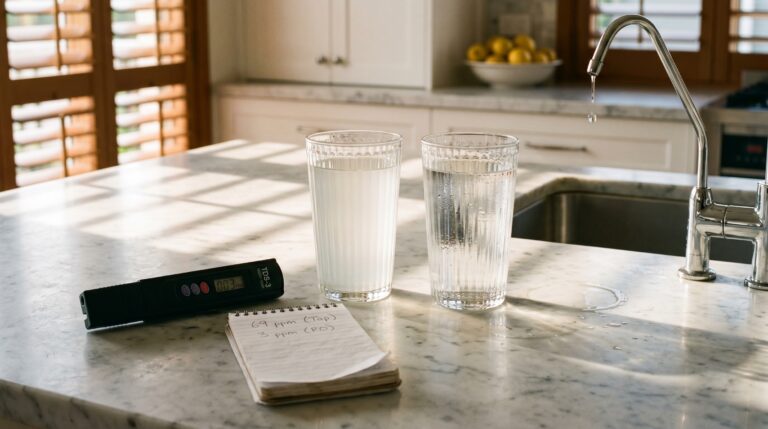
The EcoHero 5-Stage is the WaterMark-certified under-sink RO system installed at Jayce’s Palm Beach QLD home. On the SEQ grid: tap TDS in at 69 ppm, post-membrane at 3 ppm (95.7% reduction). Fluoride from 0.7 mg/L to <0.03 mg/L. PFAS to non-detect. The 50% recovery membrane (EcoHero-50) is more water-efficient than most RO systems. WaterMark AS3497 certification means it is the legally compliant choice for permanent installation in Queensland. Australian-based support and same-day filter availability nationally.
Measured at Palm Beach QLD (SEQ grid): Tap in 69 ppm TDS → Post-membrane 3 ppm. Fluoride 0.7 mg/L → <0.03 mg/L. PFAS: non-detect post-membrane.
5-year cost: ~$590 installed + ~$130/yr filters = ~$1,240 over 5 years (~$0.010/L)
5-year cost comparison: Brisbane water filters
| Option | Upfront | Annual running | 5-yr total | Cost/litre | Removes fluoride? |
|---|---|---|---|---|---|
| Tappwater EcoPro | $149 | $196 | $1,129 | $0.037 | No |
| AquaTru Classic (renter RO) | $650 | $120 | $1,250 | $0.017 | Yes (93%) |
| Waterdrop D6 (tankless RO) | $550 | $110 | $1,100 | $0.015 | Yes (>92%) |
| EcoHero 5-Stage (WaterMark RO) | $590 | $130 | $1,240 | $0.010 | Yes (93–96%) |
| Premium bottled water (1.5L) | $0 | $2,190 | $10,950 | $1.00 | Usually no |
Assumes 4L/day household drinking and cooking use. Annual filter costs from manufacturer schedules. Bottled at $3/1.5L (supermarket premium).
Brisbane shower filters: why most don’t work and what does
The shower filter category has a Brisbane-specific failure mode that most buyers never discover. The majority of shower filters sold in Australia — including expensive units at Harvey Norman and Bunnings — use KDF-55 (zinc-copper redox media) or standard granular activated carbon. Neither technology removes chloramine at shower flow rates. KDF-55 reacts with free chlorine efficiently but is largely inert against chloramine. Standard GAC has the same 1/40th contact-time problem described above.
What actually works for Brisbane shower filtration:
| Technology | Chloramine removal | Notes |
|---|---|---|
| Vitamin C (ascorbic acid) | 100% — instant | Most reliable for Brisbane. Chemically neutralises chloramine completely on contact. Short cartridge life (3–6 months). Cannot remove heavy metals — single-purpose technology. |
| Catalytic carbon (shower) | 60–85% | Works at shower flow rates better than standard GAC. Sprite HHC series uses catalytic carbon. Effective for chloramine reduction but not complete removal. Also handles heavy metals and sediment. |
| KDF-55 | <10% | Effective for free chlorine, not chloramine. The most commonly sold shower filter media in Australia. Essentially ineffective for Brisbane water. |
| Standard GAC / carbon | <15% | Same contact-time problem as drinking water. At 8L/min shower flow, contact time is milliseconds — insufficient for chloramine adsorption. |
Brisbane water after flooding: what changes and what to do
The 2022 South East Queensland floods demonstrated how dramatically water quality changes during major rain events. During February–March 2022, Wivenhoe Dam experienced extreme inflows carrying high turbidity loads (suspended sediment, organic material, and floodwater contaminants). Seqwater issued precautionary boil water alerts for some distribution areas as treatment plants managing record turbidity.
What changes during and after a Brisbane flood event:
| Parameter | Normal | During/after major flood | Action |
|---|---|---|---|
| Turbidity | <0.5 NTU | Can spike 5–50x | Follow Seqwater boil water alerts. Replace pre-filter sediment cartridges after alert lifted. |
| Microbial | Safe | Risk elevated | Follow boil water advisory. RO systems with NSF 58 provide pathogen removal, but boiling remains the declared response. |
| Chloramine dose | 1.5–2.5 mg/L | May increase temporarily | Higher chloramine = faster carbon filter depletion. Replace catalytic carbon cartridge after a major event regardless of schedule. |
| Sediment load | Very low | High | Replace sediment pre-filters (if fitted) after alert lifted. Brown or discoloured tap water: do not use for drinking until Seqwater all-clear. |
Related Water Guides
Brisbane is not the only chloramine city — see the full national guide
Sydney, Adelaide, and Darwin also use chloramine. Our main water filter guide covers all technologies side-by-side with a full city-by-city chloramine breakdown and the 3-question filter selector for any Australian city.
Australia Water Filter Guide → Reverse Osmosis Guide →Frequently asked questions
Is Brisbane tap water safe to drink?
Yes. Brisbane tap water meets all Australian Drinking Water Guidelines (ADWG 2022) parameters and is microbiologically safe under normal conditions. Seqwater monitors at over 20,000 points annually. The faint chemical taste many residents notice is chloramine — the disinfectant — not a safety issue. Fluoride is added at 0.7 mg/L (well below the ADWG health guideline of 1.5 mg/L) and PFAS appears at low trace levels, both within regulatory compliance. “Safe” and “optimal” are different questions; filtration addresses the latter.
Why does Brisbane tap water smell or taste like chemicals?
The chemical smell is chloramine — monochloramine added at 1.5–2.5 mg/L as the primary disinfectant across the SEQ grid. It produces a faint bitter or antiseptic quality distinct from free chlorine (which has a sharper pool-like smell). Chloramine does not evaporate from standing water the way free chlorine does — leaving water in a jug overnight will not remove it. A catalytic carbon filter removes it effectively. Standard carbon (Brita etc.) does not at practical flow rates.
Does Brisbane tap water have chloramine?
Yes. Brisbane and the entire SEQ grid have used monochloramine as the primary disinfectant since 2007. This includes Brisbane, Gold Coast, Sunshine Coast, Ipswich, and the Lockyer Valley. This single fact changes every filter recommendation: standard GAC carbon filters, Brita pitchers, and most standard under-sink carbon filters do not remove chloramine at practical contact times. Only catalytic carbon or reverse osmosis effectively address chloramine in Brisbane water.
Does Brisbane tap water have fluoride?
Yes — 0.7 mg/L, added under the Queensland Water Fluoridation Act 2008. This is the government-recommended level for dental health benefits. It is below the ADWG health guideline of 1.5 mg/L. If you want to reduce or eliminate fluoride, only reverse osmosis (93–96% removal) or activated alumina (80–95%) will do so. All carbon filter technologies — including catalytic carbon — cannot remove fluoride.
Will a Brita filter work for Brisbane water?
No, not for its primary purpose. Brita uses granular activated carbon (GAC), which removes free chlorine effectively but removes chloramine at approximately 1/40th the rate. At the flow rate of a Brita jug, contact time is insufficient for meaningful chloramine reduction. Brita will improve some taste characteristics and remove some sediment, but it will not address the chemical taste or smell caused by chloramine in Brisbane water. For Brisbane, the minimum effective technology is catalytic carbon (Tappwater EcoPro) or reverse osmosis.
What shower filter should I buy for Brisbane?
Vitamin C (ascorbic acid) shower filter is the most reliable option — neutralises chloramine completely on contact. Catalytic carbon shower filters (Sprite HHC series) also work at 60–85% removal. KDF-55 shower filters and standard activated carbon shower filters do not remove chloramine and should not be purchased for Brisbane use. The majority of shower filters sold at Harvey Norman and Bunnings use KDF-55 — verify the filter media before buying.
What is the TDS of Brisbane tap water?
Typically 70–115 mg/L total dissolved solids, varying by area, season, and dam source. Wivenhoe Dam-sourced water (most of inner Brisbane) measures around 70–90 mg/L. North Pine-sourced areas can run slightly higher. For context, Adelaide is ~450–600 mg/L and Melbourne is ~40–70 mg/L. Brisbane has moderate TDS — low enough that reverse osmosis for TDS reduction alone is not necessary, though RO addresses other concerns (fluoride, PFAS, chloramine) simultaneously.
Does Brisbane tap water have PFAS?
PFAS has been detected in parts of the SEQ water supply at trace levels. Seqwater’s 2024–25 annual report shows monitoring at compliance with NHMRC health guideline values (combined PFOA + PFOS <70 ng/L). Some monitoring points in areas with legacy AFFF contamination history (near Archerfield Airport, Amberley RAAF Base) measure 20–36 ng/L. Only reverse osmosis provides reliable PFAS removal (>98% via NSF P473 certified membranes). Activated carbon provides partial reduction (50–70%) but is not sufficient for high-concern locations.
What is the best water filter for a Brisbane renter?
Tappwater EcoPro ($149) for chloramine + taste improvement with no plumbing. AquaTru Classic ($650 on Amazon AU, ASIN B0F9BZHKYR) if fluoride removal is also needed — it is the only renter option that provides full RO performance with no drilling or permanent connections. For most renters, the EcoPro handles the main Brisbane water concern (chloramine) at the lowest cost.
Is Brisbane tap water hard or soft?
Soft to moderate. Brisbane water hardness is typically 30–80 mg/L as CaCO3 depending on source dam and distribution area. This compares to Adelaide (~140 mg/L, hard), Perth (~180 mg/L, hard), and Melbourne (~25 mg/L, very soft). Brisbane water does not cause significant scale in appliances or contribute meaningfully to limescale buildup compared to other Australian capitals. Water softening is generally unnecessary for Brisbane households.
Should I be worried about lead in Brisbane tap water?
Brisbane mains water lead levels are very low (<0.001 mg/L at distribution, well below the ADWG guideline of 0.01 mg/L). The risk comes from household plumbing: homes built before 2004 may have lead solder at pipe joints and fittings. If your home has pre-2004 plumbing and you have young children, a lead-rated filter is worth considering — the EcoPro (NSF 53 for lead), Tappwater, and any RO system all provide lead reduction.
Get the Australian Home Environment Checklist
30 checks across water, air and EMF. Most of them free. Ranked by impact.
No spam. Unsubscribe any time.

Former Royal Australian Navy Clearance Diver and TAG-E counter-terrorism operator. Founded Clean and Native to apply the same rigorous thinking to the home environment.
Full biography →