Ballarat Tap Water Quality 2026: What’s Actually In It?
Drafted with AI assistance and checked against published specifications and certifications. First-hand measurements appear only where stated. How we make content
Ballarat’s tap water from Central Highlands Water is safe to drink under Australian guidelines but contains TDS at 180 mg/L, hardness at 120 mg/L, and fluoride at 1 mg/L — the maximum recommended level. It’s noticeably harder and more mineralised than Melbourne’s supply, which affects taste, appliance longevity, and fluoride exposure for families with young children. The catches: carbon filters alone won’t remove fluoride or hardness, and not every household needs reverse osmosis — benchtop carbon is sufficient if you’re only targeting chlorine and taste.
| Filter Type | What It Removes | Verdict |
|---|---|---|
| Reverse Osmosis (RO) | Fluoride, hardness, TDS, chlorine, metals | Recommended for fluoride-conscious families |
| Activated Carbon (benchtop/jug) | Chlorine, taste, some organics | Good for taste only, not fluoride/hardness |
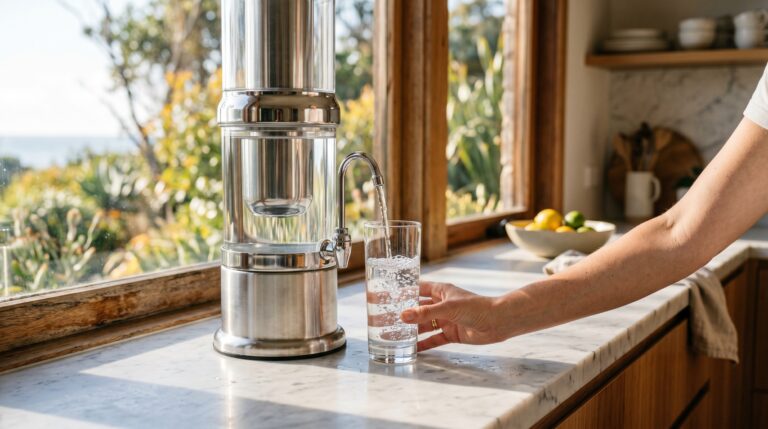
| Gravity filter (e.g. Berkey) | Chlorine, sediment, partial fluoride (with add-on) | Avoid as primary fluoride solution |
Ballarat’s tap water comes from Central Highlands Water and is safe to drink. But safe and optimal are two different things. With TDS at 180 mg/L, hardness at 120 mg/L, and fluoride sitting at the very top of NHMRC guidelines (1 mg/L), Ballarat water has a noticeably different character to Melbourne’s soft, low-mineral supply. Whether you want to filter it — and what technology actually works — depends on understanding what is actually in it.
The three products we own are measured first-hand by Jayce Love, former Royal Australian Navy Clearance Diver; every other product is assessed on published manufacturer specifications and independent certification using our documented methodology — no gifted units, no brand payments.
This guide covers Ballarat’s full water quality profile, what it means for your health, appliances, and taste, and which filter options suit Ballarat’s specific water chemistry. — Jayce Love, Clean & Native.
Ballarat Water Quality — Quick Stats (2026)
| Supplier | Central Highlands Water |
| Disinfection method | Free chlorine (standard carbon filters work) |
| TDS | ~180 mg/L (moderate — higher than Melbourne) |
| Hardness | ~120 mg/L as CaCO3 (hard — scale-forming) |
| Fluoride | ~1.0 mg/L (at NHMRC upper guideline) |
| pH | 7.7 (slightly alkaline — normal) |
| PFAS concern | No documented concern in Ballarat supply |
| Best filter for Ballarat |
Ballarat Water Chemistry — What the Numbers Mean
Central Highlands Water sources Ballarat’s supply primarily from Lal Lal Reservoir and the interconnected Ballarat-Goldfields system. Unlike Melbourne’s ultra-soft mountain catchment water (TDS ~60 mg/L, hardness ~25 mg/L), Ballarat draws from Central Highlands geology that naturally carries more dissolved minerals. That difference is why your kettle scales up faster in Ballarat and why the water tastes more “full-bodied” than what Melbourne residents are used to.
Total Dissolved Solids (TDS): 180 mg/L
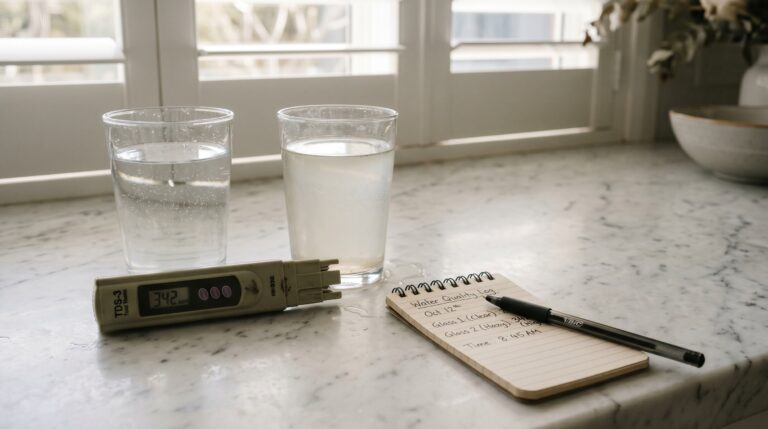
TDS measures everything dissolved in the water — minerals (calcium, magnesium, sodium, bicarbonate), trace metals, and residual treatment chemicals. At 180 mg/L, Ballarat sits well below the ADWG aesthetic guideline of 600 mg/L, so there is no health concern. But it is three times Melbourne’s typical TDS, which you will notice in taste, especially in black tea and espresso.
TDS of 180 mg/L also means reverse osmosis membranes in Ballarat will perform well without excessive fouling — the mineral load is moderate enough that standard RO membranes last their rated 12–24 months under normal use.
Hardness: 120 mg/L as CaCO3
At 120 mg/L, Ballarat water is classified as “hard” by the Australian Drinking Water Guidelines (ADWG). The calcium and magnesium responsible for this hardness are not health risks — in fact, they contribute to your daily calcium and magnesium intake. The practical problem is scale formation.
In Ballarat households, you can expect to see:
- White limescale deposits on kettle elements, coffee machines, and showerheads within weeks of use
- Reduced efficiency in hot water systems and dishwashers over time
- Soap scum on shower screens and bathroom surfaces
- A slightly “flat” lather when washing hands (hard water reduces soap effectiveness)
For appliance longevity, descaling every 2–3 months is practical with Ballarat’s hardness level. If you are making espresso, the elevated calcium hardness actually contributes positively to extraction — it provides the “buffer” that keeps espresso chemistry in range. Many specialty coffee roasters recommend water around 100–150 mg/L hardness for optimal espresso.
Fluoride: 1.0 mg/L
Ballarat is fluoridated at 1.0 mg/L — the top of the NHMRC’s recommended range of 0.7–1.0 mg/L. It is legal, common practice, and the target level set to provide dental health benefit while remaining within safety margins for all age groups including infants.
If you want to reduce fluoride: standard carbon filters (TAPP, Brita) do not remove it. Only reverse osmosis achieves meaningful fluoride reduction (90–97%) or activated alumina (80–95%). Activated alumina is used in some benchtop fluoride-specific filters but is not widely stocked in Australia. RO is the practical choice.
pH: 7.7
Slightly alkaline, well within the ADWG range of 6.5–8.5. No action required. The pH is actively managed by Central Highlands Water to minimise corrosion of distribution pipes — a higher pH reduces lead and copper leaching from older plumbing. For homes with copper pipes and older fixtures, this is actually protective.
Is Ballarat Tap Water Safe to Drink?
Yes — unequivocally. Central Highlands Water publishes annual quality reports showing compliance with all ADWG limits. There are no boil-water advisories currently in place for Ballarat (3350). There are no documented PFAS contamination issues in Ballarat’s water supply, which distinguishes it from some regional Victorian towns near defence or industrial sites that have faced PFAS investigations.
The decision to filter Ballarat water is about taste, appliance protection, and personal fluoride preferences — not safety.
Which Water Filters Work for Ballarat?
Because Ballarat uses free chlorine (not chloramine), your filter options are broader than in most other Australian capitals. Here is what actually works at each price point.
Best All-Round: AquaTru Classic Countertop RO
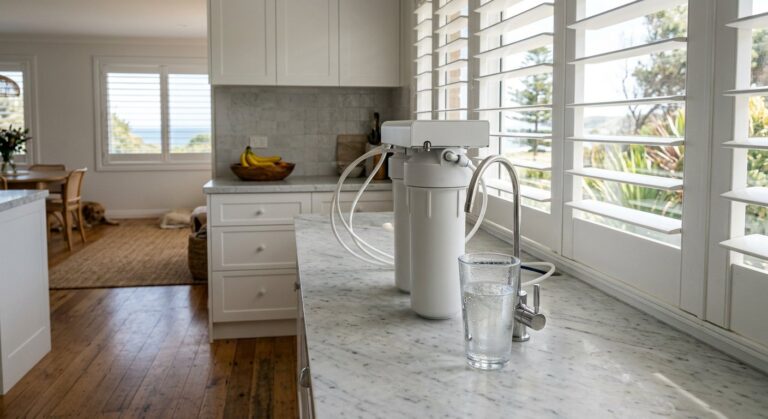
If you want to address everything — chlorine taste, hardness, fluoride, TDS, and trace contaminants — the AquaTru Classic is the most practical solution for a Ballarat kitchen. Its 4-stage reverse osmosis reduces TDS from 180 to approximately 10–20 mg/L, reduces hardness to near-zero, and removes 90–97% of fluoride. No plumber required — it sits on your bench and fills a reservoir.
The AquaTru is the most independently verified countertop RO on the Australian market, with NSF/ANSI 58 certification covering 78 contaminants. For Ballarat households where hard water is the primary frustration, this is the definitive fix.
Best for Taste Only: TAPP Water EcoPro Compact
If your goal is purely to remove the chlorine taste and improve drinking water quality — without reducing minerals or fluoride — the TAPP EcoPro Compact is the right choice. It fits directly onto your tap (no installation), uses a catalytic carbon block rated for both free chlorine and chloramine, and filters around 1,500 litres per cartridge.
For Ballarat, where the water is safe and the chlorine load is free chlorine (easiest to remove), a TAPP filter will produce noticeably better-tasting water at a low upfront cost. Replacement cartridges are available on Amazon AU. It will not reduce hardness or fluoride.
Best Under-Sink: Waterdrop D6 RO
For households wanting RO filtration without bench clutter, the Waterdrop D6 is a compact tankless under-sink system well suited to Ballarat’s water profile. At TDS 180 mg/L, the D6 membrane produces clean output without the excessive wastewater ratio that plagues older RO designs. The D6 uses a 0.0001-micron RO membrane — it removes hardness, fluoride, lead, PFAS, and the vast majority of everything else dissolved in Ballarat water.
Ballarat vs Melbourne Water: The Key Differences
| Parameter | Ballarat | Melbourne | What it means |
|---|---|---|---|
| TDS | ~180 mg/L | ~60 mg/L | Ballarat water is noticeably more mineral-rich |
| Hardness | ~120 mg/L | ~25 mg/L | Scale forms much faster in Ballarat |
| Fluoride | ~1.0 mg/L | ~1.0 mg/L | Similar fluoride levels |
| Disinfection | Free chlorine | Free chlorine | Standard carbon filters work in both cities |
| PFAS | No concern | No concern | Both supplies clean on PFAS |
The practical takeaway: if you move to Ballarat from Melbourne, you will notice your kettle scaling much faster and a heavier taste in your water. If you move from Brisbane or Sydney to Ballarat, you will notice your old filter works better — because you are no longer dealing with chloramine.
Hard Water and Appliances: What Ballarat Households Should Do
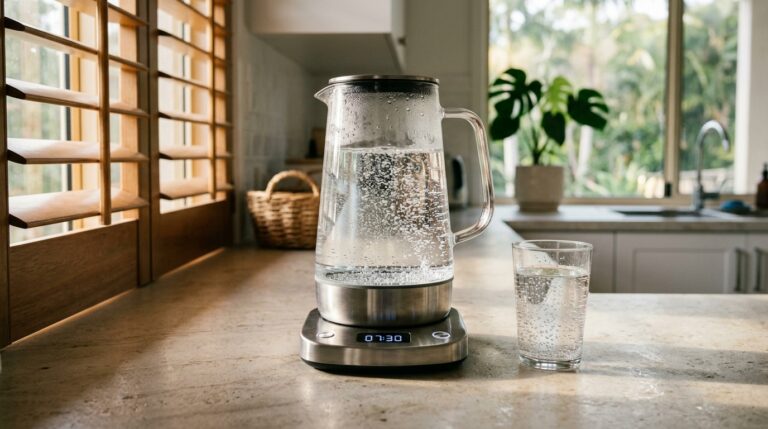
At 120 mg/L hardness, scale management is worth taking seriously. Kettle elements in Ballarat will accumulate visible white deposits within a month of regular use. Coffee machines are particularly vulnerable — limescale forms on heating elements and in the boiler, reducing heating efficiency and eventually blocking flow paths.
Practical actions for Ballarat households:
- Kettle: Descale every 4–6 weeks with white vinegar (fill to max with a 1:1 water/vinegar solution, heat, soak 30 minutes, rinse thoroughly). Citric acid sachets from the supermarket also work well.
- Coffee machine: Follow manufacturer descaling frequency — for Ballarat’s hardness, a Breville or De’Longhi machine will need descaling roughly every 2–3 months rather than the 6-month default.
- Hot water system: Check your cylinder annually for anode rod condition. Harder water accelerates magnesium anode consumption. Most Ballarat homes can extend hot water system life by replacing the sacrificial anode every 3–4 years rather than the standard 5-year guideline.
- Showerheads: Remove and soak in vinegar overnight every 3 months to maintain flow rate.
Frequently Asked Questions
Is Ballarat tap water safe to drink in 2026?
Yes. Central Highlands Water meets all Australian Drinking Water Guidelines. There are no current boil-water advisories for Ballarat (3350) and no documented PFAS contamination. The water is fluoridated at 1.0 mg/L and uses free chlorine for disinfection — both standard, regulated treatments.
Why does Ballarat water taste different to Melbourne water?
Ballarat water has around three times the mineral content of Melbourne (TDS ~180 vs ~60 mg/L) and five times the hardness (120 vs 25 mg/L as CaCO3). Both cities use free chlorine, so the taste difference is primarily mineral character rather than disinfection. The higher calcium and magnesium content gives Ballarat water a fuller, heavier taste that is most noticeable in black tea, espresso, and cold-filtered drinking water.
Does Ballarat water have fluoride?
Yes — 1.0 mg/L, which is at the top of the NHMRC’s recommended range of 0.7–1.0 mg/L. This level is considered safe for all ages including infants. If you want to reduce fluoride, only reverse osmosis (90–97% reduction) or activated alumina filters are effective — standard carbon filters like Brita do not remove fluoride.
Will Ballarat’s hard water damage my appliances?
At 120 mg/L hardness, scale will form on kettle elements, coffee machines, hot water system elements, and showerheads within weeks of use. Regular descaling (monthly for kettles, quarterly for machines) prevents damage. Consider an RO filter for your drinking and cooking water supply — producing near-zero hardness water for your coffee machine and kettle will significantly extend their lifespan.
What is the best water filter for Ballarat?
For comprehensive treatment (hardness, fluoride, TDS, taste), the AquaTru Classic countertop RO is the best all-round choice. For taste improvement only (chlorine removal, no mineral reduction), the TAPP EcoPro Compact is a lower-cost starting point. Because Ballarat uses free chlorine, standard carbon filters work well — unlike Brisbane, Sydney, or Adelaide, where chloramine requires specialised catalytic carbon.
Does a standard Brita filter work in Ballarat?
For chlorine taste reduction, yes — standard activated carbon in Brita jugs and similar pitchers effectively removes free chlorine. However, Brita does not meaningfully reduce hardness, TDS, or fluoride. If you primarily want better-tasting water without scale concerns, a Brita is functional. If you want to address hardness or fluoride, you need RO.
Is Ballarat water chloraminated?
No. Ballarat uses free chlorine for disinfection, not chloramine. This is significant for filter selection: free chlorine is much easier to remove with standard activated carbon. The cheaper benchtop and tap-mount carbon filters that fail in Sydney or Brisbane (where chloramine requires catalytic carbon) work well in Ballarat. Free chlorine also dissipates naturally if you leave water in an open jug in the fridge overnight.
What are the postcode areas supplied by Central Highlands Water in Ballarat?
Central Highlands Water supplies Ballarat Central (3350), Ballarat East, Ballarat North, Wendouree, Sebastopol, Alfredton, and surrounding townships including Buninyong and Smythesdale. The same water quality profile applies across these areas as they draw from the same treatment and distribution network. If you are in outer Ballarat regions or on a private tank supply, water chemistry may differ — contact Central Highlands Water for catchment-specific data.
Next Steps for Ballarat Households
Ballarat water is genuinely safe. The case for filtering is about quality of life — taste, appliance protection, and personal preferences about fluoride and mineral levels. If you are starting from zero:
- For taste only: Start with the TAPP EcoPro Compact — fits on your existing tap, no plumber, low cost.
- For hardness + fluoride + comprehensive filtration: The AquaTru Classic countertop RO is the most practical single-unit solution that addresses everything.
- For a plumbed solution: The Waterdrop D6 under-sink RO gives you filtered water on tap without bench clutter.
For context on how Ballarat compares to other Victorian cities, see our guides on best water filters for Melbourne and our overview of Victorian water quality by city. For the full guide on what filtration technologies remove what contaminants, see our RO filter comparison guide.
Get the Australian Home Environment Checklist
30 checks across water, air and EMF. Most of them free. Ranked by impact.
No spam. Unsubscribe any time.

Former Royal Australian Navy Clearance Diver and TAG-E counter-terrorism operator. Founded Clean and Native to apply the same rigorous thinking to the home environment.
Full biography →