PFAS Contamination Queensland Water: Affected Areas & Safe Filters

6 min read“`html

This article contains affiliate links. We may earn a commission at no extra cost to you.

PFAS Contamination Queensland Water: Affected Areas & Safe Filters

Per- and polyfluoroalkyl substances (PFAS) are a group of synthetic chemicals that don’t break down in the environment or the human body. In Queensland, contamination is concentrated around Defence sites where aqueous film-forming foam (AFFF) was used extensively for firefighting training. If you live near one of these sites, understanding your actual risk — and what filtration genuinely works — matters more than generalised concern.

Which QLD Regions Are Affected by PFAS

PFAS has been detected in groundwater, surface water, and soil near more than 10 Queensland Defence bases. The two most significant sites are RAAF Base Amberley (near Ipswich) and the Army Aviation Centre at Oakey on the Darling Downs. Both sites triggered formal community water testing programs after PFAS plumes were found to have migrated beyond base boundaries into surrounding residential and agricultural areas.

At Oakey, investigations by the Department of Defence found PFAS concentrations in some private bores exceeding the Australian Drinking Water Guidelines (ADWG) health guidance values. The ADWG currently sets a combined PFOS and PFHxS guideline value of 0.07 µg/L and PFOA at 0.56 µg/L. Some bore water samples near Oakey recorded levels significantly above these thresholds.

Other affected areas include:

  • Townsville (Lavarack Barracks and RAAF Base Townsville) — investigations ongoing, groundwater monitoring wells in place
  • Bindoon Training Area (managed jointly) — cross-border concerns affecting northern QLD supply catchments
  • Cabarlah and Jondaryan — rural communities near Oakey with documented bore water contamination
  • Brisbane Airport and surrounding industrial zones — historical AFFF use linked to localised groundwater issues

Queensland Health and the Queensland Department of Environment and Science continue to monitor affected zones. If your property sits within a known investigation area, the Queensland Government’s PFAS investigation portal lists current testing schedules and results by postcode. Town water supplies connected to treated reticulated systems carry considerably lower risk than private bores in these regions.

Do Standard Filters Remove PFAS?

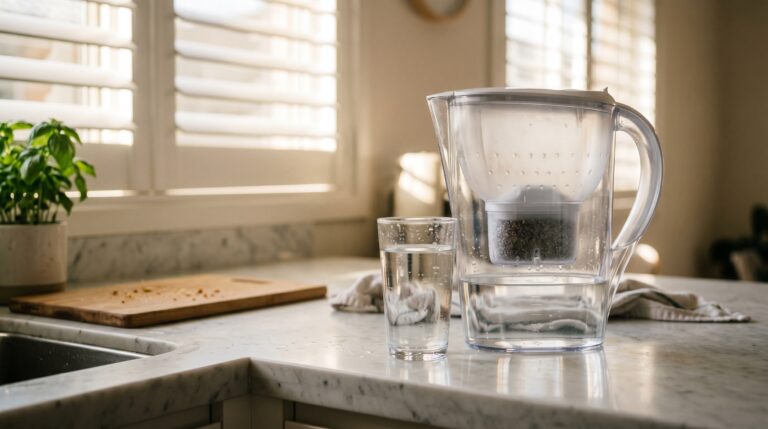
This is where many households make a costly mistake. Standard jug filters, basic fridge filters, and common activated carbon block filters marketed as “drinking water filters” do not reliably remove PFAS. Pitcher filters using granular activated carbon (GAC) have limited contact time with water and inconsistent removal rates — some independent tests show GAC alone removing less than 50% of certain PFAS compounds at realistic flow rates.

The filtration technologies with demonstrated effectiveness against PFAS are:

  • Reverse osmosis (RO) — removes 90–99% of most PFAS compounds by forcing water through a semi-permeable membrane with a pore size around 0.0001 microns
  • High-density activated carbon block — effective when used with sufficient contact time and correct carbon density; not all carbon block filters are equal
  • Nanofiltration — similar rejection rates to RO, less common in residential systems

The National Health and Medical Research Council (NHMRC) and peer-reviewed research published in journals including Environmental Science & Technology consistently identify RO as the most reliable residential solution. It’s worth noting that boiling water does not remove PFAS — it may actually concentrate it as water volume reduces.

If you’re uncertain whether your current filter meets the mark, our Australian water filter guide breaks down certification standards and what to look for on product labels.

Filter Type PFAS Removal Rate Removes Other Contaminants Suitable for QLD Bore Water
Standard GAC Pitcher 10–50% (inconsistent) Chlorine, taste/odour No
High-Density Carbon Block (Clearly Filtered) 95%+ (tested to NSF/ANSI 53 & 58) Heavy metals, chloramines, VOCs Yes (point-of-use)
5-Stage Reverse Osmosis (APEC Water Systems) 90–99% Nitrates, arsenic, fluoride, TDS Yes (under-sink)
Basic Inline Fridge Filter <20% (unreliable) Sediment, minor chlorine No

Best Filtration Solutions for PFAS-Contaminated Water

For households in confirmed PFAS investigation areas — particularly those on private bores near Oakey, Amberley, or Townsville Defence precincts — point-of-use filtration at the kitchen tap is the practical first line of defence while broader remediation occurs at the source level.

APEC Water Systems ROES-50 is a 5-stage under-sink reverse osmosis system that consistently performs well against PFAS in independent third-party testing. It uses a 0.0001-micron RO membrane combined with two stages of activated carbon, reducing PFOS, PFOA, and the shorter-chain PFAS compounds (including PFBS and PFHxS) that are increasingly detected in QLD groundwater. The system produces roughly 190 litres per day — more than adequate for a household’s drinking and cooking needs. View the APEC ROES-50 system.

Clearly Filtered’s pitcher and under-sink systems are a strong alternative if you rent or want a no-installation solution. Their proprietary Affinity Filtration Technology uses a compressed carbon block with additional ionic exchange media. Published third-party testing shows greater than 99.9% removal of PFOA and PFOS specifically — among the highest verified rates available at this price point. The pitcher format suits apartments and rental properties where plumbing modifications aren’t feasible. Explore Clearly Filtered’s range.

Whichever system you choose, verify it carries NSF/ANSI 58 certification (for RO systems) or NSF/ANSI 53 certification for contaminant reduction claims. Australian WaterMark certification covers plumbing safety but does not independently verify PFAS removal — so don’t rely on it alone as proof of effectiveness.

It’s also worth combining your filtration choice with a current water test. Knowing your actual PFAS concentrations helps you select the right system and establish a baseline to track changes over time. Our PFAS water testing guide covers accredited labs that accept private bore samples from Queensland.


Frequently Asked Questions

Is Queensland tap water from council supplies safe to drink if I live near a Defence base?

Generally yes. Queensland Urban Utilities, Unitywater, and other reticulated supply authorities test treated town water regularly against the Australian Drinking Water Guidelines. PFAS contamination issues in Queensland have primarily affected private bore water and groundwater close to contamination plumes — not treated municipal supplies. That said, if your local authority has issued a specific advisory, follow it. You can check your supplier’s annual water quality report on their website.

Does boiling water remove PFAS?

No. PFAS chemicals are heat-stable and do not evaporate when water is boiled. Boiling actually removes water as steam, which can slightly increase the concentration of PFAS remaining in the vessel. If you’re in a contaminated area, boiling is not a mitigation strategy. Reverse osmosis and certified high-density carbon block filtration are the approaches supported by current evidence.

How do I know if my bore water has PFAS?

The only reliable way is laboratory testing. Several NATA-accredited laboratories in Queensland accept private water samples, including ALS Environmental and Eurofins. A comprehensive PFAS panel typically costs between $200 and $450 depending on the number of compounds tested. Defence’s PFAS investigation websites for Amberley and Oakey also list whether specific properties have been included in government-

FREE CHECKLIST

Get the Australian Home Environment Checklist

30 checks across water, air and EMF. Free PDF. No spam.

Jayce Attard — Clean and Native founder
Written by Jayce Attard

Former Royal Australian Navy Clearance Diver and TAG-E counter-terrorism operator. Founded Clean and Native to apply the same rigorous thinking to the home environment.

Full biography →
Similar Posts