EMF Protection Products Victoria 2026: Shields, Meters & Home Solutions
QUICK VERDICT
| Measure first | TriField TF2 (~$250 AUD) — measures RF, ELF magnetic, ELF electric in one device |
| Highest-ROI reduction | Phone out of bedroom + router on timer — free, immediate, measurable |
| Best shielding product | DefenderPad laptop pad — independently tested, genuine ELF reduction |
| RF-only meter upgrade | Safe and Sound Pro II (~$380 AUD) — covers 5 GHz Wi-Fi and 5G that TF2 underreads |
| Victoria-specific concern | AusNet/CitiPower smart meters pulse RF throughout the day — measure inside the closest internal wall |
| What not to buy | Stickers, pendants, and “harmonisers” that claim to neutralise RF — no measurable effect |
Melbourne’s 5G network now covers 97% of metro suburbs. The Victorian smart meter rollout — completed through AusNet Services and CitiPower — means most homes now have a meter pulsing RF signals throughout the day. Add Ausgrid-style infrastructure creeping into suburban streets and the question isn’t theoretical anymore: what are your actual exposure levels, and which protection products are worth spending money on?
The three products we own are measured first-hand by Jayce Love, former Royal Australian Navy Clearance Diver; every other product is assessed on published manufacturer specifications and independent certification using our documented methodology — no gifted units, no brand payments.
This guide cuts through the noise. The EMF protection market runs from genuinely useful (independently tested shielding products, quality meters) to outright pseudoscience (pendants, stickers, “harmonising” crystals). We separate them with reference to measurable, physical reality.
Understanding EMF Sources in Victorian Homes
Before spending money on protection, understand what you’re dealing with. EMF in Victorian homes comes from several distinct sources operating at different frequencies. The strategy differs by source type.
Radiofrequency (RF) — 100 MHz to 6 GHz: Wi-Fi routers, mobile phones, smart meters, Bluetooth, baby monitors. Melbourne’s inner suburbs have seen measurably higher ambient RF levels since 2022 due to 5G small cell installations on suburban street infrastructure. AusNet and CitiPower smart meters pulse RF at irregular intervals — some every few seconds, others every few minutes — and are commonly located on walls adjacent to kitchens or living areas.
Extremely low frequency (ELF) magnetic fields — 50 Hz: Generated by anything carrying alternating current — power lines, household wiring, appliances, transformers. Measured in milligauss (mG). The ARPANSA public limit is 1,000 mG — far above residential levels — but building biology precautionary targets recommend below 1 mG in sleeping areas. Older Victorian homes, particularly those with knob-and-tube wiring remnants or dodgy renovations, can generate elevated ELF fields that modern builds don’t.
ELF electric fields — 50 Hz: Radiate from any wire carrying voltage, even when no current is flowing. Measured in V/m. Significant near wiring in walls behind beds. Often overlooked; easily shielded by earthed materials.
Dirty electricity — high-frequency transients on wiring: Particularly relevant in Victorian homes with solar inverters, variable speed appliances, or older wiring. Measurable with a microsurge meter; addressable with plug-in filters.
The Honest EMF Product Breakdown
| Product Category | What It Addresses | Evidence Level | Approx. AUD |
|---|---|---|---|
| TriField TF2 Meter | Measurement — RF + ELF magnetic + ELF electric | High — calibrated instrument | ~$230–280 |
| DefenderPad Laptop Pad | ELF magnetic + RF from laptop body | High — FCC-compliant tested results | ~$80–160 |
| Dirty Electricity Filters | High-frequency transients on household wiring | Moderate-High — measurable with microsurge meter | ~$40–60 per unit |
| Router Guard / Faraday Cage | Ambient Wi-Fi RF (reduces signal strength) | High — physically measurable reduction | ~$60–120 |
| DefenderShield Phone Case | RF at body from handset (front-facing only) | High — tested to FCC SAR standards | ~$80–130 |
| Somavedic / “Harmonisers” | Claimed whole-home harmonising | Low — no peer-reviewed evidence of RF reduction | $700–$900 |
| EMF Stickers / Pendants | Claimed neutralisation | None — no physical mechanism of action | $20–$200 |
Products Worth Buying in Victoria
1. TriField TF2 — The Starting Point for Every Victorian Home
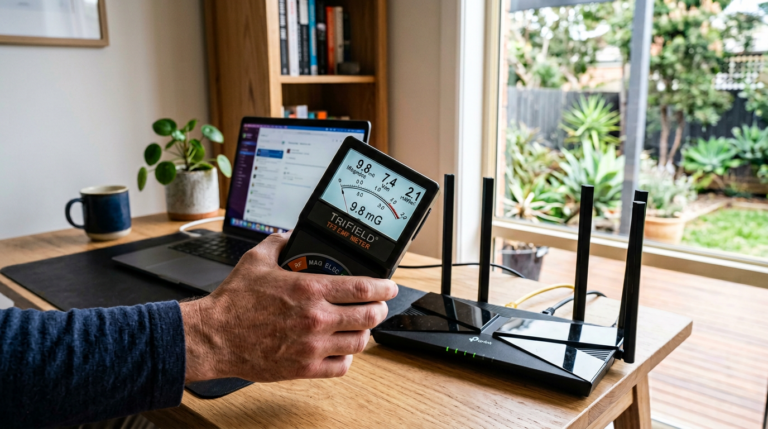
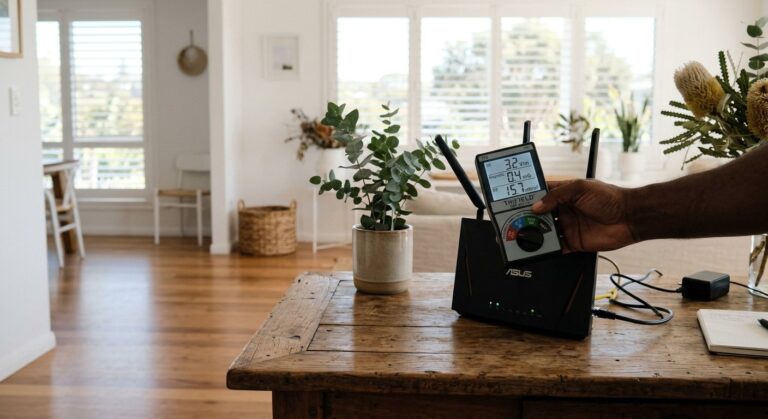
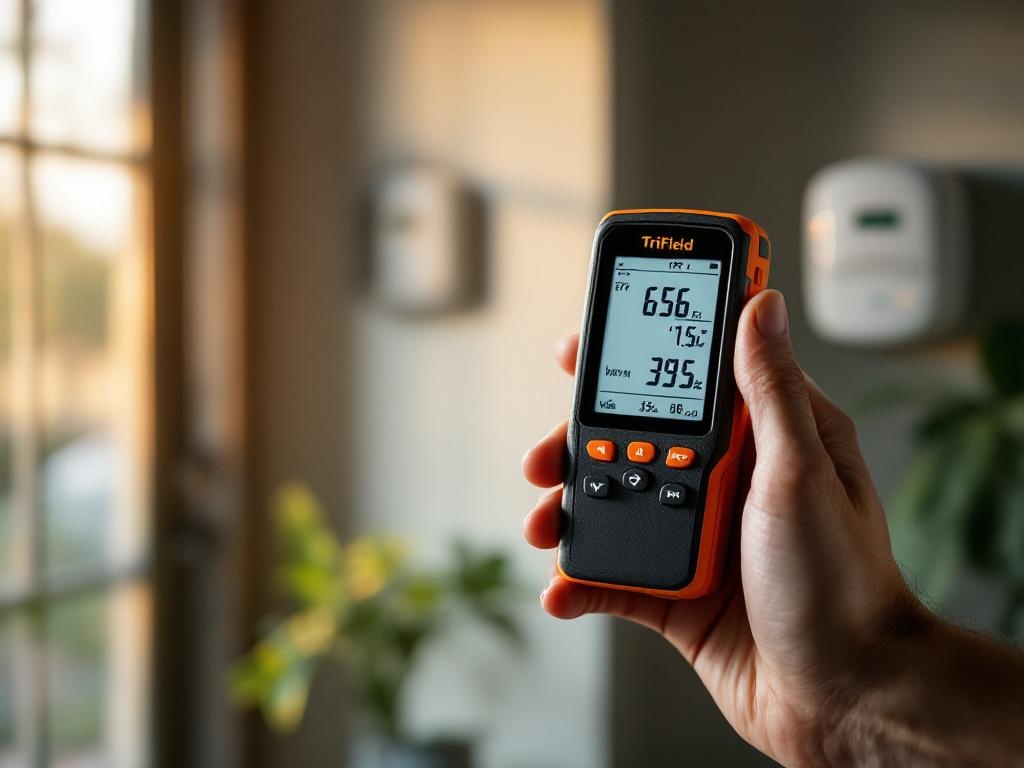
You cannot reduce what you haven’t measured. The TriField TF2 measures all three field types (RF/microwave, AC magnetic, AC electric) in a single device, which is why it’s the recommended starting point rather than any shielding product. Take baseline readings in your bedroom, at your desk, and at the closest internal point to your smart meter — then you know what you’re dealing with.
It has limitations: the RF range tops out at approximately 1 GHz, which means it will underread 5 GHz Wi-Fi bands and 5G small cell frequencies. For those specific sources, the Safe and Sound Pro II (below) is more accurate. But for most Victorians doing a first home audit, the TF2 handles 80% of the job.
Affiliate link — we may earn a commission at no extra cost to you.
2. Safe and Sound Pro II — For 5G and 5 GHz Wi-Fi Coverage
The Safe and Sound Pro II covers 200 MHz to 8 GHz, making it substantially more capable than the TF2 for measuring modern 5G small cells and 5 GHz Wi-Fi — the two fastest-growing RF sources in Melbourne suburbs. The audio mode lets you hear the pulsed nature of different RF sources, which helps distinguish a smart meter from a passing 5G handset. RF-only (no ELF capability), so pair it with the TF2 or a dedicated ELF meter for a complete picture.
Affiliate link — we may earn a commission at no extra cost to you.
3. DefenderPad Laptop EMF Pad — Highest-Evidence Shielding Product
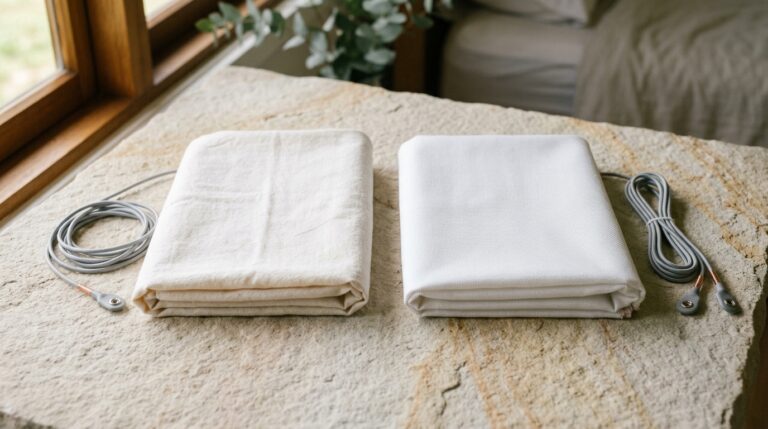
For Australians working with laptops on their laps for extended periods, the DefenderPad has something most EMF products don’t: independently tested, published results. The pad attenuates both ELF magnetic fields from the laptop’s transformer and RF from its wireless card. It does this through tested shielding materials, not marketing claims. If you use a laptop on your body for 4+ hours a day — working from home, the couch, in bed — this is the shielding product with the most legitimate use case.
Affiliate link — we may earn a commission at no extra cost to you.
4. Dirty Electricity Filters — For Victorian Homes with Solar or Old Wiring
Stetzerizer and Greenwave filters plug into standard power points and reduce high-frequency voltage transients (dirty electricity) on household wiring. This category has more robust measurement-backed evidence than most EMF products. They’re particularly relevant in Victorian homes with solar inverters (common since the Victorian Government’s solar rebate programs), variable-speed appliances, or homes built before 1980. Use a microsurge meter to verify they’re working in your specific wiring configuration — results vary significantly by home.
What about Somavedic and harmoniser devices?
Somavedic builds attractive glass units marketed as harmonising EMF and geopathic stress. They don’t claim to block RF signals — they claim a different mechanism. Independent peer-reviewed evidence for measurable EMF reduction is absent. They won’t reduce your meter readings. If you find subjective wellbeing benefits worth $700–$900, that’s a personal decision — but don’t buy them expecting to see a change on your TriField.
Victoria-Specific EMF Concerns
Smart Meters (AusNet, CitiPower, Powercor, United Energy)
Victoria completed Australia’s first mandatory smart meter rollout between 2006 and 2013. Every Victorian property has a smart meter. These devices communicate with the network using RF pulses — the frequency varies by meter and distributor, but typical patterns include bursts every few seconds to every few minutes at 915 MHz (ANSI 2FSK modulation). They are mounted on the exterior of the property, usually within a few metres of a kitchen, hallway, or living space wall.
Measurement protocol: stand 1 metre from the meter on the outside wall, RF meter on peak-hold, and measure for at least 60 seconds. Then move inside to the closest internal point and repeat. If readings consistently exceed 10,000 µW/m² at 1 metre, consider RF shielding paint on the internal wall surface or requesting an opt-out from your distributor (available in Victoria under the Smart Meters Act 2006).
5G Small Cells in Melbourne Suburbs
Telstra and Optus have been deploying 5G small cells on existing street poles and infrastructure in Melbourne inner suburbs (Fitzroy, Richmond, Collingwood, South Yarra, St Kilda) since 2022. These operate at sub-6 GHz frequencies (typically 3.5 GHz in Australia). Street-level measurements near small cells in Melbourne have recorded 1,000–10,000 µW/m² within 10–20 metres — elevated above historical Wi-Fi ambient levels but still far below ARPANSA’s 10 W/m² limit. The Safe and Sound Pro II is the appropriate meter for these frequencies; the TF2’s upper limit misses them.
Older Victorian Housing Stock
Victoria has significant pre-war and post-war housing stock with wiring that pre-dates modern earthing standards. Homes built before 1980 may have partial or no equipotential earthing of metallic plumbing, elevated ELF electric fields from un-earthed wiring, and dirty electricity from original wiring interacting with modern appliances. ELF electric field readings above 5 V/m in sleeping areas warrant investigation by a licensed electrician — this is a wiring deficiency issue, not an EMF product problem.
The Highest-ROI Actions in Order
1. Phone out of the bedroom. Charge it in the hallway. Aeroplane mode if it must stay. A mobile phone actively seeking signal is one of the highest-RF exposures in most homes — at 5–30 cm from your head for 8 hours overnight. Cost: $0.
2. Router on a timer. An $18 plug-in timer eliminates router RF for 8 hours nightly. Most people don’t need Wi-Fi between midnight and 6am. Cost: $18.
3. Ethernet for stationary devices. Desktop computers, smart TVs, and gaming consoles don’t move — hardwire them. A basic ethernet switch costs $25–$40. Reduces both RF emission and ambient Wi-Fi load.
4. Measure before buying shielding. Buy the TriField TF2 before any shielding product. Your actual readings will tell you where to spend money. Many Victorians find that behavioural changes (phone, router, positioning) achieve more than shielding at a fraction of the cost.
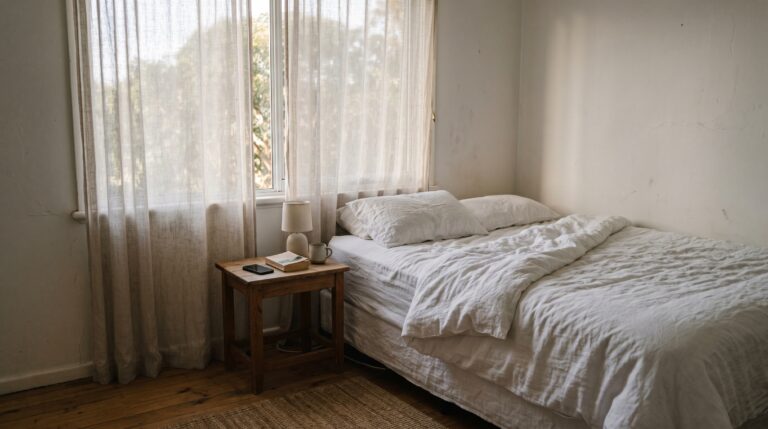
5. Address your sleeping environment specifically. The bedroom is where you spend 7–9 hours continuously. If readings in your sleeping area are elevated after behavioural changes, a router guard or repositioning the bed away from a smart-meter wall may be sufficient without purchasing dedicated shielding products.
Frequently Asked Questions
Are Victorian smart meters a significant source of EMF exposure?
They are a real and measurable RF source. Typical readings 1 metre from a Victorian smart meter range from 1,000 to 50,000 µW/m² during transmission pulses. Because they pulse intermittently rather than continuously, time-averaged exposure is considerably lower. The closest internal room wall typically attenuates readings by 50–80%. If your bedroom shares a wall with the meter box, take readings and consider repositioning furniture if levels are elevated.
Does ARPANSA consider current Melbourne 5G levels safe?
Yes. ARPANSA’s RF standard sets public limits at 10 W/m² for frequencies above 2 GHz — street-level 5G measurements in Melbourne typically fall 100–1,000× below this limit. ARPANSA publishes monitoring data and maintains current infrastructure is within guidelines. Some researchers advocate applying a precautionary approach below these thresholds, particularly for children. The long-term epidemiological data on 5G specifically is still accumulating.
Are EMF protection stickers and pendants worth buying?
No. These products have no credible mechanism of action. A sticker or pendant cannot physically redirect, absorb, or neutralise radiofrequency radiation — this would require materials with electromagnetic properties orders of magnitude different from anything in these products. Australian Competition and Consumer Commission (ACCC) guidelines on misleading claims apply to these products. Save your money and measure your home instead.
What should I do about my Victorian home’s old wiring and ELF fields?
Old wiring contributes to elevated ELF electric fields from unearthed conductors and dirty electricity from voltage transients. Start by measuring — readings above 5 V/m in sleeping areas warrant an electrician’s assessment, not an EMF product. A licensed electrician can identify earthing deficiencies. Dirty electricity filters (Stetzerizer, Greenwave) can reduce transients on older wiring but won’t fix underlying earthing problems.
How do I request a smart meter opt-out in Victoria?
Victorian distributors are required to offer a basic meter (non-communicating) option on request under the Smart Meters Act 2006. Contact your distributor directly (AusNet, CitiPower, Powercor, United Energy, or Jemena depending on your location). Note that basic meters typically cost more to read (manual reading fees) and you may lose access to time-of-use tariffs. Some distributors have extended wait times for meter replacements.
Is the TriField TF2 accurate enough for 5G frequencies?
No — the TF2’s RF range tops out at approximately 1 GHz. Australia’s sub-6 GHz 5G deployments operate at around 3.5 GHz; 5 GHz Wi-Fi also exceeds the TF2’s range. For these sources, the Safe and Sound Pro II (200 MHz to 8 GHz) is the appropriate meter. The TF2 remains useful for 2.4 GHz Wi-Fi, mobile phone handsets (which emit across multiple frequencies including below 1 GHz), and ELF measurements, where it is accurate.
What’s the building biology precautionary standard for RF in sleeping areas?
The Building Biology Standard SBM-2015 recommends RF below 10 µW/m² for sleeping areas (no concern), with “slight concern” from 10–1,000 µW/m², “severe concern” above 1,000 µW/m², and “extreme concern” above 10,000 µW/m². These are precautionary guidelines — not regulatory limits. ARPANSA’s RF limit for the public is 10 W/m² (10,000,000 µW/m²). The building biology standard is roughly 1,000,000× more conservative than the regulatory limit.
Should I buy a router guard if I can’t move my router away from bedrooms?
A router guard (Faraday cage enclosure) does demonstrably reduce Wi-Fi signal strength — this is measurable with any RF meter. The trade-off is reduced Wi-Fi range and speed for devices throughout the home. If relocation isn’t possible and the bedroom is adjacent to the router, a guard is a reasonable interim measure. Alternatively, a plug-in timer costs $18, eliminates RF entirely for 8+ hours nightly, and has no speed trade-off during the day.
Get the Australian Home Environment Checklist
30 checks across water, air and EMF. Most of them free. Ranked by impact.
No spam. Unsubscribe any time.

Former Royal Australian Navy Clearance Diver and TAG-E counter-terrorism operator. Founded Clean and Native to apply the same rigorous thinking to the home environment.
Full biography →