Best Whole House Water Filter Australia 2026: Complete Buyer’s Guide
Quick Verdict
Most Australian households do not need a whole house water filter. An under-sink RO filter covers drinking and cooking water at lower cost and with better PFAS and fluoride removal. A whole house system is the right choice if you want filtered shower water (relevant for eczema and sensitive skin), you are on bore or tank water, or you want to protect appliances from sediment and scale. If you are a renter, a whole house system is not an option — countertop or tap-mount filters are your path.
City mains water
3-stage (sediment + catalytic carbon + UV optional). Ensure catalytic carbon — standard GAC does not remove chloramine.
Bore or tank water
Test first (NATA lab ~$150). Then: sediment + oxidising stage (if iron/manganese) + carbon + UV. Do not guess.
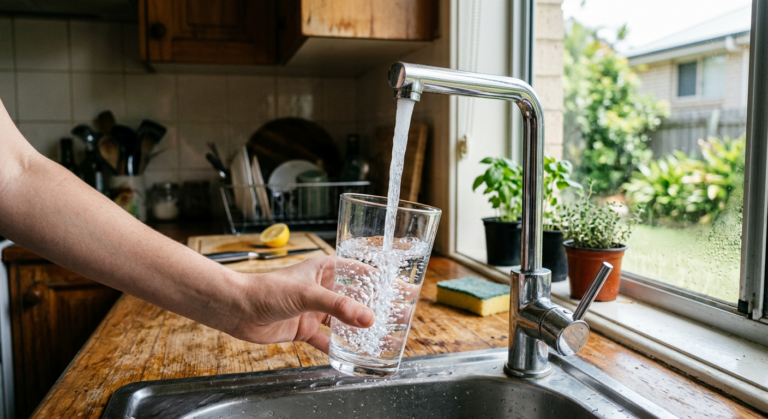
Most water filters in Australian homes treat one tap. The kitchen tap gets filtered water, and every other outlet — the shower, the bath, the laundry — runs on untreated mains water. For some households that is fine. For others — those with bore water, tank water, skin conditions, or a preference for filtered water throughout the home — a whole house system makes more sense. I am a former Royal Australian Navy Clearance Diver who has been measuring Australian tap water for three years. This guide covers what whole house water filters do, which Australian systems are worth buying in 2026, and how to work out whether you actually need one.
What Is a Whole House Water Filter and Do You Need One?
Not sure which filter to choose?
Take the 60-second quiz and get a personalised recommendation
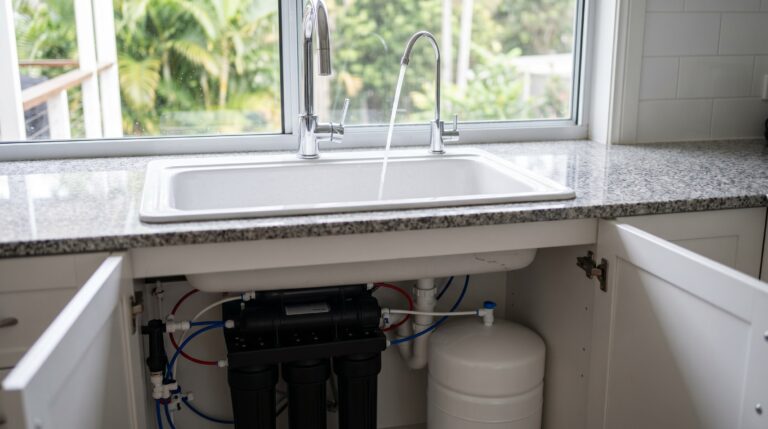
Find my filterA whole house water filter (point-of-entry filter) installs where the water supply enters your home — before it branches to individual taps, the hot water system, and appliances. Every outlet in the house receives filtered water.
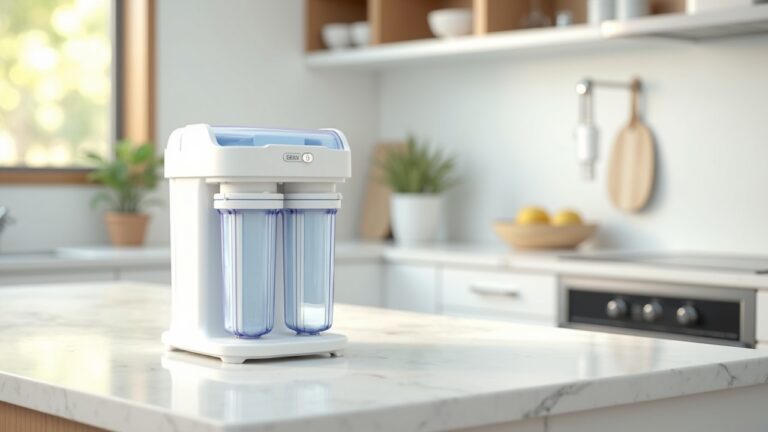
This contrasts with under-sink or countertop filters (point-of-use), which treat only the water from one specific tap.
Whole house makes sense if:
- You want filtered water for showering (chloramine absorbed through skin)
- You have eczema, sensitive skin, or young children
- You are on bore water or tank water with sediment, iron, or bacteria
- You want to protect appliances from sediment and scale
- You want filtered water from every tap, not just the kitchen
Under-sink is sufficient if:
- Your concern is drinking and cooking water quality only
- You want fluoride and PFAS removal (most whole house systems do not include RO)
- You are renting (whole house installation is not an option)
- Budget is a constraint — whole house systems start at $400-600 plus installation
Why the Carbon Stage Type Matters — Chloramine in Australian Cities
The most important buying decision for a whole house filter is not the brand — it is whether the carbon stage uses catalytic carbon or standard granular activated carbon (GAC).
Five major Australian cities use monochloramine (not free chlorine) as their water disinfectant: Brisbane, Gold Coast, Sydney, Perth, and Adelaide. Monochloramine is more stable in the distribution network, but standard GAC carbon — used in the vast majority of cheap whole house systems — cannot effectively remove it.
Catalytic carbon has a modified surface structure that creates additional free radical reaction sites, allowing it to break down monochloramine at standard household flow rates. Standard GAC does not. If you are in a chloramine city and you buy a whole house system without catalytic carbon, the carbon stage is not removing your disinfectant.
| City | Disinfectant | Carbon Required | UV Needed? | Key Concern |
|---|---|---|---|---|
| Brisbane / Gold Coast / SEQ | Monochloramine | Catalytic carbon only | Mains: No. Tank/bore: Yes. | High TDS 300-400 mg/L; chloramine for shower/skin |
| Sydney | Monochloramine | Catalytic carbon only | Mains: No. | Highest fluoride of capitals (1.0 mg/L); chloramine |
| Perth | Monochloramine | Catalytic carbon only | Mains: No. | Hard water 121-180 mg/L; scale on appliances |
| Adelaide | Chloramine | Catalytic carbon only | Mains: No. | Highest TDS in Australia (480+ mg/L); whole house + under-sink RO recommended |
| Melbourne | Chloramine (most areas) | Catalytic carbon | Mains: No. | Very soft water (15-65 mg/L); minimal scale but chloramine present |
| Cairns / Townsville | Free chlorine | Standard carbon or catalytic | Mains: No. Bore: Yes. | Standard carbon is adequate for chlorine; catalytic is better practice |
| Bore or tank water (any state) | Minimal / none | Catalytic carbon (after sediment + oxidising stages) | Yes — essential | Bacteria, iron, manganese, hardness — test before filtering |
Whole House Filtration and Skin Health — The Shower Angle
This is the most compelling reason to choose a whole house system over a point-of-use filter for Australian city households. Chloramine and residual chlorine are not only ingested via drinking water — they are also absorbed dermally and inhaled as steam during showering.
Research context: Danby et al. (2017, Journal of Investigative Dermatology, n=80) found that 3-minute exposure to chlorinated water increased transepidermal water loss (TEWL) by 15% — a direct measure of barrier breakdown. The mechanism: chloramine strips intercellular lipids (ceramides) from the stratum corneum, disrupting the skin barrier. For people with eczema or sensitive skin, this is a significant daily insult from every shower.
A whole house catalytic carbon system removes chloramine from every shower outlet, bath tap, and washing machine — not just the kitchen drinking tap. For households where eczema, sensitive skin, or skin conditions are a concern, this is the primary value proposition of whole house filtration over point-of-use. For more on this mechanism, see our shower filter guide for eczema-prone skin.
Our Top-Rated Water Filters
Reverse osmosis is the only residential technology that reliably removes PFAS, fluoride, chloramine, and heavy metals — the four contaminants most Australians are most exposed to.
How Whole House Water Filtration Works
Most whole house systems use a sequential multi-stage approach. Water passes through each stage before being distributed through your home’s plumbing:
Stage 1 — Sediment pre-filter (5-50 micron)
Catches physical particles: dirt, rust, sand, sediment. Protects everything downstream. Replace every 3 months, or more frequently with visible sediment. The most important maintenance item — a clogged sediment filter chokes flow rate and forces bypass.
Stage 2 — Catalytic activated carbon block
Critical for all chloramine cities. Standard GAC does not remove monochloramine. Catalytic carbon is specifically designed to break down chloramine at household flow rates. Ensure your system specifies “catalytic carbon” — not just “activated carbon” or “GAC.” Replace every 6-12 months.
Stage 3 — UV sterilisation (bore/tank water essential)
UV light kills bacteria, viruses, and protozoa without adding chemicals. If you are on bore water, rainwater tank, or any non-municipal supply, UV is non-negotiable. Replace the UV lamp every 12 months regardless of apparent function — UV output degrades before the lamp visibly fails.
Best Whole House Water Filters in Australia 2026
| System | Stages | Flow Rate | Catalytic Carbon | WaterMark | Price AUD | Best For |
|---|---|---|---|---|---|---|
| CHF-6000 Complete Home | 3-stage | 50+ L/min | Yes | Yes | ~$1,200 | Australian city water; top pick for chloramine cities |
| Waterdrop Whole House | 3-stage | 30-45 L/min | Yes | Verify | ~$800 | Modern install; mid-range budget |
| Big Blue 3-Stage | 3-stage | 40+ L/min | Depends on cartridge | Verify | $400-600 | Entry-level; free-chlorine cities only |
| Ultrapure ULTIMATE | Whole house + under-sink RO | 20-30 L/min | Yes | Yes | ~$1,800 | Whole home + drinking RO combined; Adelaide homeowners |
Critical buying check: Before purchasing any whole house filter, ask the supplier for the WaterMark certification number. All products permanently connected to the Australian drinking water supply must hold WaterMark AS3497 certification. “Complies with Australian standards” is marketing language — it is not the same as holding the WaterMark certificate. A licensed plumber will refuse to install a non-WaterMark product.
The CHF-6000 Complete Home is our top pick for Australian city households. It is Australian-owned and designed around Australian water chemistry — specifically including catalytic carbon for chloramine removal (which most imported US systems overlook). The company provides local support and filter replacement programs. For a combined whole-house and drinking water RO solution, the Ultrapure ULTIMATE pairs whole-house filtration with an under-sink RO stage — covering every outlet plus comprehensive fluoride and PFAS removal at the drinking tap. Particularly relevant for Adelaide households where 480+ mg/L TDS makes point-of-use RO for drinking water highly worthwhile even on top of a whole house system.
Whole House Filter vs Under-Sink Filter: Which Is Right For You?
The honest answer for most households: an under-sink RO filter for the kitchen tap first, and consider a whole house system later if shower filtration becomes a priority.
Under-sink RO gives you the most comprehensive treatment (fluoride, PFAS, lead, microplastics) at the drinking and cooking tap, at a lower upfront cost. For 80% of Australian households with standard mains water, this covers the highest-priority concern: drinking water quality. See our reverse osmosis filter Australia guide and the best water filter guide for 2026.
A whole house system adds shower and bath filtration — meaningful if you have sensitive skin, young children, or are concerned about chloramine absorption through skin. But it does not replace drinking water filtration for fluoride and PFAS removal unless the system includes an RO stage.
Decision Matrix — Which Whole House System for Your Situation
| Your Situation | Recommended System | Why |
|---|---|---|
| City mains water, want shower filtration only | 2-3 stage whole house (catalytic carbon) | Sediment + catalytic carbon covers chloramine for every outlet. Add under-sink RO separately for drinking water. |
| Eczema or sensitive skin household | Whole house catalytic carbon + under-sink RO | Whole house removes chloramine from shower; under-sink RO covers fluoride and PFAS for drinking. |
| Bore water with iron/manganese staining | NATA test first, then multi-stage with oxidising filter + carbon + UV | Iron and manganese require oxidising stage before carbon. Standard systems do not include this. |
| Rainwater tank (drinking quality) | Sediment + carbon + UV steriliser | UV is mandatory for bacteria management. Carbon handles taste and organics. |
| Adelaide homeowner (480+ mg/L TDS) | Whole house + under-sink RO (Ultrapure ULTIMATE or equivalent) | Adelaide’s mineral load is the worst of any capital. Both whole house and RO are warranted. |
| Perth homeowner (hard water, 121-180 mg/L hardness) | Whole house catalytic carbon + scale inhibitor or water softener | Hard water damages appliances. Catalytic carbon handles chloramine; water softener or scale inhibitor manages hardness separately. |
| Renter | Not applicable — AquaTru countertop RO or TAPP EcoPro tap-mount | Whole house requires plumbing modification. See our AquaTru review. |
Whole House Filters for Bore Water and Tank Water Australia
Bore water and rainwater tank users have different needs from those on mains supply. Common concerns:
Iron and manganese: Common in bore water across WA, SA, NT, and parts of QLD. Causes brown staining and metallic taste. Requires an oxidising filter stage (birm, greensand, or air injection) before the carbon stage. Standard whole house systems do not include this.
Hardness: High calcium and magnesium in bore water causes scale buildup in appliances and hot water systems. Consider a water softener stage or calcite media.
Bacteria and pathogens: Tank water and bore water can harbour E. coli, coliforms, and other pathogens. UV sterilisation is essential — do not rely on carbon filtration alone for pathogen removal.
pH: Some bore water sources are acidic (pH below 6.5), which is corrosive to copper pipes. A calcite media stage raises pH naturally.
Critical rule: Get your bore or tank water NATA-lab tested before buying a system. A basic water test ($80-150 from most Australian state labs or private testing services) identifies exactly what your water contains and which stages you actually need. Guessing wastes money on the wrong filter stages and leaves genuine risks unaddressed.
Installation Costs and What to Expect in Australia
Whole house filter installation requires connecting to the main water supply line, typically in a utility room, under the house, or in a garage. For most Australian homes this is a 2-4 hour job for a licensed plumber.
Typical installation costs in Australian capital cities in 2026: $250-500 for a standard 2-3 stage system. Budget an additional $100-200 if the installation point is difficult to access. Get two quotes — prices vary significantly between plumbers.
The installation point also determines system sizing. The filter housing must be rated for your home’s peak flow demand — typically 50+ L/min for a 3-4 bedroom home with multiple simultaneous showers. An undersized system creates a pressure drop noticeable at multiple outlets running simultaneously.
5-Year Total Cost of Ownership
| System | Unit | Install | Annual Filters | 5-Year Total |
|---|---|---|---|---|
| Big Blue 3-Stage (entry) | $500 | $300 | $150 | $1,550 |
| CHF-6000 Complete Home | $1,200 | $350 | $250 | $2,800 |
| Ultrapure ULTIMATE (whole house + RO) | $1,800 | $450 | $300 | $3,750 |
| Under-sink RO only (EcoHero, for comparison) | $699 | $175 | $135 | $1,549 |
Maintenance Schedule — What You Are Committing to
| Filter Stage | Replacement Interval | Signs It Needs Changing | Approx. Cost |
|---|---|---|---|
| Sediment pre-filter | 3 months (bore/tank: monthly) | Visible discolouration; reduced household flow rate | $15-30 |
| Catalytic carbon block | 6-12 months | Chlorine/chloramine smell returning in shower or tap water | $50-120 |
| UV lamp | 12 months (even if still lit) | Time-based only — UV output degrades before lamp fails visually | $60-120 |
| Oxidising media (iron/manganese) | 2-5 years (depends on iron load) | Iron staining returning; TDS creeping up | $80-200 |
Set calendar reminders for every filter stage. A clogged sediment filter dramatically reduces flow rate throughout the whole house and forces water through a bypass at maximum pressure. An exhausted carbon stage means your water is running through a housing that no longer filters. Both are common problems in under-maintained systems.
Not sure if you need a whole house system or just a drinking water filter?
Take our 60-second quiz and get a personalised recommendation based on your water source, city, and household needs.
Find My FilterFrequently Asked Questions
Does a whole house water filter remove fluoride?
No — standard whole house filters do not remove fluoride. They use activated carbon stages designed for chlorine, chloramine, sediment, and organic compounds. Fluoride requires a reverse osmosis membrane to remove (93-96% removal). Some combined systems pair whole house filtration with an under-sink RO stage (such as the Ultrapure ULTIMATE) — these remove fluoride at the drinking tap while filtering all household outlets. For fluoride removal, an under-sink RO filter is the more cost-effective and practical solution for most Australian households.
Does a whole house filter remove chloramine from Brisbane or Sydney water?
Only if it contains catalytic carbon. Brisbane, Gold Coast, Sydney, Perth, and Adelaide all use monochloramine as their primary disinfectant. Standard activated carbon (GAC) does not effectively remove monochloramine. Catalytic carbon is specifically engineered to break down chloramine. Before purchasing any whole house filter for these cities, confirm the carbon stage is explicitly catalytic carbon — not just “activated carbon” or “carbon block.” The CHF-6000 Complete Home and Waterdrop Whole House both use catalytic carbon.
How often do whole house water filters need replacing in Australia?
Sediment filter: every 3 months for mains water (monthly for bore or tank). Carbon stage: every 6-12 months. UV lamp: every 12 months regardless of apparent condition (UV output degrades before the lamp visibly fails). Set calendar reminders — do not rely on filter change indicators alone. A clogged sediment filter reduces flow rate to the entire house. An exhausted carbon stage means water passes through unfiltred.
Can a whole house filter be installed in a rental property?
Only with written landlord permission, as it requires modifications to the property’s main water supply line. In practice most landlords decline. Renters are better served by countertop or tap-mount filters that require no plumbing modification — the AquaTru countertop RO ($690) and TAPP EcoPro tap-mount filter ($89) are both renter-legal in all Australian states. See our AquaTru review for renter-specific guidance.
Do whole house water filters reduce water pressure?
A correctly sized system with clean filters should have minimal impact on flow rate. The two main causes of pressure drop: (1) undersized filter housing — the housing must be rated for your home’s peak demand (50+ L/min for a 3-4 bedroom home); (2) clogged sediment pre-filter — the most common maintenance issue, which chokes flow to all outlets. Replace the sediment filter every 3 months or at the first sign of flow reduction.
What is the difference between a water filter and a water softener?
A water filter removes contaminants from water. A water softener replaces calcium and magnesium ions (hardness) with sodium ions via ion exchange — this prevents scale buildup in pipes and appliances but does not remove contaminants in the filtration sense. Many whole house systems can include both a filtration stage and a softening stage. If your bore or mains water is hard (above 200 mg/L hardness), a combined system is worth considering. Perth (121-180 mg/L hardness) and Toowoomba/Darling Downs (150-250 mg/L) are the areas where water softening adds the most value for appliance protection.
Does a whole house filter need to be WaterMark certified in Australia?
Yes. Any product permanently connected to the Australian drinking water supply must hold WaterMark AS3497 certification. This is legally required under the National Construction Code and state plumbing acts. A licensed plumber will refuse to install a non-WaterMark certified product. Installing non-certified products can void home insurance and create liability for the plumber. Always ask for the WaterMark certificate number before purchasing — “complies with Australian standards” is not the same as holding the certification.
Get the Australian Home Environment Checklist
30 checks across water, air and EMF. Most of them free. Ranked by impact.
No spam. Unsubscribe any time.

Former Royal Australian Navy Clearance Diver and TAG-E counter-terrorism operator. Founded Clean and Native to apply the same rigorous thinking to the home environment.
Full biography →