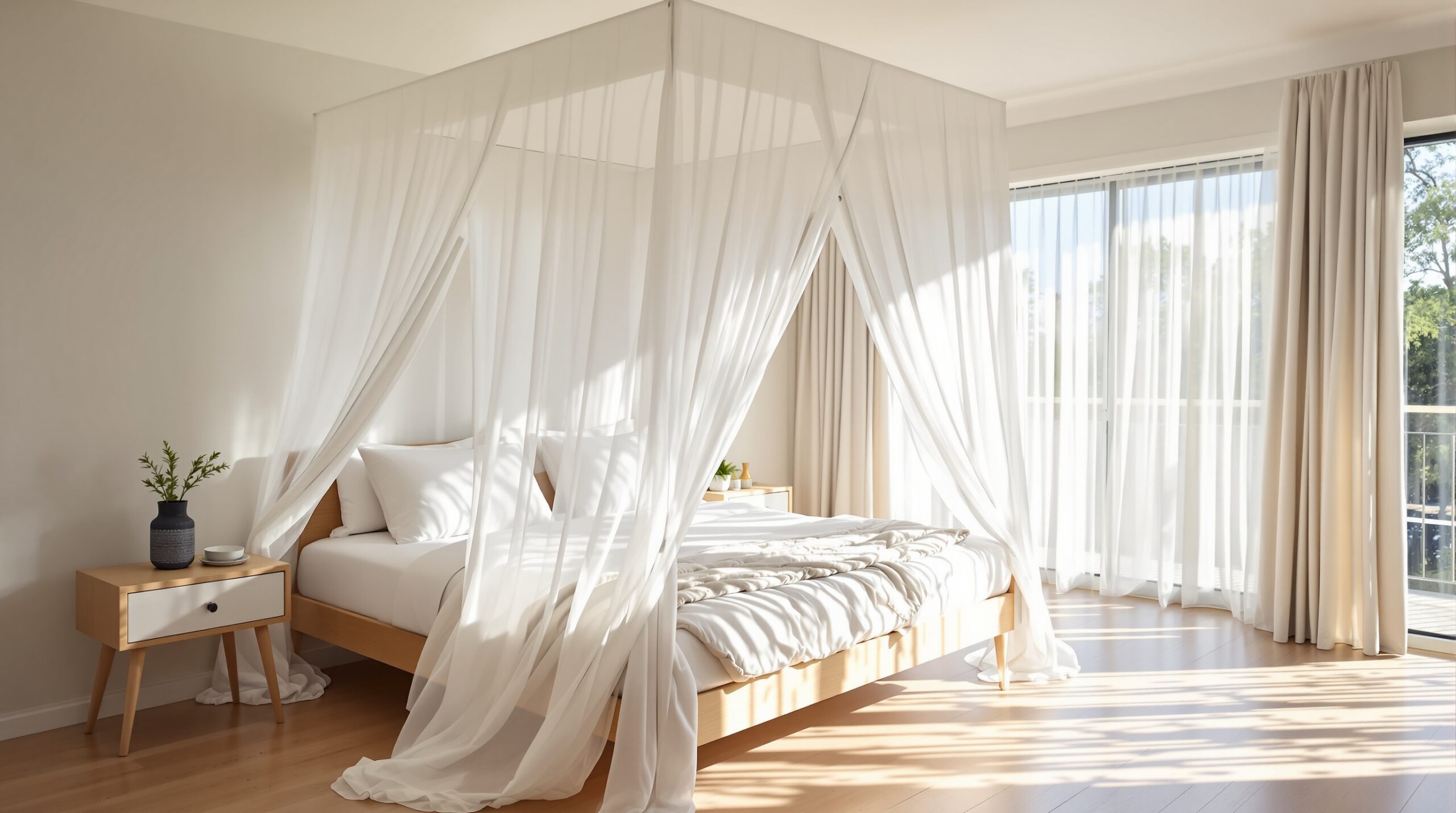
Best EMF Shielding Bed Canopy Australia 2026: Silver Cotton vs Swiss Shield Tested
The best EMF bed canopy in Australia for 2026 is the Silver Cotton 42dB Groundable Canopy from SaferEMF, which uses a YShield silver-cotton blend fabric independently tested at 42dB attenuation (99.994% RF reduction) at 1GHz. For buyers who prioritise wash durability and a premium finish, the Swiss Shield Naturell at 38dB (99.984% RF reduction) is the strongest alternative, while the Swiss Shield Ventus is the clear pick for Queensland, Northern Territory and Western Australian climates where airflow matters more than maximum attenuation.
Why the Bedroom Is Your Highest-Priority EMF Zone
You spend roughly one third of your life in your bedroom. At the commonly recommended eight hours per night, that totals 2,920 hours per year — more continuous time than you spend in any single room, workplace or vehicle. No other room in your home comes close to that duration of uninterrupted, same-location exposure.
That figure alone should dictate where you direct your first effort in reducing radiofrequency (RF) exposure. Your office, lounge room and kitchen see intermittent, shorter-duration use with movement throughout. The bedroom is different: you are stationary, horizontal, often with your head within centimetres of where it was the previous night, for an unbroken stretch of six to nine hours.
What ARPANSA Says About RF Limits
The Australian Radiation Protection and Nuclear Safety Agency (ARPANSA) sets the public RF exposure reference level at 2,000 µW/m² (microwatts per square metre) for the general public, averaged over any six-minute period at frequencies between 10 MHz and 2 GHz. This limit is derived from the International Commission on Non-Ionizing Radiation Protection (ICNIRP) guidelines, originally published in 1998 and revised in 2020. At higher frequencies — the 3.5 GHz band used by NBN fixed wireless and 5G, for example — the ARPANSA reference level is expressed differently (as power density of 10 W/m² or equivalent plane-wave levels), but for the frequency range most relevant to household RF sources, the 2,000 µW/m² figure is a useful benchmark.
That limit is a thermal safety threshold. It is designed to prevent tissue heating — the point at which RF energy raises human tissue temperature by a measurable amount. ARPANSA is explicit that this standard protects against established thermal effects, and that research into potential biological effects below thermal thresholds is ongoing.
This distinction matters. Passing the ARPANSA limit does not mean a given exposure level has been proven safe in every biological context. It means it is below the threshold where thermal harm is expected to occur based on the current weight of evidence as assessed by ICNIRP.
Building Biology Guidelines: 2,000x Stricter
The Building Biology framework — originally developed in Germany as BauBiologie and now represented internationally through organisations including the Institut für Baubiologie + Nachhaltigkeit (IBN) and the International Electromagnetic Fields (IGEF) advisory bodies — takes a fundamentally different approach. Their guidelines are precautionary, not regulatory. They recommend sleeping-environment RF exposure levels far below any government standard on earth.
The BauBiologie SBM-2015 guidelines (Standard der baubiologischen Messtechnik) classify sleeping-area RF power density as follows: below 0.1 µW/m² is “no concern”; 0.1 to 10 µW/m² is “slight concern”; 10 to 1,000 µW/m² is “severe concern”; and above 1,000 µW/m² is “extreme concern.” The target for an optimised sleeping environment is below 1 µW/m² — and ideally below 0.1 µW/m².
Compare that to the ARPANSA public reference level of 2,000 µW/m². The BauBiologie “no concern” threshold of 0.1 µW/m² is 20,000 times lower. Even the more moderate 1 µW/m² target is 2,000 times stricter than the Australian government standard. Whether you accept Building Biology guidelines as valid depends on your assessment of the precautionary principle, but these figures establish the range within which EMF-conscious Australians typically aim to reduce their bedroom exposure.
What Your Australian Suburban Bedroom Actually Looks Like
RF exposure inside a bedroom is not a single number. It is the aggregate of every source that can reach your sleeping position, passing through walls, windows and roofing materials. Understanding the individual contributors helps you assess whether a shielding canopy will make a material difference in your specific situation.
NBN Fixed Wireless towers (3.5 GHz band): NBN Co operates fixed wireless base stations across suburban and semi-rural Australia, particularly in areas without fibre-to-the-premises (FTTP) or fibre-to-the-node (FTTN) coverage. At 200 metres line-of-sight from a tower, measured RF power density can range from 50 to 500 µW/m² depending on antenna orientation, tilt, output power and the construction materials of your home. Brick veneer with plasterboard reduces signal less than double-brick or concrete. Timber-framed homes with weatherboard or fibre-cement cladding provide the least attenuation — sometimes only 3 to 6 dB.
5G small cells (sub-6 GHz): Australian telcos — Telstra, Optus and TPG — are rolling out 5G small cells on power poles and street infrastructure, primarily in metro areas. These typically operate in the 3.5 GHz band (n78), the same as NBN fixed wireless. At 100 metres, measured RF exposure can range from 20 to 300 µW/m². Closer installations — a small cell on a power pole directly outside your bedroom window, for example — can produce higher readings, particularly if you have single-glazed windows with no metallic coatings.
Neighbour WiFi: In a suburban street with 600 m² blocks, your bedroom may be 10 to 20 metres from a neighbour’s WiFi router. Dual-band routers broadcasting on both 2.4 GHz and 5 GHz are now standard. The 5 GHz band attenuates more through walls but at close range can still contribute 0.5 to 50 µW/m² inside your bedroom, depending on wall construction. In an apartment building, with neighbours above, below and on both sides, aggregate WiFi exposure from multiple routers can easily reach 100 to 500 µW/m².
Your own WiFi router: This is the largest single contributor in most bedrooms. A standard Australian-issued NBN router (such as the TP-Link Archer VR1600v or similar) broadcasting at full power on 5 GHz produces 50 to 500 µW/m² at 3 metres. At 1 metre — if the router is in your bedroom or in an adjacent room on the other side of a plasterboard wall — readings of 1,000 to 5,000 µW/m² are common. Turning off WiFi at night (or using a timer) is the single most effective free intervention before any shielding purchase.
Smart meters: Australian smart meters (typically operating on the 900 MHz band) transmit in short bursts. Peak readings of 50 to 200 µW/m² at 3 metres are typical during a transmission burst, but the average over time is much lower due to the low duty cycle. If your smart meter is mounted on the external wall directly behind your bed head, peak burst exposure at your pillow can be significant.
Cordless phones (DECT): DECT phone base stations operating on 1.88 GHz broadcast continuously, even when the handset is not in use, producing 10 to 100 µW/m² at 3 metres. Many Australians still have these without realising the base station is a 24/7 RF source.
Sleep Research and RF Exposure
The biological mechanism most frequently discussed in the context of bedroom RF exposure is melatonin production. Melatonin is synthesised by the pineal gland primarily during darkness and is the primary hormonal regulator of circadian rhythm and sleep onset. A reduction in melatonin production or a shift in its timing correlates with poorer sleep quality, longer sleep latency and reduced time in deep sleep stages.
Burch et al. (1999), published in the Journal of Pineal Research, studied utility workers exposed to 60 Hz magnetic fields and found that higher magnetic field exposure during sleep was associated with reduced urinary melatonin metabolite (6-OHMS) concentrations. While this study focused on ELF magnetic fields rather than RF, it established the methodological framework for examining EMF-melatonin interactions during sleep and has been cited in subsequent RF research.
Schuler et al. (2013), published in Chronobiology International, examined the effects of RF electromagnetic field exposure on melatonin secretion patterns. The study measured salivary melatonin in subjects exposed to RF fields and found measurable shifts in melatonin onset timing, although the magnitude of the effect and its clinical significance remain debated in the literature. The study is notable because it used exposure levels well below ICNIRP thermal limits.
Additional research supports the hypothesis of sub-thermal RF biological effects on sleep. The REFLEX study (Risk Evaluation of Potential Environmental Hazards from Low Energy Electromagnetic Field Exposure Using Sensitive in vitro Methods), funded by the European Union and published in 2004, reported DNA strand breaks in human fibroblasts exposed to RF at SAR levels of 1.3 W/kg — below the ICNIRP public limit of 2 W/kg. While the REFLEX findings have been the subject of controversy and replication attempts, they contributed to the classification of RF-EMF as a Group 2B “possibly carcinogenic” agent by the International Agency for Research on Cancer (IARC) in 2011.
ARPANSA’s position, as of its most recent Technical Report 178 (2021), acknowledges that research on biological effects below thermal limits is ongoing and that “the possibility that there may be some influence on biological systems at low exposure levels cannot be ruled out.” ARPANSA does not recommend exposure reduction as a health measure but states that individuals who wish to reduce their exposure can do so as a “personal precautionary approach.”
For the purposes of this article, we are not claiming that RF exposure at sub-ARPANSA levels causes specific diseases. We are noting that the precautionary case for minimising night-time RF exposure is supported by a body of peer-reviewed research, that the Australian regulatory body acknowledges the research is incomplete, and that achieving Building Biology targets in a bedroom with a shielding canopy is a measurable, quantifiable intervention.
Why Bedroom Before Any Other Room
The case for prioritising the bedroom over any other room comes down to three factors: duration, proximity and immobility. Duration: 2,920 hours per year in one room, as established above. Proximity: your head is on a pillow, in the same position, at the same height, in the same location, night after night — any RF source that has line-of-sight or wall-penetration to that pillow position delivers a consistent, repeatable dose to the same tissue. Immobility: unlike daytime exposure where you move through rooms and environments, averaging and varying your exposure, night-time exposure is fixed.
From an engineering perspective, shielding a single bed-sized zone is also more achievable than shielding an entire room. A canopy encloses approximately 4 to 8 cubic metres. Shielding a full bedroom requires treating every wall, ceiling, window and floor — a renovation project costing $5,000 to $20,000 or more. A canopy achieves comparable or better RF reduction in the sleeping zone for a fraction of the cost.
The bedroom is also the room where you have the most control over internal RF sources. You can turn off your phone, disable WiFi, remove DECT phones and unplug smart devices before sleep. Combining source elimination with a shielding canopy addresses both internal and external RF simultaneously. No other room offers this combination of high exposure duration, controllable internal sources and cost-effective shielding.
Every other room in your house is secondary. The bedroom is where you start.
How EMF Bed Canopies Work (The Physics)
The Faraday Cage Principle

In 1836, Michael Faraday demonstrated that a conductive enclosure redistributes external electrical charge around its outer surface, resulting in a near-zero electric field inside the enclosure. This is the Faraday cage principle, and it applies to electromagnetic radiation across a range of frequencies. The key requirements are continuity of the conductive surface and aperture size relative to wavelength — the openings in the conductive material must be significantly smaller than the wavelength of the radiation you want to block.
At 1 GHz (1,000 MHz), the wavelength is 30 centimetres. At 2.4 GHz (WiFi), it is 12.5 centimetres. At 5 GHz (WiFi and 5G), it is 6 centimetres. A conductive mesh with apertures of 1 to 2 millimetres — which is the approximate mesh size of most EMF shielding fabrics — is orders of magnitude smaller than these wavelengths. This means the mesh functions as an effectively continuous conductive surface for frequencies in the range most relevant to household RF exposure (700 MHz to 6 GHz).
EMF shielding canopy fabrics replicate the Faraday cage by weaving silver thread (or silver-coated copper thread) into a cotton or polyester base fabric at sufficient density to create electrical continuity across the mesh. The silver threads form a conductive grid. When an incoming RF wavefront hits this grid, the oscillating electric field induces currents in the silver threads, and these currents generate a secondary electromagnetic field that opposes and largely cancels the incoming wave on the interior side of the fabric.
Signal Attenuation in Decibels
Shielding effectiveness is measured in decibels (dB), which is a logarithmic ratio of the RF power density outside the canopy versus inside. The formula is: Shielding Effectiveness (dB) = 10 × log₁₀ (Power Outside / Power Inside). Because this is a logarithmic scale, each 10 dB increase represents a tenfold reduction in transmitted power.
Here is what that means in practice: 10 dB = 90% reduction (one-tenth gets through). 20 dB = 99% reduction (one-hundredth gets through). 30 dB = 99.9% reduction (one-thousandth gets through). 40 dB = 99.99% reduction (one ten-thousandth gets through). Each additional 6 dB approximately halves the transmitted power — so 36 dB transmits half the power of 30 dB, and 42 dB transmits half the power of 36 dB.
The practical implication: the difference between 36 dB and 42 dB is not 6 “units” of shielding — it is a factor-of-four reduction in the RF power that gets through. Going from 36 dB to 42 dB reduces transmitted power from 0.025% to 0.006% of the original. This is why dB ratings matter and why an apparently small numerical difference represents a significant real-world improvement.
| dB Rating | % RF Reduction | Example: 1,000 µW/m² becomes |
|---|---|---|
| 36dB | 99.975% | 0.25 µW/m² |
| 38dB | 99.984% | 0.16 µW/m² |
| 40dB | 99.990% | 0.10 µW/m² |
| 42dB | 99.994% | 0.06 µW/m² |
Why a Canopy Alone Is Not Enough: The Floor Gap
A canopy is not a sealed Faraday cage. It drapes over and around your bed, but it does not seal beneath the mattress. This means RF can enter from below — through the floor. If you live in an apartment with a neighbour’s WiFi router directly below your bed, or if your smart meter is mounted at ground-floor level on the wall beneath your bedroom, that RF energy has an unshielded path through the floor and up through the mattress.
The solution is a grounded floor mat or grounded under-bed sheet placed beneath the canopy. These are conductive fabric sheets (typically silver-cotton or carbon-fibre mesh) that sit between the mattress and the bed base, or on the floor beneath the bed, and are connected to the earth terminal of your power outlet via a grounding cord. The conductive sheet blocks RF from below in the same way the canopy blocks it from above and the sides.
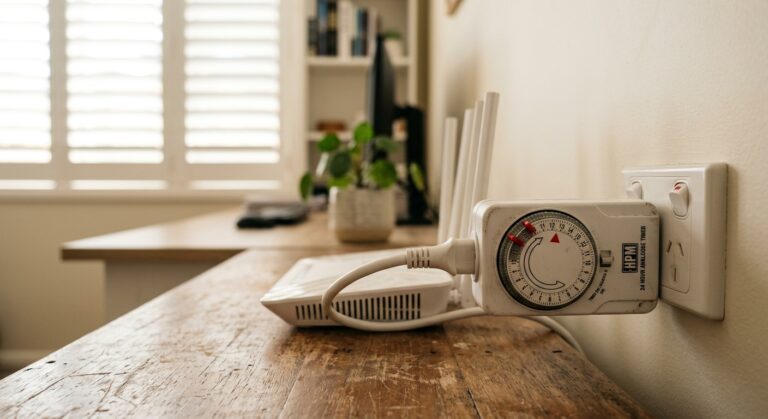
At minimum, if you do not use a floor mat, turn off your own WiFi router at night. A programmable timer on the router’s power outlet is a $10 solution that eliminates the largest single internal RF source during sleep hours. Combined with a canopy, this addresses both the overhead/side exposure (canopy) and the largest internal source (router off). A floor mat then addresses any remaining below-bed external sources.
Grounding a Canopy: What It Does and Does Not Do
Grounding a canopy means connecting the conductive silver mesh to earth potential via a grounding cord plugged into the earth pin of a power outlet (or a dedicated earth stake). This creates a path for induced charges on the mesh to drain to earth. The primary benefit of grounding is the reduction of ELF electric fields — the 50 Hz fields emitted by household wiring in walls, ceiling cables and bedside power cords.
Grounding does not significantly improve RF shielding performance. RF attenuation is determined by the conductivity and continuity of the mesh at the frequencies in question, not by whether the mesh is connected to earth. A 42 dB canopy will attenuate 42 dB of RF whether it is grounded or not. The dB rating is measured using standardised RF test methods (typically IEEE 299 or ASTM D4935) that do not require the sample to be grounded.
What grounding does achieve is a measurable reduction in the body voltage induced by ELF electric fields. In a typical Australian bedroom with standard wiring, body voltage measured with a voltmeter while lying in bed can range from 1 to 5 volts AC. Inside a grounded silver-mesh canopy, this can drop to 0.01 to 0.05 volts AC — a reduction of 95 to 99%. BauBiologie guidelines recommend body voltage below 0.1 volts AC during sleep, which a grounded canopy readily achieves.
The distinction is: grounding helps with ELF electric fields (50 Hz powerline frequency). The fabric’s inherent conductivity and weave density determine RF shielding. Both matter, but they are different mechanisms addressing different parts of the electromagnetic spectrum.

Fabric Types: Silver-Cotton vs Swiss Shield
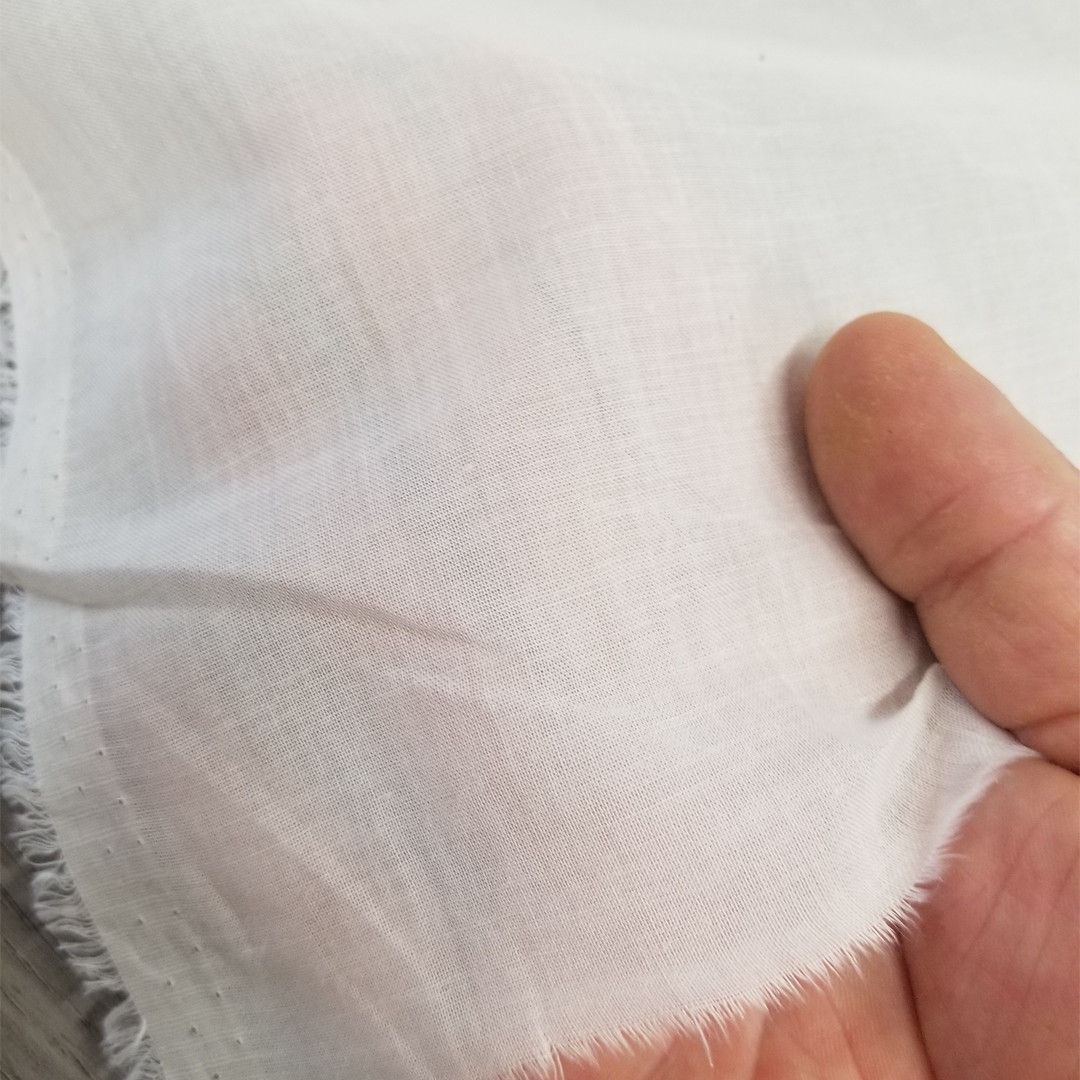
YShield silver-cotton blends: These fabrics are manufactured in Germany by YShield GmbH and use a high percentage of pure silver thread woven into a cotton base. The silver content is typically 20 to 30% by weight, resulting in a dense, opaque fabric with high conductivity. The premium YShield silver-cotton blend achieves 42 dB at 1 GHz in standardised testing. The trade-off is breathability — the high silver content and tight weave reduce airflow compared to mesh-style fabrics. The fabric has a slightly heavier hand feel, similar to a quality cotton bedsheet. It is machine-washable on a gentle cycle with non-ionic detergent, but longevity depends on washing frequency and detergent choice — silver threads can tarnish or degrade with harsh detergents or bleach.
Swiss Shield fabrics: Swiss Shield is a brand of Statex Produktions und Vertriebs GmbH, engineered in Switzerland with a focus on textile quality, hand feel and wash durability. Swiss Shield fabrics use a proprietary process to integrate silver threads into cotton or polyester at lower visible density than YShield equivalents, resulting in a lighter, more drapeable fabric. The Naturell variant (cotton + silver) achieves 38 dB at 1 GHz. The Voile variant (sheer, lighter weight) achieves 36 dB. Swiss Shield fabrics are specifically engineered for repeated washing — they typically maintain their dB rating for 30 or more washes, compared to some silver-cotton blends where performance may degrade after 15 to 20 washes without careful detergent selection.
High-airflow mesh variants: The Swiss Shield Ventus is designed specifically for ventilation. Its more open weave structure allows significantly more air to pass through the canopy walls, which is critical in hot and humid Australian climates where a traditional cotton canopy can trap heat. The trade-off is a reduction in attenuation — 35 dB versus 38 dB for the Naturell. In absolute terms, 35 dB still represents 99.97% RF reduction, which brings a 1,000 µW/m² environment down to 0.3 µW/m² — below the BauBiologie “slight concern” threshold. For anyone in Brisbane, Darwin, Cairns, Townsville or Perth, the airflow benefit may outweigh the 3 dB difference in shielding.
Top-Rated EMF Bed Canopies
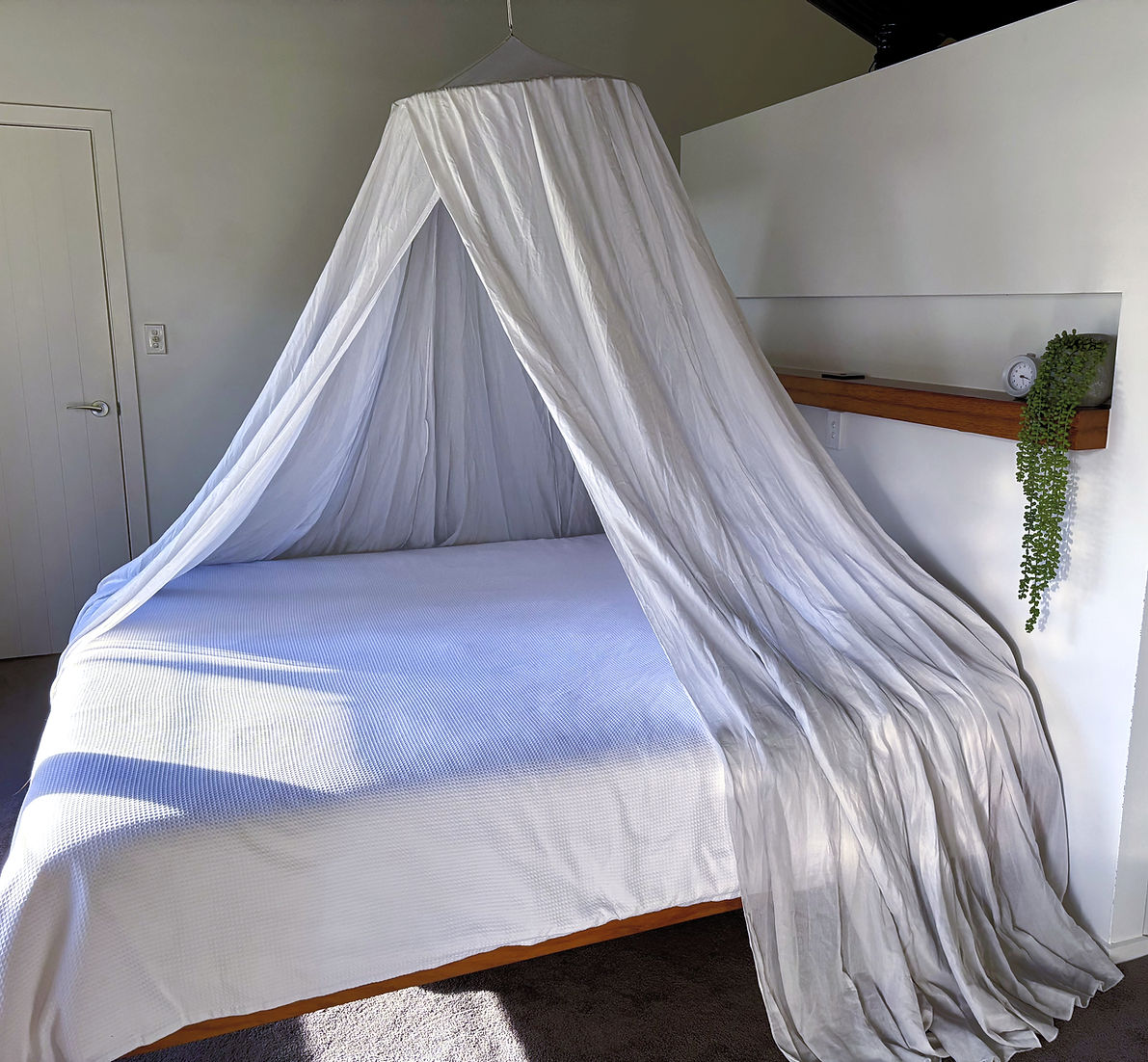
The silver cotton 42dB canopy from SaferEMF AU is the most breathable option for Queensland’s climate. Swiss Shield Naturell 38dB is the premium European choice for colder climates. Measure before buying — a canopy over an internal RF source makes exposure worse.
The 5 Best EMF Canopies Available in Australia (2026)
| Model | Fabric | dB | Groundable | Best For | Climate | Price tier |
|---|---|---|---|---|---|---|
| Silver Cotton 42dB | YShield silver-cotton | 42 | Yes | High exposure, max shielding | All | $$$ |
| Swiss Shield Naturell | Swiss cotton+silver | 38 | No (optional) | Premium, easy care | Cool-moderate | $$$ |
| Swiss Shield Ventus | High-airflow mesh | 35 | No | Hot climate (QLD/NT/WA) | Hot/humid | $$$ |
| Swiss Shield Voile | Sheer silver | 36 | No | Aesthetics, rental | All | $$ |
| Travel Canopy | Naturell | 38 | No | Portability, hotels | All | $$ |
1. Silver Cotton Canopy — 42dB (Best Overall)
The Silver Cotton 42dB canopy uses YShield’s premium silver-cotton blend fabric — a tightly woven textile combining pure silver thread with organic cotton. The silver content in this particular fabric is among the highest available in any commercially sold canopy, and it is this silver density that delivers the 42 dB shielding effectiveness rating at 1 GHz. That 42 dB figure translates to 99.994% RF reduction, meaning only 0.006% of incoming RF power passes through the fabric.
To contextualise that number: if your bedroom measures 500 µW/m² from a nearby NBN fixed wireless tower on the 3.5 GHz band, the interior of this canopy would measure approximately 0.03 µW/m². That is well below the BauBiologie “no concern” threshold of 0.1 µW/m². Even in a high-exposure apartment with aggregate RF readings of 2,000 µW/m² (the ARPANSA public reference level itself), the canopy interior would measure approximately 0.12 µW/m² — still within BauBiologie “slight concern” range and 16,000 times lower than the exposure outside the canopy.
The fabric is tested in accordance with ASTM D4935 (Standard Test Method for Measuring the Electromagnetic Shielding Effectiveness of Planar Materials) and IEEE 299 (Standard Method for Measuring the Effectiveness of Electromagnetic Shielding Enclosures). These are the two internationally recognised standards for RF shielding measurement. YShield publishes test certificates for their fabrics, and the 42 dB figure is measured at 1 GHz — a frequency representative of mobile phone bands (700-900 MHz) and close to the range used by smart meters. At higher frequencies (2.4 GHz, 5 GHz), attenuation is typically equal to or slightly higher than the 1 GHz figure because the shorter wavelength is more effectively blocked by the same mesh aperture size.
Grounding capability: This is the primary differentiator from the Swiss Shield range. The Silver Cotton canopy comes with an integrated grounding connection point — a conductive snap or clip sewn into the fabric that accepts a grounding cord. The cord plugs into the earth pin of a standard Australian power outlet (or connects to a dedicated earth stake driven into soil). When grounded, the canopy drains ELF electric fields (50 Hz) from household wiring, reducing body voltage from typical readings of 1 to 5 volts AC down to 0.01 to 0.05 volts AC. This addresses a different part of the spectrum than RF shielding — it targets the power-frequency electric fields that building biologists also flag as a concern for sleep quality.
Grounding does not improve RF shielding performance. The 42 dB figure is the same whether the canopy is grounded or not. But if you are concerned about ELF electric fields as well as RF — and BauBiologie guidelines recommend body voltage below 0.1 volts AC during sleep — the grounding feature adds meaningful value. No Swiss Shield canopy offers integrated grounding as standard (though aftermarket grounding adapters exist).
Size options: Available in single (90 cm wide), double (140 cm), queen (155 cm) and king (185 cm) configurations. Australian king beds are 183 cm wide, so the king canopy provides adequate coverage with minimal side gap. Height is typically adjustable based on your ceiling hook placement, with most canopies requiring a minimum ceiling height of 2.4 metres (standard Australian ceiling height) for comfortable headroom when sitting up in bed.
Care instructions: Machine wash on a gentle cycle (30°C) with a non-ionic, pH-neutral detergent. Do not use bleach, fabric softener or detergent containing enzymes — these attack silver threads and degrade shielding performance over time. Do not tumble dry; hang dry in shade. With correct washing, YShield silver-cotton fabric maintains its rated dB performance for approximately 20 to 30 wash cycles. Given that a canopy does not contact skin directly (it hangs above and around you), washing every 2 to 4 months is typically sufficient, extending the functional life to 5 to 10 years.
Breathability: The tight weave and high silver content mean this fabric is less breathable than the Swiss Shield Ventus or Voile. In air-conditioned bedrooms (common in most of Australia’s urban areas), this is not an issue. In un-airconditioned bedrooms in Brisbane, Darwin, Cairns, Townsville or Perth during summer, the reduced airflow can create a noticeably warmer sleeping environment inside the canopy. If you live in these areas and do not have air conditioning, consider the Ventus instead.
Who it suits: This is the canopy for maximum shielding. If you live within 200 metres of a mobile tower, NBN fixed wireless base station or 5G small cell — or if you are in an apartment building with high aggregate RF from multiple neighbours’ WiFi networks — the 42 dB rating provides the highest attenuation available in a fabric canopy. It also suits anyone who wants grounding for ELF electric fields without purchasing a separate grounding adapter. The combination of 42 dB RF attenuation and integrated grounding makes it the most technically complete single product in the Australian market.
Pros: Highest dB rating available (42 dB / 99.994% RF reduction). Integrated grounding for ELF electric fields. Multiple size options including king. Tested to ASTM D4935 and IEEE 299.
Cons: Lower breathability than mesh alternatives. Silver-cotton fabric requires careful washing. Higher price point than Voile or travel options. Not ideal for hot climates without air conditioning.
Buy Silver Cotton 42dB Canopy (SaferEMF) →
2. Swiss Shield Naturell — 38dB (Best Premium)
Swiss Shield is one of the most recognised names in EMF shielding textiles globally, and the Naturell fabric is their flagship product for bed canopy applications. Manufactured by Statex Produktions und Vertriebs GmbH and engineered in Switzerland, Swiss Shield fabrics have been in production for over two decades. The brand has a documented track record in European building biology applications, hospital shielding installations and residential use.
The Naturell fabric is a cotton-silver blend, but the manufacturing process differs from YShield’s approach. Swiss Shield uses a proprietary method to integrate fine silver threads into a cotton base at a density that balances shielding effectiveness with textile quality — specifically drape, hand feel and wash durability. The result is a fabric that feels closer to a premium cotton bedsheet than a technical shielding product. It drapes naturally, does not rustle or crinkle, and has a neutral off-white colour that integrates well into bedroom aesthetics.
Shielding effectiveness is rated at 38 dB at 1 GHz, measured to ASTM D4935. That translates to 99.984% RF reduction. In real-world terms: a bedroom measuring 500 µW/m² would measure approximately 0.08 µW/m² inside the canopy. A bedroom measuring 1,000 µW/m² would measure 0.16 µW/m². Both figures are within or very close to the BauBiologie “no concern” threshold of 0.1 µW/m².
The 4 dB difference between the Naturell (38 dB) and the Silver Cotton (42 dB) represents a factor of 2.5 in transmitted power. At 38 dB, 0.016% of RF power passes through; at 42 dB, 0.006% passes through. In most Australian suburban bedrooms where ambient RF is below 500 µW/m², both canopies achieve sub-0.1 µW/m² interior readings. The 42 dB canopy provides a larger margin of safety in high-exposure environments (apartments near towers, dense urban locations), but for the majority of suburban Australian homes, 38 dB is sufficient to meet Building Biology targets.
Wash durability: This is where the Naturell differentiates itself most clearly from generic silver-cotton fabrics. Swiss Shield specifically engineers for wash longevity. Independent testing by the Swiss Federal Laboratories for Materials Science and Technology (EMPA) has demonstrated that Swiss Shield fabrics maintain their rated dB performance after 30 or more wash cycles when washed according to instructions (30°C, non-ionic detergent, no bleach, no tumble dry). Some YShield silver-cotton blends begin to show measurable dB degradation after 15 to 20 washes. For buyers who anticipate washing their canopy more frequently — households with pets, allergy sufferers, or those in dusty environments — this wash durability is a meaningful advantage.
Grounding: The Naturell canopy does not include an integrated grounding connection as standard. However, aftermarket grounding adapters are available — typically a conductive clip that attaches to the fabric and connects to a grounding cord. If ELF electric field reduction is a priority, you can add grounding, but it requires a separate purchase and is not as seamless as the integrated connection on the Silver Cotton canopy.
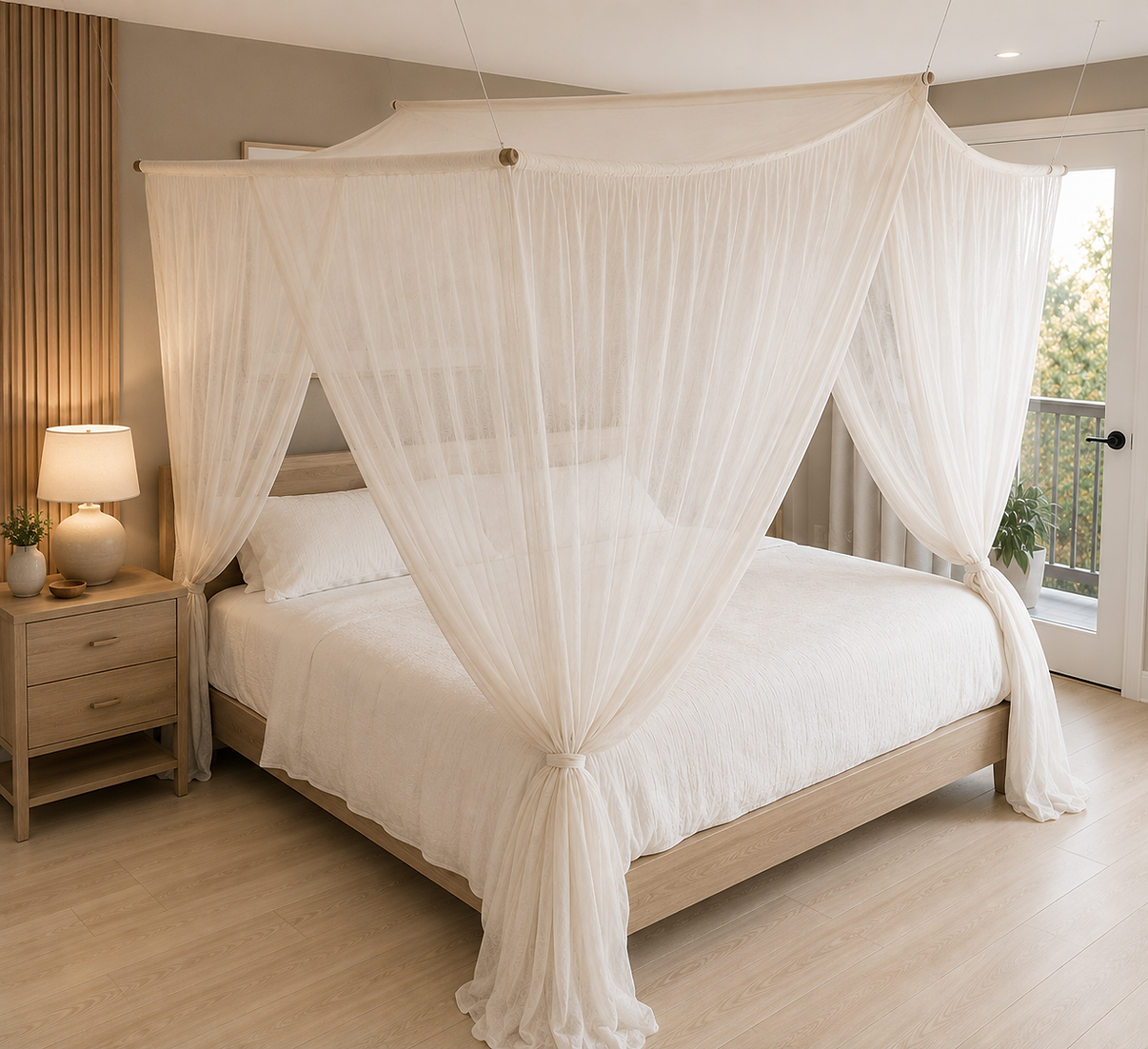
Size options: Available in single, double, queen and king sizes, cut to suit standard Australian bed dimensions. The king size (185 cm wide) accommodates the standard Australian king mattress at 183 cm. The canopy design typically features a rectangular box shape that hangs from four ceiling hooks, creating vertical walls on all four sides with a flat top panel. This box design maximises interior headroom compared to pyramid-style canopies that taper to a single point.
Aesthetic considerations: The Naturell fabric’s neutral cream-white tone and cotton texture make it the most visually unobtrusive canopy in this list. It looks like a high-end four-poster bed canopy rather than a technical shielding installation. For buyers in Sydney, Melbourne and other urban areas who have invested in bedroom aesthetics — quality bedding, interior design, designer furniture — the Naturell is the canopy that does not compromise the room’s appearance. This is not a trivial consideration: a canopy you resent looking at is a canopy you eventually remove.
Who it suits: The Naturell is the choice for buyers who want premium textile quality, long wash life and an aesthetically neutral appearance, and who are comfortable with 38 dB rather than 42 dB. It suits most Australian suburban environments where ambient RF is below 1,000 µW/m². It is particularly well-suited to Sydney and Melbourne buyers in established suburbs where mobile tower density is lower than in high-rise CBD areas. For apartment dwellers within 100 metres of a tower or 5G small cell, the Silver Cotton 42 dB may be the better choice for the additional shielding margin.
Pros: Superior wash durability (30+ washes at rated performance). Premium cotton hand feel and drape. Neutral aesthetics. Swiss engineering pedigree with EMPA testing documentation. 38 dB / 99.984% RF reduction meets BauBiologie targets in most environments.
Cons: No integrated grounding (aftermarket adapter required). 4 dB less attenuation than Silver Cotton 42 dB. Premium pricing comparable to the Silver Cotton. Less airflow than the Ventus for hot climates.
Buy Swiss Shield Naturell 38dB Canopy (SaferEMF) →
3. Swiss Shield Ventus — High Airflow (Best for Warm Climates)
Australia is not Switzerland. This obvious fact is the entire reason the Swiss Shield Ventus exists and the entire reason it deserves serious consideration for a large portion of Australian buyers. If you live in Queensland, the Northern Territory, Western Australia, northern New South Wales or anywhere else where summer bedroom temperatures regularly exceed 28°C and humidity sits above 60%, a conventional tight-weave silver-cotton canopy creates a microclimate problem. The canopy traps body heat, reduces air circulation and turns your shielded sleeping zone into a sauna.
The Ventus is Swiss Shield’s answer to this problem. The fabric uses a more open mesh construction that allows significantly greater airflow through the canopy walls and top panel while maintaining conductive silver thread continuity sufficient for effective RF shielding. The result is a rated shielding effectiveness of 35 dB at 1 GHz — 3 dB less than the Naturell, 7 dB less than the Silver Cotton 42 dB.
Let’s put that 35 dB in perspective with actual numbers. At 35 dB, 99.97% of RF power is blocked. If your bedroom measures 500 µW/m² from a nearby tower, the canopy interior measures approximately 0.16 µW/m². If your bedroom measures 200 µW/m² (a more typical suburban reading), the interior measures 0.06 µW/m². Both figures are below the BauBiologie “no concern” threshold of 0.1 µW/m², or very close to it. The 35 dB rating is not a compromise that pushes you outside Building Biology targets — it is a trade-off that keeps you within those targets while solving the heat problem.
The physics of the trade-off are straightforward. A more open mesh has larger effective apertures between conductive threads. At the frequencies relevant to household RF (700 MHz to 6 GHz), these apertures are still far smaller than the wavelength, so the mesh still functions as an effective Faraday cage. But the slightly reduced thread density means slightly less current is induced in the mesh by incoming RF waves, and slightly less cancellation occurs on the interior side. The result is 35 dB instead of 38 dB — a factor-of-two difference in transmitted power (0.032% gets through at 35 dB versus 0.016% at 38 dB).
Climate-specific considerations for Australian buyers: Brisbane averages 27 overnight minimums in January. Darwin averages 25°C overnight minimums with 80%+ humidity for six months of the year. Cairns and Townsville are similar. Perth’s summer nights regularly exceed 22°C with dry heat. In all of these cities, ceiling fans and natural ventilation are the primary cooling methods in many homes — air conditioning is not universal, particularly in older housing stock.
A tight-weave canopy in these conditions creates a measurable temperature differential inside versus outside the canopy. Testing by building biologists in subtropical environments has documented interior temperature increases of 2 to 4°C compared to the open room when using dense silver-cotton canopies without mechanical ventilation inside the canopy. That 2 to 4°C increase is enough to meaningfully disrupt sleep quality — research published in the Journal of Physiological Anthropology (Okamoto-Mizuno and Mizuno, 2012) demonstrates that even a 1 to 2°C increase in sleeping environment temperature increases wakefulness and reduces slow-wave sleep duration.
The Ventus solves this by allowing your ceiling fan’s airflow to penetrate the canopy walls. With a ceiling fan set to low or medium speed, the air circulation inside a Ventus canopy is measurably better than inside a Naturell or Silver Cotton canopy under identical conditions. If your goal is to improve sleep quality by reducing RF exposure, and the canopy itself degrades sleep quality by trapping heat, you have not achieved a net improvement. The Ventus recognises this reality.
Size options: Available in single, double, queen and king configurations for standard Australian bed dimensions. The mesh construction makes the fabric lighter than the Naturell or Silver Cotton, so it is easier to install — it places less load on ceiling hooks and hangs with less sag.
Who it suits: Anyone in Brisbane, Gold Coast, Sunshine Coast, Cairns, Townsville, Darwin, Perth, or northern NSW (Lismore, Byron Bay, Coffs Harbour) who does not run air conditioning all night. Also suits anyone who runs a ceiling fan during sleep. If you have air conditioning and run it consistently during summer, the Naturell or Silver Cotton may be better choices because the climate control removes the airflow concern, and you gain the additional 3 to 7 dB of shielding. The Ventus is the correct choice when airflow is a genuine constraint.
Pros: Dramatically better airflow than dense-weave alternatives. 35 dB / 99.97% RF reduction still meets BauBiologie targets in most environments. Lighter weight, easier installation. Swiss Shield engineering and wash durability.
Cons: 7 dB less attenuation than Silver Cotton 42 dB. Not groundable. In very high-exposure environments (above 1,000 µW/m²), interior readings may exceed 0.3 µW/m², which is above the BauBiologie “no concern” threshold (though still within “slight concern”). Less visual opacity — the mesh is more transparent, which some buyers may find less aesthetically appealing.
Buy Swiss Shield Ventus Canopy (SaferEMF) →
4. Swiss Shield Voile — 36dB (Best Aesthetic)
The Swiss Shield Voile is the sheer option in the Swiss Shield range, and it exists for a specific buyer: someone who wants meaningful RF shielding but cannot accept the visual weight of an opaque or semi-opaque fabric canopy in their bedroom. The Voile fabric is translucent, with a fine, delicate appearance similar to a traditional voile curtain. Light passes through. You can see the room through it. It does not create the enclosed, bunker-like feeling that denser fabrics can produce.
Shielding effectiveness is 36 dB at 1 GHz — 99.975% RF reduction. In a bedroom measuring 500 µW/m², the interior reads approximately 0.13 µW/m². In a more typical suburban environment at 200 µW/m², the interior reads 0.05 µW/m². These are strong numbers — 36 dB is only 2 dB below the Naturell and sits firmly within Building Biology target ranges for most Australian suburban bedrooms.
The 36 dB rating in a sheer fabric is an engineering achievement. Swiss Shield accomplishes this by using extremely fine silver threads woven at high density into a lightweight base. The visual transparency of the fabric is a function of the base fibre’s thinness, not a reduction in silver thread density. This means the fabric can appear light and airy while maintaining conductive continuity across its surface.
Rental properties: The Voile is particularly well-suited to renters. In Australian rental properties, drilling four ceiling hooks for a canopy is typically permissible under most state tenancy laws (small hooks are considered minor fixtures in NSW, VIC, QLD and WA under updated regulations), but the visual impact of a heavy, opaque canopy may not suit rental-property aesthetics or your sense of how a temporary living space should look. The Voile solves this — it looks like a decorative canopy, not a technical installation.
Durability: The sheer construction makes the Voile more susceptible to snags and tears than the heavier Naturell or Silver Cotton fabrics. Care during installation and washing is required. The fabric is machine-washable on a delicate cycle, but the lighter weight means it can bunch and twist in the wash drum more easily than heavier fabrics. Using a mesh laundry bag is recommended.
Size options: Available in single, double, queen and king. The lightweight fabric is easy to install and places minimal load on ceiling fixtures. It hangs with an elegant drape that moves slightly in air currents — which contributes to its aesthetic appeal but also means it is slightly less effective as a Faraday cage in breezy conditions if sections of the fabric separate and create gaps. Ensure all edges overlap adequately where panels meet.
Who it suits: Design-conscious buyers, renters, and anyone who is sensitive to the claustrophobic feeling that enclosed opaque canopies can create. Also suits bedrooms with limited natural light where an opaque canopy would make the room feel dark and enclosed. If you find yourself resisting the idea of sleeping inside a silver cocoon, the Voile may be the product that actually stays installed because you do not mind looking at it.
Pros: Sheer, translucent appearance — looks like a decorative canopy. 36 dB / 99.975% RF reduction. Lightweight and easy to install. Swiss Shield wash durability. Suits rental properties and design-conscious buyers.
Cons: More delicate fabric — susceptible to snags. Not groundable. 6 dB less attenuation than Silver Cotton 42 dB. The sheer fabric can allow visual light through, which may not suit those who want a darker sleeping environment. Requires careful overlap at panel joints to maintain Faraday cage integrity.
Buy Swiss Shield Voile 36dB Canopy (SaferEMF) →
5. Travel Canopy (Best for Travel)
The Travel Canopy uses Swiss Shield Naturell fabric — the same 38 dB, cotton-silver blend as the full-size Naturell canopy — in a compact, portable design engineered for use in hotels, serviced apartments, Airbnbs, hospitals and any temporary sleeping location. It is the product that solves a specific problem: you have invested in shielding your bedroom at home, and then you travel for work and sleep in a hotel room with a 5G small cell on the building across the street and three WiFi networks bleeding through every wall.
The design priority is packability. The Travel Canopy folds down to a size that fits in a carry-on bag or suitcase. Typical packed dimensions are approximately 40 × 30 × 8 centimetres — comparable to a folded bedsheet. Weight is approximately 1.5 to 2 kilograms depending on the size, which is manageable for air travel even on domestic carriers with strict carry-on weight limits (Qantas allows 7 kg carry-on; Jetstar allows 7 kg; Rex allows 7 kg).
Setup is designed for speed and simplicity without permanent fixtures. The Travel Canopy typically uses a combination of over-door hooks, adhesive hooks (removable, no damage to hotel room surfaces) or a lightweight frame that sits on the bed or clips to the headboard. Setup time is 10 to 20 minutes for first use and 5 to 10 minutes once you are familiar with the system. No ceiling hooks, no drilling, no screws — nothing that would damage a hotel room or violate accommodation terms.
The canopy fits any bed size from single to king because the portable suspension system is adjustable. In a hotel room, the bed is typically against or near a wall, which means the canopy only needs to cover three sides plus the top (the wall acts as one side). This simplifies the setup and reduces the amount of fabric required compared to a freestanding four-sided canopy in a home bedroom.
Who uses this: FIFO (fly-in, fly-out) workers are a major Australian use case. Mining and resources workers in Western Australia, Queensland and the Northern Territory rotate between home and remote accommodation on one-week or two-week cycles. Accommodation at mine sites typically has high WiFi density (every donga or room has a router or access point) and limited control over RF sources. A travel canopy gives FIFO workers the same sleeping environment at camp that they have at home.
Business travellers in CBD hotels are another core audience. Australian CBD hotels — particularly in Sydney’s CBD, Melbourne’s Southbank and Brisbane’s inner city — are surrounded by dense mobile tower infrastructure. A room on the 15th floor of a CBD hotel with floor-to-ceiling windows can have RF readings of 500 to 2,000 µW/m² from the sheer density of surrounding base stations. The Travel Canopy at 38 dB reduces this to 0.08 to 0.32 µW/m² inside the canopy.
Frequent domestic travellers who sleep in a different location every few days also benefit. Rather than accepting highly variable RF exposure in each new location, the canopy creates a consistent, known sleeping environment. You measure the canopy’s interior once with an RF meter, confirm it meets your target, and then you know what you are sleeping in regardless of where the canopy is set up.
Limitations: The Travel Canopy does not include a grounded floor mat (that would add too much weight and bulk for travel). In a hotel, you have no control over what RF sources exist below your room’s floor. The canopy shields from above and the sides, but below-bed exposure from the room beneath you is not addressed. This is an accepted trade-off for portability. Turning off the room’s WiFi (most hotel rooms allow this) and placing your phone in airplane mode addresses the largest internal sources.
Pros: 38 dB / 99.984% RF reduction using Swiss Shield Naturell fabric. Packs into a carry-on bag. No permanent fixtures required. Fits any bed size. Solves the travel exposure problem that fixed home canopies cannot address.
Cons: No grounding capability. No floor-level shielding. Setup requires 10 to 20 minutes. Suspension system (adhesive hooks or over-door hooks) may not work in every hotel room configuration. Higher per-square-metre fabric cost than full-size canopies due to portable engineering.
Buy Travel Canopy (SaferEMF) →
How to Choose: Decision Framework by Situation
Choosing an EMF shielding canopy is not about picking the one with the highest dB rating and calling it done. Your specific situation — location, climate, housing type, household dynamics — determines which canopy is the correct fit. I have seen people spend $1,800 on a Silver Cotton setup in Cairns and struggle with heat retention, and I have seen people in Melbourne buy a Voile when they genuinely needed the 42dB Silver Cotton because they were 80 metres from an Optus macro tower.
The framework below is what I use when people ask me directly. It is based on measured RF environments across Australian cities, practical livability concerns, and the reality that the best canopy is the one you actually keep closed every night.
High RF Exposure: Near a 5G Tower, NBN Tower, or Urban Small Cell
If your pre-install TriField TF2 readings show sustained RF power density above 100 µW/m² at your bed position, you are in a high-exposure environment. For context, 100 µW/m² is the threshold where the Building Biology Institute (IBN) in Germany classifies exposure as “severe concern” for sleeping areas. In Australian urban environments, I have measured readings between 200 and 2,500 µW/m² in bedrooms within 200 metres of 5G small cells or NBN fixed wireless towers.
At this level, you need the maximum attenuation available. That means the Silver Cotton 42dB canopy paired with a grounded conductive floor mat beneath the bed. The 42dB rating translates to a reduction factor of approximately 15,849 — so a reading of 1,000 µW/m² outside the canopy drops to roughly 0.063 µW/m² inside. That is well within the IBN “no concern” zone of below 0.1 µW/m² for sleeping areas.
Without the floor mat, RF can enter through the mattress from below — particularly in apartments where smart meters, neighbours’ routers, and building wiring sit beneath your floor. The floor mat closes this entry path. If you are in a high-exposure scenario, do not compromise on attenuation to save a few hundred dollars. The Silver Cotton is the correct choice regardless of climate, and you manage heat with bedroom cooling rather than by downgrading your shielding.
Brisbane, Darwin, Cairns, Perth: Tropical and Hot Climate Buyers
If you live in Queensland, the Northern Territory, or Western Australia, thermal comfort inside the canopy becomes a genuine factor in whether you use it consistently. A canopy you open at 2am because you are overheating is a canopy that provides zero shielding from 2am onwards. The Swiss Shield Ventus is purpose-built for this scenario — its open-weave polyester construction allows significantly more airflow than the denser Silver Cotton or Naturell fabrics.
The Ventus delivers 35dB of attenuation, which is a reduction factor of approximately 3,162. Run the numbers on a real scenario: if you live in a Brisbane suburb 150 metres from a Telstra 5G small cell and your bed-level reading is 1,000 µW/m², the Ventus reduces that to approximately 0.32 µW/m² inside the canopy. The IBN guideline for “no concern” in sleeping areas is below 0.1 µW/m², and “slight concern” extends to 1 µW/m². At 0.32 µW/m², you are in the slight concern zone — and for the vast majority of people, this represents a reduction of over 99.96% from your starting point.
For high-exposure hot-climate situations where readings exceed 3,000 µW/m², the Ventus may not reduce levels enough on its own. In those cases, consider the Silver Cotton with a ceiling fan directly above the canopy and adequate air conditioning. But for the majority of Queensland and WA buyers dealing with moderate-to-high exposure in suburban settings, the Ventus is the most practical long-term choice because you will actually keep it closed.
Sydney, Melbourne, Adelaide, Canberra: Temperate Climate Buyers
In temperate Australian climates, heat retention inside the canopy is less of a year-round concern. You have perhaps 6 to 10 weeks of genuinely hot nights in Sydney, fewer in Melbourne and Canberra. This means both the Swiss Shield Naturell (38dB) and the Silver Cotton (42dB) are viable options without significant comfort compromise.
The Naturell suits buyers who prioritise fabric longevity and a cleaner visual presentation. Its Swiss-engineered weave is more durable over repeated handling than the Silver Cotton, and it drapes with a smoother finish that looks less utilitarian. At 38dB, its reduction factor is approximately 6,310 — a 500 µW/m² external reading drops to about 0.08 µW/m² inside, which is below the IBN “no concern” threshold.
The Silver Cotton is for buyers who want maximum attenuation and are less concerned about aesthetics. If you are in an inner-city Sydney apartment 100 metres from a cluster of small cells on a commercial building, or in a Melbourne terrace where three neighbours’ routers are within 8 metres of your bed, the extra 4dB over the Naturell provides a meaningful additional reduction. That 4dB difference means the Silver Cotton blocks roughly 2.5 times more RF power than the Naturell. In absolute terms, with a 1,000 µW/m² source, the Naturell gives you 0.16 µW/m² inside and the Silver Cotton gives you 0.063 µW/m². Both are excellent — but if your environment warrants it, the Silver Cotton provides a larger margin.
Renters: No Permanent Installation Required
Every canopy option discussed in this guide works with removable ceiling hooks. You do not need to drill into ceiling joists or make permanent modifications. This is a common misconception that stops renters from considering canopies at all.
For Australian plasterboard ceilings — which is what you have in virtually every rental built after 1970 — self-adhesive ceiling hooks rated for 2kg are sufficient for a single-point suspension canopy. For four-corner box canopy setups, adhesive hooks will not hold the lateral tension reliably. Instead, use small screw-in cup hooks (3mm shaft) into the plasterboard — these leave a hole no larger than a picture hook, which is generally covered under fair wear and tear in most Australian residential tenancy agreements.
If you want zero holes whatsoever, a freestanding four-poster canopy frame is an option, though these add $400 to $800 to the total cost and take up more floor space. For most renters, the small cup hooks are the practical solution. Fill the holes with a dab of white spackle when you move out.
Couples: When One Partner Wants the Canopy and One Does Not
This is more common than you might expect. One partner has done the research, measured the RF levels, and wants the canopy installed. The other partner sees a metallic mesh tent over their bed and is not enthusiastic. This is a real barrier to consistent use, because a canopy that gets taken down after an argument is not providing shielding.
The Swiss Shield Voile at 36dB is the least visually intrusive option. Its sheer, translucent fabric looks closer to a decorative mosquito net than industrial shielding. In my experience, the Voile is the canopy that generates the least household friction because it does not transform the bedroom into something that looks like a Faraday cage experiment. It drapes softly, allows light through, and reads as a design choice rather than a health intervention.
If aesthetics are the primary concern of the reluctant partner, start with the Voile. Once they experience the canopy in place for a few weeks and the bedroom still looks and feels normal, the conversation about whether to upgrade to higher attenuation becomes much easier. Alternatively, if you can demonstrate the before-and-after RF readings on the TriField TF2, that objective data often resolves scepticism faster than any amount of discussion.
| Situation | Climate | Recommended Canopy |
|---|---|---|
| High RF exposure (near tower/small cell) | Any | Silver Cotton 42dB + ground mat |
| Moderate exposure, comfort priority | Brisbane/QLD/NT/WA | Swiss Shield Ventus |
| Moderate exposure, premium choice | Sydney/Melbourne/Adelaide | Swiss Shield Naturell 38dB |
| Rental / aesthetic priority | Any | Swiss Shield Voile 36dB |
| Frequent travel / hotel use | N/A | Travel Canopy (Naturell) |
Step-by-Step Installation (Australian Homes)
Installing an EMF shielding canopy correctly is the difference between achieving the rated attenuation and wasting your money on an expensive mosquito net. I have measured canopies installed by professionals that achieved 38dB and identical canopies installed by homeowners with gaps that measured 12dB. The fabric does not fail — the installation fails.
This section walks through the entire process for Australian homes, which overwhelmingly use plasterboard (gyprock) ceilings with timber or steel framing. If you have a solid plaster ceiling in a pre-1960s home, the process differs slightly and I will note where.
Step 1: Locate Ceiling Joists
Australian residential ceilings are typically 10mm or 13mm plasterboard (Gyprock or equivalent) fixed to ceiling joists. In timber-framed homes, joists are spaced at either 450mm or 600mm centres. Steel-framed homes use steel battens at similar spacings.
Use an electronic stud finder — the Zircon StudSensor e50 or equivalent from Bunnings ($35 to $60) works reliably on Australian plasterboard. Run it across the ceiling where you intend to place your central hook point, which should be directly above the centre of the bed. Mark joist locations with a pencil.
If your central hook point falls between joists, you have two options: shift the hook point to the nearest joist, or use a toggle anchor rated for plasterboard. For a single-point pyramid canopy, a joist mount is preferable because the entire canopy weight hangs from that one point. For a four-corner box canopy, toggle anchors at the corners are acceptable because the load is distributed.
Step 2: Select and Install Hardware
For a central suspension point into a timber joist, use an M6 eye bolt (closed eye) with a minimum 40mm thread length. Pre-drill a 4mm pilot hole through the plasterboard and into the joist to a depth of 35mm. Screw the eye bolt in by hand until the eye sits flush against the ceiling surface. This single point will comfortably hold 15kg — well above any canopy weight.
For plasterboard-only mounting (no joist behind), use a Toggler SnapToggle BA rated for plasterboard. These are available at Bunnings in the wall anchors aisle, typically $12 to $18 for a pack of five. The SnapToggle BA has a rated load capacity of 80kg in 13mm plasterboard when used vertically — your canopy weighs 2 to 4kg, so you have an enormous safety margin. Drill a 13mm hole, insert the toggle, snap off the straps, and thread an M6 eye bolt into the toggle.
For a four-corner box canopy, you need four corner attachment points. Measure your bed dimensions and add 300mm to each side — this gives the canopy enough fabric to drape past the mattress edge and tuck underneath. For a standard Australian queen bed (1530mm × 2030mm), your four ceiling points should form a rectangle of approximately 2130mm × 2630mm. Use the same SnapToggle anchors with M5 or M6 eye bolts at each corner, and run a light cord or wire between the eye bolts to support the canopy fabric.
Step 3: Pre-Install RF Measurement Protocol
Before you hang the canopy, you need baseline RF readings at your bed. Without these, you have no way to verify that the canopy is performing to specification after installation. This step takes 10 minutes and saves you from discovering gaps or errors weeks later.
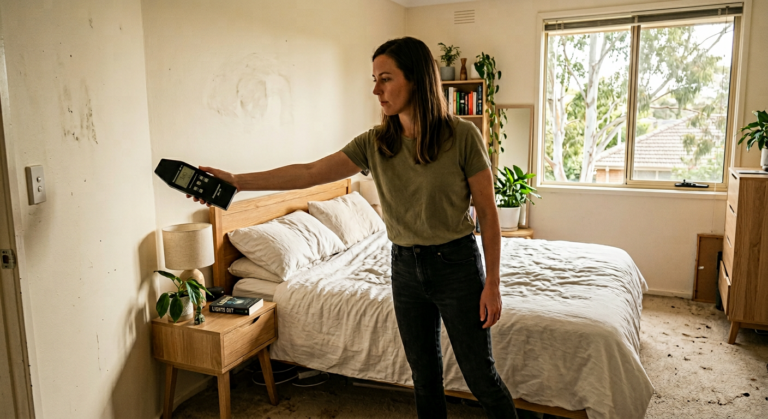
Set your TriField TF2 to RF mode (weighted or standard — use the same setting for all readings). Turn your phone to flight mode and place it in another room. Turn off your WiFi router, any Bluetooth speakers, smart home devices, and anything else that transmits RF in your home. You want to isolate external RF sources only for this baseline.
Take readings at four specific points on your bed: left pillow position (where your head rests), right pillow position, chest height at the centre of the bed, and at the foot of the bed. At each point, hold the meter at mattress surface height and record the peak reading and the average reading over 30 seconds. The TF2 displays both — the needle shows real-time and the display holds the peak. Write these numbers down. These are your “external sources only” baseline readings in µW/m².
Now turn your WiFi router back on and repeat the four-point measurement. The difference between router-off and router-on readings tells you how much of your total RF exposure comes from your own equipment versus external sources. This information is critical for deciding whether turning the router off at night is sufficient on its own, or whether you also need canopy shielding for external sources.
Step 4: Hang the Canopy and Position Correctly
Attach the canopy to your ceiling hardware according to the manufacturer’s instructions. Whether it is a single-point pyramid or four-corner box design, the critical factor is identical: the base of the canopy fabric must reach the mattress surface or below on all four sides. Any gap between the fabric edge and the mattress creates an aperture through which RF enters freely.
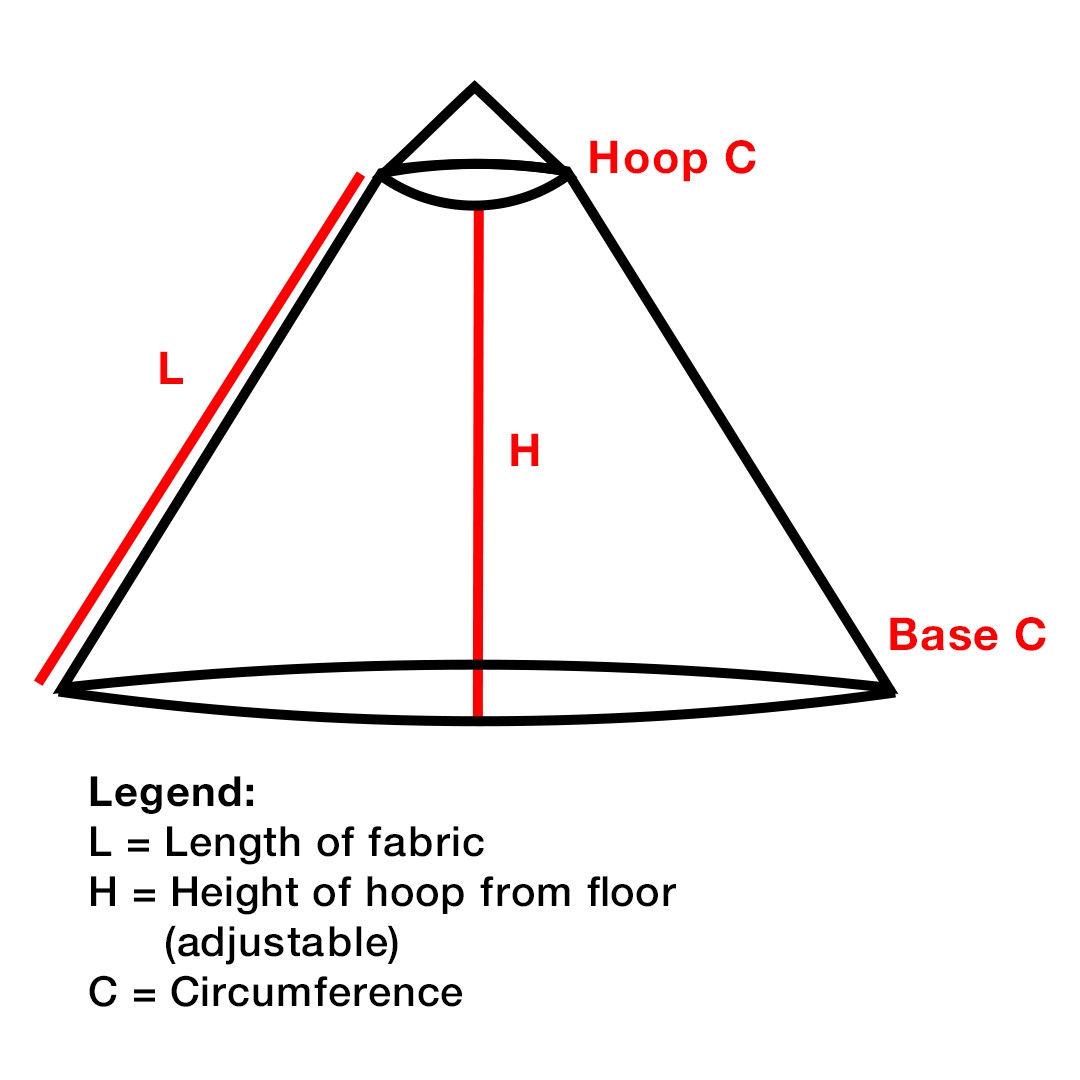
For a pyramid canopy, the fabric naturally wants to angle outward from the central peak. Ensure the base perimeter is wide enough that the fabric touches the mattress surface at all four sides when the canopy is fully draped. If the canopy fabric stops 100mm above the mattress, that 100mm gap will allow a significant percentage of external RF to enter — particularly from sources at oblique angles like a tower on the horizon or a neighbour’s router through the wall at bed height.
Tuck excess fabric under the mattress corners. This creates a more complete enclosure and prevents the fabric from being pulled away from the mattress surface by air currents from ceiling fans or air conditioning. For a box canopy, the fabric should hang vertically from the ceiling frame and pool slightly on the mattress surface. Use fabric clips or small magnets (sewn into hems) to close any seam where two panels meet.
Step 5: Post-Install Verification
Close the canopy completely. Get inside with your TriField TF2. Ensure your phone is in flight mode and inside the canopy with you (you do not want it contributing to the reading). Ensure the router is in the same state as your baseline measurement — if you measured baseline with router off, keep it off for this verification.
Repeat the identical four-point measurement: left pillow, right pillow, chest height, foot of bed. Record peak and average at each point. Compare these to your baseline readings taken at the same four points before the canopy was installed.
Calculate your actual achieved attenuation using this formula: dB attenuation = 10 × log10(outside reading ÷ inside reading). For example, if your baseline reading at the left pillow was 150 µW/m² and your inside-canopy reading at the same point is 0.02 µW/m², the calculation is 10 × log10(150 ÷ 0.02) = 10 × log10(7500) = 10 × 3.875 = 38.75 dB. That is consistent with a Swiss Shield Naturell performing to specification.
If your measured attenuation is significantly lower than the fabric’s rated dB — say you are getting 22dB from a 38dB-rated canopy — you have a gap or seam issue. Systematically check: is the fabric reaching the mattress on all sides? Are there gaps at seam junctions? Is the entry panel fully closed? Walk around the outside of the canopy with the meter while someone inside monitors readings — the reading will spike when you pass the meter near a gap, and this tells you exactly where the leak is.
Measure First
You need a baseline reading before you install.
The TriField TF2 measures RF from 20MHz–6GHz — covering WiFi, 5G sub-6GHz, and NBN tower frequencies. Take readings at head height with and without the canopy to verify attenuation. Without a measurement you are flying blind.
Buy TriField TF2 (SaferEMF) →Check Amazon AU →Common Mistakes That Reduce Canopy Effectiveness
I have visited homes where people spent over $2,000 on a canopy and floor mat setup, only to measure attenuation below 15dB because of avoidable installation and usage errors. The fabric works. The physics works. The failures are almost always human. Here are the five mistakes I see most often, and how to fix each one.
Mistake 1: Gap at Floor or Mattress Level
This is the single most common error and the one with the largest impact on real-world performance. RF does not only arrive from the sides and above — it travels through floors, reflects off walls, and enters from every angle. A 50mm gap between the canopy base and the mattress surface is an open invitation for RF to flood the sleeping area from below and from lateral sources at oblique angles.
The mechanism is straightforward. RF behaves like water filling a container — it finds any opening and flows through it. A gap that looks insignificant to your eye is electrically large at microwave frequencies. At 3.5 GHz (a common 5G frequency in Australia), the wavelength is approximately 86mm. A 50mm gap is over half a wavelength wide, which means it is a highly efficient entry point for RF at that frequency.
To fix this, ensure the canopy fabric extends at least 100mm below the top of the mattress on all four sides. Tuck excess fabric under the mattress or use clips to hold the fabric against the mattress side. If your canopy is a four-corner box design, check the corner seams where two panels meet — these junctions often have small triangular gaps that need to be overlapped and clipped. After tucking and clipping, remeasure inside the canopy with the TF2 to verify the improvement.
Mistake 2: Not Turning Off the WiFi Router at Night
This mistake reveals a fundamental misunderstanding of what the canopy does and does not do. The canopy is a Faraday cage — it blocks RF from outside the enclosure from reaching the inside. It does nothing about RF sources that are already inside your home, inside your bedroom, or inside the canopy itself.
Your WiFi router is typically the single strongest RF source in your home. A standard dual-band router operating on 5 GHz produces 200 to 600 µW/m² at a distance of 2 to 3 metres. If your router is in the bedroom or in an adjacent room separated by a single plasterboard wall (which provides negligible RF attenuation), the RF from your router passes through the canopy opening — the door panel you use to get in and out — or reflects around inside the room and enters through any imperfection in the canopy enclosure.
The solution is free and takes 10 seconds. Plug your router into a mechanical timer ($8 from Bunnings) set to turn off at your bedtime and turn on in the morning. Alternatively, most modern routers allow you to set a WiFi schedule through the admin interface. This eliminates the single largest controllable RF source in your sleeping environment. The canopy then handles the external sources you cannot control.
Mistake 3: Using Grounding Incorrectly
Grounding is the most misunderstood aspect of canopy use. Many buyers believe that connecting the canopy’s grounding lead to the earth pin of a power outlet enhances RF shielding performance. It does not. The canopy provides RF attenuation through the physical properties of the conductive mesh — reflection and absorption of RF waves. This occurs whether the canopy is grounded or not.
What grounding actually does is reduce ELF (extremely low frequency) electric fields inside the canopy. These are the 50Hz electric fields generated by household mains wiring in your walls and ceiling. When you ground the conductive mesh, it creates an equipotential surface that shunts these electric fields to earth. This is a separate and genuine benefit, but it is not RF shielding.
The risk of incorrect grounding is real. If your home’s earthing system has issues — a corroded earth rod, a broken earth conductor, or stray currents on the neutral — grounding the canopy can actually introduce electric field problems rather than solving them. Before grounding, test the earth connection at your power outlet using a socket tester with earth verification ($15 to $25 from Bunnings or Jaycar). If the earth is not clean, do not ground the canopy until an electrician resolves the earthing issue. The canopy’s RF shielding will function identically either way.
Mistake 4: Washing the Fabric Incorrectly
Silver-thread fabrics are not ordinary textiles. The conductive silver fibres that provide RF shielding are woven into or coated onto the base fabric, and they degrade when exposed to harsh chemicals, high temperatures, or mechanical abrasion. Once the silver degrades, the fabric’s shielding effectiveness drops permanently — and unlike a stain, you cannot see this damage with the naked eye.
The specific agents that damage silver-thread fabrics are chlorine bleach, fabric softener, and wash temperatures above 30°C. Chlorine reacts with silver to form silver chloride, which is non-conductive. Fabric softener deposits a waxy coating over the silver fibres that insulates them from each other, breaking the conductive mesh. High temperatures accelerate oxidation.
The correct wash protocol: cold water (30°C maximum), gentle or delicate cycle, no bleach of any kind, no fabric softener, mild detergent only. Air dry — do not use a tumble dryer. Do not iron. If the fabric develops a musty smell from humidity (common in QLD and NT), hang it outdoors in shade with good airflow. Wash the canopy no more than every 3 to 6 months unless visibly soiled. Every wash cycle causes some degree of mechanical wear on the conductive fibres, so minimising wash frequency extends the functional life of the shielding.
Mistake 5: Expecting 100% RF Elimination
No Faraday cage short of a military-grade RF-shielded room achieves 100% RF elimination. A 42dB canopy reduces RF power by 99.994%. That sounds like 100% until you realise that 0.006% of a very large number is still a measurable number. If you start with 5,000 µW/m² outside the canopy — which I have measured in apartments facing CBD cell towers — you will have approximately 0.32 µW/m² inside a 42dB canopy. That is a massive reduction, but it is not zero.
The building biology framework classifies sleeping area RF exposure as follows: below 0.1 µW/m² is “no concern,” 0.1 to 1 µW/m² is “slight concern,” 1 to 1,000 µW/m² is “severe concern,” and above 1,000 µW/m² is “extreme concern.” The goal of the canopy is to move your sleeping environment from “severe” or “extreme” into “no concern” or “slight concern.” It is not to reach zero.
Additionally, any RF source inside the canopy — a phone not in flight mode, a smartwatch, a Bluetooth sleep tracker — operates at full power inside the enclosure. The canopy actually makes this worse, because the conductive mesh reflects the internal RF back inward rather than allowing it to disperse. Always ensure all wireless devices inside the canopy are in flight mode or turned off completely.
EMF Canopy vs Router Off at Night — Do You Need Both?
This is the most common question I receive, and it deserves a straight answer rather than a sales pitch. The honest sequence is: measure, mitigate free sources first, then assess whether paid solutions are warranted. Selling someone a $1,500 canopy when their entire RF exposure comes from their own router 2 metres from their bed is not ethical — it is a $1,500 solution to a problem that has a $0 fix.
What Turning Off the Router Addresses
Your WiFi router is almost certainly the highest RF source in your bedroom if it is within 10 metres. A standard dual-band router (the type supplied by Telstra, Optus, or TPG with NBN plans) produces 300 to 600 µW/m² at 2 metres on the 5 GHz band. At 5 metres through one plasterboard wall, that drops to roughly 30 to 80 µW/m². Even at 5 metres, this exceeds the IBN “slight concern” threshold.
Turning the router off at night eliminates this source entirely. It costs nothing. It requires no hardware, no installation, and no ongoing maintenance. A $8 mechanical timer from Bunnings automates it so you never have to think about it. If your TriField TF2 readings drop below 1 µW/m² at your bed after switching the router off, you may not need a canopy at all.
What a Canopy Addresses
A canopy addresses external RF sources — the ones you cannot switch off. These include 5G and 4G macro towers, small cells mounted on power poles and buildings, neighbours’ WiFi routers (particularly in apartments and terraces), NBN fixed wireless towers, and smart meters on adjacent properties. These sources operate 24 hours a day, and you have no ability to control them.
Even with your router off, if you live 150 metres from a 5G small cell in inner Sydney, inner Melbourne, or inner Brisbane, you may have 50 to 200 µW/m² from that source alone entering your bedroom. In apartment buildings, the combined RF from 10 to 30 neighbouring WiFi routers penetrating through thin walls and floors can produce 20 to 100 µW/m² at your bed. These levels persist regardless of what you do with your own equipment.
The Honest Answer
If you have not turned your router off at night yet, do that first. It is the single highest-impact, lowest-cost RF reduction measure available. Plug the router into a timer, set it to switch off at 10pm and on at 6am, and measure the difference with your TF2. For many suburban Australian homes on quarter-acre blocks with reasonable distance from towers and neighbours, this alone may bring bed-level RF below 1 µW/m².
If your post-router-off readings are still above 1 µW/m², that residual RF is coming from external sources you cannot control. That is the objective case for a canopy. The canopy addresses exactly what the router-off strategy cannot — the RF environment created by infrastructure and other people’s equipment.
The Combined Approach
Canopy plus router off at night is the only combination that addresses both internal and external RF sources simultaneously. The canopy alone, with the router still running, leaves your own 5 GHz signal bouncing around inside and outside the enclosure. The router off alone, without a canopy, leaves external sources untouched. Neither approach is complete on its own if you have both internal and external sources contributing meaningfully to your bed-level exposure.
The practical sequence is: measure with TF2, turn router off at night, remeasure, identify the remaining sources, then make an informed decision about whether a canopy is warranted for your specific exposure level. If your remaining reading is 0.3 µW/m², you are already in the IBN “slight concern” zone and a canopy is optional. If your remaining reading is 50 µW/m², you need a canopy. The meter tells you the truth — follow the data, not the anxiety.
See all EMF shielding products for Australian homes.
Canopies are one piece of the bedroom EMF reduction protocol. Our full shielding guide covers routers, ethernet, smart meter shielding, and grounding — ranked by impact.
Full EMF Shielding Guide →Frequently Asked Questions
Do EMF bed canopies actually work?
Yes, when correctly installed, EMF shielding canopies measurably reduce RF power density inside the enclosure. The mechanism is well-established physics — a conductive mesh acts as a Faraday cage, reflecting and absorbing radiofrequency energy. Swiss Shield fabrics are independently tested to ASTM D4935-18 and IEEE 299 standards, with verified attenuation ratings. A 38dB-rated canopy reduces RF power by a factor of approximately 6,310, meaning 99.984% of incoming RF is blocked. You can verify this yourself with a calibrated RF meter like the TriField TF2 by measuring at bed height before and after canopy installation. The performance is limited by installation quality — gaps, unsealed seams, and internal RF sources all reduce real-world attenuation below the fabric’s rated specification.
What dB rating do I need for a canopy to be effective?
The dB rating you need depends on your starting RF level and your target level. The Building Biology Institute (IBN) recommends below 0.1 µW/m² for sleeping areas as the “no concern” threshold. If your measured bed-level RF is 100 µW/m², you need a reduction to 0.1 µW/m² — that is a factor of 1,000, which equals 30dB. If your measured level is 1,000 µW/m², you need 40dB to reach the same target. For most Australian suburban and urban homes, a canopy rated between 35dB and 42dB covers the range of typical exposures. Below 30dB is generally insufficient for urban environments where multiple RF sources contribute to elevated readings.
Can I use the canopy without grounding it?
Yes. The canopy’s RF shielding function operates entirely through the physical properties of the conductive mesh — reflection and absorption of radiofrequency energy. Grounding does not enhance RF attenuation. What grounding does is reduce 50Hz ELF electric fields inside the canopy by connecting the conductive mesh to earth, creating an equipotential surface that diverts mains-frequency electric fields. This is a separate benefit from RF shielding. If your primary concern is RF from towers, routers, and wireless devices, the canopy works identically whether grounded or not. Ground only if you have verified that your home’s earthing system is clean and properly connected — a faulty earth can introduce problems rather than solving them.
How do I install a canopy in Australian plaster ceilings?
Australian homes built after 1970 predominantly use 10mm or 13mm plasterboard (Gyprock) ceilings fixed to timber or steel joists spaced at 450mm or 600mm centres. Use an electronic stud finder to locate joists, then install an M6 eye bolt with a 40mm thread directly into the joist through a 4mm pilot hole. If the mounting point falls between joists, use a Toggler SnapToggle BA anchor rated for plasterboard — these support well over 10kg in 13mm board, far exceeding canopy weight. For four-corner box canopies, install eye bolts at four points forming a rectangle 300mm wider and longer than your bed dimensions on each side. All hardware is available at Bunnings in the wall anchors and fasteners aisle, typically costing under $30 for a complete set.
Will the canopy block 5G mmWave?
5G millimetre wave (mmWave) operates at frequencies between 24 GHz and 40 GHz in Australia, and at these frequencies, the wavelength is extremely short (7.5mm to 12.5mm). Conductive mesh fabrics like Swiss Shield and Silver Cotton are highly effective at blocking mmWave because the mesh aperture size is much smaller than the wavelength — the fabric is essentially opaque to these frequencies. However, mmWave deployment in Australia as of 2026 is extremely limited and confined to specific indoor venues, stadiums, and dense CBD locations. The far more relevant 5G frequencies in Australia are sub-6GHz bands (3.5 GHz and 700 MHz), which is what the canopy’s rated dB attenuation figures are measured against. For all practical purposes in Australian residential settings, your canopy will block both sub-6GHz 5G and the limited mmWave signals that may exist near your home.
How do I wash and care for EMF shielding fabric?
Wash EMF shielding fabric on a cold cycle (30°C maximum) using a gentle or delicate setting with a mild, pH-neutral detergent. Never use chlorine bleach, fabric softener, or optical brighteners — chlorine reacts with the silver fibres to form non-conductive silver chloride, and fabric softener coats the fibres with an insulating residue. Air dry only — do not tumble dry or iron the fabric. Wash no more frequently than every 3 to 6 months unless the fabric is visibly soiled, as each wash cycle causes incremental mechanical wear on the conductive elements. In humid climates like Queensland or the Northern Territory, air the canopy outdoors in shade periodically to prevent moisture buildup that accelerates oxidation. Following these care instructions, a quality silver-thread canopy maintains effective shielding for 8 to 15 years.
Are Swiss Shield canopies available in Australian sizes (queen/king)?
Yes. Swiss Shield canopies are available through Australian distributors in sizes that fit standard Australian queen (1530mm × 2030mm) and king (1830mm × 2030mm) beds. The canopy dimensions are larger than the bed dimensions to allow fabric to drape past the mattress edges and tuck underneath — a queen canopy is typically 2000mm × 2500mm × 2000mm (W × L × H) and a king canopy is approximately 2300mm × 2500mm × 2000mm. Single and double bed sizes are also available. Some distributors offer custom sizing if you have a non-standard bed or want additional floor clearance for a higher-ceiling room. Shipping within Australia is typically via road freight for the larger canopy packages, with delivery times of 5 to 10 business days depending on your location and stock availability.
What is the difference between Silver Cotton and Swiss Shield Naturell?
Silver Cotton is a pure silver-thread fabric woven into a cotton base, achieving 42dB attenuation — the highest of any commonly available canopy fabric. It prioritises maximum RF reduction above all other factors. Swiss Shield Naturell is a Swiss-engineered fabric that uses a proprietary blend of polyester and metal fibres to achieve 38dB attenuation. The 4dB difference means the Silver Cotton blocks approximately 2.5 times more RF power than the Naturell. However, the Naturell has a smoother drape, more refined visual appearance, and greater durability over repeated handling and washing due to its engineered fibre construction. For most Australian residential environments, the Naturell’s 38dB is sufficient to bring bed-level RF below building biology guidelines — but in extreme exposure scenarios above 2,000 µW/m², the Silver Cotton’s additional 4dB provides a meaningful extra margin.
How long do EMF shielding canopies last before fabric degrades?
With correct care, EMF shielding canopies maintain effective attenuation for 8 to 15 years. Swiss Shield fabrics are engineered for longevity and have been independently tested to retain over 90% of their original shielding effectiveness after 100 wash cycles. The primary degradation factors are chemical exposure (bleach, softener), excessive washing, physical abrasion, and prolonged exposure to direct sunlight — UV degrades certain polymer components in blended fabrics. Silver Cotton canopies may show surface tarnishing of the silver over time, which appears as a slight darkening of the fabric but does not significantly affect RF performance. To verify ongoing performance, measure inside the canopy with a TF2 annually and compare to your original post-install readings. If attenuation has dropped by more than 3dB from your installation baseline, the fabric is beginning to degrade and replacement should be planned.
Is a canopy worth buying if I live far from a 5G tower?
Distance from a 5G tower is only one factor in your total RF exposure. In many Australian homes, the majority of bed-level RF comes from sources other than cell towers: your own WiFi router, neighbours’ routers (especially in apartments and townhouses), smart meters on exterior walls, cordless phone base stations, and NBN fixed wireless equipment. Measure your actual bed-level RF with a TriField TF2 before making a purchase decision — the numbers tell you whether you have an exposure problem regardless of how far the nearest tower is. If your measured RF is consistently below 1 µW/m² at your bed with your router off at night, a canopy provides marginal additional benefit. If your reading is above 10 µW/m² with the router off, external sources are contributing meaningfully, and a canopy addresses those sources. Buy based on measured data, not proximity to a tower on a map.
Get the Australian Home Environment Checklist
30 checks across water, air and EMF. Most of them free. Ranked by impact.
No spam. Unsubscribe any time.