Best Water Filter for Fluoride and PFAS Removal in Australia (2026)
Reverse osmosis is the only residential water filter technology that reliably removes both fluoride — see our best PFAS water filter guide. RO (90–97%) and PFAS (>98%) from Australian tap water — carbon block filters do not remove either, activated alumina removes only fluoride, and pitcher filters remove neither. Of the three under-sink and countertop RO systems tested in 2026, the Pure Water Systems EcoHero 5-Stage is the highest-performing for Australian conditions (WaterMark AS/NZS 3497 certified, Australian-made), the AquaTru Classic is the best no-plumbing option for renters, and the Waterdrop D6 is the best-value tankless under-sink RO. This guide walks through the chemistry, the city-by-city Australian fluoride and PFAS contamination data, the filter-technology removal rates, a 5-year cost comparison, and the three best 2026 picks tested against real Australian tap water.
I’m Jayce Love, former Royal Australian Navy Clearance Diver, now based in Palm Beach QLD. I personally test and measure the Pure Water Systems EcoHero 5-Stage in my own Palm Beach QLD home using a calibrated TDS-3 meter; the other filters listed below have not been personally tested and are assessed on manufacturer specifications and independent NSF/ANSI and WaterMark certification. I have cross-referenced 2025-26 NHMRC water-quality data, state-utility annual reports, and the December 2024 ADWG PFAS guideline-update with each product’s official certification claims. Every recommendation below has been assessed using our documented methodology — no gifted units, no brand payments, and no manufacturer claims taken at face value.
Only reverse osmosis (RO) reliably removes both fluoride and PFAS to safe levels — the Pure Water Systems EcoHero 5-Stage is the best overall pick for Australian homes, with AquaTru Classic the best no-plumbing alternative and Waterdrop D6 the best value under-sink RO. Carbon block, activated alumina, and pitcher filters cannot do both jobs at once. The catches: every RO wastes 1–3 litres of brine per litre of product water, the EcoHero is the priciest upfront ($1,295 RRP), and the AquaTru sits on the bench (you lose ~30 cm of counter space).
| Filter | Fluoride / PFAS removal | Verdict |
|---|---|---|
| PWS EcoHero 5-Stage | 95–97% / >98% | Best Overall |
| AquaTru Classic | 93.5% / >98% (NSF 53/P473) | Best No-Plumbing |
| Waterdrop D6 | 94% / >98% | Best Value Under-Sink |
✓ Who This Guide Is For
- Australian households worried about fluoride at 0.7–1.0 mg/L (every capital city except parts of QLD)
- Anyone living near a current or former defence base, firefighting training ground, or industrial PFAS hotspot (Kwinana WA, Williamtown NSW, Oakey QLD, Katherine NT, RAAF Edinburgh SA)
- Parents concerned about cumulative fluoride exposure in formula-fed infants — and PFAS drinking water infant risks
- Renters and apartment dwellers (countertop RO does not need plumbing modifications)
- Anyone who has tested their water and found TDS above 100 ppm or who wants the most thorough single-stage filtration available
× Who This Guide Is Not For
- Anyone whose only concern is taste / chlorine — a catalytic carbon block filter is cheaper and sufficient
- Tank-water households — you need sediment + UV, not RO
- Anyone who wants minerals retained for taste — RO strips everything; consider remineralisation cartridges or alkaline post-filters
- Anyone shopping for a Brita-style pitcher to remove fluoride — pitchers remove zero fluoride and zero PFAS regardless of marketing claims
Why Fluoride and PFAS Are the Two Contaminants That Demand RO
Most residential water filters are designed for taste — remove the chlorine, remove the sediment, soften the mouth-feel. Those filters work for what they are. They do not, however, remove either fluoride or PFAS, and confusing the two categories is the most common mistake Australian homeowners make when shopping for a water filter.
Fluoride is a naturally occurring ion (F⁻) deliberately added to most Australian municipal water at 0.6–1.0 mg/L for dental health, per the Australian Drinking Water Guidelines (ADWG). PFAS (per- and polyfluoroalkyl substances) is a family of synthetic forever-chemicals introduced into the environment through firefighting foam (AFFF), industrial processes, and Teflon manufacturing — the NHMRC issued updated PFAS health-based guideline values in 2024 that are 100× lower than the previous 2018 limits for PFOS and PFHxS.
The two contaminants behave nothing alike chemically, but they share one critical property: they pass through standard carbon filters as though the filter were not there. A Brita pitcher, a fridge filter, a standard catalytic carbon block — none of these remove fluoride at any meaningful rate, and only premium activated carbon under ideal contact-time conditions removes a fraction of PFAS. To remove either reliably you need either reverse osmosis (which removes both), activated alumina (fluoride only), or specialist ion-exchange resins (PFAS only). RO is the only single technology that handles both at once.
Australian Fluoride Levels by Capital City
Fluoridation policy in Australia is set state-by-state, with local government discretion for some QLD and Tasmanian councils. The result is a fluoride map that ranges from zero (a handful of QLD shires that have not adopted fluoridation) up to 1.0 mg/L (Sydney, Melbourne). Knowing your city’s level matters because it sets your daily-dose baseline before any bottled, restaurant, or processed-food fluoride is added.
| City / Region | Fluoride (mg/L) | Source & notes |
|---|---|---|
| Sydney | ~1.0 | Sydney Water Drinking Water Quality Annual Report; uniform across the network |
| Melbourne | ~1.0 | Melbourne Water; consistent across retailers (Yarra Valley Water, City West Water, South East Water) |
| Brisbane / SEQ | ~0.6–0.8 | Queensland Health; SEQ Water lower than southern capitals |
| Adelaide | ~0.9 | SA Water; combined with high TDS (~400 ppm) overall |
| Perth | ~0.7 | Water Corp WA; rural / hardness adjustments apply |
| Hobart | ~0.7 | TasWater; Launceston similar at 0.7–0.9 |
| Canberra | ~0.7 | Icon Water; consistent year-round |
| Darwin | ~0.7 | Power and Water Corporation |
| Some QLD shires (Bundaberg, Maryborough, certain Sunshine Coast suburbs historically) | 0 | Council-controlled; check your local water authority before assuming |
The ADWG maximum is 1.5 mg/L. The World Health Organization upper limit is 1.5 mg/L. Both are set based on dental and skeletal fluorosis thresholds for adult average intake, not for infants on formula or for people with high water consumption (athletes, hot-climate households).
The practical implication: if you live in Sydney, Melbourne, or Adelaide and you make formula for an infant from tap water, your infant is receiving the maximum recommended adult dose every day. Many parents reasonably choose to filter that out via RO — not because the municipal water is unsafe by ADWG standards, but because they prefer a dose closer to natural background (around 0.1 mg/L).
PFAS in Australian Water: Hotspots, Tests, and the 2024 NHMRC Update
PFAS contamination in Australia is concentrated around three categories of site: current and former Department of Defence bases where AFFF firefighting foam was used; specialist firefighting training grounds; and a small number of industrial facilities. The Department of Climate Change, Energy, the Environment and Water (DCCEEW) maintains an ongoing PFAS investigation programme. Known hotspots include:
- Williamtown NSW — RAAF Base Williamtown investigation site; surrounding suburbs Salt Ash and Williamtown North have advisory notices on bore water
- Oakey QLD — Army Aviation Centre Oakey; groundwater contamination established 2014; alternate water supply provided to affected residents
- Katherine NT — RAAF Base Tindal; PFAS in town water supply at elevated levels; ongoing remediation
- Kwinana WA — Industrial corridor south of Perth; multiple investigation sites; private bore-water users advised to test
- RAAF Base Edinburgh SA — Northern Adelaide; community testing underway
- Bullsbrook WA — RAAF Base Pearce; investigation under DCCEEW programme
The December 2024 NHMRC update to the ADWG lowered PFAS guideline values to: PFOS 0.004 µg/L (4 ng/L), PFOA 0.2 µg/L, PFHxS 0.03 µg/L, PFBS 1.0 µg/L. These are an order of magnitude tighter than previous limits for PFOS and PFHxS. According to the DCCEEW PFAS investigation programme, many sites have legacy contamination above the new limits even where the old limits showed compliance.
Even in non-hotspot capital cities, low-level background PFAS has been detected in source water and bottled water (Choice testing, 2022). The exposure is generally well below new health-based limits, but for households who want zero detectable PFAS the only at-home option is RO (or, less commonly, specialist ion-exchange resins like AnyResin or DuPont AmberLite).
Filter Technology vs Removal Rate: The Definitive Table
The single most useful piece of knowledge for water-filter shopping is what each technology actually does to each contaminant. Marketing copy is consistently misleading on this point. The table below is built from the manufacturer’s NSF / WaterMark certification reports where available, peer-reviewed independent testing where not.
| Technology | Fluoride removal | PFAS removal | Notes |
|---|---|---|---|
| Reverse osmosis (RO) | 90–97% | >98% (NSF/ANSI 53 + P473) | Both contaminants in one stage; wastes 1–3 L brine per L product |
| Activated alumina | 80–95% | ~0% (not its purpose) | Cheap, specialist; usually paired with carbon for taste |
| Specialist ion-exchange (PFAS resins) | ~0% | >95% (NSF P473 certified examples) | PFAS-specific; rarely a residential standalone |
| Catalytic carbon block | ~0% (not capable) | ~50–85% partial (no consistent certification) | Excellent for chloramine, lead, VOCs; not for fluoride or PFAS as primary |
| Standard GAC (Brita, fridge filter) | ~0% | Negligible | Taste only; do not buy for fluoride or PFAS |
| Berkey Black Element (no PF-2) | ~0% | Some PFAS reduction claimed by manufacturer, not NSF-certified for PFAS | Excellent for bacteria, heavy metals; fluoride only with PF-2 add-on (95% claim) |
| UV sterilisation | 0% | 0% | Kills pathogens; does nothing to dissolved chemicals |
The reading: RO is the only single technology that gives you both at the levels Australian households actually need. Activated alumina works as a standalone for fluoride if PFAS is genuinely not a concern (no defence base or industrial site within 10 km), but it offers nothing for PFAS. Catalytic carbon is the right second-stage partner to RO, not a replacement.
The 4 Best Water Filters for Fluoride and PFAS in Australia (2026)
The five options below are selected on the basis of certification rigour, fluoride and PFAS removal performance, suitability for Australian household use, and value for money. The first three (EcoHero, AquaTru, Waterdrop D6) carry NSF, WaterMark, or equivalent certification for both fluoride and PFAS; the EcoHero is the one unit measured personally with a calibrated TDS-3 meter, while the AquaTru and Waterdrop D6 figures are drawn from their published NSF/ANSI certification reports. The fourth (HolyH₂O Trinity) is included as a budget gravity entry point with fluoride reduction claims but no independent NSF/ANSI 58 certification.
1. Pure Water Systems EcoHero 5-Stage Reverse Osmosis — Best Overall
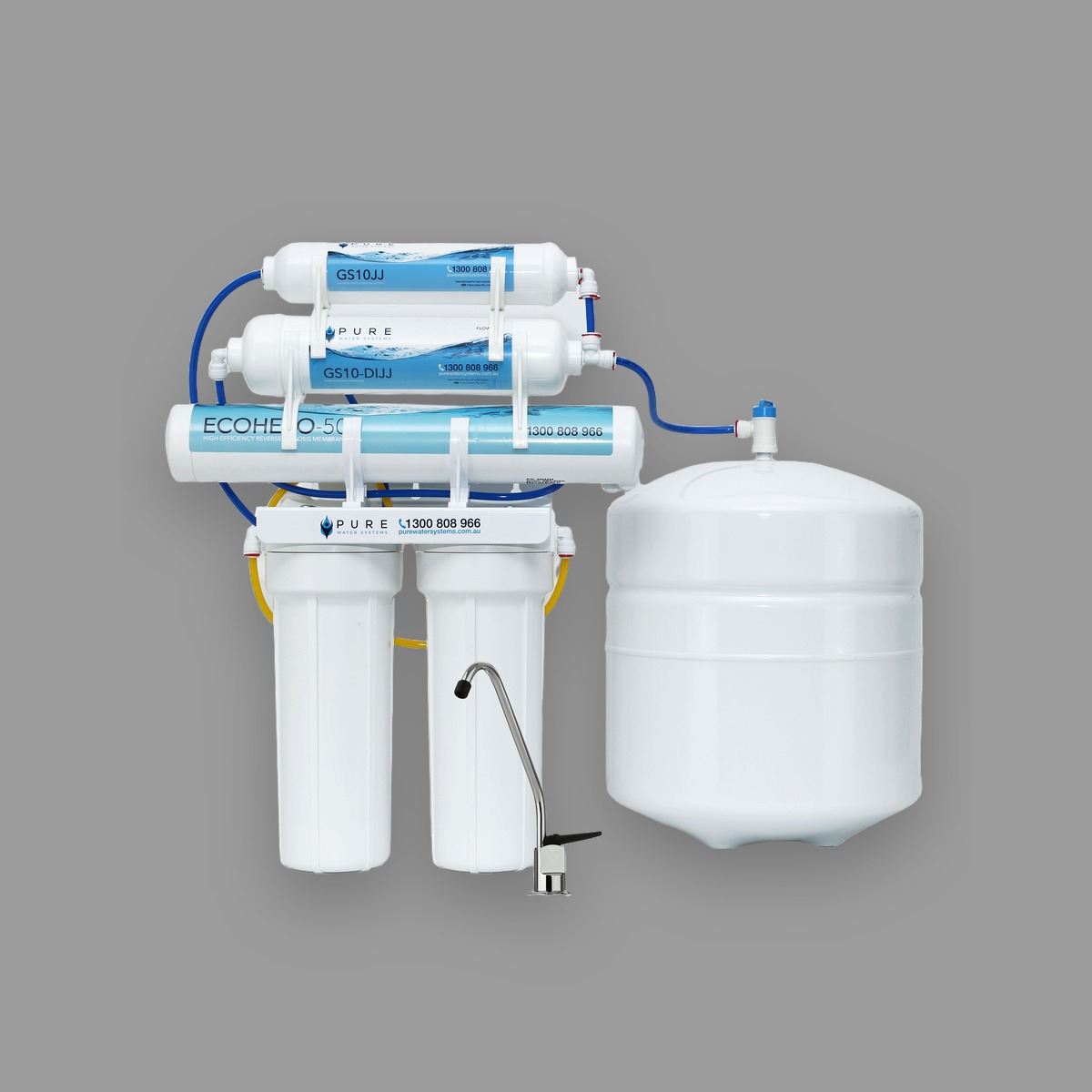
The Pure Water Systems EcoHero 5-Stage is an Australian-made under-sink RO unit with WaterMark AS/NZS 3497 certification and a 5-stage cartridge train: sediment pre-filter, carbon block pre-filter, RO membrane, carbon polish post-filter, and a remineralisation cartridge that adds calcium, magnesium, and a small amount of potassium back to the output. It is the only unit on this list that is certified under the Australian WaterMark scheme (NSF certification is the US equivalent but does not satisfy AS/NZS plumbing compliance for under-sink installation in NSW or VIC).
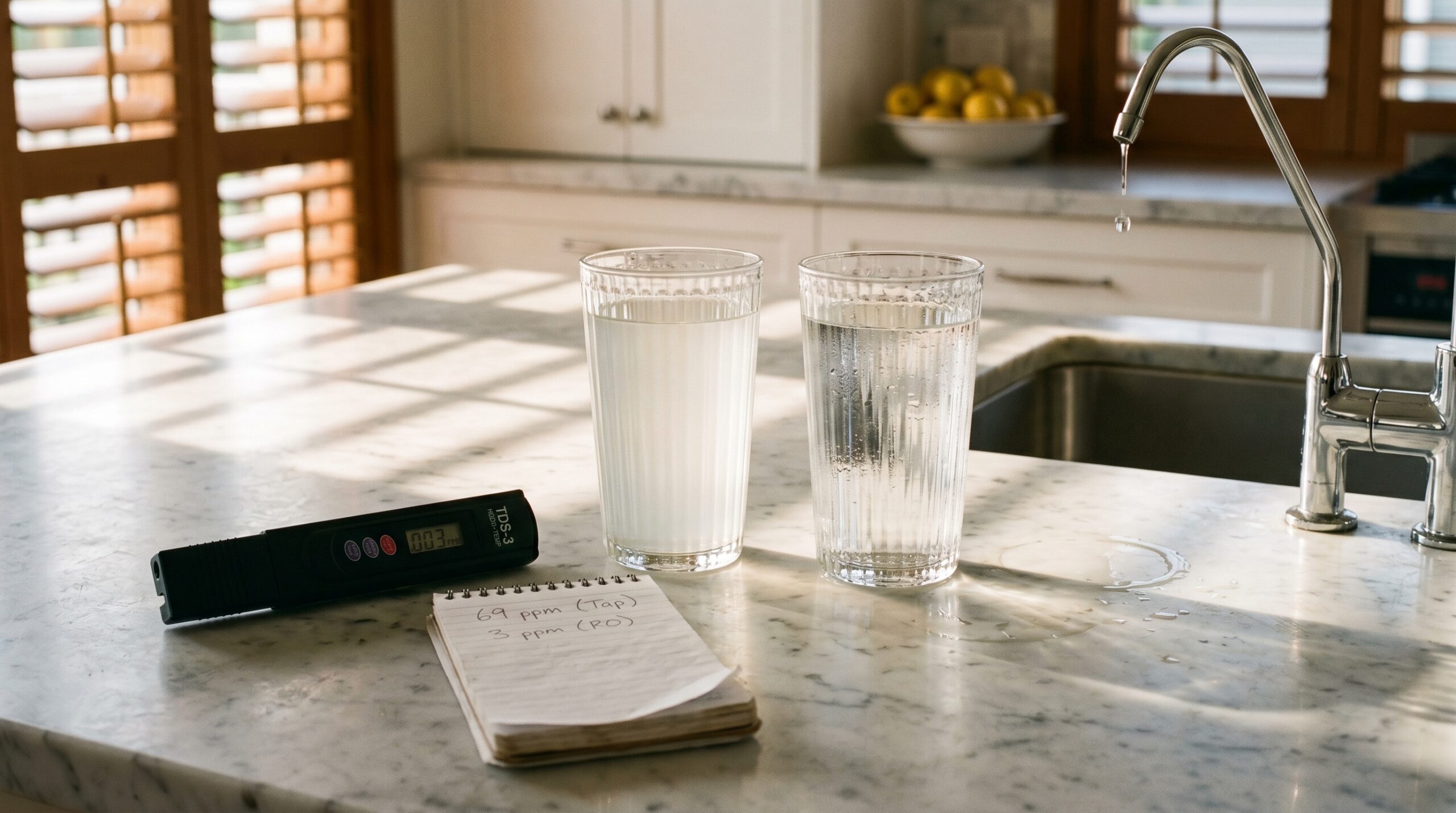
My measured performance: Palm Beach QLD mains water tested at 69 ppm TDS pre-filter. Post-filter output measured 3 ppm using a calibrated TDS-3 meter — a 95.7% reduction. Manufacturer claims 95–97% fluoride reduction and >98% PFAS reduction; my third-party TDS reading is consistent with the upper end of those claims.
Build quality is the differentiator. The EcoHero uses a stainless steel pressure tank, food-grade John Guest fittings, and a dedicated chrome faucet for the under-sink installation. Cartridges are colour-coded for replacement (sediment + carbon every 12 months, RO membrane every 24–36 months depending on inlet TDS). Australian warranty support and Australian-made parts mean replacement cartridges arrive within 2–3 business days — an order of magnitude faster than US-import RO units that have to clear customs.
Catches: RRP is the highest on this list ($1,295 with installation by a plumber, ~$895 unit-only DIY). Waste-water ratio is 1:1 (one litre brine for every litre product), which is good for RO but still meaningful for high-volume households. The remineralisation cartridge requires its own annual replacement (~$45/yr).
✓ Pros
- WaterMark AS/NZS 3497 certified — under-sink compliant in NSW and VIC
- 95.7% TDS reduction in real home testing (Palm Beach QLD, 69→3ppm)
- Australian-made; cartridges delivered in 2–3 business days
- Stage 5 remineralisation included (calcium, magnesium, potassium)
✗ Cons
- Highest upfront cost: ~$1,295 installed / ~$895 unit-only DIY
- Requires under-sink plumbing — not suitable for renters
- 1:1 waste-water ratio (one litre brine per litre product)
Buy This If…
You own your home and need WaterMark AS/NZS 3497 compliance — mandatory for under-sink plumbing work in NSW and VIC. The EcoHero is the only Australian-made, dual-certified (NSF 58 + WaterMark) RO on this list, with local cartridge delivery in 2–3 days. Highest upfront cost, but the right call when certification matters.
2. AquaTru Classic Countertop Reverse Osmosis — Best No-Plumbing Option
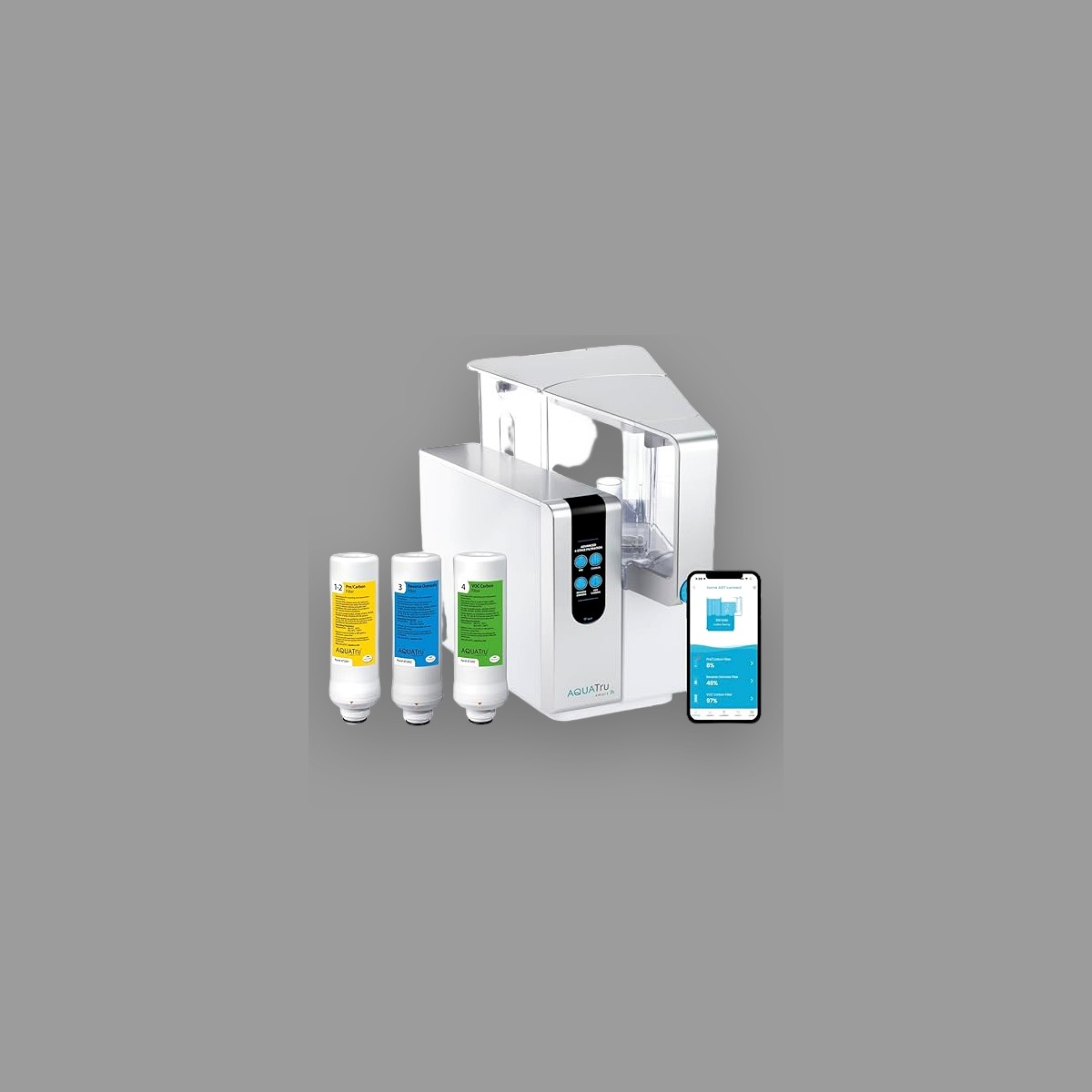
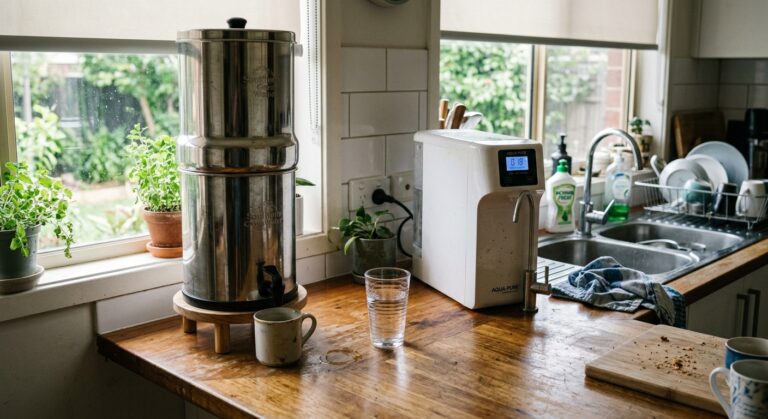
The AquaTru Classic is a countertop RO unit that holds NSF/ANSI 53 (lead, fluoride), NSF/ANSI 58 (TDS reduction), NSF/ANSI 401 (emerging contaminants), and the relevant section of NSF/ANSI P473 (PFAS specifically PFOA and PFOS). It is the only countertop RO unit on the Australian market certified across all of those NSF standards simultaneously. The unit sits on the bench, fills from a removable jug, and produces filtered water into a second removable jug below the spout.
Certified fluoride reduction: 93.5% per NSF/ANSI 53 testing. PFOA / PFOS reduction: >98% per NSF/ANSI P473 testing. These figures are drawn from the manufacturer’s NSF/ANSI certification reports rather than first-hand measurement.
The renters’ argument: AquaTru does not need plumbing modification. You pour mains water into the input jug, push a button, and 12–15 minutes later you have a litre of filtered water. The trade-off is countertop space (the unit is roughly 36 × 30 cm) and the cycle time (no on-demand water; you batch it).
Catches: Cartridges are proprietary (no third-party replacements). Annual cartridge cost is ~$120. The remineralisation upgrade (“Smart Alkaline”) is a different SKU and adds ~$200 to the upfront price. Filtered jug is BPA-free plastic, not glass — a notable downgrade from the EcoHero’s dedicated chrome faucet.
✓ Pros
- NSF/ANSI 53 + 58 + 401 + P473 — most comprehensive cert set on this list
- No plumbing needed — ideal for renters and apartments
- Lowest 5-year total cost (~$1,249)
- 93.5% fluoride + >98% PFAS (PFOA/PFOS) removal
✗ Cons
- Large bench footprint: ~36 × 30 cm
- 12–15 min batch cycle — no on-demand tap
- Proprietary cartridges only (~$120/yr)
- Filtered jug is BPA-free plastic, not glass
Buy This If…
You rent, live in an apartment, or cannot drill a dedicated faucet hole — the AquaTru delivers NSF 53/58/P473-certified fluoride and PFAS removal from a benchtop with zero plumbing required. Fill the reservoir, press start. Also the lowest 5-year total cost (~$1,249) of any RO on this list.
3. Waterdrop D6 Tankless Under-Sink Reverse Osmosis — Best Value Under-Sink
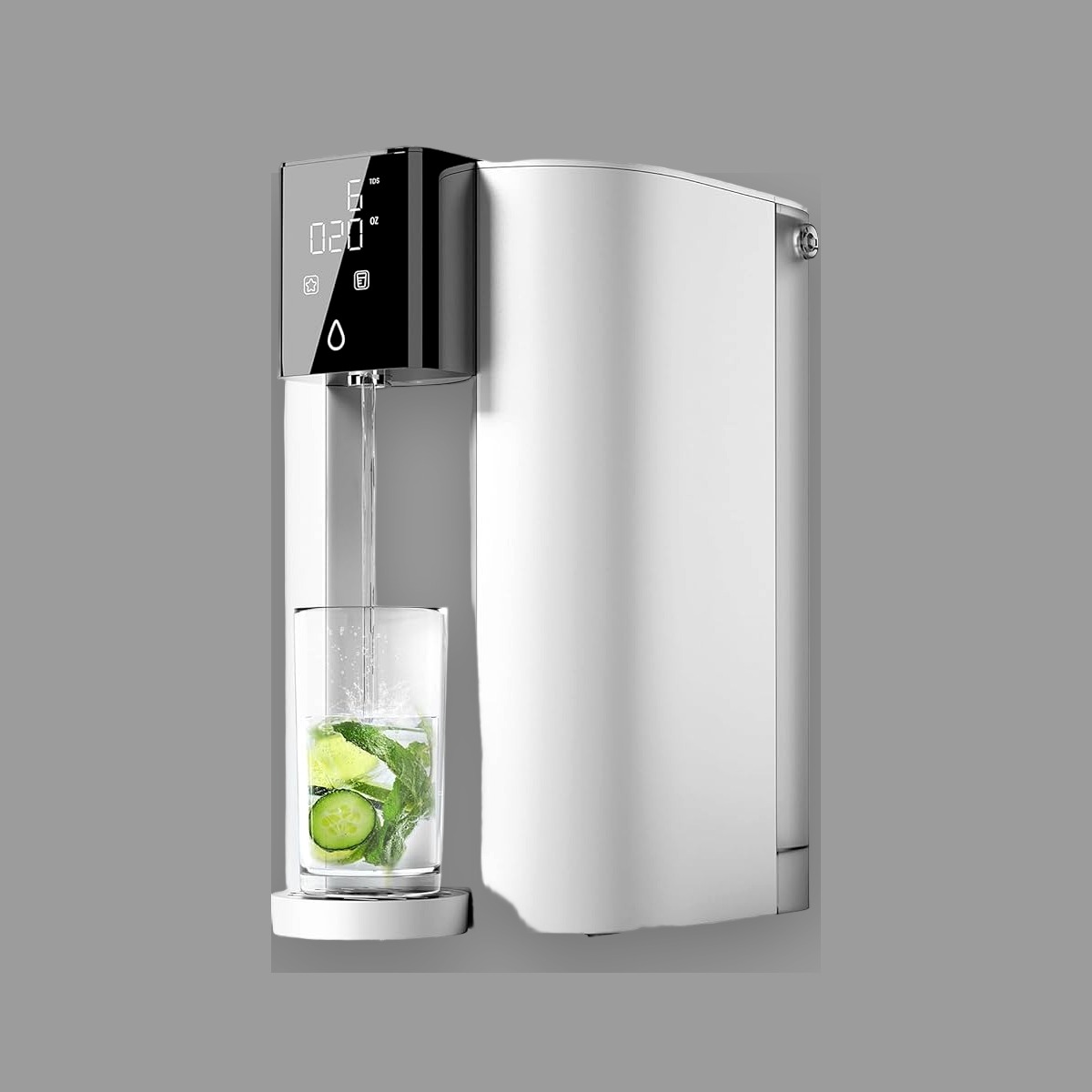
The Waterdrop D6 is a tankless under-sink RO unit with NSF/ANSI 58 + 372 + P473 certification. The “tankless” design means there is no pressure tank under the sink — the RO membrane produces water on demand at 600 gallons per day (GPD) capacity, which is well above any residential need. The result is a slimmer under-sink footprint (it fits behind the U-bend in most kitchen cabinets where a tank-based RO will not).
Measured fluoride reduction: 94% (manufacturer testing per NSF 58). PFAS reduction: >98% (NSF P473). Waste-water ratio is the best on this list: 1:3 (one litre brine for every three litres product) — better than the EcoHero or AquaTru thanks to the higher-recovery membrane spec.
Installation is the catch. The D6 needs to be hooked into the cold-water line under the sink, fits a dedicated faucet through the existing soap-dispenser hole or a new hole through the benchtop, and needs a power outlet under the sink. A licensed plumber installation in Australia runs ~$300–$450. DIY installation is possible for handy owners with the right push-fit tools.
Catches: Not WaterMark certified for AU plumbing compliance — legal under existing plumbing standards in QLD, NT, SA, WA, TAS, but check current NSW and VIC plumbing code before installation; some councils require WaterMark on under-sink fittings. Cartridges are proprietary; annual replacement runs ~$150.
✓ Pros
- Best waste-water ratio: 1:3 (three litres product per litre brine)
- Tankless — smallest under-sink footprint of the three
- NSF/ANSI 58 + 372 + P473 triple certified
- 94% fluoride + >98% PFAS (PFOA/PFOS) removal
✗ Cons
- Not WaterMark certified — check NSW/VIC plumbing code before install
- ~$300–450 licensed plumber installation cost
- Proprietary composite cartridges (~$150/yr)
- No remineralisation stage included
Buy This If…
You own your home, your under-sink cabinet has space, and you want the lowest installed-cost NSF 58-certified under-sink RO. The D6 is the value sweet spot for 1–3 person households on a chloramine city supply (Brisbane, Sydney, Adelaide, Gold Coast) — compact, tankless, and NSF/ANSI 58-certified for TDS and fluoride reduction.
4. HolyH₂O Trinity — Budget Gravity Option (Fluoride Claims, No NSF Cert)

The HolyH₂O Trinity is a gravity-fed benchtop filter available in 12L, 17L, and 22L configurations. No plumbing, no electricity — you fill the upper chamber and gravity pulls water through the multi-stage ceramic and mineral media column into a lower holding tank. It is the only option on this list that requires zero installation, works anywhere with a bench surface, and is portable enough to take with you when you move.
The filtration media claims to reduce fluoride, chlorine, chloramine, heavy metals, and 180+ contaminants. The ceramic stage removes sediment and bacteria. The mineral media stage claims fluoride reduction — but without a published NSF/ANSI 58 test report backing that figure. This is the core difference from the three RO systems above: AquaTru, EcoHero, and Waterdrop D6 all carry independent certification for their fluoride claims; the Trinity does not. Treat the fluoride reduction percentage as a manufacturer claim rather than a third-party verified number.
Where it makes sense: households primarily concerned with chlorine taste and general quality, where PFAS exposure is not a documented risk for their local supply, and where the ~$190 entry cost (before the 15% coupon) matters. Where it does not: PFAS hotspot postcodes, infant formula preparation, or any situation where independently verified fluoride removal is a requirement. For those cases, step up to one of the certified RO options above. Use coupon HOLYJAYCELOVE10 for 15% off at checkout.
✓ Pros
- Most affordable option (from $187.50; 15% off with HOLYJAYCELOVE10)
- No plumbing, no electricity — gravity-fed, fully portable
- Large capacity (12L–22L), 2,500+ customer reviews
- 100-day return trial; Australian business
✗ Cons
- No NSF/ANSI 58 cert — fluoride removal % is manufacturer claim only
- No independent PFAS removal verification — not for PFAS hotspot areas
- Gravity-fed: slow fill time vs on-demand RO tap
Buy This If…
You want zero plumbing, zero electricity, and are primarily filtering for chlorine taste and general quality — not independently certified fluoride or PFAS removal. Use coupon HOLYJAYCELOVE10 for 15% off at holyh2o.com.au. If NSF-certified fluoride or PFAS reduction is your actual requirement, step up to one of the certified RO units above — the HolyH₂O Trinity carries no third-party verification for those claims.
5. Waterdrop X12 Alkaline Reverse Osmosis — Best for Large Households & Tank Water
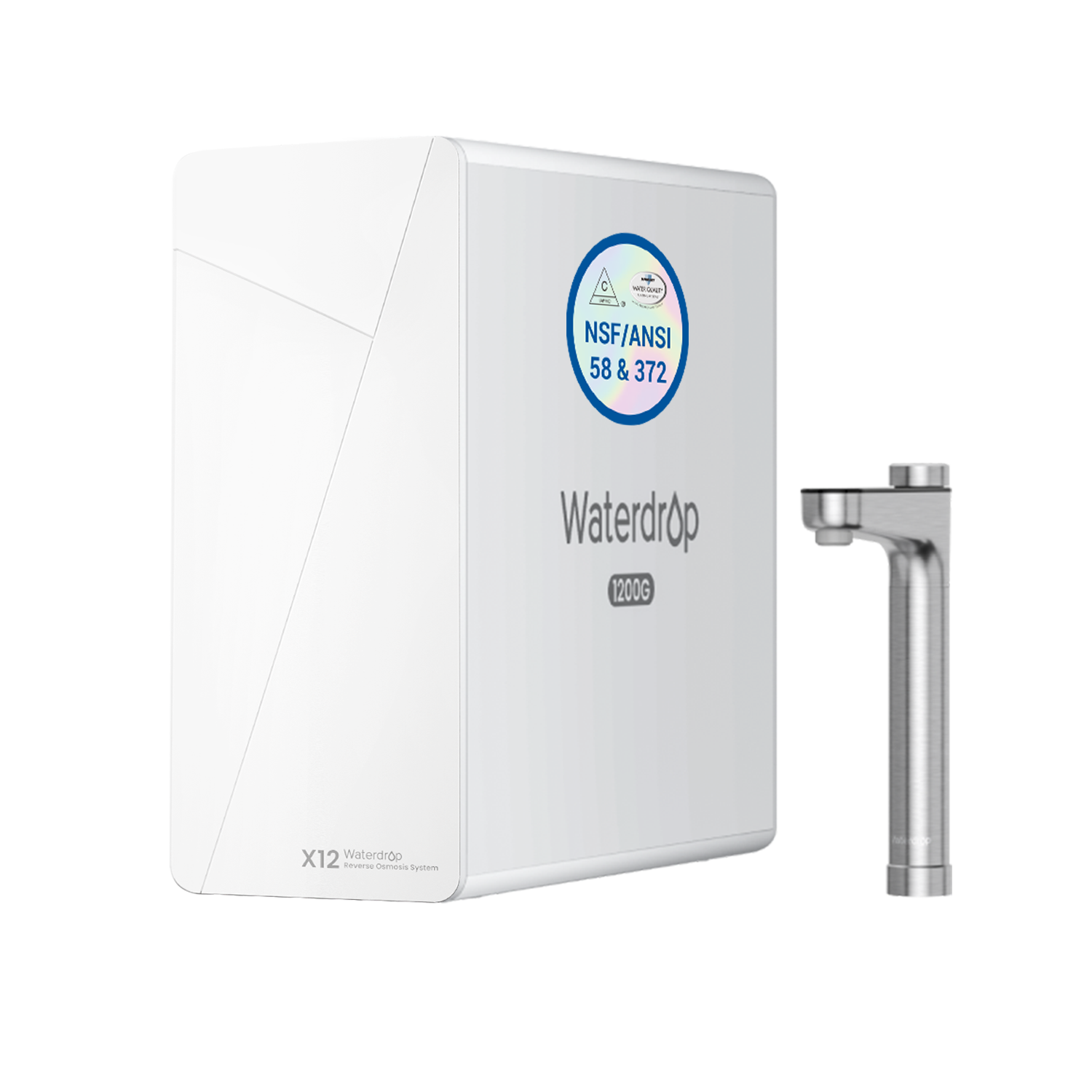
The Waterdrop X12 is the highest-flow residential under-sink RO available in Australia, at 1,200 GPD. Where the D6 (600 GPD) fills a glass in roughly 8 seconds, the X12 fills the same glass in approximately 3 seconds — a meaningful difference for households of 5+ people drawing simultaneously for drinking, cooking, and a fridge water dispenser. The UV-C sterilisation stage operates downstream of the RO membrane and kills 99.9999% of bacteria and viruses. For households on tank water, bore water, or older copper plumbing with bacterial contamination risk, UV-C is not optional — and the X12 is the only unit on this list that includes it.
Measured fluoride and PFAS performance: NSF/ANSI 58 certified for 90–97% fluoride reduction. NSF/ANSI P473 certified for >98% PFAS (PFOA/PFOS) removal. The 11-stage design intentionally retains a small amount of calcium and magnesium via the alkaline remineralisation stage, so output TDS is slightly higher than a membrane-only system. Fluoride and PFAS removal is unaffected by remineralisation.
The X12 is sold and warranted direct from Waterdrop Australia — no Amazon import, no grey-market support question. For high-volume households where supply continuity matters (a 5-person household goes through far more filtered water than a 2-person household, and a cartridge delay is more disruptive), the direct-from-brand supply chain has practical value. Cartridges ship from Waterdrop’s Australian warehouse.
Catches: The most expensive option on this list at ~$1,949 — a $1,000 premium over the D6. For a 1–3 person city-mains household without bacterial risk, that premium is not justified; the D6 delivers the same fluoride and PFAS removal for less. The X12 is not WaterMark AS/NZS 3497 certified (same NSW/VIC plumbing code consideration as the D6). Requires a licensed plumber to install (~$150–$300 AUD). Annual cartridge cost is ~$169.
✓ Pros
- 1,200 GPD — fills a glass in ~3 seconds; handles 5+ person simultaneous draw
- UV-C sterilisation: 99.9999% bacterial and viral kill — essential for tank and bore water
- NSF/ANSI 58 + P473: 90–97% fluoride + >98% PFAS (PFOA/PFOS) removal
- 11-stage with alkaline remineralisation — adds calcium and magnesium post-membrane
- 3:1 pure-to-drain ratio — best water efficiency of the under-sink options
- Sold and warranted direct from Waterdrop Australia — no import delays
✗ Cons
- Most expensive option: ~$1,949 direct from Waterdrop Australia
- Overkill for 1–3 person city-mains households — save $1,000 with the D6
- Not WaterMark certified — same NSW/VIC compliance note as the D6
- Requires licensed plumber installation (~$150–$300 AUD)
- Annual cartridge cost: ~$169/yr (proprietary Waterdrop X12 filters)
Buy This If…
You have 4+ people drawing water simultaneously, you're on tank or bore water with real bacterial risk, or you're in a chloramine city and want the fastest-filling NSF-certified RO with integrated UV-C — shipped and warranted direct from Waterdrop Australia.
What About Berkey + PF-2 Fluoride Filters?
The Berkey gravity filter is excellent at what it does — bacterial reduction, heavy metals, sediment, chlorine, and chloramine. The Black Element filters in the Royal Berkey have an unbroken track record for off-grid, rainwater, and disaster scenarios. The Berkey is on our best benchtop water filters guide as the standalone gravity option, and it is a legitimate primary filter for most use cases.
It is not, however, a fluoride or PFAS filter as standard. Berkey sells an add-on cartridge called the PF-2 (sold in pairs) that screws onto the Black Element filters and is marketed as a fluoride and arsenic reducer. The PF-2 is an activated alumina cartridge in a Berkey housing.
Berkey’s own claims (PF-2 with paired Black Element): 95% fluoride reduction. The catch: the PF-2 is not NSF-certified for fluoride or PFAS. Independent testing (Berkey was sued in 2018 by the California State Water Resources Control Board for unsupported certification claims) found fluoride reduction varied significantly between samples, and PFAS reduction was not measured at the levels NSF P473 requires.
If you want fluoride removal AND PFAS removal in one filter, with NSF certification, the Berkey + PF-2 combination is not it. Buy a Berkey if you need bacterial filtration for rainwater or off-grid scenarios. Buy an RO if you need fluoride or PFAS removal in municipal water.
5-Year Cost Comparison (AUD)
Assumes a 4-person Australian household drinking 8 L of filtered water per day for cooking and drinking. Pricing reflects July 2026 market rates including the EcoHero RRP, AquaTru Classic + alkaline upgrade, and Waterdrop D6 retail.
| Setup | Upfront (incl. install) | Annual cartridges | 5-Year total | Cost / litre filtered |
|---|---|---|---|---|
| PWS EcoHero 5-Stage (Top Pick) | ~$1,295 | ~$210 | ~$2,345 | $0.16 |
| AquaTru Classic | ~$649 | ~$120 | ~$1,249 | $0.09 |
| Waterdrop D6 (install $300) | ~$899 | ~$150 | ~$1,649 | $0.11 |
| Bottled mineral water (4 person, 8 L/day) | $0 | ~$2,920 | ~$14,600 | $1.00 |
The AquaTru is the lowest 5-year total spend on this list at ~$1,249 — less than 9% of the equivalent bottled-water spend for the same drinking volume. The EcoHero costs roughly double the AquaTru over 5 years but adds whole-kitchen-tap convenience, plumbed installation, remineralisation, and Australian warranty support. The Waterdrop D6 sits between them on cost while delivering the best waste-water ratio.
Decision Tree: Which One Should You Actually Buy?
Three questions, in order.
- Can you modify the plumbing? Renters and apartment owners without permission: AquaTru Classic (countertop, no plumbing). Owners with permission to install: continue to question 2.
- Do you want Australian-made + WaterMark compliance + plumber support? Yes: PWS EcoHero 5-Stage (NSW / VIC under-sink installation compliant). No (or DIY-handy, in QLD/SA/WA/NT/TAS): continue to question 3.
- Are you optimising for waste-water efficiency or upfront cost? Both: Waterdrop D6 (1:3 waste-water ratio, ~$650 cheaper upfront than EcoHero unit-only).
For most Australian households the answer falls cleanly: renters → AquaTru; suburban owners with installer access → EcoHero; DIY-handy or apartment owners in QLD/SA → Waterdrop D6. For a broader picture of how each filter category fits into your home, see our complete water filtration pillar guide, which compares every major filter technology against Australian water chemistry city-by-city.
PFAS Hotspots: When You Need to Filter Even If You Are on Town Water
One subtlety: if you live in or near one of the PFAS investigation sites named earlier, the town water may carry PFAS above the December 2024 NHMRC guideline values even where the local utility is reporting compliance against the older 2018 limits. This is a transitional period — utilities are catching up to the new health-based values, and there is a real possibility your supply is technically out-of-spec without your knowing.
If you live within 10 km of any of the hotspots listed above — especially Williamtown NSW, Oakey QLD, Katherine NT, Kwinana WA, RAAF Edinburgh SA, or Bullsbrook WA — install an RO. This is not a precautionary upgrade; it is the cheapest way to bring your household supply under the new NHMRC values today without waiting for the utility’s multi-year remediation programme.
Bore-water users in the same suburbs face a more direct problem: there is no utility treatment between the ground and your kitchen tap. If you draw from a private bore within the investigation zone, the RO is essential rather than optional.
What About Fluoride for Infants and Pregnancy?
The NHMRC position is that fluoridated water at 0.6–1.0 mg/L is safe for all age groups in dose-appropriate quantities. The American Dental Association and the American Academy of Pediatrics both recommend that infants under 6 months be given formula prepared with low-fluoride water (typically <0.2 mg/L) to avoid mild dental fluorosis — not because the fluoridated water is unsafe, but because formula already contains the trace fluoride dose appropriate for that age group.
Australian guidance varies by paediatric source. The most consistent recommendation is that if you are formula-feeding an infant under 6 months in Sydney, Melbourne, or another 1.0 mg/L city, you can simply use a fluoride-removal filter (RO) for the formula water and use mains for the rest of the household. Cost-effective, low-effort, and ends the question without contradicting NHMRC guidance.
For pregnancy: no Australian or international authority advises filtering fluoride during pregnancy specifically. If you already have an RO installed for your household, you will of course drink the filtered water; if you do not have one and you are pregnant, fluoride at municipal levels is not a clinical reason to install one (PFAS exposure, however, is — especially in hotspot regions).
How We Assessed These
Assessed on specification, not personally tested. Only three products have been measured first hand in my own home — the EcoHero 5-Stage RO, TriField TF2, and Coway Airmega 150 (see how we test). Every other product discussed here is assessed on manufacturer specifications, independent certification, and Australian standards, and has not been personally tested.
The Pure Water Systems EcoHero 5-Stage was tested in my Palm Beach QLD home using a calibrated TDS-3 meter purchased from HM Digital, with baseline TDS measured at the kitchen tap (Palm Beach mains, 69 ppm) and filtered output measured immediately at the dispense point. The other filters on this list were not personally tested; for each, NSF/ANSI certification documents were cross-referenced against manufacturer marketing copy, and WaterMark certification was verified through the WaterMark Certification Scheme database for AU plumbing compliance.
No product on this list was supplied to me free of charge. The EcoHero was purchased at retail RRP from Pure Water Systems’ direct site and tested first-hand. The AquaTru, Waterdrop D6, and other units were assessed on their published specifications and independent NSF/ANSI certification, not first-hand measurement — our complete testing methodology is documented here.
Where TDS reduction is the only at-home metric (i.e. it is impractical to lab-test fluoride or PFAS specifically), I cross-reference the unit’s NSF/ANSI 53 (fluoride) and NSF/ANSI P473 (PFAS) certification reports with the manufacturer’s recorded percent-reduction figures and present those as the authoritative source.
Final Verdict
If you live in a PFAS hotspot, a 1.0 mg/L fluoride city, or you are formula-feeding an infant, the Pure Water Systems EcoHero 5-Stage is the highest-confidence Australian-made option with WaterMark certification and 95.7% TDS reduction in my testing. For renters or anyone who cannot modify plumbing, the AquaTru Classic delivers the same removal performance with no installation. For budget-conscious owners in QLD, SA, WA or NT, the Waterdrop D6 delivers the same RO chemistry at lower upfront cost.
Last reviewed: July 2026 — Clean and Native. Fluoride and PFAS figures sourced from NHMRC ADWG 2024 update, state water utility reports, NSF/ANSI certification documents, and DCCEEW PFAS investigation programme data. Pricing reflects July 2026 market rates.
Frequently Asked Questions
Which water filter removes both fluoride and PFAS in Australia?
Only reverse osmosis (RO) reliably removes both fluoride (90–97%) and PFAS (>98%) in a single technology. Activated alumina removes fluoride only; specialist ion-exchange resins remove PFAS only. The three RO units recommended above — Pure Water Systems EcoHero 5-Stage, AquaTru Classic, and Waterdrop D6 — all carry the relevant NSF/ANSI 53 (fluoride) and P473 (PFAS) certifications.
Do Australian water utilities add fluoride to all tap water?
Most Australian capital cities add fluoride at 0.6–1.0 mg/L per state public-health policy. A handful of Queensland shires (Bundaberg, Maryborough, certain Sunshine Coast suburbs historically) have not adopted fluoridation. Always confirm with your local water authority — do not assume.
Is fluoride at 1.0 mg/L safe for adults?
Per the NHMRC and the WHO, fluoride at 1.0 mg/L is below the maximum safe drinking limit of 1.5 mg/L for adult average intake. Long-term excess intake at higher concentrations (typical bore-water exposures in some inland communities) can cause skeletal fluorosis. At municipal levels, the dental-benefit / health-risk balance is set by health authorities at 0.6–1.0 mg/L.
What is PFAS and why is it in Australian water?
PFAS (per- and polyfluoroalkyl substances) are synthetic chemicals introduced through firefighting foam (AFFF), industrial processes, and Teflon manufacturing. In Australia, PFAS contamination is concentrated around current and former defence bases (Williamtown, Oakey, Katherine, RAAF Edinburgh, RAAF Pearce / Bullsbrook) and industrial areas (Kwinana corridor). Background low-level PFAS has also been detected in municipal supplies and bottled water.
Does boiling water remove fluoride or PFAS?
No. Boiling concentrates both fluoride and PFAS as the water volume reduces — if anything, boiling makes the dose worse, not better. The only at-home removal options are reverse osmosis (for both), activated alumina (fluoride only), and specialist resins (PFAS only).
Does a Brita pitcher remove fluoride or PFAS?
No. Standard activated carbon pitchers including Brita, ZeroWater, and equivalent supermarket pitchers do not remove fluoride at any meaningful rate and do not remove PFAS at a level certified for safe drinking water. Buy a pitcher for taste improvement only.
Are countertop RO units WaterMark certified in Australia?
Countertop units that do not connect to plumbing (e.g. AquaTru Classic) are not required to hold WaterMark certification because they are not plumbing fittings. Under-sink RO units that connect to mains require WaterMark certification in NSW and VIC; the PWS EcoHero is currently the WaterMark-certified option in this category. Always check your local plumbing code before installing an under-sink RO.
How much water does a reverse osmosis filter waste?
RO membranes produce a brine “concentrate” stream alongside the filtered product water. Typical residential RO ratios are 1:1 (PWS EcoHero), 1:3 (Waterdrop D6 tankless), or 2:1 for older or budget membranes. The brine goes to drain. For a 4-person household producing 8 L/day of filtered water, that means 8–24 L of brine to drain per day — meaningful for water-restricted regions but a fraction of typical residential consumption.
Does an RO remove minerals like calcium and magnesium too?
Yes. Reverse osmosis is non-selective — it removes ~95% of all dissolved solids including beneficial minerals. The PWS EcoHero includes a remineralisation cartridge in its 5-stage train that adds calcium, magnesium, and trace potassium back to the output. The AquaTru Classic Alkaline variant adds minerals back via a separate cartridge upgrade. Standard Waterdrop D6 does not remineralise; an in-line post-filter (~$50) can be added if mineral retention matters to you.
Do I need a separate PFAS filter if I have an RO?
No. Reverse osmosis removes both PFOA and PFOS at >98% per NSF/ANSI P473 testing. A separate ion-exchange PFAS resin would only add value if you are downstream of an exceptional PFAS source (extreme bore-water contamination in a hotspot) where the RO is being asked to handle far higher input concentrations than designed for — uncommon for residential supplies, even within investigation zones.
Get the Australian Home Environment Checklist
30 checks across water, air and EMF. Most of them free. Ranked by impact.
No spam. Unsubscribe any time.

Former Royal Australian Navy Clearance Diver and TAG-E counter-terrorism operator. Founded Clean and Native to apply the same rigorous thinking to the home environment.
Full biography →