How to Reduce EMF Exposure at Home (Australia 2026): Practical Steps That Actually Work
Drafted with AI assistance and checked against published specifications and certifications. First-hand measurements appear only where stated. How we make content
To reduce EMF exposure at home in Australia, measure your actual field levels with a calibrated meter, remove or distance the dominant sources (typically Wi-Fi router, smart meter, bedroom wiring), then shield only the residual external fields you cannot eliminate. This sequence prevents the most common mistake — shielding before removing internal sources, which reflects fields back and increases exposure. Most Australian homes see 60–80% reduction from distance and source removal alone, before spending a dollar on shielding. The catches: measurement requires a $200–400 upfront meter investment, and wireless convenience must be traded for wired Ethernet in high-use areas.
| Strategy | Typical Reduction | Verdict |
|---|---|---|
| Measure + Distance + Remove | 60–80% fields lowered | Recommended first |
| Shielding only (no measurement) | 0–30% or negative effect | Avoid as primary step |
| Generic EMF stickers/pendants | No measurable change | Skip entirely |
To reduce EMF exposure at home in Australia, follow three steps in order: measure your actual field levels with a calibrated meter, remove or distance the dominant sources (usually your Wi-Fi router, smart meter, and bedroom wiring), then shield only the residual external fields you cannot eliminate. This sequence matters. Shielding before removing internal sources can reflect fields back at you and increase exposure — the most common and expensive mistake in EMF reduction.
The three products we own are measured first-hand by Jayce Love, former Royal Australian Navy Clearance Diver; every other product is assessed on published manufacturer specifications and independent certification using our documented methodology — no gifted units, no brand payments.
I am Jayce Love, former Royal Australian Navy Clearance Diver, now based in Palm Beach QLD. In the Navy I learned that you deal with the hazard closest to you first, then work outward. That principle applies directly to EMF. Below is the systematic, evidence-based protocol I use in my own home and recommend to every Australian who asks.
Why EMF Reduction Matters More Than the Debate Suggests
You have probably seen two camps online: one says EMF is harmless, the other says it causes every disease known to medicine. Neither is useful to you. Here is what you can actually verify.
ARPANSA — Australia’s radiation safety authority — sets exposure limits based on thermal effects only. For radiofrequency (RF) fields at 2.4 GHz (Wi-Fi frequency), the limit is 1,000 μW/cm². That is the level at which tissue heating begins in laboratory conditions. It is not a precautionary limit. It does not account for chronic low-level exposure during sleep.
The Building Biology Standard SBM-2015, developed by the Institut für Baubiologie + Nachhaltigkeit (IBN) in Germany and widely used by Australian building biologists, takes a different approach. It defines sleeping area guidelines based on the precautionary principle:
| Field Type | Building Biology “No Concern” | ARPANSA Limit | Difference |
|---|---|---|---|
| RF/Microwave | < 0.1 mW/m² (≈ 0.00001 μW/cm²) | 1,000 μW/cm² | ~100 million× |
| AC Magnetic | < 0.2 μT (microtesla) | 200 μT | 1,000× |
| AC Electric | < 5 V/m | 5,000 V/m | 1,000× |
You do not need to pick a side in the scientific debate. You can simply measure your home, compare readings to the building biology guidelines, and decide what changes are worth the effort and cost. That is the approach that works. If you want to wait for ARPANSA to lower its limits, you might be waiting decades — their last major revision was in 2002 (updated 2021 with no material change to residential exposure limits).
The practical question is not “is EMF dangerous?” It is: “What are my actual readings, and can I reduce them cheaply?” For most Australian homes, the answer to the second part is yes — often for under $50.
Step 1: Measure First — The Non-Negotiable Starting Point
This is where most people go wrong. They buy shielding paint, a bed canopy, or an “EMF harmoniser” sticker before they know what their actual exposure is. That is like buying a water filter before testing your water. You might solve a problem that does not exist while ignoring the one that does.
What You Are Measuring
There are three types of EMF field in a home, and each requires different detection and different solutions:
| Field Type | Source Examples | Behaviour | Solution Category |
|---|---|---|---|
| AC Magnetic | Powerlines, meter boxes, fridge motors, wiring errors | Penetrates most materials; drops rapidly with distance | Distance or eliminate source |
| AC Electric | House wiring in walls, bedside lamps, extension cords | Present even when devices are OFF (if circuit is live) | Demand switch, earthing, unplugging |
| RF/Microwave | Wi-Fi router, smart meter, mobile phone, Bluetooth, 5G tower | Pulsed bursts; can reflect off surfaces | Remove source, distance, then shield residual |
Recommended Meters for Australian Homes
You need a meter that covers all three field types, or a combination that does. Here are the two I recommend:
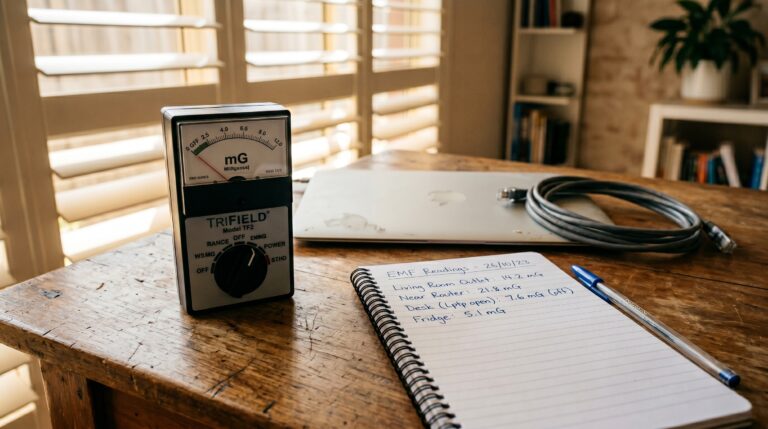
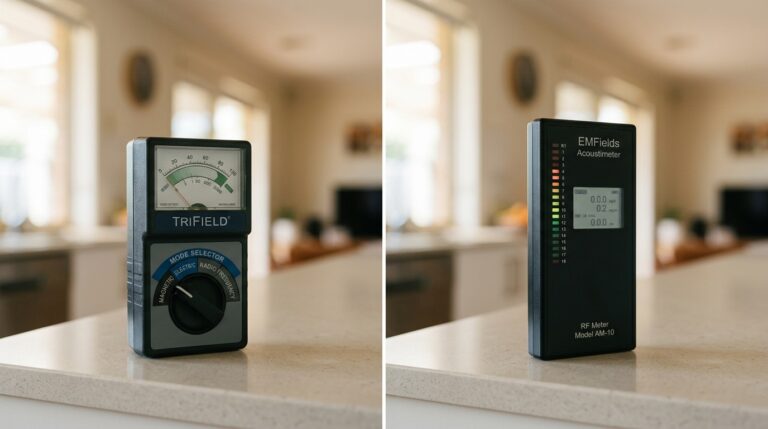
TriField TF2 — An all-in-one meter covering AC magnetic, AC electric, and RF. It is the meter I use for initial room-by-room scans at the Palm Beach house. The RF sensitivity tops out at around 19.999 mW/m², which is adequate for identifying dominant sources. It is not lab-grade, but it is accurate enough to make every decision in this article. Currently available for around $250-$280 AUD.
Check TriField TF2 Price on Amazon Australia →
Safe and Sound Pro II — A dedicated RF meter with much higher sensitivity (0.0065-2.500 mW/m²). If your primary concern is smart meters, 5G towers, or neighbour Wi-Fi, this is the upgrade. Around $550-$600 AUD.
Check Safe and Sound Pro II Price on Amazon Australia →
How to Take Readings
Follow this protocol. It takes about 30 minutes for a typical three-bedroom house:
- Start in the bedroom where you sleep. This is where you spend 7-9 hours stationary, so it is the highest-impact room to optimise.
- Measure at pillow height — approximately where your head rests. Take readings in AC magnetic, AC electric, and RF modes.
- Record with all normal devices running — Wi-Fi on, smart devices active. This is your baseline.
- Move through the house room by room. Note hot spots: areas where readings spike. Common offenders are meter boxes on the other side of a bedroom wall, powerboards behind desks, and baby monitors.
- Check the smart meter. Stand 1 metre from it with the RF meter. Australian smart meters operate at 900 MHz and transmit in short bursts. Peak readings can be 100 to 1,000 times higher than the time-averaged reading. The TriField TF2’s “Peak” mode captures this.
For a detailed walkthrough with screenshots and target numbers, see our full measurement guide.
EMF measurement guide for Australian homes
The Two Tools That Change Your EMF Readings Overnight
Step 1: measure with a TriField TF2 to know your actual exposure. Step 2: plug your router into a $15 timer. These two actions cost under $300 combined and deliver measurable results in one evening.
Step 2: The $0-$50 Bedroom Protocol — Highest Impact, Lowest Cost
Here is where the real gains happen. In practice, around 80% of the exposure reduction in a typical bedroom comes from changes that cost between zero and fifty dollars. No special products. No contractors.
Action 1: Phone on Airplane Mode (Cost: $0)
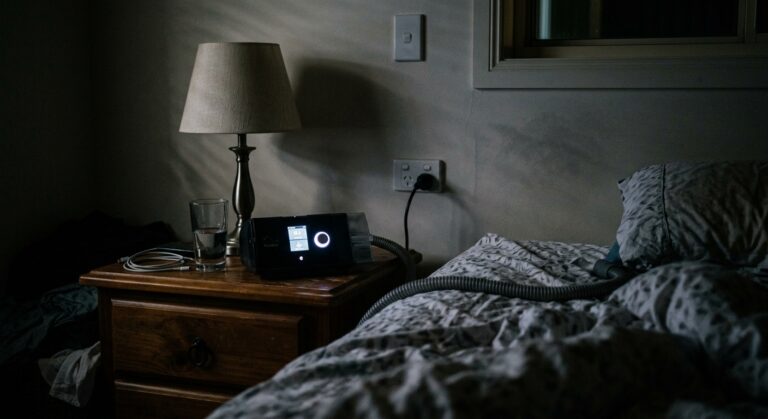
Your mobile phone, sitting on your bedside table in normal mode, is one of the strongest RF sources in your bedroom. It pings the nearest cell tower regularly, communicates with Wi-Fi, and runs Bluetooth for peripherals. A smartphone in normal mode at bedside distance produces RF peaks well above the building biology “no concern” threshold of 0.1 mW/m².
Airplane mode eliminates all three radios (cellular, Wi-Fi, Bluetooth) instantly. Your alarm still works. If you use your phone as an alarm, this one action is the single most impactful thing you can do tonight. Free. Immediate. Measurable.
Action 2: Wi-Fi Router Timer (Cost: ~$15)
A mechanical or digital timer — the same type you would use for Christmas lights — plugged between the wall socket and your router, set to turn off at 10 PM and on at 6 AM. Your router broadcasts RF continuously, 24 hours a day, including while you sleep. If the router is in or near a bedroom, this is a significant source.
A Wi-Fi router broadcasts RF continuously, day and night. Switching it off overnight with a timer removes that source during the 8 hours you are most stationary, leaving only weaker external RF in the bedroom.
Action 3: Move Your Bedside Table Setup (Cost: $0)
Extension cords and powerboards under or behind your bedside table create AC electric fields that reach your pillow. A live extension cord at close range can produce an AC electric field well above the building biology guideline of 5 V/m.
Move the powerboard at least 1.5 metres from where your head rests. If you charge your phone, charge it across the room (on airplane mode). If you use a bedside lamp, switch to a battery-powered reading light, or at minimum, unplug the lamp before sleep — not just switch it off. AC electric fields are present whenever the circuit is live, regardless of whether the device is drawing current.
Action 4: Check What Is on the Other Side of Your Bedroom Wall (Cost: $0)
In many Australian homes, the meter box is mounted on an exterior wall that backs directly onto a bedroom. The switchboard and smart meter together can produce elevated AC magnetic fields (0.3-2.0 μT at 1 metre through the wall) and RF bursts from the smart meter.
If your bed headboard shares a wall with the meter box, move the bed to a different wall. This alone can reduce AC magnetic exposure by 70-90%. It is the most commonly overlooked fix in Australian homes because people do not think to check what is behind the plasterboard.
Other common surprises on the other side of bedroom walls: fridges (running compressor = elevated magnetic field), the Wi-Fi router, or a neighbour’s smart meter in townhouses and apartments.
Bedroom Protocol Summary
| Action | Cost | Field Reduced | Typical Reduction |
|---|---|---|---|
| Phone airplane mode | $0 | RF | 90-99% of phone RF eliminated |
| Router timer | $12-18 | RF | 100x-1,000x reduction at night |
| Move powerboard from bedside | $0 | AC Electric | 80-95% reduction at pillow |
| Move bed from meter box wall | $0 | AC Magnetic + RF | 70-90% reduction |
Do these four things, re-measure, and compare. For most Australian bedrooms, you will be at or near building biology guidelines without spending more than $20. Only move to Step 3 if your readings remain elevated.
Step 3: The $100-$200 Upgrades — Demand Switches, Wired Connections, and Smart Meter Shields
If your bedroom still shows elevated AC electric fields after removing obvious sources, the culprit is the wiring inside your walls. Australian homes use 240V at 50 Hz. The live wire in every circuit radiates an AC electric field through plasterboard, timber framing, and even brick veneer. This field exists 24 hours a day, whether any device on the circuit is drawing power or not.
Demand Switch Installation (Cost: $100-$200 installed)
A demand switch (also called a cut-off switch or disconnect relay) is a device installed in your switchboard by a licensed electrician. It monitors the bedroom circuit. When no device on that circuit is drawing current (because you have turned everything off and unplugged), the demand switch disconnects the circuit from mains voltage entirely, eliminating the AC electric field from the wiring.
When you flip a light switch the next morning, the demand switch detects the load request and reconnects the circuit in milliseconds. It is invisible in daily use.
Specifications to request: Ask your electrician for a demand switch rated for Australian 240V 50Hz single-phase circuits, with a sensing current threshold below 50mA. Brands available in Australia include Gigahertz Solutions and BioSwitch. The device itself costs $80-$120; installation typically adds $50-$100 in labour.
Expected result: AC electric fields in the bedroom drop from 20-100 V/m to below 1-3 V/m. This is well within the building biology “no concern” range of under 5 V/m.
Switch to Wired Ethernet (Cost: $30-$150)
Every Wi-Fi device in your home is an RF transmitter. Your laptop, tablet, smart TV, smart speaker, robot vacuum — each one broadcasts and receives RF continuously. The single most effective RF reduction strategy beyond the router timer is to replace wireless connections with ethernet cables wherever possible.
Practical approach:
- A 10-metre Cat6 ethernet cable from Bunnings or Officeworks costs $15-$25.
- USB-C to ethernet adapters for laptops cost $15-$30.
- After connecting via ethernet, disable the Wi-Fi radio on that device. On Windows: Settings > Network > Wi-Fi > Off. On Mac: click the Wi-Fi icon > Turn Wi-Fi Off.
- For rooms far from the router, a powerline ethernet adapter (TP-Link or Netgear, ~$60-$100 for a pair) sends data through existing house wiring. Note: some powerline adapters create dirty electricity on the mains circuit. If you are measuring AC electric fields, test before and after installation.
Smart Meter RF Shielding (Cost: $40-$80)
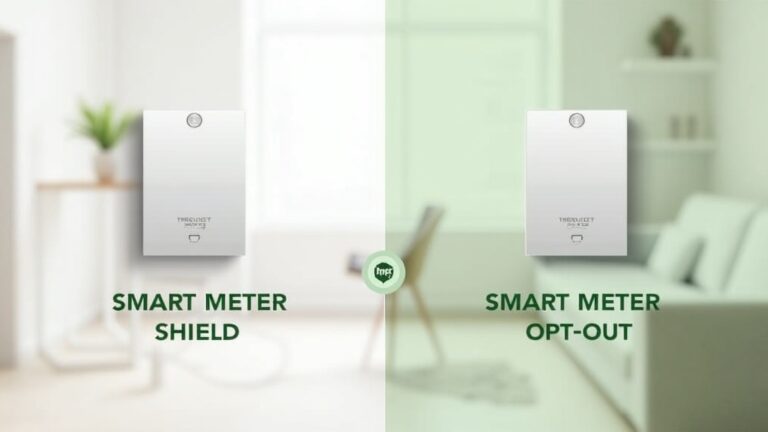
Australian smart meters (used by Ausgrid, Energex, Essential Energy, Jemena, CitiPower/Powercor, and others) operate on the 900 MHz band. They transmit usage data in bursts — typically every 15-30 seconds, with peak RF readings significantly higher than the time-averaged figure. At 1 metre from the meter, peak RF of 5-50 mW/m² is common.
If your smart meter is on the exterior wall of a bedroom or living area, and you cannot move the bed, a sheet of aluminium mesh or foil attached to the interior side of that wall will attenuate the RF signal. A single layer of aluminium foil provides approximately 20 dB of shielding at 900 MHz — that is a 100x reduction in signal strength.
Method: Attach heavy-duty aluminium foil (available from Coles or Woolworths for under $10) to the interior wall surface behind a picture frame, furniture, or under wallpaper. Cover an area at least 1 metre wider than the smart meter in each direction. Tape seams with aluminium tape ($8-$12 from Bunnings). Measure RF before and after to confirm attenuation.
This is crude but effective. If you want a professional finish, Y-Shield HSF54 shielding paint or Swiss Shield Naturell fabric are options, but they cost 10-50 times more for marginal additional attenuation. Start with foil. If it works, you are done.
Step 4: Whole-House EMF Reduction Strategies
Once you have optimised the bedroom, extend the same principles through the rest of the house. You will not achieve building biology sleeping-area levels in a living room — nor do you need to. You are awake, moving, and spending less consecutive time in any one spot. The goal here is to reduce peak exposures and eliminate unnecessary sources.
Wi-Fi Router Optimisation
- Reduce transmit power: Most routers allow you to reduce Wi-Fi transmit power in the admin settings. Dropping from 100% to 50% halves the RF output with minimal impact on coverage in a typical Australian house under 200 m².
- Disable unused bands: If you do not need 5 GHz or 6 GHz (Wi-Fi 6E), disable them. Each active band is a separate transmitter.
- Relocate the router: Place it in a central, non-bedroom location — a hallway cupboard or study. Every metre of distance reduces RF exposure. RF power drops with the inverse square law: double the distance = one quarter the power.
Smart Home Device Audit
Walk through your home and list every device with a wireless radio. Common offenders in Australian homes:
| Device | Frequency | Always-On? | Alternative |
|---|---|---|---|
| Smart speaker (Alexa, Google Home) | 2.4/5 GHz Wi-Fi + Bluetooth | Yes | Unplug when not in use; remove from bedrooms |
| Baby monitor (wireless) | 2.4 GHz or DECT 1.8 GHz | Yes | Wired camera + ethernet; audio-only with distance |
| Wireless security cameras | 2.4/5 GHz | Yes | PoE (Power over Ethernet) wired cameras |
| Smart TV | 2.4/5 GHz Wi-Fi + Bluetooth | Standby RF active | Ethernet cable; disable Wi-Fi + Bluetooth in settings |
| Bluetooth speaker | 2.4 GHz Bluetooth | When paired | 3.5mm aux cable or USB connection |
| Wireless printer | 2.4 GHz | Yes | USB cable; disable Wi-Fi in printer settings |
Every device you switch from wireless to wired — or unplug entirely — removes an RF source from your environment. The cumulative effect is substantial. A typical “smart home” with 15-20 wireless devices can produce ambient RF levels 5-10 times higher than a home with the same devices connected via ethernet.
Laptop and Desktop EMF
If you work from home — and post-2020, millions of Australians do — your laptop is a sustained exposure source. It emits all three field types: RF (Wi-Fi + Bluetooth), AC magnetic (power supply and processor), and AC electric (from the charger and wiring).
Key actions:
- Use ethernet and disable Wi-Fi and Bluetooth when connected.
- Use the laptop on a desk, not directly on your lap. AC magnetic fields from the power supply at 0 cm can reach 2-5 μT. At 30 cm (desk height), readings drop to 0.1-0.3 μT.
- If you must use a laptop on your lap, a DefenderPad laptop EMF shield provides a physical barrier with measured attenuation for both RF and ELF magnetic fields.
- Use an external keyboard and mouse (wired, not Bluetooth) to increase distance from the laptop’s primary EMF sources.
Step 5: External Sources You Cannot Control — and What to Do About Them
Some EMF sources are not yours. Mobile phone towers, neighbour Wi-Fi networks, overhead powerlines, and electrical substations produce fields that enter your home regardless of your internal setup. Here is how to address each one.
Mobile Phone Towers (4G/5G)
Australia’s 5G rollout uses two frequency bands: sub-6 GHz (primarily 3.5 GHz, used by Telstra, Optus, and TPG) and mmWave (26 GHz, currently limited to stadiums and dense urban areas). Sub-6 GHz 5G has similar penetration characteristics to 4G — it passes through walls, glass, and timber with moderate attenuation.
If a tower is within 200 metres and line-of-sight through a window, measured RF at the window can reach 0.5-5 mW/m². Standard glass provides minimal shielding. Options:
- RF shielding window film: Products like Signal Defense or Signals Defender window film attenuate RF by 10-20 dB at relevant frequencies. Cost: $80-$150 per window.
- RF shielding curtains: Swiss Shield Daylite or Naturell fabric used as curtains. More expensive ($100-$250 per window) but removable and reusable.
- Strategic furniture placement: Ensure your bed and desk are not directly beside the window facing the tower. Even 2-3 metres of additional distance plus an interior wall provides meaningful attenuation.
Overhead Powerlines
High-voltage transmission lines (275 kV and 330 kV in Queensland, NSW, and Victoria) produce AC magnetic fields that can extend 50-100 metres from the lines. At the boundary of a typical easement (30 metres), readings of 0.5-2.0 μT are common. This drops with distance but cannot be shielded by any practical residential method — magnetic fields at 50 Hz penetrate all common building materials.
The only effective strategy is distance. If you are choosing a home or deciding which room to make a bedroom, maximise distance from high-voltage lines. If you already live near lines, measure and use the room with the lowest readings as your bedroom.
Neighbour Wi-Fi (Apartments and Townhouses)
In apartments and townhouses across Sydney, Melbourne, Brisbane, and Perth, you may detect 10-30 neighbour Wi-Fi networks from your bedroom. Each contributes a small amount of RF, but the cumulative effect can be 0.1-1.0 mW/m² — enough to exceed building biology guidelines.
Shielding paint (Y-Shield HSF54, ~$90/litre, covers 5 m² per coat) applied to the shared wall and connected to earth provides 35-40 dB attenuation. This is a committed renovation decision. Measure first to confirm the neighbour wall is actually the dominant source before painting.
EMF Measurement
You cannot reduce what you have not measured.
The TriField TF2 measures AC magnetic, AC electric, and RF/microwave fields in a single meter. It is what I use to audit rooms at the Palm Beach house. The readings determine the action — not guesswork.
See the TriField TF2 Review →What Not to Buy: EMF Products That Do Not Work
The EMF reduction space is flooded with products that have no mechanism of action, no measurable effect, and no peer-reviewed evidence. The following products have no physical mechanism to alter EMF fields and produce zero detectable change on a calibrated meter:
- “EMF harmoniser” stickers, pendants, and chips: Products like Aires Tech, SafeSpace, and dozens of others claim to “harmonise” or “neutralise” EMF fields. There is no physical mechanism by which a passive sticker can alter a 2.4 GHz electromagnetic wave. On a calibrated EMF meter, before-and-after readings are identical within instrument noise.
- Shungite pyramids and orgonite: Shungite is a carbon-rich mineral. Orgonite is a mix of resin, metal shavings, and quartz. Neither attenuates RF, magnetic, or electric fields by any measurable amount at the distances used in homes.
- Phone cases claiming “EMF protection” that redirect instead of block: Some cases contain a small metal plate on one side, directing RF away from the head. The phone compensates by increasing transmit power to maintain signal, potentially increasing total RF output. Measured net effect: no reduction, and sometimes a small increase in overall RF emission.
The test is simple. If a product cannot produce a measurable change on a calibrated EMF meter, it does not work. Full stop. Do not spend money on claims that cannot be verified with a $250 meter.
The Correct Sequence: Measure, Remove, Distance, Shield
This is the hierarchy. Follow it in order. Do not skip to shielding. Every dollar spent on shielding before exhausting removal and distance options is a dollar wasted — or worse, a dollar that increases your exposure.
| Priority | Action | Typical Cost | Typical Impact |
|---|---|---|---|
| 1 | Measure (all three field types, bedroom first) | $250-$600 | Identifies the actual problem |
| 2 | Remove internal sources (airplane mode, unplug, wire up) | $0-$50 | 80-95% reduction |
| 3 | Distance (move bed, relocate router, desk arrangement) | $0 | 50-90% of remaining |
| 4 | Electrical fixes (demand switch, correct wiring errors) | $100-$300 | Eliminates AC electric fields |
| 5 | Shield external residual (foil, paint, curtains, canopy) | $40-$2,000+ | Addresses what you cannot remove |
Most Australian homes will not need Step 5. If they do, it is typically limited to a single wall (smart meter or tower-facing) rather than whole-room shielding. Bed canopies are the last resort, not the first purchase — and only appropriate when all internal sources have been confirmed eliminated by meter reading.
Room-by-Room Quick Reference for Australian Homes
Bedroom
Airplane mode on phone. Router timer. Demand switch on bedroom circuit. Move bed from meter box wall. Unplug all devices not in use. Target: RF < 0.1 mW/m², AC magnetic < 0.2 μT, AC electric < 5 V/m.
Home Office
Ethernet to laptop/desktop. Disable Wi-Fi and Bluetooth on wired devices. External wired keyboard and mouse. Monitor at arm’s length. Printer on USB, Wi-Fi disabled. Power strips under desk, not beside chair.
Kitchen/Living
Microwave oven: stand 1-2 metres away during operation (RF leakage drops rapidly with distance — compliant microwaves meet AS/NZS 60335.2.25 leakage limits of 5 mW/cm² at 5 cm, but 1 metre reduces this to near-zero). Smart speaker: unplug when not actively in use. Induction cooktop: produces elevated magnetic fields at the cooking surface (3-30 μT) but drops below 0.2 μT at 30 cm from the edge.
Children’s Rooms
Remove all wireless devices. No baby monitors within 1 metre of the cot (if needed, use a wired monitor or place wireless monitor at maximum distance). Tablets and iPads on airplane mode during use. No smart speakers.
What About 5G in Australia?
As of 2025-2026, sub-6 GHz 5G (3.5 GHz band) is widely deployed across Australian capitals by Telstra, Optus, and TPG. mmWave 5G (26 GHz) remains extremely limited — primarily in stadiums, CBDs, and fixed wireless trial areas.
Sub-6 GHz 5G penetrates building materials similarly to 4G. Your existing RF reduction strategies (distance, router management, window shielding) apply equally. The key difference is that 5G uses beamforming — the antenna directs energy toward active devices rather than broadcasting uniformly. This means ambient RF from a 5G tower when you are not using a 5G device may actually be lower than from a 4G tower broadcasting omnidirectionally.
If you are concerned about 5G tower proximity, measure with an RF meter that covers the 3.5 GHz band (the Safe and Sound Pro II covers up to 8 GHz). Do not rely on general anxiety — rely on data specific to your location.
ARPANSA’s position (updated 2023) maintains that 5G EMF levels in Australia are “well below” the ICNIRP limits. Whether you find that reassuring depends on your view of the ICNIRP limits themselves — which, as the table at the top of this article shows, are set 100 million times higher than building biology guidelines for sleeping areas.
Start with a measurement, not a purchase.
Most EMF reduction advice skips the step that makes everything else meaningful — knowing your actual readings. Our measurement guide covers the room-by-room protocol used at the Palm Beach house.
EMF Measurement Guide →Frequently Asked Questions
What is the cheapest way to reduce EMF exposure in an Australian bedroom?
Phone on airplane mode ($0) and a Wi-Fi router timer ($12-18). These two actions eliminate the two strongest RF sources in most bedrooms and cost under $20 combined.
Does Australia have EMF exposure limits for homes?
ARPANSA sets limits based on ICNIRP guidelines: 1,000 μW/cm² for RF at 2.4 GHz and 200 μT for AC magnetic fields. These are thermal safety limits, not precautionary limits. Building Biology SBM-2015 sleeping area guidelines are 100 million times lower for RF and 1,000 times lower for magnetic fields.
Do EMF harmoniser stickers actually work?
No. EMF harmoniser stickers, pendants, and chips produce zero measurable change on any calibrated EMF meter. There is no physical mechanism by which a passive sticker can alter electromagnetic fields. Before-and-after readings on a calibrated EMF meter are identical within instrument noise.
How do I reduce smart meter EMF in my Australian home?
Australian smart meters operate at 900 MHz and transmit in bursts. First, move your bed away from the smart meter wall. If RF levels remain elevated, apply aluminium foil to the interior side of the wall behind the meter. A single layer provides approximately 20 dB (100x) RF attenuation. Always measure before and after with an RF meter.
Is 5G more dangerous than 4G in Australia?
Sub-6 GHz 5G (3.5 GHz), which is the primary 5G band deployed in Australian cities, penetrates buildings similarly to 4G. 5G uses beamforming, which can reduce ambient RF when you are not actively using a 5G device. Measure with an RF meter covering 3.5 GHz (such as the Safe and Sound Pro II) to determine your actual exposure level rather than relying on general claims.
What is a demand switch and do I need one?
A demand switch is installed in your switchboard by a licensed electrician. It disconnects the bedroom circuit from mains voltage when no device is drawing current, eliminating AC electric fields from the wiring during sleep. It costs $100-$200 installed and reduces AC electric fields from 20-100 V/m to below 3 V/m. You need one only if readings remain above 5 V/m after removing or unplugging all devices.
Can a Faraday canopy increase EMF exposure?
Yes. If the primary RF source is inside the canopy — a phone not on airplane mode, a baby monitor, any wireless device — the conductive fabric reflects the signal inward, increasing exposure. A Faraday canopy should only be used after all internal sources are confirmed eliminated by meter reading.
Which EMF meter should I buy for home use in Australia?
The TriField TF2 ($250-$280 AUD) covers AC magnetic, AC electric, and RF fields in a single unit. For dedicated RF measurement with higher sensitivity, the Safe and Sound Pro II ($550-$600 AUD) is the upgrade. Both are available on Amazon Australia.
Get the Australian Home Environment Checklist
30 checks across water, air and EMF. Most of them free. Ranked by impact.
No spam. Unsubscribe any time.

Former Royal Australian Navy Clearance Diver and TAG-E counter-terrorism operator. Founded Clean and Native to apply the same rigorous thinking to the home environment.
Full biography →