EcoHero 5-Stage RO vs Waterdrop D6: The Australian Comparison (2026)
The Waterdrop D6 offers better value for most Australian homes that need fluoride, chloramine, and PFAS removal — it’s $400–$460 cheaper, delivers 400 GPD tankless flow, and carries NSF 58/401 certification. The EcoHero 5-Stage provides WaterMark AS3497 compliance and claims higher water efficiency (300% vs D6’s tankless 2:1 ratio), making it the safer choice if you’re installing in strata or need documented Australian plumbing approval. The catches: the EcoHero’s price premium ($1,009–$1,059) doesn’t translate to measurably better contaminant removal than the D6’s certified performance, and its tank-based design takes up more under-sink space.
| System | Best For | Verdict |
|---|---|---|
| Waterdrop D6 | Budget-conscious renters/homeowners in chloramine cities | Recommended |
| EcoHero 5-Stage | Strata properties needing WaterMark compliance | Good for compliance |
| Carbon jug filters | Chloramine cities (Brisbane, Sydney, Adelaide) | Avoid as primary |
The EcoHero 5-Stage Reverse Osmosis and the Waterdrop D6 are both under-sink RO systems that remove fluoride, chloramine, PFAS, lead, and dissolved solids from Australian tap water. The EcoHero costs $1,009–$1,059, carries WaterMark AS3497 certification for Australian plumbing compliance, and claims 300% water efficiency. The Waterdrop D6 costs $599–$699, uses a tankless design with 400 GPD flow rate, and holds NSF/ANSI 58 and NSF 401 certification.
The three products we own are measured first-hand by Jayce Love, former Royal Australian Navy Clearance Diver; every other product is assessed on published manufacturer specifications and independent certification using our documented methodology — no gifted units, no brand payments.
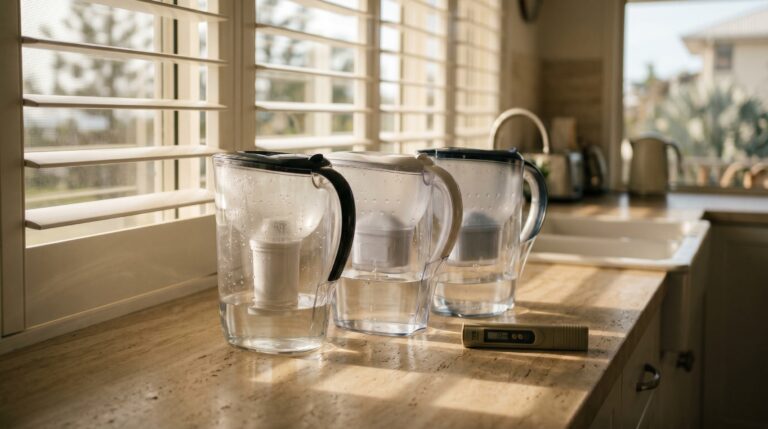
If you live in Brisbane, Sydney, Adelaide, Gold Coast, or Darwin — cities that use chloramine disinfection — a standard carbon jug filter removes chloramine at roughly 1/40th the rate it handles free chlorine, according to WQA technical documentation. That means your Brita or PUR is barely touching the disinfectant in your water. Reverse osmosis is the only benchtop or under-sink technology that reliably removes chloramine, fluoride (90–97% rejection), and PFAS in a single system. Both systems reviewed here do that job. The question is which one suits your home, your plumbing situation, and your budget. As a former Navy Clearance Diver based in Palm Beach QLD — where the only under-sink RO system I own and measure first-hand is the EcoHero 5-Stage — I have broken this comparison down to the measurable differences that actually matter.
Why This Comparison Matters for Australian Households
You are not comparing two generic RO systems here. You are comparing two fundamentally different design philosophies — one built around Australian plumbing certification, the other built around compact engineering and smart technology. The choice between them affects whether your plumber will install it without questions, how much water goes down the drain, how much space you lose under your sink, and how much you spend over five years on replacement filters.
If you live in a chloramine city — Brisbane, Sydney, Adelaide, Gold Coast, or Darwin — this decision is more consequential than it looks. According to SEQ Water data, Brisbane’s supply uses monochloramine as the residual disinfectant. Standard activated carbon (GAC) filters like Brita pitchers remove chloramine at approximately 1/40th the rate they handle free chlorine, based on water treatment engineering data. That is not a rounding error. That is a near-complete failure to filter. Both the EcoHero and Waterdrop D6 use RO membranes that reject chloramine alongside fluoride, PFAS, heavy metals, and dissolved solids — the only under-sink technology category that handles all these contaminants simultaneously.
Melbourne, Hobart, and Canberra households use free chlorine — a standard carbon block will handle taste and odour effectively in those cities. But if you also want fluoride removal (Melbourne Water adds fluoride at ~1 mg/L per ADWG guidelines) or PFAS removal, RO is still the only viable under-sink path. Carbon filters — including catalytic carbon — cannot remove fluoride. Period. If you see a carbon filter claiming fluoride removal, walk away.
Let me walk you through every measurable difference between these two systems so you can make the right call for your home.
WaterMark Certification: Why It Matters More Than You Think
Here is the difference that most comparison articles skip entirely, and it is the most important one for Australian buyers. WaterMark certification under AS3497 is the Australian standard for plumbing and drainage products. Under the National Construction Code (NCC) and state plumbing regulations, any product connected to your mains water supply should carry WaterMark certification to comply with plumbing standards. This is not a suggestion. In Queensland, NSW, Victoria, and most states, a licensed plumber installing a non-WaterMark product is technically installing a non-compliant fitting.
The EcoHero 5-Stage carries WaterMark AS3497 certification. This means it has been tested and approved for connection to Australian plumbing systems. When a plumber installs it, they can sign off on the work with confidence. When your landlord or body corporate asks whether it meets compliance, you have documentation. When you sell your home, the installation is above board.
The Waterdrop D6 holds NSF/ANSI 58 and NSF/ANSI 401 certification — both are internationally recognised and independently verified. NSF/ANSI 58, administered by NSF International, is the gold standard test for RO membrane performance. It tests total dissolved solids (TDS) rejection, contaminant reduction claims, structural integrity, and material safety under controlled laboratory conditions at specified pressures. NSF/ANSI 401 goes further, testing for emerging contaminants including pharmaceuticals, herbicides, and pesticides. These are rigorous certifications. However, NSF certification is not a substitute for WaterMark in Australian plumbing law. The two certification systems serve different purposes.
What does this mean in practice? If you are a homeowner with a cooperative plumber, the Waterdrop D6’s NSF certifications provide strong assurance of filtration performance, and many Australian plumbers will install it. If you are a renter, if your body corporate is strict, or if you want zero ambiguity on compliance, the EcoHero’s WaterMark certification eliminates the question entirely.
I have had plumbers in the Palm Beach QLD area tell me they prefer WaterMark-certified products because it protects their license. That is a real-world consideration that no spec sheet captures. If your plumber hesitates to install a product, the product’s NSF rating is irrelevant — you are not getting it installed.
Filtration Performance: Spec-by-Spec Breakdown
Both systems use semi-permeable RO membranes, which means both achieve the core performance metrics you need: 90–97% fluoride rejection, 95–99% TDS reduction, effective chloramine removal, and PFAS reduction. The underlying technology is the same. But the implementation, certification testing, and additional filtration stages differ in ways worth understanding.
EcoHero 5-Stage Filtration Process
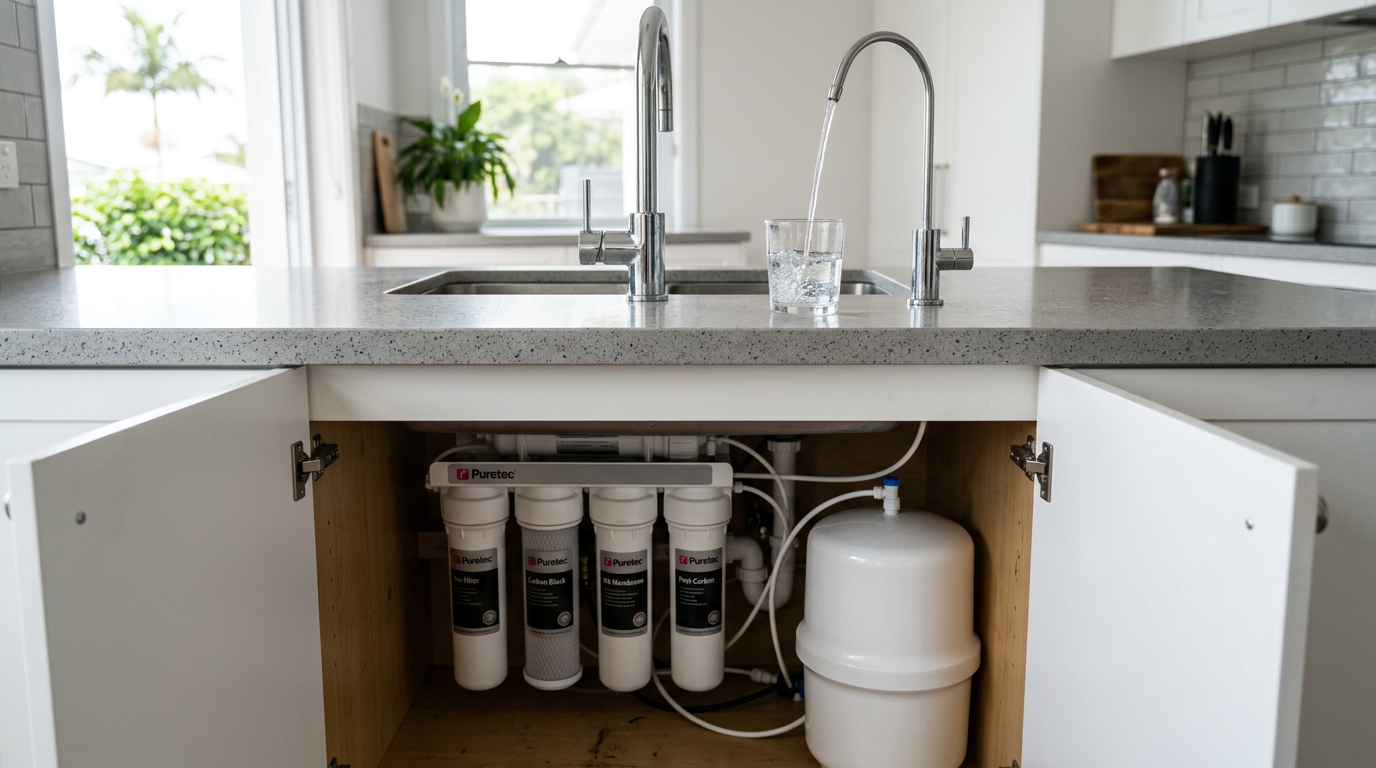
The EcoHero uses a traditional 5-stage RO configuration. While the manufacturer’s exact stage breakdown should be confirmed with the supplier, a standard 5-stage RO setup typically includes: sediment pre-filter (removes sand, rust, and particulates down to 5 microns), carbon pre-filter (reduces chlorine and chloramine to protect the RO membrane), the RO membrane itself (0.0001 micron nominal pore size — the stage that does the heavy lifting on fluoride, PFAS, heavy metals, and dissolved solids), a post-carbon polishing filter (improves taste), and in some configurations, a remineralisation stage. The EcoHero claims 300% water efficiency, which translates to a 3:1 pure-to-waste ratio. For every 3 litres of filtered water you collect, approximately 1 litre goes to drain. That is significantly better than older RO systems, which commonly wasted 3–4 litres for every 1 litre produced.
Waterdrop D6 Filtration Process
The Waterdrop D6 takes a different engineering approach. Its tankless design eliminates the pressurised storage tank that traditional RO systems use, replacing it with a high-flow pump and multi-stage composite filters. The system achieves 400 gallons per day (GPD) flow rate — roughly 1,514 litres — which means water is filtered on demand rather than stored. This is a meaningful design difference. Tank-based systems store filtered water that can develop a stale taste if not used regularly. Tankless systems deliver fresh-filtered water every time you turn the tap, but they require electricity to run the booster pump.
The D6’s pure-to-waste ratio is approximately 4:1, which means for every 4 litres of purified water, approximately 1 litre goes to drain. That is slightly less efficient than the EcoHero’s claimed 3:1 ratio. Over a year, assuming a 4-person household using 8 litres per day of RO water, the difference works out to roughly 730 litres of additional waste water annually — not enormous, but not negligible either, especially if you are on tank water or in a drought-affected area like parts of south-east Queensland or western Sydney.
The D6’s Bluetooth filter monitoring via smartphone app tracks filter life based on actual usage volume rather than a calendar estimate. This is a genuine advantage. Most RO systems tell you to replace filters every 6 or 12 months regardless of how much water you have actually pushed through them. If you are a 2-person household, you might be replacing filters 6 months early. The Waterdrop app eliminates that waste.
Contaminant Removal Comparison
| Contaminant | EcoHero 5-Stage | Waterdrop D6 | What This Means for You |
|---|---|---|---|
| Fluoride | 90–97% (RO standard) | 90–97% (NSF 58 tested) | Both reduce fluoride from ~1 mg/L to below 0.1 mg/L |
| Chloramine | Yes (RO membrane) | Yes (RO membrane) | Critical for Brisbane, Sydney, Adelaide, Gold Coast, Darwin |
| PFAS | Yes (RO membrane) | Yes (RO membrane) | PFAS confirmed at 700+ sites across AU per DCCEEW register |
| Lead | Yes | Yes (NSF 58 tested) | Older homes with lead solder joints benefit most |
| TDS Reduction | 95–99% | 95–99% (NSF 58 tested) | Adelaide TDS ~400 mg/L drops to <20 mg/L |
| Pharmaceuticals | Not independently verified | Yes (NSF 401 tested) | NSF 401 specifically tests emerging contaminants |
On core contaminant removal, both systems are effectively equivalent. The meaningful certification advantage goes to the Waterdrop D6 — its NSF/ANSI 58 and NSF 401 certifications are independently verified by one of the most rigorous testing bodies in water treatment. The EcoHero’s WaterMark certification confirms compliance with Australian plumbing standards and material safety, but you should confirm directly with the supplier whether independent third-party contaminant reduction testing (such as NSF 58) has been conducted.
5-Year Cost Comparison
The sticker price tells you less than half the story. RO systems require regular filter replacements — pre-filters, post-filters, and eventually the RO membrane itself. Over five years, filter costs often exceed the original purchase price. Here is the full cost picture, assuming a 4-person household consuming approximately 8 litres of RO water per day (2,920 litres per year).
The Waterdrop D6 is cheaper over 5 years by approximately $200–$350. That gap is primarily driven by the lower upfront cost. Annual filter replacement costs are roughly comparable — the Waterdrop’s composite filters tend to be slightly more expensive per unit, but Bluetooth monitoring means you replace them based on actual usage rather than a worst-case calendar schedule, which can save you money if your household uses less water than average.
Now anchor this against the alternative. According to ABS household expenditure data, Australians spend approximately $2 per litre on bottled water. A 4-person household drinking 8 litres per day spends roughly $5,840 per year on bottled water — $29,200 over five years. Either RO system delivers the same purity at approximately $0.10–$0.13 per litre. That is a 95% cost reduction. At $0.11/L, the EcoHero pays for itself in under 3 months compared to bottled water. The Waterdrop does it in under 2 months.
Put another way: the EcoHero costs you about $0.88/day over five years. The Waterdrop costs about $0.73/day. Both are less than a single bottle of water from the servo.
Installation and Physical Design: Tank vs Tankless
This is where your kitchen’s undersink space becomes the deciding factor. If you have never looked under your kitchen sink with a tape measure, now is the time — because these two systems have fundamentally different footprints.
EcoHero 5-Stage: Traditional Tank Design
The EcoHero uses a pressurised storage tank that holds approximately 8–12 litres of pre-filtered water. The tank sits under your sink alongside the filter housing. This means you need enough clearance for both the filter cartridge assembly and the tank — typically requiring a footprint of roughly 35 x 35 cm with 45–50 cm of vertical clearance. In smaller Australian apartment kitchens — common in Brisbane’s inner suburbs like Fortitude Valley and New Farm, or Sydney’s eastern suburbs — this can be tight.
The advantage of a tank system is simplicity. No booster pump means no electricity connection required at the sink. Water pressure from mains drives the filtration process. The tank fills passively, so when you turn the dedicated faucet, you get immediate flow from stored water. The trade-off: if you drain the tank (filling a large pot, for example), you wait for it to refill. That refill time depends on your incoming water pressure and the membrane’s flow rate.
Waterdrop D6: Tankless Design
The Waterdrop D6 eliminates the storage tank entirely. The unit’s footprint is significantly smaller — roughly the size of a shoebox standing upright. For under-sink spaces that are already occupied by waste disposal units, cleaning supplies, or plumbing that cannot be easily rerouted, this is a genuine practical advantage. If you live in a unit or townhouse in Logan, Ipswich, Penrith, or Rockingham, where kitchens tend to be compact, the D6’s size advantage matters.
The trade-off is that the D6 requires a power connection. It uses an internal booster pump to drive water through the membrane at the pressure needed for on-demand filtration. You will need a power outlet under or near your sink. In older Australian homes — particularly Queenslanders and pre-1980s brick homes — there is often no power point under the kitchen sink. Running one is a job for a licensed electrician, adding $100–$200 to your installation cost.
The 400 GPD flow rate translates to approximately 1.0 litre per minute of filtered water at the tap — faster than most tank-based systems when the tank is depleted, and roughly comparable when the tank is full. For daily use filling glasses and kettles, you will not notice a meaningful difference. For filling large pots or making kombucha in bulk, the D6’s continuous flow is more convenient than waiting for a tank to refill.
Water Efficiency: A Critical Factor for Australian Conditions
Australia is the driest inhabited continent on Earth. Water restrictions are a recurring reality in south-east Queensland, greater Sydney, Perth, and Adelaide. Wasting water is not just environmentally questionable — it directly hits your water bill. Every litre that goes down the drain as RO waste (reject water) costs you money and works against your household’s water allocation.
The EcoHero claims 300% water efficiency, which means a 3:1 pure-to-waste ratio. For every 4 litres that enter the system, approximately 3 litres become filtered drinking water and 1 litre goes to drain. This is among the best waste ratios available in residential RO systems, per published manufacturer specifications.
The Waterdrop D6 achieves approximately a 4:1 pure-to-waste ratio — for every 5 litres entering the system, 4 litres become drinking water and 1 litre is rejected. Wait — that sounds better than the EcoHero. Let me clarify the maths, because “water efficiency” marketing can be confusing.
A 3:1 pure-to-waste ratio means 3 litres pure per 1 litre waste — that is 75% efficiency. A 4:1 pure-to-waste ratio means 4 litres pure per 1 litre waste — that is 80% efficiency. The Waterdrop D6 is actually slightly more water-efficient by this metric. However, the EcoHero’s “300% water efficiency” claim likely compares its efficiency to a baseline older RO system (which typically runs at 1:3 or 1:4 pure-to-waste). The terminology is marketing language. What matters is the actual litres-in versus litres-out, which should be confirmed from each product’s technical data sheet.
For a household using 8 litres of RO water per day:
- EcoHero at 3:1 ratio: 8L pure + ~2.7L waste = 10.7L total mains use per day (~973L waste per year)
- Waterdrop D6 at 4:1 ratio: 8L pure + ~2.0L waste = 10.0L total mains use per day (~730L waste per year)
The difference is approximately 243 litres per year — less than a single bathtub. On your SEQ Water bill, that is roughly $0.90 per year at current usage charges. Not a meaningful cost difference. But if you are on tank water in regional Queensland or rural NSW, every litre counts, and the D6’s slightly lower waste output is worth noting.
Decision Tree: Which System Suits Your Situation?
Stop researching and answer three questions. Your answer determines which system you should buy.
3-Question Decision Tree
1. Do you need WaterMark certification?
Renting? Body corporate? Strict plumber? Need guaranteed AU plumbing compliance? → EcoHero 5-Stage. No questions asked.
2. Is your under-sink space tight?
Small apartment kitchen? No room for a storage tank? Have a power outlet under the sink or can add one cheaply? → Waterdrop D6. Tankless design wins on space.
3. Is budget the primary constraint?
Need the lowest upfront cost with smart filter monitoring to avoid over-replacing filters? → Waterdrop D6. $300–$400 cheaper upfront, slightly cheaper over 5 years.
If you answered “yes” to question 1, the EcoHero is your system. Full stop. WaterMark certification is non-negotiable in certain situations, and no amount of smart features or price savings changes plumbing law. If you answered “no” to question 1 and “yes” to question 2 or 3, the Waterdrop D6 delivers equivalent filtration performance at a lower cost in a smaller package.
How These Compare to Other Options
The EcoHero and Waterdrop D6 are not the only under-sink RO systems available in Australia. Here is how they stack up against two other commonly considered alternatives.
AquaTru Classic Countertop RO ($699): If you cannot modify your plumbing at all — no drilling, no plumber, no permission — the AquaTru Classic sits on your bench and connects to nothing. It is a countertop RO system with NSF certifications for PFAS, fluoride, and lead removal. The trade-off is a smaller tank (~3.8L capacity), slower throughput, and it takes up bench space rather than under-sink space. For renters in Brisbane, Sydney, or Melbourne apartments where plumbing modifications are forbidden, this is the path of least resistance. Read the full AquaTru review for details.
Tappwater EcoPro Benchtop ($89–$119): This is a carbon block filter, not an RO system. It removes free chlorine effectively, improves taste, and reduces some heavy metals. But it cannot remove fluoride and handles chloramine poorly. If you are in Melbourne or Hobart (free chlorine cities) and your only concern is taste, it is a cheap and effective option. If you are in Brisbane, Sydney, Adelaide, Gold Coast, or Darwin, or if you want fluoride removal, the EcoPro is not sufficient. Stick with RO.
For the complete ranking of under-sink systems tested against Australian water conditions, see our best under-sink water filter Australia guide.
City-Specific Recommendations
Your city determines your water chemistry, which affects how hard each system works and how quickly filters degrade.
Brisbane / SEQ (chloramine, TDS ~80–115 mg/L, moderate hardness ~80–120 mg/L CaCO₃): Both systems handle Brisbane water well. The moderate TDS and hardness means membranes will last close to their rated lifespan. Chloramine removal is the primary driver for choosing RO here — without it, you are drinking monochloramine with every glass. Suburbs like Logan, Ipswich, and Mt Crosby draw from the same SEQ Water grid. Either system works; choose based on certification and space needs.
Sydney (chloramine, TDS ~120–180 mg/L): Sydney Water adds fluoride at approximately 1.0 mg/L per ADWG guidelines. Higher TDS in western suburbs like Penrith and Blacktown means slightly faster membrane degradation compared to Brisbane. Both systems will work. The Waterdrop D6’s Bluetooth filter monitoring is actually useful here — it will tell you when higher TDS is wearing your filters faster than average.
Adelaide (chloramine, TDS ~400 mg/L, hard water ~140 mg/L CaCO₃): Adelaide has the highest TDS of any major Australian capital, according to SA Water data. This accelerates membrane fouling. Both systems will need more frequent membrane replacement in Adelaide compared to Brisbane or Melbourne. Pre-filter changes may be needed every 4–6 months rather than the standard 6–12. Factor in higher annual filter costs (~$30–$50 more per year) for Adelaide installations.
Perth (free chlorine, TDS ~170 mg/L, hard water ~180 mg/L CaCO₃): Perth has the hardest water of any Australian capital, per Water Corporation data. Hard water can cause scaling on RO membranes. Both systems will perform well, but consider a pre-filter sediment stage and monitor membrane pressure differential annually. Suburbs in the Kwinana industrial corridor and Rockingham may have additional industrial contaminant concerns — RO is the appropriate technology for these areas.
Melbourne (free chlorine, TDS ~60 mg/L, very soft ~25 mg/L CaCO₃): Melbourne’s exceptionally soft, low-TDS water is the easiest in Australia on RO membranes. Filters will last their full rated lifespan. If you are in Melbourne and only want chlorine and taste improvement, a carbon block is sufficient. But if you want fluoride removal — Melbourne Water fluoridates at ~1 mg/L — RO is your only effective option. Both systems are slightly overspecified for Melbourne’s easy water, so the cheaper Waterdrop D6 makes the stronger value case here.
What I Like About Each System
EcoHero 5-Stage: Strengths
- WaterMark AS3497 certification — the only system in this comparison with confirmed Australian plumbing compliance
- No electricity required — tank-based design runs on mains pressure alone, no power point needed
- Strong water efficiency claim — 300% efficiency (3:1 ratio) is excellent for a tank-based RO system
- Australian supplier — purchased through Pure Water Systems AU, with local customer support and warranty handling
- 5-stage filtration — comprehensive pre- and post-treatment protects the membrane and polishes taste
Waterdrop D6: Strengths
- NSF/ANSI 58 + NSF/ANSI 401 dual certification — independently verified contaminant removal including emerging contaminants
- Tankless design — dramatically smaller footprint, fits in tight apartment kitchens
- 400 GPD flow rate — ~1.0 L/min on-demand filtered water, no waiting for tank refill
- Bluetooth filter monitoring — replaces guesswork with usage-based tracking, potentially saving money on premature filter changes
- Lower upfront cost — $300–$400 less than the EcoHero at purchase
What Could Be Better on Each System
EcoHero 5-Stage: Limitations
- Higher upfront cost — at $1,009–$1,059, it is the most expensive option in this comparison
- Larger physical footprint — the storage tank requires significant under-sink real estate
- No smart monitoring — filter replacement relies on calendar estimates, which may lead to premature or late changes
- Tank taste risk — stored water can develop a slight taste if not used frequently; regular use mitigates this
Waterdrop D6: Limitations
- No confirmed WaterMark certification — may create installation complications with strict plumbers, landlords, or body corporates
- Requires electricity — the booster pump needs a power point under or near the sink; older homes may need an electrician
- Slightly higher waste water — 4:1 ratio versus the EcoHero’s claimed 3:1 produces ~243L more waste per year
- Pump noise — tankless RO systems produce audible pump noise during operation; not loud, but noticeable in quiet kitchens
Final Verdict
For Australian plumbing compliance, local support, and no-electricity simplicity: the EcoHero 5-Stage RO is the safer choice. Its WaterMark AS3497 certification eliminates uncertainty about plumbing compliance. Your plumber installs it, signs off, and you have documentation for your landlord, body corporate, or future buyer. You pay more upfront, but you buy peace of mind on the compliance question.
For the best value, smartest features, and smallest footprint with independently verified performance: the Waterdrop D6 is the stronger buy. Its dual NSF certifications (58 + 401) provide the most rigorous independent verification of contaminant removal in this comparison. The tankless design reclaims your under-sink space. Bluetooth monitoring saves you money on filters over time. And it is $300–$400 cheaper at purchase.
Either system delivers what matters most: genuine RO filtration that removes fluoride, chloramine, PFAS, lead, and dissolved solids from Australian tap water. Every glass from either system costs you roughly $0.10 — compared to $2.00 from a bottle. The worst outcome is you buy one, try it for a month, and decide to switch. The more likely outcome is you stop buying bottled water permanently.
If you want the full picture on every under-sink RO system available in Australia, including the EcoHero 5-Stage I own and measure first-hand in my Palm Beach QLD kitchen, start with our best water filter Australia 2026 guide, our dedicated reverse osmosis filter Australia guide, or read the detailed EcoHero 5-Stage review.
Last reviewed: June 2026 — Clean and Native
Ready to filter your water?
Both the EcoHero 5-Stage RO and Waterdrop D6 remove fluoride, chloramine, PFAS, and lead from Australian tap water. Choose the EcoHero for WaterMark compliance — the Waterdrop D6 for best value and compact design.
Frequently Asked Questions
Does the Waterdrop D6 have WaterMark certification in Australia?
At the time of writing, the Waterdrop D6 does not appear to carry WaterMark AS3497 certification. It holds NSF/ANSI 58 and NSF/ANSI 401 certification, which are internationally recognised but are not equivalent to WaterMark for Australian plumbing compliance purposes.
Can either system remove chloramine from Brisbane tap water?
Yes. Both the EcoHero 5-Stage and Waterdrop D6 use RO membranes that effectively reject chloramine. Brisbane and all SEQ Water supply areas use monochloramine as their residual disinfectant, and standard carbon filters remove it at approximately 1/40th the rate of free chlorine — making RO the appropriate technology.
Do I need a plumber to install these under-sink RO systems?
Under Australian plumbing regulations, any product connected to mains water should be installed by a licensed plumber. The EcoHero’s WaterMark certification simplifies this process. Some plumbers may hesitate with non-WaterMark products. Budget $150–$250 for installation either way.
Does the Waterdrop D6 need electricity to operate?
Yes. The D6’s tankless design uses an internal booster pump that requires a power connection under or near your sink. The EcoHero uses mains water pressure and does not require electricity.
Which system removes fluoride more effectively?
Both achieve 90–97% fluoride rejection through their RO membranes. On Australian municipal water fluoridated at approximately 1 mg/L per ADWG guidelines, both reduce fluoride to below 0.1 mg/L. Carbon filters — including catalytic carbon — cannot remove fluoride.
How often do I need to replace filters on each system?
Pre-filters and post-filters on both systems typically need replacement every 6–12 months depending on your water quality. RO membranes last 2–3 years. Adelaide and Perth’s harder water may require more frequent pre-filter changes. The Waterdrop D6’s Bluetooth app monitors usage and tells you when replacement is actually needed, which can extend filter life for lower-usage households.
Is the EcoHero 5-Stage RO system available on Amazon Australia?
The EcoHero is primarily sold through Pure Water Systems Australia, an Australian retailer with local warranty support. It is not widely available on Amazon AU. The Waterdrop D6 is available on Amazon AU.
Will these RO systems work with Adelaide’s hard water?
Yes, but expect faster filter degradation. Adelaide has the highest TDS (~400 mg/L) of any Australian capital, per SA Water data. Both systems will filter effectively, but pre-filters may need changing every 4–6 months rather than the standard 6–12. Budget an additional $30–$50 per year in filter costs for Adelaide installations.
Can I install the Waterdrop D6 in a rental property?
Technically yes, with landlord permission and a licensed plumber. However, the lack of confirmed WaterMark certification may complicate approval from strict landlords or body corporates. If rental compliance is critical, the EcoHero’s WaterMark certification provides cleaner documentation. Alternatively, a countertop RO system like the AquaTru Classic requires no plumbing modifications at all.
How loud is the Waterdrop D6 pump?
Tankless RO systems produce audible pump noise during operation, typically around 50–65 dB — comparable to a quiet conversation or a running dishwasher. You will hear it when filling a glass but not when the tap is off. Tank-based systems like the EcoHero fill passively and are essentially silent during use.
Get the Australian Home Environment Checklist
30 checks across water, air and EMF. Most of them free. Ranked by impact.
No spam. Unsubscribe any time.

Former Royal Australian Navy Clearance Diver and TAG-E counter-terrorism operator. Founded Clean and Native to apply the same rigorous thinking to the home environment.
Full biography →