Chloramine vs Chlorine in Australian Cities: Which Disinfectant Is in Your Tap Water?
Brisbane, Sydney, Adelaide, Gold Coast, and Darwin use chloramine as the primary disinfectant; Melbourne, Hobart, Canberra, and Perth use free chlorine. Chloramine requires catalytic carbon or reverse osmosis to remove effectively — standard activated carbon removes only a few percent of it. Free chlorine is removed by any basic carbon filter. The catches: most Australian jug filters and benchtop models use standard carbon only, which means they fail silently in chloramine cities without warning labels or performance data.
| City/Region | Disinfectant Type | Filter Verdict |
|---|---|---|
| Brisbane, Sydney, Adelaide, Gold Coast, Darwin | Chloramine | Catalytic carbon or RO required |
| Melbourne, Hobart, Canberra | Free chlorine | Standard carbon works fine |
| Standard carbon jugs in chloramine cities | N/A | Avoid — removes <3% |
The disinfectant in your tap water determines which water filter will actually work in your home. Get it wrong and you waste hundreds of dollars on a filter that removes less than 3% of the chemical you are trying to eliminate. Brisbane, Sydney, Adelaide, Gold Coast, and Darwin use chloramine — a compound that standard carbon jug filters and basic Brita cartridges barely touch. Melbourne, Hobart, and Canberra use free chlorine, which basic carbon handles well. According to the Australian Drinking Water Guidelines (ADWG 2024), both are approved disinfectants, but they behave completely differently when they hit a filter cartridge — and the difference matters more than any other filter-selection fact in Australia.
This article gives you the city-by-city breakdown, explains the chemistry in plain terms, and tells you exactly which filter technology you need based on what is actually in your water.
What Is the Actual Difference Between Chloramine and Chlorine?
Free chlorine (hypochlorous acid, HOCl) is the oldest municipal water disinfectant. It is reactive, fast-acting, and dissipates relatively quickly. Leave a glass of Melbourne tap water on the bench for 30 minutes and the free chlorine concentration drops measurably as it off-gasses. That reactivity is why it is effective — it destroys bacteria and viruses rapidly — but it is also why it does not last long in distribution pipes.
Chloramine (monochloramine, NH₂Cl) is produced by combining chlorine with ammonia. According to the ADWG, it is used specifically because it persists longer in the pipe network. Brisbane’s SEQ Water treats at the Mt Crosby Water Treatment Plant, and the water must remain disinfected across hundreds of kilometres of pipe from the plant to your tap in Logan, Ipswich, Redcliffe, or the Gold Coast hinterland. Chloramine does not off-gas easily. You cannot remove it by boiling water or leaving it on the bench.
This persistence is the entire reason chloramine exists — and the entire reason standard carbon filters fail against it. The same stability that keeps water safe in long pipe runs also makes the molecule resist adsorption onto standard activated carbon. According to peer-reviewed kinetic data on GAC adsorption rates, standard granular activated carbon removes free chlorine at approximately 40 times the rate it removes monochloramine under identical flow conditions. That ratio is not marketing — it is chemistry.
City-by-City Disinfectant Map: Which Australian Cities Use Chloramine vs Free Chlorine?
If you do not know which disinfectant is in your water, you cannot choose the right filter. Every filter purchase starts here. The following table is based on published data from each city’s water utility as of 2026.
| City / Region | Disinfectant | Water Utility | Hardness (mg/L CaCO₃) | TDS (mg/L) | Standard GAC Filter Works? |
|---|---|---|---|---|---|
| Brisbane / SEQ | Chloramine | SEQ Water / Urban Utilities | 80–120 | 80–115 | No |
| Sydney | Chloramine | Sydney Water (WaterNSW supply) | 40–90 | 80–120 | No |
| Adelaide | Chloramine | SA Water | ~140 | ~400 | No |
| Perth | Free Chlorine | Water Corporation WA | ~180 | ~170 | Yes |
| Darwin | Chloramine | Power and Water Corporation NT | 30–80 | 50–150 | No |
| Melbourne | Free Chlorine | Melbourne Water | ~25 | ~60 | Yes |
| Hobart | Free Chlorine | TasWater | 15–40 | 30–80 | Yes |
| Canberra | Free Chlorine | Icon Water | 20–50 | 40–100 | Yes |
| Townsville | Free Chlorine | Townsville Water | 30–80 | 50–120 | Yes |
| Cairns | Free Chlorine | Cairns Regional Council | 20–60 | 40–90 | Yes |
| Toowoomba | Free Chlorine | Toowoomba Regional Council | 40–100 | 60–150 | Yes |
Adelaide has the hardest mainstream metro water in Australia at roughly 140 mg/L CaCO₃ and the highest TDS at around 400 mg/L, according to SA Water published data. Perth is close behind at approximately 180 mg/L CaCO₃ hardness, though Perth metro is disinfected with free chlorine rather than chloramine. Adelaide residents face a double challenge: hard water scale plus a chloramine disinfectant that cheap carbon jugs cannot remove. If you live in the Adelaide Hills catchment zones, you are dealing with some of the most chemically complex tap water in the country.
Melbourne, by contrast, draws from the Yarra Valley catchment — a protected forested watershed that delivers some of the softest, cleanest source water of any major city globally, at roughly 25 mg/L CaCO₃ and TDS around 60 mg/L. Melbourne Water uses free chlorine because the pipe network is relatively compact and the source water quality is high. A basic carbon jug filter works perfectly well for taste and chlorine removal in Melbourne.
Sydney Water uses chloramine across the entire distribution network, from Penrith and the western suburbs through to the eastern beaches. The fluoride level sits at approximately 1.0 mg/L across Sydney — if you also want fluoride removal, that requires reverse osmosis or activated alumina. Carbon filters, including catalytic carbon, cannot remove fluoride. Never let a filter company tell you otherwise.
Why Standard Carbon Filters Fail in Chloramine Cities
This is the single most expensive mistake Australians make with water filters. You buy a $40 Brita jug in Brisbane, fill it up, and the water tastes slightly better because the carbon removes some organic compounds and a tiny fraction of the chloramine. You assume it is working. It is not — at least not for the disinfectant you are primarily concerned about.
Standard granular activated carbon (GAC) removes free chlorine through a chemical reaction: the chlorine reacts with the carbon surface, breaking down into chloride ions. This reaction is fast and efficient. Contact time of a few seconds is enough. That is why Brita jugs work in Melbourne, Hobart, and Canberra.
Chloramine, however, is a more stable molecule. The nitrogen-hydrogen bond in monochloramine (NH₂Cl) resists the same surface reaction. Standard GAC can still adsorb some chloramine, but the kinetic rate is approximately 1/40th of the free chlorine rate, according to published adsorption kinetic studies. At typical jug or faucet filter flow rates, the water passes through the carbon too quickly for meaningful chloramine reduction. You might see 2–5% removal instead of the 95%+ you get with free chlorine.
What Actually Removes Chloramine?
Three filter technologies work against chloramine:
1. Catalytic carbon — This is activated carbon that has been specially treated (usually with iron or nitrogen) to catalyse the decomposition of chloramine. The surface chemistry is different from standard GAC. Catalytic carbon breaks the chloramine molecule apart into ammonia and chloride, which are then adsorbed. Effective catalytic carbon systems (like those using Jacobi or Centaur catalytic media) achieve 95%+ chloramine removal at rated flow rates.
2. Compressed carbon block (rated for chloramine) — Dense carbon block filters force water through a much tighter matrix than loose GAC. The dramatically increased contact time and surface area allows even non-catalytic carbon to achieve better chloramine reduction — but only if the manufacturer specifically tests and rates the block for chloramine removal. Not all carbon blocks are equal. Look for NSF/ANSI 42 certification with chloramine listed as a tested contaminant, not just chlorine.
3. Reverse osmosis (RO) — RO membranes (NSF/ANSI 58 certified) physically reject chloramine along with 90–99% of all dissolved contaminants. RO is the most comprehensive option and the only technology that also removes fluoride (90–97% rejection), PFAS, lead, and heavy metals in a single system. For chloramine cities, RO is the set-and-forget choice.
| Filter Technology | Free Chlorine Removal | Chloramine Removal | Fluoride Removal | PFAS Removal | Best For |
|---|---|---|---|---|---|
| Standard GAC (Brita, jug filters) | 95%+ | 2–5% | No | No | Melbourne, Hobart, Canberra only |
| KDF-55 media | 90%+ | Ineffective | No | No | Shower filters in free chlorine cities only |
| Catalytic carbon | 95%+ | 95%+ | No | Partial | All Australian cities — whole house / undersink |
| Carbon block (chloramine-rated) | 95%+ | 90%+ | No | Partial | Under-sink in chloramine cities |
| Reverse Osmosis (NSF/ANSI 58) | 99%+ | 95–99% | 90–97% | 99%+ | Any city — the comprehensive solution |
| Vitamin C (ascorbic acid) shower | 99% | 99% | No | No | Shower filters in chloramine cities |
Now that you know which technology you need, let’s look at the best filter systems for each scenario and how much they actually cost over five years.
Best Filter Systems for Chloramine Cities vs Free Chlorine Cities
The filter you need depends on two questions: what disinfectant is in your water, and can you modify your plumbing? Here is the decision tree:
3-Question Filter Decision Tree
1. Which city?
Brisbane / Sydney / Adelaide / Gold Coast / Darwin → Chloramine present. Need catalytic carbon, chloramine-rated carbon block, or RO.
Melbourne / Canberra / Hobart / Perth / Townsville / Cairns / Toowoomba → Free chlorine. Standard carbon works.
2. Can you modify plumbing?
Yes → Under-sink RO (best value long-term).
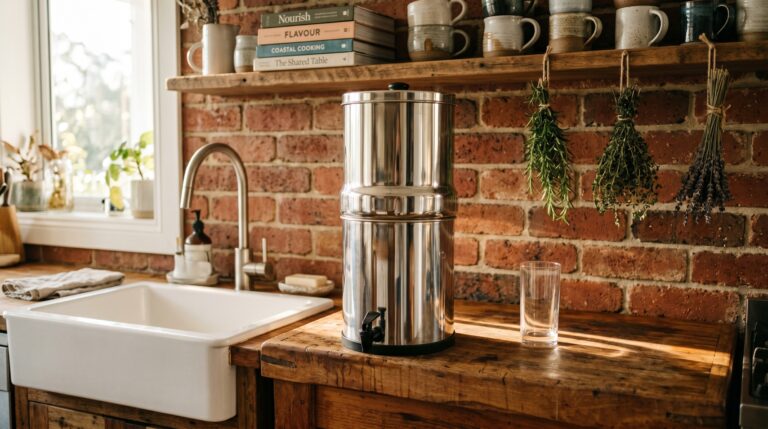
No (renting, apartment, no drill) → Countertop RO or benchtop carbon filter.
3. Primary concern?
Fluoride or PFAS → RO only (carbon cannot remove fluoride).
Taste and chlorine/chloramine only → Catalytic carbon or carbon block.
Bacteria or microbiological → UV + RO.
For Chloramine Cities: Top Picks
Best countertop (no plumbing modification): AquaTru Classic Smart Alkaline. This is a 4-stage countertop reverse osmosis unit. It sits on your bench, plugs into a power outlet, and requires zero plumbing changes. NSF/ANSI 58 certified, it removes chloramine, fluoride (90–97%), PFAS, lead, arsenic, and VOCs. For renters in Sydney’s inner west, Brisbane’s Logan corridor, or Adelaide’s northern suburbs, it is the most practical high-performance option available. Fill the tank, press a button, drink.
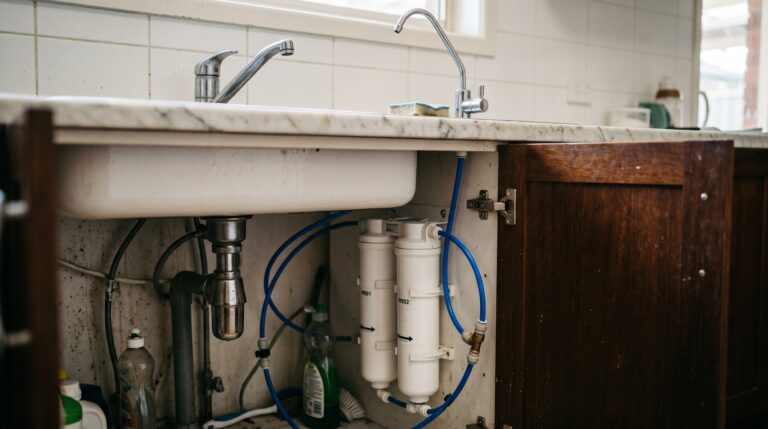
Best under-sink: Waterdrop D6 600GPD Tankless RO. If you own your home or your landlord approves, an under-sink RO system gives you filtered water on demand from a dedicated tap. The Waterdrop D6 is tankless (saves space under the bench), delivers 600 gallons per day, and carries NSF/ANSI 58 certification. The waste-to-pure ratio is approximately 1.5:1 — significantly better than older tank-based RO systems at 3:1 or 4:1.
For Free Chlorine Cities: Top Picks
Best benchtop: Tappwater EcoPro. In Melbourne, Hobart, and Canberra, you do not need reverse osmosis unless you specifically want fluoride or PFAS removal. The Tappwater EcoPro is a compact carbon block filter that attaches to your existing kitchen tap. It removes free chlorine, lead, pesticides, and microplastics effectively. At under $100 with low-cost replacement cartridges, it is the most cost-effective option for free chlorine cities.
If you are in a free chlorine city but still want fluoride removal, you still need RO. Carbon does not remove fluoride regardless of your disinfection type.
The cost comparison tells the story. An under-sink RO system like the Waterdrop D6 delivers comprehensive contaminant removal, including chloramine, fluoride, PFAS, and heavy metals, for a fraction of the long-term cost of bottled water. A countertop unit like the AquaTru requires zero plumbing modifications, making it ideal for renters in inner Sydney, inner Brisbane, or Adelaide apartments.
If you can install under-sink, the Waterdrop D6 is the clear value winner. If you cannot, the AquaTru Classic is the best countertop option for chloramine cities. Read the full comparison in our best under-sink water filter Australia guide.
Shower Filters: The Chloramine Problem Most Australians Miss
Most people focus on drinking water filters and forget about the shower. But you absorb more chloramine through your skin and lungs during a 10-minute hot shower than you do drinking two litres of unfiltered water, according to dermatological exposure studies. The heat opens pores, the steam carries volatile compounds into your airways, and the contact time is long.
Here is the problem: the vast majority of shower filters sold in Australia use KDF-55 media. KDF-55 works through a copper-zinc redox reaction that effectively neutralises free chlorine. In Melbourne, Hobart, Canberra, Townsville, Cairns, and Toowoomba, KDF-55 shower filters work exactly as advertised.
In Brisbane, Sydney, Adelaide, Gold Coast, and Darwin, KDF-55 shower filters are ineffective against chloramine. The redox reaction that breaks down free chlorine does not decompose the chloramine molecule at the flow rates and temperatures of a shower. If you have a KDF-55 shower filter in a chloramine city, it is doing very little for the primary disinfectant in your water.
What Works in Chloramine Cities for Showers?
Vitamin C (ascorbic acid) shower filters are the most effective option. Vitamin C reacts with chloramine through a direct chemical neutralisation — sodium ascorbate or ascorbic acid converts monochloramine into harmless compounds. This reaction is fast enough to work at shower flow rates. The downside is that vitamin C cartridges deplete faster than KDF filters and need replacement every 2–3 months depending on usage.
Catalytic carbon shower filters also work against chloramine, though flow rate matters. At high flow rates, contact time may be insufficient. Look for shower filters that specifically state chloramine removal and cite test results, not just “chlorine removal”.
If you are in a free chlorine city, a standard KDF-55 or carbon shower filter works fine. Do not overspend on vitamin C cartridges if you are on Melbourne or Hobart water — you do not need them.
Chloramine Health Considerations: What the ADWG Actually Says
The Australian Drinking Water Guidelines (ADWG 2024) set a health-based guideline value of 3 mg/L for monochloramine in drinking water. Most Australian water utilities dose chloramine at 1–4 mg/L to maintain a residual throughout the distribution system. At these concentrations, according to the NHMRC, chloramine is considered safe for human consumption.
That said, chloramine is more reactive with certain organic compounds in water than free chlorine. When chloramine reacts with organic matter in pipes, it can form nitrosamines — specifically NDMA (N-nitrosodimethylamine), a probable human carcinogen according to the ADWG and international health bodies including the WHO. The ADWG guideline value for NDMA is 100 ng/L (nanograms per litre). Australian water utilities monitor for NDMA, and levels in treated water are typically well below this threshold.
The practical concern for most households is not acute toxicity. It is the cumulative effect of daily exposure through drinking and bathing, the taste and odour profile (chloramine has a more persistent, harder-to-mask taste than free chlorine), and the interaction with certain equipment. Chloramine is corrosive to rubber seals, certain plumbing fixtures, and is toxic to fish and aquatic organisms — aquarium keepers in Brisbane and Sydney must dechloraminate water before adding it to tanks.
If you want to reduce chloramine exposure, the data supports using RO for drinking water and vitamin C shower filtration for bathing. These are not wellness claims — they are simple chemistry applied to documented disinfectant concentrations in Australian municipal water.
How to Test What Is in Your Water Right Now
You do not need a lab to confirm whether your water contains chloramine or free chlorine. A basic DPD (diethyl-p-phenylenediamine) test kit from Bunnings or a pool supply store distinguishes between the two for under $30.
DPD-1 reagent measures free chlorine only. It turns pink/magenta in proportion to the free chlorine concentration.
DPD-3 reagent (added after DPD-1) measures total chlorine — free chlorine plus combined chlorine (chloramine). The difference between the DPD-3 reading and the DPD-1 reading equals the chloramine concentration.
If your DPD-1 reading is near zero but your DPD-3 reading shows 1–3 mg/L, you are on chloramine-treated water. If both readings are similar (and above zero), you are on free chlorine. This takes about 60 seconds and costs less than the price of two coffees.
For TDS (total dissolved solids), a TDS-3 handheld meter costs $15–25 on Amazon AU and gives you an instant reading. In my own home, tap water measured 69 ppm TDS, dropping to 3 ppm after reverse osmosis filtration.
The Fluoride Question: Why It Matters Alongside Disinfection
Every state and territory in Australia adds fluoride to municipal water supplies at approximately 0.6–1.0 mg/L, per NHMRC guidelines. Whether or not you want to reduce fluoride is a personal decision, but if you do, the technology choice is non-negotiable.
Only reverse osmosis (90–97% fluoride rejection) or activated alumina (80–95% depending on pH and flow rate) removes fluoride. Carbon filters — including catalytic carbon, carbon block, and GAC — do not remove fluoride. This is a chemistry limitation, not a quality issue. Fluoride ions are too small and too chemically stable for carbon adsorption to be effective.
If you live in a chloramine city and want to remove both chloramine and fluoride, RO is your only single-system solution. An undersink RO system like the Waterdrop D6 or a countertop RO like the AquaTru handles both contaminants simultaneously. This is why we recommend RO as the default for chloramine cities — it solves more problems with fewer systems.
For a deeper analysis, see our complete guide to reverse osmosis filters in Australia and best water filter for Australia 2026.
Final Verdict
The disinfectant in your tap water is the most important variable in choosing a water filter. If you get this wrong, you are paying for a filter that barely touches the primary chemical you want removed.
If you live in Brisbane, Sydney, Adelaide, Gold Coast, or Darwin — you are on chloramine. Standard carbon jug filters, Brita cartridges, and KDF-55 media are largely ineffective. You need catalytic carbon, a chloramine-rated carbon block, or reverse osmosis. If you also want fluoride removed, RO is your only option.
If you live in Melbourne, Hobart, Canberra, Townsville, Cairns, or Toowoomba — you are on free chlorine. Standard carbon filters work well for taste and disinfectant removal. You only need RO if you specifically want fluoride or PFAS reduction.
For most Australian households in chloramine cities, the Waterdrop D6 under-sink RO is the best long-term value. If you cannot modify plumbing, the AquaTru Classic countertop RO is the best no-plumbing alternative. Both carry NSF/ANSI 58 certification covering chloramine, fluoride, and PFAS removal.
Test your water first. A $25 DPD kit confirms your disinfectant type. A $15 TDS meter shows dissolved solids. Then buy the right filter for your specific water chemistry. That is the systematic approach.
Last reviewed: June 2026 — Clean and Native
Ready to filter your water?
The Waterdrop D6 under-sink RO is an under-sink filter suited to Australian chloramine cities, carrying NSF/ANSI 58 certification for fluoride, PFAS, lead, and chloramine reduction.
Frequently Asked Questions
Does Brisbane tap water contain chloramine or chlorine?
Brisbane and the entire south-east Queensland (SEQ) region use chloramine as their primary disinfectant, managed by SEQ Water and Urban Utilities. Standard GAC carbon filters remove chloramine at approximately 1/40th the rate of free chlorine, making them ineffective. You need catalytic carbon, a chloramine-rated carbon block, or reverse osmosis.
Does Melbourne tap water have chloramine?
No. Melbourne Water uses free chlorine as its primary disinfectant. Melbourne’s source water from the Yarra Valley catchment is among the cleanest in Australia, with TDS around 60 mg/L and hardness of approximately 25 mg/L CaCO₃. A standard carbon jug filter or basic benchtop carbon filter works effectively in Melbourne.
Can a Brita filter remove chloramine from tap water?
No. Brita jug filters use standard granular activated carbon (GAC), which removes free chlorine effectively (95%+) but removes chloramine at only 2–5%. If you live in Brisbane, Sydney, Adelaide, Gold Coast, or Darwin, a Brita jug does not meaningfully reduce chloramine. You need a reverse osmosis system or a catalytic carbon filter.
What is the best shower filter for chloramine in Australia?
Vitamin C (ascorbic acid) shower filters are the most effective option for chloramine cities. They chemically neutralise chloramine through a direct reaction. Catalytic carbon shower filters also work at lower flow rates. KDF-55 shower filters, which are the most commonly sold type in Australia, are ineffective against chloramine and should only be used in free chlorine cities like Melbourne, Hobart, and Canberra.
Does boiling water remove chloramine?
No. Boiling water removes free chlorine through evaporation, but chloramine is far more chemically stable and does not off-gas at boiling temperatures within practical timeframes. You would need to boil water for over 20 minutes to achieve partial chloramine reduction — this is not a practical household method.
Does any carbon filter remove fluoride from Australian tap water?
No. Carbon filters — including standard GAC, catalytic carbon, and compressed carbon block — cannot remove fluoride. The fluoride ion is too small and chemically stable for carbon adsorption. Only reverse osmosis (90–97% removal) or activated alumina (80–95%) effectively reduce fluoride. If fluoride removal is a priority, you need an RO system regardless of whether your city uses chloramine or free chlorine.
How do I test whether my water has chloramine or free chlorine?
Use a DPD (diethyl-p-phenylenediamine) test kit, available at Bunnings or pool supply stores for $20–30. DPD-1 measures free chlorine. DPD-3 measures total chlorine. If the DPD-3 reading is significantly higher than DPD-1, the difference is your chloramine concentration. The test takes approximately 60 seconds.
Is chloramine in drinking water harmful?
At the concentrations used in Australian municipal water (1–4 mg/L), chloramine is considered safe by the NHMRC and meets the ADWG health-based guideline value of 3 mg/L. However, chloramine can form disinfection byproducts including NDMA (a probable carcinogen), is toxic to fish and aquatic organisms, and has a more persistent taste and odour than free chlorine. Reducing household exposure through appropriate filtration is a personal choice supported by simple chemistry.
Why do some Australian cities use chloramine instead of chlorine?
Chloramine persists longer in distribution pipes than free chlorine. Cities with large, spread-out pipe networks — like Brisbane (SEQ), Sydney, Adelaide, Gold Coast, and Darwin — use chloramine because it maintains a disinfectant residual across hundreds of kilometres of pipe from treatment plant to tap. Free chlorine would dissipate before reaching homes at the network extremities. Melbourne can use free chlorine because its protected catchment delivers high-quality source water and its distribution network is relatively compact.
What is the best water filter for Adelaide tap water?
Adelaide has both hard water (~140 mg/L CaCO₃, TDS ~400 mg/L according to SA Water) and chloramine disinfection. A reverse osmosis system is the most effective single solution — it removes chloramine, reduces hardness and TDS, and eliminates fluoride and PFAS. The Waterdrop D6 under-sink RO or AquaTru Classic countertop RO are both NSF/ANSI 58 certified and suitable for Adelaide’s water chemistry.
Get the Australian Home Environment Checklist
30 checks across water, air and EMF. Most of them free. Ranked by impact.
No spam. Unsubscribe any time.

Former Royal Australian Navy Clearance Diver and TAG-E counter-terrorism operator. Founded Clean and Native to apply the same rigorous thinking to the home environment.
Full biography →