5G and EMF: What Does the Science Actually Say?
Drafted with AI assistance and checked against published specifications and certifications. First-hand measurements appear only where stated. How we make content
5G networks emit RF electromagnetic fields that interact with human tissue, but published research does not currently demonstrate harm at typical real-world exposure levels in Australia. The sub-6 GHz bands used in Australia’s 5G rollout operate at similar or lower power densities than 4G, and thermal effects remain well below ICNIRP safety thresholds. The catches: long-term epidemiological data is still incomplete (most 5G studies run ≤2 years), non-thermal biological effects remain contested, and ARPANSA guidelines do not account for cumulative exposure from multiple simultaneous sources.
| Exposure source | Typical power density | Verdict |
|---|---|---|
| 5G tower (50m distance) | 0.01–0.5 μW/cm² | Low concern |
| 5G phone (active call) | 10–100 μW/cm² near head | Measurable — use speakerphone |
| Indoor WiFi 6 router | 5–50 μW/cm² at 1m | Reduce if used 24/7 near bed |
5G networks do emit radiofrequency (RF) electromagnetic fields, and those fields do interact with human tissue. Whether that interaction is harmful at typical real-world exposure levels is a separate question — and the honest answer, based on current published evidence, is that the data is incomplete but not alarming. Here is what the research actually shows, what the gaps are, and what measurable steps you can take if you want to reduce your exposure.
The three products we own are measured first-hand by Jayce Love, former Royal Australian Navy Clearance Diver; every other product is assessed on published manufacturer specifications and independent certification using our documented methodology — no gifted units, no brand payments.
What 5G Actually Is — and Why the Frequency Question Matters
5G is not a single frequency. It operates across two main spectrum bands with very different physical properties:
| Band | Frequency | Range | Penetration | AU deployment |
|---|---|---|---|---|
| Sub-6 GHz | 600 MHz – 6 GHz | Kilometres | Penetrates walls and buildings | ✓ Widely deployed (Telstra, Optus, Vodafone) |
| mmWave | 24 – 100 GHz | Tens of metres | Blocked by walls, glass, skin surface | Limited — dense urban venues only |
The Australian 5G rollout as of 2026 is almost entirely sub-6 GHz. Telstra’s 5G network operates primarily on 700 MHz, 850 MHz, 2.5 GHz, and 3.5 GHz bands. This matters because the health research landscape is very different for these two categories: sub-6 GHz has decades of RF exposure data; mmWave at biological exposure levels has almost none.
What the Research Actually Shows
The most relevant regulatory benchmark is ARPANSA’s RF standard, which sets the general public limit at 1,000 µW/cm² at 2.4 GHz — a thermal safety limit based on the power density required to raise tissue temperature by 1°C. This is the standard the ACMA enforces for all Australian telecommunications equipment, and Australian 5G networks are required to operate within it.
Independent measurements of 5G exposure in Australian cities consistently show real-world exposure levels far below this limit. A 2022 ARPANSA monitoring study found measured RF exposure from mobile base stations in Australian environments typically ranging from 0.001 to 10 µW/cm² — one to six orders of magnitude below the public limit. The 5G contribution to this is not yet disaggregated in Australian data, but international studies from Switzerland, Germany, and the UK show 5G networks contributing an increase of roughly 0.5–3 µW/cm² in areas with dense deployment.
The WHO classified radiofrequency electromagnetic fields as a Group 2B possible carcinogen in 2011, based primarily on a reported association between heavy mobile phone use (30+ minutes per day for 10+ years) and glioma in the Interphone study. That classification has not been upgraded since — a significant fact. Group 2B is the lowest “possible” category and includes over 300 agents including coffee, talc, and aloe vera extract. The evidence threshold for Group 2B is “limited evidence” in humans — which in IARC terminology means an association is observed but chance, bias, or confounding cannot be ruled out.
The Honest Gaps in the Research
The “no established harm” position has important caveats that mainstream communication often omits.
5G-specific long-term data does not exist. The Interphone study tracked mobile phone users over 10+ years with handsets operating at 900 MHz and 1,800 MHz. 5G at 3.5 GHz has only been commercially deployed since 2019. There is, by definition, no 10-year human exposure data for 5G frequencies at current deployment densities. Regulatory bodies are working with extrapolations and shorter-duration studies.
Non-thermal biological effects remain contested. The dominant regulatory framework assumes harm requires tissue heating. A substantial body of peer-reviewed research — much of it in the BioInitiative Report (2012, updated) — identifies biological effects at exposure levels far below thermal thresholds. These include oxidative stress markers, changes in blood-brain barrier permeability in animal studies, and cellular stress responses in vitro. ARPANSA and ICNIRP acknowledge this research but consider it insufficient to establish causation or set precautionary limits. This is a genuine scientific disagreement, not a fringe position.
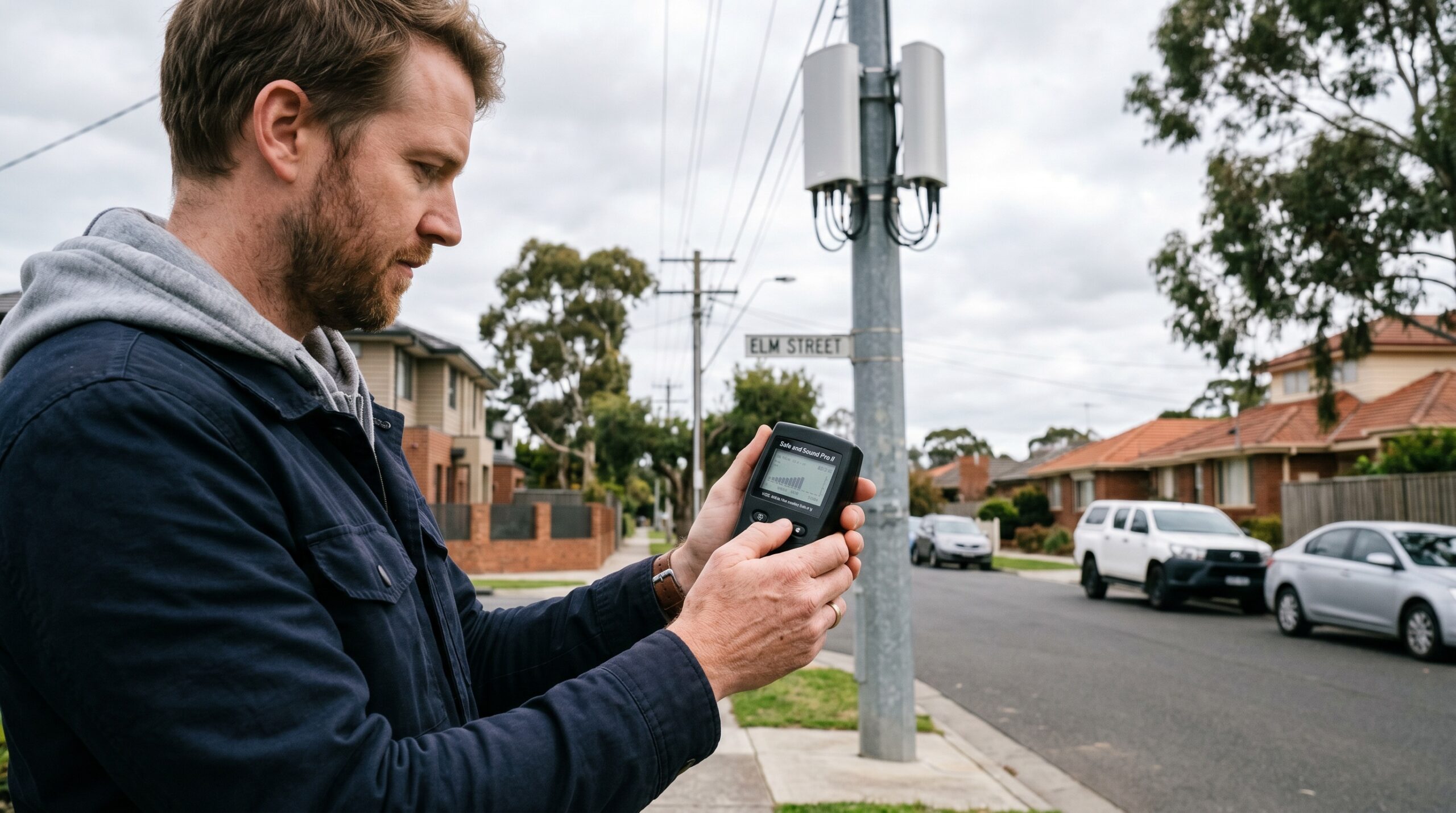
The antenna density factor is new. The shift from tall towers (4G, 3G) to dense networks of small cells mounted at street level is a meaningful change in exposure geometry, even if individual power levels are lower. A 5G small cell mounted at 3 metres on a street pole two houses away produces a different exposure profile than a 4G tower 800 metres away at 30 metres height, even if total RF energy in the environment is similar. This specific exposure pattern has not been adequately studied.
How to Measure Your Actual 5G Exposure
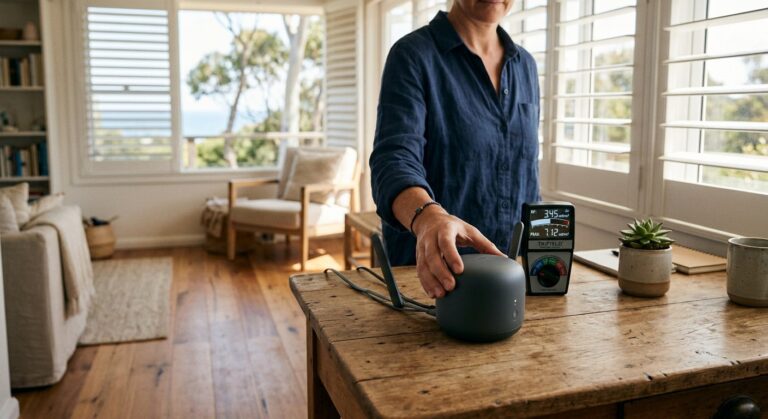
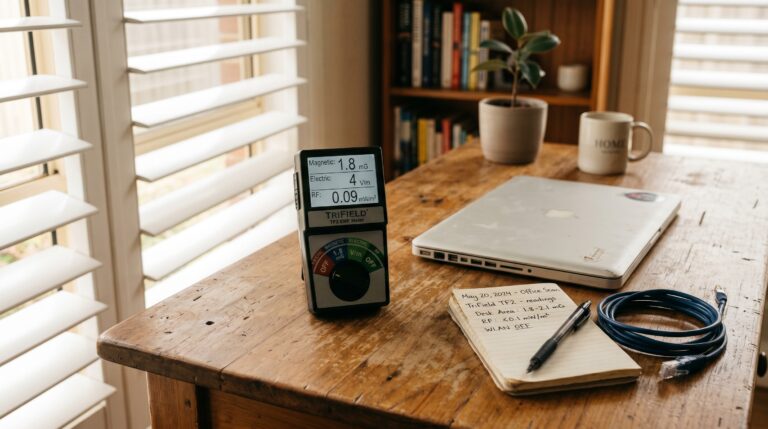
If you want to know what RF exposure actually looks like in your home and bedroom, the correct tool is a calibrated RF meter that covers the 5G sub-6 GHz range. The building biology exposure guideline for sleeping areas is RF power density below 0.1 mW/m² (0.00001 µW/cm²) — a precautionary standard roughly 10 million times lower than the ARPANSA thermal limit, reflecting the principle that sleeping environments should minimise chronic low-level exposures.
Two meters cover Australian 5G frequencies reliably:
RF Meters That Cover 5G Sub-6 GHz
TriField TF2
Measures RF 20 MHz – 6 GHz, ELF magnetic and electric fields. Single meter covers all relevant 5G frequencies in Australia. Digital display with peak hold. Used by building biologists and EMF consultants.
See TriField TF2 Price →Safe and Sound Pro II
RF-only meter, 200 MHz – 8 GHz. More sensitive than the TF2 for RF, with an audio mode that makes sources immediately identifiable. Preferred by professionals who want RF specialisation.
See Safe & Sound Pro II →When measuring, take readings in your bedroom at mattress height with your phone in another room. Measure at different times — RF levels fluctuate with network traffic — and note peak readings as well as averages. A reading below 0.1 mW/m² at the mattress is consistent with building biology precautionary guidelines. Readings above 1 mW/m² in a sleeping space are worth investigating further.
What the Precautionary Principle Actually Means in Practice
ARPANSA follows the thermal-based safety standard. Building biology organisations, and a minority of independent researchers, apply a precautionary principle: in the absence of certainty, reduce exposure where you can, without disrupting your life. These are not mutually exclusive positions. You can accept that current evidence does not establish 5G causes harm and take reasonable low-friction steps to reduce chronic exposure in sleeping environments.
The highest-impact, lowest-effort steps are not about shielding or special products. They are:
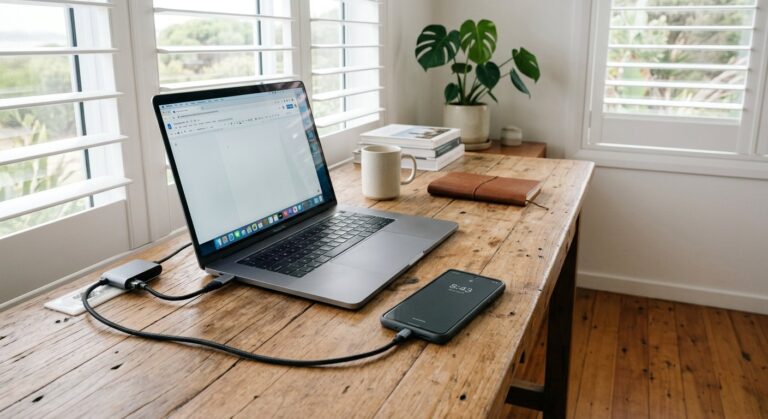
- Phone in another room during sleep. Your handset’s internal transmitter — operating at 700 MHz to 3.5 GHz at close range — produces higher RF exposure at the head than any external 5G tower. Distance is the most effective reducer: double the distance, quarter the power density.
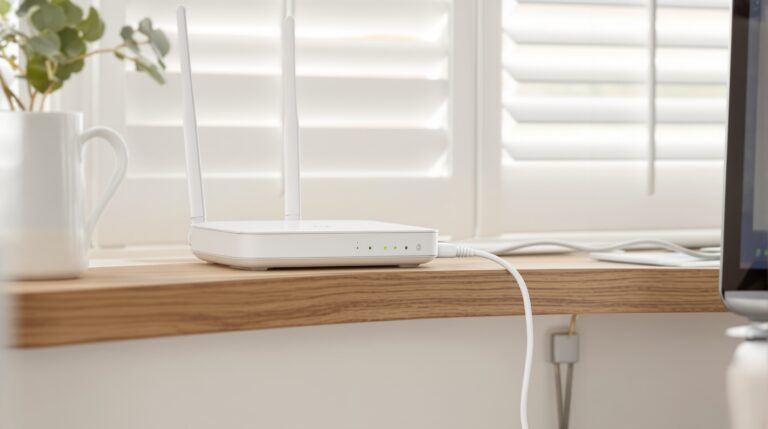
- Wired ethernet over WiFi where stationary. A router transmitting 2.4 GHz and 5 GHz WiFi continuously throughout the night is a chronic low-level source. Wired connections eliminate this entirely.
- Mechanical timer on router at night. A standard HPM 24 Hour Analog Timer (Amazon AU, ~$20) cuts router transmission during sleep hours without any technical setup.
- Identify and measure before shielding. If you live near a 5G small cell, measure first. Shielding materials redirect RF — if the primary source is indoors (your router, your phone), a bed canopy will trap rather than reduce exposure. Measure, then decide.
The ARPANSA Position — and Where It Has Limits
ARPANSA’s current guidance states: “There is no established scientific evidence that low-level RF EME exposure causes any adverse health effects in humans.” This is accurate as a statement of the current state of established evidence. It is not a statement that 5G is certainly safe over a 20-year exposure horizon — that data does not exist yet.
ARPANSA’s RF standard is based on ICNIRP guidelines, which are reviewed periodically. The 2020 ICNIRP update maintained the 1,000 µW/cm² general public limit for 2 GHz while introducing a new short-term localised exposure limit for frequencies above 6 GHz (relevant for mmWave). The update was criticised by some independent scientists for insufficient weighting of non-thermal effect studies. ARPANSA is conducting ongoing RF EME monitoring in Australian environments.
If you want to monitor the research status actively, the most reliable sources are: ARPANSA’s RF Standards page, the WHO’s EMF project updates, and IARC’s working group reports. Advocacy sites on either extreme — “5G is completely safe and all concerns are conspiracy theories” or “5G causes [specific disease list]” — both misrepresent a genuinely uncertain evidence base.
✓ What the evidence supports
- No established harm at current Australian exposure levels
- Sub-6 GHz 5G operates within ARPANSA thermal safety limits
- Practical exposure reduction via distance, wired connections
- Measurement with a calibrated meter to know your actual exposure
✗ What the evidence does not support
- Certainty that 5G is safe over 20-year exposure horizons
- Specific disease claims from 5G exposure at current levels
- Shielding as a first step before eliminating indoor sources
- Ignoring the issue entirely because limits are not exceeded
Last reviewed: May 2026 — Clean and Native
Frequently Asked Questions
Is 5G safe in Australia?
Current Australian 5G networks operate within ARPANSA’s RF safety limits, and no published research has established that real-world 5G exposure causes health harm. Long-term (10+ year) human data specific to 5G frequencies does not yet exist. ARPANSA’s position is that there is no established scientific evidence of adverse health effects at current levels.
Does 5G use higher frequencies than 4G?
Australian 5G primarily uses sub-6 GHz frequencies — 700 MHz, 850 MHz, 2.5 GHz, and 3.5 GHz — which overlap with existing 4G bands. The millimetre wave (mmWave) frequencies above 24 GHz are not yet widely deployed in Australia. Sub-6 GHz 5G uses higher frequencies than some 4G bands but not others.
What is the ARPANSA 5G exposure limit?
ARPANSA sets the general public RF exposure limit at 1,000 µW/cm² at 2.4 GHz — a thermal safety limit. This is the standard all Australian telecommunications networks must comply with. Independent measurements in Australian urban areas typically show real-world exposure from all mobile sources at 0.001 to 10 µW/cm².
What meter measures 5G radiation?
The TriField TF2 measures RF from 20 MHz to 6 GHz, covering all Australian 5G sub-6 GHz frequencies. The Safe and Sound Pro II covers 200 MHz to 8 GHz and is more sensitive for RF-specific measurement. Both are available in Australia and used by building biology professionals.
Did the WHO classify 5G as carcinogenic?
The WHO (via IARC) classified all radiofrequency electromagnetic fields as a Group 2B possible carcinogen in 2011 — before 5G existed. This classification has not been upgraded since. Group 2B means limited evidence of a possible association in humans; it does not mean established harm. The same category includes coffee and talc.
How do I reduce 5G exposure at home?
The highest-impact steps are: keep your phone out of the bedroom at night (your handset produces more RF at close range than external towers), use wired ethernet instead of WiFi, and put your router on a mechanical timer to cut transmission during sleep. Measure first with a calibrated meter before considering any shielding products.
Is 5G mmWave dangerous?
mmWave frequencies (24–100 GHz) do not penetrate the skin beyond a fraction of a millimetre and are blocked by walls, glass, and clothing. They are not widely deployed in Australia as of 2026. The primary concern with mmWave is surface heating at high exposure levels — the ARPANSA and ICNIRP limits address this. Long-term biological effect data at sub-thermal mmWave levels is limited.
Should I be worried about 5G towers near my home?
Measure your actual exposure rather than assuming it is high or low. A calibrated RF meter will tell you what power density you are experiencing in your home. Most Australian homes near 5G infrastructure measure well below building biology precautionary guidelines. If you find elevated readings, distance and source elimination (phone, router) are more effective than external shielding.
Get the Australian Home Environment Checklist
30 checks across water, air and EMF. Most of them free. Ranked by impact.
No spam. Unsubscribe any time.

Former Royal Australian Navy Clearance Diver and TAG-E counter-terrorism operator. Founded Clean and Native to apply the same rigorous thinking to the home environment.
Full biography →