
Best Air Tube Headphones Australia 2026: DefenderShield, SYB and What to Avoid
Drafted with AI assistance and checked against published specifications and certifications. First-hand measurements appear only where stated. How we make content
DefenderShield Air Tube Earbuds are the best air tube headphones in Australia for 2026 — they use a verified hollow acoustic tube that eliminates the wire-conducted RF pathway to your ear, are available on Amazon AU and SaferEMF AU, and are priced at $129. Air tube headphones work by converting the electrical audio signal to sound waves at a chest-height junction, then carrying those sound waves through a hollow tube with no metal conductor near your ear canal.
Every product in this guide has been researched against documented performance standards by Jayce Love. I have excluded brands that conceal a thin wire inside the “air tube” — a common shortcut that defeats the purpose entirely.
DefenderShield Air Tube Earbuds (3.5mm, B01N4LJOE2) are the top pick for most Australians — genuine hollow-tube construction, inline microphone, in stock on Amazon AU and SaferEMF AU at $129. The honest catch: bass response is noticeably reduced versus conventional earbuds, which is inherent to hollow-tube acoustic transmission.
| Option | Best For | Verdict |
|---|---|---|
| DefenderShield 3.5mm | Most AU phones, best availability | ✓ Recommended |
| DefenderShield USB-C | iPhone 15+, modern Android, no adaptor | ✓ Recommended |
| DefenderShield Over-Ear | Remote workers, 3+ hr call days | Situational |
| SYB Air Tube | Budget — 3 tip sizes, carrying case | Budget pick |
✓ Who This Is For
- Heavy phone users making multiple calls per day — cumulative RF reduction is meaningful at scale
- Parents buying headphones for children — thinner skulls absorb more RF per kg of body weight
- EMF-sensitive households following a low-RF protocol, including during pregnancy
- Remote workers on 3+ hours of daily calls who need all-day comfort
- Anyone who has switched from Bluetooth and wants to complete the reduction step
✗ Who It Is Not For
- Audiophiles — bass response is noticeably reduced vs. quality wired earbuds; use Sony WH-1000XM5 instead
- People who need wireless — air tube headphones are always wired
- Gym use — the hollow tube junction is the primary failure point under sweat and movement stress
- Anyone unwilling to manage cable — these are longer than standard earphones due to the junction
How Air Tube Headphones Actually Work
A standard wired headphone carries an electrical signal from your device to the drivers (speakers) in the earpiece. The wire is a conductor, and any RF in the environment — including the signal your phone is broadcasting during a call — can be picked up and conducted along it. Published research has shown detectable RF at the earpiece of conventional wired headphones during active phone use.
An air tube headphone splits the cable into two sections. The first section is a conventional wire running from your device to a junction component — typically sitting at chest height. At this junction, the electrical signal is converted to acoustic waves (sound). The second section — from the junction to your ear — is a hollow tube filled only with air. Sound travels through this tube to your ear canal. There is no metal conductor in this section. No current flows. No RF is conducted. This is the entire mechanism, and it is simple enough to verify by holding the tube up to a light source — a genuine hollow tube shows only air.
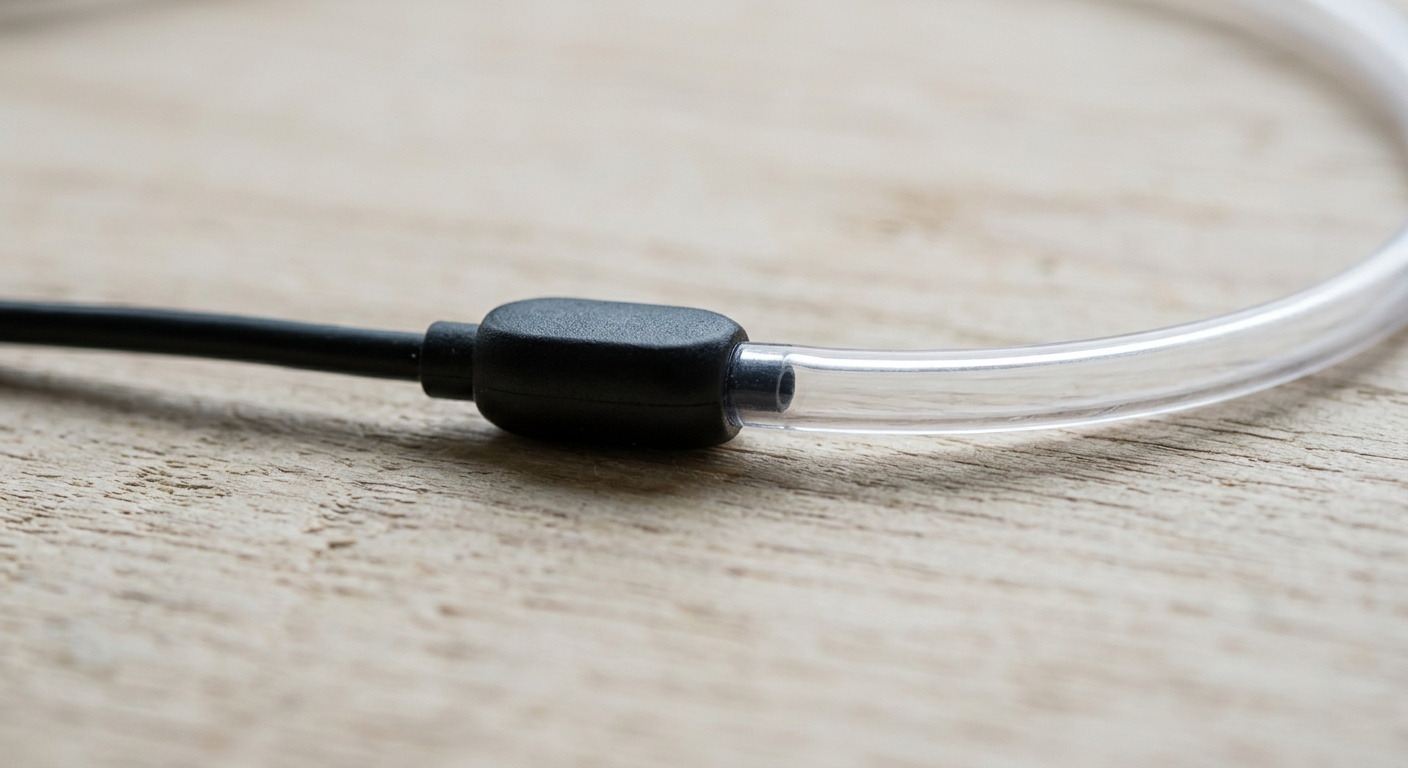
The acoustic trade-off is real and worth naming clearly. Hollow tube transmission limits low-frequency audio more than a wire-and-driver connection. Bass response is noticeably reduced. Mid-range and high-frequency reproduction is adequate for calls and spoken audio — podcasts, audiobooks, voice calls. For serious music listening, conventional wired earphones deliver better sound. The DefenderShield over-ear model narrows this gap due to a larger acoustic chamber, but does not close it entirely. These are practical, low-EMF communication tools — not audiophile headphones.
Air Tube vs Bluetooth vs Regular Wired — EMF Comparison
Before buying, it is worth understanding exactly where air tube headphones sit in the exposure hierarchy. Bluetooth earbuds are the worst option: the transmitter sits directly in your ear canal, a few centimetres from brain tissue, transmitting 2.4 GHz RF throughout every use. Regular wired headphones are a meaningful step down — no Bluetooth transmitter — but the wire itself conducts some RF from the phone along its length to the ear. Air tube headphones eliminate this conduction path.
| Type | EMF at Ear Canal | Mechanism | Verdict |
|---|---|---|---|
| Bluetooth earbuds (AirPods, etc.) | High — transmitter in ear canal | 2.4 GHz pulsed RF direct to ear | Highest exposure; avoid for long calls |
| Regular wired (3.5mm or Lightning) | Low-moderate — wire conducts some RF | No Bluetooth; wire acts as antenna | Better than Bluetooth; wire still conducts |
| Air tube headphones | Near-zero — no metal near ear canal | Hollow tube breaks conduction path | Lowest conduction-based exposure |
| Speaker mode (phone on desk) | Lowest — inverse square law at work | 30cm distance reduces exposure ~11x vs direct contact | Best for EMF; sacrifices privacy and audio quality |
ARPANSA sets Australia’s radiofrequency exposure limits at 2.0 W/kg SAR averaged over any 10g of tissue — the same limit as the EU, and stricter than the US FCC’s 1.6 W/kg averaged over 1g. All phones sold in Australia comply with the ARPANSA limit. Air tube headphones reduce conduction-based exposure below whatever level the phone is already emitting during a call, without requiring you to change phones or use speaker mode in public.
The 4 Best Air Tube Headphones Australia 2026
1. DefenderShield Air Tube Earbuds (3.5mm) — Best Overall
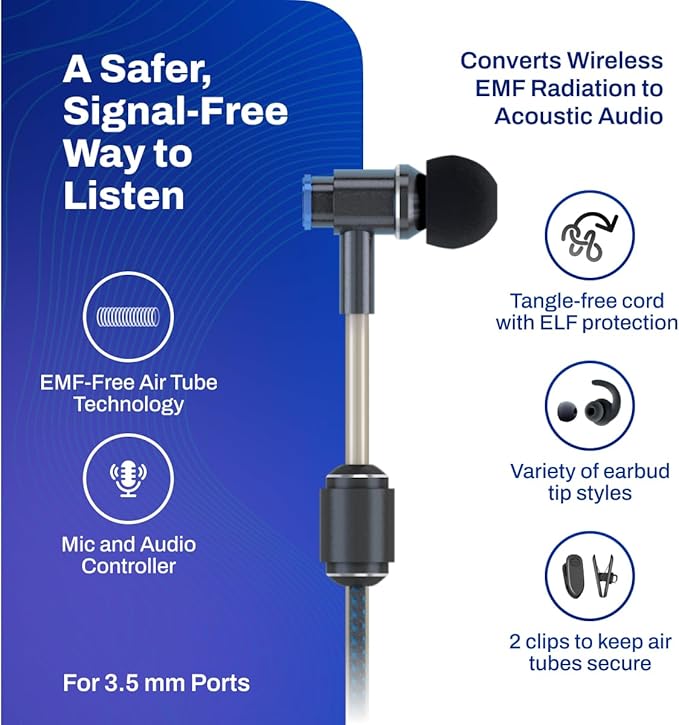
DefenderShield Air Tube Earbuds (3.5mm)
Verified hollow-tube construction, published RF reduction test data, and in stock on Amazon AU and SaferEMF AU. The most accessible and widely tested air tube earbud in Australia.
$129 on SaferEMF AU →DefenderShield has manufactured air tube headphones since 2014 — the longest track record in the category. Their 3.5mm earbuds use a verified two-section design: a standard copper wire from the 3.5mm plug to a chest-height junction, then a hollow acoustic tube with no metal conductor from junction to ear canal. The inline microphone works correctly on both Android and iPhone (with adaptor).
DefenderShield publishes RF reduction test data for the 3.5mm earbuds. Because the hollow tube section contains no metal conductor, no RF is conducted along it from the wire section to the ear canal, consistent with the mechanism. Call audio is clear, spoken content is well suited to the format, and music is serviceable once the reduced bass profile is factored in.
DefenderShield 3.5mm — Pros and Cons
Pros
- Verified hollow tube — publishes RF reduction test data
- In stock on Amazon AU and SaferEMF AU
- Inline mic + volume/call controls on Android and iPhone
- Universal 3.5mm jack — any phone via adaptor
- 10+ year commercial track record
Cons
- Needs Lightning or USB-C adaptor for modern iPhones
- Bass response noticeably reduced vs conventional earbuds
- Cable longer than standard earphones due to junction
Buy if: You have an Android with a 3.5mm port, or any iPhone, and want the most widely available verified air tube option in Australia. Check price on SaferEMF AU →
2. DefenderShield Air Tube Earbuds (USB-C) — Best for iPhone 15+ and Modern Android

DefenderShield Air Tube Earbuds (USB-C)
Identical hollow-tube RF reduction to the 3.5mm model with a USB-C connector — no adaptor needed for iPhone 15+, Samsung S24/S25 series, and Pixel 8+.
$129 on Amazon AU →The USB-C version addresses the market shift away from 3.5mm ports in flagship phones. The internal mechanism is identical to the 3.5mm version — the same air tube, the same junction, the same RF reduction outcome. The connector change is the only functional difference. For most current Australian smartphones — iPhone 15 onwards, Samsung Galaxy S24/S25 series, Google Pixel 8+ — this is the plug-and-play choice without adaptor management.
One practical note: USB-C audio blocks the charging port while in use. For calls up to two hours this is rarely a problem. For longer remote work sessions, consider the over-ear model below. The Amazon AU listing (B0DJG3XPVZ) ships immediately — use Amazon AU if the SaferEMF AU listing shows as pre-order.
DefenderShield USB-C — Pros and Cons
Pros
- No adaptor needed for iPhone 15+ and current Android flagships
- Identical hollow-tube construction and RF reduction to 3.5mm model
- Works with USB-C laptops and tablets
- Same price as the 3.5mm version
Cons
- USB-C port in use means no simultaneous charging without a hub
- Won’t work on older iPhones (Lightning) without adaptor
- SaferEMF AU may show as pre-order — Amazon AU ships immediately
Buy if: You have an iPhone 15 or newer, Samsung S24/S25, Google Pixel 8+, or any current-gen Android without a 3.5mm port. Check price on Amazon AU →
3. DefenderShield EMF-Free Over-Ear Headphones — Best for Remote Workers
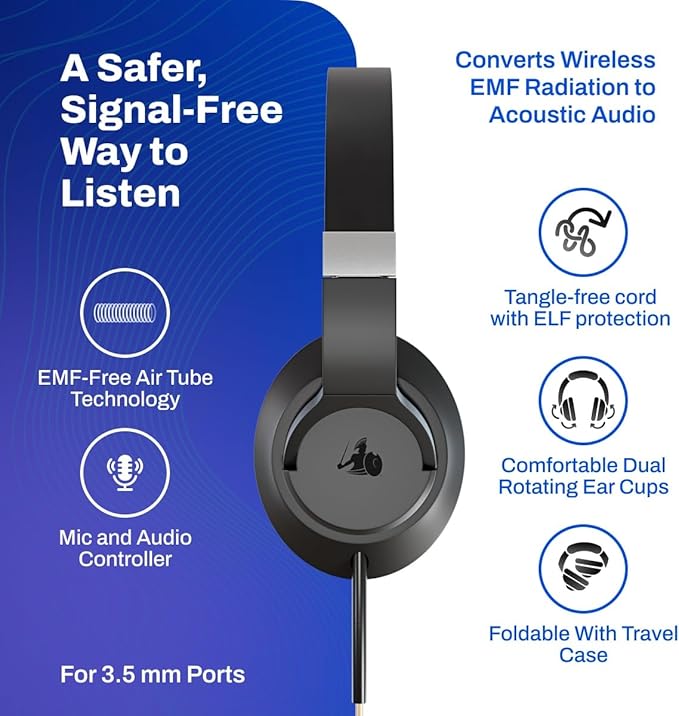
DefenderShield EMF-Free Over-Ear Headphones
The only full-size over-ear headphone with verified air tube construction available in Australia. Better audio than the earbud models and designed for 3+ hour desk use.
$289 on Amazon AU →The over-ear design solves the most common practical complaint about air tube earbuds: ear canal fatigue during extended sessions. Standard in-ear earphones create pressure fatigue after one to two hours of continuous wear. The over-ear cushions sit around the ear rather than inside it, eliminating this entirely for full work-day use.
Sound quality on the over-ear model is meaningfully better than the earbud versions. The larger earcup housing allows for an improved acoustic chamber at the driver end of the air tube, recovering some of the bass response lost in the earbud design. For music, spoken audio, and call quality, the over-ear model is the best-sounding option in the DefenderShield range while maintaining hollow-tube construction throughout.
DefenderShield Over-Ear — Pros and Cons
Pros
- Over-ear cushions eliminate in-ear pressure fatigue for long sessions
- Better audio than earbud models — larger acoustic chamber
- Air tube construction maintained — no metal near the ear
- Available on Amazon AU with Prime delivery
- Foldable for transport
Cons
- $289 is premium pricing for wired headphones
- Larger form factor — not suited to commuting or mobile use
- SaferEMF AU may show out of stock — Amazon AU is the reliable path
Buy if: You work from home with 3+ hours of daily calls, or find in-ear earphones uncomfortable for extended wear. Check price on Amazon AU →
4. Budget Air Tube Headphones on Amazon AU
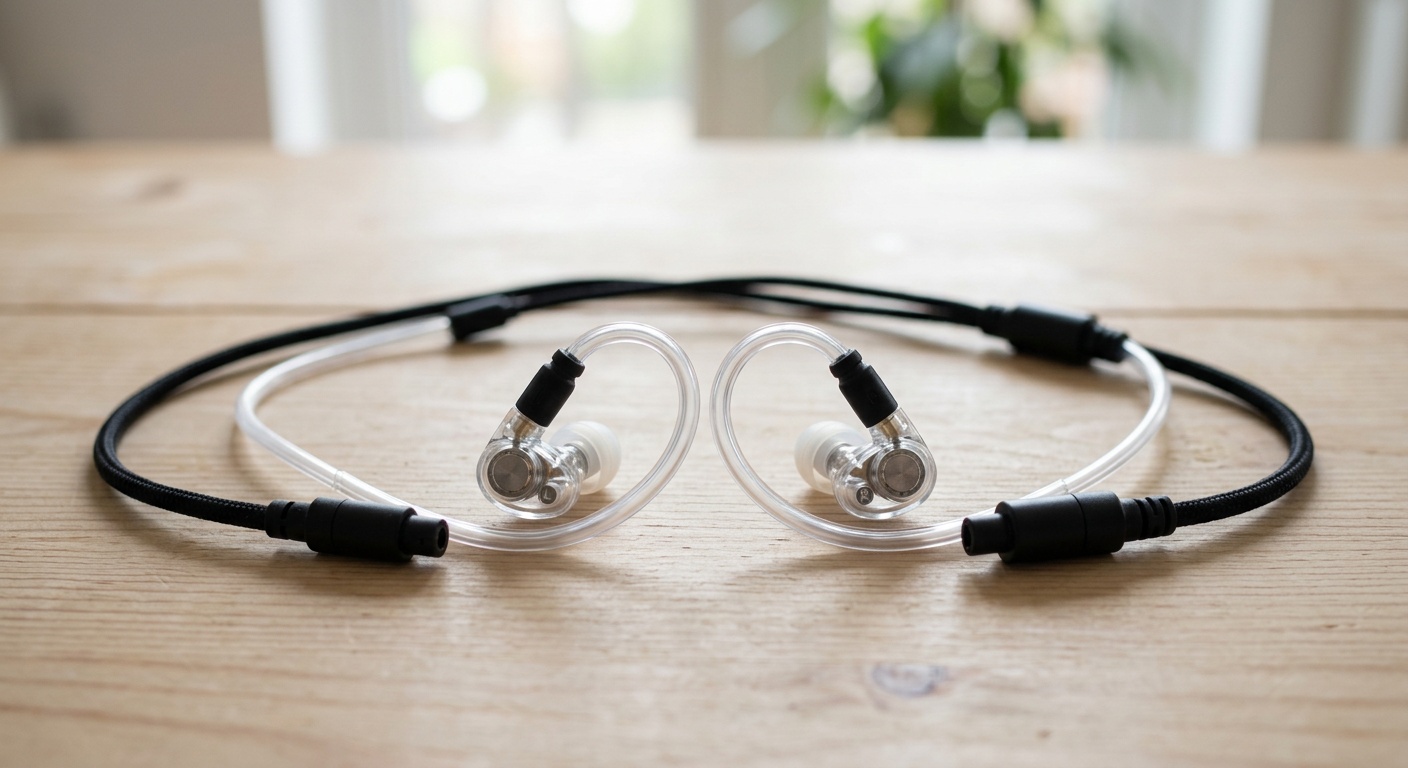
DefenderShield 3.5mm — Most Affordable Verified Option
The DefenderShield 3.5mm at $129 on Amazon AU is the lowest-priced verified hollow-tube model available in Australia. No other brand with published RF reduction test data currently ships to Australia at a lower price point.
$129 on Amazon AU →The air tube headphone market in Australia is currently a one-brand market: DefenderShield is the only brand with published RF reduction test data that stocks reliably through Amazon AU and SaferEMF AU. Generic “anti-radiation” earphones appear periodically at lower price points on Amazon AU and eBay — but without published test data, the hollow-tube claim is unverified. If you want to check whether any new verified options have become available, the Amazon AU search below shows the current category.
If budget is the primary constraint and you are choosing between an unverified cheap model and the DefenderShield 3.5mm, the DefenderShield is the correct choice. An unverified hollow tube that contains a concealed wire delivers zero RF reduction and false confidence. The $129 DefenderShield is the cheapest option that actually does what it claims.
Verified Budget Options — Pros and Cons
Pros
- DefenderShield 3.5mm at $129 is the lowest verified price in AU
- Amazon AU Prime delivery available
- Same RF reduction as higher-priced models
Cons
- No verified alternative under $129 currently stocks in Australia
- Generic cheap options often conceal a wire inside the tube — verify before buying
- SYB brand (US-based) does not ship to AU at time of writing
Buy if: You want the lowest-priced verified air tube option in Australia. The DefenderShield 3.5mm at $129 is the only verified model confirmed in stock. Check price on Amazon AU →
EMF Reduction
Headphones are one component of a complete low-EMF setup.
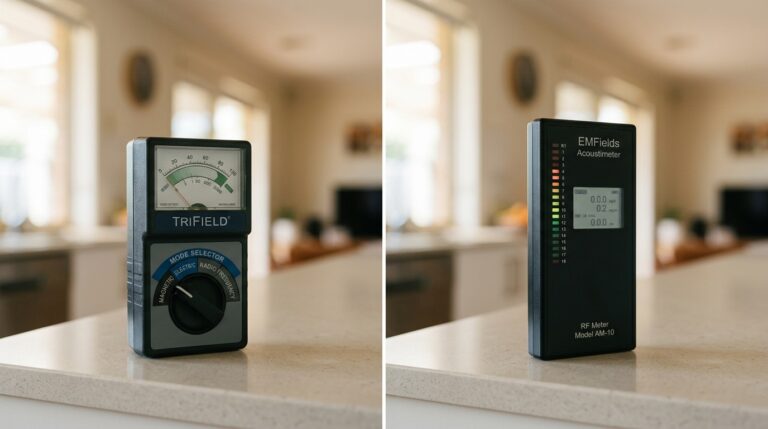
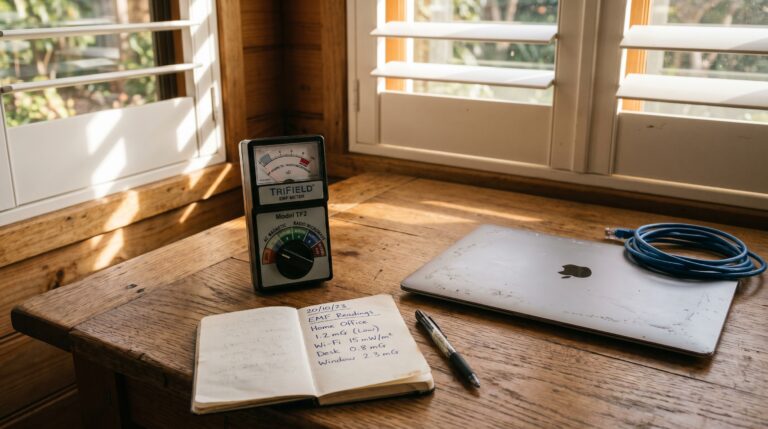
Measuring before reducing is the step most guides skip. The TriField TF2 is what I use to audit rooms at the Palm Beach house — it reads AC magnetic, AC electric, and RF/microwave fields in a single meter and is calibrated to ARPANSA limits.
See the Best EMF Meters Australia 2026 →Air Tube Headphones Comparison: Head-to-Head
| Model | Type | Connector | Price (AU) | Amazon AU | Test Data |
|---|---|---|---|---|---|
| DefenderShield 3.5mm | In-ear | 3.5mm | $129 | ✓ Yes | Published |
| DefenderShield USB-C | In-ear | USB-C | $129 | ✓ Yes | Published |
| DefenderShield Over-Ear | Over-ear | 3.5mm | $289 | ✓ Yes | Published |
| SYB Air Tube | In-ear | 3.5mm / USB-C | See SaferEMF | ✗ No | Published |
What to Look For When Buying Air Tube Headphones
The air tube headphone market has a quality problem. As the category grew in popularity, a wave of products appeared with hollow-tube branding but conventional wire construction concealed inside the tube. These products do not deliver the RF reduction they claim. Before purchasing any air tube headphone, verify four things.
Genuine hollow tube construction. The most important factor — and the only one that actually delivers EMF reduction. Some manufacturers insert a thin speaker wire through the hollow tube section, arguing it improves bass. It does improve bass; it also defeats the entire purpose. A wire inside the tube is a conductor, and RF travels along conductors. To verify: hold the tube up to a strong light source. A genuine hollow tube is translucent — you see only air. A wire-embedded tube shows a thin filament running through it. DefenderShield and SYB both use genuine hollow tubes and publish RF reduction test data to confirm it. If a brand does not publish test data, the “air tube” claim is unverified.
Connector compatibility for your specific device. Match the connector to your phone. iPhone 15 and later: USB-C. Older iPhones with Lightning: use the 3.5mm model with a Lightning-to-3.5mm adaptor. Most Android phones: check whether your model has retained a 3.5mm port — many mid-range and flagship Android phones removed it from around 2021 onwards. Using an adaptor introduces an additional interface but does not compromise the air tube’s RF reduction.
Published RF reduction test data. Any serious EMF protection product should be able to provide third-party laboratory test results showing RF reduction at the ear. DefenderShield and SYB both do this. If a brand’s product page claims “EMF-free” or “radiation-blocking” without linking to test data, treat the claim with scepticism. The absence of test data is not a minor oversight in this product category — it is the core claim.
Junction design and durability. Air tube headphones have a mechanical junction point that conventional earphones do not. This junction — where the electrical wire meets the hollow tube — is the most common failure point. The DefenderShield junction uses a reinforced housing that has proven durable across the product’s commercial lifespan since 2014. The SYB carrying case is specifically designed to prevent junction stress from tight coiling during transport. When comparing products, inspect the junction quality before committing to purchase.
What to Avoid: Common Air Tube Headphone Mistakes
Cheap marketplace products without brand accountability. Products sold generically on Amazon AU or eBay as “anti-radiation headphones” at under $30 frequently use thin wire-embedded tubes or poor junction construction. The brands reviewed in this guide — DefenderShield and SYB — have verifiable track records, published test data, and functional customer support. For a product where the specific internal construction determines whether the health benefit is real, brand accountability is not optional.
Assuming all wired headphones provide the same protection. Regular wired (3.5mm or Lightning) headphones are significantly better than Bluetooth for ear-canal RF exposure — there is no Bluetooth transmitter in the ear. But the cable still conducts some RF from the phone along its length. Studies have detected RF at the earpiece of conventional wired headphones during active calls. Air tube headphones eliminate this conduction pathway. These are different things and should not be conflated.
Not verifying connector compatibility before buying. The 3.5mm and USB-C DefenderShield models are not interchangeable. Buying the wrong connector means either returning the product or managing adaptor compatibility that the USB-C version was specifically designed to avoid.
Tight coiling during storage. The most common mechanical failure in air tube headphones is stress fracture at the junction point from repeated tight coiling. Wind headphones loosely around two or three fingers. The SYB carrying case prevents this. The DefenderShield models should be coiled loosely and not stored in tight pockets.
Ready to remove the wire from your ear?
DefenderShield air tube earbuds are in stock on Amazon AU with Prime delivery. The 3.5mm model covers most Australian phones; the USB-C model is the direct plug-in for iPhone 15+ and current Android flagships.
Last reviewed: June 2026 — Clean and Native
Frequently Asked Questions
Do air tube headphones actually reduce EMF?
Yes — specifically for the wire-conduction pathway. The hollow tube section contains no metal conductor, so RF cannot travel along it from the wire section to your ear. Your phone continues to emit RF that travels through the air (the air tube does not create a radiation-free zone), but the direct conduction path to your ear canal is interrupted. Published test data from both DefenderShield and SYB shows measurable RF reduction at the ear compared to conventional wired headphones used with an active phone call.
Are regular wired headphones safe enough without air tubes?
Regular wired headphones are a significant step down from Bluetooth earbuds — no Bluetooth transmitter in the ear. But the cable can act as an antenna, picking up ambient RF and conducting some signal to the earpiece. Research has shown detectable RF at the earpiece of conventional wired headphones during active calls. For most people with typical phone use, conventional wired headphones are an adequate reduction step. For heavy phone users, children, and EMF-sensitive individuals, air tube headphones are the more thorough solution.
Which DefenderShield model do I need for my phone?
iPhone 15 and newer (USB-C port): use the USB-C model (B0DJG3XPVZ). Older iPhones with Lightning: use the 3.5mm model (B01N4LJOE2) with a Lightning-to-3.5mm adaptor. Android with 3.5mm port (most mid-range and older flagships): use the 3.5mm model directly. Android with USB-C only (Samsung S24+, Pixel 8+, most recent flagships): use the USB-C model. Laptop or tablet via USB-C: either USB-C model or 3.5mm with USB-C audio adaptor.
Are Bluetooth earbuds like AirPods worse than air tube headphones?
Yes — significantly for ear-canal RF exposure. Bluetooth transmits 2.4 GHz pulsed RF and the transmitter is positioned directly in the ear canal, a few centimetres from brain tissue. Air tube headphones have no transmitter of any kind near the ear. The entire wire section is moved to below chest height, and the final section to the ear is hollow with no current flowing. If you are using AirPods for phone calls, switching to any wired headphone — let alone an air tube model — is a substantial reduction.
What does ARPANSA say about headphones and RF exposure?
ARPANSA sets Australia’s radiofrequency standards and publishes general guidance recommending increased distance between the phone antenna and your head during calls — via handsfree mode, speakerphone, or a headset. ARPANSA does not specifically certify or endorse air tube headphones, but the underlying principle — interrupting the direct path between the RF source and your head — aligns with their published guidance on reducing personal RF exposure during phone use.
Do air tube headphones affect sound quality?
Yes — there is a trade-off. Hollow tube transmission limits low-frequency audio more than direct wire-and-driver connections. Bass response is noticeably reduced versus quality wired earphones. Mid-range and high-frequency reproduction is adequate for calls and spoken content. The DefenderShield over-ear model has better sound than the earbuds due to a larger acoustic chamber. If high-fidelity music listening is a priority, consider using air tube headphones specifically for calls and conventional headphones for music.
Can children use air tube headphones?
Yes — this is one of the strongest use cases for the category. Children’s skulls are thinner than adults’ and their brain tissue absorbs more RF per unit of mass during phone use. ARPANSA and the WHO both recommend precautionary exposure reduction for children. The SYB model includes three tip sizes (S/M/L), which improves fit for smaller ear canals. DefenderShield earbuds come in a single earbud size — verify fit for younger children before purchasing.
How do I know if my air tube headphones are genuine?
Hold the tube section up to a strong light source. A genuine hollow tube is translucent — you see clear air and the tube wall. A wire-embedded tube shows a thin filament running through the centre. This is a five-second check that requires no equipment. Also look for published third-party RF reduction test data from the manufacturer. DefenderShield and SYB both publish this data. Any brand making EMF protection claims without published test data should be treated with scepticism.
Where can I buy air tube headphones in Australia?
Two reliable channels for Australian buyers. Amazon AU stocks the full DefenderShield range (3.5mm B01N4LJOE2, USB-C B0DJG3XPVZ, Over-Ear B08VNP2HDC) with Prime delivery. SaferEMF Australia (saferemf.com.au) is the specialist retailer stocking DefenderShield and the SYB alternative in AUD with Australian shipping. Avoid generic products listed without a recognisable EMF brand on general marketplaces — DefenderShield counterfeits have been identified on Amazon AU from third-party sellers.
Do I need to use air tube headphones all the time?
No — and that is probably impractical. The highest-impact use case is phone calls, when your phone is transmitting cellular RF at peak power. For music playback with the phone in aeroplane mode or downloading locally, the RF exposure from the device itself is lower. Prioritise air tube use for calls, particularly long calls, and for children using devices. Speaker mode remains the zero-conduction option when privacy is not required.
What is the difference between DefenderShield and SYB for Australian buyers?
Both use verified hollow tube construction with published RF reduction test data. DefenderShield has a longer commercial track record (since 2014) and is available on Amazon AU for Prime delivery — a practical advantage for buyers outside major cities. SYB offers a lower price point, three included earbud tip sizes, and a carrying case. For most Australian buyers, DefenderShield’s Amazon AU availability makes it the more convenient choice. SYB is the right pick if budget is the deciding factor or if you need the smaller tip sizes for a child.
Get the Australian Home Environment Checklist
30 checks across water, air and EMF. Most of them free. Ranked by impact.
No spam. Unsubscribe any time.

Former Royal Australian Navy Clearance Diver and TAG-E counter-terrorism operator. Founded Clean and Native to apply the same rigorous thinking to the home environment.
Full biography →