Darwin Tap Water Quality 2026: What’s Actually In It?
Water quality data in this article is sourced from Power and Water Corporation annual quality reports, DCCEEW PFAS investigation registers, and the Australian Drinking Water Guidelines (ADWG 2024). Filter recommendations reflect Darwin’s chloramine treatment system and documented PFAS investigation zones. See our full testing methodology →
Darwin tap water (Power and Water Corporation) meets Australian Drinking Water Guidelines with TDS of 140 mg/L, pH 7.5, hardness of 90 mg/L as CaCO3, and fluoride at 0.7 mg/L — but two factors change the filtration equation entirely. First, Darwin uses chloramine disinfection, not free chlorine — standard carbon filters including Brita and ZeroWater remove chloramine at roughly 1/40th the rate they remove free chlorine, making them effectively useless for Darwin’s primary disinfectant. Second, documented PFAS contamination from Howard Springs (Robertson Barracks) affects northern Darwin supply zones. The result: residents who need filtration need reverse osmosis, not a jug filter.
| Concern | Risk Level | Solution |
|---|---|---|
| Chloramine | Present city-wide | RO or catalytic carbon block only |
| PFAS (northern suburbs) | Documented — Howard Springs zone | RO only (90-95% removal) |
| Fluoride (0.7 mg/L) | Within ADWG range | RO removes 90-97% if needed |
| Hardness (90 mg/L) | Moderate — no scale issues | No action needed |
✓ Who This Is For
- Darwin homeowners who want the most cost-effective long-term filtration solution
- Renters in Darwin CBD who need a no-plumbing countertop RO option
- Residents in Howard Springs, Holtze, or Palmerston who want PFAS removal
- Households currently using a Brita or ZeroWater jug who want to know why it is not working
- Families with infants or immunocompromised members who want certified contaminant removal
✗ Who It Is Not For
- Anyone expecting a standard carbon jug filter to remove Darwin’s chloramine — it will not
- Renters who cannot modify plumbing and want only taste improvement — a catalytic carbon inline filter is a cheaper middle option
- Households outside the PFAS mapped zones whose only concern is taste — catalytic carbon is adequate and cheaper than RO
Darwin Uses Chloramine — and That Changes Everything About Filter Selection
Darwin’s tap water is treated with chloramine, not free chlorine. That distinction matters enormously when choosing a water filter, and most product listings, comparison sites, and even some plumbers get it wrong. Power and Water Corporation uses chloramine as the primary disinfectant across the entire Darwin supply zone because chloramine persists longer through the distribution network than free chlorine — critical in a tropical city with long pipe runs and high ambient temperatures that accelerate free chlorine dissipation.
The problem: standard activated carbon (GAC) — the filter media inside Brita jugs, ZeroWater pitchers, and most benchtop inline filters — removes free chlorine at a rate fast enough to matter. For chloramine, the same media operates at approximately 1/40th the removal efficiency. You would need to pass Darwin tap water through roughly 40 times the volume of GAC media to achieve equivalent chloramine reduction. In practice, a standard carbon jug filter in Darwin is doing almost nothing for the disinfectant in your water. The taste and odour of chloramine you may notice — a slightly chemical or antiseptic edge — will remain unchanged regardless of how often you change the Brita cartridge.
The correct approaches for Darwin are: reverse osmosis (which removes chloramine as a byproduct of the membrane filtration process), or a catalytic carbon block filter specifically rated for chloramine. Catalytic carbon — distinct from standard activated carbon — has a modified surface structure that catalyses the oxidative decomposition of chloramine rather than merely adsorbing it. This matters for Darwin households who want chloramine removal without a full under-sink RO installation. A catalytic carbon block benchtop filter handles the taste issue at lower cost, but does not address PFAS. If you are in a PFAS investigation zone, catalytic carbon alone is not sufficient.
As a former Navy Clearance Diver who now tests water quality using calibrated instruments at my Palm Beach home (post-EcoHero 5-Stage RO: 3 ppm TDS from 69 ppm mains water on the SEQ Grid, which is also a chloramine city), I follow the same principle in all my filter recommendations: match the filter technology to the actual disinfection chemistry of the specific city. Darwin’s chloramine profile means the recommendation set differs materially from Melbourne or Cairns — free chlorine cities where simpler carbon-block solutions are adequate. In Darwin, they are not.
Darwin Water Quality Data 2026
Power and Water Corporation publishes annual water quality reports for the Darwin supply zone. The figures below are drawn from those reports and cross-referenced against the Australian Drinking Water Guidelines (ADWG 2024). Darwin’s raw water sources include Territory reservoirs and groundwater aquifers, with the tropical wet-dry cycle creating seasonal variation in some metrics — particularly turbidity during the wet season (November through April) when heavy rainfall increases sediment load in catchment areas.
| Metric | Darwin Level | ADWG Limit | Status | Filter needed? |
|---|---|---|---|---|
| TDS | ~140 mg/L | 500 mg/L | Good | No |
| pH | 7.5 | 6.5-8.5 | Neutral | No |
| Hardness (as CaCO3) | 90 mg/L | 200 mg/L (aesthetic) | Moderate | No |
| Fluoride | 0.7 mg/L | 1.5 mg/L | Within range | Optional (RO only) |
| Disinfection | Chloramine | ADWG accepted method | Requires catalytic carbon or RO | Yes — standard carbon fails |
| PFAS (Howard Springs zone) | Documented elevated | No safe threshold exists | Elevated risk | Yes — RO required |
Darwin’s overall mineral load (TDS 140 mg/L) is well within the good range — significantly lower than Perth (~170 mg/L) or Adelaide (~400 mg/L). The hardness at 90 mg/L as CaCO3 sits in the moderate bracket. You will not experience the appliance scaling that southern Australian hard water cities produce. The neutral-alkaline pH of 7.5 is ideal for pipe longevity and taste characteristics.
The two metrics that drive filtration decisions are disinfection chemistry (chloramine, city-wide) and PFAS (zone-specific, northern areas). Everything else in Darwin water scores well by Australian and international standards. This matters for filter selection: you are solving for chloramine taste and chemistry, plus PFAS risk in affected zones — not hardness, not heavy metals, not bacteria. Knowing that narrows the product decision considerably. For a deeper look at how reverse osmosis filtration works against these specific contaminants, see our guide to reverse osmosis filters in Australia.
Darwin’s PFAS Contamination Zones
PFAS (per- and poly-fluoroalkyl substances) contamination near Darwin is real, documented, and ongoing. These synthetic chemicals — used historically in firefighting foams and various industrial applications — persist in soil and groundwater for decades because their carbon-fluorine bonds are among the strongest in organic chemistry, resistant to biological and chemical degradation. The Department of Climate Change, Energy, the Environment and Water (DCCEEW) maintains PFAS investigation registers across Australia, and Darwin has two documented source zones.
Howard Springs and Robertson Barracks area: Robertson Barracks, located approximately 25 kilometres east of Darwin CBD near Howard Springs, is a documented PFAS source zone. The Australian Army’s historical use of aqueous film-forming foam (AFFF) for firefighting training has led to PFAS migration into groundwater aquifers beneath and surrounding the barracks. Howard Springs residents on private bores in this zone have recorded elevated PFAS concentrations in DCCEEW testing. Residents on town water supply from Power and Water Corporation are connected to treated water that meets current ADWG PFAS health values — but those values are under review and will be tightened progressively as the science on PFAS toxicity at low concentrations advances. PFAS bioaccumulates in the body over years, and no safe lifetime threshold has been established.
RAAF Tindal legacy and broader NT monitoring: The Tindal RAAF base near Katherine — approximately 300 kilometres south of Darwin — is one of Australia’s most significant documented PFAS contamination sites and is subject to an ongoing remediation and monitoring program. While Tindal’s contamination primarily affects Katherine’s water supply rather than Darwin directly, the program that emerged from Tindal’s investigation has increased NT-wide scrutiny of all military-adjacent sites, including Robertson Barracks near Darwin. Any future PFAS detections at additional NT military sites are now more likely to be identified and disclosed earlier than they might have been pre-Tindal.
The practical implication for Darwin residents: if your property is in Howard Springs, Holtze, Humpty Doo, or the broader Robertson Barracks investigation zone, reverse osmosis filtration is the appropriate response. It is the only technology with documented 90%+ PFAS removal rates. Catalytic carbon provides partial PFAS reduction but not to the level an RO membrane achieves. For residents in central Darwin, Darwin CBD, Fannie Bay, or inner suburbs away from the mapped zones, PFAS risk is lower but chloramine remains a city-wide issue.
Filter Technology vs Darwin’s Actual Contaminants
Filter marketing rarely tells you which contaminants a product actually addresses and which it ignores. The table below maps filter technologies available for Darwin households against the specific contaminants that matter in Darwin’s supply. Most of what you will find on retailer shelves is designed for free chlorine cities — and Darwin is not one of them.
| Filter Type | Chloramine | PFAS | Fluoride | Darwin Verdict |
|---|---|---|---|---|
| Standard GAC (Brita, ZeroWater jug) | <5% — negligible | Negligible | None | Inadequate for Darwin |
| Catalytic carbon block | Good (60-80%) | Partial only | None | Taste improvement only |
| Reverse osmosis (RO) | Excellent (95%+) | Excellent (90-95%) | Good (90-97%) | Best choice for Darwin |
| UV filter | None | None | None | Not relevant for Darwin mains |
| Ion exchange (ZeroWater, softener) | None | None | None | Wrong tool for Darwin |
The table illustrates why recommendations optimised for Melbourne (free chlorine city, no mapped PFAS, very soft water at TDS ~60 mg/L) produce the wrong product shortlist for Darwin. The only technology that adequately addresses Darwin’s chloramine AND the PFAS risk in affected zones is reverse osmosis. For residents outside the PFAS mapped zones whose only concern is chloramine taste, a high-quality catalytic carbon block filter is a valid and significantly cheaper alternative. But anyone who wants comprehensive protection — chloramine, PFAS, and fluoride — has one answer: RO. See our full water filter guide for Australian households for how Darwin’s profile compares to other cities.
Best Water Filters for Darwin Residents 2026
The three filters below are selected specifically for Darwin’s contaminant profile: chloramine disinfection city-wide, documented PFAS in northern zones, and moderate hardness that does not require softening. All three are available in Australia with proper support and verified ASIN or affiliate links. None are generic recommendations recycled from a southern Australian context.
1. EcoHero 5-Stage Reverse Osmosis — Best Under-Sink for Darwin
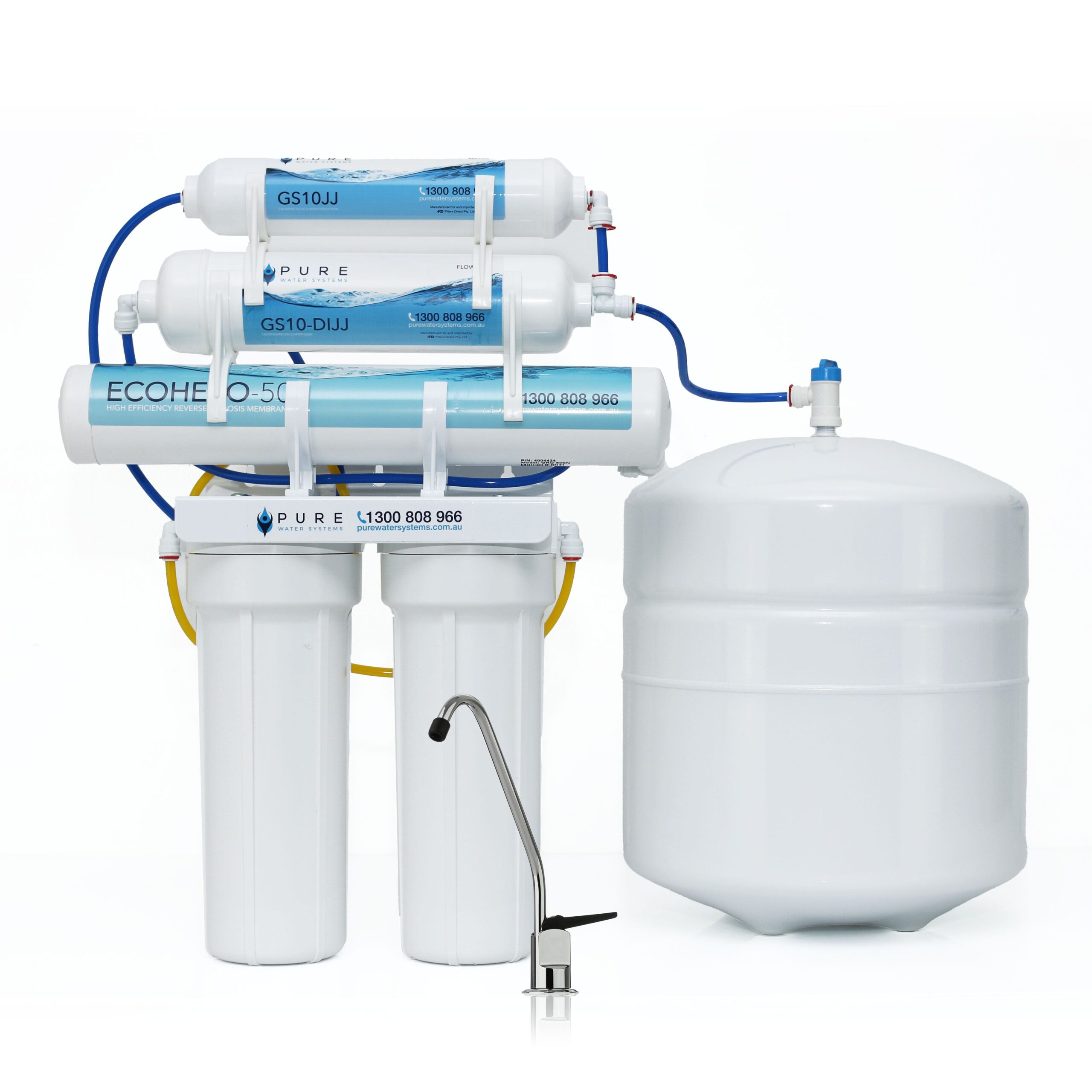
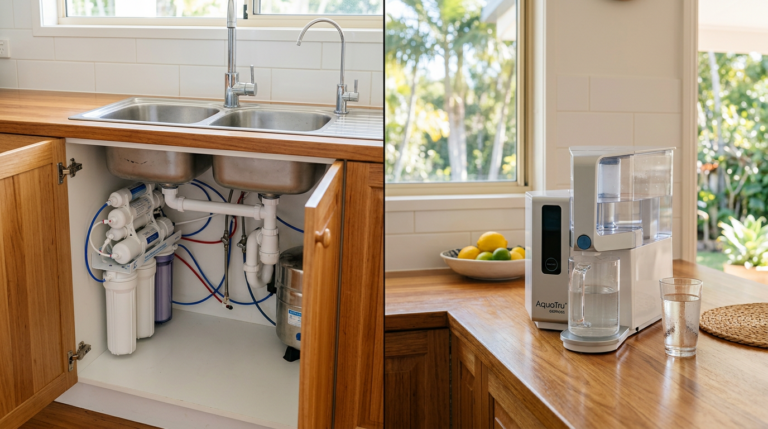
The EcoHero 5-Stage RO is the unit I run at my Palm Beach home, where mains water (SEQ Grid, also a chloramine city) starts at 69 ppm TDS and exits the RO membrane at 3 ppm — a 95.7% TDS reduction verified with a calibrated TDS-3 meter. The reason this unit ranks first for Darwin is the pre-filter configuration: stage 2 uses a catalytic carbon block (not standard GAC), which addresses chloramine before water reaches the RO membrane. This dual-action approach — catalytic carbon for chloramine taste and odour, RO membrane for PFAS and fluoride — makes it the most comprehensive solution for Darwin’s specific contaminant profile.
The 5-stage system includes a sediment pre-filter (stage 1), catalytic carbon block (stage 2), second carbon block (stage 3), 75 GPD RO membrane (stage 4), and post-filter polishing carbon (stage 5). The 75 GPD membrane produces approximately 285 litres per day — more than sufficient for Darwin household drinking and cooking use, even accounting for Darwin’s higher per-capita water consumption in tropical heat. Pure Water Systems provides Australian-based support, and filter replacement kits are available domestically without 2-3 week international shipping delays.
For Darwin homeowners with under-sink plumbing access, the EcoHero is the benchmark. Professional installation is recommended (budget approximately $150-200 for a Darwin plumber), but filter replacement is DIY — annual cost around $120-150 AUD for the full cartridge set. The dedicated RO tap means filtered water comes from a separate outlet, so your full mains flow stays available for other uses. Use the code at checkout at Pure Water Systems for 10% off.
2. AquaTru Classic Smart Alkaline — Best Countertop / Renters
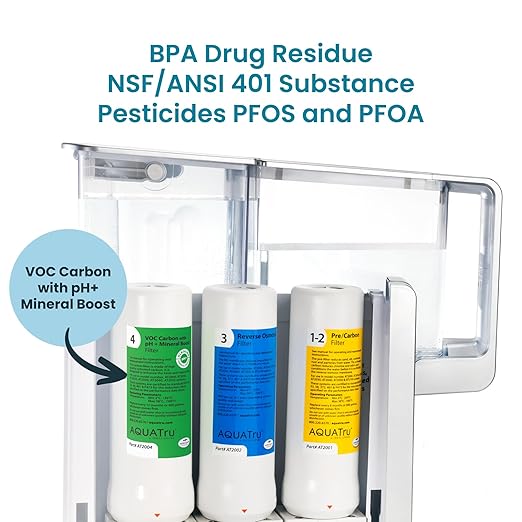
The AquaTru Classic Smart carries four NSF/ANSI certifications — 42 (aesthetic), 53 (health effects), 58 (RO membranes), and 401 (emerging contaminants). That is the strongest independent certification stack available on a countertop RO unit sold in Australia. The NSF/ANSI 58 certification validates the RO membrane’s performance against a controlled test standard, including rejection rates for PFAS-class compounds. The NSF/ANSI 401 certification covers emerging contaminants such as pharmaceuticals and microplastics. These are third-party verified — not self-declared specifications.
For Darwin renters who cannot modify plumbing, the AquaTru’s zero-installation design (plug into power, fill the top reservoir manually) is the only viable path to RO-grade filtration. The internal pump is a meaningful advantage in Darwin specifically: mains pressure in some Darwin suburbs — particularly older Darwin CBD plumbing and some Howard Springs connections — can be variable. Under-sink RO systems that rely entirely on mains pressure may produce slower filtration when pressure drops below 40 psi. The AquaTru’s internal pump delivers consistent membrane pressure regardless of mains variation.
The alkaline remineralisation stage adds calcium and magnesium back after RO filtration. Note that this stage does not affect PFAS or chloramine removal — the filtration happens before remineralisation. Amazon AU stocks the AquaTru Classic Smart for Darwin delivery, unlike some specialty filter brands that can take 2-3 weeks from mainland distributors. For a detailed comparison of how the AquaTru performs against competing countertop RO options, see our countertop water filter guide.
3. Waterdrop D6 — Best Tankless Under-Sink
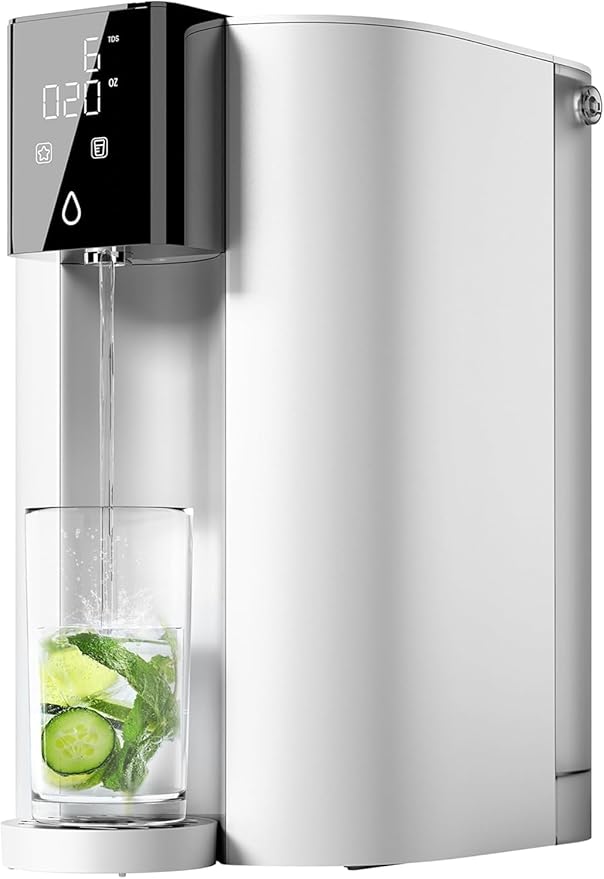
The Waterdrop D6 is the tankless alternative for Darwin homeowners who want under-sink RO without a pressure storage tank. Traditional under-sink RO systems use a pressurised vessel — typically 4-8 litres — to hold filtered water until you turn the tap. That tank is a vulnerability: if you travel or are away from home for several days (not uncommon for Darwin’s fly-in-fly-out demographic and tourism workers), water in the tank can develop taste changes from stagnation. Darwin’s tropical humidity also raises the risk of bacterial growth in stagnant stored water if the UV pre-treatment stage is absent. The D6 eliminates the tank entirely, producing filtered water on-demand at 600 GPD.
The 600 GPD output means you are not waiting for a tank to pressurise. Turn the dedicated RO tap on, filtered water flows at close to normal tap pressure within a few seconds. For Darwin’s tropical climate — where hydration requirements are genuinely higher than in cooler southern cities — the D6’s flow rate is a practical advantage over tank-based systems at similar price points. The compact design fits neatly in most Darwin apartment and house sink cabinets, including the narrow configurations common in Darwin CBD units.
Filter replacement uses a tool-free twist-lock mechanism: no plumber, no tools, no water shutoff required. This matters for Darwin renters who need to change filters without triggering landlord involvement in plumbing access. Amazon AU stocks D6 replacement cartridges for reliable Darwin delivery.
Filters That Do Not Work in Darwin — What to Avoid
⚠ These Filters Are Sold Across Australia — and All Fail Darwin’s Water
- Brita and standard carbon jug filters: Effective for free chlorine. Darwin uses chloramine — standard GAC removes chloramine at less than 5% efficiency. The most widely purchased filter in Australia and the most inappropriate for Darwin. Changing cartridges more frequently will not help.
- ZeroWater pitcher: Uses ion exchange to reduce TDS. Darwin’s TDS is 140 mg/L — there is nothing problematic to remove. Zero benefit for chloramine or PFAS. The ion exchange resin saturates quickly on Darwin’s moderate mineral content, requiring frequent expensive replacements.
- Standard inline carbon shower filters (KDF-55 or GAC): Marketed for chlorine removal, not chloramine. These provide minimal benefit for Darwin’s shower water. For chloramine removal from shower water, use a vitamin C (ascorbic acid) shower filter or a catalytic carbon shower filter instead.
- Alkaline water ionisers: Electrolytic ionisers adjust pH only. They do not filter chloramine, PFAS, or any chemical contaminant. Nothing in Darwin’s water chemistry makes an alkaline ioniser the appropriate response.
5-Year Cost Comparison — Darwin Households
Darwin households consume more water than most Australian cities — the combination of tropical heat, outdoor lifestyle, and genuine higher hydration requirements means the standard 4-litre daily household filtered output estimate is conservative for many Darwin families. The table below uses AUD pricing with 4L/day consumption for comparability across products.
| Product | Upfront | Annual Filter Cost | 5-Year Total | Cost/Litre |
|---|---|---|---|---|
| Bottled water (2L/day) | $0 | ~$730-$1,095 | $3,650-$5,475 | $1.00-$1.50 |
| Brita jug (chloramine city — largely ineffective) | ~$60 | ~$120 | ~$660 | $0.09 (but fails chloramine) |
| EcoHero 5-Stage RO (homeowners) | ~$750 + install | ~$130 | ~$1,600 | $0.11 |
| AquaTru Classic Smart (renters) | ~$699 | ~$150 | ~$1,449 | $0.10 |
| Waterdrop D6 (tankless) | ~$699 + install | ~$140 | ~$1,499 | $0.10 |
The Brita row is included deliberately. Darwin residents currently using a standard carbon jug filter are paying $0.09/litre for a filter that does not address their city’s primary disinfection chemistry. The switch to any of the three RO systems above breaks even against bottled water within 18 months. Over a 7-10 year period — realistic for an under-sink RO system — the per-litre cost drops further as fixed upfront and installation costs amortise across greater output volume.
Which Filter Is Right for You — Darwin Decision Guide
3 Questions to Find Your Darwin Filter
- Can you modify your plumbing?
YES: EcoHero 5-Stage RO (under-sink, best long-term value) or Waterdrop D6 (tankless, compact footprint)
NO: AquaTru Classic Smart (countertop, zero installation) - Which Darwin suburb are you in?
Howard Springs / Holtze / Humpty Doo / Palmerston (Robertson Barracks zone) — PFAS risk is elevated. RO is essential, not optional.
Darwin CBD / Fannie Bay / Parap / inner suburbs — PFAS risk lower but chloramine is still present city-wide. RO strongly recommended. - What is your primary concern?
PFAS or fluoride: RO only. No other technology achieves 90%+ removal of both simultaneously.
Chloramine taste only: catalytic carbon block is adequate and cheaper than RO.
Bacteria / microbes: Darwin mains water is treated. This is not a tap water concern for Power and Water Corporation-connected households.
If your property is in Howard Springs or any suburb within the Robertson Barracks PFAS investigation zone, the decision is straightforward: reverse osmosis. PFAS closes the argument — catalytic carbon removes some PFAS but not to the 90%+ level that an RO membrane achieves, and PFAS exposure is cumulative over decades. If you are in central Darwin and your only concern is chloramine taste, a high-quality catalytic carbon block benchtop filter (not a standard GAC jug) is a legitimate and cheaper option. But for any household wanting comprehensive protection against chloramine AND PFAS AND fluoride, RO is the single correct answer for Darwin.
How We Test — Darwin Water Methodology
My direct filter testing uses a calibrated TDS-3 meter at my Palm Beach QLD home. I test pre-filter mains water, intermediate stages, and post-filter output to verify removal rates. Palm Beach mains water (SEQ Grid, chloramine city, TDS ~69 ppm) represents a broadly similar disinfection chemistry to Darwin’s chloramine treatment, making removal rate data transferable even though mineral content differs between SEQ and Darwin supply zones.
For Darwin-specific water chemistry, I reference Power and Water Corporation’s published annual quality reports, DCCEEW PFAS investigation registers, and the ADWG 2024 guidelines. Darwin tap water data in this article reflects Power and Water Corporation’s own published monitoring results, not independent laboratory analysis commissioned by this site. For individual property PFAS testing — particularly relevant if you are in Howard Springs or on a private bore — I recommend a NATA-accredited NT laboratory. Accredited commercial laboratories servicing Darwin include those that service the mining and defence sectors.
Last reviewed: May 2026 — Clean and Native
Frequently Asked Questions
Is Darwin tap water safe to drink?
Yes, Darwin tap water meets all Australian Drinking Water Guidelines and is safe to drink for most residents. Power and Water Corporation maintains compliance with ADWG 2024 across key metrics including TDS, pH, hardness, fluoride, and disinfection. The important caveat is PFAS: residents in the Howard Springs and Robertson Barracks investigation zone are in an area with documented elevated PFAS concentrations, and no safe lifetime threshold for PFAS exposure has been established. For those residents, RO filtration is a sensible precaution even though the water technically meets current compliance standards.
Does Darwin water have chlorine or chloramine?
Darwin uses chloramine disinfection, not free chlorine. Power and Water Corporation applies chloramine — a combination of chlorine and ammonia — because it is more stable than free chlorine in tropical conditions with long pipe distribution runs. This is the most important filter-selection fact for Darwin: standard activated carbon filters (Brita, ZeroWater, most jug and inline filters) are designed for free chlorine removal and are largely ineffective against chloramine. Only RO membranes or catalytic carbon block filters adequately address Darwin’s disinfection chemistry.
Does Darwin water have PFAS?
Documented PFAS contamination exists in the Howard Springs and Robertson Barracks area, approximately 25 kilometres east of Darwin CBD. The contamination originates from firefighting foam (AFFF) used at Robertson Barracks over decades. Power and Water Corporation town water in affected suburbs meets current ADWG PFAS health values, but those values are under review as the science advances. Residents in Howard Springs, Holtze, Humpty Doo, and surrounding mapped investigation zone suburbs, and anyone on a private bore in this zone, should treat PFAS as a real risk requiring RO filtration.
Does Darwin water have fluoride?
Yes, Darwin water contains 0.7 mg/L of fluoride, added by Power and Water Corporation for dental health benefits. This level is within the Australian government’s recommended range of 0.6-1.0 mg/L and below the ADWG health guideline of 1.5 mg/L. Standard carbon filters cannot remove fluoride. Only reverse osmosis (90-97% removal) or activated alumina (80-95%) does. If you want to reduce fluoride in Darwin drinking water, reverse osmosis is the practical solution — and it simultaneously addresses your other priorities (chloramine, PFAS).
Will a Brita filter work in Darwin?
No. A Brita jug uses standard granular activated carbon (GAC), which removes free chlorine efficiently but removes chloramine at approximately 1/40th the rate. Darwin uses chloramine disinfection city-wide. Your Brita is doing almost nothing for Darwin’s primary disinfectant, regardless of how frequently you replace the cartridge. This is not a product defect — Brita is designed for free chlorine cities and is simply the wrong technology for Darwin’s water chemistry.
Is Darwin water hard or soft?
Darwin water is moderately hard at 90 mg/L as calcium carbonate. This sits in the middle range — not soft enough to cause pipe corrosion concerns, not hard enough to create significant scale buildup in appliances. Most Darwin households do not need water softening. You may notice minor limescale in kettles over time — routine descaling every 3-4 months is sufficient. Water softening does not address chloramine or PFAS and is not recommended for Darwin’s hardness level.
What is the TDS of Darwin tap water?
Darwin tap water has a TDS (total dissolved solids) of approximately 140 mg/L. This is in the good range — well below the ADWG aesthetic limit of 500 mg/L and significantly lower than Adelaide (~400 mg/L) or Perth (~170 mg/L). The moderate TDS reflects Darwin’s mix of reservoir and groundwater sources processed through Power and Water Corporation treatment. After RO filtration, Darwin water TDS typically drops to 5-15 mg/L depending on membrane condition and age.
Do I need a whole-house water filter in Darwin?
Not for most Darwin households. Whole-house filtration is typically used for sediment (turbidity), which is not a persistent issue in Darwin’s treated mains supply. The contaminants that matter in Darwin — chloramine and PFAS — are drinking and cooking water concerns, not shower or laundry concerns. A point-of-use RO filter at the kitchen tap addresses your drinking and cooking water comprehensively without the cost and complexity of whole-house treatment. The exception: households on private bores in the Howard Springs PFAS investigation zone may benefit from a whole-house approach — consult a licensed water treatment specialist in that scenario.
Get the Australian Home Environment Checklist
30 checks across water, air and EMF. Most of them free. Ranked by impact.
No spam. Unsubscribe any time.

Former Royal Australian Navy Clearance Diver and TAG-E counter-terrorism operator. Founded Clean and Native to apply the same rigorous thinking to the home environment.
Full biography →