Best Bore and Tank Water Filter Australia 2026: Sediment, Iron, Bacteria and What Rural Homes Actually Need
The best bore and tank water filter system for an Australian rural home in 2026 depends entirely on your source water chemistry — iron, bacteria, hardness, and salinity all demand different treatment stages, and a single filter cannot solve all of them.
I’m Jayce Love, former Royal Australian Navy Clearance Diver, now based at Palm Beach on the Gold Coast. Over the past two years I’ve researched bore and tank water treatment for South-East Queensland properties, including acreage blocks on bore water and rain-fed tanks, drawing on manufacturer specifications, independent certification (NSF/ANSI, WaterMark AS/NZS 3500), and the Australian Drinking Water Guidelines. What comes up consistently: the most expensive mistake rural Australians make is buying a filter before testing their water. The second most expensive mistake is buying a system designed for town water and expecting it to handle bore chemistry. I have not personally tested the sediment, iron, UV, or reverse osmosis products discussed here; this assessment is based on published manufacturer specifications and independent certification, not first-hand measurement. The only products I measure first-hand are the EcoHero 5-Stage RO, TriField TF2, and Coway Airmega 150.
This guide covers both problems — systematically.
Bore Water vs Tank Water vs Scheme Water: What You Are Actually Dealing With
Town scheme water arrives at your tap having already been treated to meet the Australian Drinking Water Guidelines (ADWG) 2022. It is disinfected (usually with chloramine or free chlorine depending on your city), pH-adjusted, and tested thousands of times per year by your utility. You are filtering an already-treated product.
Bore water and tank water are completely different problems. Nobody has treated them. Nobody is testing them. You are the water authority, the treatment plant, and the consumer simultaneously.
Bore water contamination profile
Bore water is drawn from underground aquifers. Depending on the geology of the area, it can contain dissolved minerals including iron, manganese, calcium, magnesium, sodium, and fluoride at concentrations that exceed ADWG limits. It frequently contains bacteria — E. coli and coliforms are common in shallow bores under 30 metres — and it can carry hydrogen sulphide gas, which produces that rotten-egg odour. Turbidity varies by season and bore depth. Some artesian bores in South Australia and Queensland also carry arsenic at low but measurable levels.
Tank (rainwater) contamination profile
Rainwater tanks collect roof runoff. The primary contamination risks are biological: bird and possum faeces on the roof, leaf matter decomposing in the tank, mosquito larvae if the inlet is unscreened, and biofilm forming on tank walls. Depending on proximity to agricultural land or industry, chemical contamination is also possible. The National Health and Medical Research Council (NHMRC) 2011 guidance on rainwater use notes that untreated tank water used for drinking should be considered potentially contaminated with Cryptosporidium and Giardia — pathogens that UV sterilisation addresses directly but chlorine alone does not reliably neutralise at typical dosing levels.
Why scheme water filtration advice does not apply
Most filtration guides online — including most content from Australian filter retailers — are written for scheme water. They recommend activated carbon blocks to remove chlorine or chloramine taste. That advice is useless for bore and tank water. You do not have chloramine; you have iron staining your appliances, bacteria in your water, and potentially salinity high enough to taste. The filtration pathway is fundamentally different.
Australian Bore Water Issues by State: What Your Aquifer Actually Contains
Australia is a geologically diverse continent and bore water chemistry varies enormously by region. Broad generalisations are dangerous here — a Queensland coastal bore and a West Australian inland bore may require completely different treatment trains. That said, recognisable patterns exist by state and region.
Queensland — iron, manganese, turbidity
Bore water across South-East Queensland and the Darling Downs frequently presents with elevated iron (0.5-8 mg/L is common; the ADWG aesthetic guideline is 0.3 mg/L) and manganese (0.05-0.5 mg/L; ADWG guideline is 0.1 mg/L). Iron at these levels stains laundry orange, clogs irrigation lines, and produces an unpleasant metallic taste. Turbidity after rain events is also a significant issue on properties with shallow bores. North Queensland bores near agricultural areas show pesticide and nitrate contamination requiring RO for drinking water safety.
Western Australia — salinity, hardness, fluoride
WA’s inland aquifers are among the most mineralised in Australia. Salinity is the primary challenge: bore TDS in the Wheatbelt can exceed 2,000 mg/L — the ADWG health guideline for sodium is 180 mg/L and WHO guidance puts the palatability threshold at 1,000 mg/L TDS. Hardness above 300 mg/L CaCO3 is not unusual. The Water Corporation’s 2023-24 Drinking Water Quality Annual Report confirms that fluoride occurs naturally in some WA aquifers at concentrations above the ADWG health guideline of 1.5 mg/L. High-salinity WA bore water requires reverse osmosis — there is no other technology that addresses TDS and salinity at a household scale.
South Australia — hardness, alkalinity
South Australian bore water is characterised by high hardness (often 200-400 mg/L CaCO3) and high alkalinity. Adelaide town water is already among the hardest in Australian capital cities at approximately 140 mg/L; bore water in rural SA is frequently harder again. Scale deposition in hot water systems, kettles, and irrigation emitters is the main practical problem. Fluoride also occurs in some SA bore formations at elevated levels.
New South Wales — agricultural runoff, nitrates
Shallow bores and dams on NSW farming properties face contamination pressure from agricultural runoff. Nitrate contamination is the primary health concern — the ADWG health guideline for nitrate is 50 mg/L (as NO3). Properties near horticultural or intensive livestock operations should specifically test for nitrates, since elevated nitrate in drinking water poses a genuine risk, particularly to infants (methaemoglobinaemia). Standard carbon filtration does not remove nitrates. Reverse osmosis is the only household-scale technology that reliably reduces nitrate levels.
Northern Territory — seasonal turbidity, biological contamination
NT bore water quality is highly seasonal. Wet season events mobilise surface contamination into shallow bores. Biological contamination — including E. coli — is documented in shallow community bores across remote NT. UV sterilisation combined with sediment pre-filtration is the minimum viable drinking water treatment for NT bore sources.
Get a NATA-Accredited Water Test Before You Buy Anything
This section belongs before the product recommendations because it is the most important step in the process. A NATA-accredited laboratory water test costs approximately $150-$400 depending on the panel requested. That $150-400 can save you from spending $2,000 on the wrong system.
A comprehensive bore water panel should test for: total dissolved solids (TDS), pH, turbidity, total hardness, iron (total and dissolved), manganese, nitrate, fluoride, sodium, chloride, sulphate, E. coli, and total coliforms. If you are near agricultural land, add a pesticide and herbicide screen. If you are in a known fluoride or arsenic area, add those specifically.
In Queensland, ALS Global and Intertek both operate NATA-accredited water testing labs with sample collection kits available online. National testing services including ALS and Bureau Veritas operate across all states. Your state health department may also provide referrals — Queensland Health, NSW Health, and SA Health all publish guidance on private water testing options.
For rainwater tanks, a basic microbiological test (E. coli, total coliforms) combined with a chemical screen costs roughly $150-$200 and tells you definitively whether your tank water is safe to drink without additional treatment. Do not assume it is safe because it looks clear. Cryptosporidium and Giardia oocysts are invisible to the naked eye.

Once you have your results, match the contaminants found against the treatment stages below. The test result is your system specification document. For guidance on interpreting test results against ADWG thresholds, see our complete water filtration guide.
The Three-Stage Approach: How a Complete Bore or Tank Water System Works
The right framework for bore and tank water treatment is sequential — not a single filter, but a treatment train where each stage prepares the water for the next. This is how municipal water treatment plants work. At a household scale, you need the same logic in three stages.
Stage 1 — Sediment pre-filtration
Sediment enters bore and tank water as particulate matter: silt, rust particles from iron oxidation, organic debris from tank roofs, and general turbidity. Before any subsequent treatment stage can function correctly, this sediment must be removed. UV lamps are inactivated by turbidity — particles shield bacteria from UV exposure. Carbon filters load and fail prematurely when exposed to high sediment. A two-stage sediment filter — 50 micron first, then 5 micron — is the minimum pre-treatment before any UV or carbon stage.
For bore water with high iron content, a sediment filter alone will not remove dissolved iron. You need the iron filter described in Stage 1b below before the sediment polishing stage. The sequence for high-iron bore water is: iron oxidation filter, then sediment filter, then UV, then carbon or RO for drinking water.
Stage 1b — Iron and manganese removal (bore-specific)
Iron and manganese in bore water exist in two forms: dissolved (ferrous, Fe2+) and particulate (ferric, Fe3+). Particulate iron is orange-brown and visible — you can catch some of it with a sediment filter. Dissolved iron is invisible in the tap but oxidises on contact with air and oxygen, causing orange staining in sinks, toilets, and laundry. Standard activated carbon filters, GAC media, and KDF-55 media do not remove dissolved iron effectively. You need a dedicated iron filter using oxidising media — birm, KDF-85, greensand, or catalytic carbon specifically rated for iron oxidation.
These systems work by oxidising dissolved ferrous iron to ferric iron, then capturing the precipitate. Most require periodic backwashing. For very high iron levels (above 5 mg/L), aeration before filtration dramatically improves removal efficiency and extends filter media life. This is a whole-house treatment stage — you want iron removed before it reaches your hot water system, not just your drinking tap.
Stage 2 — UV sterilisation
UV sterilisation is mandatory for bore water used for drinking and food preparation. The ADWG 2022 recommends UV disinfection as a reliable barrier against Cryptosporidium, Giardia, and bacterial pathogens. UV works by damaging the DNA of micro-organisms, preventing replication. It leaves no chemical residual in the water and does not alter taste or odour. Critically, UV only works on water that is already low in turbidity and colour — which is why the sediment stage must come first.
For residential bore and tank use, a UV system rated at 30,000 microwatt-seconds per centimetre squared (30,000 µWs/cm2) meets the minimum dose for Cryptosporidium and Giardia inactivation per WHO guidelines. NSF/ANSI 55 Class A certification (which requires a minimum dose of 38,000 µWs/cm2) is the benchmark to look for. Replace the UV lamp annually regardless of apparent function — UV output degrades over time even when the lamp is still lit.
Stage 3 — Polishing for drinking water (carbon or RO)
After sediment removal and UV disinfection, the water is safe to drink in a microbiological sense. For drinking water quality that meets ADWG aesthetic and chemical guidelines — removing any residual odour, dissolved organics, or chemical contaminants such as fluoride, nitrates, or PFAS — you need a final polishing stage at the drinking tap.
For most bore and tank situations, an under-sink or benchtop reverse osmosis unit at the kitchen tap is the most effective polishing solution. RO removes 90-97% of TDS, fluoride, nitrate, PFAS, heavy metals, and most dissolved contaminants regardless of what is in the source water. It is the most versatile final-stage technology for unknown or variable bore water chemistry. Carbon block alone is not sufficient if nitrates, fluoride, or high TDS are present.
Tank Water Maintenance: What You Must Do Before Filtration
Filtration is not a substitute for tank maintenance. If your tank has six months of leaf sludge on the bottom, biofilm on the walls, and an unscreened inlet, no filter system will reliably deliver safe water. The tank must be in good condition first.
First-flush diverters
The first water running off your roof after a dry period carries the highest concentration of bird droppings, dust, and atmospheric contaminants. A first-flush diverter automatically discards the first 20-40 litres of runoff before directing water into the tank. This is the single most cost-effective improvement you can make to tank water quality before any filtration. The NHMRC recommends first-flush diverters as standard practice for all residential rainwater tanks intended for drinking use.
Mosquito screening
All tank inlets, overflows, and vents must be screened with 1 mm mesh or finer. An unscreened tank is a mosquito breeding site. In Queensland and the Northern Territory, this is a public health issue — Aedes aegypti mosquitoes breed in water storage and can transmit dengue fever and Ross River virus. Council health inspectors in many local government areas specifically look for screened rainwater tanks during property inspections.
Tank inlet screens: the $15 fix that prevents dengue risk
The Rain Harvesting TATS12 is a purpose-built inlet basket screen in fine stainless steel mesh sized to exclude Aedes aegypti mosquitoes. Fits standard 90mm tank inlets. Required by most Australian councils in QLD and NT.
View Tank Inlet Screen on Amazon AU →Annual internal clean
Rainwater tanks accumulate sediment sludge on the floor over time. This sludge harbours bacteria and can be disturbed by heavy rainfall events, suddenly elevating turbidity and bacterial counts above what a UV system can safely manage (because turbidity reduces UV dose effectiveness). Tanks used for drinking water should be inspected and professionally cleaned every three to five years at minimum — annually if you have heavy tree cover over the roof catchment area.
Roof material compatibility
Some older roof coatings and lead flashing can leach contaminants into tank water. The NHMRC guidance specifically cautions against collecting water from roofs with lead-based paint or treated timber that may leach biocide compounds. If you have an older home, add lead to your NATA water test panel.
Iron and Manganese: Why This Is a Separate Problem From Taste and Odour
Iron in bore water does not just taste bad — it damages infrastructure and is one of the primary drivers of early system failure when treated incorrectly. At concentrations above 0.3 mg/L (the ADWG aesthetic guideline), iron precipitates as rust and causes permanent orange staining in sinks, toilets, tile grout, and laundry. At concentrations above 1 mg/L, it accelerates membrane fouling in RO systems and blocks carbon filter media within weeks rather than months.
This is why iron removal is a whole-house, pre-treatment issue — not a drinking-water-only issue. Running high-iron bore water through an RO membrane without iron pre-treatment will foul the membrane in a matter of months and void the manufacturer warranty. Running it through a UV lamp without sediment pre-filtration reduces the UV dose received by bacteria and compromises disinfection effectiveness.
KDF-55 vs KDF-85 for iron
KDF-55 media (copper-zinc galvanic alloy) is effective for free chlorine removal and some heavy metal reduction. It is not effective for iron removal. KDF-85, which uses a different iron content formulation, does have some iron reduction capacity but works best at low iron concentrations (below 1 mg/L) and is most effective as a pre-filter to protect other media. For bore water with iron above 1 mg/L, a dedicated birm, greensand, or catalytic oxidation system is required.
Manganese — the underrated problem
Manganese is frequently present in bore water alongside iron. At levels above 0.1 mg/L (the ADWG aesthetic guideline), it causes black staining and a bitter, astringent taste. At chronic exposure levels above 0.4 mg/L (the ADWG health guideline), the WHO and ADWG note potential neurological effects with long-term consumption. Manganese requires higher oxidation potential to precipitate than iron — systems designed for iron removal may not adequately address manganese at the same media. Specify systems tested for both simultaneously, and verify against your NATA test result concentrations before purchasing.
The Systems: What to Buy and When
Stage 1: Two-Stage Sediment Pre-Filter

A whole-house sediment pre-filter system typically costs $80-$180 for the housing and first cartridges. Replacement cartridges run $15-$40 each depending on micron rating and brand. In bore water with high turbidity, expect to change the 50 micron cartridge every 2-4 weeks and the 5 micron every 4-8 weeks — far more frequently than the manufacturers’ guidelines suggest, which are typically written assuming clean town water.
Budget for ongoing media costs before committing to this system. For extremely turbid bore water, a spin-down centrifugal pre-filter installed before the sediment cartridge stage significantly extends cartridge life and reduces ongoing filter costs.
Stage 2: UV Steriliser

Sizing a UV system correctly
UV systems are rated by flow rate in litres per minute (or US gallons per minute). For a household of 4 people with a single bathroom, a 12 GPM (approximately 45 LPM) unit is adequate. If you are running irrigation, stock water, or multiple bathrooms simultaneously, size up. Under-sizing a UV unit means water passes through faster than the lamp can deliver the required UV dose — and you get inadequate disinfection despite running the system.
Transmittance and turbidity limitations
UV systems are rated at a specified UV transmittance (UVT) — typically 75% or 95% for residential systems. If your bore water has colour (humic acids, iron, tannins), UVT will be lower, and the effective UV dose delivered is reduced. This is exactly why sediment pre-filtration must precede UV, and why NATA testing for colour and turbidity is essential before specifying a UV system. In highly coloured bore water, you may need a UV unit rated for lower transmittance, or additional pre-treatment to reduce colour before the UV stage.
Annual lamp replacement
UV lamp output drops to approximately 60-70% of original intensity after 9,000 hours of operation — roughly one year of continuous use. Most manufacturers specify annual replacement regardless of whether the lamp is still lit. A burned-out lamp provides zero disinfection while appearing functional. Systems with UV intensity monitors and audible or visual alarms when output drops below effective dose are worth the additional cost for bore water applications where biological contamination is a real risk.
Stage 1b: Iron and Manganese Filter (Whole-House)
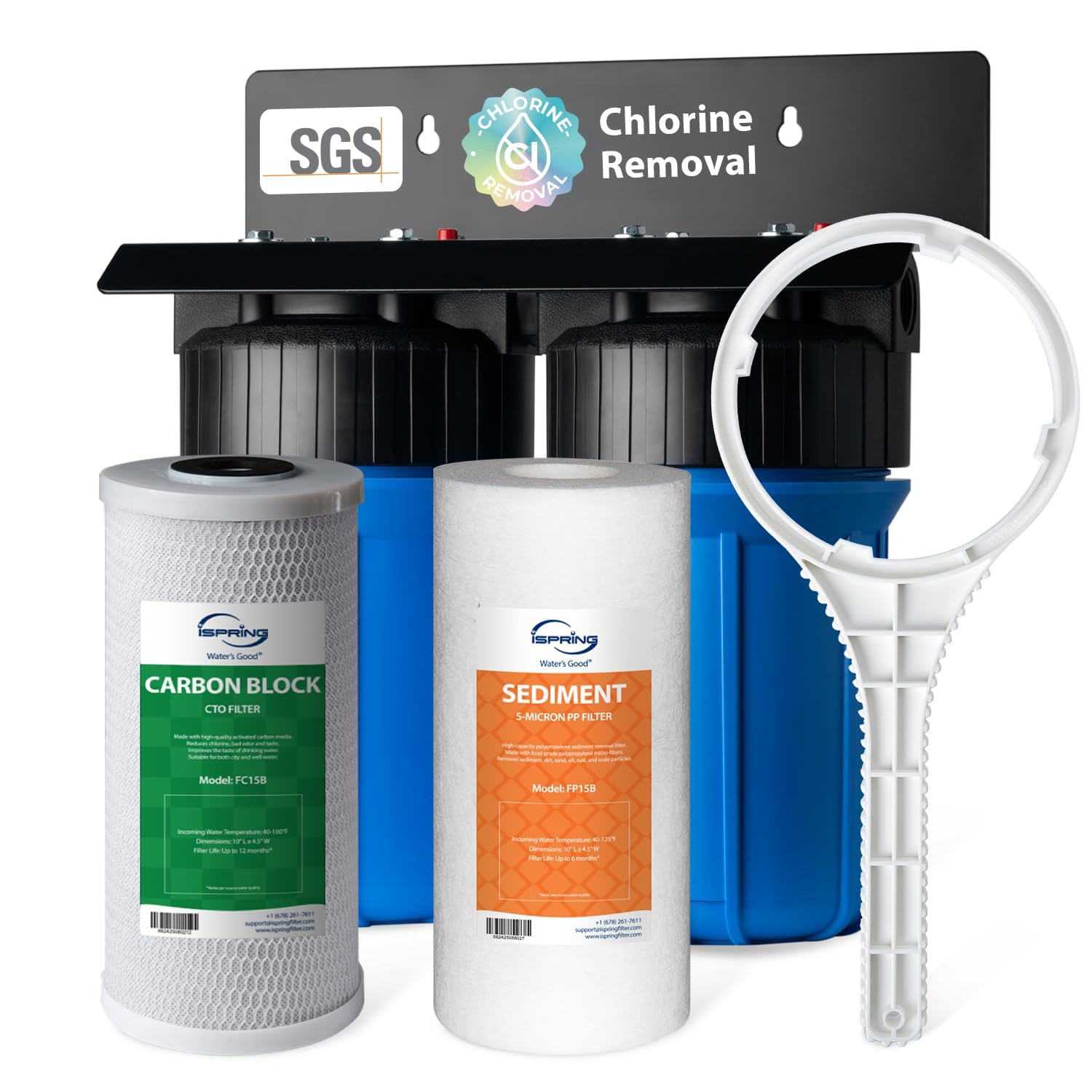
Birm media operates effectively at pH 6.8-9.0 and requires dissolved oxygen in the water at a ratio of approximately 15% of the iron concentration. If your bore water pH is below 6.8 or has very low dissolved oxygen, birm performance drops significantly. In these cases, greensand (potassium permanganate regenerated) or a catalytic carbon iron filter may perform better — another reason your NATA test results are the specification document for every purchasing decision.
Pure Water Systems Whole-House Multi-Stage (Best Complete Bore System)

For bore water applications, an Australian specialist supplier that configures systems to your specific water test results is worth considerably more than a generic multi-stage unit purchased from a marketplace. The difference is system design — a supplier like PWS will match media type to your iron and manganese concentrations, size the UV unit to your bore flow rate, and specify the correct sediment micron ratings based on your turbidity reading. A marketplace unit is designed for a hypothetical average customer, not your bore.
PWS components carry WaterMark certification where required under Australian Standard AS/NZS 3500 — the plumbing standard that governs water service installations in Australian homes. When engaging a licensed plumber to install your system (mandatory under state plumbing regulations for any connection to a household water supply), WaterMark-certified components are generally required. Non-certified components may not be approved for installation by a licensed plumber.
Bore and Tank Water System Options
Complete water filtration guide →Stage 3: Waterdrop D6 Under-Sink Reverse Osmosis (Drinking Water Polish)
RO after bore treatment, not instead of it
An RO unit installed directly on raw bore water with high iron, turbidity, or TDS will fail rapidly. The RO membrane is sensitive to fouling — iron precipitate, sediment, and high TDS all accelerate membrane degradation. The cost of a replacement membrane ($80-$200) every few months rather than every 2-3 years represents a significant avoidable expense. The whole-house pre-treatment stages described above are not optional add-ons to the RO system — they are membrane protection. An RO system installed after proper whole-house pre-treatment will reach its rated membrane lifespan of 2-3 years reliably. Without pre-treatment, expect 2-6 months.
Waste ratio for bore water applications
Standard RO systems produce approximately 3-4 litres of wastewater for every 1 litre of purified water. For bore water applications, this is generally not a concern — the bore is replenishing the aquifer continuously. For tank water applications where the tank volume is limited, a tankless RO system with a 1:1 or 2:1 waste ratio (such as the Waterdrop D6’s stated ratio) is preferred to minimise tank depletion.
Five-Year Cost Comparison by System Type
5-Year Total Cost of Ownership — Bore and Tank Water Treatment Systems
Upfront hardware + 5 years of annual filter/lamp/media consumables. Assumes household of 4 at 4L drinking water/day. Installation cost excluded (varies by region and plumber rates).
Calculation: Hardware upfront + (annual consumables x 5). PWS system assumes $2,500 hardware + $660/yr consumables (sediment cartridges, UV lamp, filter media). Sediment + UV DIY assumes $800 hardware + $560/yr. Sediment + UV only assumes $500 hardware + $340/yr. Bottled water: 4L/day x 365 x 5 years at $0.69/L (2L bottle, Woolworths 2026 pricing). Sources: Pure Water Systems AU, Amazon AU product listings, Woolworths AU. Colour legend: #3A8A5A = complete bore system (recommended); #1A3326 = partial systems; #999999 = bottled water benchmark.
The complete bore system costs more upfront than partial systems, but covers every contaminant pathway. A partial system that leaves fluoride, nitrates, or biological contamination unaddressed is not a cost saving — it is a health liability. Against the bottled water benchmark, the complete PWS system plus Waterdrop D6 pays back within three years on consumable costs alone, not accounting for the value of having safe water at every tap in the house rather than just purchased drinking water.
Decision Tree: Which System Do You Need?
Bore and Tank Water — 3-Question System Selector
1. What is your water source?
Bore water: Start with NATA test. Iron/manganese present = add whole-house iron filter as Stage 1b. All bore water = sediment pre-filter + UV mandatory.
Tank (rainwater): First-flush diverter + mosquito screening first. Then sediment pre-filter + UV minimum. Add RO at kitchen tap for drinking if near agricultural land or if NATA test shows chemical contamination.
2. What did your NATA test show?
Iron above 0.5 mg/L or manganese above 0.1 mg/L: Whole-house iron/manganese filter required before sediment filter.
Fluoride above 1.5 mg/L, nitrate above 50 mg/L, or TDS above 500 mg/L: Under-sink RO at drinking tap is mandatory.
E. coli or coliforms detected: UV steriliser is mandatory. Do not drink until installed and operational.
3. What is your primary concern?
Bacteria and safety: UV steriliser after sediment pre-filter — this is the priority stage.
Iron staining and taste: Whole-house iron filter + sediment. RO at the kitchen tap for drinking quality.
High TDS / salinity / fluoride: Whole-house treatment + under-sink RO is the only solution. Carbon filters do not address these.
Who This Is For — and Who Should Think Carefully
✓ Who This Is For
- Rural and regional Australians on bore water as their primary supply
- Properties on rainwater tanks used for drinking and cooking
- Acreage blocks and farms in QLD, WA, SA, and NSW with documented iron, hardness, or biological contamination
- Anyone who has never tested their bore or tank water and wants a systematic approach
- Off-grid households and rural properties where scheme water connection is not viable
✕ Who Should Pause First
- Anyone who has not yet done a NATA-accredited water test — buy the test before any hardware
- Properties with bore TDS above 2,000 mg/L — a standard household RO system may not deliver adequate rejection at extreme salinity; specialist systems or a water consultant may be required
- Those expecting a single carbon filter to solve bore water problems — it cannot
- Anyone assuming tank water is safe because it looks clear — Cryptosporidium and Giardia are invisible
- Properties with compromised bore casing or recent flooding — fix the physical bore integrity before adding filtration
Final Verdict
There is no single product that solves bore or tank water. Anyone selling you one filter for all of it is either uninformed or not being straight with you. The correct answer is a treatment train designed around your specific water test results — and that train has at minimum three stages: sediment, disinfection, and polishing.
For bore water with iron contamination — which covers most QLD and inland NSW properties — add a whole-house iron filter before the sediment stage. For WA bore water with high salinity and TDS, the under-sink RO is not optional — it is the only technology that addresses what is in that water. For rainwater tanks, fix the physical infrastructure first: first-flush diverter, screened inlets, and clean tank walls before any filtration investment makes sense.
The Pure Water Systems whole-house configuration combined with a Waterdrop D6 under-sink RO at the kitchen tap is the most complete solution available through Australian suppliers for most bore water scenarios. It covers bacteria, sediment, iron (with the appropriate pre-filter stage), and chemical contaminants including fluoride and nitrates at the drinking tap. Use code at Pure Water Systems for 10% off. The Waterdrop D6 is on Amazon AU with the link below.
For tank water where chemical contamination is not a concern and your NATA test shows only microbiological risk, a properly sized sediment pre-filter plus NSF/ANSI 55 Class A UV steriliser is the minimum viable system, and the total hardware cost sits below $1,000 for a family home.
Either way: test first, build the system from the test results, and install through a licensed plumber. That sequence, done in that order, is how you get safe water from an unregulated source.
Last reviewed: May 2026 — Clean and Native
Frequently Asked Questions
Bore water in Australia should not be consumed untreated. While some bore water may be chemically within ADWG guidelines, biological contamination — including E. coli, coliforms, Cryptosporidium, and Giardia — is common in shallow bores and cannot be assessed by visual inspection. A NATA-accredited water test is the only way to determine what your specific bore water contains. Until you have test results, treat bore water intended for drinking with a UV steriliser installed after sediment pre-filtration at minimum.
No. Standard activated carbon filters and GAC media do not remove dissolved (ferrous) iron from bore water. Iron removal requires an oxidising filter media — birm, KDF-85, greensand, or catalytic oxidation media. A sediment filter will catch precipitated (ferric) iron particles if they are already visible as orange-brown particulate, but dissolved iron passes straight through carbon and sediment filters and oxidises after the tap, causing staining. If your NATA test shows iron above 0.5 mg/L, specify a dedicated whole-house iron filter as the first treatment stage.
Yes. The NHMRC guidance on rainwater use notes that tank water should be considered potentially contaminated with biological pathogens including Cryptosporidium and Giardia. A UV steriliser installed after sediment pre-filtration provides the minimum acceptable biological barrier for tank water used for drinking and food preparation. If your property is near agricultural land, a NATA chemical test panel should also be conducted to check for nitrate and pesticide contamination, which UV does not remove.
UV lamps should be replaced annually regardless of whether they are still visibly lit. UV output degrades to approximately 60-70% of rated intensity after 9,000 hours of continuous operation — roughly one year. A lamp that appears lit but has degraded output delivers an inadequate UV dose and provides false security without actual disinfection. Specify a UV system with an intensity monitor and audible alarm if you are using the system for drinking water from a bore or tank source.
Standard residential RO systems are rated for feed water TDS up to approximately 2,000 mg/L. For WA Wheatbelt bore water with TDS in the 2,000-5,000 mg/L range, standard membrane rejection rates drop and system recovery ratios deteriorate. Above 2,000 mg/L TDS, consult a water treatment specialist before purchasing any system. For moderately high TDS (500-2,000 mg/L), a standard under-sink RO such as the Waterdrop D6 after proper whole-house pre-treatment will deliver 90-97% TDS rejection at the drinking tap.
A first-flush diverter is a device installed in the downpipe between your roof and tank that automatically discards the first 20-40 litres of runoff from any rain event. This runoff contains the highest concentration of bird droppings, dust, and atmospheric contaminants accumulated on the roof during dry periods. The NHMRC recommends first-flush diverters as standard practice for all residential rainwater tanks intended for drinking. They cost $80-$200 installed and meaningfully reduce bacterial and chemical loading on your filtration system, extending filter media life.
Yes, fluoride occurs naturally in some Australian aquifers — particularly in parts of WA and SA — and can exceed the ADWG health guideline of 1.5 mg/L in some bore sources. Carbon filters, including catalytic carbon, cannot remove fluoride. The only household-scale technologies that remove fluoride are reverse osmosis (90-97% removal) and activated alumina (80-95% removal). If your NATA test shows fluoride above 1.5 mg/L, an under-sink RO at the drinking tap is mandatory, not optional.
Yes, in all Australian states and territories, any water filtration equipment connected to a household water supply must be installed by a licensed plumber. This applies whether you purchase a PWS whole-house system or individual filter housings and UV units. Under state plumbing regulations (based on AS/NZS 3500), connections to water supply lines require licensed trade work. WaterMark-certified components are generally required for plumber-installed systems. Get at least two quotes and confirm the plumber holds a current licence in your state.
Get the Australian Home Environment Checklist
30 checks across water, air and EMF. Most of them free. Ranked by impact.
No spam. Unsubscribe any time.

Former Royal Australian Navy Clearance Diver and TAG-E counter-terrorism operator. Founded Clean and Native to apply the same rigorous thinking to the home environment.
Full biography →