Best Water Softeners Australia 2026: Salt-Based, Salt-Free and Electronic Descalers Ranked
Drafted with AI assistance and checked against published specifications and certifications. First-hand measurements appear only where stated. How we make content
The best water softener for Australian homes in 2026 depends entirely on where you live and what problem you are actually trying to solve — Perth and Adelaide households with genuine hard water above 150 mg/L need a true salt-based ion exchange system, while most Brisbane and Sydney homeowners can manage with a scale conditioner at a fraction of the cost.
As a former Royal Australian Navy Clearance Diver with nine years of technical experience in demanding water environments, I scrutinise every product claim in this guide against ADWG 2022 data and independent research — not manufacturer spec sheets.
Quick Verdict — 2026
The honest truth: only ion exchange actually softens water
Salt-free conditioners, electronic descalers, and magnetic devices do not remove hardness minerals. They modify the crystal structure of calcium carbonate so it deposits less aggressively — that is scale prevention, not softening. If you have Perth or Adelaide hardness levels (140–200 mg/L CaCO&sub3;) and your skin is dry, your appliances are furring up, and your taps are scaling, you need a true ion exchange system. The PWS Water Softener is WaterMark certified, sized for Australian hardness levels, and the only whole-house solution on this list that actually removes calcium and magnesium from your water.
| Product | Technology | Truly Softens? | Verdict |
|---|---|---|---|
| PWS Water Softener | Ion exchange | YES | Top pick for Perth & Adelaide |
| Aquasana EQ-1000-AST-UV | TAC + UV | NO (scale prevention) | Best salt-free whole-house option |
| Electronic Descaler | Electromagnetic | NO (scale prevention) | Budget pick for renters |
| WaterBoss 22,000 Grain | Ion exchange | YES | Budget true softening option |
Who This Guide Is For — and Who It Is Not
✓ Who This Is For
- Perth homeowners seeing white scale on taps, showerheads, and inside kettles
- Adelaide households dealing with hard River Murray water plus chloramine
- Anyone whose hot water system efficiency has noticeably dropped in the last 2-3 years
- Parents of children with eczema in hard water cities looking for a clinical trial of soft water
- Brisbane homeowners wanting scale protection without salt or plumbing complexity
- Renters in any hard water city who need a no-install, budget option to slow scale accumulation
× Who It Is Not For
- Melbourne households on Yarra Valley mains supply (18-25 mg/L — a softener is unnecessary)
- Sydney metro residents on Blue Mountains catchment (50-80 mg/L — scale is rarely a real problem)
- Anyone expecting a salt-free or electronic system to deliver the skin and laundry benefits of genuine soft water — it will not
- Households wanting to remove fluoride, PFAS, or chloramine — a softener addresses none of these (see our whole-house filter guide for those concerns)
- People on sodium-restricted diets who plan to drink softened water as their only source
What Is Hard Water? How to Test Yours
Hard water is water with elevated concentrations of dissolved calcium and magnesium ions, measured in milligrams per litre of calcium carbonate (mg/L CaCO&sub3;) or in German degrees hardness (dH). The Australian Drinking Water Guidelines (ADWG 2022) classify water above 200 mg/L as hard, but in practice, most people begin noticing limescale problems above 100 mg/L. The Australian Building Codes Board and WaterMark certification scheme both recognise hardness as a water quality parameter affecting plumbing system longevity.
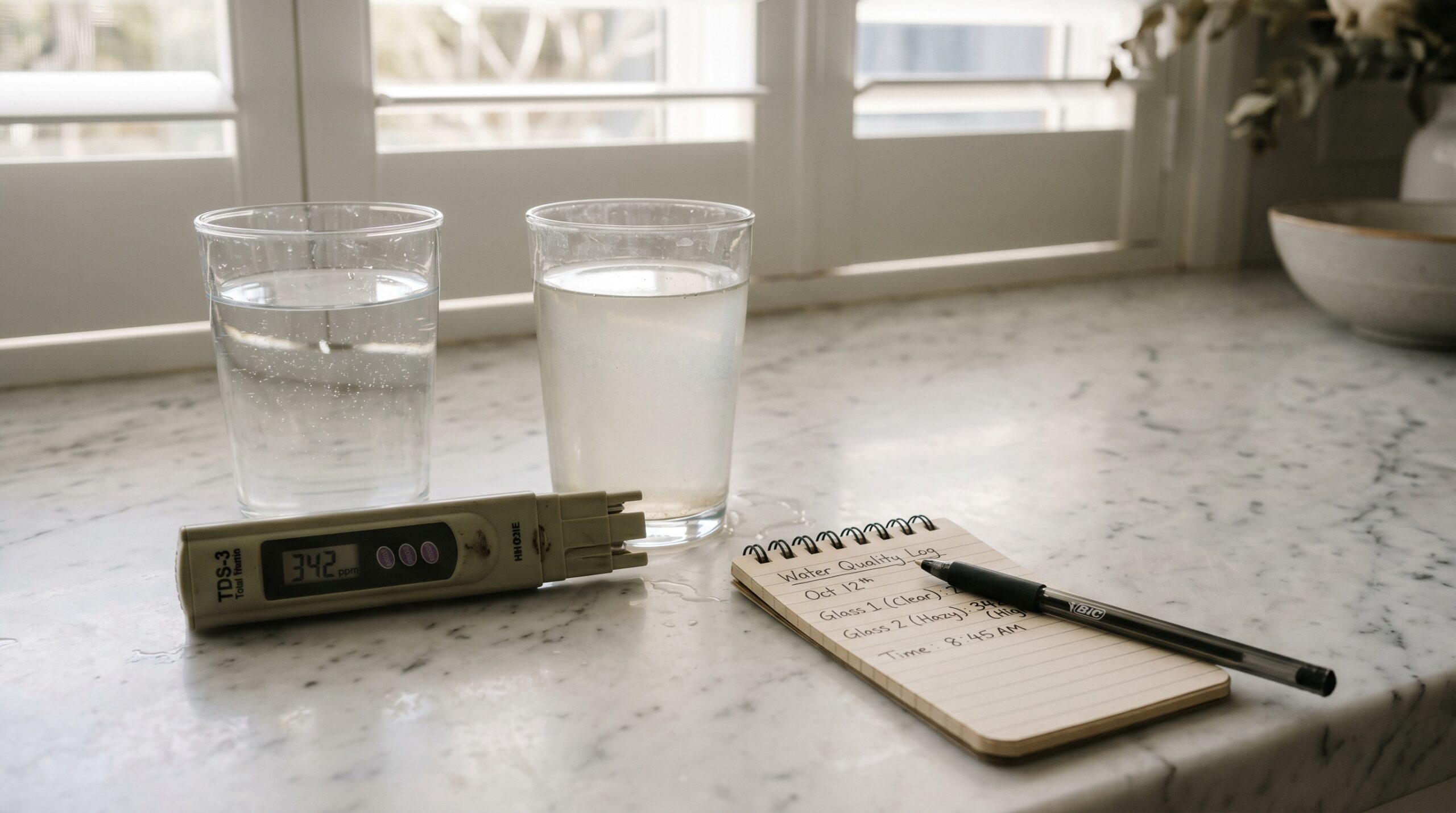
You do not need a lab test to get a working answer. A TDS-3 handheld meter ($10-15 on Amazon AU) gives you total dissolved solids in ppm (which approximates mg/L). Perth tap water consistently reads 150-200 ppm. Adelaide varies from 140 to over 300 ppm depending on the River Murray source and season. Brisbane reads 80-120 ppm. Sydney Blue Mountains catchment water reads 50-80 ppm. If you are in Melbourne on Yarra Valley catchment supply, your TDS is typically 40-70 ppm — a water softener is not a worthwhile investment.
For a more specific hardness reading, purchase a hardness test strip kit (available from pool supply stores or Bunnings). These measure calcium hardness directly, not total dissolved solids. Look for a kit that reads in mg/L CaCO&sub3; and test your cold tap in the morning before the plumbing has been flushed. A reading above 150 mg/L CaCO&sub3; puts you firmly in “softener justified” territory. Above 200 mg/L — which is the reality for many Perth households drawing from Gnangara groundwater — scale damage to hot water systems, dishwashers, and water heaters is measurable and expensive.
Salt-Based vs. Salt-Free: The Honest Truth Australian Marketers Won’t Tell You
The phrase “salt-free water softener” is one of the most misleading terms in the residential water treatment market. There is no such thing as a salt-free softener — there are only salt-free scale conditioners. The distinction is not semantic. It determines whether your skin benefits, whether your soap lathers, whether your appliances are protected, and whether you are actually solving a hard water problem or just slowing its progression.
Ion exchange softening works by passing water through a bed of resin beads charged with sodium ions. Calcium and magnesium ions are attracted to the resin and swap places with sodium ions. The water leaving the system actually has lower hardness — measurably so with a test strip. You can drink it, shower in it, and wash with it. Soap lathers more easily because soap reacts with calcium and magnesium to form the grey scum that stops lather forming. Remove the calcium and magnesium, and you remove the scum. This is chemistry with a century of industrial and residential application behind it.
Template-assisted crystallisation (TAC), which is what systems like the Aquasana EQ-1000 use, works differently. It converts dissolved calcium carbonate into a stable crystalline form that is less likely to stick to pipe walls and heating elements. The calcium and magnesium remain in the water — you would still get a positive reading on a hardness test strip. The scale deposits less aggressively, but you have not changed the water’s chemistry in a meaningful way. For people with eczema or dry skin, this matters. For protecting a hot water system from scale deposits, it provides partial protection at best under high hardness conditions.
Electronic descalers — which use electromagnetic coils wrapped around the pipe — have an even weaker evidence base. A 2011 review published in the Journal of Water Supply: Research and Technology found mixed results across independent trials, with no consensus on efficacy in water above 200 mg/L CaCO&sub3;. At Perth hardness levels, electronic descalers are not a credible solution to serious scale damage.
Australian City Guide: Do You Actually Need a Water Softener?
Not every Australian household needs a water softener. The case for one depends almost entirely on your postcode and your water source. Here is the honest breakdown by city.
Perth — Strongest Case in Australia
Perth draws groundwater from the Gnangara mound and other superficial aquifer systems managed by the Water Corporation. Hardness ranges from 150 to over 200 mg/L CaCO&sub3; depending on your suburb. Rockingham, Mandurah, and southern corridor suburbs often see the highest hardness readings. The Water Corporation updated its design standards in January 2026 (DS 81 Process Engineering) acknowledging scale-related infrastructure considerations. If you live in Perth and your taps are crusty, your shower screens are white, and your hot water system has started losing efficiency, a salt-based ion exchange softener will solve every one of those problems. This is the strongest case for a whole-house softener in Australia.
Adelaide — Worst of Both Worlds
Adelaide water comes from the River Murray and varies between 140 and over 200 mg/L CaCO&sub3; depending on the time of year and how much dilution the Murray is receiving. It is also a chloramine city — SA Water uses chloramine as the primary disinfectant. That means Adelaide residents face hard water AND a disinfectant that standard carbon filters cannot remove. A salt-based softener addresses hardness. It does not address chloramine. For Adelaide, the complete solution is a whole-house softener combined with a catalytic carbon or reverse osmosis filter. On its own, a softener produces softer water that still tastes of chloramine. See our guide to chloramine in Australian cities for the filtration side of this problem.
Brisbane and South-East Queensland — Moderate, Manageable
Brisbane hardness runs 80-120 mg/L CaCO&sub3; from the Wivenhoe/Somerset catchment system. This is moderate hardness — annoying but not at the level where appliance damage is severe. A TAC conditioner or electronic descaler is a proportionate response for Brisbane homeowners. A full salt-based softener is not unreasonable if you are particularly sensitive to dry skin or have a high-value hot water system to protect, but it is not essential. Logan and Ipswich areas on different supply zones can see slightly higher variation — worth testing your specific supply.
Sydney — Generally Soft, Exceptions Apply
Sydney’s Blue Mountains catchment produces very soft water, typically 50-80 mg/L CaCO&sub3;. A salt-based softener is rarely justified for Sydney metro households. The exception is tank water: households on rainwater tanks in western Sydney suburbs like Penrith or those on private bores can see much higher hardness. Test your specific source before investing in any treatment system.
Melbourne — Do Not Bother
Melbourne water from the Yarra Valley catchment is among the softest in any major Australian city, at 18-25 mg/L CaCO&sub3; and TDS around 40-70 ppm. Buying a water softener for Melbourne tap water is money wasted. If you have a specific concern about your individual supply, test it first.
Product Reviews: Best Water Softeners Australia 2026
1. PWS Water Softener — Best Overall (Top Pick for Perth and Adelaide)

Technology and Certifications
The PWS system uses proven cation exchange resin — sodium-form resin beads that physically swap calcium and magnesium ions for sodium ions as water passes through the tank. This is not electromagnetic treatment, not crystal modification — it is the same ion exchange process used in industrial water treatment worldwide. Critically for Australian installations, the unit carries WaterMark certification, which is the AS/NZS plumbing product compliance mark required for whole-house water treatment equipment connected to the mains supply. Without WaterMark, a product cannot legally be connected to Australian mains plumbing by a licensed plumber. Many imported softeners on Amazon and eBay do not carry this mark — installing them voids your plumbing warranty and may create insurance issues.
Sizing and Capacity
The Small Home configuration provides 10,000 litres of treated water per regeneration cycle at 100 mg/L hardness (18L resin bed). The Large Home steps up to 17,000 litres per cycle (28L resin bed). At Perth hardness levels of 180 mg/L, capacity between regenerations will be proportionally lower — a household of four using 600 litres per day should budget for regeneration every 8-14 days depending on their specific hardness. The system regenerates automatically based on a timer or meter trigger, using salt from the brine tank and a set volume of water.
Flow Rate
20-40 litres per minute continuous flow. This is adequate for a full Australian family home running multiple fixtures simultaneously. Compact American-spec softeners often specify 12-15 L/min, which creates noticeable pressure drop during peak morning use. The PWS flow rate avoids this problem.
Installation Requirement
Licensed plumber required. This is both a legal requirement (WaterMark certification mandates licensed installation) and a practical one — the system requires a bypass valve, a drain connection for regeneration water, and correct placement before the hot water system. Budget $300-600 for installation in Perth or Adelaide. The plumber typically needs 3-4 hours. Pure Water Systems can recommend installers in most major cities.
Running Costs
Salt block or granular salt costs approximately $15-25 per 25 kg bag. A Perth four-person household at 180 mg/L hardness will use roughly 8-12 kg of salt per regeneration cycle and regenerate every 10-14 days — call it 250-400 kg of salt per year, or roughly $180-320 annually. Regeneration uses approximately 150-250 litres of water per cycle. There is no consumable filter cartridge to replace, and the resin bed typically lasts 10-15 years before needing replacement.
What It Does Not Address
Ion exchange softening removes calcium and magnesium. It does not filter chloramine (Adelaide), chlorine (Perth uses chloramine too), PFAS, or sediment. Adelaide and Perth residents should also consider a whole-house catalytic carbon filter or an under-sink RO system for drinking water quality. See our whole-house water filter guide for pairing options.
Our Top Pick for Perth and Adelaide
✓ Pros
- Only WaterMark-certified whole-house ion exchange system available in Australia
- Measurably removes calcium and magnesium — hardness test confirms soft water output
- 20–40 L/min flow rate handles multiple fixtures simultaneously with no pressure drop
- Ten-year resin bed lifespan; local AU installer network via Pure Water Systems
✗ Cons
- $3,295 + $300–600 licensed plumber installation — highest upfront cost on this list
- Ongoing salt cost: $180–320/year depending on household size and local hardness
- Does not remove chloramine, PFAS, or sediment — pair with carbon/RO for full coverage
- Requires licensed plumber for installation; DIY voids warranty and WaterMark compliance
2. Aquasana EQ-1000-AST-UV — Best Salt-Free Scale Prevention + Whole-House Quality

What the TAC Stage Actually Does
Template-assisted crystallisation media converts dissolved calcium carbonate into stable aragonite crystals that remain suspended in the water rather than precipitating onto pipe surfaces. Independent studies published in the Water Conditioning and Purification International journal have confirmed TAC’s effectiveness in reducing scale deposition on heating elements at hardness levels below 200 mg/L CaCO&sub3;. Above that level — which includes parts of Adelaide and some Perth groundwater zones — efficacy drops. Do a hardness test before choosing this system. If you are above 200 mg/L, the PWS ion exchange unit is the correct choice.
Carbon and KDF Filtration Stages
The EQ-1000 includes activated carbon (for chlorine and VOC removal) and KDF-55 media (for heavy metals and some chloramine reduction). The important caveat here: KDF-55 does not reliably remove chloramine at the flow rates of a whole-house system. For Brisbane, which uses chloramine, the carbon and KDF stages will reduce chloramine exposure but not eliminate it. For chloramine removal guidance specific to Australian cities, see our chloramine vs. chlorine city guide. If chloramine removal is your primary concern, a catalytic carbon system is more reliable.
UV Disinfection
The UV stage delivers 40 mJ/cm² dose — sufficient to inactivate 99.99% of bacteria and viruses including Cryptosporidium and Giardia per NSF/ANSI Standard 55 Class A requirements. This is meaningful for households on bore water, tank water, or in areas with known contamination risk. For mains water in Brisbane or Sydney, it is a precautionary addition rather than an essential one.
Running Costs and Maintenance
The carbon filter requires replacement every 3-5 years. Aquasana quotes approximately $150 per year in filter media costs, though this varies with water volume and sediment load. There is no salt cost, no regeneration water use, and no brine discharge. The UV lamp requires annual replacement at approximately $80-120 per lamp. Total annual running cost is approximately $150-220. No licensed plumber is required for the filter media changes — the plumber is needed for initial installation only.
The Honest Limitation
A hardness test strip run on water post-treatment from an EQ-1000 will still show elevated calcium and magnesium. Your skin will not feel meaningfully softer. Soap will still form some scum. The system protects your pipes from the most aggressive scale deposition, but it does not deliver the skin and laundry benefits of a true ion exchange softener. This is not a criticism of Aquasana — the product does what it claims to do. The problem is when retailers describe it as a “water softener.” It is a scale conditioner with filtration and UV. For Brisbane homeowners who primarily want to protect appliances and improve overall water quality rather than achieve actually soft water, it is a strong option.
✓ Pros
- No salt, no brine discharge — simpler ongoing maintenance than ion exchange
- Four-stage system: TAC scale prevention + carbon + KDF-55 + UV disinfection in one unit
- UV stage inactivates 99.99% of bacteria and Cryptosporidium — useful for tank/bore water
- Lower upfront cost than PWS at approximately $2,500 installed
✗ Cons
- Does NOT remove hardness — calcium and magnesium remain in water after treatment
- No skin or laundry improvement: soap still scums, skin still reacts to mineral content
- UV lamp needs annual replacement at $80–120; must not lapse or bacteria protection fails
- Efficacy of TAC stage drops at hardness above 200 mg/L — not reliable for all Perth/Adelaide zones
3. Electronic Descaler (Yarna CWD24) — Budget Option for Renters and Mild Hardness

How Electronic Descalers Work
Electronic descalers wrap signal wires around your supply pipe and generate oscillating electromagnetic fields intended to alter the nucleation behaviour of calcium carbonate crystals. The theory is that modified crystals form loose aggregates that stay in suspension rather than adhering to pipe walls and heating elements. This mechanism is real — it is the same principle used in some industrial applications. The debate is not whether the physics exists, but whether the effect is strong enough to matter in a residential setting, and whether it holds at Australian hardness levels above 150 mg/L.
Evidence Base
Independent testing is limited and inconsistent. A 2011 review in the Journal of Water Supply: Research and Technology summarised results from multiple trials and found no statistically consistent reduction in scale at hardness levels above 150 mg/L CaCO&sub3;. Several small studies showed partial scale reduction in mild hardness water. The technology is not without merit for light applications, but it is not a solution for Perth or Adelaide water at current hardness levels. At Brisbane’s 80-120 mg/L, an electronic descaler may reduce the rate of scale accumulation on a hot water system — it will not eliminate it.
Who It Is Right For
Renters who cannot modify plumbing. Apartment dwellers in Brisbane or coastal areas with moderate hardness. Homeowners who want a low-risk, low-cost trial before committing to a plumbed system. People who understand they are getting partial scale reduction, not water softening. At $150-300, the downside is limited. Do not buy one expecting any improvement in water feel, soap lather, or skin condition — there will be none, because the minerals remain in the water.
The Hard Limit
Perth and Adelaide hardness levels are above the range where electronic descalers have demonstrated meaningful efficacy in independent tests. If you are in Perth paying $200 for an electronic descaler instead of investing in a proper solution, you are likely to spend that money again in appliance servicing within two years. The maths do not work.
✓ Pros
- No plumbing required — clamps onto exterior of pipe, suitable for renters and apartments
- Zero ongoing costs: no salt, no cartridges, no replacement parts
- Approximately $150–300 — lowest upfront cost on this list
- Self-install in under 30 minutes; no licensed plumber needed
✗ Cons
- No independent evidence of efficacy above 150 mg/L hardness — ineffective for Perth/Adelaide
- Hardness minerals remain in water; zero skin, lathering, or laundry benefit
- No WaterMark certification; not a credible solution for serious hard water damage
- Reviews show mixed results even at moderate hardness — outcomes unreliable
4. WaterBoss 22,000 Grain Water Softener — Budget True Softening

Capacity at Australian Hardness Levels
The “22,000 grain” specification is stated at US hardness conventions. At Perth hardness levels (approximately 180 mg/L CaCO&sub3;, which converts to roughly 10.5 grains per US gallon), a 22,000 grain unit treats approximately 2,100 US gallons — around 7,950 litres — between regeneration cycles. For a household of four using 600 L/day, this means regeneration roughly every 13 days. That is a workable cycle for a couple or small household, but a family of five to six will regenerate more frequently and should consider the larger PWS Large Home configuration for efficiency.
Flow Rate Limitation
The WaterBoss is rated to 12-15 L/min, which is below the PWS system’s 20-40 L/min. In a smaller Australian home with one bathroom, this is not a problem. In a home where two showers might run simultaneously or a dishwasher and washing machine are operating at the same time, you may notice reduced pressure downstream. This is the practical limitation of a smaller, lower-cost system.
WaterMark Certification — Important Caveat
The WaterBoss is a US-market product. It does not carry WaterMark certification. Under the Australian Building Codes Board framework, plumbing products connected to the mains supply in most Australian states and territories are required to be WaterMark certified. In practice, some plumbers will install non-WaterMark systems, but this may affect your home insurance validity and is a grey area under state plumbing regulations. If this concerns you — and it should — the PWS Water Softener’s WaterMark certification is worth the price premium. Verify WaterMark compliance by checking the product’s listing on the ABCB WaterMark product database before installation.
Best Use Case
A renting homeowner in a hard water zone who owns their property, has a single bathroom, and wants genuine ion exchange softening at the lowest possible upfront cost. Verify Amazon AU stock availability before ordering — this model ships from US stock and availability is not guaranteed. If it is out of stock or the import price has risen, the PWS system represents better long-term value when WaterMark compliance and local support are factored in.
✓ Pros
- True ion exchange — actually removes calcium and magnesium; hardness test confirms output
- $800–1,200 on Amazon AU — lowest entry price for genuine softening on this list
- Compact self-contained unit with integrated brine tank; suits smaller homes and garages
✗ Cons
- No WaterMark certification — compliance grey area under AU plumbing regulations; affects home insurance
- 12–15 L/min flow rate causes pressure drop when multiple fixtures run simultaneously
- US-spec import with limited AU warranty support; Amazon AU stock availability unreliable
- At 22,000 grain capacity, larger Perth families regenerate every 8–10 days — more frequent than PWS
5-Year Cost Comparison: What Hard Water Actually Costs You
The upfront cost of a water softener is easy to see. The cost of not treating hard water is distributed across years of appliance repair bills, scale removal products, and premature replacement of hot water systems. According to Canstar Blue’s 2024 Australian appliance repair data, the average Perth or Adelaide household spends $500-1,500 per year on plumbing callouts, descaling, and appliance servicing attributable to hard water damage. A dishwasher heating element calcified at Perth hardness levels typically fails within 5-7 years of installation without treatment.
5-Year Total Cost of Ownership — Australian Hard Water Treatment Options
The electronic descaler at $200 looks compelling until you remember it does not work reliably at Perth hardness levels. The real comparison is between $4,295 for the PWS system (including 5 years of salt) against $2,500-7,500 in ongoing repair and descaling costs for doing nothing. For most Perth homeowners, the PWS pays for itself within 3-4 years.
Full Comparison Table
| Product | Technology | Truly Softens? | Price (AUD) | Salt Needed? | WaterMark? | Best For |
|---|---|---|---|---|---|---|
| PWS Water Softener | Ion exchange resin | YES | $3,295 | Yes | YES | Perth, Adelaide — serious hardness |
| Aquasana EQ-1000-AST-UV | TAC + Carbon + KDF + UV | NO (scale prevention) | ~$2,500 | No | Verify before install | Scale prevention + whole-house quality, Brisbane/NSW |
| Electronic Descaler (Yarna CWD24) | Electromagnetic coil | NO (scale prevention) | ~$200 | No | No | Renters, mild hardness, budget |
| WaterBoss 22,000 Grain | Ion exchange resin | YES | ~$800-1,200 | Yes | NO | Budget true softening, small household |
Installation: What to Expect in Australia
A whole-house salt-based softener is a plumbed appliance. In every Australian state and territory, connecting any device to the mains water supply requires a licensed plumber. For systems carrying WaterMark certification, this is also a legal requirement tied to the certification conditions. Attempting a DIY installation of a WaterMark-certified system may void the product warranty and potentially the WaterMark certification itself.
The typical installation for a whole-house softener involves four elements. First, the plumber identifies the correct location on the cold water main — this should be after the meter and pressure reducer, and before your hot water system, so the softener treats water going to both hot and cold fixtures. Second, a bypass valve is fitted so the softener can be isolated for maintenance or salt refilling without cutting off the household water supply. Third, a drain connection is made for the regeneration cycle brine discharge — this goes to sewer, not stormwater. Fourth, the brine tank and resin tank are positioned, typically in a garage, laundry, or utility cupboard within 1.5 metres of the drain point.
Installation typically takes 3-4 hours for an experienced plumber. Cost in Perth or Adelaide runs $300-600 for a simple installation, depending on how much pipe work is needed to reach the correct installation point. Pure Water Systems advises on preferred installers in most metro areas. Budget the installation cost as part of your total system cost — it is not optional.
Salt top-up is homeowner-maintained. Most salt-based softeners have a brine tank that holds 25-50 kg of salt, enough for several weeks of operation. Pool and spa salt (sodium chloride) is suitable and available from Bunnings or pool shops at roughly $15-25 per 25 kg bag. Do not use table salt (iodised) or road salt — these introduce impurities into the resin bed.
Does Hard Water Cause Dry Skin and Eczema? The Australian Evidence
This is one of the most-searched questions around hard water in Australia, and the answer from the clinical literature is more nuanced than either camp claims. A 2021 study published in the British Journal of Dermatology found that children with eczema living in hard water areas had higher rates of filaggrin gene mutations and that hard water exposure increased skin barrier disruption in those individuals. A 2022 trial at the University of Sheffield tested soft water intervention in eczema patients and found a statistically significant reduction in transepidermal water loss — a key eczema marker — in the soft water group.
For the Australian context specifically, Adelaide’s hard water (chloramine + 140-200 mg/L CaCO&sub3;) presents a double skin irritant. The chloramine itself is a known mild irritant at concentrations used in mains water treatment, and the calcium and magnesium in hard water interact with soap to leave a residue that disrupts the skin’s protective acid mantle. Perth conditions are similar. If you or your children have diagnosed eczema and you live in Perth or Adelaide, a trial of genuine soft water from a properly installed ion exchange system is a reasonable clinical experiment. A scale conditioner or electronic descaler leaves the calcium and magnesium in the water — it is not a useful intervention for skin conditions. Read our deeper look at hard water and eczema in Australia for the full evidence summary.
For shower filtration in hard water cities, the hard water interaction with chloramine also matters — particularly in Adelaide and Perth. See our best shower filter Australia guide for options that address both issues at the tap level if a whole-house system is not immediately feasible. If eczema is the primary driver, our dedicated shower filters for eczema roundup compares each option by filter media type.
Is Soft Water Safe to Drink?
Yes, with one caveat that is worth understanding. Ion exchange softening replaces calcium and magnesium with sodium. The sodium concentration increase depends on the hardness of your incoming water. At Perth hardness levels, a 180 mg/L CaCO&sub3; feed water softened to near-zero hardness will add approximately 50-80 mg/L of sodium to the treated water. The ADWG 2022 aesthetic guideline for sodium is 180 mg/L — most softened water sits well below this. For individuals on sodium-restricted diets (heart failure, hypertension, renal disease), their GP or cardiologist should be consulted before drinking softened water as the primary source.
Many households with whole-house softeners install a separate reverse osmosis unit at the kitchen tap for drinking and cooking water. This removes the added sodium (and any remaining hardness) to near-zero. It is not a requirement, but it is a common and sensible setup for health-conscious households. Our whole-house water filter guide covers how to integrate softening with point-of-use RO filtration.
Ready to solve your hard water problem?
The PWS Water Softener is the only WaterMark-certified, Australian-supported ion exchange system on this list. It actually removes calcium and magnesium — not just slows scale deposition.
Last reviewed: June 2026 — Clean and Native
Frequently Asked Questions
Get the Australian Home Environment Checklist
30 checks across water, air and EMF. Most of them free. Ranked by impact.
No spam. Unsubscribe any time.

Former Royal Australian Navy Clearance Diver and TAG-E counter-terrorism operator. Founded Clean and Native to apply the same rigorous thinking to the home environment.
Full biography →