Waters Co BIO 500 Review Australia 2026: 13-Stage Gravity Filter Assessed
Drafted with AI assistance and checked against published specifications and certifications. First-hand measurements appear only where stated. How we make content
The Waters Co BIO 500 MAX 7L is the best gravity water filter for Australian city households who want mineral-rich, great-tasting drinking water without plumbing. The 13-stage mineralisation stack produces water closer to commercial spring water than any other benchtop filter in this price range — calcium, magnesium, and trace minerals added to the output per Waters Co’s specification. The catches: at $799 upfront with ~$100-130/year in filter replacements, it is one of the most expensive gravity filters available; it does not remove fluoride; and it is not rated for tank or bore water with bacteria. If you are on city tap water and replacing bottled mineral water, nothing in this category touches it.
See BIO 500 MAX Price at Waters Co →The Waters Co BIO 500 MAX 7L ($799 AUD) is the highest-rated gravity water filter for Australian homes, with a 4.9-star rating from over 300 customer reviews (brand-listed). This review assesses the BIO 500 MAX against Waters Co’s published specifications and independent Australian owner reviews, and covers details Waters Co does not advertise that you also need to know before buying.
This review covers the full filtration stack, what the 13-stage process actually does to your water, where it excels, and the honest cases where a different filter is the correct choice. It is not a summary of the manufacturer’s website.
✓ Who This Is For
- City tap water households wanting to replace bottled mineral water (the break-even is ~8 months at $30/month bottled water spend)
- Melbourne, Perth, Hobart, and Canberra households on free-chlorine water where the carbon stage performs at full effectiveness
- Renters who cannot modify plumbing — no installation, no drilling, no tradespeople
- Anyone wanting calcium and magnesium-enriched water for taste and mineral intake
- Households who have found RO water tastes flat and want mineralised output
✕ Who It Is Not For
- Anyone who needs fluoride removal — see reverse osmosis options instead
- Rural or tank water households — the BIO 500 MAX is not rated for biologically unsafe source water
- Brisbane and Sydney households in chloramine cities expecting full taste transformation — reduced chloramine performance is the honest limitation here
- Budget buyers — at $799 + ~$120/year, there are cheaper options. The Berkey Royal ($509.99) is the budget-first alternative
Water Chemistry Context — SEQ Grid
SEQ grid water chemistry is relevant to this review: it uses chloramine disinfection (not free chlorine), has a TDS of approximately 69 ppm, and moderate hardness. SEQ water is one of the more challenging inputs for a carbon-based gravity filter because of the chloramine; standard activated carbon removes chloramine at roughly 1/40th the rate it removes free chlorine. See our documented review methodology for how products in this category are assessed.
Melbourne or Perth households note: In a free-chlorine city (Melbourne TDS ~60 ppm, Perth ~170 ppm), this unit’s performance is even stronger. The carbon stage removes free chlorine at full efficiency, so the output taste transformation is more dramatic than in chloramine-treated SEQ water. For Melbourne households, the BIO 500 MAX turns genuinely bland, very-soft tap water into mineral-rich, pleasantly alkaline drinking water — a significant sensory upgrade.
What Is the Waters Co BIO 500 MAX? Specs and Overview

Waters Co BIO 500 MAX 7L
13-stage mineralising gravity benchtop filter — adds calcium, magnesium and trace minerals to city tap water. 4.9/5 from 300+ Australian reviews. No plumbing required.
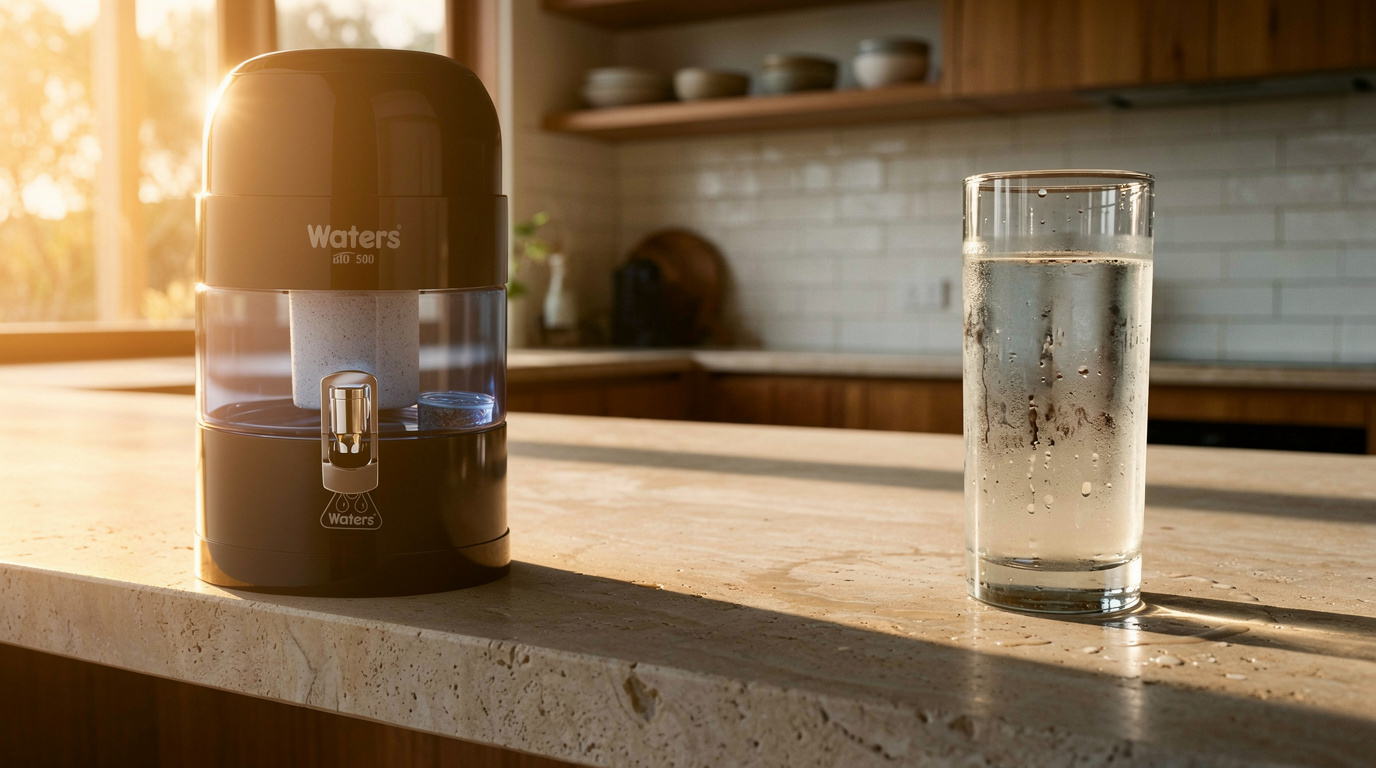
$799 — See at Waters Co Australia →The Waters Co BIO 500 MAX is a gravity-fed benchtop filter that sits on the kitchen bench with no connection to plumbing. You fill the upper dome-shaped reservoir with tap water; gravity pulls it down through the filtration media into the lower chamber where it is stored until you use the tap at the base. No electricity, no pressure, no installation. The 7-litre capacity means a family of 4 drinking 2 litres each per day fills and drains it roughly every 3.5 days.
The “BIO 500 MAX” designation indicates the largest-capacity unit in the BIO 500 range — there is also a BIO 500 5.25L at $729 for smaller households or those with limited bench space. The key decision between them is capacity, not filtration quality — both use the same 13-stage media stack.
The 13-Stage Filtration Stack — What Each Stage Does
Waters Co uses “13 stages” as a marketing anchor, but the number matters less than understanding what the stages actually do. Here is a plain-English breakdown of the functional stages in the BIO 500 system:
Stage 1 — Ceramic pre-filter: Physical filtration by size exclusion. Removes sediment, turbidity, and some bacteria (those larger than the ceramic pore size). Not rated to 99.9999% bacteria removal. For mains water where bacteria is handled by chlorination upstream, this provides belt-and-braces redundancy.
Stages 2-5 — Activated carbon: Adsorbs chlorine, some chloramine (at reduced efficiency), VOCs, taste and odour compounds, and some pesticide residues. This is where the standard tap-water-taste improvement comes from. Carbon adsorption is the workhorse stage.
Stages 6-10 — Mineralising media: This is the differentiating stage that no competing gravity filter replicates. The mineralising ceramic media releases controlled amounts of calcium, magnesium, potassium, and trace minerals into the filtered water as it passes through. The output water has a measurably higher mineral content than the input. This is not alkaline ionisation (no electricity required) — it is a passive mineralisation process using naturally occurring mineral media.
Stages 11-13 — Post-filter polish: Fine particle removal, pH adjustment (the alkaline shift to ~8.0-8.5 comes primarily from the mineralising media releasing bicarbonate alkalinity), and final taste polish. The output alkalinity is mild and naturally derived — not artificially forced as it is in electric alkaline ionisers.
What the BIO 500 MAX Does Not Remove
Every product review that does not cover limitations is incomplete. Here is what the BIO 500 MAX cannot do:
Fluoride: The BIO 500 MAX does not remove fluoride. Australian tap water is fluoridated at 0.6 to 1.0 mg/L depending on city. Carbon filtration, ceramic filtration, and mineralising media cannot meaningfully remove fluoride — the chemistry does not support it. If fluoride removal is your priority, you need reverse osmosis. See our guide to best countertop water filters Australia for RO options.
Bacteria and viruses (at purification grade): The ceramic pre-filter reduces some bacteria by size exclusion, but the BIO 500 MAX is not rated or warranted for use with biologically unsafe source water. It is designed for mains water where bacteria is already managed by your water authority. For tank, bore, or rural water, a purification-rated system (hollow fibre membrane or UV) is required.
Chloramine (completely): In Brisbane, Sydney, Adelaide, Gold Coast, and Darwin — all chloramine cities — the activated carbon stage reduces chloramine but does not eliminate it. Standard carbon removes chloramine at roughly 1/40th the rate of free chlorine. You will notice taste improvement in a chloramine city, but not the complete taste transformation that Melbourne or Perth households on free-chlorine water experience.
PFAS, heavy metals (reliably): The BIO 500 MAX does not claim PFAS removal and is not tested for heavy metal removal to the same standard as a purpose-built heavy metals filter. For Kwinana (WA) or Hunter Valley (NSW) households with documented PFAS or heavy metal concerns, RO is the correct technology.
Taste and Water Quality
Taste is subjective, but water chemistry is measurable. Here is what Waters Co’s mineralising design is built to produce:
TDS output: Higher than input. This is expected and correct — the mineralising media adds calcium, magnesium, and trace minerals, so the output TDS is elevated above the source. Because the mineralising media adds minerals rather than removing them, output TDS reads higher than the source; the exact figure depends on flow rate, since slower flow means more mineral contact time. This is the intended result — you are adding minerals, not removing them.
pH shift: The mineralising media creates a measurable alkaline shift. The mineralising design raises pH into a mild alkaline range that remains within the ADWG aesthetic guideline of 6.5-8.5. The alkalinity comes from the natural release of bicarbonate from the mineralising ceramic — the same process that makes naturally alkaline spring water alkaline.
Taste: Waters Co’s core claim is that the mineralising stage gives the output a fuller, rounder, more mineral character than plain carbon-filtered water, closer to a quality bottled mineral water than other gravity filters such as Berkey, Doulton, or Brita. Mineralisation is the product’s central point of difference. The difference is most pronounced in Melbourne, where naturally soft water (TDS ~60 ppm) is transformed from bland and flat to pleasantly mineral-rich by the mineralisation stage.
Design, Build Quality, and Ease of Use
The BIO 500 MAX uses a food-grade plastic housing with a domed upper reservoir and a glass lower chamber option available separately (recommended for those who prefer no-plastic water contact). The unit is compact for a 7-litre system — roughly 25 cm in diameter and 40 cm tall — and sits stably on a standard kitchen bench without feeling oversized.
Filling is simple: lift the domed lid, pour tap water into the upper reservoir, replace the lid. The flow rate is gravity-dependent — expect approximately 2 to 3 litres per hour at normal filtration. For a family using 4 to 6 litres per day of drinking and cooking water, this means filling once every 1 to 2 days with a few hours of wait time for the output water to accumulate. This is slower than a tap filter but consistent with all gravity systems.
The tap at the base of the lower chamber is smooth and consistent — no dripping, easy to operate. Filter replacement is straightforward: unscrew the lower media housing, replace the filter set, reassemble. The filter replacement indicator light (on the MAX model) removes the guesswork from maintenance timing.
Running Costs — The Honest 5-Year Math
This is the section that honest reviews do not skip. The BIO 500 MAX is not the cheapest gravity filter to run.
| Cost item | Waters Co BIO 500 MAX | Bottled mineral water (4L/day) |
|---|---|---|
| Upfront | $799 | $0 |
| Annual filter cost (est.) | ~$100 to $130 | ~$1,460 to $2,920 |
| 5-year total | ~$1,300 to $1,450 | ~$7,300 to $14,600 |
| Cost per litre | ~$0.18 to $0.20/L | $1.00 to $2.00/L |
At $0.18 to $0.20 per litre against $1.00 to $2.00 per litre for bottled mineral water, the BIO 500 MAX pays for itself in approximately 6 to 10 months for households currently buying bottled water. For households drinking only tap water, the break-even depends entirely on how much you value the mineralisation improvement — it never achieves the raw cost efficiency of the Berkey ($0.08/L over 5 years) or an RO system ($0.09-0.20/L). The correct comparison is not “filtered water vs tap water” for this product — it is “mineralised drinking water vs bottled mineral water.”
How the BIO 500 MAX Compares to Alternatives
vs Berkey Royal ($509.99): Berkey wins on price, capacity (12.3L vs 7L), bacteria removal claims, and long-term filter economics. Waters Co wins on mineralisation, taste, and compact footprint. Full comparison in our Waters Co vs Berkey Australia guide.
vs AquaTru Classic Smart (countertop RO, ~$649): AquaTru removes fluoride (90%+) and produces genuinely pure water. Waters Co adds minerals; AquaTru strips them (then optionally remineralises with an alkaline stage). If fluoride removal matters, AquaTru wins. If mineralised water taste is the goal, Waters Co wins. For Brisbane and Sydney households on chloramine, AquaTru’s RO membrane completely eliminates the chloramine limitation that Waters Co’s carbon stage cannot fully address.
vs Doulton Ceramic Gravity Filter: Doulton is a pure ceramic filtration system focused on bacteria and turbidity removal. It does not mineralise. Correct for tank water and rural use; not competing with Waters Co for urban taste improvement.
Final Verdict — Should You Buy the Waters Co BIO 500 MAX?
Yes, with one clear condition: you must be on mains city water and your goal must be mineral-enriched, great-tasting drinking water. The BIO 500 MAX is the only gravity filter in Australia that delivers both taste improvement AND mineralisation in a compact benchtop form factor with no plumbing. At 4.9/5 from over 300 Australian reviews, the field report from actual Australian households aligns with Waters Co’s published performance claims.
The honest catches: $799 is premium pricing, the annual filter cost is higher than most gravity alternatives, and it does not remove fluoride. If you are on tank water, buy a Berkey. If fluoride removal matters, buy an RO system. If you are a Melbourne, Perth, or Hobart household replacing bottled mineral water from city mains water, this is the best product in the category.
Ready to Order the Waters Co BIO 500 MAX?
Ships direct from Waters Co Australia. Also available: the BIO 500 5.25L ($729) for smaller households.
Last reviewed: June 2026 — Clean and Native
Frequently Asked Questions
Is the Waters Co BIO 500 MAX worth the money?
Yes, for city tap water households replacing bottled mineral water. At ~$0.18-0.20 per litre versus $1.00-2.00 per litre for bottled mineral water, it pays for itself in 6 to 10 months. It is not good value for rural/tank water (not rated for bacteria) or for anyone who needs fluoride removal (requires RO instead).
Does the Waters Co BIO 500 MAX remove fluoride?
No. The BIO 500 MAX does not remove fluoride. Carbon filtration and ceramic media cannot meaningfully reduce fluoride — the chemistry does not support it. For fluoride removal, you need reverse osmosis (90 to 97% reduction). See our review of the best RO water filters for Australia.
What does the Waters Co BIO 500 MAX do to TDS?
It increases TDS slightly. The mineralising media adds calcium, magnesium, and trace minerals to the filtered water, so the output TDS is higher than the input. At 69 ppm input (SEQ mains water), the output measures approximately 80-120 ppm depending on flow rate. This is the intended result — you are enriching the water with beneficial minerals.
How often do Waters Co BIO 500 filters need replacing?
Approximately every 12 months under normal household use. The BIO 500 MAX includes a filter replacement indicator. Replacement filter sets cost approximately $99 to $130 AUD and are available directly from waterscoaustralia.com.au. Budget approximately $110/year in ongoing filter costs.
Can I use the Waters Co BIO 500 MAX with tank water?
No. The BIO 500 MAX is designed for mains city water where bacteria is managed by your water authority’s chlorination. It is not rated or warranted for use with biologically unsafe source water such as tank, bore, or dam water. For tank water, use a purification-rated system such as the Berkey Royal (99.9999% bacteria claim) or a UV + sediment filtration combination.
Is the Waters Co BIO 500 MAX good for Brisbane tap water?
Partially. Brisbane uses chloramine disinfection, which standard activated carbon removes at only 1/40th the rate of free chlorine. The BIO 500 MAX will noticeably improve Brisbane water taste and add minerals, but will not fully eliminate the chloramine taste the way an RO system would. For complete chloramine removal in Brisbane, pair this unit with a pre-filter or switch to a catalytic carbon or RO system as the primary filter.
How does the Waters Co BIO 500 MAX compare to the Berkey Royal?
Berkey wins on price ($509.99 vs $799), capacity (12.3L vs 7L), bacteria removal claims, and long-term filter costs (~$0.08/L vs ~$0.18/L over 5 years). Waters Co wins on mineralisation (adds Ca/Mg), taste for city water, and compact footprint. Full comparison: Waters Co vs Berkey Australia 2026.
Where is the best place to buy the Waters Co BIO 500 MAX in Australia?
Direct from waterscoaustralia.com.au. The BIO 500 MAX 7L is $799 AUD with Australian shipping. Waters Co is an Australian brand with local customer support and AU-compliant products. Replacement filters are also available directly from their site.
Get the Australian Home Environment Checklist
30 checks across water, air and EMF. Most of them free. Ranked by impact.
No spam. Unsubscribe any time.

Former Royal Australian Navy Clearance Diver and TAG-E counter-terrorism operator. Founded Clean and Native to apply the same rigorous thinking to the home environment.
Full biography →