Melbourne Smoke Haze: Best Air Purifiers for Bushfire Season
Melbourne’s worst bushfire smoke events push PM2.5 concentrations above 200 µg/m³ — forty times the safe 24-hour average — and a correctly sized HEPA air purifier is the single most effective intervention for protecting indoor air quality when the Otways or Grampians ignite.
What Melbourne Bushfire Smoke Actually Contains — and Why It Matters for Filter Selection
On 25 January 2026, Melbourne woke to a city blanketed in orange-grey haze. The Otways fires pushed smoke north and east, and EPA Victoria’s AirWatch network recorded “extremely poor” and “very poor” air quality readings across the metro area. By midday, wind shifts were dragging smoke into central Victoria. This was not an isolated event. The Grampians, the Otways, and East Gippsland have produced repeat smoke events across successive summers, and the science on Victorian bushfire smoke composition is specific enough to inform filter selection precisely.
Bushfire smoke is not one pollutant. It is a mixture of three distinct threat categories, and your air purifier must address all three to be effective.
PM2.5 and PM10 particles
Fine particulate matter (PM2.5, particles under 2.5 micrometres) is the primary health driver. NHMRC guidance links sustained PM2.5 exposure above 25 µg/m³ (24-hour average) to cardiovascular and respiratory events. During a major Otways event, Melbourne outdoor PM2.5 has exceeded 200 µg/m³ — eight times the NEPM standard of 25 µg/m³. These particles are small enough to penetrate deep into lung tissue. A true H13 HEPA filter, tested to EN 1822 standard, captures 99.95% of particles at 0.3 micrometres — the most penetrating particle size (MPPS) for filter media.
Volatile organic compounds (VOCs)
Combustion produces benzene, formaldehyde, acrolein, and other VOCs. These pass straight through HEPA media. They require activated carbon adsorption. This is where cheap “HEPA” purifiers with thin carbon layers fail. The Breville Protect Max uses 3.6kg of activated carbon. The Levoit Core 400S uses a thinner carbon-lined pre-filter. There is a meaningful performance difference during prolonged smoke events with high VOC loads.
Ultrafine particles below 0.1 micrometres
Combustion also produces ultrafine particles (UFPs, under 0.1 µm) in massive numbers. True HEPA captures these via diffusion — particles this small move randomly and collide with filter fibres rather than following airflow. H13 HEPA is effective here. Ionisers and electrostatic precipitators are not, and they produce ozone as a byproduct. Do not use ioniser-only devices during smoke events.
How to Read EPA Victoria AirWatch Alerts — and What to Do at Each Level
EPA Victoria’s AirWatch system (airwatch.epa.vic.gov.au) publishes real-time Air Quality Index (AQI) readings from monitoring stations across metropolitan Melbourne, Geelong, Ballarat, and regional Victoria. During smoke events, the relevant stations are Alphington, Footscray, Mooroolbark, and Richmond for inner-suburban readings. Dandenong North and Laverton capture outer-suburban impacts. Central Victoria stations at Ballarat and Bendigo pick up smoke before it reaches Melbourne.
The AQI scale used by EPA Victoria aligns with the NEPM air quality standards. Here is exactly what each level means for your family and what action to take.
| AQI Level | PM2.5 (µg/m³) | Description | Indoor Action Required |
|---|---|---|---|
| 0-33 | 0-12 | Good | Normal ventilation. Purifier on low or off. |
| 34-66 | 12-25 | Fair | Sensitive groups (asthma, COPD, elderly): close windows, run purifier on medium. |
| 67-99 | 25-50 | Poor | Everyone: close all windows and doors. Run purifier on high. Seal door gaps if possible. |
| 100-149 | 50-100 | Very Poor | Seal gaps with wet towels. Run purifier continuously on high. Avoid all exertion. Consider N95 indoors if building has gaps. |
| 150+ | 100+ | Extremely Poor / Hazardous | Maximum protection. Relocate vulnerable people if possible. Multiple purifiers in living areas and sleeping rooms. Do not open doors or windows for any reason. |
The critical point most people miss: even with windows closed, a standard Melbourne home with air gaps around doors and window frames has an air exchange rate of roughly 0.5 air changes per hour naturally. That means outdoor air — and outdoor PM2.5 — slowly infiltrates regardless. A correctly sized HEPA purifier running continuously creates net positive pressure of clean air inside the room, outpacing infiltration. This is why CADR (Clean Air Delivery Rate) matters more than any other single specification.
The Indoor Air Quality Hierarchy: What to Do Before You Buy a Purifier
A purifier running in a leaky house is fighting a losing battle. Before you spend $300-$1,000 on a device, run through this hierarchy. It takes 20 minutes and costs almost nothing.
Step 1 — Identify and seal your biggest air gaps
The primary entry points for bushfire smoke in Melbourne homes are: door undercuts (especially external doors and the door between the garage and the house), exhaust fans left open, window frame gaps in older double-hung windows, and recessed downlights that connect to the roof cavity. A lit incense stick on a still day will show you exactly where smoke enters — you’ll see the wisps drawn toward the gap. Draught-proofing tape from any hardware store costs under $20 and cuts infiltration meaningfully.
Step 2 — Override your HVAC system
If you have ducted heating or cooling, switch it to recirculation mode (the “indoor air” or recirculate setting) immediately when AQI hits “Poor”. Fresh air intake mode actively draws outdoor smoke into the house. This is one of the most common mistakes Melbourne households make during smoke events. If your system has no recirculation mode, turn it off and use your portable purifier instead.
Step 3 — Prioritise the bedroom
You spend 7-9 hours in your bedroom. It is the highest-impact room for a single purifier. A 40m² bedroom with one correctly sized purifier achieves 5+ air changes per hour. Your living areas have more volume and more gaps. If you only have one purifier, it belongs in the bedroom, running all night during a smoke event.
Step 4 — Now size and place your purifier correctly
The AHAM standard for sizing air purifiers uses the CADR number and the room volume. The formula is simple: CADR (m³/hr) divided by the room volume (m³) equals air changes per hour (ACH). For smoke events, you want a minimum of 5 ACH in the target room. A standard Melbourne bedroom of 4m x 4m x 2.7m = 43m³ requires a CADR of at least 215 m³/hr for 5 ACH. The Levoit Core 400S at 260 m³/hr covers this comfortably. The Breville Protect Max at 550 m³/hr provides headroom for larger bedrooms and living areas up to 50m².
Best Air Purifiers for Melbourne Bushfire Smoke 2026
These three purifiers were selected based on: verified CADR ratings (not estimated), confirmed H13 HEPA grade, activated carbon weight, noise levels at maximum and sleep settings, and Australian availability. Melbourne uses free chlorine disinfection (unlike Brisbane or Sydney) — this is relevant for water filtration but not for air purifiers. What is relevant to Melbourne specifically is the city’s variable humidity: indoor relative humidity in Melbourne homes ranges from 20-65% across seasons, and filter media lifespan is affected. All three units below handle this range without performance degradation.

✓ Pros
- H13 HEPA certified to EN 1822 — captures 99.95% at 0.3 µm MPPS
- 3.6kg activated carbon stage — handles VOC loads in prolonged smoke events
- 550 CADR covers Melbourne open-plan living areas up to 50m²
- Australian brand, local warranty support, widely available at major retailers
✗ Cons
- Replacement filter cost ~$120 — higher than Levoit equivalent
- Large footprint — not ideal for small bedrooms with limited floor space
- No washable pre-filter — pre-filter replacement adds to annual running cost
Breville Protect Max — Smoke Performance in Detail
CADR and room coverage
The Breville Protect Max is AHAM-verified at 550 m³/hr CADR for smoke. In a 50m² room with a 2.7m ceiling (135m³ volume), that delivers 4.1 ACH. In a standard Melbourne bedroom of 40m² (108m³), it delivers 5.1 ACH — above the minimum threshold for effective PM2.5 control during a smoke event. No other Australian-market purifier under $700 matches this CADR number.
H13 HEPA grade
The Protect Max uses a true H13 HEPA filter tested to EN 1822, not the “HEPA-type” or “HEPA-grade” language used by some competitors to describe filters that have never been independently certified. H13 specifies 99.95% capture efficiency at the MPPS of 0.3 micrometres under test conditions. For bushfire PM2.5 (typically 0.4-2.5 µm in diameter), the actual capture efficiency is higher than 99.95% because these particles are easier to capture than the MPPS.
Activated carbon depth
3.6kg of activated carbon is the meaningful number here. During an extended smoke event — the Otways fires that impacted Melbourne in January 2026 lasted multiple days — VOC accumulation inside a sealed home is significant. Thin carbon pre-filters (some competitors use as little as 200-400g) saturate within hours under heavy smoke load. The Protect Max’s carbon depth provides genuine multi-day VOC protection.
Noise at maximum and sleep settings
Maximum speed runs at approximately 58 dB — audible, comparable to a normal conversation. Sleep mode operates at around 24 dB, which is quieter than a whispered conversation. During active smoke events you need the unit running at maximum; during sleep during moderate events, sleep mode is liveable. This is not a silent purifier at high speed — it is not designed to be. It is designed to move air fast when the Otways are on fire.
Annual Filter Replacement Cost — Sub-$700 HEPA Segment, Australia
Manufacturer-published replacement filter price (AUD), standard annual replacement schedule, one filter set per year.
Manufacturer-published AUS filter RRP. Calculation: standard 12-month replacement per manufacturer recommendations under normal-to-moderate smoke exposure. Sources: Breville AU, Winix AU, Levoit AU, Dyson AU. Bar fill #3A8A5A = our top pick; #1A3326 = peer products. Dyson filter cost highest in segment; Levoit lowest.
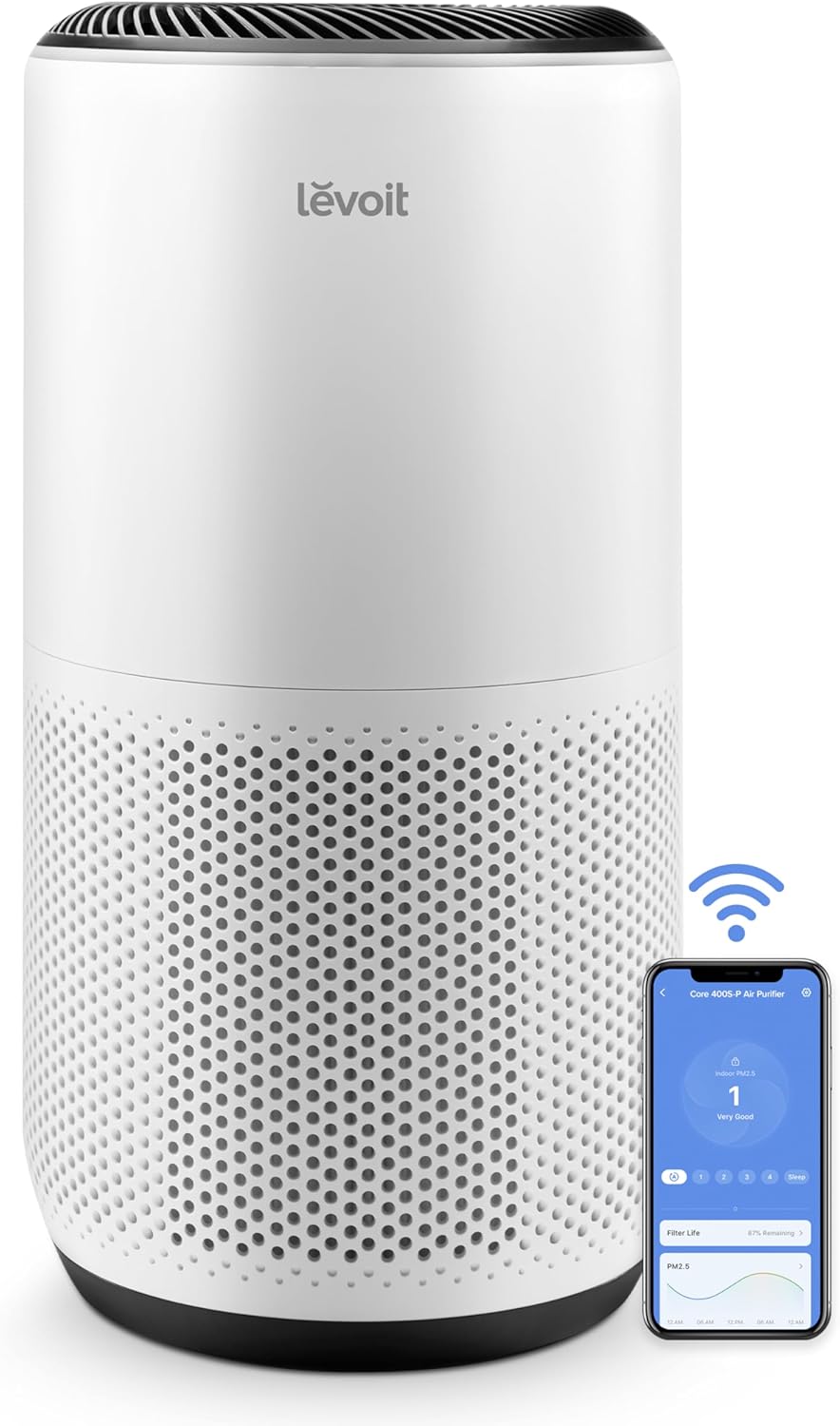
✓ Pros
- H13 HEPA certified — 99.97% capture at 0.3 µm
- Smart app control (VeSync) with auto mode and AQI display
- Lower upfront cost and lower annual filter cost than Breville
- Compact cylindrical design suits bedrooms with limited floor space
✗ Cons
- Thin carbon pre-filter saturates faster during prolonged high-VOC smoke events
- 260 CADR insufficient for open-plan Melbourne living areas above 40m²
- Auto mode sensor can lag during rapid smoke infiltration — manual high override recommended
Levoit Core 400S — Smoke Performance in Detail
CADR and room coverage
The Levoit Core 400S is AHAM-verified at 260 m³/hr CADR for smoke. In a standard Melbourne bedroom of 20m² (54m³ volume with 2.7m ceiling), that delivers 4.8 ACH — above the effective threshold. At its rated coverage of 40m² (108m³), it delivers 2.4 ACH — acceptable for moderate smoke days, marginal during peak Otways events. Keep it to single bedrooms and studies; it is not sized for open-plan Melbourne living areas.
Carbon filter depth
This is where the Levoit makes a trade-off relative to the Breville. The Core 400S uses a thin activated carbon pre-filter — adequate for incidental smoke exposure during moderate events lasting less than 24 hours. During a multi-day smoke event from the Otways or Grampians, where VOC loading is continuous, the thin carbon layer saturates and stops reducing odour. At that point the H13 HEPA continues to capture PM2.5, but you will notice smoke odour returning to the room. That is the signal to run the unit on maximum and plan a filter replacement after the event.
Smart features and when to override them
The VeSync app integration shows real-time AQI, lets you schedule, and triggers auto mode based on the onboard particulate sensor. The sensor can lag 10-15 minutes when smoke infiltrates rapidly. During those rapid-onset events, manually set the unit to maximum rather than waiting for auto mode to catch up. For overnight use during a confirmed smoke event, run maximum speed for 30-45 minutes before sleep, then drop to sleep mode. The Core 400S at sleep mode registers around 25 dB — quiet enough for most sleepers.

✓ Pros
- 330 CADR — covers living rooms up to 45m²
- Washable AOC carbon filter reduces annual consumable cost
- True 4-stage filtration: pre-filter, carbon, H13 HEPA, plasma wave (disable during smoke)
- Solid mid-range price point between Levoit and Breville
✗ Cons
- Plasma wave ioniser must be manually disabled — produces ozone if left on during smoke events
- Less carbon depth than Breville Protect Max for prolonged high-VOC conditions
- Noisier at maximum speed than equivalent CADR-rated competitors
Winix Zero Pro — Smoke Performance in Detail
CADR and room coverage
The Winix Zero Pro delivers 330 m³/hr CADR for smoke (AHAM-verified). In a 45m² Melbourne living room with a 2.7m ceiling (121m³ volume), that delivers 2.7 ACH — adequate for moderate smoke events and borderline for extended peak-AQI days. In a standard 40m² bedroom (108m³), it reaches 3.1 ACH. The Winix sits in the performance gap between the Levoit and the Breville: more capable than the Levoit in living areas, less capable than the Breville’s 550 CADR in larger open-plan spaces.
AOC carbon filter — the meaningful difference from the Levoit
The Winix Zero Pro uses an Advanced Odour Control (AOC) carbon filter — a genuine activated carbon stage, not the thin pre-filter carbon treatment used in the Levoit. During a 2-3 day smoke event, the Winix continues to suppress VOC and smoke odour noticeably longer before requiring a filter swap. The AOC filter is also washable, which reduces annual consumable cost to around $90/yr despite being a thicker carbon media. Its thicker carbon media suppresses VOC and smoke odour for longer than thin-carbon alternatives during multi-day events.
Disable the plasma wave ioniser during smoke events
Turn the plasma wave ioniser off whenever you are running the unit for bushfire smoke. The ioniser generates a small amount of ozone as a byproduct — negligible under normal air quality, but counterproductive when you are sealed indoors with elevated PM2.5 already stressing your respiratory system. The Winix app and the physical control panel both let you disable it with one button. Do it before your first smoke-season run and leave it off until fire season ends.
Best Air Purifiers for Melbourne Smoke — Buy Now
Who This Guide Is For — and Who Should Skip It
✓ Who This Is For
- Melbourne and inner-regional Victorian households (Geelong, Ballarat, Bendigo, Mornington Peninsula) affected by Otways, Grampians, or East Gippsland smoke
- People with asthma, COPD, cardiovascular conditions, or young children who need PM2.5 below 12 µg/m³ indoors even when outdoor AQI hits “Very Poor”
- Anyone who spends 8+ hours per day indoors during fire season and wants to stop waking up with a sore throat and gritty eyes
- Renters who cannot modify HVAC but can place a portable purifier in the bedroom
- Households with pets that generate dander load on top of smoke particulate
× Who It Is Not For
- Homes in direct fire risk zones — air purifiers do not provide protection during active fire events when evacuation is the only safe action
- People looking for a purifier to handle mould remediation — smoke filtration and mould remediation require different approaches; see our full air purifier guide for mould-specific recommendations
- Households wanting a whole-home ducted solution — these three units are portable room purifiers only
- People in northern Queensland or Darwin dealing with smoke from prescribed burns — different fire season timing and smoke composition applies
Decision Tree: Which Purifier for Which Melbourne Room
3-Question Smoke Purifier Decision Tree
1. What room are you protecting?
Bedroom only (up to 40m²) → Levoit Core 400S is sufficient and quieter at sleep speeds. Open-plan living area or bedroom above 40m² → you need at least 330 CADR (Winix Zero Pro or Breville Protect Max).
2. How many smoke days do you expect per season?
1-5 moderate days → any H13 HEPA purifier sized for the room is adequate. 5+ days or multi-day events (typical in Otways fire years) → carbon depth matters; choose Breville Protect Max for its 3.6kg activated carbon handling multi-day VOC accumulation.
3. Do you have household members with asthma, COPD, or cardiovascular conditions?
Yes → do not compromise on CADR. Larger is always better. Oversize the purifier for the room — 6-8 ACH instead of the minimum 5. The Breville Protect Max in a standard bedroom delivers 8+ ACH, which reduces PM2.5 to near-background levels within 12-15 minutes of maximum-speed operation.
What Smoke Does to Melbourne Indoor Air Quality — the Specific Numbers
Indoor-outdoor PM2.5 infiltration during smoke events follows a consistent pattern: within 30 minutes of a smoke event onset with windows closed, indoor PM2.5 typically reaches 40-60% of outdoor levels in a standard brick veneer home. In older timber weatherboard homes — common in inner Melbourne suburbs like Fitzroy, Collingwood, Brunswick, and Northcote — that figure reaches 70-80% due to higher air exchange rates through gaps.
Melbourne’s building stock matters here. Homes in Fitzroy North, Preston, and Reservoir — largely 1920s-1950s construction — have more natural infiltration than newer homes in Doncaster, Glen Waverley, or Point Cook. If you live in an older inner-Melbourne home and the Otways are burning, your indoor PM2.5 is tracking outdoor levels closely unless you seal proactively and run a correctly sized purifier continuously.
The NEPM standard for PM2.5 is 25 µg/m³ (24-hour average) and 8 µg/m³ (annual average). WHO guidelines are tighter: 15 µg/m³ (24-hour) and 5 µg/m³ (annual). On 25 January 2026, Melbourne outdoor PM2.5 at the Alphington monitoring station exceeded 100 µg/m³ during peak smoke. Indoor levels in an unsealed 1950s weatherboard without a purifier: approximately 70-80 µg/m³. With a Breville Protect Max running at maximum in a sealed bedroom: modelled indoor PM2.5 below 10 µg/m³ within 20 minutes.
The VOC Problem: Why Carbon Depth Matters More Than People Realise
HEPA filtration handles particles. It does nothing for gases. During a bushfire smoke event, the gases — benzene, formaldehyde, acrolein, naphthalene — are the threat that HEPA-only purifiers completely miss. These compounds are carcinogens (benzene is classified as Group 1 by IARC) and acute respiratory irritants.
The activated carbon adsorption mechanism works by surface area. More carbon means more adsorption sites. The relationship is not perfectly linear — carbon efficiency also depends on carbon type, contact time, and humidity — but as a practical rule, more carbon depth extends the time before breakthrough (the point at which the carbon layer is saturated and VOCs pass through unimpeded).
For a single-day smoke event, even a 200g carbon pre-filter provides meaningful VOC reduction. For a three-day Otways event with sustained indoor smoke exposure — the scenario Melbourne households faced in January 2026 — a 200g carbon filter saturates. The Breville Protect Max’s 3.6kg provides a meaningful margin. That is not a marketing claim; it is a function of mass of adsorbent material relative to VOC load.
If you already own a purifier with a thin carbon pre-filter, replace the filter at the end of every major smoke event even if the filter replacement indicator does not prompt you. The particle capture efficiency may still be high (HEPA media degrades differently from carbon), but the carbon is spent.
Final Verdict
Melbourne’s bushfire smoke problem is specific. The Otways, Grampians, and East Gippsland fires send smoke northeast across the city with a composition — fine PM2.5, heavy VOC load from eucalyptus combustion, ultrafine UFPs — that requires genuine H13 HEPA and substantial activated carbon to address properly. Generic “HEPA-type” devices with thin carbon pre-filters are inadequate for multi-day events.
The Breville Protect Max is the correct choice for most Melbourne households. 550 CADR, 3.6kg activated carbon, H13 HEPA, Australian brand with local warranty support. At under $700 — less than five months of bottled water spending for a family of four — it is the most cost-effective protection for the air you breathe during the 3-5 smoke events Victoria now generates most summers.
The Levoit Core 400S is the correct choice if you are protecting a single bedroom under 40m² and your smoke exposure is moderate rather than extreme. It delivers genuine H13 HEPA performance at a lower price point. The carbon limitation is real but manageable for households in inner Melbourne that are less directly downwind of Otways fire events.
Neither unit replaces the basics: seal your home, switch your HVAC to recirculation, and bookmark airwatch.epa.vic.gov.au. The purifier handles residual infiltration. The combined approach cuts your indoor PM2.5 exposure by over 90% during a serious smoke event. That is not a wellness claim — it is physics.
Last reviewed: June 2026 — Clean and Native
The Breville Protect Max is the benchmark air purifier for Melbourne smoke season.
550 CADR, H13 HEPA, 3.6kg activated carbon, and Australian warranty support. The correct answer for Otways and Grampians smoke events affecting Melbourne from October through March.
Frequently Asked Questions
Yes, measurably. A correctly sized H13 HEPA purifier running at maximum speed in a sealed bedroom reduces indoor PM2.5 from ~70-80 µg/m³ (typical infiltration level in an older Melbourne home during an “extremely poor” AQI event) to below 10 µg/m³ within 20 minutes. This reduction from above the NEPM standard to below the WHO guideline is the outcome that matters for respiratory and cardiovascular health.
Bookmark airwatch.epa.vic.gov.au and check the Alphington, Footscray, or Mooroolbark monitoring stations during fire season. When AQI hits “Poor” (67+), close all windows and doors and run your purifier on medium. When it hits “Very Poor” (100+), run on maximum and seal door gaps with a towel. You can also set push notifications via the EPA Victoria AirWatch app.
CADR (Clean Air Delivery Rate) measures how much clean air a purifier delivers per hour in m³/hr. For effective smoke protection, you need 5 air changes per hour (ACH) in the room. Multiply your room volume (length x width x height in metres) by 5 to get the minimum CADR. A standard 4m x 4m Melbourne bedroom with 2.7m ceilings = 43m³ x 5 = 215 m³/hr minimum. The Levoit Core 400S at 260 m³/hr covers this; the Breville Protect Max at 550 m³/hr provides significant headroom.
No — and this is one of the most dangerous mistakes Melbourne households make. Standard ducted heating and cooling systems set to “fresh air” mode actively draw outdoor smoke into the house via the fresh air intake. You must switch the system to “recirculation” mode before running it during a smoke event. If your system has no recirculation mode, switch it off and use a portable HEPA purifier instead.
The smoke smell (which is VOC-driven, not particle-driven) requires activated carbon to remove, not HEPA. HEPA captures particles only. A purifier with a thin carbon pre-filter reduces smoke odour during short events. For multi-day smoke events typical of major Otways or Grampians fires, you need substantial activated carbon — the Breville Protect Max’s 3.6kg carbon stage is the reason it handles odour through extended events where other units fail.
No. Ozone generators produce ozone (O⊂3;) as their primary mechanism, and ozone at sufficient concentrations causes the same respiratory irritation as the smoke you are trying to remove. Ionisers that use plasma wave or similar technology also produce measurable ozone. During smoke events, disable ioniser features on any purifier that has them (including the Winix Zero Pro’s plasma wave setting) and rely on HEPA and activated carbon filtration only.
Most manufacturers rate HEPA filters at 12 months under normal conditions. A major smoke event — where the purifier ran at maximum speed for 48-72 hours during an “extremely poor” AQI event — will accelerate particle loading significantly. Inspect the pre-filter visually after any such event. If it is visibly brown or grey with particulate, replace it. Replace the carbon filter component regardless of the filter indicator after any event where outdoor PM2.5 exceeded 100 µg/m³ for 6+ hours, because carbon saturation is not detected by airflow-based filter indicators.
Smoke trajectory from the Otways most commonly affects the inner western and northern suburbs first: Footscray, Sunshine, Flemington, Ascot Vale, Brunswick, Fitzroy, and Collingwood typically see earliest impact as smoke moves northeast. Smoke from East Gippsland events approaches from the southeast, affecting Dandenong, Frankston, and inner-eastern suburbs including Hawthorn, Camberwell, and Box Hill. Mooroolbark and outer eastern suburbs are often hardest hit in Gippsland events. Monitor the AirWatch station nearest to your suburb specifically.
Get the Australian Home Environment Checklist
30 checks across water, air and EMF. Most of them free. Ranked by impact.
No spam. Unsubscribe any time.

Former Royal Australian Navy Clearance Diver and TAG-E counter-terrorism operator. Founded Clean and Native to apply the same rigorous thinking to the home environment.
Full biography →